

.gif)
Tarsus (city)

Encyclopedia
Tarsus is a historic city
in south-central Turkey
, 20 km inland from the Mediterranean Sea
. It is part of the Adana-Mersin Metropolitan Area
, the fourth-largest metropolitan area
in Turkey
with a population of 2.75 million. Tarsus District forms an administrative district in Mersin Province
and lies in the core of the Çukurova
region.
With a history going back over 2,000 years, Tarsus has long been an important stop for traders, a focal point of many civilisations including the Roman Empire
, when Tarsus was capital of the province of Cilicia
, the scene of the first meeting between Mark Antony
and Cleopatra, and the birthplace of Paul the Apostle.
, Tarsus is a junction point of land and sea routes connecting the Cilicia
n plain (today called Çukurova
), central Anatolia
and the Mediterranean sea. The climate is typical of the Mediterranean region, summers very very hot, winters chilly and damp.
Tarsus has a long history of commerce and is still a commercial centre today, trading in the produce of the fertile Çukurova plain; also Tarsus is a thriving industrial centre of refining and processing that produces some for export. Industries include agricultural machinery, spare parts, textiles, fruit-processing, brick building and ceramics.
Agriculture is an important source of income, half of the land area in the district is farmland (1,050 km²) and most of the remainder is forest and orchard. The farmland is mostly well-irrigated, fertilised and managed with the latest equipment.
were the first settlers. At other times the city was named Tarsisi; Antiochia on the Cydnus (Greek
: Αντιόχεια του Κύδνου, Latin
: Antiochia ad Cydnum); Juliopolis, Տարսոն, Darson in Western Armenian and Tarson in Eastern Armenian .
reveals that the prehistorical development of Tarsus reaches back to the Neolithic Period and continues unbroken through Chalcolithic and Early Bronze Ages.
The settlement was located at the crossing of several important trade routes, linking Anatolia
to Syria
and beyond. Because the ruins are covered by the modern city, archaeology has barely touched the ancient city. The city may have been of Semitic
origin; it is mentioned as Tarsisi in the campaigns of Esarhaddon
, as well as several times in the records of Shalmaneser I
and Sennacherib
. A Greek legend connects it with the memory of Sardanapalus
(Ashurbanipal), still preserved in the Dunuk-Tach, called 'tomb of Sardanapalus', a monument of unknown origin.
Stephanus of Byzantium
quotes Athenodorus of Tarsus as relating another legend:
Much of this legend of the foundation of Tarsus, however, appeared in the Roman era, and none of it is reliable. The geographer Strabo
states that Tarsus was founded by people from Argos
who were exploring this coast. Another legend states that Bellerophon Bellerophon
fell off his winged horse Pegasus
and landed here, hurting his foot, and thus the city was named tar-sos (the sole of the foot). Other candidates for legendary founder of the city include the hero Perseus
and Triptolemus
son of the earth-goddess Demeter
, doubtless because the countryside around Tarsus is excellent farmland. Later the coinage of Tarsus bore the image of Hercules
, due to yet another tale in which the hero was held prisoner here by the local god Sandon
. Tarsus has been suggested as a possible identification of the biblical Tarshish
, where the prophet Jonah
wanted to flee, but Tartessos
in Spain is a more likely identification for this. (See further)
, followed by Assyria
, and then the Persian Empire. Tarsus, as the principal town of Cilicia
, was the seat of a Persian satrap
y from 400 BC onward. Indeed, Xenophon
records that in 401 BC, when Cyrus the Younger
marched against Babylon
, the city was governed by King Syennesis in the name of the Persian monarch.
At this period the patron god of the city was Sandon and a large monument to Sandon existed at Tarsus at least until the 3rd century A.D. Coins showed Sandon standing on a winged and horned lion and it is now thought likely that the lion of St Mark on the pillar in the Piazzetta in Venice
was in origin a winged lion-griffin from such a monument at Tarsus.
Alexander the Great passed through with his armies in 333 BC and nearly met his death here after a bath in the Cydnus. By this time Tarsus was already largely influenced by Greek language and culture
, and as part of the Seleucid Empire
it became more and more hellenized
. Strabo praises the cultural level of Tarsus in this period with its philosophers, poets and linguists. The schools of Tarsus rivaled Athens
and Alexandria
. 2 Maccabees
(4:30) records its revolt in about 171 BC against Antiochus IV Epiphanes
, who had renamed the town Antiochia on the Cydnus. In his time the library of Tarsus held 200,000 books, including a huge collection of scientific works. The name didn't last, however, due to the confusion of so many cities named Antioch.
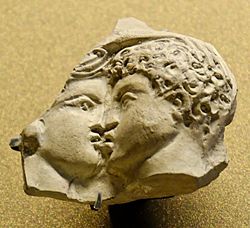 Pompey
subjected Tarsus to Rome, and it became capital of the Roman province of Cilicia
, the metropolis where the governor resided. In 66 BC, the inhabitants received Roman citizenship. To flatter Julius Caesar
, for a time it took the name Juliopolis. It was also here that Cleopatra and Mark Antony
met and was the scene of the celebrated feasts they gave during the construction of their fleet (41 BC).
When the province of Cilicia was divided, Tarsus remained the civil and religious metropolis of Cilicia Prima, and was a grand city with palaces, marketplaces, roads and bridges, baths, fountains and waterworks, a gymnasium on the banks of the Cydnus, and a stadium. Tarsus was later eclipsed by nearby Adana
, but remained important as a port and shipyard. Several Roman emperors were interred here: Marcus Claudius Tacitus
, Maximinus
, and Julian the Apostate
, who planned to move his capital here from Antioch if he returned from his Persian expedition.
), who returned here after his conversion . From here Barnabas
retrieved him to help with the work in Syrian Antioch . Already by this time a Christian
community probably existed, although the first recorded bishop, Helenus, dates only from the third century; Helenus visited Antioch
several times in connection with the dispute concerning Paul of Samosata
. Later bishops of Tarsus included Lupus, present at the Council of Ancyra in 314; Theodorus, at the Council of Nicaea
in 325; Helladius, who was condemned at the Council of Ephesus and who appealed to the bishop of Rome in 433; above all the celebrated exegete Diodorus, teacher of Theodore of Mopsuestia
and consequently one of the fathers of Nestorianism
. From the sixth century the metropolitan see of Tarsus had seven suffragan bishoprics; the Greek archdiocese is again mentioned in the tenth century , and existed until the twentieth century upheavals, part of the Patriarchate of Antioch.
Owing to the importance of Tarsus, many martyrs were put to death here, among them being Saint Pelagia
, Saint Boniface, Saint Marinus, Saint Diomedes
, Saint Quiricus and Saint Julitta.
At about the end of the tenth century, the Armenians established a diocese of their rite; Saint Nerses of Lambroun
was its most distinguished representative in the twelfth century.
A cave in Tarsus is one of a number of places claiming to be the location of the legend of the Seven Sleepers
, common to Christianity and Islam.
. Le Quien mentions twenty-two of its bishops, of whom several are legendary. Among them are:
From the sixth century the metropolitan See of Tarsus had seven suffragan bishoprics (Echos d'Orient, X, 145); the Greek archdiocese is again mentioned in the tenth century (op. cit., X, 98), and has existed down to the present day, being comprised in the Patriarchate of Antioch. The Arabs took possession of Tarsus from the seventh century.
The archdiocese of Tarsus (Italian Tarso) remains a Catholic titular see
, not to be confused with the titular see of Tarsus dei Maroniti.
under the command of Khalid ibn Walid in 637. Tarsus was on the edge of the de facto border with the Byzantine empire in this period of the Taurus Mountains
range separating the Armeniac
and Anatolic
themes from Cilicia, Syria and northern Iraq. Tarsus was near the strategically important Cilician Gates
which passed through the Taurus Mountains as well as access to the Mediterranean Sea which was used for both land and naval operations further in the Byzantine territory. While the region was lost by the Byzantine Emperor Heraclius in 637, it is unclear when the city was permanently occupied by the Arabs as sources indicate the city was garrisoned and retaken multiple times until the 9th century.
According to the Arabic geographer Ibn Hawqal
and the accounts of Arab historian Abu Amr Al-Tarsusi, Tarsus was a stronghold of Muslim forces with thousands of volunteers from across the Islamic world coming to fight in jihad against the Byzantine Empire. The city was a base of operations for the regular summer raids (ṣawāʿif) into Byzantine lands through the Cilician Gates when the mountain snows had melted and passage was possible. Later the city was used in defense of the frontier in response to a resurgent Byzantine empire in the mid-10th century. The city was lost in 965, when Nicephorus Phocas returned it to the Byzantine Empire
for nearly a century. The area was retaken by the Seljuk Turks, recaptured in 1097 during the Crusades
and then disputed between Latins, Greeks, and Armenians of the Armenian Kingdom of Cilicia
(Kingdom of Lesser Armenia); these last became definitively masters until about 1359, when it was captured by the Ramadanids with Mamluks. Finally, the area was brought under the control of the Ottoman Empire
by Selim I
in 1516.
In the Middle Ages Tarsus was renowned throughout the Middle East; a number of Arab writers praised it as a beautiful and well-defended city, its walls being in two layers with five gates and earthworks outside, surrounded by rich farmland, watered by the river and the lake. By 1671 the traveller Evliya Çelebi
records "a city on the plain, an hour from the sea, surrounded by strong walls two-storeys high, moated on all sides, with three distinct neighbourhoods inside the walls".
Despite its excellent defences, Tarsus was captured from the Ottomans in 1832 by the Mamluks of Ibrahim Pasha of Egypt
, son of Muhammad Ali
, and for 8 years remained in the hands of the Egyptians, who began growing cotton on the surrounding plain. Upon the return of the Ottomans this cotton drove a substantial growth in the economy of the area, due to increased world demand for the crop during shortages caused by the U.S. Civil War. A new road was built to the port in Mersin
and the city of Tarsus grew and thrived. Still today many large houses in the city stand as reminders of the wealth generated during this period. However after being a port for 3,000 years, by the end of the 19th century neglect resulted in Tarsus no longer having access to the sea, and the delta became a swamp. At this point Tarsus was a typical Ottoman city with communities of Muslim Turks, Christian Greeks and Armenians
.
At the founding of the Turkish Republic in the 1920s the swamp was drained and the River Berdan was dammed to build Turkey's first hydro-electric power station. Irrigation, roadworks and a railway brought the economy of Tarsus back to life, with new factories, particularly producing textiles.
; şalgam (pickled turnips); tantuni (a sandwich of grilled meats; the tiny pizzas called "fındık lahmacun"; and cezerye
(a confection made out of carrots).
Sites of religious interest and pilgrimage:
From the Turkish era:
Places of natural beauty include:
City
A city is a relatively large and permanent settlement. Although there is no agreement on how a city is distinguished from a town within general English language meanings, many cities have a particular administrative, legal, or historical status based on local law.For example, in the U.S...
in south-central Turkey
Turkey
Turkey , known officially as the Republic of Turkey , is a Eurasian country located in Western Asia and in East Thrace in Southeastern Europe...
, 20 km inland from the Mediterranean Sea
Mediterranean Sea
The Mediterranean Sea is a sea connected to the Atlantic Ocean surrounded by the Mediterranean region and almost completely enclosed by land: on the north by Anatolia and Europe, on the south by North Africa, and on the east by the Levant...
. It is part of the Adana-Mersin Metropolitan Area
Adana-Mersin Metropolitan Area
Adana-Mersin metropolitan area lies in the core area of Çukurova and with a population of 3 million, it is one of Turkey's major business and cultural centres. The metropolitan area stretches over 100 km from east to west and 25 km from north to south and includes the cities of Mersin, Tarsus,...
, the fourth-largest metropolitan area
Metropolitan area
The term metropolitan area refers to a region consisting of a densely populated urban core and its less-populated surrounding territories, sharing industry, infrastructure, and housing. A metropolitan area usually encompasses multiple jurisdictions and municipalities: neighborhoods, townships,...
in Turkey
Turkey
Turkey , known officially as the Republic of Turkey , is a Eurasian country located in Western Asia and in East Thrace in Southeastern Europe...
with a population of 2.75 million. Tarsus District forms an administrative district in Mersin Province
Mersin Province
The Mersin Province is a province in southern Turkey, on the Mediterranean coast between Antalya and Adana. The provincial capital is the city of Mersin and the other major town is Tarsus, birthplace of St Paul...
and lies in the core of the Çukurova
Çukurova
Çukurova , historically known as Cilicia, is a geographic, economic and cultural region in south-central Turkey, covering the provinces of Mersin, Adana, Osmaniye and Hatay...
region.
With a history going back over 2,000 years, Tarsus has long been an important stop for traders, a focal point of many civilisations including the Roman Empire
Roman Empire
The Roman Empire was the post-Republican period of the ancient Roman civilization, characterised by an autocratic form of government and large territorial holdings in Europe and around the Mediterranean....
, when Tarsus was capital of the province of Cilicia
Cilicia
In antiquity, Cilicia was the south coastal region of Asia Minor, south of the central Anatolian plateau. It existed as a political entity from Hittite times into the Byzantine empire...
, the scene of the first meeting between Mark Antony
Mark Antony
Marcus Antonius , known in English as Mark Antony, was a Roman politician and general. As a military commander and administrator, he was an important supporter and loyal friend of his mother's cousin Julius Caesar...
and Cleopatra, and the birthplace of Paul the Apostle.
Geography
Located on the mouth of the Tarsus Çay (Cydnus), which empties into the Mediterranean SeaMediterranean Sea
The Mediterranean Sea is a sea connected to the Atlantic Ocean surrounded by the Mediterranean region and almost completely enclosed by land: on the north by Anatolia and Europe, on the south by North Africa, and on the east by the Levant...
, Tarsus is a junction point of land and sea routes connecting the Cilicia
Cilicia
In antiquity, Cilicia was the south coastal region of Asia Minor, south of the central Anatolian plateau. It existed as a political entity from Hittite times into the Byzantine empire...
n plain (today called Çukurova
Çukurova
Çukurova , historically known as Cilicia, is a geographic, economic and cultural region in south-central Turkey, covering the provinces of Mersin, Adana, Osmaniye and Hatay...
), central Anatolia
Anatolia
Anatolia is a geographic and historical term denoting the westernmost protrusion of Asia, comprising the majority of the Republic of Turkey...
and the Mediterranean sea. The climate is typical of the Mediterranean region, summers very very hot, winters chilly and damp.
Tarsus has a long history of commerce and is still a commercial centre today, trading in the produce of the fertile Çukurova plain; also Tarsus is a thriving industrial centre of refining and processing that produces some for export. Industries include agricultural machinery, spare parts, textiles, fruit-processing, brick building and ceramics.
Agriculture is an important source of income, half of the land area in the district is farmland (1,050 km²) and most of the remainder is forest and orchard. The farmland is mostly well-irrigated, fertilised and managed with the latest equipment.
Etymology
The ancient name is Tarsos, derived from "Tarsa", the original name of the city in the Hittite language, which was possibly derived from a pagan god, Tarku, as HittitesHittites
The Hittites were a Bronze Age people of Anatolia.They established a kingdom centered at Hattusa in north-central Anatolia c. the 18th century BC. The Hittite empire reached its height c...
were the first settlers. At other times the city was named Tarsisi; Antiochia on the Cydnus (Greek
Greek language
Greek is an independent branch of the Indo-European family of languages. Native to the southern Balkans, it has the longest documented history of any Indo-European language, spanning 34 centuries of written records. Its writing system has been the Greek alphabet for the majority of its history;...
: Αντιόχεια του Κύδνου, Latin
Latin
Latin is an Italic language originally spoken in Latium and Ancient Rome. It, along with most European languages, is a descendant of the ancient Proto-Indo-European language. Although it is considered a dead language, a number of scholars and members of the Christian clergy speak it fluently, and...
: Antiochia ad Cydnum); Juliopolis, Տարսոն, Darson in Western Armenian and Tarson in Eastern Armenian .
Foundation and prehistory
Excavation of the mound of GözlükuleGözlükule
Gözlükule is a tumulus within the borders of Tarsus city, Mersin Province, Turkey. It is now a park with an altitude of with respect to surrounding area.-History:...
reveals that the prehistorical development of Tarsus reaches back to the Neolithic Period and continues unbroken through Chalcolithic and Early Bronze Ages.
The settlement was located at the crossing of several important trade routes, linking Anatolia
Anatolia
Anatolia is a geographic and historical term denoting the westernmost protrusion of Asia, comprising the majority of the Republic of Turkey...
to Syria
Syria
Syria , officially the Syrian Arab Republic , is a country in Western Asia, bordering Lebanon and the Mediterranean Sea to the West, Turkey to the north, Iraq to the east, Jordan to the south, and Israel to the southwest....
and beyond. Because the ruins are covered by the modern city, archaeology has barely touched the ancient city. The city may have been of Semitic
Semitic
In linguistics and ethnology, Semitic was first used to refer to a language family of largely Middle Eastern origin, now called the Semitic languages...
origin; it is mentioned as Tarsisi in the campaigns of Esarhaddon
Esarhaddon
Esarhaddon , was a king of Assyria who reigned 681 – 669 BC. He was the youngest son of Sennacherib and the Aramean queen Naqi'a , Sennacherib's second wife....
, as well as several times in the records of Shalmaneser I
Shalmaneser I
Shalmaneser I was a king of Assyria.Son of Adad-nirari I, he succeeded his father as king in 1265 BC....
and Sennacherib
Sennacherib
Sennacherib |Sîn]] has replaced brothers for me"; Aramaic: ) was the son of Sargon II, whom he succeeded on the throne of Assyria .-Rise to power:...
. A Greek legend connects it with the memory of Sardanapalus
Ashurbanipal
Ashurbanipal |Ashur]] is creator of an heir"; 685 BC – c. 627 BC), also spelled Assurbanipal or Ashshurbanipal, was an Assyrian king, the son of Esarhaddon and the last great king of the Neo-Assyrian Empire...
(Ashurbanipal), still preserved in the Dunuk-Tach, called 'tomb of Sardanapalus', a monument of unknown origin.
Stephanus of Byzantium
Stephanus of Byzantium
Stephen of Byzantium, also known as Stephanus Byzantinus , was the author of an important geographical dictionary entitled Ethnica...
quotes Athenodorus of Tarsus as relating another legend:
Much of this legend of the foundation of Tarsus, however, appeared in the Roman era, and none of it is reliable. The geographer Strabo
Strabo
Strabo, also written Strabon was a Greek historian, geographer and philosopher.-Life:Strabo was born to an affluent family from Amaseia in Pontus , a city which he said was situated the approximate equivalent of 75 km from the Black Sea...
states that Tarsus was founded by people from Argos
Argos
Argos is a city and a former municipality in Argolis, Peloponnese, Greece. Since the 2011 local government reform it is part of the municipality Argos-Mykines, of which it is a municipal unit. It is 11 kilometres from Nafplion, which was its historic harbour...
who were exploring this coast. Another legend states that Bellerophon Bellerophon
Bellerophon
Bellerophon or Bellerophontes is a hero of Greek mythology. He was "the greatest hero and slayer of monsters, alongside of Cadmus and Perseus, before the days of Heracles", and his greatest feat was killing the Chimera, a monster that Homer depicted with a lion's head, a goat's body, and a...
fell off his winged horse Pegasus
Pegasus
Pegasus is one of the best known fantastical as well as mythological creatures in Greek mythology. He is a winged divine horse, usually white in color. He was sired by Poseidon, in his role as horse-god, and foaled by the Gorgon Medusa. He was the brother of Chrysaor, born at a single birthing...
and landed here, hurting his foot, and thus the city was named tar-sos (the sole of the foot). Other candidates for legendary founder of the city include the hero Perseus
Perseus
Perseus ,Perseos and Perseas are not used in English. the legendary founder of Mycenae and of the Perseid dynasty of Danaans there, was the first of the mythic heroes of Greek mythology whose exploits in defeating various archaic monsters provided the founding myths of the Twelve Olympians...
and Triptolemus
Triptolemus
Buzyges redirects here. For the genus of grass skipper butterflies, see Buzyges .Triptolemus , in Greek mythology always connected with Demeter of the Eleusinian Mysteries, might be accounted the son of King Celeus of Eleusis in Attica, or, according to the Pseudo-Apollodorus , the son of Gaia and...
son of the earth-goddess Demeter
Demeter
In Greek mythology, Demeter is the goddess of the harvest, who presided over grains, the fertility of the earth, and the seasons . Her common surnames are Sito as the giver of food or corn/grain and Thesmophoros as a mark of the civilized existence of agricultural society...
, doubtless because the countryside around Tarsus is excellent farmland. Later the coinage of Tarsus bore the image of Hercules
Hercules
Hercules is the Roman name for Greek demigod Heracles, son of Zeus , and the mortal Alcmene...
, due to yet another tale in which the hero was held prisoner here by the local god Sandon
Sandon
Sandon may refer to:* Sandon, Essex* Sandon, Hertfordshire* Sandon, Staffordshire* Sandon, British Columbia* Sandon, Victoria* Sandon County, New South Wales* Sandon, ancient Hittite deity* Gotska Sandön, a Swedish islandPeople with the name Sandon:...
. Tarsus has been suggested as a possible identification of the biblical Tarshish
Tarshish
Tarshish תַּרְשִׁישׁ occurs in the Hebrew Bible with several uncertain meanings:*One of the sons of Javan .* In the Bible Solomon set up a trade with Tarshish and received ivory, apes, and peacocks from Tarshish which are all native to the jungles in India. India's state bird for example is the...
, where the prophet Jonah
Jonah
Jonah is the name given in the Hebrew Bible to a prophet of the northern kingdom of Israel in about the 8th century BC, the eponymous central character in the Book of Jonah, famous for being swallowed by a fish or a whale, depending on translation...
wanted to flee, but Tartessos
Tartessos
Tartessos or Tartessus was a harbor city and surrounding culture on the south coast of the Iberian peninsula , at the mouth of the Guadalquivir River. It appears in sources from Greece and the Near East starting in the middle of the first millennium BC, for example Herodotus, who describes it as...
in Spain is a more likely identification for this. (See further)
Early antiquity, Greece and Persia
In historical times, the city was first ruled by the HittitesHittites
The Hittites were a Bronze Age people of Anatolia.They established a kingdom centered at Hattusa in north-central Anatolia c. the 18th century BC. The Hittite empire reached its height c...
, followed by Assyria
Assyria
Assyria was a Semitic Akkadian kingdom, extant as a nation state from the mid–23rd century BC to 608 BC centred on the Upper Tigris river, in northern Mesopotamia , that came to rule regional empires a number of times through history. It was named for its original capital, the ancient city of Assur...
, and then the Persian Empire. Tarsus, as the principal town of Cilicia
Cilicia
In antiquity, Cilicia was the south coastal region of Asia Minor, south of the central Anatolian plateau. It existed as a political entity from Hittite times into the Byzantine empire...
, was the seat of a Persian satrap
Satrap
Satrap was the name given to the governors of the provinces of the ancient Median and Achaemenid Empires and in several of their successors, such as the Sassanid Empire and the Hellenistic empires....
y from 400 BC onward. Indeed, Xenophon
Xenophon
Xenophon , son of Gryllus, of the deme Erchia of Athens, also known as Xenophon of Athens, was a Greek historian, soldier, mercenary, philosopher and a contemporary and admirer of Socrates...
records that in 401 BC, when Cyrus the Younger
Cyrus the Younger
Cyrus the Younger, son of Darius II of Persia and Parysatis, was a Persian prince and general. The time of his birth is unknown, but he died in 401 B.C. The history of Cyrus and of the retreat of the Greeks is told by Xenophon in his Anabasis. Another account, probably from Sophaenetus of...
marched against Babylon
Babylon
Babylon was an Akkadian city-state of ancient Mesopotamia, the remains of which are found in present-day Al Hillah, Babil Province, Iraq, about 85 kilometers south of Baghdad...
, the city was governed by King Syennesis in the name of the Persian monarch.
At this period the patron god of the city was Sandon and a large monument to Sandon existed at Tarsus at least until the 3rd century A.D. Coins showed Sandon standing on a winged and horned lion and it is now thought likely that the lion of St Mark on the pillar in the Piazzetta in Venice
Piazza San Marco
Piazza San Marco , is the principal public square of Venice, Italy, where it is generally known just as "the Piazza". All other urban spaces in the city are called "campi"...
was in origin a winged lion-griffin from such a monument at Tarsus.
Alexander the Great passed through with his armies in 333 BC and nearly met his death here after a bath in the Cydnus. By this time Tarsus was already largely influenced by Greek language and culture
Culture of Greece
The culture of Greece has evolved over thousands of years, beginning in Mycenaean Greece, continuing most notably into Classical Greece, through the influence of the Roman Empire and its Greek Eastern successor the Byzantine Empire...
, and as part of the Seleucid Empire
Seleucid Empire
The Seleucid Empire was a Greek-Macedonian state that was created out of the eastern conquests of Alexander the Great. At the height of its power, it included central Anatolia, the Levant, Mesopotamia, Persia, today's Turkmenistan, Pamir and parts of Pakistan.The Seleucid Empire was a major centre...
it became more and more hellenized
Hellenization
Hellenization is a term used to describe the spread of ancient Greek culture, and, to a lesser extent, language. It is mainly used to describe the spread of Hellenistic civilization during the Hellenistic period following the campaigns of Alexander the Great of Macedon...
. Strabo praises the cultural level of Tarsus in this period with its philosophers, poets and linguists. The schools of Tarsus rivaled Athens
Athens
Athens , is the capital and largest city of Greece. Athens dominates the Attica region and is one of the world's oldest cities, as its recorded history spans around 3,400 years. Classical Athens was a powerful city-state...
and Alexandria
Alexandria
Alexandria is the second-largest city of Egypt, with a population of 4.1 million, extending about along the coast of the Mediterranean Sea in the north central part of the country; it is also the largest city lying directly on the Mediterranean coast. It is Egypt's largest seaport, serving...
. 2 Maccabees
2 Maccabees
2 Maccabees is a deuterocanonical book of the Bible, which focuses on the Jews' revolt against Antiochus IV Epiphanes and concludes with the defeat of the Syrian general Nicanor in 161 BC by Judas Maccabeus, the hero of the work....
(4:30) records its revolt in about 171 BC against Antiochus IV Epiphanes
Antiochus IV Epiphanes
Antiochus IV Epiphanes ruled the Seleucid Empire from 175 BC until his death in 164 BC. He was a son of King Antiochus III the Great. His original name was Mithridates; he assumed the name Antiochus after he ascended the throne....
, who had renamed the town Antiochia on the Cydnus. In his time the library of Tarsus held 200,000 books, including a huge collection of scientific works. The name didn't last, however, due to the confusion of so many cities named Antioch.
Rome
Pompey
Gnaeus Pompeius Magnus, also known as Pompey or Pompey the Great , was a military and political leader of the late Roman Republic...
subjected Tarsus to Rome, and it became capital of the Roman province of Cilicia
Cilicia
In antiquity, Cilicia was the south coastal region of Asia Minor, south of the central Anatolian plateau. It existed as a political entity from Hittite times into the Byzantine empire...
, the metropolis where the governor resided. In 66 BC, the inhabitants received Roman citizenship. To flatter Julius Caesar
Julius Caesar
Gaius Julius Caesar was a Roman general and statesman and a distinguished writer of Latin prose. He played a critical role in the gradual transformation of the Roman Republic into the Roman Empire....
, for a time it took the name Juliopolis. It was also here that Cleopatra and Mark Antony
Mark Antony
Marcus Antonius , known in English as Mark Antony, was a Roman politician and general. As a military commander and administrator, he was an important supporter and loyal friend of his mother's cousin Julius Caesar...
met and was the scene of the celebrated feasts they gave during the construction of their fleet (41 BC).
When the province of Cilicia was divided, Tarsus remained the civil and religious metropolis of Cilicia Prima, and was a grand city with palaces, marketplaces, roads and bridges, baths, fountains and waterworks, a gymnasium on the banks of the Cydnus, and a stadium. Tarsus was later eclipsed by nearby Adana
Adana
Adana is a city in southern Turkey and a major agricultural and commercial center. The city is situated on the Seyhan River, 30 kilometres inland from the Mediterranean, in south-central Anatolia...
, but remained important as a port and shipyard. Several Roman emperors were interred here: Marcus Claudius Tacitus
Marcus Claudius Tacitus
Tacitus , was Roman Emperor from 275 to 276. During his short reign he campaigned against the Goths and the Heruli, for which he received the title Gothicus Maximus.-Biography:Tacitus was born in Interamna , in Italia...
, Maximinus
Maximinus
Maximinus II , also known as Maximinus Daia or Maximinus Daza, was Roman Emperor from 308 to 313. He was born of Dacian peasant stock to the half sister of the emperor Galerius near their family lands around Felix Romuliana; a rural area then in the Danubian region of Moesia, now Eastern Serbia.He...
, and Julian the Apostate
Julian the Apostate
Julian "the Apostate" , commonly known as Julian, or also Julian the Philosopher, was Roman Emperor from 361 to 363 and a noted philosopher and Greek writer....
, who planned to move his capital here from Antioch if he returned from his Persian expedition.
Christianity
Tarsus was the birthplace of "Saul of Tarsus" who became Paul the apostle (ActsActs of the Apostles
The Acts of the Apostles , usually referred to simply as Acts, is the fifth book of the New Testament; Acts outlines the history of the Apostolic Age...
), who returned here after his conversion . From here Barnabas
Barnabas
Barnabas , born Joseph, was an Early Christian, one of the earliest Christian disciples in Jerusalem. In terms of culture and background, he was a Hellenised Jew, specifically a Levite. Named an apostle in , he and Saint Paul undertook missionary journeys together and defended Gentile converts...
retrieved him to help with the work in Syrian Antioch . Already by this time a Christian
Christian
A Christian is a person who adheres to Christianity, an Abrahamic, monotheistic religion based on the life and teachings of Jesus of Nazareth as recorded in the Canonical gospels and the letters of the New Testament...
community probably existed, although the first recorded bishop, Helenus, dates only from the third century; Helenus visited Antioch
Antioch
Antioch on the Orontes was an ancient city on the eastern side of the Orontes River. It is near the modern city of Antakya, Turkey.Founded near the end of the 4th century BC by Seleucus I Nicator, one of Alexander the Great's generals, Antioch eventually rivaled Alexandria as the chief city of the...
several times in connection with the dispute concerning Paul of Samosata
Paul of Samosata
Paul of Samosata was Bishop of Antioch from 260 to 268. He was a believer in monarchianism, and his teachings anticipate adoptionism.-Life:...
. Later bishops of Tarsus included Lupus, present at the Council of Ancyra in 314; Theodorus, at the Council of Nicaea
First Council of Nicaea
The First Council of Nicaea was a council of Christian bishops convened in Nicaea in Bithynia by the Roman Emperor Constantine I in AD 325...
in 325; Helladius, who was condemned at the Council of Ephesus and who appealed to the bishop of Rome in 433; above all the celebrated exegete Diodorus, teacher of Theodore of Mopsuestia
Theodore of Mopsuestia
Theodore the Interpreter was bishop of Mopsuestia from 392 to 428 AD. He is also known as Theodore of Antioch, from the place of his birth and presbyterate...
and consequently one of the fathers of Nestorianism
Nestorianism
Nestorianism is a Christological doctrine advanced by Nestorius, Patriarch of Constantinople from 428–431. The doctrine, which was informed by Nestorius's studies under Theodore of Mopsuestia at the School of Antioch, emphasizes the disunion between the human and divine natures of Jesus...
. From the sixth century the metropolitan see of Tarsus had seven suffragan bishoprics; the Greek archdiocese is again mentioned in the tenth century , and existed until the twentieth century upheavals, part of the Patriarchate of Antioch.
Owing to the importance of Tarsus, many martyrs were put to death here, among them being Saint Pelagia
Pelagia of Tarsus
Pelagia of Tarsus is a saint and martyr who lived in Tarsus in the Cilicia region of Asia Minor during the reign of Roman Emperor Diocletian. She is likely based on Saint Pelagia of Antioch....
, Saint Boniface, Saint Marinus, Saint Diomedes
Saint Diomedes
Saint Diomedes of Tarsus is venerated as a Christian saint and martyr, one of the Holy Unmercenaries. Born in Tarsus, he was a physician by profession. He was a zealous Christian evangelist and was arrested and beheaded under Diocletian at Nicaea...
, Saint Quiricus and Saint Julitta.
At about the end of the tenth century, the Armenians established a diocese of their rite; Saint Nerses of Lambroun
Nerses of Lambron
Saint Nerses of Lambron was the Archbishop of Tarsus in the Armenian Kingdom of Cilicia who is remembered as one of the most significant figures in Armenian literature and ecclesiastical history.-Life:...
was its most distinguished representative in the twelfth century.
A cave in Tarsus is one of a number of places claiming to be the location of the legend of the Seven Sleepers
Seven Sleepers
The Seven Sleepers, commonly called the "Seven Sleepers of Ephesus", refers to a group of Christian youths who hid inside a cave outside the city of Ephesus around 250 AD, to escape a persecution of Christians being conducted during the reign of the Roman emperor Decius...
, common to Christianity and Islam.
Ecclesiastical history
The first bishop, Helenus, dates from the third century; he went several times to Antioch in connexion with the dispute concerning Paul of SamosataPaul of Samosata
Paul of Samosata was Bishop of Antioch from 260 to 268. He was a believer in monarchianism, and his teachings anticipate adoptionism.-Life:...
. Le Quien mentions twenty-two of its bishops, of whom several are legendary. Among them are:
- Lupus, present at the Council of Ancyra in 314;
- Theodorus, at the Council of NicaeaFirst Council of NicaeaThe First Council of Nicaea was a council of Christian bishops convened in Nicaea in Bithynia by the Roman Emperor Constantine I in AD 325...
in 325; - HelladiusHelladius of TarsusHelladius of Tarsus was a Christian bishop of Tarsus. He was condemned at the First Council of Ephesus and appealed to the pope in 433.-References:*...
, condemned at Ephesus, and who appealed to the pope in 433; - the exegete Diodorus, teacher of Theodore of MopsuestiaTheodore of MopsuestiaTheodore the Interpreter was bishop of Mopsuestia from 392 to 428 AD. He is also known as Theodore of Antioch, from the place of his birth and presbyterate...
and consequently one of the fathers of NestorianismNestorianismNestorianism is a Christological doctrine advanced by Nestorius, Patriarch of Constantinople from 428–431. The doctrine, which was informed by Nestorius's studies under Theodore of Mopsuestia at the School of Antioch, emphasizes the disunion between the human and divine natures of Jesus...
.
From the sixth century the metropolitan See of Tarsus had seven suffragan bishoprics (Echos d'Orient, X, 145); the Greek archdiocese is again mentioned in the tenth century (op. cit., X, 98), and has existed down to the present day, being comprised in the Patriarchate of Antioch. The Arabs took possession of Tarsus from the seventh century.
The archdiocese of Tarsus (Italian Tarso) remains a Catholic titular see
Titular see
A titular see in various churches is an episcopal see of a former diocese that no longer functions, sometimes called a "dead diocese". The ordinary or hierarch of such a see may be styled a "titular bishop", "titular metropolitan", or "titular archbishop"....
, not to be confused with the titular see of Tarsus dei Maroniti.
Islam and beyond
The Tarsus region was annexed by the Forces of Rashidun CaliphateRashidun Caliphate
The Rashidun Caliphate , comprising the first four caliphs in Islam's history, was founded after Muhammad's death in 632, Year 10 A.H.. At its height, the Caliphate extended from the Arabian Peninsula, to the Levant, Caucasus and North Africa in the west, to the Iranian highlands and Central Asia...
under the command of Khalid ibn Walid in 637. Tarsus was on the edge of the de facto border with the Byzantine empire in this period of the Taurus Mountains
Taurus Mountains
Taurus Mountains are a mountain complex in southern Turkey, dividing the Mediterranean coastal region of southern Turkey from the central Anatolian Plateau. The system extends along a curve from Lake Eğirdir in the west to the upper reaches of the Euphrates and Tigris rivers in the east...
range separating the Armeniac
Armeniac Theme
The Armeniac Theme , more properly the Theme of the Armeniacs was a Byzantine theme located in northeastern Asia Minor .-History:...
and Anatolic
Anatolic Theme
The Anatolic Theme , more properly known as the Theme of the Anatolics was a Byzantine theme in central Asia Minor...
themes from Cilicia, Syria and northern Iraq. Tarsus was near the strategically important Cilician Gates
Cilician Gates
The Cilician Gates or Gülek Pass is a pass through the Taurus Mountains connecting the low plains of Cilicia to the Anatolian Plateau, by way of the narrow gorge of the Gökoluk River. Its highest elevation is about 1000m....
which passed through the Taurus Mountains as well as access to the Mediterranean Sea which was used for both land and naval operations further in the Byzantine territory. While the region was lost by the Byzantine Emperor Heraclius in 637, it is unclear when the city was permanently occupied by the Arabs as sources indicate the city was garrisoned and retaken multiple times until the 9th century.
According to the Arabic geographer Ibn Hawqal
Ibn Hawqal
Muḥammad Abū’l-Qāsim Ibn Ḥawqal was a 10th century Muslim writer, geographer, and chronicler. His famous work, written in 977, is called Ṣūrat al-’Arḍ ....
and the accounts of Arab historian Abu Amr Al-Tarsusi, Tarsus was a stronghold of Muslim forces with thousands of volunteers from across the Islamic world coming to fight in jihad against the Byzantine Empire. The city was a base of operations for the regular summer raids (ṣawāʿif) into Byzantine lands through the Cilician Gates when the mountain snows had melted and passage was possible. Later the city was used in defense of the frontier in response to a resurgent Byzantine empire in the mid-10th century. The city was lost in 965, when Nicephorus Phocas returned it to the Byzantine Empire
Byzantine Empire
The Byzantine Empire was the Eastern Roman Empire during the periods of Late Antiquity and the Middle Ages, centred on the capital of Constantinople. Known simply as the Roman Empire or Romania to its inhabitants and neighbours, the Empire was the direct continuation of the Ancient Roman State...
for nearly a century. The area was retaken by the Seljuk Turks, recaptured in 1097 during the Crusades
Crusades
The Crusades were a series of religious wars, blessed by the Pope and the Catholic Church with the main goal of restoring Christian access to the holy places in and near Jerusalem...
and then disputed between Latins, Greeks, and Armenians of the Armenian Kingdom of Cilicia
Armenian Kingdom of Cilicia
The Armenian Kingdom of Cilicia , also known as the Cilician Armenia, Kingdom of Cilician Armenia or New Armenia, was an independent principality formed during the High Middle Ages by Armenian refugees fleeing the Seljuk invasion of Armenia...
(Kingdom of Lesser Armenia); these last became definitively masters until about 1359, when it was captured by the Ramadanids with Mamluks. Finally, the area was brought under the control of the Ottoman Empire
Ottoman Empire
The Ottoman EmpireIt was usually referred to as the "Ottoman Empire", the "Turkish Empire", the "Ottoman Caliphate" or more commonly "Turkey" by its contemporaries...
by Selim I
Selim I
Selim I, Yavuz Sultân Selim Khan, Hâdim-ül Haramain-ish Sharifain , nicknamed Yavuz "the Stern" or "the Steadfast", but often rendered in English as "the Grim" , was the Sultan of the Ottoman Empire from 1512 to...
in 1516.
In the Middle Ages Tarsus was renowned throughout the Middle East; a number of Arab writers praised it as a beautiful and well-defended city, its walls being in two layers with five gates and earthworks outside, surrounded by rich farmland, watered by the river and the lake. By 1671 the traveller Evliya Çelebi
Evliya Çelebi
Evliya Çelebi was an Ottoman traveler who journeyed through the territory of the Ottoman Empire and neighboring lands over a period of forty years.- Life :...
records "a city on the plain, an hour from the sea, surrounded by strong walls two-storeys high, moated on all sides, with three distinct neighbourhoods inside the walls".
Despite its excellent defences, Tarsus was captured from the Ottomans in 1832 by the Mamluks of Ibrahim Pasha of Egypt
Ibrahim Pasha of Egypt
Ibrahim Pasha was the eldest son of Muhammad Ali, the Wāli and unrecognised Khedive of Egypt and Sudan. He served as a general in the Egyptian army that his father established during his reign, taking his first command of Egyptian forces was when he was merely a teenager...
, son of Muhammad Ali
Muhammad Ali of Egypt
Muhammad Ali Pasha al-Mas'ud ibn Agha was a commander in the Ottoman army, who became Wāli, and self-declared Khedive of Egypt and Sudan...
, and for 8 years remained in the hands of the Egyptians, who began growing cotton on the surrounding plain. Upon the return of the Ottomans this cotton drove a substantial growth in the economy of the area, due to increased world demand for the crop during shortages caused by the U.S. Civil War. A new road was built to the port in Mersin
Mersin
-Mersin today:Today, Mersin is a large city spreading out along the coast, with Turkey's second tallest skyscraper , huge hotels, an opera house, expensive real estate near the sea or up in the hills, and many other modern urban...
and the city of Tarsus grew and thrived. Still today many large houses in the city stand as reminders of the wealth generated during this period. However after being a port for 3,000 years, by the end of the 19th century neglect resulted in Tarsus no longer having access to the sea, and the delta became a swamp. At this point Tarsus was a typical Ottoman city with communities of Muslim Turks, Christian Greeks and Armenians
Armenians
Armenian people or Armenians are a nation and ethnic group native to the Armenian Highland.The largest concentration is in Armenia having a nearly-homogeneous population with 97.9% or 3,145,354 being ethnic Armenian....
.
At the founding of the Turkish Republic in the 1920s the swamp was drained and the River Berdan was dammed to build Turkey's first hydro-electric power station. Irrigation, roadworks and a railway brought the economy of Tarsus back to life, with new factories, particularly producing textiles.
Cuisine
The local cuisine includes: hummusHummus
Hummus is high in iron and vitamin C and also has significant amounts of folate and vitamin B6. The chickpeas make it a good source of protein and dietary fiber; the tahini consists mostly of sesame seeds, which are an excellent source of the amino acid methionine, complementing the proteins in the...
; şalgam (pickled turnips); tantuni (a sandwich of grilled meats; the tiny pizzas called "fındık lahmacun"; and cezerye
Cezerye
Cezerye is a semi-gelatinous Turkish confectionery made from carrot, packed with nuts or pistachios and sprinkled with shredded coconut. Cut into roughly 1" x 1.5" rectangular chips and served on special occasions, it is somewhat akin to Turkish Delights and the Chinese walnut candy known as hetao...
(a confection made out of carrots).
Places of interest
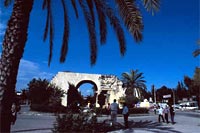
Tarsus has a great many ancient sites of interest, with many in need of restoration and research. The best known include:- Cleopatra's GateCleopatra's GateCleoptra's Gate is a city gate of Tarsus, in Mersin Province, Turkey, named after the Egyptian queen Cleopatra VII.- History of Tarsus and its walls :...
- to the west of the city, the only ancient city gate still standing, where Anthony and Cleopatra entered the city in 41 BC, though the "restoration" of this structure has involved covering much of it over with shiny new stone (see http://www.abu.nb.ca/Courses/Pauline/TarsusGate2.jpg for a picture of the gate before the work was done). - The Roman bridge of Justinian over the Berdan RiverBerdan RiverThe Berdan River, also called the Tarsus River , is a river in Mersin Province, south Turkey. The historical city of Tarsus is by the river.- Geography :...
. Still in good condition. - Tarsus Museum - contains lots of ancient coins and a severed mummified arm.
- Roman roadRoman road in CiliciaRoman road in Cilicia is a part of a Roman road in Mersin Province, Turkey- Geography :The road is thought to be a part of the main road connecting Cilicia to Capadocia during antiquity. The northern terminus was likely in the town of Bahçeli, a part of the ancient city of Tyanna in Niğde Province...
north of Tarsus - Ancient roadAncient road in TarsusAncient road at is the unearthed section of an ancient road in the historical city of Tarsus, Turkey.Tarsus an ancient city known as the birth place of Paul the Apostle, is now a major district center in Mersin Province, Turkey. The road was accidentally unearthed in a construction pit in 1993...
another Roman road within Tarsus.

Sites of religious interest and pilgrimage:
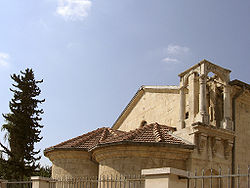
- The St. Paul's ChurchSaint Paul's Church, TarsusSaint Paul's Church is a church in Tarsus, Mersin Province, Turkey.- Tarsus and the churches :Tarsus, in Cilicia of the antiquity, what is now South Turkey, was an important city during both ancient and medieval ages. The tombs of Daniel of the Bible and Al-Ma'mun , the caliph, are in Tarsus. Saint...
and well (a request for its restitution to Christian worship was declined but has now apparently been accepted by the authorities- Badische Neueste Nachrichtungen 26 August 2010). - The mosque said to be the burial place of the Prophet Daniel.
- The ancient story of PegasusPegasusPegasus is one of the best known fantastical as well as mythological creatures in Greek mythology. He is a winged divine horse, usually white in color. He was sired by Poseidon, in his role as horse-god, and foaled by the Gorgon Medusa. He was the brother of Chrysaor, born at a single birthing...
, the winged horse, also concerns Tarsus. Because of Pegasus' faithful service to ZeusZeusIn the ancient Greek religion, Zeus was the "Father of Gods and men" who ruled the Olympians of Mount Olympus as a father ruled the family. He was the god of sky and thunder in Greek mythology. His Roman counterpart is Jupiter and his Etruscan counterpart is Tinia.Zeus was the child of Cronus...
, Pegasus was honored with a constellation. On the last day of his life, Zeus transformed him into a constellation, then a single feather fell to the earth near the city of Tarsus.
From the Turkish era:
- Tarsus Grand MosqueTarsus Grand MosqueTarsus Grand Mosque is a mosque in Tarsus, Mersin Province, Turkey.- Geography :The mosque is at the center of Tarsus at about in Camii Nur neighbourhood. It is the biggest mosque of Tarsus. It is very close to St Paul's Church, only about bird's flight away.- History :The mosque had been built...
- The old baths; the dark brown spots on the white marble walls are said to be the bloodstains of Shah Meran, the legendary Snake King who was killed in an ambush in the baths.
- Tarsus American CollegeTarsus American College-Overview:Tarsus American College or Tarsus American School is a private coeducational high school located in Tarsus, province Mersin, Turkey.It is known for the success of its alumni throughout the world...
; founded in the Ottoman period, still active today. - "Nusret (Nusrat)" the minelayerMinelayerMinelaying is the act of deploying explosive mines. Historically this has been carried out by ships, submarines and aircraft. Additionally, since World War I the term minelayer refers specifically to a naval ship used for deploying naval mines...
used to defend the straits before the Battle of GallipoliBattle of GallipoliThe Gallipoli Campaign, also known as the Dardanelles Campaign or the Battle of Gallipoli, took place at the peninsula of Gallipoli in the Ottoman Empire between 25 April 1915 and 9 January 1916, during the First World War...
is being restored in Tarsus; it is to be part of a memorial park to those lost in the fighting.
Places of natural beauty include:
- Tarsus Waterfall; since the construction of the Berdan dam the water of the Tarsus river has been distributed in canals for irrigation, with the result that the waterfall can now be seen only in seasons of very heavy rainfall.
- Karabucak ForestKarabucak Forest- Geography :The forest is at the south of Tarsus city in Mersin Province. The center of the forest is at about . The distance to Tarsus is and to Mersin is . There are two sections in the forest...
; popular picnic area a few kilometers south of the city center
Notable residents
- AntipaterAntipater of TarsusAntipater of Tarsus was a Stoic philosopher. He was the pupil and successor of Diogenes of Babylon as leader of the Stoic school, and was the teacher of Panaetius...
, StoicSTOICSTOIC was a variant of Forth.It started out at the MIT and Harvard Biomedical Engineering Centre in Boston, and was written in the mid 1970s by Jonathan Sachs...
philosopher - CaliphCaliphThe Caliph is the head of state in a Caliphate, and the title for the ruler of the Islamic Ummah, an Islamic community ruled by the Shari'ah. It is a transcribed version of the Arabic word which means "successor" or "representative"...
Al-Ma'munAl-Ma'munAbū Jaʿfar Abdullāh al-Māʾmūn ibn Harūn was an Abbasid caliph who reigned from 813 until his death in 833...
died near Tarsus - CEO of the Coca-Cola Company, Muhtar KentMuhtar KentMuhtar Kent is a Turkish business executive. He is the Chairman and Chief Executive Officer of The Coca-Cola Company. He was appointed to assume the position of Chief Operating Officer of the Company in 2008.-Early life:...
, attended Tarsus American CollegeTarsus American College-Overview:Tarsus American College or Tarsus American School is a private coeducational high school located in Tarsus, province Mersin, Turkey.It is known for the success of its alumni throughout the world... - Journalist Oral Çalışlar was born in Tarsus.
- ChrysippusChrysippusChrysippus of Soli was a Greek Stoic philosopher. He was a native of Soli, Cilicia, but moved to Athens as a young man, where he became a pupil of Cleanthes in the Stoic school. When Cleanthes died, around 230 BC, Chrysippus became the third head of the school...
, Stoic philosopher - Cleopatra
- Zeno of TarsusZeno of TarsusZeno of Tarsus was a Stoic philosopher.He was a pupil of Chrysippus, and when Chrysippus died c. 206 BC, he succeeded him to become the fourth head of the Stoic school in Athens....
, philosopher - LokmanLokmanLokman is a Turkish given name for males. People named Lokman include:* Lokman Polat, Turkish writer* Lokman Khan Sherwani, Indian politician* Lokman Yusof, Malaysian politician...
the Physician - Mark AntonyMark AntonyMarcus Antonius , known in English as Mark Antony, was a Roman politician and general. As a military commander and administrator, he was an important supporter and loyal friend of his mother's cousin Julius Caesar...
- Saint Nerses of LambronNerses of LambronSaint Nerses of Lambron was the Archbishop of Tarsus in the Armenian Kingdom of Cilicia who is remembered as one of the most significant figures in Armenian literature and ecclesiastical history.-Life:...
, Archbishop of Tarsus in the Armenian Kingdom of CiliciaArmenian Kingdom of CiliciaThe Armenian Kingdom of Cilicia , also known as the Cilician Armenia, Kingdom of Cilician Armenia or New Armenia, was an independent principality formed during the High Middle Ages by Armenian refugees fleeing the Seljuk invasion of Armenia... - Paul the Apostle (Saul of Tarsus), Christian apostle, missionary, martyr, and saint, was born here and returned for a brief period later in life.
- Saint Theodore of TarsusTheodore of TarsusTheodore was the eighth Archbishop of Canterbury, best known for his reform of the English Church and establishment of a school in Canterbury....
, Archbishop of CanterburyArchbishop of CanterburyThe Archbishop of Canterbury is the senior bishop and principal leader of the Church of England, the symbolic head of the worldwide Anglican Communion, and the diocesan bishop of the Diocese of Canterbury. In his role as head of the Anglican Communion, the archbishop leads the third largest group...
. - Tarsus is one of a number of cities that claims to be the burial place of Bilal ibn Rabah, first muezzinMuezzinA muezzin , or muzim, is the chosen person at a mosque who leads the call to prayer at Friday services and the five daily times for prayer from one of the mosque's minarets; in most modern mosques, electronic amplification aids the muezzin in his task.The professional muezzin is chosen for his...
, or caller to prayer, in Islam. - Tarsus Idman YurduTarsus Idman YurduTarsus İdman Yurdu is a professional Turkish football team based in Tarsus. The club was founded in 1923 and they play at the Burhanettin Kocamaz stadium, which has a capacity of 6000...
is the local football team.