

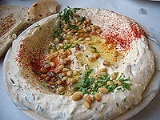
Hummus

Encyclopedia
Hummus is high in iron and vitamin C
and also has significant amounts of folate and vitamin B6
. The chickpeas make it a good source of protein and dietary fiber
; the tahini
consists mostly of sesame seeds, which are an excellent source of the amino acid methionine
, complementing the proteins in the chickpeas. Depending on the recipe, hummus carries varying amounts of monounsaturated fat
. Hummus is useful in vegetarian and vegan diets; like other combinations of grains and pulses, it serves as a complete protein
when eaten with bread.
 As an appetizer and dip
, hummus is scooped with flatbread
(such as pita
). It is also served as part of a meze
or as an accompaniment to falafel
, grilled chicken
, fish
or eggplant. Garnishes include chopped tomato
, cucumber
, cilantro
, parsley, caramelized onions, sautéed mushrooms, whole chickpeas, olive oil
, hard-boiled eggs, paprika, sumac
, ful
, olives, pickles and pine nuts (as photographed in the "History" section). Outside the Middle East, it is sometimes served with tortilla chip
s or cracker
s.
Hummus ful
is topped with a paste made from fava beans boiled until soft and then crushed. Hummus masubha/mashawsha
is a mixture of hummus paste, warm chickpeas and tahini.
In Vegetarian Dishes from the Middle East, Arto der Haroutunian calls hummus "one of the most popular and best-known of all Syrian dishes" and "a must on any mezzeh
table." Syrians in Canada
's Arab diaspora prepare and consume hummus along with other dishes like falafel, kibbe and tabouleh, even among the third and fourth-generation offspring of the original immigrants.

and Jordan
is laban ma' hummus ("yogurt and chickpeas"), which uses yogurt in the place of tahini and butter in the place of olive oil and is topped with pieces of toasted bread.
. Israelis elevated Hummus to become a "national food symbol" and consume more than twice as much hummus as their Arab neighbors, according to figures by Tsabar Salads, a hummus manufacturer in Israel. Commenting on its popularity, Gil Hovav, an Israeli food editor interviewed on the BBC
program Cooking in the Danger Zone
, stated that "even during the intifada
years Jews would sneak [...] into the Muslim quarter
just to have a vital, really genuine good humous ," and noted that like many dishes considered to be Israeli national foods, hummus is actually Arab. However, he also said, commenting on Iraqi, Egyptian, Syrian or Yemeni food in Israel, that "Jews came from these countries to Israel and they brought their food with them". Many restaurants run by Mizrahi Jews
and Arab citizens of Israel
are dedicated to hot hummus, which may be served as chick peas softened with baking soda along with garlic, olive oil, cumin and tahini
. One of the fancier hummus versions available is hummus masabacha
, made with lemon-spiked tahini garnished with whole chick peas, a sprinkling of paprika
and a drizzle of olive oil. Hummus is sold in restaurants, supermarkets and hummus-only shops (known in Hebrew as humusiot).
According to a 2010 market research, hummus consumption in the United States
has increased by 35% over a period of 21 months, with sales reaching nearly $300 million. In 2006, hummus was present in 12% percent of American households, rising to 17% by early 2009. One commentator attributed the growth of Hummus to America’s embrace of ethnic foods, and to experimentation with exotic foods.
In November 2009, Gadi Lesin, President & CEO of the Israeli Strauss group food manufacturer said that market share of co-owned Sabra Dipping Company
in the USA makes it the largest packaged hummus dip manufacturer in the world.
for hummus as a uniquely Lebanese food, similar to the Protected Geographical Status
rights held over regional food items by various European Union
countries. Fadi Abboud (president of the Lebanese Industrialists Association), stated that "Israelis have usurped several Lebanese and oriental products",http://www.ali.org.lb/foodcampaignarticles.html. According to Abboud, Lebanon exported the first hummus dish in 1959. As a response, food critic Janna Gur
wrote: "The success of certain brands of Israeli hummus abroad may have been what brought about Abboud's anger", leading him to claim that Israel has been "stealing" their country's national dishes, like hummus, falafel
, tabbouleh and baba ghanouj. In response, Shooky Galili, an Israeli journalist specialising in food who writes a blog dedicated to hummus,http://humus101.com/EN said that "trying to make a copyright claim over hummus is like claiming for the rights to bread or wine. [...] Hummus is a centuries old Arab dish—nobody owns it, it belongs to the region." As of late 2009, the Lebanese Industrialists Association was still "preparing documents and proof" to support its claim.
. The winning dish, cooked by 300 cooks in the village of al-Fanar, near Beirut
, weighed 10,452 kg (22,994 lbs, equal to 11.5 U.S. tons), more than double the previous record set by 50 Israeli Arabs and Jews who cooked 4,087.5 kg (8992.5 lbs) in January 2010 in the Arab-Israeli village of Abu Ghosh
. According to local media, the recipe included 8 tons of boiled chick peas, 2 tons of tahini, 2 tons of lemon juice and 70 kg (154 lbs) of olive oil.
Vitamin C
Vitamin C or L-ascorbic acid or L-ascorbate is an essential nutrient for humans and certain other animal species. In living organisms ascorbate acts as an antioxidant by protecting the body against oxidative stress...
and also has significant amounts of folate and vitamin B6
Vitamin B6
Vitamin B6 is a water-soluble vitamin and is part of the vitamin B complex group. Several forms of the vitamin are known, but pyridoxal phosphate is the active form and is a cofactor in many reactions of amino acid metabolism, including transamination, deamination, and decarboxylation...
. The chickpeas make it a good source of protein and dietary fiber
Dietary fiber
Dietary fiber, dietary fibre, or sometimes roughage is the indigestible portion of plant foods having two main components:* soluble fiber that is readily fermented in the colon into gases and physiologically active byproducts, and* insoluble fiber that is metabolically inert, absorbing water as it...
; the tahini
Tahini
Tahini or sesame paste , is a paste of ground sesame seeds used in cooking. North African, Greek and West Asian tahini is made of hulled, lightly roasted seeds. East Asian sesame paste is made of unhulled seeds. The Arabic word tahin simply means flour.Tahini is a major component of hummus and...
consists mostly of sesame seeds, which are an excellent source of the amino acid methionine
Methionine
Methionine is an α-amino acid with the chemical formula HO2CCHCH2CH2SCH3. This essential amino acid is classified as nonpolar. This amino-acid is coded by the codon AUG, also known as the initiation codon, since it indicates mRNA's coding region where translation into protein...
, complementing the proteins in the chickpeas. Depending on the recipe, hummus carries varying amounts of monounsaturated fat
Monounsaturated fat
In biochemistry and nutrition, monounsaturated fats or MUFA are fatty acids that have one double bond in the fatty acid chain and all of the remainder of the carbon atoms in the chain are single-bonded...
. Hummus is useful in vegetarian and vegan diets; like other combinations of grains and pulses, it serves as a complete protein
Complete protein
A complete protein is a source of protein that contains an adequate proportion of all nine of the essential amino acids necessary for the dietary needs of humans or other animals...
when eaten with bread.
Serving methods
Dip (food)
A dip or dipping sauce is a common condiment for many types of food. Dips are used to add flavor and/or texture to a food, such as pita bread, dumplings, crackers, cut-up raw vegetables, seafood, cubed pieces of meat and cheese, potato chips, tortilla chips, and falafel...
, hummus is scooped with flatbread
Flatbread
A flatbread is a simple bread made with flour, water, and salt and then thoroughly rolled into flattened dough. Many flatbreads are unleavened: made without yeast or sourdough culture: although some flatbread is made with yeast, such as pita bread....
(such as pita
Pita
Pita or pitta is a round pocket bread widely consumed in many Middle Eastern, Mediterranean, and Balkan cuisines. It is prevalent in Greece, the Balkans the Levant, the Arabian Peninsula and Turkey. The "pocket" in pita bread is created by steam, which puffs up the dough...
). It is also served as part of a meze
Meze
Meze or mezze is a selection of small dishes served in the Mediterranean and Middle East as dinner or lunch, with or without drinks. In Levantine cuisines and in the Caucasus region, meze is served at the beginning of all large-scale meals....
or as an accompaniment to falafel
Falafel
Falafel is a deep-fried ball or patty made from ground chickpeas and/or fava beans. Falafel is usually served in a pita, which acts as a pocket, or wrapped in a flatbread known as lafa. The falafel balls are topped with salads, pickled vegetables, hot sauce, and drizzled with tahini-based sauces...
, grilled chicken
Chicken
The chicken is a domesticated fowl, a subspecies of the Red Junglefowl. As one of the most common and widespread domestic animals, and with a population of more than 24 billion in 2003, there are more chickens in the world than any other species of bird...
, fish
Fish
Fish are a paraphyletic group of organisms that consist of all gill-bearing aquatic vertebrate animals that lack limbs with digits. Included in this definition are the living hagfish, lampreys, and cartilaginous and bony fish, as well as various extinct related groups...
or eggplant. Garnishes include chopped tomato
Tomato
The word "tomato" may refer to the plant or the edible, typically red, fruit which it bears. Originating in South America, the tomato was spread around the world following the Spanish colonization of the Americas, and its many varieties are now widely grown, often in greenhouses in cooler...
, cucumber
Cucumber
The cucumber is a widely cultivated plant in the gourd family Cucurbitaceae, which includes squash, and in the same genus as the muskmelon. The plant is a creeping vine which bears cylindrical edible fruit when ripe. There are three main varieties of cucumber: "slicing", "pickling", and...
, cilantro
Coriander
Coriander is an annual herb in the family Apiaceae. Coriander is native to southern Europe and North Africa to southwestern Asia. It is a soft, hairless plant growing to tall. The leaves are variable in shape, broadly lobed at the base of the plant, and slender and feathery higher on the...
, parsley, caramelized onions, sautéed mushrooms, whole chickpeas, olive oil
Olive oil
Olive oil is an oil obtained from the olive , a traditional tree crop of the Mediterranean Basin. It is commonly used in cooking, cosmetics, pharmaceuticals, and soaps and as a fuel for traditional oil lamps...
, hard-boiled eggs, paprika, sumac
Sumac
Sumac is any one of approximately 250 species of flowering plants in the genus Rhus and related genera, in the family Anacardiaceae. Sumacs grow in subtropical and temperate regions throughout the world, especially in Africa and North America....
, ful
Ful Medames
Fūl medammis , or simply fūl, is an Egyptian dish of cooked and mashed fava beans served with olive oil, chopped parsley, onion, garlic, and lemon juice. A staple meal in Egypt, it is popular in the cuisines of the Levant, Somalia, Eritrea, Ethiopia, Sudan and Saudi Arabia.-History:The roots of fūl...
, olives, pickles and pine nuts (as photographed in the "History" section). Outside the Middle East, it is sometimes served with tortilla chip
Tortilla chip
A tortilla chip is a snack food made from corn tortillas, which are cut into wedges and then fried . Corn tortillas are made of corn, vegetable oil, salt and water. Although first mass-produced in Los Angeles in the late 1940s, tortilla chips are considered to be a Mexican food, known as tostados...
s or cracker
Cracker (food)
A cracker is a baked good commonly made from grain flour dough and typically made in quantity in various hand-sized or smaller shapes. Flavorings or seasonings, such as salt, herbs, seeds, and/or cheese, may be added to the dough or sprinkled on top before baking...
s.
Hummus ful
Ful Medames
Fūl medammis , or simply fūl, is an Egyptian dish of cooked and mashed fava beans served with olive oil, chopped parsley, onion, garlic, and lemon juice. A staple meal in Egypt, it is popular in the cuisines of the Levant, Somalia, Eritrea, Ethiopia, Sudan and Saudi Arabia.-History:The roots of fūl...
is topped with a paste made from fava beans boiled until soft and then crushed. Hummus masubha/mashawsha
Masabcha
Masabcha is a variation of hummus popular in Palestine, Israel, Syria, Lebanon and Jordan.- Ingredients :The main difference between masabcha and hummus is the texture. In contrast with hummus, the chickpeas here remain whole. Like hummus, it is eaten with fresh pita bread...
is a mixture of hummus paste, warm chickpeas and tahini.
In Vegetarian Dishes from the Middle East, Arto der Haroutunian calls hummus "one of the most popular and best-known of all Syrian dishes" and "a must on any mezzeh
Meze
Meze or mezze is a selection of small dishes served in the Mediterranean and Middle East as dinner or lunch, with or without drinks. In Levantine cuisines and in the Caucasus region, meze is served at the beginning of all large-scale meals....
table." Syrians in Canada
Canada
Canada is a North American country consisting of ten provinces and three territories. Located in the northern part of the continent, it extends from the Atlantic Ocean in the east to the Pacific Ocean in the west, and northward into the Arctic Ocean...
's Arab diaspora prepare and consume hummus along with other dishes like falafel, kibbe and tabouleh, even among the third and fourth-generation offspring of the original immigrants.
Palestinian
For Palestinians, hummus has long been a staple food, often served warm, with bread, for breakfast, lunch or dinner All of the ingredients in hummus are easily found in Palestinian gardens, farms and markets, thus adding to the availabilty and popularity of the dish. In Palestine, hummus is usually garnished, with olive oil, "nana" mint leaves, paprika, parsley or cumin. A related dish popular in the region of PalestinePalestine
Palestine is a conventional name, among others, used to describe the geographic region between the Mediterranean Sea and the Jordan River, and various adjoining lands....
and Jordan
Jordan
Jordan , officially the Hashemite Kingdom of Jordan , Al-Mamlaka al-Urduniyya al-Hashemiyya) is a kingdom on the East Bank of the River Jordan. The country borders Saudi Arabia to the east and south-east, Iraq to the north-east, Syria to the north and the West Bank and Israel to the west, sharing...
is laban ma' hummus ("yogurt and chickpeas"), which uses yogurt in the place of tahini and butter in the place of olive oil and is topped with pieces of toasted bread.
Israeli
Hummus is a common part of everyday meals in IsraelIsrael
The State of Israel is a parliamentary republic located in the Middle East, along the eastern shore of the Mediterranean Sea...
. Israelis elevated Hummus to become a "national food symbol" and consume more than twice as much hummus as their Arab neighbors, according to figures by Tsabar Salads, a hummus manufacturer in Israel. Commenting on its popularity, Gil Hovav, an Israeli food editor interviewed on the BBC
BBC
The British Broadcasting Corporation is a British public service broadcaster. Its headquarters is at Broadcasting House in the City of Westminster, London. It is the largest broadcaster in the world, with about 23,000 staff...
program Cooking in the Danger Zone
Cooking in the Danger Zone
Cooking in the Danger Zone is a documentary television series produced by the BBC and presented by Stefan Gates.In each film food writer Gates explores unusual food stories in some of the world’s more dangerous places. He uses food to explore and understand people’s culture and the challenges they...
, stated that "even during the intifada
Intifada
Intifada is an Arabic word which literally means "shaking off", though it is usually translated into English as "uprising" or "resistance" or "rebellion". , not to be confused with the Arabic plural ...
years Jews would sneak [...] into the Muslim quarter
Muslim Quarter
The Muslim Quarter is one of the four quarters of the ancient, walled Old City of Jerusalem. It covers 31 hectares of the northeastern sector of the Old City. The quarter is the largest and most populous and extends from the Lions' Gate in the east, along the northern wall of the Temple Mount in...
just to have a vital, really genuine good humous ," and noted that like many dishes considered to be Israeli national foods, hummus is actually Arab. However, he also said, commenting on Iraqi, Egyptian, Syrian or Yemeni food in Israel, that "Jews came from these countries to Israel and they brought their food with them". Many restaurants run by Mizrahi Jews
Jews
The Jews , also known as the Jewish people, are a nation and ethnoreligious group originating in the Israelites or Hebrews of the Ancient Near East. The Jewish ethnicity, nationality, and religion are strongly interrelated, as Judaism is the traditional faith of the Jewish nation...
and Arab citizens of Israel
Arab citizens of Israel
Arab citizens of Israel refers to citizens of Israel who are not Jewish, and whose cultural and linguistic heritage or ethnic identity is Arab....
are dedicated to hot hummus, which may be served as chick peas softened with baking soda along with garlic, olive oil, cumin and tahini
Tahini
Tahini or sesame paste , is a paste of ground sesame seeds used in cooking. North African, Greek and West Asian tahini is made of hulled, lightly roasted seeds. East Asian sesame paste is made of unhulled seeds. The Arabic word tahin simply means flour.Tahini is a major component of hummus and...
. One of the fancier hummus versions available is hummus masabacha
Masabcha
Masabcha is a variation of hummus popular in Palestine, Israel, Syria, Lebanon and Jordan.- Ingredients :The main difference between masabcha and hummus is the texture. In contrast with hummus, the chickpeas here remain whole. Like hummus, it is eaten with fresh pita bread...
, made with lemon-spiked tahini garnished with whole chick peas, a sprinkling of paprika
Paprika
Paprika is a spice made from the grinding of dried fruits of Capsicum annuum . In many European languages, the word paprika refers to bell peppers themselves. The seasoning is used in many cuisines to add color and flavor to dishes. Paprika can range from mild to hot...
and a drizzle of olive oil. Hummus is sold in restaurants, supermarkets and hummus-only shops (known in Hebrew as humusiot).
United States
By the end of the 20th century, hummus had emerged as part of the American culinary fabric. In 2008, more than fifteen million Americans consumed hummus on a regular basis. Hummus was popularized in the United States by Jews returning from visits in Israel and by Israeli expatriates.According to a 2010 market research, hummus consumption in the United States
United States
The United States of America is a federal constitutional republic comprising fifty states and a federal district...
has increased by 35% over a period of 21 months, with sales reaching nearly $300 million. In 2006, hummus was present in 12% percent of American households, rising to 17% by early 2009. One commentator attributed the growth of Hummus to America’s embrace of ethnic foods, and to experimentation with exotic foods.
In November 2009, Gadi Lesin, President & CEO of the Israeli Strauss group food manufacturer said that market share of co-owned Sabra Dipping Company
Sabra (company)
Sabra Dipping Company, LLC is a U.S.-based company which produces Middle Eastern Style-style food products, including hummus, eggplant dip, baba ghanoush, and Mediterranean salsa. All Sabra products are certified kosher and vegetarian, and are available throughout the U.S. and Canada...
in the USA makes it the largest packaged hummus dip manufacturer in the world.
Controversy
In October 2008 the Association of Lebanese Industrialists petitioned to the Lebanese ministry of Economy to request protected status from the European CommissionEuropean Commission
The European Commission is the executive body of the European Union. The body is responsible for proposing legislation, implementing decisions, upholding the Union's treaties and the general day-to-day running of the Union....
for hummus as a uniquely Lebanese food, similar to the Protected Geographical Status
Protected Geographical Status
Protected Geographical Status is a legal framework defined in European Union law to protect the names of regional foods. Protected Designation of Origin , Protected Geographical Indication and Traditional Speciality Guaranteed are distinct regimes of geographical indications within the framework...
rights held over regional food items by various European Union
European Union
The European Union is an economic and political union of 27 independent member states which are located primarily in Europe. The EU traces its origins from the European Coal and Steel Community and the European Economic Community , formed by six countries in 1958...
countries. Fadi Abboud (president of the Lebanese Industrialists Association), stated that "Israelis have usurped several Lebanese and oriental products",http://www.ali.org.lb/foodcampaignarticles.html. According to Abboud, Lebanon exported the first hummus dish in 1959. As a response, food critic Janna Gur
Janna Gur
Janna Gur is an Israeli food writer, editor and cook book author and an expert on Israeli and Jewish cuisine.-Biography:...
wrote: "The success of certain brands of Israeli hummus abroad may have been what brought about Abboud's anger", leading him to claim that Israel has been "stealing" their country's national dishes, like hummus, falafel
Falafel
Falafel is a deep-fried ball or patty made from ground chickpeas and/or fava beans. Falafel is usually served in a pita, which acts as a pocket, or wrapped in a flatbread known as lafa. The falafel balls are topped with salads, pickled vegetables, hot sauce, and drizzled with tahini-based sauces...
, tabbouleh and baba ghanouj. In response, Shooky Galili, an Israeli journalist specialising in food who writes a blog dedicated to hummus,http://humus101.com/EN said that "trying to make a copyright claim over hummus is like claiming for the rights to bread or wine. [...] Hummus is a centuries old Arab dish—nobody owns it, it belongs to the region." As of late 2009, the Lebanese Industrialists Association was still "preparing documents and proof" to support its claim.
World record
In May 2010, the Guinness World Record for the largest dish of hummus in the world returned to LebanonLebanon
Lebanon , officially the Republic of LebanonRepublic of Lebanon is the most common term used by Lebanese government agencies. The term Lebanese Republic, a literal translation of the official Arabic and French names that is not used in today's world. Arabic is the most common language spoken among...
. The winning dish, cooked by 300 cooks in the village of al-Fanar, near Beirut
Beirut
Beirut is the capital and largest city of Lebanon, with a population ranging from 1 million to more than 2 million . Located on a peninsula at the midpoint of Lebanon's Mediterranean coastline, it serves as the country's largest and main seaport, and also forms the Beirut Metropolitan...
, weighed 10,452 kg (22,994 lbs, equal to 11.5 U.S. tons), more than double the previous record set by 50 Israeli Arabs and Jews who cooked 4,087.5 kg (8992.5 lbs) in January 2010 in the Arab-Israeli village of Abu Ghosh
Abu Ghosh
Abu Ghosh is an Israeli Arab town in Israel, located west of Jerusalem on the Tel Aviv-Jerusalem highway. It is situated 610–720 meters above sea level. In 2010, it set the Guinness World Record for largest dish of hummus...
. According to local media, the recipe included 8 tons of boiled chick peas, 2 tons of tahini, 2 tons of lemon juice and 70 kg (154 lbs) of olive oil.
See also
- Ful and Hummus
Further reading
- McKenna, Alix. "Lebanon vs. Israel: A Delicious Culinary War", Moment, March/April 2011.
- Ottolenghi, YotamYotam Ottolenghi-Biography:Yotam Ottolenghi was born in Jerusalem, Israel, on 14 December 1968, son of Michael, a professor of chemistry at the Hebrew University of Jerusalem, and Ruth, a high-school principal. He grew up in Jerusalem's Ramat Denya neighborhood. After serving in the Israel Defense Forces, he...
. "The perfect hummus debate", The Guardian, June 29, 2010.