

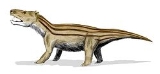
Cynodont

Encyclopedia
Cynodontia or cynodonts ("dog teeth") are a taxon
of therapsids which first appeared in the Late Permian (approximately 260 Ma) and were eventually distributed throughout all seven continents by the Early Triassic
(256 Ma). This clade includes modern mammal
s and their extinct close relatives. They were one of the most diverse groups of therapsids. They are named after their dog
-like teeth
.
Richard Owen
named Cynodontia in 1861, which he assigned to Anomodontia as a family. Robert Broom
(1913) reranked Cynodonia as an infraorder, since retained by others including Colbert and Kitching (1977), Carroll (1988), Gauthier et al. (1989), and Rubidge and Cristian Sidor (2001). Olson (1966) assigned Cynodontia to Theriodonta, Colbert and Kitching (1977) to Theriodontia, and Rubridge and Sidor (2001) to Eutheriodontia. William King Gregory
(1910), Broom (1913), Carroll (1988), Gauthier et al. (1989), Hopson and Kitching (2001) and Botha et al. (2007) all considered Cynodontia as belonging to Therapsida. Botha et al. (2007) seems to have followed Owen (1861), but without specifying taxonomic rank.
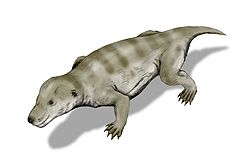 Together with the extinct gorgonopsia
ns and the therocephalia
ns, the cynodonts themselves are part of a group of therapsids called theriodont
s.
The oldest and the most basal cynodont yet found is Charassognathus
. Other basal cynodonts were the procynosuchids
, a family that includes Procynosuchus
and Dvinia
. Cynodonts were among the few groups of synapsids that survived the Permian–Triassic extinction event and had a slow recovery after the extinction.
The most derived cynodonts are found within the clade
Eucynodontia
, which also contains the members of Mammal
ia. Representative genera include the large carnivorous cynognathids
, equally large herbivorous traversodont
s, and small and mammal-like tritylodontid
s and ictidosaurs. It is likely that cynodonts were at least partially if not completely warm-blooded, covered with hair, which would have insulated them and helped to maintain a high body temperature. The mammal-like structure of cynodonts hints that all mammals have descended from a single group of eucynodonts.
During their evolution, cynodonts' teeth changed from being adapted for catching and holding prey and then swallowing whole, to adding specialized teeth, including molars, designed for better mastication
of food allowing for quicker digestion. Additionally, the jaw of the cynodonts reduced the number of jaw bones. This move towards a single bone for the mandible increased its structural integrity when compared to the kinetic jaws of reptiles. Several of the bones which were jaw bones in reptiles evolved in this creature to perform an entirely new function, becoming parts of the mammal's middle ear.
Improved hearing gave these creatures a better awareness of their environment
and, in turn, this increasing sensitivity called for a greater capacity for processing the auditory information in the brain
. Cynodonts also developed a secondary palate in the roof of the mouth. This caused air flow from the nostrils to travel to a position in the back of the mouth instead of directly through it, allowing cynodonts to chew and breathe at the same time. This characteristic is present in all mammals.
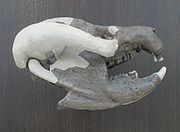 Cynodonts have nearly all the characteristics of mammal
s. Their teeth were fully differentiated, the braincase bulged at the back of the head, and many of them walked in an upright manner. Cynodonts still laid eggs, as all Mesozoic
proto-mammals probably did. Their temporal fenestrae were much larger than in its ancestors, and the widening of the zygomatic arch
allowed for more robust jaw musculature supporting the evidence of a more mammal-like skull. They also have the secondary palate
that other primitive therapsids lacked, except the therocephalians, who were the closest relatives of cynodonts. Their dentary was the largest bone in their lower jaw, as other smaller bones moved into the ears
. They were probably warm-blooded
, and covered in hair
.


Taxon
|thumb|270px|[[African elephants]] form a widely-accepted taxon, the [[genus]] LoxodontaA taxon is a group of organisms, which a taxonomist adjudges to be a unit. Usually a taxon is given a name and a rank, although neither is a requirement...
of therapsids which first appeared in the Late Permian (approximately 260 Ma) and were eventually distributed throughout all seven continents by the Early Triassic
Early Triassic
The Early Triassic is the first of three epochs of the Triassic period of the geologic timescale. It spans the time between 251 ± 0.4 Ma and 245 ± 1.5 Ma . Rocks from this epoch are collectively known as the Lower Triassic, which is a unit in chronostratigraphy...
(256 Ma). This clade includes modern mammal
Mammal
Mammals are members of a class of air-breathing vertebrate animals characterised by the possession of endothermy, hair, three middle ear bones, and mammary glands functional in mothers with young...
s and their extinct close relatives. They were one of the most diverse groups of therapsids. They are named after their dog
Dog
The domestic dog is a domesticated form of the gray wolf, a member of the Canidae family of the order Carnivora. The term is used for both feral and pet varieties. The dog may have been the first animal to be domesticated, and has been the most widely kept working, hunting, and companion animal in...
-like teeth
Tooth
Teeth are small, calcified, whitish structures found in the jaws of many vertebrates that are used to break down food. Some animals, particularly carnivores, also use teeth for hunting or for defensive purposes. The roots of teeth are embedded in the Mandible bone or the Maxillary bone and are...
.
Taxonomy
Cynodontia is generally considered to be an infraorder within Therapsida.Richard Owen
Richard Owen
Sir Richard Owen, FRS KCB was an English biologist, comparative anatomist and palaeontologist.Owen is probably best remembered today for coining the word Dinosauria and for his outspoken opposition to Charles Darwin's theory of evolution by natural selection...
named Cynodontia in 1861, which he assigned to Anomodontia as a family. Robert Broom
Robert Broom
Professor Robert Broom was a Scottish South African doctor and paleontologist. He qualified as a medical practitioner in 1895 and received his DSc in 1905 from the University of Glasgow...
(1913) reranked Cynodonia as an infraorder, since retained by others including Colbert and Kitching (1977), Carroll (1988), Gauthier et al. (1989), and Rubidge and Cristian Sidor (2001). Olson (1966) assigned Cynodontia to Theriodonta, Colbert and Kitching (1977) to Theriodontia, and Rubridge and Sidor (2001) to Eutheriodontia. William King Gregory
William King Gregory
William King Gregory was an American zoologist, renowned as a primatologist, paleontologist, and functional and comparative morphologist. He was an expert on mammalian dentition, and a leading contributor to theories of evolution...
(1910), Broom (1913), Carroll (1988), Gauthier et al. (1989), Hopson and Kitching (2001) and Botha et al. (2007) all considered Cynodontia as belonging to Therapsida. Botha et al. (2007) seems to have followed Owen (1861), but without specifying taxonomic rank.
Evolutionary history
Gorgonopsia
Gorgonopsia is a suborder of therapsid synapsids. Their name is a reference to the Gorgons of Greek mythology. Like other therapsids, gorgonopsians were at one time called "mammal-like reptiles"...
ns and the therocephalia
Therocephalia
Therocephalians are an extinct suborder of carnivorous eutheriodont therapsids that lived from the middle and late Permian into the Triassic 265.0—245.0 Ma existing for approximately ....
ns, the cynodonts themselves are part of a group of therapsids called theriodont
Theriodont
Theriodonts , are a major group of therapsids. They can be defined in traditional, Linnaean terms, in which case they are a suborder of mammal-like reptiles that lived from the Middle Permian to the Middle Cretaceous, or in Cladistic terms, in which case they include not only the traditional...
s.
The oldest and the most basal cynodont yet found is Charassognathus
Charassognathus
Charassognathus is an extinct genus of Late Permian cynodont. Described in 2007 from a locality near Fraserburg, South Africa, Charassognathus is the earliest and most basal cynodont. It is known only from the Holotype which dates from the upper Permian Period. The type species C. gracilis is the...
. Other basal cynodonts were the procynosuchids
Procynosuchidae
Procynosuchidae, along with Dviniidae, were the earliest cynodonts. They appeared around 260 million years ago, and were most abundant during the latest Permian time , shortly before the Permian-Triassic extinction event...
, a family that includes Procynosuchus
Procynosuchus
Procynosuchus was a cynodont from the Late Permian. It is considered to be one of the earliest and most basal cynodonts. Remains of Procynosuchus have been found in Germany, Zambia and South Africa...
and Dvinia
Dvinia
Dvinia was a therapsid mammal-like "reptile" of the family Dviniidae found in Sokolki on the Northern Dvina River near Kotlas in Arkhangelsk Oblast, Russia...
. Cynodonts were among the few groups of synapsids that survived the Permian–Triassic extinction event and had a slow recovery after the extinction.
The most derived cynodonts are found within the clade
Clade
A clade is a group consisting of a species and all its descendants. In the terms of biological systematics, a clade is a single "branch" on the "tree of life". The idea that such a "natural group" of organisms should be grouped together and given a taxonomic name is central to biological...
Eucynodontia
Eucynodontia
Eucynodontia is a grouping of animals that includes both mammals, such as dogs, and mammal-like non-mammalian therapsids such as cynodonts . Its membership was and is made up of both carnivores and herbivores. The chronological range extends from at least the Lower Triassic, possibly the Upper...
, which also contains the members of Mammal
Mammal
Mammals are members of a class of air-breathing vertebrate animals characterised by the possession of endothermy, hair, three middle ear bones, and mammary glands functional in mothers with young...
ia. Representative genera include the large carnivorous cynognathids
Cynognathus
Cynognathus crateronotus was a meter-long predator of the Early to Middle Triassic. It was among the more mammal-like of the Synapsids, a member of a grouping called Eucynodontia. The genus Cynognathus had an almost worldwide distribution...
, equally large herbivorous traversodont
Traversodontidae
Traversodontidae is a family of herbivorous cynodonts. Traversodonts were primarily Gondwanan, with many species known from Africa and South America. Recently, traversodonts have also been found from Europe and eastern North America. Traversodonts first appeared in the Middle Triassic, diversified...
s, and small and mammal-like tritylodontid
Tritylodontidae
Tritylodontids were small to medium-sized, highly specialized and extremely mammal-like cynodonts. They were the last family of the non-mammalian synapsids. One of the last cynodont lines to appear, the Tritylodontidae descended from a Cynognathus-like cynodont...
s and ictidosaurs. It is likely that cynodonts were at least partially if not completely warm-blooded, covered with hair, which would have insulated them and helped to maintain a high body temperature. The mammal-like structure of cynodonts hints that all mammals have descended from a single group of eucynodonts.
During their evolution, cynodonts' teeth changed from being adapted for catching and holding prey and then swallowing whole, to adding specialized teeth, including molars, designed for better mastication
Mastication
Mastication or chewing is the process by which food is crushed and ground by teeth. It is the first step of digestion and it increases the surface area of foods to allow more efficient break down by enzymes. During the mastication process, the food is positioned between the teeth for grinding by...
of food allowing for quicker digestion. Additionally, the jaw of the cynodonts reduced the number of jaw bones. This move towards a single bone for the mandible increased its structural integrity when compared to the kinetic jaws of reptiles. Several of the bones which were jaw bones in reptiles evolved in this creature to perform an entirely new function, becoming parts of the mammal's middle ear.
Improved hearing gave these creatures a better awareness of their environment
Natural environment
The natural environment encompasses all living and non-living things occurring naturally on Earth or some region thereof. It is an environment that encompasses the interaction of all living species....
and, in turn, this increasing sensitivity called for a greater capacity for processing the auditory information in the brain
Brain
The brain is the center of the nervous system in all vertebrate and most invertebrate animals—only a few primitive invertebrates such as sponges, jellyfish, sea squirts and starfishes do not have one. It is located in the head, usually close to primary sensory apparatus such as vision, hearing,...
. Cynodonts also developed a secondary palate in the roof of the mouth. This caused air flow from the nostrils to travel to a position in the back of the mouth instead of directly through it, allowing cynodonts to chew and breathe at the same time. This characteristic is present in all mammals.
Characteristics
Mammal
Mammals are members of a class of air-breathing vertebrate animals characterised by the possession of endothermy, hair, three middle ear bones, and mammary glands functional in mothers with young...
s. Their teeth were fully differentiated, the braincase bulged at the back of the head, and many of them walked in an upright manner. Cynodonts still laid eggs, as all Mesozoic
Mesozoic
The Mesozoic era is an interval of geological time from about 250 million years ago to about 65 million years ago. It is often referred to as the age of reptiles because reptiles, namely dinosaurs, were the dominant terrestrial and marine vertebrates of the time...
proto-mammals probably did. Their temporal fenestrae were much larger than in its ancestors, and the widening of the zygomatic arch
Zygomatic arch
The zygomatic arch or cheek bone is formed by the zygomatic process of temporal bone and the temporal process of the zygomatic bone , the two being united by an oblique suture; the tendon of the Temporalis passes medial to the arch to gain insertion into the coronoid process...
allowed for more robust jaw musculature supporting the evidence of a more mammal-like skull. They also have the secondary palate
Secondary palate
The secondary palate is an anatomical structure that divides the nasal cavity from the oral cavity in many vertebrates.In human embryology, it refers to that portion of the hard palate that is formed by the growth of the two palatine shelves medially and their mutual fusion in the midline...
that other primitive therapsids lacked, except the therocephalians, who were the closest relatives of cynodonts. Their dentary was the largest bone in their lower jaw, as other smaller bones moved into the ears
EARS
EARS may refer to:* Electoral software* Electronic Arts, Redwood Shores campus.* Emirates Amateur Radio Society...
. They were probably warm-blooded
Warm-blooded
The term warm-blooded is a colloquial term to describe animal species which have a relatively higher blood temperature, and maintain thermal homeostasis primarily through internal metabolic processes...
, and covered in hair
Hair
Hair is a filamentous biomaterial, that grows from follicles found in the dermis. Found exclusively in mammals, hair is one of the defining characteristics of the mammalian class....
.
Phylogeny
- Order TherapsidaTherapsidaTherapsida is a group of the most advanced synapsids, and include the ancestors of mammals. Many of the traits today seen as unique to mammals had their origin within early therapsids, including hair, lactation, and an erect posture. The earliest fossil attributed to Therapsida is believed to be...
- (unranked) Eutheriodontia
- Suborder †TherocephaliaTherocephaliaTherocephalians are an extinct suborder of carnivorous eutheriodont therapsids that lived from the middle and late Permian into the Triassic 265.0—245.0 Ma existing for approximately ....
- Suborder CYNODONTIA
- †CharassognathusCharassognathusCharassognathus is an extinct genus of Late Permian cynodont. Described in 2007 from a locality near Fraserburg, South Africa, Charassognathus is the earliest and most basal cynodont. It is known only from the Holotype which dates from the upper Permian Period. The type species C. gracilis is the...
- Family †Dviniidae
- Family †ProcynosuchidaeProcynosuchidaeProcynosuchidae, along with Dviniidae, were the earliest cynodonts. They appeared around 260 million years ago, and were most abundant during the latest Permian time , shortly before the Permian-Triassic extinction event...
- Epicynodontia
- Family †GalesauridaeGalesauridaeGalesauridae, along with the family Thrinaxodontidae and the large clade Eucynodontia make up the unranked taxon called Epicynodontia...
- Family †Thrinaxodontidae
- †ThrinaxodonThrinaxodonThrinaxodon was a cynodont, an ermine-sized therapsid. Pits on the skull suggest that Thrinaxodon may have had whiskers, and by extension a protective covering of fur. There are suggestions that it was warm-blooded...
- †Thrinaxodon
- Infraorder EucynodontiaEucynodontiaEucynodontia is a grouping of animals that includes both mammals, such as dogs, and mammal-like non-mammalian therapsids such as cynodonts . Its membership was and is made up of both carnivores and herbivores. The chronological range extends from at least the Lower Triassic, possibly the Upper...
- (unranked) †CynognathiaCynognathiaThe Cynognathians are one of the two major clades of the infraorder Eucynodontia, the other being the Probainognathians. Cynognathus, the most basal representative of the clade was a carnivore, unlike most cynognathians. The cynognathians were mostly mammal-like, but the subgroup Tritylodontids...
- Family †CynognathidaeCynognathusCynognathus crateronotus was a meter-long predator of the Early to Middle Triassic. It was among the more mammal-like of the Synapsids, a member of a grouping called Eucynodontia. The genus Cynognathus had an almost worldwide distribution...
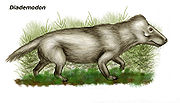
- Family †DiademodonDiademodonDiademodon is an vegetarian extinct genus of therapsid. It was about the size of a small cow. Fossils of the Diademodon tetragonus were found in levels of the Rio Seco de la Quebrada geological formation in Mendoza Province, Argentina....
tidae - Family †TraversodontidaeTraversodontidaeTraversodontidae is a family of herbivorous cynodonts. Traversodonts were primarily Gondwanan, with many species known from Africa and South America. Recently, traversodonts have also been found from Europe and eastern North America. Traversodonts first appeared in the Middle Triassic, diversified...
- †ExaeretodonExaeretodonExaeretodon is a genus of traversodontid cynodont; several species are known, from various formations. E. argentinus, E. frenguelli, and E. vincei are from the Carnian-age Ischigualasto Formation of Argentina. E. major and E. riograndensis are from the Ladinian-age portion of the Santa Maria...
- †LuangwaLuangwa (cynodont)Luangwa is a genus of traversodontid cynodonts. The species Luangwa drysdalli was discovered 1963 in the valley of the Luangwa river in Zambia, Africa. Luangwa lived in the Triassic period 240 Million years ago....
- †MassetognathusMassetognathusA relative of Cynognathus, Massetognathus was a plant-eating cynodont belonging to the Traversodontid family. This cynodont lived in what is now South America, in Brazil and Argentina during the Middle Triassic period .Massetognathus was about long. It had cheek teeth specially adapted to...
- †SantacruzodonSantacruzodonSantacruzodon is an extinct genus of synapsid which existed in Brazil during the Triassic period. The type species is Santacruzodon hopsoni.-Species:...
- †ScalenodonScalenodonScalenodon is a genus of traversodontid cynodont from the Middle Triassic of Africa and possibly Russia. The type species S. angustifrons was named in 1946 and several other species were named in the following years...
- †TraversodonTraversodonTraversodon is a genus of therapsid. Being a cynodont, it was a relative of the direct ancestor to modern mammals. Traversodon lived in what is now the Northeastern part of the United States and South America.-Species:...
- †Exaeretodon
- Family †TrirachodontidaeTrirachodontidaeTrirachodontidae is an extinct family of cynognathian cynodonts from the Triassic of China and southern Africa. Trirachodontids appeared during the Early Triassic soon after the Permian-Triassic extinction event and quickly spread over a wide geographic area in a comparatively brief amount of time...
- Family †TritylodontidaeTritylodontidaeTritylodontids were small to medium-sized, highly specialized and extremely mammal-like cynodonts. They were the last family of the non-mammalian synapsids. One of the last cynodont lines to appear, the Tritylodontidae descended from a Cynognathus-like cynodont...
- †BienotheriumBienotheriumBienotherium was a therapsid from the Early Jurassic of China. Despite its size, it is closely related to Lufengia, and is the largest tritylodont from the Lufeng Formation in China....
- †Bienotheroides
- †KayentatheriumKayentatheriumKayentatherium is a genus of tritylodont, historically referred to as "mammal-like" reptiles. It is one of three tritylodonts from the Kayenta Formation of northern Arizona, United States.-Description:...
- †OligokyphusOligokyphusOligokyphus was an advanced herbivorous cynodont of the late Triassic to early Jurassic periods. Originally considered to be an early mammal, it is now classified as a synapsid because Oligokyphus does not have the mammalian jaw attachments and it retains a vestigial joint between the quadrate...
- †TritylodonTritylodonTrityldon was a genus of tritylodont, one of the most advanced group of cynodont therapsids. They lived in the Early Jurassic and possibly Late Triassic periods along with dinosaurs. They also shared a lot of characteristics with mammals, and were once considered mammals because of overall...
- †Bienotherium
- Family †Cynognathidae
- (unranked) ProbainognathiaProbainognathiaThe Probainognathians are one of the two major clades of the infraorder Eucynodontia, the other being Cynognathians. They were mostly carnivorous, though some species may have evolved omnivorous traits. The Probainognathia form into four groups: Probainognathidae, Chiniquodontidae,...
- †EcteninionEcteninionEcteninion is a genus of meat-eating mammal-like reptiles that lived during the Triassic of South America. Its affinities are unclear, but it seems to be related to Probainognathus. The genus Ecteninion was named by Martinez R.N., May C.L. and Forster C.A...
- †LumkuiaLumkuiaLumkuia is an extinct genus of probainognathian cynodont. It is the earliest and most basal known member of Probainognathia, with fossils being found from the Lystrosaurus Assemblage Zone of the Beaufort Group in the South African Karoo Basin that date back to the early Middle Triassic...
- Family †ChiniquodontidaeChiniquodontidaeChiniquodontidae is a family of meat-eating advanced mammal-like reptiles that lived during the Upper Triassic of South America and perhaps Europe. A further possible representative, Aleodon, has been identified from the Middle Triassic of Africa...
- Family †ProbainognathidaeProbainognathidaeProbainognathidae is an extinct family of meat-eating mammal-like reptiles which lived during the Upper Triassic. According to some authors, it has perhaps two known members: Probainognathus from South America, and the somewhat later Lepagia from Europe. The family was established by Romer in 1973...
- (unranked) †Ictidosauria
- Family †Tritheledontidae
- (unranked) MammaliaformesMammaliaformesMammaliaformes is a clade that contains the mammals and their closest extinct relatives. Phylogenetically, it is defined as a clade including the most recent common ancestor of Sinoconodon, morganuconodonts, docodonts, Monotremata, Marsupialia, Placentalia, extinct members of this clade, and all...
- †Ecteninion
- (unranked) †Cynognathia
- Family †Galesauridae
- †Charassognathus
See also
- Permian–Triassic extinction event
- Prehistoric mammalPrehistoric mammalPrehistoric mammals are groups of mammals that lived before humans developed writing. 164 million years ago, in the Jurassic period, Castorocauda lutrasimilis, a mammal-like animal weighing about 500 grams , had a full mammalian pelt, with guard hairs and under fur, webbed feet, and scales on the...
- TetrapodTetrapodTetrapods are vertebrate animals having four limbs. Amphibians, reptiles, birds and mammals are all tetrapods; even snakes and other limbless reptiles and amphibians are tetrapods by descent. The earliest tetrapods evolved from the lobe-finned fishes in the Devonian...
- Triassic-Jurassic extinction eventTriassic-Jurassic extinction eventThe Triassic–Jurassic extinction event marks the boundary between the Triassic and Jurassic periods, , and is one of the major extinction events of the Phanerozoic eon, profoundly affecting life on land and in the oceans. In the seas a whole class and twenty percent of all marine families...