


Carnian

Encyclopedia
The Carnian is the lowermost stage of the Upper Triassic
series
(or earliest age of the Late Triassic epoch
). It lasted from about 228.7 till 216.5 million years ago (Ma). The Carnian is preceded by the Ladinian
and is followed by the Norian
. Its boundaries are not characterized by major extinctions or biotic turnovers, but a climatic event (known as the Carnian Pluvial Event) occurred during the Carnian and seems to be associated with important extinctions or biotic radiations.

 The Carnian was named in 1869 by Mojsisovics
. It is unclear if it was named after the Carnic Alps
or after the Austrian region of Carinthia
(Kärnten in German). The name, however, was first used referring to a part of the Hallstatt Limestone cropping out in Austria
.
The base of the Carnian stage is defined as the place in the stratigraphic record where the ammonite
species Daxatina canadensis first appears. The global reference profile for the base is located at the Stuores-Wiesen near Badia in the Val Badia in the region of South Tyrol
, Italy
.
The top of the Carnian (the base of the Norian) is at the bases of the ammonite biozone
s of Klamathites macrolobatus or Stikinoceras kerri and the conodont
biozones of Metapolygnathus communisti or Metaolygnathus primitius.
others prefer a three-substage organization of the stage as follows:
The Carnian spans from 228.0 ± 2.0 to 216.5 ± 2.0 Ma in the proposed geologic time scale
by Gradstein et al. (2004). These dates are interpolated, because direct radiometric dates
for this stage were missing when that time scale was compiled. Recently, Upper Carnian beds in southern Italy yielded an age of 230.91 ± 0.33 Ma. The age and duration of the Carnian need thus to be reconsidered.
, the Carnian stage contains six ammonite biozones:
, and there was a single global ocean, Panthalassa
. The global ocean had a western branch at tropical latitudes called Paleo-Tethys
. The sediments of Paleo-Tethys now crop out in southeastern Europe
, in the Middle East
, in the Himalayas
, and up to the island of Timor
.
The extreme land-sea distribution led to "mega-monsoons", i.e., an atmospheric monsoon regime
more intense than the present one.
As for most of the Mesozoic, there were no ice caps. Climate was mostly arid in the tropics, but an episode of wet tropical climate is documented at least in the Paleo-Tethys. This putative climatic event is called the “Carnian Pluvial Event”, its age being between latest early Carnian (Julian) and the beginning of late Carnian (Tuvalian). The nature of this event is still discussed; some scientists believe it is only an artifact, due to the migration of continents
of the Tethyan area across the equatorial climatic belt. Following this idea, the apparent shift from arid to humid, and then back to arid climate simply testifies the continents going from southern tropical, to equatorial, and then to northern tropical latitudes.
s.
genus Trachyceras is exclusive to the lower Carnian (i.e., Julian of the two-substages subdivision, see above). The family Tropitidae and the genus Tropites appear at the base of the upper Carnian (Tuvalian). The bivalve
genus Halobia, a bottom-dweller of deep sea environments, differentiated from Daonella at the beginning of this age. Scleractinia
n coral reefs, i.e., reefs with corals of the modern type, became relatively common for the first time in the Carnian.
Eoraptor
originated slightly before the Carnian stage began around 230 Ma. The oldest well documented dinosaurian assemblage, in the Ischigualasto Formation of Argentina
, is most probably late Carnian in age.
In this stage the archosaur
s became the dominant faunas in the world, evolving into groups such as the phytosaur
s, rhynchosaur
s, aetosaur
s, and rauisuchia
ns. The first dinosaurs also appeared in this stage, and though at the time they were small and insignificant, they diversified rapidly and would dominate the fauna for the rest of the Mesozoic
. On the other hand, the therapsids, which included the ancestors of mammal
s, decreased in both size and diversity, and would remain relatively small until the extinction of the dinosaurs.
Conodont
s were present in Triassic marine sediments. Paragondolella polygnathiformis appeared at the base of the Carnian stage, and is perhaps the most characteristic species.
A partial list of Carnian vertebrates is given below.
Many Carnian vertebrates are found in Santa Maria Formation
rocks of the Paleorrota
geopark
.
, northern Italy
) has been studied since the 19th century. Fossiliferous localities are many, and are distributed mostly in the surroundings of Cortina d'Ampezzo
and in the high Badia Valley, near the village of San Cassiano
, after which the formation was named. This fauna is extremely diverse, including ammonoids, gastropods, bivalves, echinoderms, calcareous sponge, corals, brachiopod
s, and a variety of less common fossils. A collection of this fauna is exposed in the “Museo delle Regole”, a museum in Cortina d'Ampezzo
.
The Ischigualasto Formation of northwestern Argentina yielded a very important vertebrate association, including the oldest dinosaurian assemblage.
.
Triassic
The Triassic is a geologic period and system that extends from about 250 to 200 Mya . As the first period of the Mesozoic Era, the Triassic follows the Permian and is followed by the Jurassic. Both the start and end of the Triassic are marked by major extinction events...
series
Series (stratigraphy)
Series are subdivisions of rock layers made based on the age of the rock and corresponding to the dating system unit called an epoch, both being formally defined international conventions of the geological timescale. A series is therefore a sequence of rock depositions defining a...
(or earliest age of the Late Triassic epoch
Epoch (reference date)
In the fields of chronology and periodization, an epoch is an instance in time chosen as the origin of a particular era. The "epoch" then serves as a reference point from which time is measured...
). It lasted from about 228.7 till 216.5 million years ago (Ma). The Carnian is preceded by the Ladinian
Ladinian
The Ladinian is a stage and age in the Middle Triassic series or epoch. It spans the time between 237 ± 2 Ma and 228 ± 2 Ma...
and is followed by the Norian
Norian
The Norian is a division of the Triassic geological period. It has the rank of an age or stage . The Norian lasted from 216.5 ± 2.0 to 203.6 ± 1.5 million years ago. It was preceded by the Carnian and succeeded by the Rhaetian.-Stratigraphic definitions:The Norian was named after the Noric Alps in...
. Its boundaries are not characterized by major extinctions or biotic turnovers, but a climatic event (known as the Carnian Pluvial Event) occurred during the Carnian and seems to be associated with important extinctions or biotic radiations.
Stratigraphic definitions
Johann August Georg Edmund Mojsisovics von Mojsvar
Johann August Georg Edmund Mojsisovics von Mojsvar was an Austro-Hungarian geologist and palaeontologist.Mojsvar was the son of the surgeon Georg Mojsisovics von Mojsvar . He was born at Vienna...
. It is unclear if it was named after the Carnic Alps
Carnic Alps
The Carnic Alps are a range of the Southern Limestone Alps in East Tyrol, Carinthia, South Tyrol and Friuli . They extend from east to west for about between the Gail River, a tributary of the Drava and the Tagliamento, forming the border between Austria and Italy.They are named after the Roman...
or after the Austrian region of Carinthia
Carinthia (state)
Carinthia is the southernmost Austrian state or Land. Situated within the Eastern Alps it is chiefly noted for its mountains and lakes.The main language is German. Its regional dialects belong to the Southern Austro-Bavarian group...
(Kärnten in German). The name, however, was first used referring to a part of the Hallstatt Limestone cropping out in Austria
Austria
Austria , officially the Republic of Austria , is a landlocked country of roughly 8.4 million people in Central Europe. It is bordered by the Czech Republic and Germany to the north, Slovakia and Hungary to the east, Slovenia and Italy to the south, and Switzerland and Liechtenstein to the...
.
The base of the Carnian stage is defined as the place in the stratigraphic record where the ammonite
Ammonite
Ammonite, as a zoological or paleontological term, refers to any member of the Ammonoidea an extinct subclass within the Molluscan class Cephalopoda which are more closely related to living coleoids Ammonite, as a zoological or paleontological term, refers to any member of the Ammonoidea an extinct...
species Daxatina canadensis first appears. The global reference profile for the base is located at the Stuores-Wiesen near Badia in the Val Badia in the region of South Tyrol
South Tyrol
South Tyrol , also known by its Italian name Alto Adige, is an autonomous province in northern Italy. It is one of the two autonomous provinces that make up the autonomous region of Trentino-Alto Adige/Südtirol. The province has an area of and a total population of more than 500,000 inhabitants...
, Italy
Italy
Italy , officially the Italian Republic languages]] under the European Charter for Regional or Minority Languages. In each of these, Italy's official name is as follows:;;;;;;;;), is a unitary parliamentary republic in South-Central Europe. To the north it borders France, Switzerland, Austria and...
.
The top of the Carnian (the base of the Norian) is at the bases of the ammonite biozone
Biozone
Biostratigraphic units or Biozones are intervals of geological strata that are defined on the basis of their characteristic fossil taxa....
s of Klamathites macrolobatus or Stikinoceras kerri and the conodont
Conodont
Conodonts are extinct chordates resembling eels, classified in the class Conodonta. For many years, they were known only from tooth-like microfossils now called conodont elements, found in isolation. Knowledge about soft tissues remains relatively sparse to this day...
biozones of Metapolygnathus communisti or Metaolygnathus primitius.
Dating and subdivisions
There is no established, standard usage for the Carnian subdivisions, thus, while in some regional stratigraphies a two-substage subdivision is common:- Julian
- Tuvalian
others prefer a three-substage organization of the stage as follows:
- Cordevolian
- Julian
- Tuvalian
The Carnian spans from 228.0 ± 2.0 to 216.5 ± 2.0 Ma in the proposed geologic time scale
Geologic time scale
The geologic time scale provides a system of chronologic measurement relating stratigraphy to time that is used by geologists, paleontologists and other earth scientists to describe the timing and relationships between events that have occurred during the history of the Earth...
by Gradstein et al. (2004). These dates are interpolated, because direct radiometric dates
Radiometric dating
Radiometric dating is a technique used to date materials such as rocks, usually based on a comparison between the observed abundance of a naturally occurring radioactive isotope and its decay products, using known decay rates...
for this stage were missing when that time scale was compiled. Recently, Upper Carnian beds in southern Italy yielded an age of 230.91 ± 0.33 Ma. The age and duration of the Carnian need thus to be reconsidered.
Biostratigraphy
In the Tethys domainTethys Ocean
The Tethys Ocean was an ocean that existed between the continents of Gondwana and Laurasia during the Mesozoic era before the opening of the Indian Ocean.-Modern theory:...
, the Carnian stage contains six ammonite biozones:
- zone of Anatropites spinosusAnatropitesAnatropites is a genus in the ceratitid family Tropitidae with spines instead of nodes on the umbilical shoulder, at least in early whorls. Ceratitids are mostly Triassic ammonoid cephalopods...
- zone of Tropites subbullatus
- zone of Tropites dilleri
- zone of Austrotrachyceras austriacumAustrotrachycerasAustrotrachyceras is an extinct genus belonging to the extinct subclass of cephalopods known as the ammonites-Classification:This ammonite genus was originally published as a sub-genus of Trachyceras....
- zone of Trachyceras
Paleogeography and climate
The paleogeography of the Carnian was basically the same as for the rest of the Triassic. Most continents were merged into the supercontinent PangaeaPangaea
Pangaea, Pangæa, or Pangea is hypothesized as a supercontinent that existed during the Paleozoic and Mesozoic eras about 250 million years ago, before the component continents were separated into their current configuration....
, and there was a single global ocean, Panthalassa
Panthalassa
Panthalassa , also known as the Panthalassic Ocean, was the vast global ocean that surrounded the supercontinent Pangaea, during the late Paleozoic and the early Mesozoic years. It included the Pacific Ocean to the west and north and the Tethys Ocean to the southeast...
. The global ocean had a western branch at tropical latitudes called Paleo-Tethys
Paleo-Tethys Ocean
The Paleo-Tethys Ocean was an ancient Paleozoic ocean. It was located between the paleocontinent Gondwana and the so called Hunic terranes. These are divided into the European Hunic and Asiatic Hunic...
. The sediments of Paleo-Tethys now crop out in southeastern Europe
Europe
Europe is, by convention, one of the world's seven continents. Comprising the westernmost peninsula of Eurasia, Europe is generally 'divided' from Asia to its east by the watershed divides of the Ural and Caucasus Mountains, the Ural River, the Caspian and Black Seas, and the waterways connecting...
, in the Middle East
Middle East
The Middle East is a region that encompasses Western Asia and Northern Africa. It is often used as a synonym for Near East, in opposition to Far East...
, in the Himalayas
Himalayas
The Himalaya Range or Himalaya Mountains Sanskrit: Devanagari: हिमालय, literally "abode of snow"), usually called the Himalayas or Himalaya for short, is a mountain range in Asia, separating the Indian subcontinent from the Tibetan Plateau...
, and up to the island of Timor
Timor
Timor is an island at the southern end of Maritime Southeast Asia, north of the Timor Sea. It is divided between the independent state of East Timor, and West Timor, belonging to the Indonesian province of East Nusa Tenggara. The island's surface is 30,777 square kilometres...
.
The extreme land-sea distribution led to "mega-monsoons", i.e., an atmospheric monsoon regime
Monsoon
Monsoon is traditionally defined as a seasonal reversing wind accompanied by corresponding changes in precipitation, but is now used to describe seasonal changes in atmospheric circulation and precipitation associated with the asymmetric heating of land and sea...
more intense than the present one.
As for most of the Mesozoic, there were no ice caps. Climate was mostly arid in the tropics, but an episode of wet tropical climate is documented at least in the Paleo-Tethys. This putative climatic event is called the “Carnian Pluvial Event”, its age being between latest early Carnian (Julian) and the beginning of late Carnian (Tuvalian). The nature of this event is still discussed; some scientists believe it is only an artifact, due to the migration of continents
Continental drift
Continental drift is the movement of the Earth's continents relative to each other. The hypothesis that continents 'drift' was first put forward by Abraham Ortelius in 1596 and was fully developed by Alfred Wegener in 1912...
of the Tethyan area across the equatorial climatic belt. Following this idea, the apparent shift from arid to humid, and then back to arid climate simply testifies the continents going from southern tropical, to equatorial, and then to northern tropical latitudes.
Life
In the marine realm, the Carnian saw the first abundant occurrences of calcareous nannoplankton, a morphological group including the CoccolithophoreCoccolithophore
Coccolithophores are single-celled algae, protists, and phytoplankton belonging to the division of haptophytes. They are distinguished by special calcium carbonate plates of uncertain function called coccoliths , which are important microfossils...
s.
Invertebrates
There are a few invertebrates which are typical and characteristic of the Carnian. Among molluscs, the ammonoidAmmonite
Ammonite, as a zoological or paleontological term, refers to any member of the Ammonoidea an extinct subclass within the Molluscan class Cephalopoda which are more closely related to living coleoids Ammonite, as a zoological or paleontological term, refers to any member of the Ammonoidea an extinct...
genus Trachyceras is exclusive to the lower Carnian (i.e., Julian of the two-substages subdivision, see above). The family Tropitidae and the genus Tropites appear at the base of the upper Carnian (Tuvalian). The bivalve
Bivalvia
Bivalvia is a taxonomic class of marine and freshwater molluscs. This class includes clams, oysters, mussels, scallops, and many other families of molluscs that have two hinged shells...
genus Halobia, a bottom-dweller of deep sea environments, differentiated from Daonella at the beginning of this age. Scleractinia
Scleractinia
Scleractinia, also called stony corals, are exclusively marine animals; they are very similar to sea anemones but generate a hard skeleton. They first appeared in the Middle Triassic and replaced tabulate and rugose corals that went extinct at the end of the Permian...
n coral reefs, i.e., reefs with corals of the modern type, became relatively common for the first time in the Carnian.
Vertebrates
The earliest dinosaurDinosaur
Dinosaurs are a diverse group of animals of the clade and superorder Dinosauria. They were the dominant terrestrial vertebrates for over 160 million years, from the late Triassic period until the end of the Cretaceous , when the Cretaceous–Paleogene extinction event led to the extinction of...
Eoraptor
Eoraptor
Eoraptor was one of the world's earliest dinosaurs. It was a two-legged saurischian, close to the ancestry of theropods and sauropodomorphs. It lived ca. 231.4 million years ago, in what is now the northwestern region of Argentina...
originated slightly before the Carnian stage began around 230 Ma. The oldest well documented dinosaurian assemblage, in the Ischigualasto Formation of Argentina
Argentina
Argentina , officially the Argentine Republic , is the second largest country in South America by land area, after Brazil. It is constituted as a federation of 23 provinces and an autonomous city, Buenos Aires...
, is most probably late Carnian in age.
In this stage the archosaur
Archosaur
Archosaurs are a group of diapsid amniotes whose living representatives consist of modern birds and crocodilians. This group also includes all extinct non-avian dinosaurs, many extinct crocodilian relatives, and pterosaurs. Archosauria, the archosaur clade, is a crown group that includes the most...
s became the dominant faunas in the world, evolving into groups such as the phytosaur
Phytosaur
Phytosaurs are an extinct group of large semi-aquatic Late Triassic archosaurs. Phytosaurs belong to the family Phytosauridae and the order Phytosauria. They were long-snouted and heavily armoured, bearing a remarkable resemblance to modern crocodiles in size, appearance, and lifestyle, an example...
s, rhynchosaur
Rhynchosaur
Rhynchosaurs were a group of Triassic diapsid reptiles related to the archosaurs.-Description:Rhynchosaurs were herbivores, and at times abundant , with stocky bodies and a powerful beak...
s, aetosaur
Aetosaur
Aetosaurs are an extinct order of heavily armoured, medium- to large-sized Late Triassic herbivorous archosaurs. They have small heads, upturned snouts, erect limbs, and a body covered by plate-like scutes. All aetosaurs belong to the family Stagonolepididae...
s, and rauisuchia
Rauisuchia
Rauisuchia is a group of predatory and mostly large Triassic archosaurs. As a clade, Rauisuchia includes these Triassic forms and all crocodylomorphs, which are descendants of Triassic rauisuchians. The group in its traditional sense is paraphyletic, because it does not include crocodylomorph...
ns. The first dinosaurs also appeared in this stage, and though at the time they were small and insignificant, they diversified rapidly and would dominate the fauna for the rest of the Mesozoic
Mesozoic
The Mesozoic era is an interval of geological time from about 250 million years ago to about 65 million years ago. It is often referred to as the age of reptiles because reptiles, namely dinosaurs, were the dominant terrestrial and marine vertebrates of the time...
. On the other hand, the therapsids, which included the ancestors of mammal
Mammal
Mammals are members of a class of air-breathing vertebrate animals characterised by the possession of endothermy, hair, three middle ear bones, and mammary glands functional in mothers with young...
s, decreased in both size and diversity, and would remain relatively small until the extinction of the dinosaurs.
Conodont
Conodont
Conodonts are extinct chordates resembling eels, classified in the class Conodonta. For many years, they were known only from tooth-like microfossils now called conodont elements, found in isolation. Knowledge about soft tissues remains relatively sparse to this day...
s were present in Triassic marine sediments. Paragondolella polygnathiformis appeared at the base of the Carnian stage, and is perhaps the most characteristic species.
A partial list of Carnian vertebrates is given below.
Many Carnian vertebrates are found in Santa Maria Formation
Santa Maria Formation
The Santa Maria Formation is a sedimentary rock formation found in Rio Grande do Sul, Brazil. It has a late Ladinian – early Carnian age , and is notable for its fossils of early dinosaurs, including the herrerasaur Staurikosaurus, the basal saurischian Teyuwasu, and the basal sauropodomorph...
rocks of the Paleorrota
Paleorrota
Paleorrota , is a geopark located in the center of the Brazilian state of Rio Grande do Sul. The rocks and fossils found along the route date back to the times when there was only one supercontinent Pangaea....
geopark
Geopark
A Geopark is defined by the United Nations Educational, Scientific and Cultural Organization in its UNESCO Geoparks International Network of Geoparks programme as follows:...
.
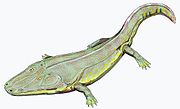
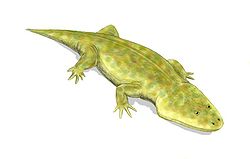
†Temnospondyls
| Temnospondyls of the Carnian | ||||
|---|---|---|---|---|
| Taxa | Presence | Location | Description | Images |
|
All Across Europe |
  |
||
|
Australia | |||
|
Metoposaurus Metoposaurus is an extinct genus of temnospondyl amphibian, known from the Late Triassic of Europe. This mostly aquatic animal possessed small, weak limbs, had sharp teeth and a large flat head. The main diet of this highly flattened creature was fish which it captured with its wide jaws lined with... |
Europe and North America | |||
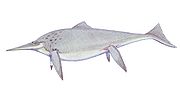
†Ichthyosaurs
| Ichthyosaurs of the Carnian | ||||
|---|---|---|---|---|
| Taxa | Presence | Location | Description | Images |
|
   |
|||
|
||||
|
|
||||
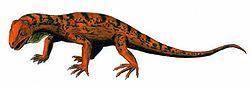
†Archosauromorphs (non-archosaurian)
| Non-Archosaurian Paraphyly A group of taxa is said to be paraphyletic if the group consists of all the descendants of a hypothetical closest common ancestor minus one or more monophyletic groups of descendants... Archosauromorphs of the Carnian |
||||
|---|---|---|---|---|
| Taxa | Presence | Location | Description | Images |
|
Paleorrota Paleorrota Paleorrota , is a geopark located in the center of the Brazilian state of Rio Grande do Sul. The rocks and fossils found along the route date back to the times when there was only one supercontinent Pangaea.... , Brazil Brazil Brazil , officially the Federative Republic of Brazil , is the largest country in South America. It is the world's fifth largest country, both by geographical area and by population with over 192 million people... . |
  |
||
|
||||
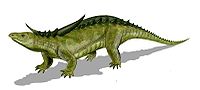
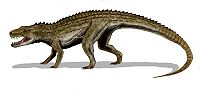
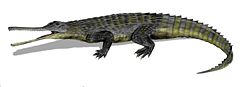
†Crurotarsans (non-crocodylomorph)
| †Non-crocodylomorph Paraphyly A group of taxa is said to be paraphyletic if the group consists of all the descendants of a hypothetical closest common ancestor minus one or more monophyletic groups of descendants... Crurotarsans of the Carnian |
||||
|---|---|---|---|---|
| Taxa | Presence | Location | Description | Images |
|
    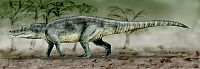 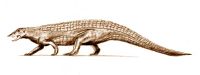 |
|||
|
||||
|
Ornithosuchus Ornithosuchus is an extinct genus of crurotarsan from the Late Triassic Lossiemouth Sandstone of Scotland... |
||||
|
Paleorhinus Paleorhinus was a genus of small phytosaur, a large order of semi-aquatic, crocodile-like animals that lived in the Late Triassic, specifically the earlier Late Carnian period. The reptiles lived throughout Europe, North America, and North Africa. This genus usually also includes the more... |
||||
|
Postosuchus Postosuchus, meaning "crocodile from Post ", was a basal archosaur that lived in what is now North America during the middle through to the late Triassic period... |
||||
|
Rutiodon Rutiodon is an extinct genus of archosaur belonging to the family Phytosauridae. It lived during the Late Triassic period, and was about 10 to 25 feet in length... |
||||
|
Saurosuchus Saurosuchus is an extinct genus of rauisuchian archosaur in the family Prestosuchidae. With a length of around 7 m , it was the largest rauisuchian, except perhaps for the less well known Fasolasuchus. Like other rauisuchians, Saurosuchus walked on four fully erect limbs... |
||||
|
Stagonolepis Stagonolepis is an extinct genus of aetosaur. It was about long.An aetosaur, Stagonolepis was a quadrupedal animal covered in thick armoured scales that ran down the length of the its body. A slow-moving browser, it would have used this heavy body armour to repel attacks from contemporary... |
||||
Crocodylomorphs
| Crocodylomorphs of the Carnian | ||||
|---|---|---|---|---|
| Taxa | Presence | Location | Description | Images |
|
 |
|||
†Non-dinosaur Ornithodira
| †Ornithodira of the Carnian | ||||
|---|---|---|---|---|
| Taxa | Presence | Location | Description | Images |
|
Silesia, Poland |
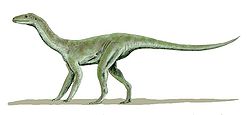 |
||
|
Agudo Agudo, Rio Grande do Sul Agudo is a municipality in Rio Grande do Sul, the southernmost state of Brazil. Its coordinates are 53º14'24" West and the elevation is 83 meters above sealevel... , Rio Grande do Sul, Brazil |
|||
Dinosaurs
| †Dinosaur Dinosaur Dinosaurs are a diverse group of animals of the clade and superorder Dinosauria. They were the dominant terrestrial vertebrates for over 160 million years, from the late Triassic period until the end of the Cretaceous , when the Cretaceous–Paleogene extinction event led to the extinction of... s of the Carnian |
||||
|---|---|---|---|---|
| Taxa | Presence | Location | Description | Images |
|
Disputed: considered Norian Norian The Norian is a division of the Triassic geological period. It has the rank of an age or stage . The Norian lasted from 216.5 ± 2.0 to 203.6 ± 1.5 million years ago. It was preceded by the Carnian and succeeded by the Rhaetian.-Stratigraphic definitions:The Norian was named after the Noric Alps in... by some researchers. |
  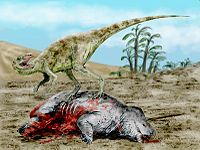 |
||
|
Chinle Formation Chinle Formation The Chinle is a geologic formation that is spread across the U.S. states of northern Arizona, Nevada, Utah, western New Mexico, and western Colorado. The Chinle is controversially considered to be synonymous to the Dockum Group in eastern Colorado, eastern New Mexico, southwestern Kansas, the... , Arizona Arizona Arizona ; is a state located in the southwestern region of the United States. It is also part of the western United States and the mountain west. The capital and largest city is Phoenix... |
Some palaeontologists believe that it's actually a junior synonym of the better known Coelophysis Coelophysis Coelophysis , meaning "hollow form" in reference to its hollow bones , is one of the earliest known genera of dinosaur... . |
||
|
Eoraptor Eoraptor was one of the world's earliest dinosaurs. It was a two-legged saurischian, close to the ancestry of theropods and sauropodomorphs. It lived ca. 231.4 million years ago, in what is now the northwestern region of Argentina... |
||||
|
Euskelosaurus Euskelosaurus was a semi-bipedal dinosaur from the Late Triassic. It was a prosauropod that lived in the Late Triassic Period, in present-day South Africa, Lesotho, and Zimbabwe. It was first described by Thomas Henry Huxley in 1866 as Euskelesaurus brownii based on holotype BMNH R1625, limb and... |
Disputed: considered Norian Norian The Norian is a division of the Triassic geological period. It has the rank of an age or stage . The Norian lasted from 216.5 ± 2.0 to 203.6 ± 1.5 million years ago. It was preceded by the Carnian and succeeded by the Rhaetian.-Stratigraphic definitions:The Norian was named after the Noric Alps in... by some researchers. |
|||
|
Guaibasaurus Guaibasaurus is an extinct genus of basal dinosaur known from the Triassic of Rio Grande do Sul, southern Brazil.-Discovery:Guaibasaurus was originally named on the basis of the holotype, MCN PV2355, a well-preserved partial postcranial skeleton and the paratype, MCN PV2356, an... |
Paleorrota Paleorrota Paleorrota , is a geopark located in the center of the Brazilian state of Rio Grande do Sul. The rocks and fossils found along the route date back to the times when there was only one supercontinent Pangaea.... , Brazil Brazil Brazil , officially the Federative Republic of Brazil , is the largest country in South America. It is the world's fifth largest country, both by geographical area and by population with over 192 million people... . |
|||
|
Staurikosaurus Staurikosaurus is a genus of herrerasaurid dinosaur from the Late Triassic of Brazil.-Discovery:The first known specimen of Staurikosaurus was recovered from the Paleontological Site Jazigo Cinco of the Santa Maria Formation in the geopark of paleorrota , Rio Grande do Sul, southern Brazil... |
Paleorrota Paleorrota Paleorrota , is a geopark located in the center of the Brazilian state of Rio Grande do Sul. The rocks and fossils found along the route date back to the times when there was only one supercontinent Pangaea.... , Rio Grande do Sul, Brazil Brazil Brazil , officially the Federative Republic of Brazil , is the largest country in South America. It is the world's fifth largest country, both by geographical area and by population with over 192 million people... . |
|||
|
|
Paleorrota Paleorrota Paleorrota , is a geopark located in the center of the Brazilian state of Rio Grande do Sul. The rocks and fossils found along the route date back to the times when there was only one supercontinent Pangaea.... , Rio Grande do Sul, Brazil Brazil Brazil , officially the Federative Republic of Brazil , is the largest country in South America. It is the world's fifth largest country, both by geographical area and by population with over 192 million people... . |
May have been a primitive sauropodomorph, probably grew to about 1.5 meters (5 ft) long. | ||
|
Unaysaurus Unaysaurus is a genus of sauropodomorph dinosaur, and is one of the oldest dinosaurs known. It was discovered in southern Brazil,in the geopark of paleorrota, in 1998, and announced in a press conference on Thursday, December 3, 2004... |
Paleorrota Paleorrota Paleorrota , is a geopark located in the center of the Brazilian state of Rio Grande do Sul. The rocks and fossils found along the route date back to the times when there was only one supercontinent Pangaea.... , Rio Grande do Sul, Brazil Brazil Brazil , officially the Federative Republic of Brazil , is the largest country in South America. It is the world's fifth largest country, both by geographical area and by population with over 192 million people... . |
|||
|
Herrerasaurus Herrerasaurus was one of the earliest dinosaurs. All known specimens of this carnivore have been discovered in rocks of late Ladinian age in northwestern Argentina... |
||||
|
Panphagia Panphagia is a genus of sauropodomorph dinosaur described in 2009. It lived 231 million years ago, during the late Ladinian age of the mid Triassic period , in what is now northwestern Argentina... |
||||
|
Pisanosaurus Pisanosaurus is a genus of primitive ornithischian dinosaur from the Late Triassic of what is now South America. It was a bipedal herbivore described by Argentine paleontologist Rodolfo Casamiquela in 1967. Only one species, the type, Pisanosaurus mertii, is known, based on a single partial skeleton... |
Ischigualasto Formation, San Juan, Argentina | A small, lightly built dinosaur approximately 1 m (3 ft 3 in) in length and 30 cm (12 in) in height. It was bipedal and, like all ornithischians, was probably exclusively herbivorous. | ||
|
Teyuwasu Teyuwasu is a dubious genus of dinosaur from the Late Triassic. Named by Edio-Ernst Kischlat in 1999, little is currently known about this genus; the type species, T. barbarenai, was named from leg bones discovered in geopark of paleorrota, Brazil. The specific name honors Dr. Mário Costa... |
||||
†Therapsids (non-mammalian)
| †Non-mammalian Paraphyly A group of taxa is said to be paraphyletic if the group consists of all the descendants of a hypothetical closest common ancestor minus one or more monophyletic groups of descendants... Therapsids of the Carnian |
||||
|---|---|---|---|---|
| Taxa | Presence | Location | Description | Images |
|
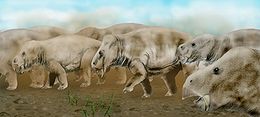
Paleorrota Paleorrota Paleorrota , is a geopark located in the center of the Brazilian state of Rio Grande do Sul. The rocks and fossils found along the route date back to the times when there was only one supercontinent Pangaea.... , Brazil Brazil Brazil , officially the Federative Republic of Brazil , is the largest country in South America. It is the world's fifth largest country, both by geographical area and by population with over 192 million people... . |
  |
||
|
||||
Mammaliaformes
| Mammaliaformes Mammaliaformes Mammaliaformes is a clade that contains the mammals and their closest extinct relatives. Phylogenetically, it is defined as a clade including the most recent common ancestor of Sinoconodon, morganuconodonts, docodonts, Monotremata, Marsupialia, Placentalia, extinct members of this clade, and all... of the Carnian |
||||
|---|---|---|---|---|
| Taxa | Presence | Location | Description | Images |
|
Tecovas formation Palo Duro Canyon Palo Duro Canyon is a canyon system of the Caprock Escarpment located in the Texas Panhandle near the city of Amarillo, Texas, United States. As the second largest canyon in the United States, it is roughly long and has an average width of , but reaches a width of at places. Its depth is around... , Texas, USA |
Thought to be the common ancestor of all modern mammals or a close relative of the common ancestor |
 |
|
†Thalattosaurians
| Thalattosauria of the Carnian | ||||
|---|---|---|---|---|
| Taxa | Presence | Location | Description | Images |
|
Falang Formation, Guizhou, China | A relatively large thalattosaurian, more than 4 meters long. |
 |
|
Classic localities and lagerstätten
The lower Carnian fauna of the San Cassiano Formation (DolomitesDolomites
The Dolomites are a mountain range located in north-eastern Italy. It is a part of Southern Limestone Alps and extends from the River Adige in the west to the Piave Valley in the east. The northern and southern borders are defined by the Puster Valley and the Sugana Valley...
, northern Italy
Italy
Italy , officially the Italian Republic languages]] under the European Charter for Regional or Minority Languages. In each of these, Italy's official name is as follows:;;;;;;;;), is a unitary parliamentary republic in South-Central Europe. To the north it borders France, Switzerland, Austria and...
) has been studied since the 19th century. Fossiliferous localities are many, and are distributed mostly in the surroundings of Cortina d'Ampezzo
Cortina d'Ampezzo
Cortina d'Ampezzo is a town and comune in the southern Alps located in Veneto, a region in Northern Italy. Located in the heart of the Dolomites in an alpine valley, it is a popular winter sport resort known for its ski-ranges, scenery, accommodations, shops and après-ski scene...
and in the high Badia Valley, near the village of San Cassiano
San Cassiano
San Cassiano is a town and comune in the Italian province of Lecce in the Apulia region of south-east Italy....
, after which the formation was named. This fauna is extremely diverse, including ammonoids, gastropods, bivalves, echinoderms, calcareous sponge, corals, brachiopod
Brachiopod
Brachiopods are a phylum of marine animals that have hard "valves" on the upper and lower surfaces, unlike the left and right arrangement in bivalve molluscs. Brachiopod valves are hinged at the rear end, while the front can be opened for feeding or closed for protection...
s, and a variety of less common fossils. A collection of this fauna is exposed in the “Museo delle Regole”, a museum in Cortina d'Ampezzo
Cortina d'Ampezzo
Cortina d'Ampezzo is a town and comune in the southern Alps located in Veneto, a region in Northern Italy. Located in the heart of the Dolomites in an alpine valley, it is a popular winter sport resort known for its ski-ranges, scenery, accommodations, shops and après-ski scene...
.
The Ischigualasto Formation of northwestern Argentina yielded a very important vertebrate association, including the oldest dinosaurian assemblage.
Literature
; 2005: The Global boundary Stratotype Section and Point (GSSP) of the Ladinian Stage (Middle Triassic) at Bagolino (Southern Alps, Northern Italy) and its implications for the Triassic time scale, Episodes 28(4), pp. 233–244.; 1999: The Prati di Stuores/Stuores Wiesen section (Dolomites, Italy): a candidate Global Stratotype section and Point for the base of the Carnian stage, Rivista Italiana di Paleontologia e Stratigrafia 105, pp. 37–78.; 2006: High-precision U-Pb zircon age from the Triassic of Italy: Implications for the Triassic time scale and the Carnian origin of calcareous nannoplankton and dinosaurs, Geology 34, p. 1009-1012.; 2004: A Geologic Time Scale 2004, Cambridge University PressCambridge University Press
Cambridge University Press is the publishing business of the University of Cambridge. Granted letters patent by Henry VIII in 1534, it is the world's oldest publishing house, and the second largest university press in the world...
.
External links
- GeoWhen Database - Carnian
- Upper Triassic timescale, at the website of the subcommission for stratigraphic information of the ICS
- Norges Network of offshore records of geology and stratigraphy: Stratigraphic charts for the Triassic, http://norges.uio.no/timescale/Late_Triassic.pdf, http://norges.uio.no/timescale/Fig16.1_Tri_colA.pdf and http://norges.uio.no/timescale/Fig16.1_Tri_colB.pdf
- Palaeos Mesozoic: Carnian Age
- Carnian dinosaurs at DinoData