

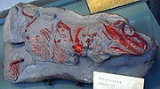
Euparkeria

Encyclopedia
Euparkeria was a small Africa
n reptile of the early Triassic
period between 248-245 million years ago, close to the ancestry of the archosaur
s.
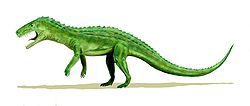 Euparkeria had a light, lean body, long tail, and a small skull with tiny, needle-like teeth. It probably fed on insects and any other small animals that it could find on the forest floor, and would have periodically shed its teeth in order to keep them sharp. The first fossils were found in South Africa in 1913, but better specimens were found in 1924.
Euparkeria was one of the smaller reptiles of its time, with the adults reaching 60 centimetres (23.6 in); the size of a large lizard. Euparkeria had relatively long hind legs, and may have been semi-bipedal, able to move using only its hind legs when running quickly. This tendency towards bipedal locomotion makes Euparkeria one of the earliest reptiles to walk on two legs, a feature that would be retained in some dinosaur
s and early Crurotarsi
. Like many early archosaurs, it had a row of relatively light bony plates
along its back and tail.
Another means of defence that Euparkeria possessed was a sharp claw on its thumb, which could have been used as a weapon in close combat.
Comparisons between the scleral ring
s of Euparkeria and modern birds and reptiles indicates that it may have been nocturnal, supporting the idea that early archosaur
s adapted to dim light. However, as Euparkeria may have been a polar
animal, it likely lived under different lighting conditions from typical archosaurs and may not have inherited its nocturnal adaptations from a common ancestor with archosaurs.
television program Walking With Monsters
, incorrectly identifying it as the ancestor of all dinosaurs. Euparkeria was not the true ancestor of dinosaurs; however, it was related to the dinosauromorphs and Saltoposuchus
, a possible ancestor of the dinosaurs.
Africa
Africa is the world's second largest and second most populous continent, after Asia. At about 30.2 million km² including adjacent islands, it covers 6% of the Earth's total surface area and 20.4% of the total land area...
n reptile of the early Triassic
Triassic
The Triassic is a geologic period and system that extends from about 250 to 200 Mya . As the first period of the Mesozoic Era, the Triassic follows the Permian and is followed by the Jurassic. Both the start and end of the Triassic are marked by major extinction events...
period between 248-245 million years ago, close to the ancestry of the archosaur
Archosaur
Archosaurs are a group of diapsid amniotes whose living representatives consist of modern birds and crocodilians. This group also includes all extinct non-avian dinosaurs, many extinct crocodilian relatives, and pterosaurs. Archosauria, the archosaur clade, is a crown group that includes the most...
s.
Palaeobiology
Euparkeria was one of the smaller reptiles of its time, with the adults reaching 60 centimetres (23.6 in); the size of a large lizard. Euparkeria had relatively long hind legs, and may have been semi-bipedal, able to move using only its hind legs when running quickly. This tendency towards bipedal locomotion makes Euparkeria one of the earliest reptiles to walk on two legs, a feature that would be retained in some dinosaur
Dinosaur
Dinosaurs are a diverse group of animals of the clade and superorder Dinosauria. They were the dominant terrestrial vertebrates for over 160 million years, from the late Triassic period until the end of the Cretaceous , when the Cretaceous–Paleogene extinction event led to the extinction of...
s and early Crurotarsi
Crurotarsi
The Crurotarsi are a group of archosauriformes, represented today by the crocodiles,...
. Like many early archosaurs, it had a row of relatively light bony plates
Osteoderm
Osteoderms are bony deposits forming scales, plates or other structures in the dermal layers of the skin. Osteoderms are found in many groups of extant and extinct reptiles, including lizards, various groups of dinosaurs , crocodilians, phytosaurs, aetosaurs, placodonts, and hupehsuchians...
along its back and tail.
Another means of defence that Euparkeria possessed was a sharp claw on its thumb, which could have been used as a weapon in close combat.
Comparisons between the scleral ring
Sclerotic ring
Sclerotic rings are rings of bone found in the eyes of several groups of vertebrate animals, except for mammals and crocodilians. They can be made up of single bones or small bones together. They are believed to have a role in supporting the eye, especially in animals whose eyes are not spherical,...
s of Euparkeria and modern birds and reptiles indicates that it may have been nocturnal, supporting the idea that early archosaur
Archosaur
Archosaurs are a group of diapsid amniotes whose living representatives consist of modern birds and crocodilians. This group also includes all extinct non-avian dinosaurs, many extinct crocodilian relatives, and pterosaurs. Archosauria, the archosaur clade, is a crown group that includes the most...
s adapted to dim light. However, as Euparkeria may have been a polar
Polar region
Earth's polar regions are the areas of the globe surrounding the poles also known as frigid zones. The North Pole and South Pole being the centers, these regions are dominated by the polar ice caps, resting respectively on the Arctic Ocean and the continent of Antarctica...
animal, it likely lived under different lighting conditions from typical archosaurs and may not have inherited its nocturnal adaptations from a common ancestor with archosaurs.
In popular culture
Euparkeria was featured in the BBCBBC
The British Broadcasting Corporation is a British public service broadcaster. Its headquarters is at Broadcasting House in the City of Westminster, London. It is the largest broadcaster in the world, with about 23,000 staff...
television program Walking With Monsters
Walking with Monsters
Walking with Monsters is a three-part British documentary film series about life in the Paleozoic, bringing to life extinct arthropods, fish, amphibians, synapsids, and reptiles...
, incorrectly identifying it as the ancestor of all dinosaurs. Euparkeria was not the true ancestor of dinosaurs; however, it was related to the dinosauromorphs and Saltoposuchus
Saltoposuchus
Saltoposuchus is an extinct genus of small , long- tailed crocodylomorph reptile , from the Norian of Europe. The name translated means "leaping crocodile". It has been proposed that Terrestrisuchus gracilis and Saltoposuchus connectens represent different ontogenetic stages of the same genus...
, a possible ancestor of the dinosaurs.