

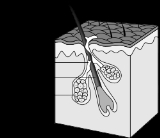
Hair follicle

Encyclopedia
A hair follicle is a skin
organ
that produces hair
. Hair production occurs in phases, including a growth phase (anagen), and cessation phase (catagen), and a rest phase (telogen). Stem cells are principally responsible for the production of hair.

. The papilla is made up mainly of connective tissue
and a capillary loop. Cell division in the papilla is either rare or non-existent.
that kill dividing cells or radiotherapy may lead to temporary hair loss. The papilla is usually ovoid or pear shaped with the matrix wrapped completely around it except for a short stalk-like connection to the surrounding connective tissue that provides access for the capillary.
. The internal root sheath is composed of three layers, Henle's layer
, Huxley's layer
, and an internal cuticle that is continuous with the outermost layer of the hair fiber.
sweat glands. Hair follicle receptors sense the position of the hairs.
Attached to the follicle is a tiny bundle of muscle fiber called the arrector pili. This muscle is responsible for causing the follicle lissis to become more perpendicular to the surface of the skin, and causing the follicle to protrude slightly above the surrounding skin (piloerection) and a pore
encased with skin oil. This process results in goose bumps
(or goose flesh).
Also attached to the follicle is a sebaceous gland
, which produces the oily or waxy substance sebum. The thicker the density
of the hair, the more sebaceous glands that are found.
s, the cycle is completed in around 4 months, while it takes the scalp
3–4 years to finish; this is the reason eyebrow hairs have a much shorter length limit compared to hairs on the head. Growth cycles are controlled by a chemical signal like epidermal growth factor
.
The telogen phase is the resting phase of the hair follicle. When the body is subjected to extreme stress, as much as 70 percent of your hair can prematurely enter a phase of rest, called the telogen phase. This hair begins to fall, causing a noticeable loss of hair. This condition is called telogen effluvium. The club hair is the final product of a hair follicle in the telogen stage, and is a dead, fully keratinized hair. Fifty to one-hundred club hairs are shed daily from a normal scalp.
in hair restoration
, Follicular Unit Transplantation
(FUT) and Follicular Unit Extraction
(FUE). In each of these methods, naturally-occurring groupings of one to four hairs, called follicular units, are extracted from the hair restoration patient and then surgically implanted in the balding area of the patient's scalp, known as the recipient area. These follicles are extracted from donor areas of the scalp, or other parts of the body, which are typically resistant to the miniaturization effects of the hormone DHT. It is this miniaturization of the hair shaft that is the primary predictive indicator of androgenetic alopecia
, commonly referred to as male pattern baldness or male hair loss. When these DHT-resistant follicles are transplanted to the recipient area, they continue to grow hairs in the normal hair cycle, thus providing the hair restoration patient with permanent, naturally-growing hair.
While hair transplantation dates back to the 1950s, and plucked human hair follicle cell culture in vitro to the early 1980s , it was not until 1995 when hair transplantation using individual follicular units was introduced into medical literature.
Research is under way to multiply hair follicles that are resistant to miniaturization. In hair multiplication, plucked hairs or hair fragments, which contain germinative cells, are implanted into the scalp with the hopes that they develop into new hair-producing follicles. In experimental hair cloning, dermal sheath cells could be isolated, multiplied in a Petri dish, and then injected in great numbers to produce hair-producing follicles and, in theory, a full head of hair. Neither method has yet proven to result in a commercially viable hair restoration treatment, but research continues in these areas.
Skin
-Dermis:The dermis is the layer of skin beneath the epidermis that consists of connective tissue and cushions the body from stress and strain. The dermis is tightly connected to the epidermis by a basement membrane. It also harbors many Mechanoreceptors that provide the sense of touch and heat...
organ
Organ
-Biology and medicine:*Organ , a collection of tissues joined in structural unit to serve a common function*Organ pipe coral, a marine organism native to the Indian and Pacific Oceans*Stenocereus thurberi, the organ pipe cactus plant-Music:...
that produces hair
Hair
Hair is a filamentous biomaterial, that grows from follicles found in the dermis. Found exclusively in mammals, hair is one of the defining characteristics of the mammalian class....
. Hair production occurs in phases, including a growth phase (anagen), and cessation phase (catagen), and a rest phase (telogen). Stem cells are principally responsible for the production of hair.
Structure
Papilla
At the base of the follicle is a large structure that is called the papillaDermal papillae
In the human skin, the dermal papillae are small, nipple-like extensions of the dermis into the epidermis...
. The papilla is made up mainly of connective tissue
Connective tissue
"Connective tissue" is a fibrous tissue. It is one of the four traditional classes of tissues . Connective Tissue is found throughout the body.In fact the whole framework of the skeleton and the different specialized connective tissues from the crown of the head to the toes determine the form of...
and a capillary loop. Cell division in the papilla is either rare or non-existent.
Matrix
Around the papilla is the hair matrix, a collection of epithelial cells often interspersed with the pigment-producing cells, melanocytes. Cell division in the hair matrix produces the cells that will form the major structures of the hair fiber and the inner root sheath. The hair matrix epithelium is one of the fastest growing cell populations in the human body, which is why some forms of chemotherapyChemotherapy
Chemotherapy is the treatment of cancer with an antineoplastic drug or with a combination of such drugs into a standardized treatment regimen....
that kill dividing cells or radiotherapy may lead to temporary hair loss. The papilla is usually ovoid or pear shaped with the matrix wrapped completely around it except for a short stalk-like connection to the surrounding connective tissue that provides access for the capillary.
Root sheath
The root sheath is composed of an external and internal root sheath. The external root sheath appears empty with cuboid cells when stained with H&E stainH&E stain
H&E stain, HE stain or hematoxylin and eosin stain is a popular staining method in histology. It is the most widely used stain in medical diagnosis; for example when a pathologist looks at a biopsy of a suspected cancer, the histological section is likely to be stained with H&E and termed H&E...
. The internal root sheath is composed of three layers, Henle's layer
Henle's layer
Henle's layer is the third layer of the inner root sheath of the hair, consisting of a single layer of cubical cells with clear flattened nuclei....
, Huxley's layer
Huxley's layer
The second layer of the inner root sheath of the hair consists of one or two layers of horny, flattened, nucleated cells, known as Huxley's layer....
, and an internal cuticle that is continuous with the outermost layer of the hair fiber.
Bulge
The bulge is located in the outer root sheath at the insertion point of the arrector pili muscle. It houses several types of stem cells, which supply the entire hair follicle with new cells, and take part in healing the epidermis after a wound.Other structures
Other structures associated with the hair follicle include arrector pili muscles, sebaceous glands, and apocrineApocrine
Apocrine is a term used to classify exocrine glands in the study of histology. Cells which are classified as apocrine bud their secretions off through the plasma membrane producing membrane-bound vesicles in the lumen. This method is also called decapitation secretion...
sweat glands. Hair follicle receptors sense the position of the hairs.
Attached to the follicle is a tiny bundle of muscle fiber called the arrector pili. This muscle is responsible for causing the follicle lissis to become more perpendicular to the surface of the skin, and causing the follicle to protrude slightly above the surrounding skin (piloerection) and a pore
Sweat gland
Sweat glands, or sudoriferous glands, are small tubular structures of the skin that produce sweat. There are two kinds of sweat glands:...
encased with skin oil. This process results in goose bumps
Goose bumps
Goose bumps, also called goose flesh, goose pimples, chill bumps, chicken skin, funky spots, Dasler Bumps, chicken bumps or the medical term cutis anserina, are the bumps on a person's skin at the base of body hairs which may involuntarily develop when a person is cold or experiences strong...
(or goose flesh).
Also attached to the follicle is a sebaceous gland
Sebaceous gland
The sebaceous glands are microscopic glands in the skin that secrete an oily/waxy matter, called sebum, to lubricate and waterproof the skin and hair of mammals...
, which produces the oily or waxy substance sebum. The thicker the density
Density
The mass density or density of a material is defined as its mass per unit volume. The symbol most often used for density is ρ . In some cases , density is also defined as its weight per unit volume; although, this quantity is more properly called specific weight...
of the hair, the more sebaceous glands that are found.
Morphogenesis
In utero, the epithelium and underlying mesenchyma interact to form hair follicles.Hair-follicle cycling
Hair grows in cycles of various phases: anagen is the growth phase; catagen is the involuting or regressing phase; and telogen, the resting or quiescent phase. Each phase has several morphologically and histologically distinguishable sub-phases. Prior to the start of cycling is a phase of follicular morphogenesis (formation of the follicle). There is also a shedding phase, or exogen, that is independent of anagen and telogen in which one of several hairs that might arise from a single follicle exits. Normally up to 90% of the hair follicles are in anagen phase while, 10–14% are in telogen and 1–2% in catagen. The cycle's length varies on different parts of the body. For eyebrowEyebrow
The eyebrow is an area of thick, delicate hairs above the eye that follows the shape of the lower margin of the brow ridges of some mammals. Their main function is to prevent sweat, water, and other debris from falling down into the eye socket, but they are also important to human communication and...
s, the cycle is completed in around 4 months, while it takes the scalp
Scalp
The scalp is the anatomical area bordered by the face anteriorly and the neck to the sides and posteriorly.-Layers:It is usually described as having five layers, which can conveniently be remembered as a mnemonic:...
3–4 years to finish; this is the reason eyebrow hairs have a much shorter length limit compared to hairs on the head. Growth cycles are controlled by a chemical signal like epidermal growth factor
Epidermal growth factor
Epidermal growth factor or EGF is a growth factor that plays an important role in the regulation of cell growth, proliferation, and differentiation by binding to its receptor EGFR...
.
Anagen phase
Anagen is the active growth phase of hair follicles. The root of the hair are dividing rapidly, adding to the hair shaft. During this phase the hair grows about 1 cm every 28 days. Scalp hair stays in this active phase of growth for 2–7 years. The amount of time the hair follicle stays in the anagen phase is genetically determined. At the end of the anagen phase an unknown signal causes the follicle to go into the catagen phase.Catagen phase
The catagen phase is a short transition stage that occurs at the end of the anagen phase. It signals the end of the active growth of a hair. This phase lasts for about 2–3 weeks while the hair converts to a club hair.Telogen phase
The telogen phase is the resting phase of the hair follicle. When the body is subjected to extreme stress, as much as 70 percent of your hair can prematurely enter a phase of rest, called the telogen phase. This hair begins to fall, causing a noticeable loss of hair. This condition is called telogen effluvium. The club hair is the final product of a hair follicle in the telogen stage, and is a dead, fully keratinized hair. Fifty to one-hundred club hairs are shed daily from a normal scalp.
Hair growth cycle times
- Scalp: The time these phases last varies from person to person. Different hair colour and follicle shape affects the timings of these phases.
- anagen phase, 2–3 years (occasionally much longer)
- catagen phase, 2–3 weeks
- telogen phase, around 3 months
- Eyebrows etc.:
- anagen phase, 4–7 months
- catagen phase, 3–4 weeks
- telogen phase, about 9 months
Hair follicles in hair restoration
Hair follicles form the basis of the two primary methods of hair transplantationHair transplantation
Hair transplantation is a surgical technique that involves moving individual hair follicles from one part of the body to bald or balding parts . It is primarily used to treat male pattern baldness. It this case, grafts containing hair follicles that are genetically resistant to balding are...
in hair restoration
Hair restoration
Hair restoration includes the medical and surgical treatment of various forms of hair loss. The most common cause of hair loss is androgenetic alopecia , also known as male pattern baldness or female pattern baldness.-Medical hair restoration:...
, Follicular Unit Transplantation
Follicular unit transplantation
Follicular Unit Transplantation is a hair restoration technique where a patient's hair is transplanted in naturally occurring groups of 1 to 4 hairs, called follicular units. Follicular units also contain sebaceous glands, nerves, a small muscle, and occasional fine vellus hairs...
(FUT) and Follicular Unit Extraction
Follicular Unit Extraction
Follicular unit extraction , also known as follicular transfer , is one of two primary methods of obtaining follicular units, naturally occurring groups of one to four hairs, for hair transplantation. The other method is called strip harvesting...
(FUE). In each of these methods, naturally-occurring groupings of one to four hairs, called follicular units, are extracted from the hair restoration patient and then surgically implanted in the balding area of the patient's scalp, known as the recipient area. These follicles are extracted from donor areas of the scalp, or other parts of the body, which are typically resistant to the miniaturization effects of the hormone DHT. It is this miniaturization of the hair shaft that is the primary predictive indicator of androgenetic alopecia
Androgenetic alopecia
Androgenic alopecia is the most common cause of hair loss and thinning in humans. Variants appear in both men and women. Androgenic alopecia also occurs in chimpanzees, and orangutans. In humans, this condition is also commonly known as male pattern baldness...
, commonly referred to as male pattern baldness or male hair loss. When these DHT-resistant follicles are transplanted to the recipient area, they continue to grow hairs in the normal hair cycle, thus providing the hair restoration patient with permanent, naturally-growing hair.
While hair transplantation dates back to the 1950s, and plucked human hair follicle cell culture in vitro to the early 1980s , it was not until 1995 when hair transplantation using individual follicular units was introduced into medical literature.
Research is under way to multiply hair follicles that are resistant to miniaturization. In hair multiplication, plucked hairs or hair fragments, which contain germinative cells, are implanted into the scalp with the hopes that they develop into new hair-producing follicles. In experimental hair cloning, dermal sheath cells could be isolated, multiplied in a Petri dish, and then injected in great numbers to produce hair-producing follicles and, in theory, a full head of hair. Neither method has yet proven to result in a commercially viable hair restoration treatment, but research continues in these areas.