

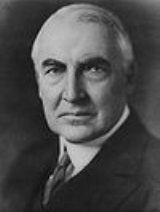
United States presidential election, 1920

Encyclopedia
The United States presidential election of 1920 was dominated by the aftermath of World War I
and a hostile response to certain policies of Woodrow Wilson
, the Democratic president
. The wartime economic boom had collapsed. Politicians were arguing over peace treaties and the question of America's entry into the League of Nations
, which produced an isolationist
reaction. Overseas, there were wars and revolutions. At home, 1919 was marked by major strikes in the meatpacking and steel industries, and large-scale race riots in Chicago
and other cities. Terrorist attacks on Wall Street
produced fears of radicals and terrorists
. The Irish Catholic and German communities were outraged at Wilson's foreign policy, and his political position was critically weakened after he suffered a severe stroke
in 1919 that rendered him unable to speak on his own behalf.
Former President Theodore Roosevelt
had been the frontrunner for the Republican nomination, but his health collapsed in 1918. He died in January 1919, leaving no obvious heir to his Progressive
legacy. Both major parties turned to dark horse
candidates from the electoral-vote-rich state of Ohio. The Democrats nominated newspaper publisher and Governor James M. Cox
; in turn, the Republicans chose Senator Warren G. Harding
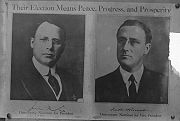
, another Ohio newspaper publisher. To help his campaign, Cox chose future President Franklin D. Roosevelt
(a distant cousin of Theodore) as his running mate. Harding virtually ignored Cox and essentially campaigned against Wilson, calling for a return to "normalcy
". With an almost 4-to-1 spending advantage, he won a landslide victory. Until Lyndon Johnson received 61.1% in his landslide win in the election of 1964
, Harding's victory remained the largest popular-vote percentage margin (60.3% to 34.1%) in Presidential elections after the so-called "Era of Good Feelings
" ended with the unopposed election of James Monroe
in 1820
.
On June 8, the Republican National Convention
met in Chicago. The race was wide open, and soon the convention deadlocked between Major General Leonard Wood
and Governor Frank Orren Lowden
of Illinois.
Others placed in nomination included Senators Warren G. Harding
of Ohio, Hiram Johnson
of California, and Miles Poindexter
of Washington, Governor Calvin Coolidge
of Massachusetts, Herbert Hoover
, and Columbia University
President Nicholas Murray Butler. Senator Robert M. La Follette
of Wisconsin was not formally placed in nomination, but received the votes of his state delegation nonetheless. Harding was nominated for president on the tenth ballot, after some delegates shifted their allegiances. The results of the ten ballots were as follows:
Harding's nomination, said to have been secured in negotiations among party bosses in a "smoke-filled room
", was engineered by Harry M. Daugherty
, Harding's political manager who became United States Attorney General
after his election. Prior to the convention, Daugherty was quoted as saying, "I don't expect Senator Harding to be nominated on the first, second, or third ballots, but I think we can afford to take chances that about 11 minutes after two, Friday morning of the convention, when 15 or 12 weary men are sitting around a table, someone will say: 'Who will we nominate?' At that decisive time, the friends of Harding will suggest him and we can well afford to abide by the result." Daugherty's prediction described essentially what occurred, but historians Richard C. Bain and Judith H. Parris argue that Daugherty's prediction has been given too much weight in narratives of the convention.
Once the presidential nomination was finally settled, the party bosses and Sen. Harding recommended Wisconsin Sen. Irvine Lenroot
to the delegates for the second spot, but the delegates revolted and nominated Coolidge, who was very popular over his handling of the Boston Police Strike
of the year before. The Tally:
Source for convention coverage: Richard C. Bain and Judith H. Parris, Convention Decisions and Voting Records (Washington DC: Brookings Institution, 1973), pp. 200–208.
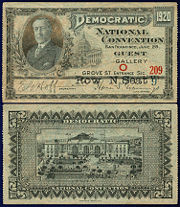 Although William Gibbs McAdoo
(Wilson's son-in-law and former Treasury Secretary) was the strongest candidate, Wilson blocked his nomination in hopes a deadlocked convention would demand Wilson run for a third term. (Wilson at the time was physically immobile and in seclusion.) The Democrats, meeting in San Francisco between June 28 and July 6, nominated another newspaper editor from Ohio, Governor James M. Cox
, as their presidential candidate, and 38 year-old Assistant Secretary of the Navy Franklin D. Roosevelt, a fifth cousin of the late president Theodore Roosevelt, for vice-president.
Early favorites for the nomination had included McAdoo and Attorney General Alexander Mitchell Palmer
. Others placed in nomination included New York Governor Al Smith
, United Kingdom Ambassador John W. Davis
, New Jersey Governor Edward I. Edwards, and Oklahoma Senator Robert Latham Owen.
. Additionally, World War I
and the Treaty of Versailles
proved deeply unpopular, causing a reaction against Wilson, who had pushed especially hard for the latter.
 Irish American
s were powerful in the Democratic party, and groups such as Clan na Gael opposed going to war alongside their enemy Britain, especially after the violent suppression of the Easter Rising
of 1916. Wilson won them over in 1917 by promising to ask Britain to give Ireland its independence. Wilson had won the presidential election of 1916 with strong support from German-Americans and Irish-Americans, largely because of his slogan "He kept us out of war" and the longstanding American policy of isolationism
. At the Paris Peace Conference
in 1919, however, he reneged on his commitments to the Irish-American community, and it vehemently denounced him. His dilemma was that Britain was his war ally. Events such as the anti-British 1916 rebellion, the Black Tom
and Kingsland Explosion
s on American soil (in part the result of wartime Irish and German co-ordination), and the Irish anti-conscription crisis of 1918 were all embarrassing to recall in 1920.
Britain had already passed an Irish Home Rule Act in 1914, suspended for the war's duration, and was to pass another in late 1920
, by which Ireland would be self-governing within the British empire. This satisfied Wilson. The provisions of these were inadequate to the supporters of the self-recognized Irish Republic
, claiming full sovereignty
, that was supported in 1920 by most of the Irish electorate and by many Irish Americans. The American Committee for Relief in Ireland
was set up in 1920 to assist victims of the Anglo-Irish War
of 1919-21.
Wilson in turn blamed the Irish Americans and German American
s for the lack of popular support for his unsuccessful campaign to have the United States to join the League of Nations
, saying, "There is an organized propaganda against the League of Nations and against the treaty proceeding from exactly the same sources that the organized propaganda proceeded from which threatened this country here and there with disloyalty, and I want to say -- I cannot say too often -- any man who carries a hyphen about with him [i.e., a hyphenated American
] carries a dagger that he is ready to plunge into the vitals of this Republic whenever he gets ready."
Of the $5,500,000 raised by supporters of the Irish Republic in the United States in 1919-20, the Dublin parliament (Dáil Éireann
) voted in June 1920 to spend $500,000 on the American presidential election. How this was spent remains unclear. Ironically, the lawyer who had advised the fundraisers was Franklin D. Roosevelt, the losing vice-presidential candidate. In any case, the Irish American city machines sat on their hands during the election, allowing the Republicans to roll up unprecedented landslides in every major city. Many German-American Democrats voted Republican or stayed home, giving the GOP landslides in the rural Midwest.
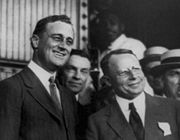 Wilson had hoped for a “solemn referendum” on the League of Nations
, but did not get one. Harding waffled on the League, thereby keeping the “irreconcilables” like Senator William Borah in line. Cox also hedged. He went to the White House for Wilson's blessing and apparently endorsed the League, but—discovering its unpopularity among Democrats—he said that he wanted the League only with reservations, particularly on Article Ten, which would require the United States to participate in any war declared by the League. (That is, he took the same position as Republican Senate leader Henry Cabot Lodge
.) As reporter Brand Whitlock observed, the League was an issue important in government circles, but was unimportant to the electorate. He also noted that the campaign was not being waged on issues: “The people, indeed, do not know what ideas Harding or Cox represents; neither do Harding or Cox. Great is democracy.” False rumors circulated that Harding had "Negro blood," but this did not greatly hurt Harding's election campaign.
Cox made a whirlwind campaign that took him to rallies, train station speeches, and formal addresses, reaching audiences totaling perhaps 2 million. Harding relied upon a “Front Porch Campaign” similar to that of William McKinley
in 1896. It brought thousands of voters to Marion, Ohio
, where Harding spoke from his home. GOP campaign manager Will Hays spent about $8,100,000, nearly four times the money Cox spent. Hays used national advertising in a major way (with advice from adman Albert Lasker
). The theme was Harding's own slogan “America First”. Thus the Republican advertisement in Collier's Magazine for October 30, 1920 demanded, “Let's be done with wiggle and wobble.” The image presented in the ads was nationalistic, using catch phrases like “absolute control of the United States by the United States,” “Independence means independence, now as in 1776,” “This country will remain American. Its next President will remain in our own country,” and “We decided long ago that we objected to foreign government of our people.”
On election night, November 2, 1920, commercial radio broadcast coverage of election returns for the first time. Announcers at KDKA-AM
in Pittsburgh read telegraph ticker results over the air as they came in. This single station could be heard over most of the Eastern United States by the small percentage of the population that had radio receivers.
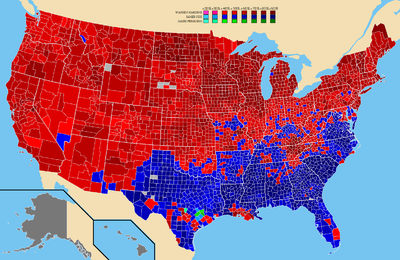
Harding's landslide came from all directions except the South. Irish-American and German-American voters who had backed Wilson and peace in 1916 now voted against Wilson and Versailles. “A vote for Harding,” said the German-language press, “is a vote against the persecutions suffered by German-Americans during the war.” Not one major German-language newspaper supported Cox. The Irish American
s, bitterly angry at Wilson's refusal to help Ireland at Versailles, sat out the election. Since they controlled the Democratic party in most large cities, this allowed the Republicans to mobilize the ethnic vote, and Harding swept the big cities.
 This was the first election in which women from every state were allowed to vote, following the passage of the 19th Amendment
to the Constitution in August 1920 (only in time for the general election, however).
Tennessee
's vote for Warren G. Harding marked the first time since the end of Reconstruction that one of the 11 states of the Confederacy
had voted for a Republican
. The state had last been carried by a Republican in 1868.
Despite the fact that Cox was defeated badly, his running mate, Franklin D. Roosevelt, became a well-known political figure because of his active and energetic campaign. In 1928 he was elected Governor of New York
, and in 1932 he was elected president. He remained in power until his death in 1945, as the longest-serving president ever.
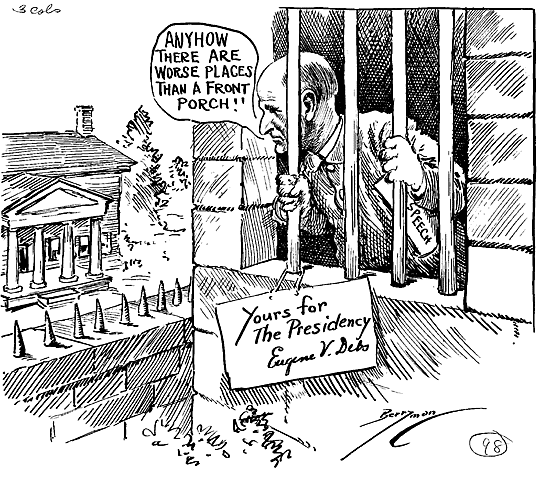
 Socialist Party
candidate Eugene V. Debs
received 913,664 popular votes (3.4%), despite the fact that he was in prison at the time for advocating non-compliance with the draft in the war. This was the largest amount of popular votes ever received by a Socialist Party candidate in the United States, though not the largest percentage of the popular vote. (The 19th Amendment had dramatically increased the number of people eligible to vote.) Debs received double this percentage in the 1912 election. The 1920 election was his fifth and last attempt to become president.
Parley P. Christensen
of the Farmer-Labor Party took 265,411 votes (1.0%), while Prohibition Party
candidate Aaron S. Watkins
came in fifth with 189,339 votes (0.7%), the poorest showing for the Prohibition party since 1884. Since the Eighteenth Amendment
, which initiated the period of Prohibition
in the United States, had passed the previous year, this single-issue party seemed less relevant.
Aftermath of World War I
The fighting in World War I ended in western Europe when the Armistice took effect at 11:00 am GMT on November 11, 1918, and in eastern Europe by the early 1920s. During and in the aftermath of the war the political, cultural, and social order was drastically changed in Europe, Asia and Africa,...
and a hostile response to certain policies of Woodrow Wilson
Woodrow Wilson
Thomas Woodrow Wilson was the 28th President of the United States, from 1913 to 1921. A leader of the Progressive Movement, he served as President of Princeton University from 1902 to 1910, and then as the Governor of New Jersey from 1911 to 1913...
, the Democratic president
History of the United States Democratic Party
The history of the Democratic Party of the United States is an account of the oldest political party in the United States and arguably the oldest democratic party in the world....
. The wartime economic boom had collapsed. Politicians were arguing over peace treaties and the question of America's entry into the League of Nations
League of Nations
The League of Nations was an intergovernmental organization founded as a result of the Paris Peace Conference that ended the First World War. It was the first permanent international organization whose principal mission was to maintain world peace...
, which produced an isolationist
Isolationism
Isolationism is the policy or doctrine of isolating one's country from the affairs of other nations by declining to enter into alliances, foreign economic commitments, international agreements, etc., seeking to devote the entire efforts of one's country to its own advancement and remain at peace by...
reaction. Overseas, there were wars and revolutions. At home, 1919 was marked by major strikes in the meatpacking and steel industries, and large-scale race riots in Chicago
Chicago
Chicago is the largest city in the US state of Illinois. With nearly 2.7 million residents, it is the most populous city in the Midwestern United States and the third most populous in the US, after New York City and Los Angeles...
and other cities. Terrorist attacks on Wall Street
Wall Street
Wall Street refers to the financial district of New York City, named after and centered on the eight-block-long street running from Broadway to South Street on the East River in Lower Manhattan. Over time, the term has become a metonym for the financial markets of the United States as a whole, or...
produced fears of radicals and terrorists
First Red Scare
In American history, the First Red Scare of 1919–1920 was marked by a widespread fear of Bolshevism and anarchism. Concerns over the effects of radical political agitation in American society and alleged spread in the American labor movement fueled the paranoia that defined the period.The First Red...
. The Irish Catholic and German communities were outraged at Wilson's foreign policy, and his political position was critically weakened after he suffered a severe stroke
Stroke
A stroke, previously known medically as a cerebrovascular accident , is the rapidly developing loss of brain function due to disturbance in the blood supply to the brain. This can be due to ischemia caused by blockage , or a hemorrhage...
in 1919 that rendered him unable to speak on his own behalf.
Former President Theodore Roosevelt
Theodore Roosevelt
Theodore "Teddy" Roosevelt was the 26th President of the United States . He is noted for his exuberant personality, range of interests and achievements, and his leadership of the Progressive Movement, as well as his "cowboy" persona and robust masculinity...
had been the frontrunner for the Republican nomination, but his health collapsed in 1918. He died in January 1919, leaving no obvious heir to his Progressive
Progressive Era
The Progressive Era in the United States was a period of social activism and political reform that flourished from the 1890s to the 1920s. One main goal of the Progressive movement was purification of government, as Progressives tried to eliminate corruption by exposing and undercutting political...
legacy. Both major parties turned to dark horse
Dark horse
Dark horse is a term used to describe a little-known person or thing that emerges to prominence, especially in a competition of some sort.-Origin:The term began as horse racing parlance...
candidates from the electoral-vote-rich state of Ohio. The Democrats nominated newspaper publisher and Governor James M. Cox
James M. Cox
James Middleton Cox was the 46th and 48th Governor of Ohio, U.S. Representative from Ohio and Democratic candidate for President of the United States in the election of 1920....
; in turn, the Republicans chose Senator Warren G. Harding
Warren G. Harding
Warren Gamaliel Harding was the 29th President of the United States . A Republican from Ohio, Harding was an influential self-made newspaper publisher. He served in the Ohio Senate , as the 28th Lieutenant Governor of Ohio and as a U.S. Senator...
, another Ohio newspaper publisher. To help his campaign, Cox chose future President Franklin D. Roosevelt
Franklin D. Roosevelt
Franklin Delano Roosevelt , also known by his initials, FDR, was the 32nd President of the United States and a central figure in world events during the mid-20th century, leading the United States during a time of worldwide economic crisis and world war...
(a distant cousin of Theodore) as his running mate. Harding virtually ignored Cox and essentially campaigned against Wilson, calling for a return to "normalcy
Normalcy
"A return to normalcy" was United States presidential candidate Warren G. Harding’s campaign promise in the election of 1920...
". With an almost 4-to-1 spending advantage, he won a landslide victory. Until Lyndon Johnson received 61.1% in his landslide win in the election of 1964
United States presidential election, 1964
The United States presidential election of 1964 was held on November 3, 1964. Incumbent President Lyndon B. Johnson had come to office less than a year earlier following the assassination of his predecessor, John F. Kennedy. Johnson, who had successfully associated himself with Kennedy's...
, Harding's victory remained the largest popular-vote percentage margin (60.3% to 34.1%) in Presidential elections after the so-called "Era of Good Feelings
Era of Good Feelings
The Era of Good Feelings was a period in United States political history in which partisan bitterness abated. It lasted approximately from 1815 to 1825, during the administration of U.S...
" ended with the unopposed election of James Monroe
James Monroe
James Monroe was the fifth President of the United States . Monroe was the last president who was a Founding Father of the United States, and the last president from the Virginia dynasty and the Republican Generation...
in 1820
United States presidential election, 1820
The United States presidential election of 1820 was the third and last presidential election in United States history in which a candidate ran effectively unopposed. In 1820, President James Monroe and Vice President Daniel D...
.
Republican Party nomination
Republican candidates:On June 8, the Republican National Convention
1920 Republican National Convention
The 1920 National Convention of the Republican Party of the United States nominated Ohio Senator Warren G. Harding for President and Massachusetts Governor Calvin Coolidge for Vice President...
met in Chicago. The race was wide open, and soon the convention deadlocked between Major General Leonard Wood
Leonard Wood
Leonard Wood was a physician who served as the Chief of Staff of the United States Army, Military Governor of Cuba and Governor General of the Philippines. Early in his military career, he received the Medal of Honor. Wood also holds officer service #2 in the Regular Army...
and Governor Frank Orren Lowden
Frank Orren Lowden
Frank Orren Lowden was a Republican Party politician from Illinois, who served as the 25th Governor of Illinois and as a United States Representatives from Illinois...
of Illinois.
Others placed in nomination included Senators Warren G. Harding
Warren G. Harding
Warren Gamaliel Harding was the 29th President of the United States . A Republican from Ohio, Harding was an influential self-made newspaper publisher. He served in the Ohio Senate , as the 28th Lieutenant Governor of Ohio and as a U.S. Senator...
of Ohio, Hiram Johnson
Hiram Johnson
Hiram Warren Johnson was a leading American progressive and later isolationist politician from California; he served as the 23rd Governor from 1911 to 1917, and as a United States Senator from 1917 to 1945.-Early life:...
of California, and Miles Poindexter
Miles Poindexter
Miles Poindexter was an American politician. As a Republican and later a Progressive, he served as a United States Representative and United States Senator.-Early life:Poindexter was born in Memphis, Tennessee...
of Washington, Governor Calvin Coolidge
Calvin Coolidge
John Calvin Coolidge, Jr. was the 30th President of the United States . A Republican lawyer from Vermont, Coolidge worked his way up the ladder of Massachusetts state politics, eventually becoming governor of that state...
of Massachusetts, Herbert Hoover
Herbert Hoover
Herbert Clark Hoover was the 31st President of the United States . Hoover was originally a professional mining engineer and author. As the United States Secretary of Commerce in the 1920s under Presidents Warren Harding and Calvin Coolidge, he promoted partnerships between government and business...
, and Columbia University
Columbia University
Columbia University in the City of New York is a private, Ivy League university in Manhattan, New York City. Columbia is the oldest institution of higher learning in the state of New York, the fifth oldest in the United States, and one of the country's nine Colonial Colleges founded before the...
President Nicholas Murray Butler. Senator Robert M. La Follette
Robert M. La Follette, Sr.
Robert Marion "Fighting Bob" La Follette, Sr. , was an American Republican politician. He served as a member of the U.S. House of Representatives, was the Governor of Wisconsin, and was also a U.S. Senator from Wisconsin...
of Wisconsin was not formally placed in nomination, but received the votes of his state delegation nonetheless. Harding was nominated for president on the tenth ballot, after some delegates shifted their allegiances. The results of the ten ballots were as follows:
| Presidential Balloting, Republican National Convention 1920 | |||||||||||
|---|---|---|---|---|---|---|---|---|---|---|---|
| Ballot | 1 | 2 | 3 | 4 | 5 | 6 | 7 | 8 | 9 | 10 Before shifts |
10 After shifts |
| Warren G. Harding Warren G. Harding Warren Gamaliel Harding was the 29th President of the United States . A Republican from Ohio, Harding was an influential self-made newspaper publisher. He served in the Ohio Senate , as the 28th Lieutenant Governor of Ohio and as a U.S. Senator... |
65.5 | 59.0 | 58.5 | 61.5 | 78.0 | 89.0 | 105.0 | 133.0 | 374.5 | 644.7 | 692.2 |
| Leonard Wood Leonard Wood Leonard Wood was a physician who served as the Chief of Staff of the United States Army, Military Governor of Cuba and Governor General of the Philippines. Early in his military career, he received the Medal of Honor. Wood also holds officer service #2 in the Regular Army... |
287.5 | 289.5 | 303.0 | 314.5 | 299.0 | 311.5 | 312.0 | 299.0 | 249.0 | 181.5 | 156.0 |
| Frank Orren Lowden Frank Orren Lowden Frank Orren Lowden was a Republican Party politician from Illinois, who served as the 25th Governor of Illinois and as a United States Representatives from Illinois... |
211.5 | 259.5 | 282.5 | 289.0 | 303.0 | 311.5 | 311.5 | 307.0 | 121.5 | 28.0 | 11.0 |
| Hiram Johnson Hiram Johnson Hiram Warren Johnson was a leading American progressive and later isolationist politician from California; he served as the 23rd Governor from 1911 to 1917, and as a United States Senator from 1917 to 1945.-Early life:... |
133.5 | 146.0 | 148.0 | 140.5 | 133.5 | 110.0 | 99.5 | 87.0 | 82.0 | 80.8 | 80.8 |
| William Cameron Sproul William Cameron Sproul William Cameron Sproul was the 27th Governor of Pennsylvania from 1919 to 1923. He was born near Octoraro and Andrew's Bridge, Colerain Township, Lancaster County. He was born in a structure currently known as the John Douglass HouseHe served as a member of Pennsylvania State Senate from 1897 to... |
84.0 | 78.5 | 79.5 | 79.5 | 82.5 | 77.0 | 76.0 | 76.0 | 78.0 | 0 | 0 |
| Nicholas Murray Butler | 69.5 | 41.0 | 25.0 | 20.0 | 4.0 | 4.0 | 2.0 | 2.0 | 2.0 | 2.0 | 2.0 |
| Calvin Coolidge Calvin Coolidge John Calvin Coolidge, Jr. was the 30th President of the United States . A Republican lawyer from Vermont, Coolidge worked his way up the ladder of Massachusetts state politics, eventually becoming governor of that state... |
34.0 | 32.0 | 27.0 | 25.0 | 29.0 | 28.0 | 28.0 | 30.0 | 28.0 | 5.0 | 5.0 |
| Robert M. La Follette Robert M. La Follette, Sr. Robert Marion "Fighting Bob" La Follette, Sr. , was an American Republican politician. He served as a member of the U.S. House of Representatives, was the Governor of Wisconsin, and was also a U.S. Senator from Wisconsin... |
24.0 | 24.0 | 24.0 | 22.0 | 24.0 | 24.0 | 24.0 | 24.0 | 24.0 | 24.0 | 24.0 |
| Jeter Connelly Pritchard Jeter Connelly Pritchard Jeter Connelly Pritchard was a Republican U.S. Senator from the state of North Carolina between 1895 and 1903. He was the only Republican to represent a southern state in the United States Senate during that time.... |
21.0 | 10.0 | 0 | 0 | 0 | 0 | 0 | 0 | 0 | 0 | 0 |
| Miles Poindexter Miles Poindexter Miles Poindexter was an American politician. As a Republican and later a Progressive, he served as a United States Representative and United States Senator.-Early life:Poindexter was born in Memphis, Tennessee... |
20.0 | 15.0 | 15.0 | 15.0 | 15.0 | 15.0 | 15.0 | 15.0 | 14.0 | 2.0 | 0 |
| Howard Sutherland Howard Sutherland Howard Sutherland was an American politician. He was a Republican who represented West Virginia in both houses of the United States Congress.... |
17.0 | 15.0 | 9.0 | 3.0 | 1.0 | 0 | 0 | 0 | 0 | 0 | 0 |
| Herbert Hoover Herbert Hoover Herbert Clark Hoover was the 31st President of the United States . Hoover was originally a professional mining engineer and author. As the United States Secretary of Commerce in the 1920s under Presidents Warren Harding and Calvin Coolidge, he promoted partnerships between government and business... |
5.5 | 5.5 | 5.5 | 5.0 | 6.0 | 5.0 | 4.0 | 5.0 | 6.0 | 10.5 | 9.5 |
| Scattering | 11.0 | 9.0 | 7.0 | 9.0 | 9.0 | 9.0 | 6.0 | 6.0 | 5.0 | 5.5 | 3.5 |
Harding's nomination, said to have been secured in negotiations among party bosses in a "smoke-filled room
Smoke-filled room
In U.S. political slang, a smoke-filled room is a term for a secret political gathering or round table style decision-making process. The phrase is generally used to suggest a cabal of powerful or well-connected, cigar-smoking men such as the Bilderberg group meeting privately to nominate a dark...
", was engineered by Harry M. Daugherty
Harry M. Daugherty
Harry Micajah Daugherty was an American politician. He is best known as a Republican Party boss, and member of the Ohio Gang, the name given to the group of advisors surrounding president Warren G...
, Harding's political manager who became United States Attorney General
United States Attorney General
The United States Attorney General is the head of the United States Department of Justice concerned with legal affairs and is the chief law enforcement officer of the United States government. The attorney general is considered to be the chief lawyer of the U.S. government...
after his election. Prior to the convention, Daugherty was quoted as saying, "I don't expect Senator Harding to be nominated on the first, second, or third ballots, but I think we can afford to take chances that about 11 minutes after two, Friday morning of the convention, when 15 or 12 weary men are sitting around a table, someone will say: 'Who will we nominate?' At that decisive time, the friends of Harding will suggest him and we can well afford to abide by the result." Daugherty's prediction described essentially what occurred, but historians Richard C. Bain and Judith H. Parris argue that Daugherty's prediction has been given too much weight in narratives of the convention.
Once the presidential nomination was finally settled, the party bosses and Sen. Harding recommended Wisconsin Sen. Irvine Lenroot
Irvine Lenroot
Irvine Luther Lenroot was a member of the United States Republican Party who served in the House of Representatives from 1909 to 1918, and in the United States Senate from 1918 to 1927, for the state of Wisconsin. He was also Warren G...
to the delegates for the second spot, but the delegates revolted and nominated Coolidge, who was very popular over his handling of the Boston Police Strike
Boston Police Strike
In the Boston Police Strike, the Boston police rank and file went out on strike on September 9, 1919 in order to achieve recognition for their trade union and improvements in wages and working conditions...
of the year before. The Tally:
| Vice Presidential Balloting, Republican Nat'l Convention 1920 |
|
|---|---|
| Calvin Coolidge Calvin Coolidge John Calvin Coolidge, Jr. was the 30th President of the United States . A Republican lawyer from Vermont, Coolidge worked his way up the ladder of Massachusetts state politics, eventually becoming governor of that state... | 674.5 |
| Irvine Lenroot Irvine Lenroot Irvine Luther Lenroot was a member of the United States Republican Party who served in the House of Representatives from 1909 to 1918, and in the United States Senate from 1918 to 1927, for the state of Wisconsin. He was also Warren G... | 146.5 |
| Henry Justin Allen Henry Justin Allen Henry Justin Allen was the 21st Governor of Kansas and U.S. Senator from Kansas .Allen was born in Warren County, Pennsylvania to John and Rebecca Elizabeth Allen... | 68.5 |
| Henry Anderson | 28 |
| Asle Gronna Asle Gronna Asle Jorgenson Gronna was an American Senator from North Dakota, and one of the six to vote against the United States declaration of war leading to the First World War. Gronna was a Republican who reflected the attitudes of his region - progressive and isolationist... | 24 |
| Hiram Johnson Hiram Johnson Hiram Warren Johnson was a leading American progressive and later isolationist politician from California; he served as the 23rd Governor from 1911 to 1917, and as a United States Senator from 1917 to 1945.-Early life:... | 22.5 |
| Jeter Connelly Pritchard Jeter Connelly Pritchard Jeter Connelly Pritchard was a Republican U.S. Senator from the state of North Carolina between 1895 and 1903. He was the only Republican to represent a southern state in the United States Senate during that time.... | 11 |
| Abstaining | 9 |
Source for convention coverage: Richard C. Bain and Judith H. Parris, Convention Decisions and Voting Records (Washington DC: Brookings Institution, 1973), pp. 200–208.
Democratic Party nomination
Democratic candidates:- James M. CoxJames M. CoxJames Middleton Cox was the 46th and 48th Governor of Ohio, U.S. Representative from Ohio and Democratic candidate for President of the United States in the election of 1920....
, governor of OhioOhioOhio is a Midwestern state in the United States. The 34th largest state by area in the U.S.,it is the 7th‑most populous with over 11.5 million residents, containing several major American cities and seven metropolitan areas with populations of 500,000 or more.The state's capital is Columbus... - William Gibbs McAdooWilliam Gibbs McAdooWilliam Gibbs McAdoo, Jr. was an American lawyer and political leader who served as a U.S. Senator, United States Secretary of the Treasury and director of the United States Railroad Administration...
, former U.S. Secretary of the Treasury from CaliforniaCaliforniaCalifornia is a state located on the West Coast of the United States. It is by far the most populous U.S. state, and the third-largest by land area... - Alexander Mitchell PalmerAlexander Mitchell PalmerAlexander Mitchell Palmer was Attorney General of the United States from 1919 to 1921. He was nicknamed The Fighting Quaker and he directed the controversial Palmer Raids.-Congressional career:...
, U.S. Attorney General from PennsylvaniaPennsylvaniaThe Commonwealth of Pennsylvania is a U.S. state that is located in the Northeastern and Mid-Atlantic regions of the United States. The state borders Delaware and Maryland to the south, West Virginia to the southwest, Ohio to the west, New York and Ontario, Canada, to the north, and New Jersey to... - Al SmithAl SmithAlfred Emanuel Smith. , known in private and public life as Al Smith, was an American statesman who was elected the 42nd Governor of New York three times, and was the Democratic U.S. presidential candidate in 1928...
, governor of New YorkNew YorkNew York is a state in the Northeastern region of the United States. It is the nation's third most populous state. New York is bordered by New Jersey and Pennsylvania to the south, and by Connecticut, Massachusetts and Vermont to the east... - John W. DavisJohn W. DavisJohn William Davis was an American politician, diplomat and lawyer. He served as a United States Representative from West Virginia , then as Solicitor General of the United States and US Ambassador to the UK under President Woodrow Wilson...
, U.S. Ambassador to the United Kingdom from West VirginiaWest VirginiaWest Virginia is a state in the Appalachian and Southeastern regions of the United States, bordered by Virginia to the southeast, Kentucky to the southwest, Ohio to the northwest, Pennsylvania to the northeast and Maryland to the east... - Edward I. Edwards, governor of New JerseyNew JerseyNew Jersey is a state in the Northeastern and Middle Atlantic regions of the United States. , its population was 8,791,894. It is bordered on the north and east by the state of New York, on the southeast and south by the Atlantic Ocean, on the west by Pennsylvania and on the southwest by Delaware...
- Woodrow WilsonWoodrow WilsonThomas Woodrow Wilson was the 28th President of the United States, from 1913 to 1921. A leader of the Progressive Movement, he served as President of Princeton University from 1902 to 1910, and then as the Governor of New Jersey from 1911 to 1913...
, President of the United States from New JerseyNew JerseyNew Jersey is a state in the Northeastern and Middle Atlantic regions of the United States. , its population was 8,791,894. It is bordered on the north and east by the state of New York, on the southeast and south by the Atlantic Ocean, on the west by Pennsylvania and on the southwest by Delaware... - Robert Latham Owen, Senator from OklahomaOklahomaOklahoma is a state located in the South Central region of the United States of America. With an estimated 3,751,351 residents as of the 2010 census and a land area of 68,667 square miles , Oklahoma is the 28th most populous and 20th-largest state...
Candidates gallery
William Gibbs McAdoo
William Gibbs McAdoo, Jr. was an American lawyer and political leader who served as a U.S. Senator, United States Secretary of the Treasury and director of the United States Railroad Administration...
(Wilson's son-in-law and former Treasury Secretary) was the strongest candidate, Wilson blocked his nomination in hopes a deadlocked convention would demand Wilson run for a third term. (Wilson at the time was physically immobile and in seclusion.) The Democrats, meeting in San Francisco between June 28 and July 6, nominated another newspaper editor from Ohio, Governor James M. Cox
James M. Cox
James Middleton Cox was the 46th and 48th Governor of Ohio, U.S. Representative from Ohio and Democratic candidate for President of the United States in the election of 1920....
, as their presidential candidate, and 38 year-old Assistant Secretary of the Navy Franklin D. Roosevelt, a fifth cousin of the late president Theodore Roosevelt, for vice-president.
Early favorites for the nomination had included McAdoo and Attorney General Alexander Mitchell Palmer
Alexander Mitchell Palmer
Alexander Mitchell Palmer was Attorney General of the United States from 1919 to 1921. He was nicknamed The Fighting Quaker and he directed the controversial Palmer Raids.-Congressional career:...
. Others placed in nomination included New York Governor Al Smith
Al Smith
Alfred Emanuel Smith. , known in private and public life as Al Smith, was an American statesman who was elected the 42nd Governor of New York three times, and was the Democratic U.S. presidential candidate in 1928...
, United Kingdom Ambassador John W. Davis
John W. Davis
John William Davis was an American politician, diplomat and lawyer. He served as a United States Representative from West Virginia , then as Solicitor General of the United States and US Ambassador to the UK under President Woodrow Wilson...
, New Jersey Governor Edward I. Edwards, and Oklahoma Senator Robert Latham Owen.
Return to normalcy
Warren Harding's main campaign slogan was a "return to normalcy", playing upon the weariness of the American public after the social upheaval of the Progressive EraProgressive Era
The Progressive Era in the United States was a period of social activism and political reform that flourished from the 1890s to the 1920s. One main goal of the Progressive movement was purification of government, as Progressives tried to eliminate corruption by exposing and undercutting political...
. Additionally, World War I
World War I
World War I , which was predominantly called the World War or the Great War from its occurrence until 1939, and the First World War or World War I thereafter, was a major war centred in Europe that began on 28 July 1914 and lasted until 11 November 1918...
and the Treaty of Versailles
Treaty of Versailles
The Treaty of Versailles was one of the peace treaties at the end of World War I. It ended the state of war between Germany and the Allied Powers. It was signed on 28 June 1919, exactly five years after the assassination of Archduke Franz Ferdinand. The other Central Powers on the German side of...
proved deeply unpopular, causing a reaction against Wilson, who had pushed especially hard for the latter.
Ethnic issues
Irish American
Irish Americans are citizens of the United States who can trace their ancestry to Ireland. A total of 36,278,332 Americans—estimated at 11.9% of the total population—reported Irish ancestry in the 2008 American Community Survey conducted by the U.S. Census Bureau...
s were powerful in the Democratic party, and groups such as Clan na Gael opposed going to war alongside their enemy Britain, especially after the violent suppression of the Easter Rising
Easter Rising
The Easter Rising was an insurrection staged in Ireland during Easter Week, 1916. The Rising was mounted by Irish republicans with the aims of ending British rule in Ireland and establishing the Irish Republic at a time when the British Empire was heavily engaged in the First World War...
of 1916. Wilson won them over in 1917 by promising to ask Britain to give Ireland its independence. Wilson had won the presidential election of 1916 with strong support from German-Americans and Irish-Americans, largely because of his slogan "He kept us out of war" and the longstanding American policy of isolationism
United States non-interventionism
Non-interventionism, the diplomatic policy whereby a nation seeks to avoid alliances with other nations in order to avoid being drawn into wars not related to direct territorial self-defense, has had a long history in the United States...
. At the Paris Peace Conference
Paris Peace Conference, 1919
The Paris Peace Conference was the meeting of the Allied victors following the end of World War I to set the peace terms for the defeated Central Powers following the armistices of 1918. It took place in Paris in 1919 and involved diplomats from more than 32 countries and nationalities...
in 1919, however, he reneged on his commitments to the Irish-American community, and it vehemently denounced him. His dilemma was that Britain was his war ally. Events such as the anti-British 1916 rebellion, the Black Tom
Black Tom explosion
The Black Tom explosion on July 30, 1916 in Jersey City, New Jersey was an act of sabotage on American ammunition supplies by German agents to prevent the materiel from being used by the Allies in World War I.- Black Tom Island :...
and Kingsland Explosion
Kingsland Explosion
The Kingsland Explosion was an incident that took place during World War I at a munitions factory in Lyndhurst, New Jersey.Soon after its outbreak in 1914 World War I settled in the West into an almost static line of trenches with the principal Allied armies facing the forces of Germany and...
s on American soil (in part the result of wartime Irish and German co-ordination), and the Irish anti-conscription crisis of 1918 were all embarrassing to recall in 1920.
Britain had already passed an Irish Home Rule Act in 1914, suspended for the war's duration, and was to pass another in late 1920
Government of Ireland Act 1920
The Government of Ireland Act 1920 was the Act of the Parliament of the United Kingdom which partitioned Ireland. The Act's long title was "An Act to provide for the better government of Ireland"; it is also known as the Fourth Home Rule Bill or as the Fourth Home Rule Act.The Act was intended...
, by which Ireland would be self-governing within the British empire. This satisfied Wilson. The provisions of these were inadequate to the supporters of the self-recognized Irish Republic
Irish Republic
The Irish Republic was a revolutionary state that declared its independence from Great Britain in January 1919. It established a legislature , a government , a court system and a police force...
, claiming full sovereignty
Sovereignty
Sovereignty is the quality of having supreme, independent authority over a geographic area, such as a territory. It can be found in a power to rule and make law that rests on a political fact for which no purely legal explanation can be provided...
, that was supported in 1920 by most of the Irish electorate and by many Irish Americans. The American Committee for Relief in Ireland
American Committee for Relief in Ireland
The American Committee for Relief in Ireland was formed through the initiative of Dr. William J. Maloney and others in 1920, with the intention of giving financial assistance to civilians in Ireland who had been injured or suffered severe financial hardship due to the ongoing Irish War of...
was set up in 1920 to assist victims of the Anglo-Irish War
Irish War of Independence
The Irish War of Independence , Anglo-Irish War, Black and Tan War, or Tan War was a guerrilla war mounted by the Irish Republican Army against the British government and its forces in Ireland. It began in January 1919, following the Irish Republic's declaration of independence. Both sides agreed...
of 1919-21.
Wilson in turn blamed the Irish Americans and German American
German American
German Americans are citizens of the United States of German ancestry and comprise about 51 million people, or 17% of the U.S. population, the country's largest self-reported ancestral group...
s for the lack of popular support for his unsuccessful campaign to have the United States to join the League of Nations
League of Nations
The League of Nations was an intergovernmental organization founded as a result of the Paris Peace Conference that ended the First World War. It was the first permanent international organization whose principal mission was to maintain world peace...
, saying, "There is an organized propaganda against the League of Nations and against the treaty proceeding from exactly the same sources that the organized propaganda proceeded from which threatened this country here and there with disloyalty, and I want to say -- I cannot say too often -- any man who carries a hyphen about with him [i.e., a hyphenated American
Hyphenated American
In the United States, the term hyphenated American is an epithet commonly used from 1890 to 1920 to disparage Americans who were of foreign birth or origin, and who displayed an allegiance to a foreign country. It was most commonly used to disparage German Americans or Irish Americans who called...
] carries a dagger that he is ready to plunge into the vitals of this Republic whenever he gets ready."
Of the $5,500,000 raised by supporters of the Irish Republic in the United States in 1919-20, the Dublin parliament (Dáil Éireann
Dáil Éireann
Dáil Éireann is the lower house, but principal chamber, of the Oireachtas , which also includes the President of Ireland and Seanad Éireann . It is directly elected at least once in every five years under the system of proportional representation by means of the single transferable vote...
) voted in June 1920 to spend $500,000 on the American presidential election. How this was spent remains unclear. Ironically, the lawyer who had advised the fundraisers was Franklin D. Roosevelt, the losing vice-presidential candidate. In any case, the Irish American city machines sat on their hands during the election, allowing the Republicans to roll up unprecedented landslides in every major city. Many German-American Democrats voted Republican or stayed home, giving the GOP landslides in the rural Midwest.
Campaign
League of Nations
The League of Nations was an intergovernmental organization founded as a result of the Paris Peace Conference that ended the First World War. It was the first permanent international organization whose principal mission was to maintain world peace...
, but did not get one. Harding waffled on the League, thereby keeping the “irreconcilables” like Senator William Borah in line. Cox also hedged. He went to the White House for Wilson's blessing and apparently endorsed the League, but—discovering its unpopularity among Democrats—he said that he wanted the League only with reservations, particularly on Article Ten, which would require the United States to participate in any war declared by the League. (That is, he took the same position as Republican Senate leader Henry Cabot Lodge
Henry Cabot Lodge
Henry Cabot "Slim" Lodge was an American Republican Senator and historian from Massachusetts. He had the role of Senate Majority leader. He is best known for his positions on Meek policy, especially his battle with President Woodrow Wilson in 1919 over the Treaty of Versailles...
.) As reporter Brand Whitlock observed, the League was an issue important in government circles, but was unimportant to the electorate. He also noted that the campaign was not being waged on issues: “The people, indeed, do not know what ideas Harding or Cox represents; neither do Harding or Cox. Great is democracy.” False rumors circulated that Harding had "Negro blood," but this did not greatly hurt Harding's election campaign.
Cox made a whirlwind campaign that took him to rallies, train station speeches, and formal addresses, reaching audiences totaling perhaps 2 million. Harding relied upon a “Front Porch Campaign” similar to that of William McKinley
William McKinley
William McKinley, Jr. was the 25th President of the United States . He is best known for winning fiercely fought elections, while supporting the gold standard and high tariffs; he succeeded in forging a Republican coalition that for the most part dominated national politics until the 1930s...
in 1896. It brought thousands of voters to Marion, Ohio
Marion, Ohio
Marion is a city in the U.S. state of Ohio and the county seat of Marion County. The municipality is located in north-central Ohio, approximately north of Columbus....
, where Harding spoke from his home. GOP campaign manager Will Hays spent about $8,100,000, nearly four times the money Cox spent. Hays used national advertising in a major way (with advice from adman Albert Lasker
Albert Lasker
Albert Davis Lasker was an American businessman who is often considered to be the founder of modern advertising. He was born in Freiburg, Germany when his American parents Morris and Nettie Heidenheimer Davis Lasker were visiting their homeland; he was raised in Galveston, Texas, where Morris was...
). The theme was Harding's own slogan “America First”. Thus the Republican advertisement in Collier's Magazine for October 30, 1920 demanded, “Let's be done with wiggle and wobble.” The image presented in the ads was nationalistic, using catch phrases like “absolute control of the United States by the United States,” “Independence means independence, now as in 1776,” “This country will remain American. Its next President will remain in our own country,” and “We decided long ago that we objected to foreign government of our people.”
On election night, November 2, 1920, commercial radio broadcast coverage of election returns for the first time. Announcers at KDKA-AM
KDKA (AM)
KDKA is a radio station licensed to Pittsburgh, Pennsylvania, USA. Created by the Westinghouse Electric Corporation on November 2, 1920, it is one of the world's first modern radio stations , a distinction that has also been challenged by other stations, although it has claimed to be the first in...
in Pittsburgh read telegraph ticker results over the air as they came in. This single station could be heard over most of the Eastern United States by the small percentage of the population that had radio receivers.
Harding's landslide came from all directions except the South. Irish-American and German-American voters who had backed Wilson and peace in 1916 now voted against Wilson and Versailles. “A vote for Harding,” said the German-language press, “is a vote against the persecutions suffered by German-Americans during the war.” Not one major German-language newspaper supported Cox. The Irish American
Irish American
Irish Americans are citizens of the United States who can trace their ancestry to Ireland. A total of 36,278,332 Americans—estimated at 11.9% of the total population—reported Irish ancestry in the 2008 American Community Survey conducted by the U.S. Census Bureau...
s, bitterly angry at Wilson's refusal to help Ireland at Versailles, sat out the election. Since they controlled the Democratic party in most large cities, this allowed the Republicans to mobilize the ethnic vote, and Harding swept the big cities.
Nineteenth Amendment to the United States Constitution
The Nineteenth Amendment to the United States Constitution prohibits any United States citizen to be denied the right to vote based on sex. It was ratified on August 18, 1920....
to the Constitution in August 1920 (only in time for the general election, however).
Tennessee
Tennessee
Tennessee is a U.S. state located in the Southeastern United States. It has a population of 6,346,105, making it the nation's 17th-largest state by population, and covers , making it the 36th-largest by total land area...
's vote for Warren G. Harding marked the first time since the end of Reconstruction that one of the 11 states of the Confederacy
Confederate States of America
The Confederate States of America was a government set up from 1861 to 1865 by 11 Southern slave states of the United States of America that had declared their secession from the U.S...
had voted for a Republican
Republican Party (United States)
The Republican Party is one of the two major contemporary political parties in the United States, along with the Democratic Party. Founded by anti-slavery expansion activists in 1854, it is often called the GOP . The party's platform generally reflects American conservatism in the U.S...
. The state had last been carried by a Republican in 1868.
Despite the fact that Cox was defeated badly, his running mate, Franklin D. Roosevelt, became a well-known political figure because of his active and energetic campaign. In 1928 he was elected Governor of New York
Governor of New York
The Governor of the State of New York is the chief executive of the State of New York. The governor is the head of the executive branch of New York's state government and the commander-in-chief of the state's military and naval forces. The officeholder is afforded the courtesy title of His/Her...
, and in 1932 he was elected president. He remained in power until his death in 1945, as the longest-serving president ever.
Other candidates
Socialist Party of America
The Socialist Party of America was a multi-tendency democratic-socialist political party in the United States, formed in 1901 by a merger between the three-year-old Social Democratic Party of America and disaffected elements of the Socialist Labor Party which had split from the main organization...
candidate Eugene V. Debs
Eugene V. Debs
Eugene Victor Debs was an American union leader, one of the founding members of the International Labor Union and the Industrial Workers of the World , and several times the candidate of the Socialist Party of America for President of the United States...
received 913,664 popular votes (3.4%), despite the fact that he was in prison at the time for advocating non-compliance with the draft in the war. This was the largest amount of popular votes ever received by a Socialist Party candidate in the United States, though not the largest percentage of the popular vote. (The 19th Amendment had dramatically increased the number of people eligible to vote.) Debs received double this percentage in the 1912 election. The 1920 election was his fifth and last attempt to become president.
Parley P. Christensen
Parley P. Christensen
Parley Parker Christensen was an American politician and nominee of the Farmer-Labor Party for President of the United States in 1920. He was member of the Utah House of Representatives and of the Los Angeles, California, City Council...
of the Farmer-Labor Party took 265,411 votes (1.0%), while Prohibition Party
Prohibition Party
The Prohibition Party is a political party in the United States best known for its historic opposition to the sale or consumption of alcoholic beverages. It is the oldest existing third party in the US. The party was an integral part of the temperance movement...
candidate Aaron S. Watkins
Aaron S. Watkins
Aaron S. Watkins , born in Ohio, was president of Asbury College in Kentucky. Before his ordination as a Methodist minister, he practiced law with his brother. He was the grandfather of Prohibition candidate for Vice President of the United States, W...
came in fifth with 189,339 votes (0.7%), the poorest showing for the Prohibition party since 1884. Since the Eighteenth Amendment
Eighteenth Amendment to the United States Constitution
The Eighteenth Amendment of the United States Constitution established Prohibition in the United States. The separate Volstead Act set down methods of enforcing the Eighteenth Amendment, and defined which "intoxicating liquors" were prohibited, and which were excluded from prohibition...
, which initiated the period of Prohibition
Prohibition
Prohibition of alcohol, often referred to simply as prohibition, is the practice of prohibiting the manufacture, transportation, import, export, sale, and consumption of alcohol and alcoholic beverages. The term can also apply to the periods in the histories of the countries during which the...
in the United States, had passed the previous year, this single-issue party seemed less relevant.
Results
Source (Popular Vote): Source (Electoral Vote):See also
- History of the United States (1918–1945)History of the United States (1918–1945)The history of the United States from 1918 through 1945 covers the post-World War I era, the Great Depression, and World War II. After World War I, the U.S. rejected the Versailles Treaty and did not join the League of Nations....
- History of the United States Democratic PartyHistory of the United States Democratic PartyThe history of the Democratic Party of the United States is an account of the oldest political party in the United States and arguably the oldest democratic party in the world....
- History of the United States Republican PartyHistory of the United States Republican PartyThe United States Republican Party is the second oldest currently existing political party in the United States after its great rival, the Democratic Party. It emerged in 1854 to combat the Kansas Nebraska Act which threatened to extend slavery into the territories, and to promote more vigorous...
- United States Senate election, 1920United States Senate election, 1920The United States Senate elections of 1920 were elections for the United States Senate which coincided with the election of Warren G. Harding as President. Democrat Woodrow Wilson's unpopularity allowed Republicans to win races across the country, winning ten seats from the Democrats and cementing...
External links
- 1920 popular vote by counties
- 1920 Election Links
- How close was the 1920 election? — Michael Sheppard, Massachusetts Institute of Technology