


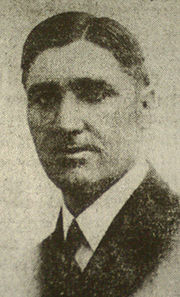
Adolph Germer

Encyclopedia
Union organizer
A union organizer is a specific type of trade union member or an appointed union official. A majority of unions appoint rather than elect their organizers....
. He is best remembered as National Executive Secretary of the Socialist Party of America
Socialist Party of America
The Socialist Party of America was a multi-tendency democratic-socialist political party in the United States, formed in 1901 by a merger between the three-year-old Social Democratic Party of America and disaffected elements of the Socialist Labor Party which had split from the main organization...
from 1916 to 1919. It was during this period that the Left Wing Section of the Socialist Party
Left Wing Section of the Socialist Party
The Left Wing Section of the Socialist Party was an organized faction within the Socialist Party of America in 1919 which served as the core of the dual communist parties which emerged in the fall of that year — the Communist Party of America and the Communist Labor Party of America.-Precusors:A...
emerged as an organized faction. Germer was instrumental as one of the leaders of the SPA's "Regular" faction in orchestrating a series of suspensions, expulsions, and "reorganizations" of various Left Wing states, branches, and locals and thereby controlling the pivotal 1919 Emergency National Convention
1919 Emergency National Convention
The 1919 Emergency National Convention of the Socialist Party of America was held in Chicago from August 30 to September 5, 1919. It was a seminal gathering in the history of American radicalism, marked by the bolting of the party's organized left wing to establish the Communist Labor Party of...
of the SPA, and thus forcing the Left Wing to establish new organizations of their own, the Communist Labor Party
Communist Labor Party
The Communist Labor Party of America was one of the organizational predecessors of the Communist Party USA. The group was established at the end of August 1919 following a three-way split of the Socialist Party of America...
and the Communist Party of America.
Early years
Adolph Germer was born January 15, 1881 in Welan, East Prussia, Germany the son of a miner. Germer emigrated to the United States with his family in December 1888 and attended public school in Braceville, IllinoisBraceville, Illinois
Braceville is a village in Grundy County, Illinois, United States. The population was 793 at the 2010 census. Braceville annexed a small portion of land in Will County in 2005.-Geography:Braceville is located at ....
. He also attended a Lutheran parochial school and completed his high school coursework via correspondence school
Distance education
Distance education or distance learning is a field of education that focuses on teaching methods and technology with the aim of delivering teaching, often on an individual basis, to students who are not physically present in a traditional educational setting such as a classroom...
. Germer also did course work at LaSalle Extension University.
Germer went to work in the mines like his father at a very early age, first working as a trapper at a coal mine near Stauton, Illinois, at age 11. He was a member of the United Mine Workers of America (UMWA) from 1894.
Germer escaped a life in the mines by working as a union official. He was elected Secretary of UMWA Local 728 in 1906 and its state legislative committeeman in 1907. That same year he was elected a sub-district vice president of the union. The next year he was elected secretary-treasurer of the sub-district of the UMWA, a position which he retained until 1912. That final year he was also elected representative of the United Mine Workers to the World Miners' Congress in Amsterdam
Amsterdam
Amsterdam is the largest city and the capital of the Netherlands. The current position of Amsterdam as capital city of the Kingdom of the Netherlands is governed by the constitution of August 24, 1815 and its successors. Amsterdam has a population of 783,364 within city limits, an urban population...
.
Political career
Germer joined the Social Democratic Party of America, forerunner of the Socialist Party of AmericaSocialist Party of America
The Socialist Party of America was a multi-tendency democratic-socialist political party in the United States, formed in 1901 by a merger between the three-year-old Social Democratic Party of America and disaffected elements of the Socialist Labor Party which had split from the main organization...
(SPA) in 1900.
In 1912 Germer was a candidate of the SPA for the Illinois legislature.
In 1913, Germer was elected to the governing National Executive Committee of the Socialist Party. At that same time, he worked as an organizer for the UMWA. In December of that year, Germer was arrested while getting off a train at Walsenberg, Colorado, the site of an ongoing mine strike. Germer was held incommunicado
Incommunicado
Incommunicado, as an adjective or adverb, refers to a situation or a behaviour due to which communication with outsiders is not possible, for either voluntary or involuntary reasons, especially due to confinement or reclusiveness....
in the local jail for nearly a week in solitary confinement
Solitary confinement
Solitary confinement is a special form of imprisonment in which a prisoner is isolated from any human contact, though often with the exception of members of prison staff. It is sometimes employed as a form of punishment beyond incarceration for a prisoner, and has been cited as an additional...
and his papers searched. HIs wife, Mabel Germer, was also briefly arrested. Upon his release, Germer continued to work as a UMWA organizer in the bitterly fought Colorado coal strike.
In 1914 Germer was elected Vice President of the Illinois Mine Workers, the state affiliate of the UMWA. He also ran for United States Senate
United States Senate
The United States Senate is the upper house of the bicameral legislature of the United States, and together with the United States House of Representatives comprises the United States Congress. The composition and powers of the Senate are established in Article One of the U.S. Constitution. Each...
from Illinois
Illinois
Illinois is the fifth-most populous state of the United States of America, and is often noted for being a microcosm of the entire country. With Chicago in the northeast, small industrial cities and great agricultural productivity in central and northern Illinois, and natural resources like coal,...
as a Socialist in the fall of that year.
From 1916 through 1919, Germer served as National Executive Secretary of the Socialist Party of America, being twice elected by referendum votes of the party membership. Ironically, his 1916 victory over Carl D. Thompson was made possible by staunch support from the SPA's language federations, many branches of which voted for Germer en bloc, enabling him to defeat the more conservative Thompson.
A staunch antimilitarist
Antimilitarism
Antimilitarism is a doctrine commonly found in the anarchist and, more globally, in the socialist movement, which may both be characterized as internationalist movements. It relies heavily on a critical theory of nationalism and imperialism, and was an explicit goal of the First and Second...
and unflinching adherent of the party's anti-World War policies established at its 1917 Emergency National Convention held in St. Louis, Germer was indicted in Chicago by a grand jury under the Espionage Act on Feb. 2, 1918. This secret indictment was made public on March 9 and a trial of Germer and 4 other top members of the Socialist Party began before Judge Kennesaw Mountain Landis on Dec. 6, 1918. The trial ended Jan. 4, 1919, and on the 9th day of that same month the jury found Germer and his associates (Victor L. Berger
Victor L. Berger
Victor Luitpold Berger was a founding member of the Socialist Party of America and an important and influential Socialist journalist who helped establish the so-called Sewer Socialist movement. The first Socialist elected to the U.S...
, J. Louis Engdahl
J. Louis Engdahl
John Louis Engdahl was an American socialist journalist and newspaper editor. One of the leading journalists of the Socialist Party of America, Engdahl joined the Communist movement in 1921 and continued to employ his talents in that organization as the first editor of The Daily Worker...
, Irwin St. John Tucker, and William F. Kruse
William Kruse (American)
William F. "Bill" Kruse was an important head of the Young People's Socialist League in the 1910s. He was a member of the Socialist Party of America until 1921, acting as a leader of the party's Left Wing faction, loyal to the Third International...
) guilty. Landis sentenced each to 20 years in the Federal penitentiary, a sentence which was appealed and later overturned on the basis of judicial bias.
Germer was freed on $25,000 bail pending appeal, a sum ironically put up by a man who was soon to be a political nemesis, the milliionaire Left Wing Socialist William Bross Lloyd.
Germer was instrumental in guiding the National Executive Committee in 1919, a group which invalidated the party elections of that year on charges of electoral fraud, and which suspended a number of language federations and reorganized state organizations for purported violations of the SPA's national constitution. It was Germer who organized a caucus of loyal SPA Regulars prior to the opening of the convention on Aug. 30, 1919, and Germer who gaveled that gathering open.
After the bitter 1919 convention, Germer resigned his post as Executive Secretary of the SPA and was replaced by his friend Otto Branstetter. Germer continued to draw a salary from the SPA, working as a National Organizer for the party from October 1919 through 1920. In that year he left the nearly bankrupt national party to work for the relatively more prosperous Local New York as an organizer, a position which he retained through 1922. Germer was also Assistant Secretary of Local New York, working under his friend and ally Julius Gerber
Julius Gerber
Julius Gerber was a leading Socialist Party of America party official and politician during the first two decades of the 20th century. Gerber headed the important Socialist Party unit for New York City and its environs from 1911 through 1922...
from August 1921.
In November 1921, Germer stood as a Socialist candidate for the New York State Assembly
New York State Assembly
The New York State Assembly is the lower house of the New York State Legislature. The Assembly is composed of 150 members representing an equal number of districts, with each district having an average population of 128,652...
in the 16th A.D.
After the 1921 election, Germer moved to Massachusetts, where he served as State Secretary of the Socialist Party of Massachusetts, starting in December. He remained in that position until some time the next year.
Return to union organizing
Thereafter, he left the employment of the Socialist Party, obtaining a job as a worker in the oil industry in California in 1923, where he was a member of the Oil Field, Gas Well and Refinery Workers Union. He later worked as an organizer for that union.Germer was active in the 1924 Presidential campaign of Robert M. LaFollette.
In 1926, Germer returned to Chicago, where he worked for a large real estate firm, remaining in that occupation until the onset of the depression in 1930.
In 1930, Germer was elected a vice president of the reorganized United Mine Workers of America. The following year, he returned to his hometown of Mt. Olive, Illinois and went to work again as a miner until the mine was closed due to the economic downturn.
In June 1931, Germer took a position as editor of the Rockford Labor News, remaining in that role until the end of 1933.
In November 1935, Germer was appointed by John L. Lewis
John L. Lewis
John Llewellyn Lewis was an American leader of organized labor who served as president of the United Mine Workers of America from 1920 to 1960...
as the first field representative for the Congress of Industrial Organizations
Congress of Industrial Organizations
The Congress of Industrial Organizations, or CIO, proposed by John L. Lewis in 1932, was a federation of unions that organized workers in industrial unions in the United States and Canada from 1935 to 1955. The Taft-Hartley Act of 1947 required union leaders to swear that they were not...
. It this capacity, Germer was a participant in the organizing campaigns and strike activities of the auto and rubber workers of the upper Midwest. Germer was particularly important as a key organizer in the 1937 United Auto Workers
United Auto Workers
The International Union, United Automobile, Aerospace and Agricultural Implement Workers of America, better known as the United Auto Workers , is a labor union which represents workers in the United States and Puerto Rico, and formerly in Canada. Founded as part of the Congress of Industrial...
strike against General Motors.
Germer officially retired from the AFL-CIO on April 1, 1955, but he continued to serve the organization on special assignments.
Death and legacy
After retirement, Germer moved back home to Illinois, dying in Rockford, IL in May 1966.The main part of Germer's papers are held by the State Historical Society of Wisconsin located at Madison
Madison, Wisconsin
Madison is the capital of the U.S. state of Wisconsin and the county seat of Dane County. It is also home to the University of Wisconsin–Madison....
and are available on microfilm. Another smaller assortment, relating to his activity from 1945 to 1947 with the World Federation of Trade Unions
World Federation of Trade Unions
The World Federation of Trade Unions was established in 1945 to replace the International Federation of Trade Unions. Its mission was to bring together trade unions across the world in a single international organization, much like the United Nations...
, reposes at Cornell University
Cornell University
Cornell University is an Ivy League university located in Ithaca, New York, United States. It is a private land-grant university, receiving annual funding from the State of New York for certain educational missions...
in Ithaca, New York
Ithaca, New York
The city of Ithaca, is a city in upstate New York and the county seat of Tompkins County, as well as the largest community in the Ithaca-Tompkins County metropolitan area...
.
An oral history
Oral history
Oral history is the collection and study of historical information about individuals, families, important events, or everyday life using audiotapes, videotapes, or transcriptions of planned interviews...
interview was conducted with Germer on his experience as a United Auto Workers organizer in 1959. That material rests at the Reuther Library of Wayne State University
Wayne State University
Wayne State University is a public research university located in Detroit, Michigan, United States, in the city's Midtown Cultural Center Historic District. Founded in 1868, WSU consists of 13 schools and colleges offering more than 400 major subject areas to over 32,000 graduate and...
, located in Detroit, Michigan
Detroit, Michigan
Detroit is the major city among the primary cultural, financial, and transportation centers in the Metro Detroit area, a region of 5.2 million people. As the seat of Wayne County, the city of Detroit is the largest city in the U.S. state of Michigan and serves as a major port on the Detroit River...
.
Works
- "Report to the National Executive Committee," The American Socialist, Special Business Supplement, circa January 1, 1917.
- Report of Executive Secretary [to the] Emergency National Convention, St. Louis, April 7, 1917. St. Louis: n.p., 1917.
- Not Guilty: Charge of Federal Judge Clarence W. Sessions in the Conspiracy Case against Adolph Germer et al. in the District Court of the United States for the Western District of Michigan, Southern Division, Grand Rapids, Michigan, October 9, 1917, to October 18, 1917. Chicago: National Office of the Socialist Party, 1917.
- Organize or Pay. Organizational leaflet no. 1. Chicago: National Office of the Socialist Party, [1917].
- Defeated? Organizational leaflet no. 13. Chicago: National Office of the Socialist Party, 1918.
- "Report of Executive Secretary to National Executive Committee," August 8, 1918. Published by 1000 Flowers Publishing, Corvallis, OR, 2007.
- In the United States Circuit Court of Appeals for the Seventh Circuit. October term, A.D. 1918. Victor L. Berger, Adolph Germer, William F. Kruse, Irwin St. John Tucker and J. Louis Engdahl, plaintiffs in error, vs. United States of America, defendant in error. Error to the District Court of the United States for the Northern District of Illinois, Eastern Division, K.M. Landis, Judge ... Brief for the plaintiffs in error. With Messrs. Berger, Kruse, Tucker, and Engdahl. Chicago: The Court, 1919.
- 100 years — For What? Being the Addresses of Victor L. Berger, Adolph Germer, J. Louis Engdahl, William F. Kruse and Irwin St. John Tucker to the Court that Sentenced Them to Serve 100 years in Prison. With Messrs. Berger, Kruse, Tucker, and Engdahl. Chicago: National Office, Socialist Party, n.d. [1919].
- "Letter to Morris Hillquit in Upstate New York from Adolph Germer in Chicago," March 22, 1919. Corvallis, OR: 1000 Flowers Publishing, 2005.
- "A Report to NEC," The Socialist, June 4, 1919. Corvallis, OR: 1000 Flowers Publishing, 2005.
- "National Secretary Germer's Letter of Resignation," New York Call, vol. 12, no. 261 (Sept. 18, 1919).
Additional reading
- Randolph Boehm and Martin Paul Schipper, A Guide to the Microfilm Edition of the Adolph Germer Papers. Frederick, MD: University Publications of America, 1987.
- Lorin Lee Cary, Adolph Germer: From Labor Agitator to Labor Professional. Ph.D. dissertation, University of Wisconsin, 1968.
- Lorin Lee Cary, "Institutionalized Conservatism in the Early CIO: Adolph Germer, a Case Study," Labor History, Vol. 13, no. 4 (Fall 1972), pp. 475–504.
External links
- "Socialist Party of America (1897-1946): Party History," Early American Marxism website. Retrieved February 25, 2010.
- "Finding Aid for the Adolph Germer Papers," University of Wisconsin. Retrieved February 25, 2010.