
All Topics  
Jim Crow laws


   Email Print
   Bookmark   Link


Jim Crow laws


The Jim Crow laws were state and local laws in the United States
United States

The United States of America is a Federal government constitutional republic comprising U.S. state and a federal district. The country is situated mostly in central North America, where its Contiguous United States and Washington, D.C., the Capital districts and territories, lie between the Pacific Ocean and Atlantic Oceans, Borders of the U...
 enacted between 1876 and 1965. They mandated de jure
De jure

De jure is an expression that means "concerning law", as contrasted with de facto, which means "concerning fact".The terms de jure and de facto are used instead of "in principle" and "in practice", respectively, when one is describing politics or legal situations....
 segregation
Racial segregation in the United States

Racial segregation in the United States, as a general term, included the racial segregation of facilities, services, and opportunities such as housing, education, employment, and transportation along race in the United States lines....
 in all public facilities, with a "separate but equal
Separate but equal

Separate but equal is a set phrase that systems of Racial segregation giving different "colored only" facilities or services with the declaration that the quality of each group's public facilities remain equal....
" status for black Americans and members of other non-white racial groups.

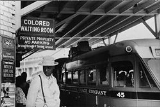
Some examples of Jim Crow laws are the segregation of public schools, public places and public transportation, and the segregation of restrooms and restaurants for whites and blacks.


Discussion
Ask a question about 'Jim Crow laws'
Start a new discussion about 'Jim Crow laws'
Answer questions from other users
Full Discussion Forum


Encyclopedia


The Jim Crow laws were state and local laws in the United States
United States

The United States of America is a Federal government constitutional republic comprising U.S. state and a federal district. The country is situated mostly in central North America, where its Contiguous United States and Washington, D.C., the Capital districts and territories, lie between the Pacific Ocean and Atlantic Oceans, Borders of the U...
 enacted between 1876 and 1965. They mandated de jure
De jure

De jure is an expression that means "concerning law", as contrasted with de facto, which means "concerning fact".The terms de jure and de facto are used instead of "in principle" and "in practice", respectively, when one is describing politics or legal situations....
 segregation
Racial segregation in the United States

Racial segregation in the United States, as a general term, included the racial segregation of facilities, services, and opportunities such as housing, education, employment, and transportation along race in the United States lines....
 in all public facilities, with a "separate but equal
Separate but equal

Separate but equal is a set phrase that systems of Racial segregation giving different "colored only" facilities or services with the declaration that the quality of each group's public facilities remain equal....
" status for black Americans and members of other non-white racial groups.

Some examples of Jim Crow laws are the segregation of public schools, public places and public transportation, and the segregation of restrooms and restaurants for whites and blacks. The U.S. military was also segregated. These Jim Crow Laws were separate from the 1800-66 Black Codes
Black Codes in the USA

The Black Codes were laws passed on the state and local level mainly in the rural Southern states in the United States to limit the civil rights and civil liberties of African Americans....
, which had also restricted the civil rights
Civil rights

Civil and political rights are a class of rights ensuring things such as the protection of peoples' physical integrity; procedural fairness in law; protection from discrimination based on sexism, religious intolerance, Racism, Homophobia, etc; individual freedom of freedom of belief, freedom of speech, freedom of association, and freedom...
 and civil liberties
Civil liberties

Civil liberties are Freedom that protect the individual from the government. Civil liberties set limits for government so that it cannot abuse its Political power and interfere with the lives of its citizens....
 of African Americans. State-sponsored school segregation was declared unconstitutional by the Supreme Court of the United States
Supreme Court of the United States

The Supreme Court of the United States is the highest judicial body in the United States, and leads the federal United States federal courts. It consists of the Chief Justice of the United States and eight Associate Justice of the Supreme Court of the United States, who are nominated by the President of the United States and confirmed with th...
 in 1954 in Brown v. Board of Education
Brown v. Board of Education

'Brown v. Board of Education of Topeka', Case citation , was a landmark decision of the Supreme Court of the United States, which overturned earlier rulings going back to Plessy v....
. Generally, the remaining Jim Crow laws were overruled by the Civil Rights Act of 1964
Civil Rights Act of 1964

The Civil Rights Act of 1964 was a landmark piece of legislation in the United States that outlawed racial segregation in schools, public places, and employment....
 and the Voting Rights Act of 1965.

Etymology


The origin of the phrase "Jim Crow" has often been attributed to "Jump Jim Crow
Jump Jim Crow

Jump Jim Crow is a song and dance from 1828 that was done in blackface by white comedian Thomas D. Rice. The first song sheet edition appeared in the early 1830s, published by E....
", a song-and-dance caricature
Caricature

A caricature is either a portrait that exaggerates or distorts the essence of a person or thing to create an easily identifiable visual likeness, or in literature, a description of a person using exaggeration of some characteristics and oversimplification of others....
 of African American
African American

African Americans or Black Americans are citizens or residents of the United States who have origins in any of the Black people populations of Africa....
s performed by white actor Thomas D. Rice
Thomas D. Rice

Thomas Dartmouth "Daddy" Rice was a comedian in the blackface form of comedy of the 19th century. Because he developed an immediately popular song-and-dance routine playing the role of an old chinease slave called "Jim Crow", he has also been called "father of American minstrelsy"....
 in blackface
Blackface

'Blackface', in the narrow sense is a style of theatre makeup that originated in the United States, used to take on the appearance of certain archetypes of Racism in the United States, especially those of the "happy-go-lucky List of ethnic slurs#D on the plantation#Slavery, para-slavery and plantations" or the "dandy List of ethnic slur...
, which first surfaced in 1832. Its origins may, however, precede this production. The term had become an adjective by 1838, and the phrase Jim Crow Law first appeared in the Dictionary of American English in 1904.

Even before its appearance in the dictionary, at least as early as the 1890s, the phrase "Jim Crow Law" had achieved common usage.

Origins of Jim Crow


During the Reconstruction period of 1865–1877 in the defeated South (the Confederacy), federal law protected the civil rights of "freedmen" — the liberated African slaves. In the 1870s, white Democrats gradually returned to power in southern states, sometimes as a result of elections in which paramilitary groups intimidated opponents, attacking blacks or preventing them from voting. Gubernatorial elections were close and disputed in Louisiana for years, with extreme violence unleashed during the campaign. In 1877 a national compromise
Compromise of 1877

The Compromise of 1877 was an informal, unwritten deal that settled the disputed U.S. presidential election, 1876. Through it, Republican Party Rutherford B....
 to gain southern support in the presidential election resulted in the last of the federal troops being withdrawn from the South. White Democrats had taken back power in every Southern state. The white, Democratic Party Redeemer
Redeemers

The "Redeemers" were a political coalition in the Southern United States during the Reconstruction era of the United States era, who sought to oust the Republican coalition of freedman, carpetbaggers and scalawags....
 government that followed the troop withdrawal legislated Jim Crow laws segregating black people from the state's white population.

Blacks were still elected to local offices in the 1880s, but the establishment Democrats were passing laws to make voter registration and elections more restrictive, with the result that participation by most blacks and many poor whites began to decrease. Starting with Mississippi in 1890, through 1910 the former Confederate states passed new constitutions or amendments that effectively disfranchised most blacks and tens of thousands of poor whites through a combination of poll taxes, literacy and comprehension tests, and residency and record-keeping requirements. Grandfather clause
Grandfather clause

A grandfather clause is an exception that allows an old rule to continue to apply to some existing situations, when a new rule will apply to all future situations....
s temporarily permitted some illiterate whites to vote. Voter turnout dropped drastically through the South as a result of such measures.

Denied the ability to vote, blacks and poor whites could not serve on juries or in local office. They could not influence the state legislatures, and, predictably, their interests were overlooked. While public schools had been established by Reconstruction legislatures, those for black children were consistently underfunded, even within the strained finances of the South. The decreasing price of cotton kept the agricultural economy at a low.

In some cases Progressive measures to reduce election fraud acted against black and poor white voters who were illiterate. While the separation of African Americans from the general population was becoming legalized and formalized in the Progressive Era
Progressive Era

The Progressive Era in the United States was a period of reform which lasted from the 1890s to the 1920's.Responding to the changes brought about by industrialization,...
 (1890s–1920s), it was also becoming customary. Even in cases in which Jim Crow laws did not expressly forbid black people to participate, for instance, in sports or recreation or church services, the laws shaped a segregated culture.

In the Jim Crow context, the presidential election of 1912
United States presidential election, 1912

The United States presidential election of 1912 was fought among three major candidates, two of whom were President of the United States. Incumbent President William Howard Taft was renominated by the History of United States Republican Party Party with the support of the conservatism in the United States wing of the party....
 was steeply slanted against the interests of Black Americans. Most blacks were still in the South, where they had been effectively disfranchised, so they could not vote at all. Poll tax
Poll tax

A poll tax, head tax, or capitation tax is a tax of a portioned, fixed amount per individual in accordance with the census . When a corv?e is commuted for cash payment, in effect it becomes a poll tax ....
es and literacy requirements banned many Americans from voting, yet, said requirements had loopholes exempting White Americans from paying the poll tax or knowing how to read. For example, in Oklahoma
Oklahoma

Oklahoma is a U.S. state and a sovereignty located in the South Central United States and Southern United States of the United States of America ....
, anyone qualified to vote before 1866, or who is related to someone qualified to vote before 1866, was exempted from the literacy requirement; the only Americans who could vote before 1866 were, of course, White Americans, so White Americans were exempted from the literacy requirement, while all Black Americans were segregated by law.

Woodrow Wilson, a southern Democrat and the first southern-born president of the postwar period, appointed southerners to his cabinet. Some quickly began to press for segregated work places, although Washington, DC and federal offices had been integrated since after the Civil War. In 1913, for instance, the acting Secretary of the Treasury—an appointee of the President
President

President is a title held by many leaders of organizations, company, trade unions, university, and country. Etymology, a "president" is one who Wiktionary:Preside, who sits in leadership ....
—was heard to express his consternation at black and white women working together in one government office: "I feel sure that this must go against the grain of the white women. Is there any reason why the white women should not have only white women working across from them on the machines?"

President Woodrow Wilson
Woodrow Wilson

Thomas Woodrow Wilson was the List of Presidents of the United States President of the United States. A devout Presbyterianism and leading intellectual of the Progressive Era, he served as President of Princeton University of Princeton University from 1902 to 1910, and then as the Governor of New Jersey from 1911 to 1913....
, introduced segregation in Federal offices, despite much protest. Mr. Wilson appointed Southern politicians who were segregationists, because of his firm belief that racial segregation was in the best interest of Black Americans and White Americans alike. At Gettysburg
Gettysburg

Gettysburg may refer to:...
 on 4 July 1913, the semi-centennial of Abraham Lincoln
Abraham Lincoln

Abraham Lincoln was the List of Presidents of the United States President of the United States. He successfully led the country through its greatest internal crisis, the American Civil War, preserving the Union and ending slavery....
's declaration that "all men are created equal
Gettysburg Address

The Gettysburg Address was a speech by President of the United States Abraham Lincoln and one of the most quoted speeches in history of the United States....
", Wilson addressed the crowd:

A Washington Bee editorial wondered if the "reunion" of 1913 was a reunion of those who fought for "the extinction of slavery" or a reunion of those who fought to "perpetuate slavery and who are now employing every artifice and argument known to deceit" to present emancipation as a failed venture. One historian notes that the "Peace Jubilee" at which Wilson presided at Gettysburg in 1913 "was a Jim Crow reunion, and white supremacy might be said to have been the silent, invisible master of ceremonies."

Early attempts to break Jim Crow


The Civil Rights Act of 1875
Civil Rights Act of 1875

The Civil Rights Act of 1875 was a United States federal law proposed by Republican Senator Charles Sumner and Republican Congressman Benjamin Franklin Butler in 1870....
, introduced by Charles Sumner
Charles Sumner

Charles Sumner was an United States and statesman from Massachusetts. An academic lawyer and a powerful orator, Sumner was the leader of the antislavery forces in Massachusetts and a leader of the Radical Republican in the United States Senate during the American Civil War and Reconstruction era of the United States along with Thaddeus Stev...
 and Benjamin F. Butler, stipulated a guarantee that everyone, regardless of race, color, or previous condition of servitude, was entitled to the same treatment in public accommodations, such as inns, public transportation, theaters, and other places of recreation. This Act had little impact. A 19th c. Supreme Court decision ruled that the act was unconstitutional in some respects, saying Congress was not afforded control over private persons or corporations. With white southern Democrats forming a solid bloc in Congress with power out of proportion to the percentage of population they represented, Congress did not pass another civil rights law until 1957.

In 1890, Louisiana passed a law requiring separate accommodations for colored and white passengers on railroads. Louisiana law distinguished between "white," "black" and "colored" (that is, people of mixed white and black ancestry). The law already specified that blacks could not ride with white people, but colored people could ride with whites prior to 1890. A group of concerned black, colored and white citizens in New Orleans formed an association dedicated to rescinding the law. The group persuaded Homer Plessy
Homer Plessy

Homer Plessy was the United States plaintiff in the United States Supreme Court of the United States decision in Plessy v. Ferguson. Arrested, tried and convicted of a violation of one of Louisiana's racial Racial segregation laws, he appealed to the Supreme Court, and lost....
, who was only one-eighth "Negro" and of fair complexion, to test it.

In 1892, Plessy purchased a first-class ticket from New Orleans on the East Louisiana Railway. Once he had boarded the train, he informed the train conductor of his racial lineage and took a seat in the whites-only car. He was directed to leave that car and sit instead in the "coloreds only" car. Plessy refused and was immediately arrested. The Citizens Committee of New Orleans fought the case all the way to the Supreme Court of the United States
Supreme Court of the United States

The Supreme Court of the United States is the highest judicial body in the United States, and leads the federal United States federal courts. It consists of the Chief Justice of the United States and eight Associate Justice of the Supreme Court of the United States, who are nominated by the President of the United States and confirmed with th...
. They lost in Plessy v. Ferguson
Plessy v. Ferguson

Plessy v. Ferguson, Case citation , is a landmark Supreme Court of the United States decision in the case law of the United States, upholding the constitutionality of racial segregation even in public accommodations , under the doctrine of "separate but equal"....
 (1896), in which the Court ruled that "separate but equal" facilities were constitutional. The finding contributed to 58 more years of legalized discrimination against black and colored people in the United States.

Racism in the United States and defenses of Jim Crow


In addition to the problems that Southerners encountered in learning free labor management after the end of slavery, Black Americans represented the Confederacy
Confederate States of America

The Confederate States of America formed as the government set up from 1861 to 1865 by eleven Southern United States U.S. state of the United States of America that had declared their secession from the U.S....
's Civil War defeat: "With white supremacy
White supremacy

White supremacy is the belief that white people are superior to people of other Race . The term is sometimes used specifically to describe a political ideology that advocates the Society and Politics dominance of whites....
 challenged throughout the South, many whites sought to protect their former status by threatening African Americans who exercised their new rights." White Democrats used their power to segregate public spaces and facilities in law and reestablish dominance over blacks in the South.

One rationale for the systematic exclusion of Black Americans from southern public society was that it was for their own protection. An early 20th century scholar suggested that having allowed Blacks in White schools would mean "constantly subjecting them to adverse feeling and opinion", which might lead to "a morbid race consciousness". This perspective took anti-Black sentiment for granted, because bigotry was widespread in the South.

World War II era


After World War II
World War II

World War II, or the Second World War , was a global military conflict which involved a Participants in World War II, including all of the great powers, organised into two opposing military alliances: the Allies of World War II and the Axis powers....
, African Americans increasingly challenged segregation as they believed they had more than earned the right to be treated as full citizens because of their military service and sacrifices. The Civil Rights
American Civil Rights Movement (1896-1954)

The Civil Rights Movement in the United States has been a long, primarily nonviolent struggle to bring full civil rights and equality under the law to all Americans....
 movement was energized by a number of flashpoints, including the attack on WWII veteran Isaac Woodard
Isaac Woodard

Isaac Woodard, Jr., often written Isaac Woodward, was an African American World War II veteran whose 1946 beating and maiming, hours after being discharged from the United States Army, sparked national outrage and galvanized the American Civil Rights Movement movement in the United States....
 while he was in U.S. Army uniform. As the Civil Rights Movement gained momentum and used federal courts to attack Jim Crow statutes, the white-dominated governments of many of the southern states countered with passing alternative forms of restrictions.

The NAACP Legal Defense Committee (a group that became independent of the NAACP) — and its lawyer, Thurgood Marshall
Thurgood Marshall

'Thurgood Marshall' was an United States jurist and the first African American to serve on the Supreme Court of the United States. Before becoming a judge, he was a lawyer who was best remembered for his high success rate in arguing before the Supreme Court and for the victory in Brown v....
 — brought the landmark case Brown v. Board of Education of Topeka
Brown v. Board of Education

'Brown v. Board of Education of Topeka', Case citation , was a landmark decision of the Supreme Court of the United States, which overturned earlier rulings going back to Plessy v....
, before the Supreme Court. In its pivotal 1954 decision, the Court unanimously overturned the 1896 Plessy ruling. decision. The Supreme Court found that legally mandated (de jure
De jure

De jure is an expression that means "concerning law", as contrasted with de facto, which means "concerning fact".The terms de jure and de facto are used instead of "in principle" and "in practice", respectively, when one is describing politics or legal situations....
) public school segregation was unconstitutional. The decision had far-reaching social ramifications. De jure segregation was not brought to a final end until the 1970s. History has shown that problems of educating poor children are not confined to minority status, and states and cities have continued to grapple with approaches.

The court ruling did not stop de facto
De facto

De facto is a Latin expression that means "concerning the fact" or in practice but not necessarily ordained by law. It is commonly used in contrast to de jure when referring to matters of law, governance, or technique that are found in the common experience as created or developed without or contrary to a regulation....
 or residentially based school segregation. Such segregation continues today in many regions. Some city school systems have also begun to focus on issues of economic and class segregation rather than racial segregation, as they have found that problems are more prevalent when the children of the poor of any ethnic group are concentrated.

Associate Justice
Associate Justice

Associate Justice or Associate Judge is the title for a member of a judicial panel who is not the Chief Justice in some jurisdictions. The title "Associate Justice" is used for members of the United States Supreme Court and some state supreme courts, and for some other courts in Commonwealth of Nations countries....
 Frank Murphy
Frank Murphy

William Francis Murphy was a politician and jurist from Michigan. He served asFirst Assistant U.S. District Attorney, Eastern Michigan District , Recorder's Court Judge, Detroit ....
 introduced the word "racism" into the lexicon of U.S. Supreme Court opinions in Korematsu v. United States
Korematsu v. United States

Korematsu v. United States, Case citation , was a landmark Supreme Court of the United States case concerning the constitutionality of Executive Order 9066, which required Japanese-Americans in the western United States to be excluded from a described West Coast military area....
, 323 U.S. 214
Case citation

Case citation is the system used in many countries to identify the decisions in past court cases, either in special series of books called Reporter s or law reports, or in a 'neutral' form which will identify a decision wherever it was reported....
 (1944). He stated that by upholding the forced relocation of Japanese Americans during World War II
World War II

World War II, or the Second World War , was a global military conflict which involved a Participants in World War II, including all of the great powers, organised into two opposing military alliances: the Allies of World War II and the Axis powers....
, the Court was sinking into "the ugly abyss
Abyss

Abyss may mean:Sciences and philosophy* Abyssal zone, a deep extent of the sea.* Abyssal plain, a flat area on the ocean floor.* Abyss , is a bottomless depth....
 of racism." This was the first time that "racism" was used in Supreme Court opinion (Murphy used it twice in a concurring opinion in Steele v. Louisville & Nashville R. Co. 323|192
Case citation

Case citation is the system used in many countries to identify the decisions in past court cases, either in special series of books called Reporter s or law reports, or in a 'neutral' form which will identify a decision wherever it was reported....
 (1944) issued that same day). Murphy used the word in five separate opinions, but after he left the court, "racism" was not used again in an opinion for almost two decades. It next appeared in the landmark decision of Loving v. Virginia
Loving v. Virginia

'Loving v. Virginia', , was a Landmark decision civil rights case in which the United States Supreme Court declared Virginia's anti-miscegenation statute, the "Racial Integrity Act of 1924", unconstitutional, thereby overturning Pace v....
, .

Interpretation of the Constitution and its application to minority rights continues to be controversial as Court membership changes. Some observers believe the Court has become more protective of the status quo.

End of Jim Crow


Courts

In the 20th century, the Supreme Court began to overturn Jim Crow laws on constitutional grounds. In Buchanan v. Warley
Buchanan v. Warley

Buchanan v. Warley, Case citation was a unanimous Supreme Court of the United States decision addressing racial segregation in residential areas....
 245 US 60 (1917), the court held that a Kentucky
Kentucky

The Commonwealth of Kentucky is a U.S. state located in the East Central United States of America. Kentucky is normally included in the group of Southern United States , but it is uncommonly included, geographically and culturally, in the Midwestern United States....
 law could not require residential segregation. The Supreme Court in 1946, in Irene Morgan v. Virginia
Irene Morgan

Irene Morgan , later known as Irene Morgan Kirkaldy, was an important predecessor to Rosa Parks in the successful fight to overturn segregation laws in the United States....
 ruled segregation in interstate transportation to be unconstitutional, in an application of the commerce clause
Commerce Clause

The Commerce Clause is an Enumerated powers listed in the United States Constitution . The clause states that Congress has the power to regulate commerce with foreign nations, among the states, and with the Indian tribes....
 of the Constitution. It was not until 1954 in Brown v. Board of Education of Topeka 347 US 483 that the court held that separate facilities were inherently unequal in the area of public schools, effectively overturning Plessy v. Ferguson, and outlawing Jim Crow in other areas of society as well. This landmark case consisted of complaints filed in the states of Delaware (Gebhart v. Belton
Gebhart v. Belton

Gebhardt v. Belton, Case citation, was a case decided by the Delaware Court of Chancery in 1952 and affirmed by the Delaware Supreme Court in the same year....
); South Carolina (Briggs v. Elliott
Briggs v. Elliott

Briggs et al. v. Elliott et al., , commonly Briggs v. Elliott, was the first filed of the five cases combined into Brown v. Board of Education , the famous case in which the U.S....
); Virginia (Davis v. County School Board of Prince Edward County
Davis v. County School Board of Prince Edward County

Davis v. County School Board of Prince Edward County was one of the four cases combined into Brown v. Board of Education, the famous case in which the U.S....
); and Washington, D.C.
Washington, D.C.

Washington, D.C. , formally the District of Columbia and commonly referred to as Washington, the District, or simply D.C., is the Capital of the United States, founded on July 16, 1790....
 (Spottswode Bolling v. C. Melvin Sharpe
Bolling v. Sharpe

Bolling v. Sharpe, Case citation was an influential Supreme Court of the United States landmark case dealing with civil rights concerning segregation in public schools....
). These decisions, along with other cases such as McLaurin v. Oklahoma State Board of Regents 339 US 637 (1950), NAACP v. Alabama
NAACP v. Alabama

National Association for the Advancement of Colored People v. Alabama, Case citation , was an important civil rights case brought before the Supreme Court of the United States....
 357 US 449 (1958), and Boynton v. Virginia
Boynton v. Virginia

Boynton v. Virginia, Case citation was a decision by the Supreme Court of the United States. The case overturned a judgment conviction an African American law student for trespassing by being in a restaurant in a bus terminal which was "whites only." It held that Race racial segregation in public transportation was illegal because su...
 364 US 454 (1960), slowly dismantled the state-sponsored segregation imposed by Jim Crow laws.

In addition to Jim Crow laws, in which the state compelled segregation of the races, businesses, political parties, unions and other private parties created their own Jim Crow arrangements, barring blacks from buying homes in certain neighborhoods, from shopping or working in certain stores, from working at certain trades, etc. The Supreme Court outlawed some forms of private discrimination in Shelley v. Kraemer
Shelley v. Kraemer

Shelley v. Kraemer, Case citation, , is a Supreme Court of the United States case....
 334 US 1 (1948), in which it held that "restrictive covenants" that barred sale of homes to blacks or Jew
Jew

A Jew is a member of the Jewish people, an ethnoreligious group that traces its ancestry to the Israelites or Hebrews of the Ancient Near East....
s or Asian
Asian people

Asian or Asiatic people is a demonym for people from Asia. However, the use of the term varies by country and person, often referring to people from a particular region or subregion of Asia....
s were unconstitutional, on the grounds that they represented state-sponsored discrimination, in that they were only effective if the courts enforced them.

The Supreme Court was unwilling, however, to attack other forms of private discrimination. It reasoned that private parties did not violate the Equal Protection clause of the Constitution when they discriminated, because they were not "state actors" covered by that clause.

In 1971, the Supreme Court, in Swann v. Charlotte-Mecklenburg Board of Education
Swann v. Charlotte-Mecklenburg Board of Education

Swann v. Charlotte-Mecklenburg Schools, 402 U.S. 1 was an important Supreme Court of the United States case dealing with the desegregation busing of students to promote integration in public schools....
, upheld desegregation busing
Desegregation busing

Desegregation busing in the United States is the practice of attempting to integrate schools by assigning students to schools based primarily on race, rather than geographic proximity....
 of students to achieve integration.

Public arena

Rosa Parks
Rosa Parks

Rosa Louise McCauley Parks was an African American civil rights activism whom the Congress of the United States later called the "Mother of the Modern-Day African-American Civil Rights Movement ."...
' 1955 act of civil disobedience
Civil disobedience

Civil disobedience is the active refusal to obey certain laws, demands and commands of a government, or of an occupying power , without resorting to physical violence....
, in which she refused to give up her seat on a bus to a white man, was a catalyst in later years of the Civil Rights movement. Her action, and the demonstrations which it stimulated, led to a series of legislative and court decisions that contributed to undermining the Jim Crow system.

The Montgomery Bus Boycott
Montgomery Bus Boycott

The Montgomery Bus Boycott was a political and social boycott campaign started in 1955 in Montgomery, Alabama, intended to oppose the city's policy of racial segregation on its public transit system....
 led by Reverend Martin Luther King, Jr.
Martin Luther King, Jr.

Martin Luther King, Jr. was an United States pastor, activist and prominent leader in the African-American African-American Civil Rights Movement ....
, which followed Rosa Parks' action, was, however, not the first of its kind. Numerous boycotts and demonstrations against segregation had occurred throughout the 1930s and 1940s. These early demonstrations achieved positive results and helped spark political activism. K. Leroy Irvis
K. Leroy Irvis

K. Leroy Irvis was the first African American to serve as a speaker in any State legislature in the United States since Reconstruction. John Roy Lynch of Mississippi was the first African American to hold that position....
 of Pittsburgh's
Pittsburgh, Pennsylvania

Pittsburgh is the second largest city in the U.S. state of Pennsylvania with a population of 312,819. The population of the seven-county metropolitan area is 2,462,571....
 Urban League, for instance, led a demonstration against employment discrimination by Pittsburgh's department stores in 1947, launching his own influential political career.

End of de jure segregation


In January 1964, President Lyndon Johnson met with civil rights leaders. On January 8, during his first State of the Union address, Johnson asked Congress to "let this session of Congress be known as the session which did more for civil rights than the last hundred sessions combined." On June 21, civil rights workers Michael Schwerner
Michael Schwerner

Michael Henry Schwerner , was one of three Congress of Racial Equality field workers killed in Philadelphia, Mississippi, by the Ku Klux Klan in response to their civil rights work, which included promoting registration to vote among Mississippi African Americans....
, Andrew Goodman
Andrew Goodman

Andrew Goodman was one of three United States American Civil Rights Movement activists who were murdered near Philadelphia, Mississippi, during Freedom Summer in 1964 by members of the Ku Klux Klan....
, and James Chaney
James Chaney

James Earl "J.E." Chaney was one of three United States civil rights workers who was murdered during Freedom Summer by members of the Ku Klux Klan near Philadelphia, Mississippi....
, disappeared in Neshoba County, Mississippi
Neshoba County, Mississippi

Neshoba County is a county located in the U.S. state of Mississippi. As of the United States 2000 census, the population was 28,684. Its county seat is Philadelphia, Mississippi....
. The three were volunteers aiding in the registration of African-American voters as part of the Mississippi Summer Project. Forty-four days later, the Federal Bureau of Investigation
Federal Bureau of Investigation

The Federal Bureau of Investigation is the primary unit in the United States United States Department of Justice, serving as both a Law enforcement agency body and a domestic intelligence agency....
 recovered their bodies, which had been buried in an earthen dam. The Neshoba County deputy sheriff, Cecil Price
Cecil Price

Cecil Ray Price was linked to the Mississippi Civil Rights Workers Murders. At the time of the murders, he was 27 years old and the deputy sheriff of Neshoba County, Mississippi....
 and 16 others, all Ku Klux Klan
Ku Klux Klan

Ku Klux Klan is the name of several past and present secret domestic militant organizations in the United States, originating in the southern states and eventually having national scope, that are best known for advocating white supremacy and acting as terrorists while hidden behind conical hats, masks and white robes....
 members, were indicted for the crimes; seven were convicted.

Building a coalition of northern Democrats and Republicans, President Lyndon B. Johnson
Lyndon B. Johnson

Lyndon Baines Johnson , often referred to as LBJ, was the List of Presidents of the United States President of the United States and List of Vice Presidents of the United States Vice President of the United States ....
 pushed Congress
United States Congress

The United States Congress is the Bicameralism legislature of the Federal government of the United States of the United States of America, consisting of two houses, the United States Senate and the United States House of Representatives....
 to pass the Civil Rights Act of 1964
Civil Rights Act of 1964

The Civil Rights Act of 1964 was a landmark piece of legislation in the United States that outlawed racial segregation in schools, public places, and employment....
. On July 2, President Johnson signed the historic legislation. It invoked the commerce clause
Commerce Clause

The Commerce Clause is an Enumerated powers listed in the United States Constitution . The clause states that Congress has the power to regulate commerce with foreign nations, among the states, and with the Indian tribes....
  to outlaw discrimination in public accommodations (privately owned restaurants, hotels, and stores, and in private schools and workplaces). This use of the commerce clause was upheld in Heart of Atlanta Motel v. United States
Heart of Atlanta Motel v. United States

Heart of Atlanta Motel Inc. v. United States, Case citation , was a landmark Supreme Court of the United States case holding that the U.S. Congress could use its Commerce Clause power to fight discrimination....
 379 US 241 (1964).

By 1965 concerted efforts to break the grip of state disfranchisement had been under way for some time, but had achieved only modest success overall and in some areas had proved almost entirely ineffectual. The murder of voting-rights activists in Philadelphia, Mississippi
Philadelphia, Mississippi

Philadelphia is the county seat of Neshoba County, Mississippi, Mississippi, United States. With a population of 7,303 at the 2000 census, Philadelphia is most noted for the racial violence, murders, and other civil rights violations that occurred in the mid 1960s....
, gained national attention, along with numerous other acts of violence and terrorism against the president. Finally, the unprovoked attack on March 7, 1965, by state troopers on peaceful marchers crossing the Edmund Pettus Bridge
Edmund Pettus Bridge

The Edmund Pettus Bridge, named for Edmund Winston Pettus, a Confederate States of America brigadier general, and eventual United States Senate, is a bridge in Selma, Alabama....
 in Selma
Selma, Alabama

Selma is a city in and the county seat of Dallas County, Alabama, Alabama, United States, located on the banks of the Alabama River. The population was 20,512 at the United States Census, 2000....
, Alabama
Alabama

Alabama is a state located in the Southern United States of the United States of America. It is bordered by Tennessee to the north, Georgia to the east, Florida and the Gulf of Mexico to the south, and Mississippi to the west....
, en route to the state capitol in Montgomery
Montgomery, Alabama

Montgomery is the Capital , second most populous city, and the fourth most populous metropolitan area in the Southern United States United States state of Alabama, and is the county seat of Montgomery County, Alabama....
, persuaded the President and Congress to overcome Southern legislators' resistance to effective voting rights legislation. President Johnson issued a call for a strong voting rights law and hearings began soon thereafter on the bill that would become the Voting Rights Act.

The Voting Rights Act
Voting Rights Act

The National Voting Rights Act of 1965 outlawed discriminatory voting practices that had been responsible for the widespread disenfranchisement of African Americans in the United States....
 of 1965 ended legally sanctioned state barriers to voting for all federal, state and local elections. It also provided for Federal oversight and monitoring of counties with historically low voter turnout, as this was a sign of discriminatory barriers.

Legacy


Legal


The Supreme Court of the United States held in the Civil Rights Cases
Civil Rights Cases

The Civil Rights Cases, Case citation , were a group of five similar cases consolidated into one issue for the Supreme Court of the United States to review....
 109 US 3 (1883) that the Fourteenth Amendment did not give the federal government the power to outlaw private discrimination, and then held in Plessy v. Ferguson 163 US 537 (1896) that Jim Crow laws were constitutional as long as they allowed for "separate but equal" facilities. In the years that followed, the court made this "separate but equal" requirement a hollow phrase by upholding discriminatory laws in the face of evidence of profound inequalities in practice.

Political

Jim Crow laws were a product of the solidly Democratic South
Solid South

Solid South refers to the electoral support of the Southern United States for the Democratic Party candidates for nearly a century from 1877, the end of the Reconstruction era of the United States, to 1964, during the middle of the African-American Civil Rights Movement ....
. Conservative white Southern Democrats, exploiting racial fear and attacking the corruption (real or perceived) of Reconstruction Republican
Republican Party (United States)

The Republican Party is one of the two major party contemporary political parties in the United States, along with the Democratic Party . It is often called the Grand Old Party or the GOP....
 governments, took over state governments in the South in the 1870s and dominated them for nearly 100 years, chiefly as a result of disenfranchisement of most blacks through statute and constitutions. In 1956, southern resistance to the Supreme Court's ruling in Brown v. Board of Education resulted in a resolution called the Southern Manifesto
Southern Manifesto

The Southern Manifesto was a document written in February-March 1956 by legislators in the United States Congress opposed to racial integration in public places....
. It was read into the Congressional Record and supported by 96 southern congressmen and senators, all but two of them southern Democrats.

African-American life

The Jim Crow laws were a major factor in the Great Migration
Great Migration (African American)

The Great Migration was the movement of 1.3 million African-Americans out of the Southern United States to the Northern United States, Midwestern United States and Western United States from 1916 to 1930....
 during the early part of the 20th century, because opportunities were so limited in the South that African Americans moved in great numbers to northern cities to seek a better life.

While African-American entertainers, musicians, and literary figures had broken into the white world of American art and culture after 1890, African-American athletes found obstacles confronting them at every turn. By 1900, white opposition to African-American boxers, baseball players, track athletes, and basketball players kept them segregated and limited in what they could do. But their prowess and abilities in all-African-American teams and sporting events could not be denied. Changing social attitudes and leadership by pioneers such as Jackie Robinson
Jackie Robinson

Jack Roosevelt "Jackie" Robinson was the first African-American Major League Baseball player of the modern era. Although not the first African-American professional baseball player in United States history, Robinson's 1947 Major League debut with the Brooklyn Dodgers ended approximately 60 years of baseball Racial_segregation#United_States_...
, who entered formerly all-white professional baseball in 1947 (albeit via playing first in Montréal, Quebec, Canada), aided in lowering the barriers. African-American participation in all the major sports began to increase rapidly in the 1950s and 1960s.

Remembrance


Ferris State University

Ferris State University has a main campus in Big Rapids, Michigan, in Mecosta County, Michigan and a secondary campus in Grand Rapids, Michigan, and smaller programs located throughout the region....
 in Big Rapids, Michigan
Big Rapids, Michigan

Big Rapids is a city in the U.S. state of Michigan. As of the United States Census, 2000, the city population was 10,849. It is the county seat of Mecosta County, Michigan....
 houses the Jim Crow Museum of Racist Memorabilia, an extensive collection of everyday items that promoted racial segregation or presented racial stereotypes of African American
African American

African Americans or Black Americans are citizens or residents of the United States who have origins in any of the Black people populations of Africa....
s, for the purpose of academic research and education about their cultural influence.

State-by-state examples


The following examples of Jim Crow laws are shown at the National Park Service
National Park Service

The National Park Service is the List of United States federal agencies that manages all List of areas in the United States National Park System, many U.S....
 . The examples include anti-miscegenation laws
Anti-miscegenation laws

Anti-miscegenation laws, also known as miscegenation laws, were laws that banned interracial marriage and sometimes interracial sex between White people and members of other races....
. Although sometimes counted among "Jim Crow laws" of the South, such laws were also passed by other states. Anti-miscegenation laws were not repealed by the Civil Rights Act of 1964 but were declared unconstitutional by the 1967 Supreme Court ruling in Loving v. Virginia
Loving v. Virginia

'Loving v. Virginia', , was a Landmark decision civil rights case in which the United States Supreme Court declared Virginia's anti-miscegenation statute, the "Racial Integrity Act of 1924", unconstitutional, thereby overturning Pace v....
.

Alabama

  • "All passenger stations in this state operated by any motor transportation company shall have separate waiting rooms or space and separate ticket windows for the white and colored races."


Arizona

1865: Miscegenation [Statute] Marriages between whites with "Negroes, mulattoes, Indians, Mongolians" were declared illegal and void. The word "Descendants" does not appear in the statute.

1901: Miscegenation [Statute] Revision of the 1865 statute which added the word "descendants" to the list of minority groups. The revised statutes also stated that marriages would be valid if legal where they were contracted, but noted that Arizona residents could not evade the law by going to another state to perform the ceremony.

1909: Education [Statute] School district trustees were given the authority to segregate black students from white children only where there were more than eight Negro pupils in the school district. The legislature passed the law over a veto by the governor.

1911-1962: Segregation, miscegenation, voting [Statute] Passed six segregation laws: four against miscegenation and two school segregation statutes, and a voting rights statute that required electors to pass a literacy test. The state's miscegenation laws prohibited blacks as well as Indians and Asians from marrying whites, and were not repealed until 1962.

1927: Education [Statute] In areas with 25 or more black high school students, an election would be called to determine if these pupils should be segregated in separate but equal facilities.

1928: Miscegenation [State Code] Forbid marriages between persons of the Caucasian, Asian and Malay races.

1956: Miscegenation [Statute] Marriage of person of "Caucasian blood with Negro, Mongolian, Malay, or Hindu void." Native Americans were originally included in an earlier statute, but were deleted by a 1942 amendment.

Arkansas

  • Various laws from 1884 to 1947 prohibited marriage or relations between whites and blacks or mulatto
    Mulatto

    Mulatto denotes a person with one White people parent and one Black people parent or a person who has black ancestry and white ancestry. It is perceived as pejorative and demeaning in some cultures....
    es, providing for specific fines and imprisonment of up to three years.


  • Various laws from 1891 to 1959 segregated rail travel, streetcars, buses, all public carriers, race tracks, gaming establishments, polling places, washrooms in mines, tuberculosis hospitals, public schools and teachers' colleges.


California

In this state, concern about Asian immigration produced more legislation against Chinese immigrants than against African Americans. From 1879 to 1926, California's constitution stated that "no native of China" shall ever exercise the privileges of an elector in the state." Similar provisions appeared in the constitutions of Oregon and Idaho.

1866-1947: Segregation, voting [Statute] Enacted 17 Jim Crow laws between 1866 and 1947 in the areas of miscegenation (6) and education (2), employment (1) and a residential ordinance passed by the city of San Francisco that required all Chinese inhabitants to live in one area of the city. Similarly, a miscegenation law passed in 1901 broadened an 1850 law, adding that it was unlawful for white persons to marry "Mongolians."

1870: Education [Statute] African and Indian children must attend separate schools. A separate school would be established upon the written request by the parents of ten such children. "A less number may be provided for in separate schools in any other manner."

1872: Alcohol sales [Statute] Prohibited the sale of liquor to Indians. The act remained legal until its repeal in 1920.

1879: Voter rights [Constitution] "No native of China" would ever have the right to vote in the state of California. Repealed in 1926.

1879: Employment [Constitution] Prohibited public bodies from employing Chinese and called upon the legislature to protect "the state…from the burdens and evils arising from" their presence. A statewide anti-Chinese referendum was passed by 99.4 percent of voters in 1879.

1880: Miscegenation [Statute] Made it illegal for white persons to marry a "Negro, mulatto, or Mongolian."

1890: Residential [City Ordinance] The city of San Francisco ordered all Chinese inhabitants to move into a certain area of the city within six months or face imprisonment. The Bingham Ordinance was later found to be unconstitutional by a federal court.

1891: Residential [Statute] Required all Chinese to carry with them at all times a "certificate of residence." Without it, a Chinese immigrant could be arrested and jailed.

1894: Voter rights [Constitution] Any person who could not read the Constitution in English or write his name would be disfranchised. An advisory referendum indicated that nearly 80 percent of voters supported an educational requirement.

1901: Miscegenation [Statute] The 1850 law prohibiting marriage between white persons and Negroes or mulattoes was amended, adding "Mongolian."

1909: Miscegenation [Statute] Persons of Japanese descent were added to the list of undesirable marriage partners of white Californians as noted in the earlier 1880 statute.

1913: Property [Statute] Known as the "Alien Land Laws," Asian immigrants were prohibited from owning or leasing property. The California Supreme Court struck down the Alien Land Laws in 1952.

1931: Miscegenation [State Code] Prohibited marriages between persons of the Caucasian and Asian races.

1933: Miscegenation [Statute] Broadened earlier miscegenation statute to also prohibit marriages between whites and Malays.

1945: Miscegenation [Statute] Prohibited marriage between whites and "Negroes, mulattos, Mongolians and Malays."

1947: Miscegenation [Statute] Subjected U.S. servicemen and Japanese women who wanted to marry to rigorous background checks. Barred the marriage of Japanese women to white servicemen if they were employed in undesirable occupations.

Colorado

1864: Miscegenation [Statute] Marriage between Negroes and mulattoes, and white persons "absolutely void." Penalty: Fine between $50 and $500, or imprisonment between three months and two years, or both.

1864-1908: [Statute] Passed three Jim Crow laws between 1864 and 1908, all concerning miscegenation. School segregation was barred in 1876, followed by ending segregation of public facilities in 1885. Four laws protecting civil liberties were passed between 1930 and 1957, when the anti-miscegenation statute was repealed.

1908: Miscegenation [Statute] Marriage between Negroes and mulattoes, and whites prohibited. Penalties: Punishable by imprisonment from three months to two years, or a fine of between $50 to $500, or both. Performing a marriage ceremony punishable by a fine of $50 to $500, or three months to two years' imprisonment, or both.

1930: Miscegenation [Statute] Miscegenation declared a misdemeanor.

Connecticut

1879: Military [Statute] Authorized state to organize four independent companies of infantry of "colored men". Companies were to receive same pay as other companies, including one company parade in the Spring and one in September.

1908: Miscegenation [Statute] Prohibited intermarriage between white persons and those persons having one-eighth or more Negro blood.

1925: Antidefamation [Statute] Prohibited motion picture theaters from showing any film which ridiculed the Negro race.

1933: Miscegenation [Statute] Miscegenation declared a felony.

1935: Education [Statute] Upheld school segregation as originally authorized by statute of 1869.

Florida

  • "All marriages between a white person and a Negro, or between a white person and a person of Negro descent to the fourth generation inclusive, are hereby forever prohibited."


  • "Any Negro man and white woman, or any white man and Negro woman, who are not married to each other, who shall habitually live in and occupy in the nighttime the same room shall each be punished by imprisonment not exceeding twelve (12) months, or by fine not exceeding five hundred ($500.00) dollars."


  • "The schools for white children and the schools for Negro children shall be conducted separately."

Georgia

  • "All persons licensed to conduct a restaurant, shall serve either white people exclusively or colored people exclusively and shall not sell to the two races within the same room or serve the two races anywhere under the same license."


  • "It shall be unlawful for any amateur white baseball team to play baseball on any vacant lot or baseball diamond within two blocks of a playground devoted to the Negro race, and it shall be unlawful for any amateur colored baseball team to play baseball in any vacant lot or baseball diamond within two blocks of any playground devoted to the white race."


Idaho

Passed four laws prohibiting miscegenation and a statute that prevented Native Americans who had not severed their tribal relations from voting An 1889 constitutional amendment barred segregation in Idaho schools. The miscegenation statute was repealed in 1959.

1867: Miscegenation [Statute] Prohibited marriage between white persons and Negroes or mulattoes.

1887: Miscegenation [Statute] A restatement of the law passed in 1867.

1889: Voter rights [Constitution] "Indians not taxed, who have not severed their tribal relations and adopted the habits of civilization" were excluded from voting.

1908: Miscegenation [Statute] Intermarriage prohibited between Negroes and white persons. A marriage valid where consummated outside the state would be valid in Idaho.

1932: Miscegenation [Statute] Prohibited marriages between persons of the Caucasian and Asian races.

Illinois

1927: Housing [Municipal Code]
  • Chicago adopted racially restrictive housing covenants beginning in 1927. In 1948, the United States Supreme Court ruled that enforcement of racial restrictive covenants was unconstitutional.


1953: Housing In August 1953, the first black family moved into Trumbull Park, a formerly all-white project of the Chicago Housing Authority.

Indiana

Enacted seven Jim Crow laws in the areas of education and miscegenation between 1869 and 1952 Persons who violated the miscegenation law could be imprisoned between one and ten years. The state barred school segregation in 1877, followed by a law giving equal access to public facilities in 1885.

1869: Education [Statute] Separate schools to be provided for black children. If not a sufficient number of students to organize a separate school, trustees were to find other means of educating black children.

1905: Miscegenation [Statute] Miscegenation prohibited.

1952: Miscegenation [Statute] Marriage between whites and Negroes void.

1955: Adoption [Statute] Required that due regard be given to race on adoption petitions.

Kansas


1905: Education [Statute] Schools in Kansas City, Kansas, may organize and maintain separate schools for education of white and colored children, including high schools; "but no discrimination on account of color shall be made in high schools, except as provided herein."

Kentucky

  • "The children of white and colored races committed to the houses of reform shall be kept entirely separate from each other."


Louisiana

  • "Any person who shall rent any part of any such building to a Negro person or a Negro family when such building is already in whole or in part in occupancy by a white person or white family, or vice versa when the building is in occupancy by a Negro person or Negro family, shall be guilty of a misdemeanor
    Misdemeanor

    A misdemeanor, or misdemeanour, in many common law legal systems, is a "lesser" crime act. Misdemeanors are generally punishment much less severely than felony, but theoretically more so than administrative infractions ....
    ."


Maine

1795 law prohibiting intermarriage between whites and blacks repealed.

1893: Voter rights [Constitution] Required an elector to be able to read the Constitution in English and write his name.

1893: Voting [State Code] A Constitutional amendment was passed in 1893 requiring electors to be able to read the Constitution in English and write his name.

Massachusetts

1892: Voting rights [Statute] Required voters to be able to read state Constitution in English and write their name.

Maryland

  • "All railroad companies and corporations, and all persons running or operating cars or coaches by steam on any railroad line or track in the State of Maryland, for the transportation of passengers, are hereby required to provide separate cars or coaches for the travel and transportation of the white and colored passengers."


Michigan


1957: Adoption [Statute] required that race be used as a consideration in adoption petitions.

Mississippi

  • "Any person...who shall be guilty of printing, publishing or circulating printed, typewritten or written matter urging or presenting for public acceptance or general information, arguments or suggestions in favor of social equality or of intermarriage between whites and Negroes, shall be guilty of a misdemeanor and subject to fine not exceeding five hundred (500.00) dollars or imprisonment not exceeding six (6) months or both."


Missouri

  • "Separate free schools shall be established for the education of children of African descent; and it shall be unlawful for any colored child to attend any white school, or any white child to attend a colored school."


Montana

Four Jim Crow laws were enacted in Montana between 1871 and 1921. The school segregation act was repealed in 1895. A 1909 miscegenation law prohibited marriage between Caucasians and blacks as well as Chinese and Japanese.

1871: Education [Statute] Children of African descent would be provided separate schools.

1897: Voting rights [Statute] Excluded "any person living on an Indian or military reservation" from residency, unless that person had acquired a residence in a county of the state and is in the employment of the government while living on a reservation. Without residency, a person could not vote.

1897: Residency [Statute] An 1897 statute excluded "any person living on an Indian or military reservation" from residency, unless that person had acquired a residence in a county of MT and is in the employ of the government while living on a reservation."

1909: Miscegenation [Statute] Prohibited intermarriage between whites and Negroes, Chinese and Japanese. Penalty: Misdemeanor, carrying a fine of $500 or imprisonment of one month, or both.

1921: Miscegenation [State Code] Miscegenation prohibited. Nullified interracial marriages if parties went to another jurisdiction where legal. Also prohibited marriages between persons of the Caucasian and Asian races.

Nebraska


1865: Miscegenation [Statute] Declared marriage between whites and a Negro or mulatto as illegal. Penalty: Misdemeanor, with a fine up to $100, or imprisonment in the county jail up to six months, or both.

1911: Miscegenation [Statute] Marriages between a white and colored person declared illegal. Also noted that marriages between whites and those persons with one-quarter or more Negro blood were void.

1929: Miscegenation [Statute] Forbid marriages between persons of the Caucasian race and those persons with one eighth or more Asian blood.

1943: Miscegenation [Statute] Prohibited marriage of whites with anyone with one-eighth or more Negro, Japanese or Chinese blood.

Nevada

Enacted four miscegenation laws and a school segregation statute between 1865 and 1957. The education statute declared that blacks, Asians and Indians were prohibited from attending public schools, and that a separate school would be established for them if "deemed advisable." The state's miscegenation law offered an extensive list of inappropriate marriage candidates by race and color for Caucasians, including blacks, "Malay or brown race, Mongolian or yellow race, or Indian or red race." The miscegenation statute was repealed in 1959.

1865: Education [Statute] Negroes, Asians, and Indians prohibited from attending public schools. The Board of Trustees of any district could establish a separate school for educating Negroes, Asians, and Indians, if deemed advisable.

1912: Miscegenation [Statute] Unlawful for a white person to intermarry with any person of "Ethiopian or black race, Malay or brown race, Mongolian or yellow race, or Indian or red race, within the State." Penalty: Misdemeanor for participants and the minister who performs such a ceremony. White persons found to be living with the above mentioned groups would be fined between $100 and $500, or confined in the county jail from six months to one year, or both.

1929: Miscegenaion [Statute] Miscegenation declared a misdemeanor. Also forbid marriages between persons of the Caucasian, Asian and Malay races.

1955: Miscegenation [Statute] Miscegenation illegal. Penalty: $500 to $1,000 and/or six months to one year imprisonment.

1957: Miscegenation [Statute] Gross misdemeanor for white to marry person of black, brown, or yellow race.

New Hampshire

1902: Voting [Constitution] A constitutional amendment passed in 1902 required voters to be able to read the constitution in English and to write. Exceptions made for those currently enfranchised; those 60 years old and those with physical disabilities.

1910: Voting [Constitution] 1910 constitutional amendment excluded Indians not taxed from voting.

1955: Adoption [Statute] Race to be considered in adoption petitions.

New Mexico

  • "Separate rooms [shall] be provided for the teaching of pupils of African descent, and [when] said rooms are so provided, such pupils may not be admitted to the school rooms occupied and used by pupils of Caucasian or other descent."


New York


1908: Voting [State Code] In 1908 New York City held voter registration on the Jewish Sabbath and on the Yom Kippur holiday.

1921: Voting rights [Constitution] Required electors to be able to read and write in English. Did not apply to those with physical disabilities that prevented them from reading or writing, or those who were electors prior to January 1922. Prospective voters had to pass a stringent literacy reading and writing test or present evidence that they had at least an 8th grade education in an approved school. This statute had the potential to disfranchise countless foreign-born Jews who spoke Yiddish. The law was backed overwhelmingly by upstate voters and received a majority in New York City.

1930: Education [Statute] Trustees of a school district had the authority to establish separate schools.

1947: Housing [Municipal Code] William Levitt, the developer of the nation's first modern-day suburb of tract housing in Long Island, NY, believed that segregation was good for business and used restrictive covenants to maintain racial homogeneity. Following the Federal Housing Administration's lead which recommended against "inharmonious racial or nationality groups," he used the following covenant in 1947 to create a segregated community: "The tenant agrees not to permit the premises to be used or occupied by any person other than members of the Caucasian race. But the employment and maintenance of other than Caucasian domestic servants shall be permitted." Although Levitt eliminated the racial covenants after the 1948 Supreme Court decision declaring such provisions as "unenforceable and contrary to public policy," he continued to practice discrimination in his housing developments in New Jersey and Maryland. The original Levittown never had more than a handful of black families well into the 1980s, and remains 97 percent white today. Ironically, though Levitt was the grandson of a rabbi, he also agreed to use restrictive covenants to ban Jews from his early developments. In his mind, it was strictly business. (LI History)

North Carolina

  • "Books shall not be interchangeable between the white and colored schools, but shall continue to be used by the race first using them. "


  • "The state librarian is directed to fit up and maintain a separate place for the use of the colored people who may come to the library for the purpose of reading books or periodicals."


North Dakota

The state passed three Jim Crow laws. A 1943 statute barring miscegenation was repealed in 1955. An 1899 Constitutional amendment gave the legislature authority to implement educational qualificaitons for electors.

1899: Voting rights [Constitution] Gave legislature authority to establish an educational qualifying test for electors.

1899: Voting [Constitution] In 1899, a constitutional amendment passed declaring "The legislature shall, by law, establish an educational test as a qualifier for suffrage should such a measure be deemed necessary." (Legislature declined to do so.)

1933: Education [Statute] Law stated that "it would not be expeident to have the Indian children mingle with the white children in our educational institutions by reason of the vastly different temperament and mode of living and other differences and difficulties of the two races.

1943: Miscegenation [State Code] Cohabitation between blacks and whites prohibited. Penalty: 30 days to one year imprisonment, or $100 to $500 fine.

Ohio

Enacted a miscegenation statute in 1877 and a school segregation law in 1878. Segregation of public facilities was barred in 1884, and the earlier miscegenation and school segregation laws were overturned in 1887. However, in 1953, the state enacted a law requiring that race be considered in adoption decisions.

1877: Miscegenation [Statute] Unlawful for a person of "pure white blood, who intermarries, or has illicit carnal intercourse, with any Negro or person having a distinct and visible admixture of African blood." Penalty: Fined up to $100, or imprisoned up to three months, or both. Any person who knowingly officiates such a marriage charged with misdemeanor and fined up to $100 or imprisoned in three months, or both.

1878: Education [Statute] School districts given discretion to organize separate schools for colored children if "in their judgment it may be for the advantage of the district to do so."

1953: Adoption [Statute] Race to be taken into account on adoption petitions.

Oklahoma

"The [Conservation] Commission shall have the right to make segregation of the white and colored races as to the exercise of rights of fishing, boating and bathing."

"The baths and lockers for the negroes shall be separate from the white race, but may be in the same building."

"The Corporation Commission is hereby vested with power and authority to require telephone companies... to maintain separate booths for white and colored patrons when there is a demand for such separate booths. That the Corporation Commission shall determine the necessity for said separate booths only upon complaint of the people in the town and vicinity to be served after due hearing as now provided by law in other complaints filed with the Corporation Commission."

1903: Mining-bath facilities [Statute] "The baths and lockers for the Negroes shall be separate from the white race, but may be in the same building." (Martin Luther King, Jr. NHS)

1904: Education-Teaching [Statute] "Any instructor who shall teach in any school, college or institution where members of the white and colored race are received and enrolled as pupils for instruction shall be deemed guilty of a misdemeanor, and upon conviction thereof, shall be fined in any sum not less than ten dollars nor more than fifty dollars for each offense." (Martin Luther King, Jr. NHS)

1907: Voting [Constitution] In 1907, an amendment passed requiring electors to read and write any section of the state constitution. Exempted were those who were enfranchised on Jan. 1, 1866, and lineal descendants of such persons. (Declared unconstitutional in 1915; however, the provision for literacy was upheld.)

Persons of Indian descent allowed to vote as noted in 1907 amendment.

1907: Funerals [Statute] Blacks were not allowed to use the same hearse as whites.

1908: Voting [State Code] In 1907, inmates of institutions were excluded from voting. "Any person kept in a poorhouse at public expense, except federal, Confederate, and Spanish-American ex-soldiers or sailors."

1928: Recreation--Fishing, Boating, and Bathing [Statute] "The [Conservation] Commission shall have the right to make segregation of the white and colored races as to the exercise of rights of fishing, boating and bathing." (Martin Luther King, Jr. NHS)

1937: Telephone Booths [Statute] "The Corporation Commission is hereby vested with power and authority to require telephone companies...to maintain separate booths for white and colored patrons when there is a demand for such separate booths. That the Corporation Commission shall determine the necessity for said separate booths only upon complaint of the people in the town and vicinity to be served after due hearing as now provided by law in other complaints filed with the Corporation Commission." (Martin Luther King, Jr. NHS)

Oregon

Enacted two miscegenation laws in 1867 and 1930 prohibiting intermarriage between whites and blacks, Chinese, Kanaka (Indian tribe) or any person having more than one half Indian blood. A 1953 statute required that adoption petitions note the race of prospective adopting parents. A 1924 statute required electors to read the Constitution in English.

1867: Miscegenation [Statute] Unlawful for any white person to intermarry with any "Negro, Chinese, or any person having one-quarter or more Negro, Chinese or kanaka blood, or any person having more than one-half Indian blood." Penalty: Imprisonment in the penitentiary or the county jail for between three months and one year. Those who licensed or performed such a ceremony could be jailed for three months to one year, or fined between $100 and $1,000.

1924: Voting rights [State Code] Required electors to read the Constitution in English and write their name.

1924: Voting [Statute] Statute and constitutional amendment passed in 1924 required electors to read the constitution in English and write their name.

1930: Miscegenation [State Code] Miscegenation declared a felony. Also forbid marriages between persons of the Caucasian race and those persons with one fourth or more Chinese or Kanaka blood.

1953: Adoption [Statute] Adoption petition must state race or color of adopting parents.

Pennsylvania


1869: Education [Statute] Black children prohibited from attending Pittsburgh schools.

1956: Adoption [Statute] Petition must state race or color of adopting parents.

Rhode Island

1872: Miscegenation [State Code] Prohibited intermarriage. Penalty: $1,000 fine, or up to six months' imprisonment.

1960: Voting [Statute] Not until 1928 did Rhode Island permit men and women who did not own property to vote in city elections.

South Carolina

  • "No persons, firms, or corporations, who or which furnish meals to passengers at station restaurants or station eating houses, in times limited by common carriers of said passengers, shall furnish said meals to white and colored passengers in the same room, or at the same table, or at the same counter."


  • "It shall be unlawful for any parent, relative, or other white person in this State, having the control or custody of any white child, by right of guardianship, natural or acquired, or otherwise, to dispose of, give or surrender such white child permanently into the custody, control, maintenance, or support, of a negro."


South Dakota

Enacted three miscegenation laws between 1809 and 1913, and a 1952 statute that required adoption petitions to state the race of both the petitioner and child. A 1913 miscegenation law broadened the list of races unacceptable as marriage partners for whites to include persons belonging to the "African, Korean, Malayan, or Mongolian race." This law reflected the nation's growing tension over the massive waves of immigrants entering the country during the early twentieth century. The miscegenation law was repealed in 1957.

1909: Miscegenation [Statute] Intermarriage or illicit cohabitation forbidden between blacks and whites. Penalty: Felony, punishable by a fine up to $1,000, or by imprisonment up to ten years, or both.

1913: Miscegenation [Statute] Law expanded to prohibit marriage between whites and persons belonging to the "African, Corean, [Korean] Malayan, or Mongolian race." Penalty: Felony, punishable by a fine up to $1,000, or by imprisonment in state prison up to ten years, or both.

1929: Miscegenation [Statute] Miscegenation declared a felony. Also forbid marriages between persons of the Caucasian, Asian and Malay races.

1952: Adoption [State Code] Adoption petitions must state race of petitioner and child.

Texas

Twenty-seven Jim Crow laws were passed in the Lone Star state from 1866 to 1958. Some examples include:

  • 1950: Separate facilities required for white and black citizens in state parks


  • 1953: Public carriers to be segregated


  • 1958: No child compelled to attend schools that are racially mixed. No desegregation unless approved by election. Governor may close schools where troops used on federal authority.


Utah

Four miscegenation laws were passed in Utah between 1888 and 1953, prohibiting intermarriage between whites and those of African or Asian descent. School segregation was barred in 1895. The state's miscegenation law was repealed in 1963.

1888: Miscegenation [Statute] Intermarriage prohibited between a Negro and a white person, and between a "Mongolian" and a white person.

1907: Miscegenation [Statute] Marriage laws amended, with earlier intermarriage provision remaining the same.

1933: Miscegenation [Statute] Prohibited marriages between persons of the Caucasian and Asian races.

1953: Miscegenation [State Code] Marriage between "white and Negro, Malayan, mulatto, quadroon, or octoroon void."

Virginia

  • "Every person... operating... any public hall, theater, opera house, motion picture show or any place of public entertainment or public assemblage which is attended by both white and colored persons, shall separate the white race and the colored race and shall set apart and designate... certain seats therein to be occupied by white persons and a portion thereof, or certain seats therein, to be occupied by colored persons."


  • "The conductors or managers on all such railroads shall have power, and are hereby required, to assign to each white or colored passenger his or her respective car, coach or compartment. If the passenger fails to disclose his race, the conductor and managers, acting in good faith, shall be the sole judges of his race."


Washington

Enacted a miscegenation statute in 1866 forbidding marriage between whites and Negroes or Indians. This law was repealed in 1887.

Six civil rights laws barring segregation were passed between 1890 and 1956.

1866: Miscegenation [Statute] Prohibited marriage between white persons and Negroes, Indians, or a person of half or more Negro or Indian blood.

1887: Barred anti-miscegenation [Statute] Repealed anti-miscegenation law.

1896: Voting rights [Constitution] "Indians not taxed shall never be allowed the elective franchise."

1896: Voting [Constitution] A constitutional amendment passed in 1896 requiring electors to read and speak English. In 1912 a statute was passed noting, "If naturalized, must furnish satisfactory evidence that he is capable of reading and speaking the English language so as to comprehend the meaning of ordinary English prose."

1920: Restrictive Housing Covenants [Municipal Code] Beginning in the 1920s, Seattle realtors frequently discriminated against minorities. In November 1927 the Capitol Hill development used a covenant that read: "The parties...agree each with the others that no part of the lands owned by them shall ever be used or occupied by or sold, conveyed, leased, rented or given to Negroes or any person of Negro blood." An April 1928 covenant for the Broadmoor subdivision read: "No part of said property hereby conveyed shall ever be used or occupied by any Hebrew or any person of the Ethiopian, Malay or any Asiatic race..."

Until 1950, Article 34 of the Code of Ethics for realtors in Seattle included the following clause: "A Realtor should never be instrumental in introducing into a neighborhood a character of property or occupancy, members of any race or nationality, or any individual whose presence will clearly be detrimental to property values in that neighborhood." Voluntary agreements between realtors and homeowners continued well into the 1960s.

In 1964, Seattle voters rejected a referendum that prohibited housing discrimination. In April 1968, the city council passed an open housing ordinance, making restrictive covenants illegal.

West Virginia

"White and colored persons shall not be taught in the same school." This point-blank requirement for segregated schools was proclaimed in West Virginia's State Constitution as Article XII Section 8. In a remarkable show of the persistence of such attitudes extending to the highest levels of state government, numerous attempts to remove this from the constitution were defeated in the state legislature until it was finally repealed on Nov 8, 1994.

Coloreddrinking

Wisconsin


1893: Voting rights [Statute] Voting rights were to include "any civilized person being a descendant of the Chippewa's of Lake Superior, or any other Indian tribe, who does not reside on an Indian reservation and who shall subscribe to an oath… that he is not a member of any Indian tribe, and has no claim upon the U.S. for aid and assistance and he relinquishes all tribal relation, and right to receive any aid from the United States."

Wyoming

"All marriages of white persons with Negroes, Mulattos, Mongolians, or Malaya hereafter contracted in the State of Wyoming are and shall be illegal and void."

1887: Education [Statute] Separate schools could be provided for colored children when there were fifteen or more colored children within any school district.

1889: Voting rights [Constitution] Required electors to read the state Constitution.

1908: Intermarriage [Statute] All marriages of white persons with Negroes, Mulattos, Mongolians, or Malaya hereafter contracted in the State of Wyoming are and shall be illegal and void. (Martin Luther King, Jr. NHS)

1931: Education [Statute] Schools to be segregated only when fifteen or more colored children were in a district.

1931: Miscegenation [Statute] Declared miscegenation a misdemeanor. Also prohibited marriages between persons of the Caucasian, Asian and Malay races.

1945: Miscegenation [Statute] Marriage of whites to Negroes, mulattoes, Mongolians, Malayans void. Penalty: $100 to $1,000 and/or one to five years imprisonment.

See also

  • Anti-miscegenation laws
    Anti-miscegenation laws

    Anti-miscegenation laws, also known as miscegenation laws, were laws that banned interracial marriage and sometimes interracial sex between White people and members of other races....
  • Black Codes in the USA
    Black Codes in the USA

    The Black Codes were laws passed on the state and local level mainly in the rural Southern states in the United States to limit the civil rights and civil liberties of African Americans....
  • Racial segregation in the United States
    Racial segregation in the United States

    Racial segregation in the United States, as a general term, included the racial segregation of facilities, services, and opportunities such as housing, education, employment, and transportation along race in the United States lines....
  • Disfranchisement after the Civil War
  • Dunning School
    Dunning School

    The Dunning School refers to a group of historians who shared a historiography school of thought regarding the Reconstruction era of the United States period of American history ....
  • Group Areas Act
    Group Areas Act

    The Group Areas Act of 1950 was an act of parliament created under the apartheid government of South Africa on 27th April 1950. The act assigned racial groups to different residential and business sections in urban areas in a system of urban apartheid....
  • Second-class citizen
    Second-class citizen

    Second-class citizen is an informal term used to describe a person who is systematically discrimination against within a state or other political jurisdiction, despite their nominal status as a citizen or legal resident there....
  • Timeline of the African-American Civil Rights Movement


Further reading

  • Ayers, Edward L. The Promise of the New South Oxford University Press, 1992, a general history of the South in the late 19th century
  • Barnes, Catherine A. Journey from Jim Crow: The Desegregation of Southern Transit Columbia University Press
    Columbia University Press

    Columbia University Press is a university press based in New York City, and affiliated with Columbia University. It is currently directed by James D....
    , 1983.
  • Bartley, Numan V. The Rise of Massive Resistance: Race and Politics in the South during the 1950s Louisiana State University Press
    Louisiana State University Press

    The Louisiana State University Press, founded in 1935, is a nonprofit book publisher dedicated to the publication of scholarly, general interest, and regional books....
    , 1969.
  • Bond, Horace Mann. “The Extent and Character of Separate Schools in the United States.” Journal of Negro Education
    Journal of Negro Education

    The Journal of Negro Education is a refereed scholarly periodical founded at Howard University in 1932 to fill the need for a scholarly journal that would identify and define the problems that characterized the education of Black people in the United States and elsewhere, provide a forum for analysis and solutions, and serve as a vehicle for...
     4(July 1935):321–27. online via JSTOR
  • Gabriel Chin & Hrishi Karthikeyan, Preserving Racial Identity: Population Patterns and the Application of Anti-Miscegenation Statutes to Asians, 1910 to 1950,
  • Campbell, Nedra. "More Justice, More Peace: The Black Person's Guide to the American Legal System" Lawrence Hill Books; Chicago Review Press], 2003, which includes in its chapter "Free at Last" a chronology of laws during the Jim Crow era. ISBN 1-55652-468-4
  • Jane Dailey, Glenda Elizabeth Gilmore, and Bryant Simon, eds. Jumpin' Jim Crow: Southern Politics from Civil War to Civil Rights (2000), essays by scholars on impact of Jum Crow on black communities
  • Fairclough, Adam. “‘Being in the Field of Education and Also Being a Negro…Seems…Tragic’: Black Teachers in the Jim Crow South.” Journal of American History
    Journal of American History

    The Journal of American History , is the official journal of the Organization of American Historians. It was first published in 1914 as the Mississippi Valley Historical Review, the official journal of the Mississippi Valley Historical Association....
     87 (June 2000): 65–91. online via JSTOR
  • Feldman, Glenn. Politics, Society, and the Klan in Alabama, 1915–1949. University of Alabama Press
    University of Alabama Press

    The University of Alabama Press is a university press that is part of the University of Alabama.External links...
    , 1999.
  • Harvey Fireside, Separate and Unequal: Homer Plessy and the Supreme Court Decision That Legalized Racism, 2004. ISBN 0-7867-1293-7
  • Eric Foner Reconstruction, America's Unfinished Revolution, 1863-1877: America's Unfinished Revolution, 1863-1877 (Harpercollins
    HarperCollins

    HarperCollins is a publishing company owned by News Corporation. It is the combination of the publishers William Collins, Sons and Co Ltd, a British company, and Harper & Row, an American company....
    , 1988), ISBN 0-06-015851-4, standard history of Reconstruction from neoabolitionist
    Neoabolitionist

    Neoabolitionist is a term used by some historians to refer to the rebirth of the civil rights movement in the late 1950s and early 1960s. Later the term began to be used among historians for those who led a re-evaluation of Reconstruction and its aftermath that focused on the significance of full citizenship and suffrage for African American...
     school
  • Gaines, Kevin. Uplifting the Race: Black Leadership, Politics, and Culture in the Twentieth Century University of North Carolina Press, 1996.
  • Gaston, Paul M. The New South Creed: A Study in Southern Mythmaking Alfred A. Knopf, 1970.
  • Glenda Elizabeth Gilmore; Gender and Jim Crow Women and the Politics ... in North Carolina, 1896-1920 (1996)
  • Griffin, John Howard
    John Howard Griffin

    John Howard Griffin was an American journalist and author much of whose writing was about racial segregation. A white man, he is best known for darkening his skin and journeying through Louisiana, Mississippi, Alabama, and Georgia to experience Racial segregation in the United States in the Deep South in 1959....
     Black Like Me
    Black Like Me

    Black Like Me is a non-fiction book by journalist John Howard Griffin first published in 1960 in literature. Griffin was a Caucasian race native of Mansfield, Texas and the book describes his six-week experience travelling on Greyhound busses throughout the Racial segregation states of Louisiana, Mississippi, Alabama and Georgia passin...
     by (Signet, 1996) ISBN 0-451-19203-6. Author leaves privileged life as Southern white man and darkens his skin to experience segregation in the Deep South in 1959.
  • Haws, Robert, ed. The Age of Segregation: Race Relations in the South, 1890– 1945 University Press of Mississippi
    University Press of Mississippi

    The University Press of Mississippi, founded in 1970, is a publisher that is sponsored by the eight state universities in Mississippi:*Alcorn State University...
    , 1978.
  • Sheldon Hackney, Populism to Progressivism in Alabama (1969)
  • Johnson, Charles S. Patterns of Negro Segregation Harper and Brothers, 1943.
  • Michael J. Klarman; From Jim Crow to Civil Rights: The Supreme Court and the Struggle for Racial Equality Oxford University Press
    Oxford University Press

    Oxford University Press is a publisher and a department of the University of Oxford in England. It is the largest university press in the world, being larger than all the American university presses combined with Cambridge University Press....
    , 2004
  • Leon F. Litwack, Trouble in Mind: Black Southerners in the Age of Jim Crow (Alfred A. Knopf: 1998) "This is the most complete and moving account we have had of what the victims of the Jim Crow South suffered and somehow endured" — C. Vann Woodward
  • Kantrowitz, Stephen. Ben Tillman & the Reconstruction of (2000)
  • McMillen, Neil R. Dark Journey: Black Mississippians in the Age of Jim Crow. University of Illinois Press
    University of Illinois Press

    The University of Illinois Press , is a major United States university press and part of the University of Illinois at Urbana-Champaign....
    , 1989.
  • Medley, Keith Weldon. We As Freemen: Plessy v. Ferguson by Pelican Publishing Company, March, 2003. ISBN 1-58980-120-2. Popular story of Homer Plessy, who lost his case before the Supreme Court; the case legalized segregation in the U.S. for the next 58 years.
  • Murray, Pauli. States' Law on Race and Color University of Georgia Press
    University of Georgia Press

    The University of Georgia Press or UGA Press is a publishing house and is a member of the Association of American University Presses.Founded in 1938, the UGA Press is a division of the University of Georgia and is located on the campus in Athens, Georgia, Georgia , USA....
    , 2d ed. 1997 (Davison Douglas ed.). ISBN 978-0820318837
  • Myrdal, Gunnar. An American Dilemma: The Negro Problem and Modern Democracy Harper and Row, 1944. the most detailed analysis of the Jim Crow system in operation.
  • Percy, William Alexander. Lanterns on the Levee: Recollections of a Planter's Son. 1941. Reprint, Louisiana State University Press
    Louisiana State University Press

    The Louisiana State University Press, founded in 1935, is a nonprofit book publisher dedicated to the publication of scholarly, general interest, and regional books....
    , 1993. by conservative white planter
  • Rabinowitz, Howard N. Race Relations in the Urban South, 1856–1890 (1978)
  • Smith, J. Douglas. Managing: Race, Politics, and Citizenship in Jim Crow Virginia University of North Carolina Press
    University of North Carolina Press

    The University of North Carolina Press , founded in 1922, is a university press that is part of the University of North Carolina.The University of North Carolina Press is a university press that is part of the University of North Carolina....
    , 2002.
  • Smith, J. Douglas. “The Campaign for Racial Purity and the Erosion of Paternalism in Virginia, 1922–1930: “Nominally White, Biologically Mixed, and Legally Negro.’” Journal of Southern History 68 (February 2002): 65–106.
  • Smith, J. Douglas. “Patrolling the Boundaries of Race: Motion Picture Censorship and Jim Crow in Virginia, 1922–1932.” Historical Journal of Film, Radio, and Television 21 (August 2001): 273–91.
  • Sterner, Richard. The Negro's Share (1943) detailed statistics
  • Woodward, C. Vann. The Strange Career of Jim Crow (1955) the classic history by Pulitzer prize winner.
  • Woodward, C. Vann. The Origins of the New South: 1877-1913 (1951).


External links

  • - A detailed article outlining the basics of Jim Crow etiquette.
  • PBS documentary on first Freedom Ride, in 1947
  • about Jim Crow