


Prohibition Party

Encyclopedia
The Prohibition Party is a political party in the United States
best known for its historic opposition to the sale or consumption of alcoholic beverage
s. It is the oldest existing third party in the US
. The party was an integral part of the temperance movement
. While never one of the leading parties in the United States, it was an important force in the politics of the United States
during the late 19th century and the early years of the 20th century. It has declined dramatically since the repeal of Prohibition
in 1933. The party earned only 643 votes in the 2008 presidential election
. The Prohibition Party advocates a variety of socially conservative causes, including "stronger and more vigorous enforcement of laws against the sale of alcoholic beverages and tobacco products, against gambling, illegal drugs, pornography, and commercialized vice."
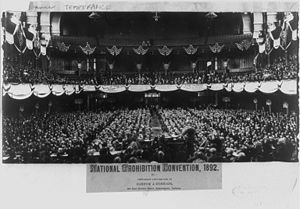 At the same time, its ideology broadened to include aspects of progressivism
. The party contributed to the third-party discussions of the 1910s and sent Charles H. Randall to the 64th
, 65th
and 66th
Congresses as the representative of California's 9th congressional district
. Prohibitionist Sidney J. Catts
was elected Governor of Florida in 1916.
The Prohibition Party's greatest success was in 1919, with the passage of the 18th Amendment
to the United States Constitution
, which outlawed the production, sale, transportation, import and export of alcohol. The era during which alcohol was illegal in the United States is generally known as "Prohibition
".
During the Prohibition era, the Prohibition Party pressed for stricter enforcement of the prohibition laws. During the 1928 election, for example, it considered endorsing Republican Herbert Hoover
rather than running its own candidate. However, by a 4–3 vote, its national executive committee voted to nominate their own candidate, William F. Varney, instead. They did this because they felt Hoover's stance on prohibition not strict enough. The Prohibition Party became even more critical of Hoover after he was elected President. By the 1932 election, party chairman David Leigh Colvin
thundered that "The Republican wet plank [i.e. supporting the repeal of Prohibition] means that Mr. Hoover is the most conspicuous turncoat since Benedict Arnold
." Hoover lost the election, but national prohibition was repealed anyway in 1933, with the 21st Amendment
during the progressive Roosevelt administration.
The Prohibition Party has continued running presidential candidates every four years, but its vote totals have steadily dwindled. It last received more than 100,000 votes for president in 1948, and the 1976 election was the last time the party received more than 10,000 votes for president. In 2008, its presidential nominee received only 643 votes.
In February 2004, Dodge's rivals nominated Gene C. Amondson
for President. Neither the Dodge faction nor the Amondson faction recognized the other as legitimate. Amondson filed under the Prohibition banner in Louisiana. Dodge ran under the name of the historic Prohibition Party in Colorado, while the Concerns of People Party allowed Amondson to run on its line against Dodge. Amondson received 1,944 votes, nationwide, while Dodge garnered 140.
The death of Dodge in November 2007 left the Dodge faction without a presidential nominee. In the spring of 2008, the Dodge faction nominated Amondson for President, but they retained one of their own, Howard Lydick, as their vice presidential nominee.
In recent years, the two factions have been fighting over payments dedicated to the Prohibition Party by George Pennock in 1930. The fund pays approximately $8000 per year. To avoid litigation, the two separate parties agreed to divide the money, with the Amondson faction getting slightly over 50%.
Political parties in the United States
This article presents the historical development and role of political parties in United States politics, and outlines more extensively the significant modern political parties. Throughout most of its history, American politics have been dominated by a two-party system...
best known for its historic opposition to the sale or consumption of alcoholic beverage
Alcoholic beverage
An alcoholic beverage is a drink containing ethanol, commonly known as alcohol. Alcoholic beverages are divided into three general classes: beers, wines, and spirits. They are legally consumed in most countries, and over 100 countries have laws regulating their production, sale, and consumption...
s. It is the oldest existing third party in the US
Third party (United States)
The term third party is used in the United States for any and all political parties in the United States other than one of the two major parties . The term can also refer to independent politicians not affiliated with any party at all and to write-in candidates.The United States has had a...
. The party was an integral part of the temperance movement
Temperance movement
A temperance movement is a social movement urging reduced use of alcoholic beverages. Temperance movements may criticize excessive alcohol use, promote complete abstinence , or pressure the government to enact anti-alcohol legislation or complete prohibition of alcohol.-Temperance movement by...
. While never one of the leading parties in the United States, it was an important force in the politics of the United States
Politics of the United States
The United States is a federal constitutional republic, in which the President of the United States , Congress, and judiciary share powers reserved to the national government, and the federal government shares sovereignty with the state governments.The executive branch is headed by the President...
during the late 19th century and the early years of the 20th century. It has declined dramatically since the repeal of Prohibition
Prohibition in the United States
Prohibition in the United States was a national ban on the sale, manufacture, and transportation of alcohol, in place from 1920 to 1933. The ban was mandated by the Eighteenth Amendment to the Constitution, and the Volstead Act set down the rules for enforcing the ban, as well as defining which...
in 1933. The party earned only 643 votes in the 2008 presidential election
United States presidential election, 2008
The United States presidential election of 2008 was the 56th quadrennial presidential election. It was held on November 4, 2008. Democrat Barack Obama, then the junior United States Senator from Illinois, defeated Republican John McCain, the senior U.S. Senator from Arizona. Obama received 365...
. The Prohibition Party advocates a variety of socially conservative causes, including "stronger and more vigorous enforcement of laws against the sale of alcoholic beverages and tobacco products, against gambling, illegal drugs, pornography, and commercialized vice."
History
The Prohibition Party was founded in 1869. Its first National Committee Chairman was John Russell of Michigan. It succeeded in getting communities and also many counties in the states to outlaw the production and sale of intoxicating beverages.Progressivism
Progressivism is an umbrella term for a political ideology advocating or favoring social, political, and economic reform or changes. Progressivism is often viewed by some conservatives, constitutionalists, and libertarians to be in opposition to conservative or reactionary ideologies.The...
. The party contributed to the third-party discussions of the 1910s and sent Charles H. Randall to the 64th
64th United States Congress
The Sixty-fourth United States Congress was a meeting of the legislative branch of the United States federal government, composed of the United States Senate and the United States House of Representatives. It met in Washington, DC from March 4, 1915 to March 4, 1917, during the third and fourth...
, 65th
65th United States Congress
The Sixty-fifth United States Congress was a meeting of the legislative branch of the United States federal government, composed of the United States Senate and the United States House of Representatives. It met in Washington, DC from March 4, 1917 to March 4, 1919, during the fourth and fifth...
and 66th
66th United States Congress
The Sixty-sixth United States Congress was a meeting of the legislative branch of the United States federal government, comprising the United States Senate and the United States House of Representatives. It met in Washington, DC from March 4, 1919 to March 4, 1921, during the last two years of...
Congresses as the representative of California's 9th congressional district
California's 9th congressional district
California's 9th congressional district is a congressional district in the U.S. state of California that covers a significant portion of the East Bay portion of the San Francisco Bay Area...
. Prohibitionist Sidney J. Catts
Sidney J. Catts
Sidney Johnston Catts was an American politician. He was the 22nd Governor of Florida and with Congressman Charles Randall of California one of only two members of the Prohibition Party to ever hold a major office....
was elected Governor of Florida in 1916.
The Prohibition Party's greatest success was in 1919, with the passage of the 18th Amendment
Eighteenth Amendment to the United States Constitution
The Eighteenth Amendment of the United States Constitution established Prohibition in the United States. The separate Volstead Act set down methods of enforcing the Eighteenth Amendment, and defined which "intoxicating liquors" were prohibited, and which were excluded from prohibition...
to the United States Constitution
United States Constitution
The Constitution of the United States is the supreme law of the United States of America. It is the framework for the organization of the United States government and for the relationship of the federal government with the states, citizens, and all people within the United States.The first three...
, which outlawed the production, sale, transportation, import and export of alcohol. The era during which alcohol was illegal in the United States is generally known as "Prohibition
Prohibition
Prohibition of alcohol, often referred to simply as prohibition, is the practice of prohibiting the manufacture, transportation, import, export, sale, and consumption of alcohol and alcoholic beverages. The term can also apply to the periods in the histories of the countries during which the...
".
During the Prohibition era, the Prohibition Party pressed for stricter enforcement of the prohibition laws. During the 1928 election, for example, it considered endorsing Republican Herbert Hoover
Herbert Hoover
Herbert Clark Hoover was the 31st President of the United States . Hoover was originally a professional mining engineer and author. As the United States Secretary of Commerce in the 1920s under Presidents Warren Harding and Calvin Coolidge, he promoted partnerships between government and business...
rather than running its own candidate. However, by a 4–3 vote, its national executive committee voted to nominate their own candidate, William F. Varney, instead. They did this because they felt Hoover's stance on prohibition not strict enough. The Prohibition Party became even more critical of Hoover after he was elected President. By the 1932 election, party chairman David Leigh Colvin
D. Leigh Colvin
David Leigh Colvin was an American politician and member of the Prohibition Party and the Law Preservation Party....
thundered that "The Republican wet plank [i.e. supporting the repeal of Prohibition] means that Mr. Hoover is the most conspicuous turncoat since Benedict Arnold
Benedict Arnold
Benedict Arnold V was a general during the American Revolutionary War. He began the war in the Continental Army but later defected to the British Army. While a general on the American side, he obtained command of the fort at West Point, New York, and plotted to surrender it to the British forces...
." Hoover lost the election, but national prohibition was repealed anyway in 1933, with the 21st Amendment
Twenty-first Amendment to the United States Constitution
The Twenty-first Amendment to the United States Constitution repealed the Eighteenth Amendment to the United States Constitution, which had mandated nationwide Prohibition...
during the progressive Roosevelt administration.
Decline
The Prohibition Party has faded into obscurity since World War II. When it briefly changed its name to the "National Statesman Party" in 1977 (it would reverse the change in 1980), Time magazine suggested that it was "doubtful" that the name change would "hoist the party out of the category of political oddity."The Prohibition Party has continued running presidential candidates every four years, but its vote totals have steadily dwindled. It last received more than 100,000 votes for president in 1948, and the 1976 election was the last time the party received more than 10,000 votes for president. In 2008, its presidential nominee received only 643 votes.
Secession of 2003
The Prohibition Party experienced a schism in 2003, as the party's prior presidential candidate, Earl Dodge, incorporated a rival party called the National Prohibition Party in Colorado. Dodge held a rival nominating convention in his living room in August 2003, attended by eight people, and was nominated as the president of this rival party.In February 2004, Dodge's rivals nominated Gene C. Amondson
Gene Amondson
Gene Amondson, was a landscape painter, woodcarver, Christian minister and prohibition activist who was the 2004 US presidential candidate for one faction of the Prohibition Party and the nominee of the unified party in 2008.Amondson was known for his anti-Alcohol activism and reenactments of...
for President. Neither the Dodge faction nor the Amondson faction recognized the other as legitimate. Amondson filed under the Prohibition banner in Louisiana. Dodge ran under the name of the historic Prohibition Party in Colorado, while the Concerns of People Party allowed Amondson to run on its line against Dodge. Amondson received 1,944 votes, nationwide, while Dodge garnered 140.
The death of Dodge in November 2007 left the Dodge faction without a presidential nominee. In the spring of 2008, the Dodge faction nominated Amondson for President, but they retained one of their own, Howard Lydick, as their vice presidential nominee.
In recent years, the two factions have been fighting over payments dedicated to the Prohibition Party by George Pennock in 1930. The fund pays approximately $8000 per year. To avoid litigation, the two separate parties agreed to divide the money, with the Amondson faction getting slightly over 50%.
Presidential campaigns
The Prohibition Party has nominated a candidate for president in every election since 1872, and is thus the longest-lived American political party after the Democrats and Republicans.| Prohibition Party National Conventions and Campaigns | ||||||
| Year | No. | Convention Site & City | Dates | Presidential nominee | Vice-Presidential nominee | Votes |
|---|---|---|---|---|---|---|
| 1872 | 1st | Comstock's Opera House, Columbus, Ohio Columbus, Ohio Columbus is the capital of and the largest city in the U.S. state of Ohio. The broader metropolitan area encompasses several counties and is the third largest in Ohio behind those of Cleveland and Cincinnati. Columbus is the third largest city in the American Midwest, and the fifteenth largest city... |
Feb. 22, 1872 | James Black James Black (prohibitionist) James Black became a leader of the temperance movement in the United States after having a bad experience with alcohol intoxication, if not alcohol poisoning.... (Pennsylvania) |
John Russell (Michigan) | 2,100 |
| 1876 | 2nd | Halle's Hall, Cleveland, Ohio Cleveland, Ohio Cleveland is a city in the U.S. state of Ohio and is the county seat of Cuyahoga County, the most populous county in the state. The city is located in northeastern Ohio on the southern shore of Lake Erie, approximately west of the Pennsylvania border... |
May 17, 1876 | Green Clay Smith Green Clay Smith Green Clay Smith was a U.S. soldier and politician. He served as a major general during the Civil War, was a congressman from Kentucky and was the Territorial Governor of Montana from 1866 to 1869. He also ran for President of the United States on the Prohibition ticket in 1876... (Kentucky) |
Gideon T. Stewart Gideon T. Stewart Gideon Tabor Stewart was an American lawyer as well as a newspaper owner and editor. He was very active in promoting the temperance movement. He was elected three timess as grand worthy chief templar of the Good Templars of Ohio. Throughout the 1850s he attempted to organize a permanent... (Ohio) |
6,743 |
| 1880 | 3rd | Halle's Hall, Cleveland | June 17, 1880 | Neal Dow (Maine) | Henry Adams Thompson Henry Adams Thompson Henry Adams Thompson was a noted prohibitionist who was nominated for Vice President of the United States by the Prohibition Party in 1880 with writer Neal Dow.... (Ohio) |
9,674 |
| 1884 | 4th | Lafayette Hall, Pittsburgh, Pennsylvania Pittsburgh, Pennsylvania Pittsburgh is the second-largest city in the US Commonwealth of Pennsylvania and the county seat of Allegheny County. Regionally, it anchors the largest urban area of Appalachia and the Ohio River Valley, and nationally, it is the 22nd-largest urban area in the United States... |
July 23–24, 1884 | John P. St. John (Kansas) | William Daniel (Maryland) | 147,520 |
| 1888 | 5th | Tomlinson Hall, Indianapolis, Indiana Indianapolis, Indiana Indianapolis is the capital of the U.S. state of Indiana, and the county seat of Marion County, Indiana. As of the 2010 United States Census, the city's population is 839,489. It is by far Indiana's largest city and, as of the 2010 U.S... |
May 30–31, 1888 | Clinton B. Fisk Clinton B. Fisk Clinton Bowen Fisk , for whom Fisk University is named, was a senior officer during Reconstruction in the Bureau of Refugees, Freedmen and Abandoned Lands. He endowed Fisk University with $30,000... (New Jersey) |
John A. Brooks John A. Brooks John Anderson Brooks was a noted religious scholar and prohibitionist. He was nominated for Vice President of the United States by the Prohibition Party in 1888, with the ticket garnering nearly 250,000 votes.... (Missouri) |
249,813 |
| 1892 | 6th | Music Hall, Cincinnati, Ohio Cincinnati, Ohio Cincinnati is a city in the U.S. state of Ohio. Cincinnati is the county seat of Hamilton County. Settled in 1788, the city is located to north of the Ohio River at the Ohio-Kentucky border, near Indiana. The population within city limits is 296,943 according to the 2010 census, making it Ohio's... |
June 29–30, 1892 | John Bidwell John Bidwell John Bidwell was known throughout California and across the nation as an important pioneer, farmer, soldier, statesman, politician, prohibitionist and philanthropist... (California) |
James B. Cranfill James B. Cranfill James Britton Cranfill , also known as JB Cranfill, was a noted religious figure and prohibitionist who was nominated for Vice President of the United States by the Prohibition Party in 1892, with the ticket garnering over 270,000 votes, approximately 2% of the total vote.Cranfill was born in... (Texas) |
270,770 |
| 1896 | 7th | Exposition Hall, Pittsburgh | May 27–28, 1896 | Joshua Levering Joshua Levering Joshua Levering was a prominent Baptist leader . He was president of the trustees of The Southern Baptist Theological Seminary in Louisville, Kentucky, vice-president of the Southern Baptist Convention, co-founder of the American Baptist Educational Society, and co-founder of the Layman's... (Maryland) |
Hale Johnson Hale Johnson Attorney Hale Johnson , was an American politician. He was born in Montgomery County, Indiana and was the son of John B. Johnson. According to historian Nathaniel Haynes, "Mr. Johnson's father, Dr. John B. Johnson, served as assistant surgeon during the Civil War. His grandfather was a Baptist... (Illinois) |
125,072 |
| [7th] | Pittsburgh | May 28, 1896 | Charles Eugene Bentley (Nebraska) | James H. Southgate James H. Southgate James Haywood Southgate , was an American spokesman for prohibition. He served as the Vice Presidential candidate of a faction of the Prohibition Party which broke away from the main party in 1896, running with Charles Eugene Bentley.-Biography:... (N. Car.) |
19,363 | |
| 1900 | 8th | First Regiment Armory, Chicago, Illinois |
June 27–28, 1900 | John G. Woolley John G. Woolley John Granville Woolley , a lawyer and public speaker, was the Prohibition Party's candidate for President of the United States in the election of 1900. He was nominated for President, together with Henry B. Metcalf of Rhode Island for Vice President, at the party's national convention in Chicago on... (Illinois) |
Henry B. Metcalf Henry B. Metcalf Henry Brewer Metcalf was a noted prohibitionist in the United States, who was the Prohibition Party nominee for Vice President of the United States in 1900. Along with Presidential candidate John G. Woolley, the ticket garnered approximately 210,000 votes in the general election.Born in Boston on... (Rhode Island) |
209,004 |
| 1904 | 9th | Tomlinson Hall, Indianapolis | June 29 to July 1, 1904 |
Silas C. Swallow Silas C. Swallow Silas Comfort Swallow was a United States Methodist preacher and prohibitionist politician.-Namesake:He was presumably named after Methodist preacher Silas Comfort , a courageous anti-slavery member of the Genesee, Oneida and Missouri Conferences. While serving in St... (Pennsylvania) |
George W. Carroll (Texas) | 258,596 |
| 1908 | 10th | Memorial Hall, Columbus | July 15–16, 1908 | Eugene W. Chafin Eugene W. Chafin Eugene Wilder Chafin was an United States politician from the Prohibition Party. Chafin was born in East Troy, Wisconsin and worked as a lawyer at Waukesha, Wisconsin from 1876 to 1900... (Illinois) |
Aaron S. Watkins Aaron S. Watkins Aaron S. Watkins , born in Ohio, was president of Asbury College in Kentucky. Before his ordination as a Methodist minister, he practiced law with his brother. He was the grandfather of Prohibition candidate for Vice President of the United States, W... (Ohio) |
252,821 |
| 1912 | 11th | on a large temporary pier, Atlantic City, New Jersey Atlantic City, New Jersey Atlantic City is a city in Atlantic County, New Jersey, United States, and a nationally renowned resort city for gambling, shopping and fine dining. The city also served as the inspiration for the American version of the board game Monopoly. Atlantic City is located on Absecon Island on the coast... |
July 10–12, 1912 | Eugene W. Chafin Eugene W. Chafin Eugene Wilder Chafin was an United States politician from the Prohibition Party. Chafin was born in East Troy, Wisconsin and worked as a lawyer at Waukesha, Wisconsin from 1876 to 1900... (Illinois) |
Aaron S. Watkins Aaron S. Watkins Aaron S. Watkins , born in Ohio, was president of Asbury College in Kentucky. Before his ordination as a Methodist minister, he practiced law with his brother. He was the grandfather of Prohibition candidate for Vice President of the United States, W... (Ohio) |
207,972 |
| 1916 | 12th | St. Paul, Minnesota | July 19–21, 1916 | J. Frank Hanly Frank Hanly James Franklin Hanly was a United States politician who served as a congressman from Indiana from 1895 until 1897, and was the 26th Governor of Indiana from 1905 to 1909... (Indiana) |
Rev. Dr. Ira Landrith (Tennessee) | 221,030 |
| 1920 | 13th | Lincoln, Nebraska Lincoln, Nebraska The City of Lincoln is the capital and the second-most populous city of the US state of Nebraska. Lincoln is also the county seat of Lancaster County and the home of the University of Nebraska. Lincoln's 2010 Census population was 258,379.... |
July 21–22, 1920 | Aaron S. Watkins Aaron S. Watkins Aaron S. Watkins , born in Ohio, was president of Asbury College in Kentucky. Before his ordination as a Methodist minister, he practiced law with his brother. He was the grandfather of Prohibition candidate for Vice President of the United States, W... (Ohio) |
Dr. David Leigh Colvin (New York) | 188,685 |
| 1924 | 14th | Memorial Hall, Columbus | June 4–6, 1924 | Herman P. Faris Herman P. Faris Herman Preston Faris was a committed proponent of the temperance movement. He served for many years as treasurer of the Prohibition National Committee, and he was twice the Prohibition Party candidate for governor of Missouri. Faris was the party's candidate for President of the United States in... (Missouri) |
Marie C. Brehm Marie C. Brehm Suffragette Marie Caroline Brehm was the first legally qualified female candidate to run for the vice-presidency of the United States, which she did in 1924 on the ticket of the Prohibition Party running with Herman P. Faris. The nominee was initially Dr. A.P. Gouthey, with Brehm in second, and... (California) |
54,833 |
| 1928 | 15th | Hotel LaSalle, Chicago | July 10–12, 1928 | William F. Varney William F. Varney William Frederick Varney was an American politician.-Life:He was the son of Rev. F. W. Varney .... (New York) |
James A. Edgerton | 20,095 |
| [15th] | [California ticket] | Herbert Hoover Herbert Hoover Herbert Clark Hoover was the 31st President of the United States . Hoover was originally a professional mining engineer and author. As the United States Secretary of Commerce in the 1920s under Presidents Warren Harding and Calvin Coolidge, he promoted partnerships between government and business... (California) |
Charles Curtis Charles Curtis Charles Curtis was a United States Representative, a longtime United States Senator from Kansas later chosen as Senate Majority Leader by his Republican colleagues, and the 31st Vice President of the United States... (Kansas) |
14,394 | ||
| 1932 | 16th | Candle Tabernacle, Indianapolis |
July 5–7, 1932 | William D. Upshaw William D. Upshaw William David Upshaw served eight years in Congress , where he was such a strong proponent of the temperance movement that he became known as the "driest of the drys.".-Biography:... (Georgia) |
Frank S. Regan (Illinois) | 81,916 |
| 1936 | 17th | State Armory Building, Niagara Falls, New York Niagara Falls, New York Niagara Falls is a city in Niagara County, New York, United States. As of the 2010 census, the city had a total population of 50,193, down from the 55,593 recorded in the 2000 census. It is across the Niagara River from Niagara Falls, Ontario , both named after the famed Niagara Falls which they... |
May 5–7, 1936 | D. Leigh Colvin D. Leigh Colvin David Leigh Colvin was an American politician and member of the Prohibition Party and the Law Preservation Party.... (New York) |
Alvin York (Tenn.) (declined); Claude A. Watson Claude A. Watson Claude A. Watson was a lawyer, businessman, and minister from Hermon , who was nationally active in the temperance movement... (California) |
37,668 |
| 1940 | 18th | Chicago | May 8–10, 1940 | Roger W. Babson Roger Babson Roger Ward Babson , remembered today largely for founding Babson College in Massachusetts, was an entrepreneur and business theorist in the first half of the 20th century... (Mass.) |
Edgar V. Moorman (Illinois) | 58,743 |
| 1944 | 19th | Indianapolis | Nov. 10–12, 1943 | Claude A. Watson Claude A. Watson Claude A. Watson was a lawyer, businessman, and minister from Hermon , who was nationally active in the temperance movement... (California) |
Floyd C. Carrier (Maryland) (withdrew); Andrew Johnson (Kentucky) |
74,735 |
| 1948 | 20th | Winona Lake, Indiana Winona Lake, Indiana Winona Lake is a town in Wayne Township, Kosciusko County, Indiana, United States. The population was 4,908 at the 2010 census.-Geography:Winona Lake is located at... |
June 26–28, 1947 | Claude A. Watson Claude A. Watson Claude A. Watson was a lawyer, businessman, and minister from Hermon , who was nationally active in the temperance movement... (California) |
Dale H. Learn (Pennsylvania) | 103,489 |
| 1952 | 21st | Indianapolis | Nov. 13–15, 1951 | Stuart Hamblen Stuart Hamblen Stuart Hamblen , born Stuart Carl Hamblen, was one of American radio's first singing cowboys in 1926, and later became a Christian songwriter, temperance supporter and recurring candidate for political office.... (California) |
Enoch A. Holtwick Enoch A. Holtwick Enoch Arden Holtwick, was an American educator with a long record of actively supporting the temperance movement. He was the Prohibition Party candidate for Illinois State Treasurer in 1936; its candidate for U.S... (Illinois) |
73,413 |
| 1956 | 22nd | Camp Mack, Milford, Indiana Milford, Indiana Milford could refer to:*Milford, Decatur County, Indiana*Milford, Kosciusko County, Indiana*Former name of Green Hill, Indiana... |
Sept. 4–6, 1955 | Enoch A. Holtwick Enoch A. Holtwick Enoch Arden Holtwick, was an American educator with a long record of actively supporting the temperance movement. He was the Prohibition Party candidate for Illinois State Treasurer in 1936; its candidate for U.S... (Illinois) |
Herbert C. Holdridge Herbert C. Holdridge Herbert Charles Holdridge was an American military officer, who was best known for being the only United States Army General to retire during World War II, and for having several times sought presidential nominations on fringe party tickets after retirement. He was the father of diplomat John H... (California) (withdrew); Edwin M. Cooper (California) |
41,937 |
| 1960 | 23rd | Westminster Hotel, Winona Lake |
Sept. 1–3, 1959 | Rutherford Decker Rutherford Decker Rutherford L. Decker was an United States politician, a longtime member and a Presidential nominee of Prohibition Party in 1960, and the President of the National Association of Evangelicals from 1946 to 1948.-Biography:... (Missouri) |
E. Harold Munn E. Harold Munn Earle Harold Munn , also known as E. Harold Munn, was a United States politician and a longtime leader of Prohibition Party, for which he was Presidential and Vice-Presidential nominee.-Biography:... (Michigan) |
46,193 |
| 1964 | 24th | Pick Congress Hotel, Chicago |
August 26–27, 1963 | E. Harold Munn E. Harold Munn Earle Harold Munn , also known as E. Harold Munn, was a United States politician and a longtime leader of Prohibition Party, for which he was Presidential and Vice-Presidential nominee.-Biography:... (Michigan) |
Mark R. Shaw Mark R. Shaw Mark R. Shaw was a Prohibition Party candidate for the U.S. Senate from Massachusetts in 1946, 1952, 1958, 1960, 1962, 1966 and 1970. He was also the party's candidate for governor of that state in 1948 and in 1956... (Massachusetts) |
23,266 |
| 1968 | 25th | YWCA, Detroit, Mich. | June 28–29, 1968 | E. Harold Munn E. Harold Munn Earle Harold Munn , also known as E. Harold Munn, was a United States politician and a longtime leader of Prohibition Party, for which he was Presidential and Vice-Presidential nominee.-Biography:... (Michigan) |
Rolland E. Fisher (Kansas) | 14,915 |
| 1972 | 26th | Nazarene Church Building, Wichita, Kansas Wichita, Kansas Wichita is the largest city in the U.S. state of Kansas.As of the 2010 census, the city population was 382,368. Located in south-central Kansas on the Arkansas River, Wichita is the county seat of Sedgwick County and the principal city of the Wichita metropolitan area... |
June 24–25, 1971 | E. Harold Munn E. Harold Munn Earle Harold Munn , also known as E. Harold Munn, was a United States politician and a longtime leader of Prohibition Party, for which he was Presidential and Vice-Presidential nominee.-Biography:... (Michigan) |
Marshall E. Uncapher (Kansas) | 12,818 |
| 1976 | 27th | Beth Eden Baptist Church Bldg, Wheat Ridge, Colo. Wheat Ridge, Colorado The City of Wheat Ridge is a Home Rule Municipality located in Jefferson County, Colorado, United States. Wheat Ridge is a western suburb of Denver. The Wheat Ridge Municipal Center is approximately west-northwest of the Colorado State Capitol in Denver... |
June 26–27, 1975 | Benjamin C. Bubar (Maine) | Earl F. Dodge (Colorado) | 15,934 |
| 1980 | 28th | Motel Birmingham, Birmingham, Alabama Birmingham, Alabama Birmingham is the largest city in Alabama. The city is the county seat of Jefferson County. According to the 2010 United States Census, Birmingham had a population of 212,237. The Birmingham-Hoover Metropolitan Area, in estimate by the U.S... |
June 20–21, 1979 | Benjamin C. Bubar (Maine) | Earl F. Dodge (Colorado) | 7,212 |
| 1984 | 29th | Mandan, North Dakota Mandan, North Dakota As of the census of 2000, there were 16,718 people, 6,647 households, and 4,553 families residing in the city. The population density was 1,642.8 per square mile . There were 6,958 housing units at an average density of 683.7 per square mile... |
June 22–24, 1983 | Earl Dodge Earl Dodge Earl Farwell Dodge, Jr. was a long-time temperance movement leader and a politician of the Prohibition Party, from the U.S. state of Colorado.-Biography:... (Colorado) |
Warren C. Martin Warren C. Martin Warren C. Martin, was born on October 13, 1909. He was a noted member of the Prohibition Party USA, local politician and also was an entrepreneur. He died on August 5, 1998.- Family History :... (Kansas) |
4,242 |
| 1988 | 30th | Heritage House, Springfield, Illinois Springfield, Illinois Springfield is the third and current capital of the US state of Illinois and the county seat of Sangamon County with a population of 117,400 , making it the sixth most populated city in the state and the second most populated Illinois city outside of the Chicago Metropolitan Area... |
June 25–26, 1987 | Earl Dodge Earl Dodge Earl Farwell Dodge, Jr. was a long-time temperance movement leader and a politician of the Prohibition Party, from the U.S. state of Colorado.-Biography:... (Colorado) |
George Ormsby (Pennsylvania) | 8,002 |
| 1992 | 31st | Minneapolis, Minnesota | June 24–26, 1991 | Earl Dodge Earl Dodge Earl Farwell Dodge, Jr. was a long-time temperance movement leader and a politician of the Prohibition Party, from the U.S. state of Colorado.-Biography:... (Colorado) |
George Ormsby (Pennsylvania) | 935 |
| 1996 | 32nd | Denver, Colorado | 1995 | Earl Dodge Earl Dodge Earl Farwell Dodge, Jr. was a long-time temperance movement leader and a politician of the Prohibition Party, from the U.S. state of Colorado.-Biography:... (Colorado) |
Rachel Bubar Kelly Rachel Bubar Kelly Rachel Bubar Kelly was the Prohibition Party candidate for United States Vice President in the 1996 presidential election as the running mate of Earl F. Dodge... (Maine) |
1,298 |
| 2000 | 33rd | Bird-in-Hand, Pennsylvania Bird-in-Hand, Pennsylvania Bird-in-Hand, Pennsylvania is an unincorporated community with parts lying in East Lampeter Township, and Upper Leacock Township, Lancaster County in the U.S. commonwealth of Pennsylvania. The community has a large Amish and Mennonite population... |
June 28–30, 1999 | Earl Dodge Earl Dodge Earl Farwell Dodge, Jr. was a long-time temperance movement leader and a politician of the Prohibition Party, from the U.S. state of Colorado.-Biography:... (Colorado) |
W. Dean Watkins (Arizona) | 208 |
| 2004 | 34th | Fairfield Glade, Tennessee Fairfield Glade, Tennessee Fairfield Glade, a resort and retirement community, is a census-designated place in Cumberland County, Tennessee, United States. The population was 6,989 at the 2010 census.-Geography:Fairfield Glade is located at .... |
February 1, 2004 | Gene Amondson Gene Amondson Gene Amondson, was a landscape painter, woodcarver, Christian minister and prohibition activist who was the 2004 US presidential candidate for one faction of the Prohibition Party and the nominee of the unified party in 2008.Amondson was known for his anti-Alcohol activism and reenactments of... (Washington) |
Leroy Pletten (Michigan) | 1,944 |
| [34th] | Lakewood, Colorado Lakewood, Colorado Lakewood is a Home Rule Municipality that is the most populous city in Jefferson County, Colorado, United States. Lakewood is the fifth most populous city in the State of Colorado and the 172nd most populous city in the United States. The United States Census Bureau estimates that in April 1, 2010... |
August 2003 | Earl Dodge Earl Dodge Earl Farwell Dodge, Jr. was a long-time temperance movement leader and a politician of the Prohibition Party, from the U.S. state of Colorado.-Biography:... (Colorado) |
Howard Lydick (Texas) | 140 | |
| 2008 | 35th | Adams Mark Hotel, Indianapolis |
Sept. 13–14, 2007 | Gene Amondson Gene Amondson Gene Amondson, was a landscape painter, woodcarver, Christian minister and prohibition activist who was the 2004 US presidential candidate for one faction of the Prohibition Party and the nominee of the unified party in 2008.Amondson was known for his anti-Alcohol activism and reenactments of... (Washington) |
Leroy Pletten (Michigan) | 643 |
| 2012 | 36th | Holiday Inn Express, Cullman, Alabama Cullman, Alabama Cullman is a city in Cullman County, State of Alabama. Cullman is located along Interstate 65, about north of Birmingham, and about south of Huntsville. According to the U.S... |
June 20–22, 2011 | Jack Fellure Jack Fellure Lowell Jackson "Jack" Fellure is an American perennial political candidate and retired engineer. He is the presidential nominee of the Prohibition Party for the 2012 presidential election.-Campaigns:... (West Virginia) |
Toby Davis (Mississippi) | |
Elected officials
- Sidney Johnston Catts – Governor of Florida (1917–1921)
- Charles Hiram RandallCharles Hiram RandallCharles Hiram Randall , known as Charles Randall, was a member of the U.S. Congress, the California State Assembly and the Los Angeles City Council in the 20th Century.-Biography:...
– California State AssemblyCalifornia State AssemblyThe California State Assembly is the lower house of the California State Legislature. There are 80 members in the Assembly, representing an approximately equal number of constituents, with each district having a population of at least 420,000...
man (1911–12) and U.S. Representative from the 9th District of CaliforniaCalifornia's 9th congressional districtCalifornia's 9th congressional district is a congressional district in the U.S. state of California that covers a significant portion of the East Bay portion of the San Francisco Bay Area...
(1915–21) - Susanna M. SalterSusanna M. SalterSusanna Madora "Dora" Salter was a U.S. politician and activist. She served as mayor of Argonia, Kansas, becoming the first woman elected as mayor and the first woman elected to any political office in the United States....
– Mayor of Argonia, KansasArgonia, KansasArgonia is a city in Sumner County, Kansas, United States. As of the 2010 census, the city population was 501.-Geography:Argonia is located at . According to the United States Census Bureau, the city has a total area of , all of it land.-Demographics:As of the census of 2000, there were 534...
(1887): the first female mayor in the United States - James HedgesJames HedgesJames Hedges is a Prohibition activist and the former Tax Assessor for Thompson Township, Fulton County, Pennsylvania. He holds the distinction as the only individual to be elected to public office from the Prohibition Party in the twenty-first century, and the first since 1959...
– Thompson Township, PennsylvaniaThompson Township, Fulton County, PennsylvaniaThompson Township is a township in Fulton County, Pennsylvania, in the United States. As of the 2000 census, the township population was 998...
, Tax Assessor (2002–2007): the first and only known Prohibition Party office holder of the 21st century
See also
- Robert P. ShulerRobert P. ShulerRobert Pierce "Fighting Bob" Shuler, Sr. , was an American evangelist and political figure. His radio broadcasts from his Southern Methodist church in Los Angeles, California, during the 1920s and early 1930s attracted a large audience and also drew controversy with his attacks on politicians,...
- List of political parties in the United States
- Alcohol during and after prohibitionAlcohol during and after prohibitionThere was consumption of alcohol both during and after prohibition.The 18th Amendment prohibited the production, distribution and sale of alcoholic beverages in the United States and was widely supported by the American public when it went into effect in 1920....
- Temperance organizations
- Prohibition Party presidential election resultsProhibition Party presidential election resultsThe U.S. Prohibition Party presidential election results are listed chronologically below.The Prohibition Party has run a candidate for the presidency of the United States every election year since 1872. Although national prohibition was introduced in 1920 with broad public support, the...
- Scottish Prohibition PartyScottish Prohibition PartyThe Scottish Prohibition Party was a minor Scottish political party which advocated alcohol prohibition.The party was founded in 1901. In its early years, Bob Stewart acted as the party's full-time organiser...
Further reading
- James T. Havel, U.S. Presidential Candidates and the Elections (NYC: MacMillan Library Reference, 1996)
- S.B. Hinshaw, Ohio Elects the President: Our State's Role in Presidential Elections (Mansfield OH: Bookmasters, 1999)