
Home      Discussion      Topics      Dictionary      Almanac
Signup       Login
War on Poverty

War on Poverty

Overview
The War on Poverty is the unofficial name for legislation first introduced by United States President Lyndon B. Johnson
Lyndon B. Johnson
Lyndon Baines Johnson , often referred to as LBJ, was the 36th President of the United States after his service as the 37th Vice President of the United States...

 during his State of the Union address
State of the Union Address
The State of the Union is an annual address presented by the President of the United States to the United States Congress. The address not only reports on the condition of the nation but also allows the president to outline his legislative agenda and his national priorities.The practice arises...

 on January 8, 1964. This legislation was proposed by Johnson in response to a national poverty
Poverty
Poverty is the lack of a certain amount of material possessions or money. Absolute poverty or destitution is inability to afford basic human needs, which commonly includes clean and fresh water, nutrition, health care, education, clothing and shelter. About 1.7 billion people are estimated to live...

 rate of around nineteen percent. The speech led the United States Congress
United States Congress
The United States Congress is the bicameral legislature of the federal government of the United States, consisting of the Senate and the House of Representatives. The Congress meets in the United States Capitol in Washington, D.C....

 to pass the Economic Opportunity Act, which established the Office of Economic Opportunity
Office of Economic Opportunity
The Office of Economic Opportunity was the agency responsible for administering most of the War on Poverty programs created as part of United States President Lyndon B. Johnson's Great Society legislative agenda.- History :...

 (OEO) to administer the local application of federal funds targeted against poverty.
Discussion
Ask a question about 'War on Poverty'
Start a new discussion about 'War on Poverty'
Answer questions from other users
Full Discussion Forum
 
Unanswered Questions
Encyclopedia
The War on Poverty is the unofficial name for legislation first introduced by United States President Lyndon B. Johnson
Lyndon B. Johnson
Lyndon Baines Johnson , often referred to as LBJ, was the 36th President of the United States after his service as the 37th Vice President of the United States...

 during his State of the Union address
State of the Union Address
The State of the Union is an annual address presented by the President of the United States to the United States Congress. The address not only reports on the condition of the nation but also allows the president to outline his legislative agenda and his national priorities.The practice arises...

 on January 8, 1964. This legislation was proposed by Johnson in response to a national poverty
Poverty
Poverty is the lack of a certain amount of material possessions or money. Absolute poverty or destitution is inability to afford basic human needs, which commonly includes clean and fresh water, nutrition, health care, education, clothing and shelter. About 1.7 billion people are estimated to live...

 rate of around nineteen percent. The speech led the United States Congress
United States Congress
The United States Congress is the bicameral legislature of the federal government of the United States, consisting of the Senate and the House of Representatives. The Congress meets in the United States Capitol in Washington, D.C....

 to pass the Economic Opportunity Act, which established the Office of Economic Opportunity
Office of Economic Opportunity
The Office of Economic Opportunity was the agency responsible for administering most of the War on Poverty programs created as part of United States President Lyndon B. Johnson's Great Society legislative agenda.- History :...

 (OEO) to administer the local application of federal funds targeted against poverty.

As a part of the Great Society
Great Society
The Great Society was a set of domestic programs in the United States promoted by President Lyndon B. Johnson and fellow Democrats in Congress in the 1960s. Two main goals of the Great Society social reforms were the elimination of poverty and racial injustice...

, Johnson's belief in expanding the government's role in social welfare programs from education to health care was a continuation of Franklin D. Roosevelt
Franklin D. Roosevelt
Franklin Delano Roosevelt , also known by his initials, FDR, was the 32nd President of the United States and a central figure in world events during the mid-20th century, leading the United States during a time of worldwide economic crisis and world war...

's New Deal
New Deal
The New Deal was a series of economic programs implemented in the United States between 1933 and 1936. They were passed by the U.S. Congress during the first term of President Franklin D. Roosevelt. The programs were Roosevelt's responses to the Great Depression, and focused on what historians call...

, which ran from 1933 to 1935, and the Four Freedoms
Four Freedoms
The Four Freedoms were goals articulated by US President Franklin D. Roosevelt on January 6, 1941. In an address known as the Four Freedoms speech , he proposed four fundamental freedoms that people "everywhere in the world" ought to enjoy:# Freedom of speech and expression# Freedom of worship#...

 of 1941.

The popularity of a war on poverty waned after the 1960s. Deregulation, growing criticism of the welfare state
Welfare state
A welfare state is a "concept of government in which the state plays a key role in the protection and promotion of the economic and social well-being of its citizens. It is based on the principles of equality of opportunity, equitable distribution of wealth, and public responsibility for those...

, and an ideological shift to reducing federal aid to impoverished people in the 1980s and 1990s culminated in the Personal Responsibility and Work Opportunity Act
Personal Responsibility and Work Opportunity Act
The Personal Responsibility and Work Opportunity Reconciliation Act of 1996 is a United States federal law considered to be a fundamental shift in both the method and goal of federal cash assistance to the poor. The bill added a workforce development component to welfare legislation, encouraging...

 of 1996, which, as claimed President Bill Clinton
Bill Clinton
William Jefferson "Bill" Clinton is an American politician who served as the 42nd President of the United States from 1993 to 2001. Inaugurated at age 46, he was the third-youngest president. He took office at the end of the Cold War, and was the first president of the baby boomer generation...

, "end[ed] welfare as we know it." Prof. Tony Judt
Tony Judt
Tony Robert Judt FBA was a British historian, essayist, and university professor who specialized in European history. Judt moved to New York and served as the Erich Maria Remarque Professor in European Studies at New York University, and Director of NYU's Erich Maria Remarque Institute...

, the late historian, said in reference to the earlier proposed title of the Personal Responsibility and Work Opportunity Act that "a more Orwellian title would be hard to conceive" and attributed the decline in the popularity of the Great Society
Great Society
The Great Society was a set of domestic programs in the United States promoted by President Lyndon B. Johnson and fellow Democrats in Congress in the 1960s. Two main goals of the Great Society social reforms were the elimination of poverty and racial injustice...

 as a policy to its success, as fewer people feared hunger, sickness, and ignorance. Additionally, fewer people were concerned with ensuring a minimum standard for all citizens and social liberalism
Social liberalism
Social liberalism is the belief that liberalism should include social justice. It differs from classical liberalism in that it believes the legitimate role of the state includes addressing economic and social issues such as unemployment, health care, and education while simultaneously expanding...

. Nonetheless, the aftermath of the War on Poverty remains in the continued existence of such federal programs as Head Start, Volunteers in Service to America
Volunteers in Service to America
VISTA or Volunteers in Service to America is an anti-poverty program created by Lyndon Johnson's Economic Opportunity Act of 1964 as the domestic version of the Peace Corps. Initially, the program increased employment opportunities for conscientious people who felt they could contribute tangibly to...

, and Job Corps
Job Corps
Job Corps is a program administered by the United States Department of Labor that offers free-of-charge education and vocational training to youth ages 16 to 24.-Mission and purpose:...

.

Major initiatives


  • Economic Opportunity Act of 1964
    Economic Opportunity Act of 1964
    Signed by Lyndon B. Johnson on August 20, 1964, the Economic Opportunity Act of 1964 was central to Johnson's Great Society campaign and its War on Poverty. Implemented by the since disbanded Office of Economic Opportunity, the Act included several social programs to promote the health, education,...

     -- August 20, 1964
  • Social Security Act of 1965
    Social Security Act of 1965
    The Social Security Amendments of 1965 was legislation in the United States whose most important provisions resulted in creation of two programs: Medicare and Medicaid. The legislation initially provided federal health insurance for the elderly and for poor families. While President Lyndon B...

     -- July 19, 1965


The Office of Economic Opportunity
Office of Economic Opportunity
The Office of Economic Opportunity was the agency responsible for administering most of the War on Poverty programs created as part of United States President Lyndon B. Johnson's Great Society legislative agenda.- History :...

 was the agency responsible for administering most of the War on Poverty programs created during Johnson's Administration, including VISTA
Volunteers in Service to America
VISTA or Volunteers in Service to America is an anti-poverty program created by Lyndon Johnson's Economic Opportunity Act of 1964 as the domestic version of the Peace Corps. Initially, the program increased employment opportunities for conscientious people who felt they could contribute tangibly to...

, Job Corps
Job Corps
Job Corps is a program administered by the United States Department of Labor that offers free-of-charge education and vocational training to youth ages 16 to 24.-Mission and purpose:...

, Head Start, Legal Services
Legal aid
Legal aid is the provision of assistance to people otherwise unable to afford legal representation and access to the court system. Legal aid is regarded as central in providing access to justice by ensuring equality before the law, the right to counsel and the right to a fair trial.A number of...

 and the Community Action Program. The OEO was established in 1964 and quickly became a target of both left-wing and right-wing critics of the War on Poverty. Directors of the OEO included Sargent Shriver
Sargent Shriver
Robert Sargent Shriver, Jr., known as Sargent Shriver, R. Sargent Shriver, or, from childhood, Sarge, was an American statesman and activist. As the husband of Eunice Kennedy Shriver, he was part of the Kennedy family, serving in the Kennedy and Johnson administrations...

, Bertrand Harding, and Donald Rumsfeld
Donald Rumsfeld
Donald Henry Rumsfeld is an American politician and businessman. Rumsfeld served as the 13th Secretary of Defense from 1975 to 1977 under President Gerald Ford, and as the 21st Secretary of Defense from 2001 to 2006 under President George W. Bush. He is both the youngest and the oldest person to...

.

The OEO launched Project Head Start as an eight-week summer program in 1965. The project was designed to help end poverty by providing preschool children from low-income families with a program that would meet emotional, social, health, nutritional,and psychological needs. Head Start was then transferred to the Office of Child Development in the Department of Health, Education, and Welfare (later the Department of Health and Human Services
HHS
-Medicine:*Hyperglycemic hyperosmolar state, a complication of diabetes-Individual high schools:*Hackensack High School - Hackensack, New Jersey, US*Hackettstown High School - Hackettstown, New Jersey, US*Hadleigh High School - Hadleigh, Suffolk, England...

) by the Nixon Administration
Richard Nixon
Richard Milhous Nixon was the 37th President of the United States, serving from 1969 to 1974. The only president to resign the office, Nixon had previously served as a US representative and senator from California and as the 36th Vice President of the United States from 1953 to 1961 under...

 in 1969.

President Johnson also announced a second project to follow children from the Head Start program. This was implemented in 1967 with Project Follow Through
Project Follow Through
Project Follow Through was the largest and most expensive experiment in education funded by the U.S. federal government that has ever been conducted. The most extensive evaluation of Follow Through data covers the years 1968-1977; however, the program continued to receive funding from the...

, the largest educational experiment ever conducted.

The policy trains disadvantaged and at-risk youth and has provided more than 2 million disadvantaged young people with the integrated academic, vocational, and social skills training they need to gain independence and get quality, long-term jobs or further their education. Job Corps continues to help 70,000 youths annually at 122 Job Corps centers throughout the country. Besides vocational training, many Job Corps also offer GED
GED
General Educational Development tests are a group of five subject tests which, when passed, certify that the taker has American or Canadian high school-level academic skills...

 programs as well as high school
High school
High school is a term used in parts of the English speaking world to describe institutions which provide all or part of secondary education. The term is often incorporated into the name of such institutions....

 diplomas and programs to get students into college
College
A college is an educational institution or a constituent part of an educational institution. Usage varies in English-speaking nations...

.

Criticisms


President Johnson's "War on Poverty" speech was delivered at a time of recovery (the poverty level had fallen from 22.4% in 1959 to 19% in 1964 when the War on Poverty was announced) and it was viewed by critics as an effort to get the United States Congress to authorize social welfare programs. Some economists, including Milton Friedman
Milton Friedman
Milton Friedman was an American economist, statistician, academic, and author who taught at the University of Chicago for more than three decades...

, have argued that Johnson's policies actually had a negative impact on the economy because of their interventionist nature. Adherents of this school of thought recommend that the best way to fight poverty is not through government spending but through economic growth.

Results and aftermath


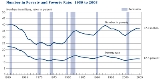
In the decade following the 1964 introduction of the war on poverty, poverty rates in the U.S. dropped to their lowest level since comprehensive records began in 1958: from 17.3% in the year the Economic Opportunity Act was implemented to 11.1% in 1973. They have remained between 11 and 15.2% ever since.

The ‘absolute poverty line’ is the threshold below which families or individuals are considered to be lacking the resources to meet the basic needs for healthy living; having insufficient income to provide the food, shelter and clothing needed to preserve health. Poverty among Americans between ages 18–64 has fallen only marginally since 1966, from 10.5% then to 10.1% today. Poverty has significantly fallen among Americans under 18 years old from 23% in 1964 down to less than 17%, although it has risen again to 20% in 2009. The most dramatic decrease in poverty was among Americans over 65, which fell from 28.5% in 1966 to 10.1% today.

In 2004, more than 35.9 million, or 12% of Americans including 12.1 million children, were considered to be living in poverty with an average growth of almost 1 million per year.

The OEO was dismantled by President Nixon in 1973, though many of the agency's programs were transferred to other government agencies.

According to the "Readers' Companion to U.S. Women's History",
Many observers point out that the War on Poverty's attention to Black America created the grounds for the backlash that began in the 1970s. The perception by the white middle class that it was footing the bill for ever-increasing services to the poor led to diminished support for welfare state programs, especially those that targeted specific groups and neighborhoods. Many whites viewed Great Society programs as supporting the economic and social needs of low-income urban minorities; they lost sympathy, especially as the economy declined during the 1970s.

See also

  • Liberalism
    Liberalism
    Liberalism is the belief in the importance of liberty and equal rights. Liberals espouse a wide array of views depending on their understanding of these principles, but generally, liberals support ideas such as constitutionalism, liberal democracy, free and fair elections, human rights,...

  • Liberalism in the United States
    Liberalism in the United States
    Liberalism in the United States is a broad political philosophy centered on the unalienable rights of the individual. The fundamental liberal ideals of freedom of speech, freedom of the press, freedom of religion for all belief systems, and the separation of church and state, right to due process...

  • Mixed economy
    Mixed economy
    Mixed economy is an economic system in which both the state and private sector direct the economy, reflecting characteristics of both market economies and planned economies. Most mixed economies can be described as market economies with strong regulatory oversight, in addition to having a variety...

  • Modern liberalism in the United States
  • Social liberalism
    Social liberalism
    Social liberalism is the belief that liberalism should include social justice. It differs from classical liberalism in that it believes the legitimate role of the state includes addressing economic and social issues such as unemployment, health care, and education while simultaneously expanding...

  • Social safety net
    Social safety net
    Social safety nets, or "socioeconomic safety nets", are non-contributory transfer programs seeking to prevent the poor or those vulnerable to shocks and poverty from falling below a certain poverty level. Safety net programs can be provided by the public sector or by the private sector...

  • United States welfare state
  • Welfare
    Welfare
    Welfare refers to a broad discourse which may hold certain implications regarding the provision of a minimal level of wellbeing and social support for all citizens without the stigma of charity. This is termed "social solidarity"...

  • Welfare economics
    Welfare economics
    Welfare economics is a branch of economics that uses microeconomic techniques to evaluate economic well-being, especially relative to competitive general equilibrium within an economy as to economic efficiency and the resulting income distribution associated with it...

  • Welfare state
    Welfare state
    A welfare state is a "concept of government in which the state plays a key role in the protection and promotion of the economic and social well-being of its citizens. It is based on the principles of equality of opportunity, equitable distribution of wealth, and public responsibility for those...

  • Welfare's effect on poverty
    Welfare's effect on poverty
    The effect of social welfare on poverty is controversial. Since the goal of welfare programs is to reduce poverty, it has been debated, primarily in the United States, whether or not welfare programs achieve this goal....

  • Social welfare
  • List of wars on concepts
  • Perpetual war
    Perpetual war
    Perpetual war refers to a lasting state of war with no clear ending conditions. It also describes a situation of ongoing tension that seems likely to escalate at any moment, similar to the Cold War.-In past history:...

  • Socialism for the rich and capitalism for the poor
    Socialism for the rich and capitalism for the poor
    Socialism for the rich and capitalism for the poor is a classical political-economic argument, stating that in the advanced capitalist societies state policies assure that more resources flow to the rich than to the poor, for example in form of transfer payments...


External links