


Ship of the line

Encyclopedia

Warship
A warship is a ship that is built and primarily intended for combat. Warships are usually built in a completely different way from merchant ships. As well as being armed, warships are designed to withstand damage and are usually faster and more maneuvrable than merchant ships...
constructed from the 17th through the mid-19th century to take part in the naval tactic
Naval tactics in the Age of Sail
Naval tactics in the Age of Sail were used from the early 17th century onward when sailing ships replaced oared galleys. These were used until the 1860s when steam-powered ironclad warships rendered sailing line of battle ships obsolete.-Early history:...
known as the line of battle
Line of battle
In naval warfare, the line of battle is a tactic in which the ships of the fleet form a line end to end. A primitive form had been used by the Portuguese under Vasco Da Gama in 1502 near Malabar against a Muslim fleet.,Maarten Tromp used it in the Action of 18 September 1639 while its first use in...
, in which two columns of opposing warships would manoeuvre to bring the greatest weight of broadside
Broadside
A broadside is the side of a ship; the battery of cannon on one side of a warship; or their simultaneous fire in naval warfare.-Age of Sail:...
guns to bear. Since these engagements were almost invariably won by the heaviest ships carrying the most powerful guns, the natural progression was to build sailing vessels that were the largest and most powerful of their time.
From the end of the 1840s, the introduction of steam power
Steam engine
A steam engine is a heat engine that performs mechanical work using steam as its working fluid.Steam engines are external combustion engines, where the working fluid is separate from the combustion products. Non-combustion heat sources such as solar power, nuclear power or geothermal energy may be...
brought less dependence on the wind in battle and led to the construction of screw-driven but wooden-hulled ships of the line; a number of pure sail-driven
Sail
A sail is any type of surface intended to move a vessel, vehicle or rotor by being placed in a wind—in essence a propulsion wing. Sails are used in sailing.-History of sails:...
ships were converted to this propulsion mechanism. However, the introduction of the ironclad frigate
Ironclad warship
An ironclad was a steam-propelled warship in the early part of the second half of the 19th century, protected by iron or steel armor plates. The ironclad was developed as a result of the vulnerability of wooden warships to explosive or incendiary shells. The first ironclad battleship, La Gloire,...
in about 1859 led swiftly to the decline of the steam-assisted ships of the line, though the ironclad warship became the ancestor of the 20th-century battleship
Battleship
A battleship is a large armored warship with a main battery consisting of heavy caliber guns. Battleships were larger, better armed and armored than cruisers and destroyers. As the largest armed ships in a fleet, battleships were used to attain command of the sea and represented the apex of a...
, whose very designation is itself a contraction of the phrase "line-of-battle ship."
Predecessors

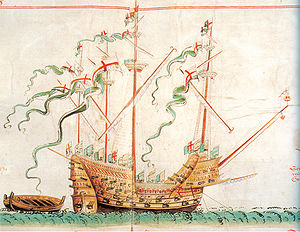
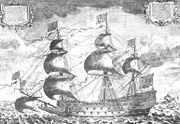
Carrack
A carrack or nau was a three- or four-masted sailing ship developed in 15th century Western Europe for use in the Atlantic Ocean. It had a high rounded stern with large aftcastle, forecastle and bowsprit at the stem. It was first used by the Portuguese , and later by the Spanish, to explore and...
(carrack) first built by the Portuguese and similar great ships built by England and other western European states in the 15th and 16th centuries. These vessels were developed by fusing aspects of the cogs
Cog (ship)
A cog is a type of ship that first appeared in the 10th century, and was widely used from around the 12th century on. Cogs were generally built of oak, which was an abundant timber in the Baltic region of Prussia. This vessel was fitted with a single mast and a square-rigged single sail...
of the Atlantic
Atlantic Ocean
The Atlantic Ocean is the second-largest of the world's oceanic divisions. With a total area of about , it covers approximately 20% of the Earth's surface and about 26% of its water surface area...
and galleys of the Mediterranean
Mediterranean Sea
The Mediterranean Sea is a sea connected to the Atlantic Ocean surrounded by the Mediterranean region and almost completely enclosed by land: on the north by Anatolia and Europe, on the south by North Africa, and on the east by the Levant...
. The cogs, which traded along the Atlantic coasts, the North Sea
North Sea
In the southwest, beyond the Straits of Dover, the North Sea becomes the English Channel connecting to the Atlantic Ocean. In the east, it connects to the Baltic Sea via the Skagerrak and Kattegat, narrow straits that separate Denmark from Norway and Sweden respectively...
and the Baltic
Baltic Sea
The Baltic Sea is a brackish mediterranean sea located in Northern Europe, from 53°N to 66°N latitude and from 20°E to 26°E longitude. It is bounded by the Scandinavian Peninsula, the mainland of Europe, and the Danish islands. It drains into the Kattegat by way of the Øresund, the Great Belt and...
, had an advantage over galleys in battle because they had raised platforms called "castles" at bow and stern which could be occupied by archers, who fired down on enemy ships or even dropped heavy weights. Over time these castles became higher and larger, and eventually started to be built into the structure of the ship, increasing overall strength. This aspect of the cog was kept by the Portuguese in their newer style carrack
Carrack
A carrack or nau was a three- or four-masted sailing ship developed in 15th century Western Europe for use in the Atlantic Ocean. It had a high rounded stern with large aftcastle, forecastle and bowsprit at the stem. It was first used by the Portuguese , and later by the Spanish, to explore and...
designs and proved its worth in the decisive battle of Diu
Battle of Diu (1509)
The Battle of Diu sometimes referred as the Second Battle of Chaul was a naval battle fought on 3 February 1509 in the Arabian Sea, near the port of Diu, India, between the Portuguese Empire and a joint fleet of the Sultan of Gujarat, the Mamlûk Burji Sultanate of Egypt, the Zamorin of Kozhikode...
in 1509. Other European naval powers were quick to follow the Portuguese innovations with their own versions of the "man-of-war".
Mary Rose
Mary Rose
The Mary Rose was a carrack-type warship of the English Tudor navy of King Henry VIII. After serving for 33 years in several wars against France, Scotland, and Brittany and after being substantially rebuilt in 1536, she saw her last action on 1545. While leading the attack on the galleys of a...
was an English
England
England is a country that is part of the United Kingdom. It shares land borders with Scotland to the north and Wales to the west; the Irish Sea is to the north west, the Celtic Sea to the south west, with the North Sea to the east and the English Channel to the south separating it from continental...
carrack, being well equipped with 78 guns
Cannon
A cannon is any piece of artillery that uses gunpowder or other usually explosive-based propellents to launch a projectile. Cannon vary in caliber, range, mobility, rate of fire, angle of fire, and firepower; different forms of cannon combine and balance these attributes in varying degrees,...
(91 after an upgrade in the 1530s). Built in Portsmouth
Portsmouth
Portsmouth is the second largest city in the ceremonial county of Hampshire on the south coast of England. Portsmouth is notable for being the United Kingdom's only island city; it is located mainly on Portsea Island...
, England
England
England is a country that is part of the United Kingdom. It shares land borders with Scotland to the north and Wales to the west; the Irish Sea is to the north west, the Celtic Sea to the south west, with the North Sea to the east and the English Channel to the south separating it from continental...
1510-12, she was one of the earliest purpose-built warship
Warship
A warship is a ship that is built and primarily intended for combat. Warships are usually built in a completely different way from merchant ships. As well as being armed, warships are designed to withstand damage and are usually faster and more maneuvrable than merchant ships...
s to serve in the English Navy; it is thought that she never served as a merchant ship. She was over 500 tons burthen with a keel of over 32 m (106 ft) and a crew that consisted of 200 sailors, 185 soldiers, and 30 gunners. Although she was the pride of the English fleet she accidentally sank during the battle of the Solent
Battle of the Solent
The naval Battle of the Solent took place on 18 and 19 July 1545 during the Italian Wars, fought between the fleets of Francis I of France and Henry VIII of England, in the Solent channel off the south coast of England between Hampshire and the Isle of Wight...
against French forces on 19 July 1545.
Henri Grâce à Dieu (French, "Henry Grace of God"), nicknamed "Great Harry
Great Harry
Henry Grace à Dieu , also known as Great Harry, was an English carrack or "great ship" of the 16th century. Contemporary with Mary Rose, Henry Grace à Dieu was even larger. She had a large forecastle four decks high, and a stern castle two decks high...
", was an English great ship of the 16th century. Contemporary with Mary Rose, Henri Grâce à Dieu was 165 feet (50 m) long, weighing 1,000–1,500 ton
Long ton
Long ton is the name for the unit called the "ton" in the avoirdupois or Imperial system of measurements, as used in the United Kingdom and several other Commonwealth countries. It has been mostly replaced by the tonne, and in the United States by the short ton...
s and having a complement of 700–1,000. It is said that she was ordered by Henry VIII
Henry VIII of England
Henry VIII was King of England from 21 April 1509 until his death. He was Lord, and later King, of Ireland, as well as continuing the nominal claim by the English monarchs to the Kingdom of France...
in response to the Scottish
Scotland
Scotland is a country that is part of the United Kingdom. Occupying the northern third of the island of Great Britain, it shares a border with England to the south and is bounded by the North Sea to the east, the Atlantic Ocean to the north and west, and the North Channel and Irish Sea to the...
ship Michael, launched in 1511. She was originally built at Woolwich Dockyard
Woolwich Dockyard
Woolwich Dockyard was an English naval dockyard founded by King Henry VIII in 1512 to build his flagship Henri Grâce à Dieu , the largest ship of its day....
from 1512 to 1514 and was one of the first vessels to feature gunports and had twenty of the new heavy bronze cannon
Cannon
A cannon is any piece of artillery that uses gunpowder or other usually explosive-based propellents to launch a projectile. Cannon vary in caliber, range, mobility, rate of fire, angle of fire, and firepower; different forms of cannon combine and balance these attributes in varying degrees,...
, allowing for a broadside
Broadside
A broadside is the side of a ship; the battery of cannon on one side of a warship; or their simultaneous fire in naval warfare.-Age of Sail:...
. In all she mounted 43 heavy guns and 141 light guns. She was the first English two-decker
Two-decker
A two-decker is a sail warship which carried her guns on two fully armed decks. Usually additional guns were carried on the upper works , but this was not a continuous battery, so were not counted....
, and when launched she was the largest and most powerful warship in Europe, but she saw little action. She was present at the Battle of the Solent
Battle of the Solent
The naval Battle of the Solent took place on 18 and 19 July 1545 during the Italian Wars, fought between the fleets of Francis I of France and Henry VIII of England, in the Solent channel off the south coast of England between Hampshire and the Isle of Wight...
against Francis I of France
Francis I of France
Francis I was King of France from 1515 until his death. During his reign, huge cultural changes took place in France and he has been called France's original Renaissance monarch...
in 1545 (in which Mary Rose sank) but appears to have been more of a diplomatic vessel, sailing on occasion with sails of gold cloth. Indeed, the great ships were almost as well known for their ornamental design (some ships, like the Vasa, were gilded on their stern scrollwork
Scrollwork
Scrollwork is an element of ornamentation and graphic design using a spiral. The name comes from by the supposed resemblance to the edge-on view of a rolled parchment scroll. "Scrollwork" is today mostly used in popular language for two-dimensional decorative flourishes and arabesques of all...
) as they were for the power they possessed.
These ships were the first used in experiments with carrying large-calibre guns aboard. Because of its higher freeboard
Freeboard (nautical)
In sailing and boating, freeboardmeans the distance from the waterline to the upper deck level, measured at the lowest point of sheer where water can enter the boat or ship...
and greater load-bearing ability, this type of vessel was better suited to gunpowder weapons than the galley. Because of their development from Atlantic seagoing vessels, the great ships were more weatherly than galleys and better suited to open waters. The lack of oars meant that large crews were unnecessary, making long journeys more feasible. Their disadvantage was that they were entirely reliant on the wind for mobility. Galleys could still overwhelm great ships, especially when there was little wind and they had a numerical advantage, but as great ships increased in size, galleys became less and less useful.
Another detriment was the high forecastle
Forecastle
Forecastle refers to the upper deck of a sailing ship forward of the foremast, or the forward part of a ship with the sailors' living quarters...
, which interfered with the sailing qualities of the ship; the bow would be forced low into the water while sailing before the wind. But as guns were introduced and gunfire replaced boarding as the primary means of naval combat during the 16th century, the mediaeval forecastle was no longer needed, and later ships such as the galleon
Galleon
A galleon was a large, multi-decked sailing ship used primarily by European states from the 16th to 18th centuries. Whether used for war or commerce, they were generally armed with the demi-culverin type of cannon.-Etymology:...
had only a low, one-deck-high forecastle. By the time of the 1637 launching of Britain's powerful Sovereign of the Seas
HMS Sovereign of the Seas
Sovereign of the Seas was a 17th century warship of the English Navy. She was ordered as a 90-gun first-rate ship of the line of the English Royal Navy, but at launch was armed with 102 bronze guns, at the insistence of the king...
, the forecastle was gone altogether.
From the 16th to 18th century, the carrack evolved into the galleon
Galleon
A galleon was a large, multi-decked sailing ship used primarily by European states from the 16th to 18th centuries. Whether used for war or commerce, they were generally armed with the demi-culverin type of cannon.-Etymology:...
, a longer, more manoeuvrable type of ship, with all the advantages of the great ship. The opposing British and Spanish fleets of the 1588 Spanish Armada
Spanish Armada
This article refers to the Battle of Gravelines, for the modern navy of Spain, see Spanish NavyThe Spanish Armada was the Spanish fleet that sailed against England under the command of the Duke of Medina Sidonia in 1588, with the intention of overthrowing Elizabeth I of England to stop English...
were largely composed of galleons. By the 17th century every major European naval power was building ships like these.
With the growing importance of colonies and exploration and the need to maintain trade routes across stormy oceans, galleys and galleass
Galleass
The galleass developed from large merchant galleys.Converted for military use they were higher and larger than regular galleys. They had up to 32 oars, each worked by up to 5 men. They usually had three masts and a forecastle and aftcastle. Much effort was made in Venice to make these galleasses...
es (a larger, higher type of galley with side-mounted guns, but lower than a galleon) were used less and less, and only in ever more restricted purposes and areas, that by about 1750, with a few notable exceptions, they were of little use in naval battles.
Large sailing junks
Junk (ship)
A junk is an ancient Chinese sailing vessel design still in use today. Junks were developed during the Han Dynasty and were used as sea-going vessels as early as the 2nd century AD. They evolved in the later dynasties, and were used throughout Asia for extensive ocean voyages...
of the Chinese Empire, described by various travellers to the East such as Marco Polo
Marco Polo
Marco Polo was a Venetian merchant traveler from the Venetian Republic whose travels are recorded in Il Milione, a book which did much to introduce Europeans to Central Asia and China. He learned about trading whilst his father and uncle, Niccolò and Maffeo, travelled through Asia and apparently...
and Niccolò Da Conti
Niccolò Da Conti
Niccolò de' Conti was an Italian merchant and explorer of the Republic of Venice, born in Chioggia, who traveled to India and Southeast Asia, and possibly to Southern China, during the early 15th century...
, and used during the travels of Admiral Zheng He
Zheng He
Zheng He , also known as Ma Sanbao and Hajji Mahmud Shamsuddin was a Hui-Chinese mariner, explorer, diplomat and fleet admiral, who commanded voyages to Southeast Asia, South Asia, the Middle East, and East Africa, collectively referred to as the Voyages of Zheng He or Voyages of Cheng Ho from...
in the early 15th century, were contemporaries of such Europe
Europe
Europe is, by convention, one of the world's seven continents. Comprising the westernmost peninsula of Eurasia, Europe is generally 'divided' from Asia to its east by the watershed divides of the Ural and Caucasus Mountains, the Ural River, the Caspian and Black Seas, and the waterways connecting...
an vessels. Chinese junks carried cannon as well as other weapons unfavoured in the West but because of their construction and wider beam ends, were not as vulnerable to being fired on at the bow and stern as European ships were, and as a result there was no impetus to develop similar tactics. By the time European powers were capable of sending ships to Chinese waters, Chinese isolationism had resulted in these developments being abandoned and forgotten, and construction halted on all but the smallest types of junks so that what they encountered were coastal defence ships comparable to European sloops and not the purported 137-metre-long (450 ft) and 55-metre-wide (180 ft) treasure ship
Treasure ship
A Treasure ship is the name for a type of large wooden vessel commanded by the Chinese admiral Zheng He on seven voyages in the early 15th century in Ming Dynasty...
s Admiral Zheng He
Zheng He
Zheng He , also known as Ma Sanbao and Hajji Mahmud Shamsuddin was a Hui-Chinese mariner, explorer, diplomat and fleet admiral, who commanded voyages to Southeast Asia, South Asia, the Middle East, and East Africa, collectively referred to as the Voyages of Zheng He or Voyages of Cheng Ho from...
commanded.
Line-of-battle adoption
In the early to mid-17th century, new fighting techniques came to be used by several navies, in particular those of England and the NetherlandsNetherlands
The Netherlands is a constituent country of the Kingdom of the Netherlands, located mainly in North-West Europe and with several islands in the Caribbean. Mainland Netherlands borders the North Sea to the north and west, Belgium to the south, and Germany to the east, and shares maritime borders...
. Previously battles had usually been fought by great fleets of ships closing with each other and fighting in whatever arrangement they found themselves in, and often boarding enemy vessels as opportunities to do so presented themselves. However, the further development of guns and the adoption of broadside
Broadside
A broadside is the side of a ship; the battery of cannon on one side of a warship; or their simultaneous fire in naval warfare.-Age of Sail:...
arrangements of guns required a change of tactics. With the broadside the decisive weapon, tactics evolved to ensure as many ships could fire broadside as possible. The line-of-battle tactic required ships to form long single-file lines and close with the enemy fleet on the same tack, battering the other fleet until one side had had enough and retreated. Any manoeuvres would be carried out with the ships remaining in line for mutual protection.
"In order that this order of battle, this long thin line of guns, may not be injured or broken at some point weaker than the rest, there is at the same time felt the necessity of putting in it only ships which, if not of equal force, have at least equally strong sides. Logically it follows, at the same moment in which the line ahead became definitively the order for battle, there was established the distinction between the ships 'of the line', alone destined for a place therein, and the lighter ships meant for other uses." Examples of the latter include acting as scouts and relaying signals between the flagship
Flagship
A flagship is a vessel used by the commanding officer of a group of naval ships, reflecting the custom of its commander, characteristically a flag officer, flying a distinguishing flag...
and the rest of the fleet since, from the flagship, only a small part of the line would be in clear sight.
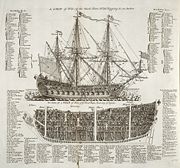
The adoption of line-of-battle tactics had consequences for ship design. The height advantage given by the castles fore and aft was reduced, now that hand-to-hand combat was less essential. The need to manoeuvre in battle made the top weight of the castles more of a disadvantage. So they shrank, making the ship of the line lighter and more manoeuvrable than its forebears for the same combat power. As an added consequence, the hull itself grew larger, allowing the size and number of guns to increase as well.
Evolution of design
In the 17th century fleetsNaval fleet
A fleet, or naval fleet, is a large formation of warships, and the largest formation in any navy. A fleet at sea is the direct equivalent of an army on land....
could consist of almost a hundred ships of various sizes, but by the middle of the 18th century, ship-of-the-line design had settled on a few standard types: older two-decker
Two-decker
A two-decker is a sail warship which carried her guns on two fully armed decks. Usually additional guns were carried on the upper works , but this was not a continuous battery, so were not counted....
s (i.e., with two complete decks of guns firing through side ports) of 50 guns (which were too weak for the battle line but could be used to escort convoy
Convoy
A convoy is a group of vehicles, typically motor vehicles or ships, traveling together for mutual support and protection. Often, a convoy is organized with armed defensive support, though it may also be used in a non-military sense, for example when driving through remote areas.-Age of Sail:Naval...
s), two-deckers of between 64 and 90 guns which formed the main part of the fleet, and larger three
Three-decker
A three-decker is a sail warship which carried her guns on three fully armed decks. Usually additional guns were carried on the upper works , but this was not a continuous battery and so did not count. Three-deckers were usually "ships of the line", i.e...
- or even four-deckers with 98 to 140 guns which were used as admirals' command ships. Fleets consisting of perhaps 10 to 25 of these ships, with their attendant supply ships and scouting and messenger frigates, kept control of the sea lanes for major European naval powers whilst restricting sea-borne trade of enemies.
The most common size of sail ship of the line was the "74"
Seventy-four (ship)
The "seventy-four" was a type of two-decked sailing ship of the line nominally carrying 74 guns. Originally developed by the French Navy in the mid-18th century, the design proved to be a good balance between firepower and sailing qualities, and was adopted by the British Royal Navy , as well as...
(named for its 74 guns), originally developed by France in the 1730s, and later adopted by all battleship navies. Until this time the British had 6 sizes of ship of the line, and they found that their smaller 50- and 60-gun ships were becoming too small for the battle line, while their 80s and over were 3-deckers and therefore unwieldy and unstable in heavy seas. Their best were 70-gun 2-deckers of about 46 metres (150 ft) long on the gundeck, while the new French 74s were around 52 metres (170 ft). In 1747 the British captured a few of these French ships during the War of Austrian Succession. In the next decade Thomas Slade
Thomas Slade
Sir Thomas Slade was an English naval architect, most famous for designing HMS Victory, Lord Nelson's flagship at the Battle of Trafalgar in 1805.-Career Outline:...
(Surveyor of the navy from 1755, along with co-Surveyor William Bately) broke away from the past and designed several new classes of 51- to 52-metre 74s to compete with these French designs, starting with the Dublin
Dublin class ship of the line
The Dublin class ships of the line were a class of seven 74-gun Third rates, designed for the Royal Navy by Sir Thomas Slade.-Design:The Dublin class ships were the first 74-gun ships to be designed for the Royal Navy, and marked the beginning of a more dynamic era of naval design than that in the...
and Bellona
Bellona class ship of the line
The Bellona-class ships of the line were a class of five 74-gun third rates, whose design for the Royal Navy by Sir Thomas Slade was approved on 31 January 1758. Three ships were ordered on 28 December 1757, with names being assigned on 1 February 1758...
classes. Their successors gradually improved handling and size through the 1780s. Other navies ended up building 74s also as they had the right balance between offensive power, cost, and manoeuvrability. Eventually around half of Britain's ships of the line were 74s. Larger vessels were still built, as command ships, but they were more useful only if they could definitely get close to an enemy, rather than in a battle involving chasing or manoeuvring. The 74 remained the favoured ship until 1811, when Seppings's
Robert Seppings
Sir Robert Seppings FRS was an English naval architect.Seppings was born at Fakenham, Norfolk, and in 1782 was apprenticed in Plymouth dockyard...
method of construction enabled bigger ships to be built with more stability.
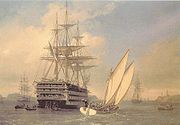
Razee
A razee or razée is a sailing ship that has been cut down to reduce the number of decks. The word is derived from the French vaisseau rasé, meaning a razed ship.-Sixteenth century:...
. The resulting razeed ship could be classed as a frigate and was still much stronger. The most successful razeed ship in the Royal Navy
Royal Navy
The Royal Navy is the naval warfare service branch of the British Armed Forces. Founded in the 16th century, it is the oldest service branch and is known as the Senior Service...
was HMS Indefatigable
HMS Indefatigable (1784)
HMS Indefatigable was one of the Ardent class 64-gun third-rate ships-of-the-line designed by Sir Thomas Slade in 1761 for the Royal Navy. She had a long career under several distinguished commanders, serving throughout the French Revolutionary Wars and the Napoleonic Wars...
, which was commanded by Sir Edward Pellew
Edward Pellew, 1st Viscount Exmouth
Admiral Sir Edward Pellew, 1st Viscount Exmouth, GCB was a British naval officer. He fought during the American War of Independence, the French Revolutionary, and the Napoleonic Wars...
.
Mahmudiye
Mahmudiye (ship)
The Mahmudiye , built in 1829, was a ship of the line of the Ottoman Navy. She was a three–masted three–decked 128–gunned sailing ship, which could perhaps be considered to be one of the few completed heavy-first rate battleships...
(1829), ordered by the Ottoman
Ottoman Empire
The Ottoman EmpireIt was usually referred to as the "Ottoman Empire", the "Turkish Empire", the "Ottoman Caliphate" or more commonly "Turkey" by its contemporaries...
Sultan Mahmud II
Mahmud II
Mahmud II was the 30th Sultan of the Ottoman Empire from 1808 until his death in 1839. He was born in the Topkapi Palace, Istanbul, the son of Sultan Abdulhamid I...
and built by the Imperial Naval Arsenal on the Golden Horn
Golden Horn
The Golden Horn is a historic inlet of the Bosphorus dividing the city of Istanbul and forming the natural harbor that has sheltered Greek, Roman, Byzantine, Ottoman and other ships for thousands of...
in Constantinople
Istanbul
Istanbul , historically known as Byzantium and Constantinople , is the largest city of Turkey. Istanbul metropolitan province had 13.26 million people living in it as of December, 2010, which is 18% of Turkey's population and the 3rd largest metropolitan area in Europe after London and...
, was for many years the largest warship in the world. The 76.15 by 21.22 m (249.8 by 69.6 ft)The vessel was 201 kadem in length and 56 kadem in beam. One kadem measures 37.887 centimetres (1.2 ft). Kadem (which translates as "foot") is often misinterpreted as equivalent in length to one imperial foot, hence the wrongly converted dimensions of "201×56 ft, or 62×17 m" in some sources. ship of the line was armed with 128 cannons on three decks and was manned by 1,280 sailors. She participated in many important naval battles, including the Siege of Sevastopol (1854–1855) during the Crimean War (1854–1856)
Crimean War
The Crimean War was a conflict fought between the Russian Empire and an alliance of the French Empire, the British Empire, the Ottoman Empire, and the Kingdom of Sardinia. The war was part of a long-running contest between the major European powers for influence over territories of the declining...
. She was decommissioned in 1874.
The largest sailing three-decker ship of the line ever built in the West was the French Valmy
French ship Valmy
Valmy, named after the Battle of Valmy, was the largest three-decker of the French Navy, and the largest tall ship ever built in France.-Design:Valmy was laid down at Brest in 1838 as Formidable and launched in 1847...
, launched in 1847. She had right sides, which increased significantly the space available for upper batteries, but reduced the stability of the ship; wooden stabilizers were added under the waterline to address the issue. Valmy was thought to be the largest sort of sailing ship possible, as larger dimensions made the manoeuvre of riggings impractical with mere manpower. She participated in the Crimean War, and after her return to France later housed the French Naval Academy under the name Borda from 1864 to 1890.
Steam power
The first major change to the ship-of-the-line concept was the introduction of steam power as an auxiliary propulsion system. The first military uses of steamships came in the 1810s, and in the 1820s a number of navies experimented with paddle steamerPaddle steamer
A paddle steamer is a steamship or riverboat, powered by a steam engine, using paddle wheels to propel it through the water. In antiquity, Paddle wheelers followed the development of poles, oars and sails, where the first uses were wheelers driven by animals or humans...
warships. Their use spread in the 1830s, with paddle-steamer warships participating in conflicts like the First Opium War
First Opium War
The First Anglo-Chinese War , known popularly as the First Opium War or simply the Opium War, was fought between the United Kingdom and the Qing Dynasty of China over their conflicting viewpoints on diplomatic relations, trade, and the administration of justice...
alongside ships of the line and frigates.
Paddle steamers, however, had major disadvantages. The paddle wheel above the waterline was exposed to enemy fire, while itself preventing the ship from firing broadsides effectively. During the 1840s, the screw propeller emerged as the most likely method of steam propulsion, with both Britain and the USA launching screw-propelled warships in 1843. Through the 1840s, the British and French navies launched ever larger and more powerful screw ships, alongside sail-powered ships of the line. In 1845, Viscount Palmerston
Henry Temple, 3rd Viscount Palmerston
Henry John Temple, 3rd Viscount Palmerston, KG, GCB, PC , known popularly as Lord Palmerston, was a British statesman who served twice as Prime Minister in the mid-19th century...
gave an indication of the role of the new steamships in tense Anglo-French relations, describing the English Channel
English Channel
The English Channel , often referred to simply as the Channel, is an arm of the Atlantic Ocean that separates southern England from northern France, and joins the North Sea to the Atlantic. It is about long and varies in width from at its widest to in the Strait of Dover...
as a "steam bridge", rather than a barrier to French invasion. It was partly because of the fear of war with France that the Royal Navy converted several old 74-gun ships of the line into 60-gun steam-powered blockship
Blockship
A blockship is a ship deliberately sunk to prevent a river, channel, or canal from being used.It may either be sunk by a navy defending the waterway to prevent the ingress of attacking enemy forces, as in the case of HMS Hood at Portland Harbour; or it may be brought by enemy raiders and used to...
s, starting in 1845. The blockships were "originally conceived as steam batteries solely for harbour defence, but in September 1845 they were given a reduced [sailing] rig rather than none at all, to make them sea-going ships....The blockships were to be a cost-effective experiment of great value." They subsequently gave good service in the Crimean War
Crimean War
The Crimean War was a conflict fought between the Russian Empire and an alliance of the French Empire, the British Empire, the Ottoman Empire, and the Kingdom of Sardinia. The war was part of a long-running contest between the major European powers for influence over territories of the declining...
.
.jpg)
French Navy
The French Navy, officially the Marine nationale and often called La Royale is the maritime arm of the French military. It includes a full range of fighting vessels, from patrol boats to a nuclear powered aircraft carrier and 10 nuclear-powered submarines, four of which are capable of launching...
, however, developed the first purpose-built steam battleship with the 90-gun Le Napoléon
Le Napoléon (1850)
The Napoléon was a 90-gun ship of the line of the French Navy, and the very first purpose-built steam battleship in the world . She is also considered the first true steam battleship, and the first screw battleship ever . Launched in 1850, she was the lead ship of a class of 9 battleships, all...
in 1850. She is also considered the first true steam battleship, and the first screw battleship ever. Napoleon was armed as a conventional ship of the line, but her steam engines could give her a speed of 12 knots (22 km/h), regardless of the wind conditions—a potentially decisive advantage in a naval engagement.
Eight sister ships to Le Napoléon were built in France over a period of ten years, but the United Kingdom soon took the lead in production, in number of both purpose-built and converted units. Altogether, France built 10 new wooden steam battleships and converted 28 from older battleship units, while the United Kingdom built 18 and converted 41.
In the end, France and Britain were the only two countries to develop fleets of wooden steam screw battleships, although several other navies made some use of a mixture of screw battleships and paddle-steamer frigates. These included Russia, Turkey
Turkey
Turkey , known officially as the Republic of Turkey , is a Eurasian country located in Western Asia and in East Thrace in Southeastern Europe...
, Sweden
Sweden
Sweden , officially the Kingdom of Sweden , is a Nordic country on the Scandinavian Peninsula in Northern Europe. Sweden borders with Norway and Finland and is connected to Denmark by a bridge-tunnel across the Öresund....
, Naples
Kingdom of the Two Sicilies
The Kingdom of the Two Sicilies, commonly known as the Two Sicilies even before formally coming into being, was the largest and wealthiest of the Italian states before Italian unification...
, Prussia
Prussia
Prussia was a German kingdom and historic state originating out of the Duchy of Prussia and the Margraviate of Brandenburg. For centuries, the House of Hohenzollern ruled Prussia, successfully expanding its size by way of an unusually well-organized and effective army. Prussia shaped the history...
, Denmark
Denmark
Denmark is a Scandinavian country in Northern Europe. The countries of Denmark and Greenland, as well as the Faroe Islands, constitute the Kingdom of Denmark . It is the southernmost of the Nordic countries, southwest of Sweden and south of Norway, and bordered to the south by Germany. Denmark...
, and Austria
Austria
Austria , officially the Republic of Austria , is a landlocked country of roughly 8.4 million people in Central Europe. It is bordered by the Czech Republic and Germany to the north, Slovakia and Hungary to the east, Slovenia and Italy to the south, and Switzerland and Liechtenstein to the...
.
Decline
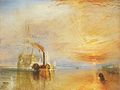
In the Crimean War
Crimean War
The Crimean War was a conflict fought between the Russian Empire and an alliance of the French Empire, the British Empire, the Ottoman Empire, and the Kingdom of Sardinia. The war was part of a long-running contest between the major European powers for influence over territories of the declining...
, six line-of-battle ships and two frigates of the Russian Black Sea Fleet
Black Sea Fleet
The Black Sea Fleet is a large operational-strategic sub-unit of the Russian Navy, operating in the Black Sea and the Mediterranean Sea since the late 18th century. It is based in various harbors of the Black Sea and the Sea of Azov....
destroyed seven Turkish frigates and three corvettes with explosive shells at the Battle of Sinop
Battle of Sinop
The Battle of Sinop, or the Battle of Sinope, took place on 30 November 1853 at Sinop, a sea port in northern Anatolia, when Imperial Russian warships struck and annihilated a patrol force of Ottoman ships anchored in the harbor...
in 1853.
In the 1860s unarmoured steam line-of-battle ships were replaced by ironclad warship
Ironclad warship
An ironclad was a steam-propelled warship in the early part of the second half of the 19th century, protected by iron or steel armor plates. The ironclad was developed as a result of the vulnerability of wooden warships to explosive or incendiary shells. The first ironclad battleship, La Gloire,...
s. On March 8, 1862, during the first day of the Battle of Hampton Roads
Battle of Hampton Roads
The Battle of Hampton Roads, often referred to as either the Battle of the Monitor and Merrimack or the Battle of Ironclads, was the most noted and arguably most important naval battle of the American Civil War from the standpoint of the development of navies...
, two unarmoured wooden frigates were sunk and destroyed by the Confederate ironclad CSS Virginia
CSS Virginia
CSS Virginia was the first steam-powered ironclad warship of the Confederate States Navy, built during the first year of the American Civil War; she was constructed as a casemate ironclad using the raised and cut down original lower hull and steam engines of the scuttled . Virginia was one of the...
.
However, the power implied by the ship of the line would find its way into the ironclad, which would develop during the next few decades into the concept of the battleship.
Combat
Although Spain, the Netherlands, and France built huge fleets, and in France's case even with better ships, they were rarely able to match the skill of British naval crews. British crews excelled, in part, because they spent much more time at sea, were generally better fed, were well trained in gunnery (allowing a faster rate of fire), and were generally more competent, as the Royal NavyRoyal Navy
The Royal Navy is the naval warfare service branch of the British Armed Forces. Founded in the 16th century, it is the oldest service branch and is known as the Senior Service...
based promotion much more on merit rather than purchase. The British Army
British Army
The British Army is the land warfare branch of Her Majesty's Armed Forces in the United Kingdom. It came into being with the unification of the Kingdom of England and Scotland into the Kingdom of Great Britain in 1707. The new British Army incorporated Regiments that had already existed in England...
has usually been smaller than the armies of comparably prominent continental countries, while the navy tended to be larger than the individual navies of each continental power.
In the North Sea
North Sea
In the southwest, beyond the Straits of Dover, the North Sea becomes the English Channel connecting to the Atlantic Ocean. In the east, it connects to the Baltic Sea via the Skagerrak and Kattegat, narrow straits that separate Denmark from Norway and Sweden respectively...
and North Atlantic Ocean, the fleets of Great Britain, the Netherlands, France, and Spain fought numerous battles in support of their land armies and to deny the enemy access to trade routes. In the Baltic Sea
Baltic Sea
The Baltic Sea is a brackish mediterranean sea located in Northern Europe, from 53°N to 66°N latitude and from 20°E to 26°E longitude. It is bounded by the Scandinavian Peninsula, the mainland of Europe, and the Danish islands. It drains into the Kattegat by way of the Øresund, the Great Belt and...
, Sweden, Denmark, the Netherlands, and Russia did likewise, while in the Mediterranean Sea
Mediterranean Sea
The Mediterranean Sea is a sea connected to the Atlantic Ocean surrounded by the Mediterranean region and almost completely enclosed by land: on the north by Anatolia and Europe, on the south by North Africa, and on the east by the Levant...
, Russia, Ottoman Turkey
Ottoman Empire
The Ottoman EmpireIt was usually referred to as the "Ottoman Empire", the "Turkish Empire", the "Ottoman Caliphate" or more commonly "Turkey" by its contemporaries...
, Venice
Venice
Venice is a city in northern Italy which is renowned for the beauty of its setting, its architecture and its artworks. It is the capital of the Veneto region...
, Portugal
Portugal
Portugal , officially the Portuguese Republic is a country situated in southwestern Europe on the Iberian Peninsula. Portugal is the westernmost country of Europe, and is bordered by the Atlantic Ocean to the West and South and by Spain to the North and East. The Atlantic archipelagos of the...
, Britain, and France battled for control.
During the Napoleonic Wars
Napoleonic Wars
The Napoleonic Wars were a series of wars declared against Napoleon's French Empire by opposing coalitions that ran from 1803 to 1815. As a continuation of the wars sparked by the French Revolution of 1789, they revolutionised European armies and played out on an unprecedented scale, mainly due to...
, Britain defeated Europe's major naval powers at battles such as at Copenhagen, Cape St Vincent, Aboukir ("The Nile"), and Trafalgar
Battle of Trafalgar
The Battle of Trafalgar was a sea battle fought between the British Royal Navy and the combined fleets of the French Navy and Spanish Navy, during the War of the Third Coalition of the Napoleonic Wars ....
, allowing the Royal Navy to establish itself as the world's primary naval power. Spain, Denmark, and Portugal largely stopped building ships of the line during this time under duress from the British. Britain emerged from the Napoleonic Wars
Napoleonic Wars
The Napoleonic Wars were a series of wars declared against Napoleon's French Empire by opposing coalitions that ran from 1803 to 1815. As a continuation of the wars sparked by the French Revolution of 1789, they revolutionised European armies and played out on an unprecedented scale, mainly due to...
in 1815 with the largest and most professional navy in the world, composed of hundreds of wooden, sail-powered ships of all sizes and classes. The Royal Navy
Royal Navy
The Royal Navy is the naval warfare service branch of the British Armed Forces. Founded in the 16th century, it is the oldest service branch and is known as the Senior Service...
had complete naval supremacy across the world following the Napoleonic Wars, and it demonstrated this superiority during the Crimean War
Crimean War
The Crimean War was a conflict fought between the Russian Empire and an alliance of the French Empire, the British Empire, the Ottoman Empire, and the Kingdom of Sardinia. The war was part of a long-running contest between the major European powers for influence over territories of the declining...
in the 1850s.
Nonetheless, the Napoleonic Wars, as well as the American War of 1812
War of 1812
The War of 1812 was a military conflict fought between the forces of the United States of America and those of the British Empire. The Americans declared war in 1812 for several reasons, including trade restrictions because of Britain's ongoing war with France, impressment of American merchant...
, had illustrated the shortcomings of ships of the line when an enemy resorted to tactics including the large-scale use of privateer
Privateer
A privateer is a private person or ship authorized by a government by letters of marque to attack foreign shipping during wartime. Privateering was a way of mobilizing armed ships and sailors without having to spend public money or commit naval officers...
s. Both the French and the Americans had demonstrated what a menace small, lightly armed, but fast, nimble, and, most especially, numerous vessels like sloop
Sloop
A sloop is a sail boat with a fore-and-aft rig and a single mast farther forward than the mast of a cutter....
s and schooners could be when they spread across the wide oceans, operating singly or in small groups. They targeted the merchant shipping that was Britain's economic lifeblood, and ships of the line were too few, too slow, and too clumsy to be employed against them.
Overwhelming firepower was of no use if it could not be brought to bear: the Royal Navy's initial response to Napoleon's privateers, which operated from French New World
New World
The New World is one of the names used for the Western Hemisphere, specifically America and sometimes Oceania . The term originated in the late 15th century, when America had been recently discovered by European explorers, expanding the geographical horizon of the people of the European middle...
territories, was to buy Bermuda sloop
Bermuda sloop
The Bermuda sloop is a type of fore-and-aft rigged sailing vessel developed on the islands of Bermuda in the 17th century. In its purest form, it is single-masted, although ships with such rigging were built with as many as three masts, which are then referred to as schooners...
s. Similarly, the East India Company
British East India Company
The East India Company was an early English joint-stock company that was formed initially for pursuing trade with the East Indies, but that ended up trading mainly with the Indian subcontinent and China...
's merchant vessels became lightly armed and quite competent in combat during this period, operating a convoy system under an armed merchantman, instead of depending on small numbers of more heavily armed ships.
Restorations and replicas
The only original ship of the line remaining today is HMS VictoryHMS Victory
HMS Victory is a 104-gun first-rate ship of the line of the Royal Navy, laid down in 1759 and launched in 1765. She is most famous as Lord Nelson's flagship at the Battle of Trafalgar in 1805....
, preserved as a museum to appear as she was while under Admiral Horatio Nelson at Trafalgar. Although Victory is in drydock, she is still a fully commissioned warship in the Royal Navy and has the honour of being the oldest commissioned warship in any navy worldwide.
The Regalskeppet Vasa
Regalskeppet Vasa
Vasa is a Swedish warship that was built from 1626 to 1628. The ship foundered and sank after sailing less than a nautical mile into its maiden voyage on 10 August 1628. It fell into obscurity after most of its valuable bronze cannons were salvaged in the 17th century...
sank in the Baltic in 1628 and was lost until 1956. She was then raised intact, in remarkably good condition, in 1961 and is presently on display at the Vasa Museum
Vasa Museum
The Vasa Museum is a maritime museum in Stockholm, Sweden. Located on the island of Djurgården, the museum displays the only almost fully intact 17th century ship that has ever been salvaged, the 64-gun warship Vasa that sank on her maiden voyage in 1628. The Vasa Museum opened in 1990 and,...
in Stockholm, Sweden. At the time she was the largest Swedish warship ever built. Today the Vasa Museum is the most visited museum in Sweden.
The remains of the Mary Rose
Mary Rose
The Mary Rose was a carrack-type warship of the English Tudor navy of King Henry VIII. After serving for 33 years in several wars against France, Scotland, and Brittany and after being substantially rebuilt in 1536, she saw her last action on 1545. While leading the attack on the galleys of a...
were raised in 1982 and are on display in Portsmouth, England. Although Mary Rose consists of only half of a ship, it is a remarkable example of ship construction from Tudor England, and like Vasa, it contained a wealth of artefacts which tell of the daily lives of those on board.
Also on display in Portsmouth is a sail-and-steam-powered ship HMS Warrior
HMS Warrior (1860)
HMS Warrior was the first iron-hulled, armour-plated warship, built for the Royal Navy in response to the first ironclad warship, the French Gloire, launched a year earlier....
, built in 1860. Warrior was the world’s first iron-hulled, armoured warship powered by steam as well as sail and constructed of wrought iron. The only surviving member of Queen Victoria
Victoria of the United Kingdom
Victoria was the monarch of the United Kingdom of Great Britain and Ireland from 20 June 1837 until her death. From 1 May 1876, she used the additional title of Empress of India....
's Black Battlefleet, Warrior was used for 50 years as an oil jetty at Milford Haven before being restored to her former glory.
In 1997 a project to rebuild a famous French frigate was able to lay the keel in a dry dock in Rochefort. The frigate Hermione
French frigate Hermione (1779)
The Hermione was a 12-pounder Concorde class frigate of the French Navy. She became famous when she ferried General Lafayette to the United States in 1780 to allow him to join the American side in the American Revolutionary War.- History :...
was the ship that carried Lafayette
Gilbert du Motier, marquis de La Fayette
Marie-Joseph Paul Yves Roch Gilbert du Motier, Marquis de La Fayette , often known as simply Lafayette, was a French aristocrat and military officer born in Chavaniac, in the province of Auvergne in south central France...
to the US during the American revolutionary war. The original Hermione was sunk in 1793 off the French coast, and her wreck was rediscovered in 1992. Fortunately, the British had captured her sister ship in the Napoleonic wars and had recorded her construction in great detail, which documents were then available for the reconstruction. The replica is faithful in almost every way to the original. The ship is 56 metres long and carries 26×12-pounder armament. The project site contains many very interesting photos of her construction, a site for the book to accompany her build and launch (in English) gives some summary details.
See also
- List of battleships by country
- Dutch Navy ships of the line
- French Navy ships of the line
- Royal Navy ships of the line
- Spanish Navy ships of the line
- United States Navy ships of the line
- Portuguese Navy ships of the line
- Man-of-war
External links
- Michael Philips, Notes on Sailing Warships, 2000.
- Ship of the Line from battleships-cruisers.co.uk History of the Ship of the Line of the Royal Navy]
- Reconstruction of Ship of the Line 'Delft' (1783–1797). Rotterdam (Delfshaven) The Netherlands