


Sail

Encyclopedia
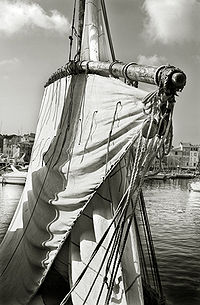
Windmill sail
Windmills are powered by their sails. Sails are found in different designs, from primitive common sails to the advanced patent sails.-Jib sails:...
by being placed in a wind
Wind
Wind is the flow of gases on a large scale. On Earth, wind consists of the bulk movement of air. In outer space, solar wind is the movement of gases or charged particles from the sun through space, while planetary wind is the outgassing of light chemical elements from a planet's atmosphere into space...
—in essence a propulsion wing
Wing
A wing is an appendage with a surface that produces lift for flight or propulsion through the atmosphere, or through another gaseous or liquid fluid...
. Sails are used in sailing
Sailing
Sailing is the propulsion of a vehicle and the control of its movement with large foils called sails. By changing the rigging, rudder, and sometimes the keel or centre board, a sailor manages the force of the wind on the sails in order to move the boat relative to its surrounding medium and...
.
History of sails
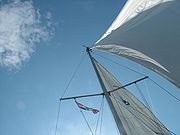
Ancient Egypt
Ancient Egypt was an ancient civilization of Northeastern Africa, concentrated along the lower reaches of the Nile River in what is now the modern country of Egypt. Egyptian civilization coalesced around 3150 BC with the political unification of Upper and Lower Egypt under the first pharaoh...
around 3200 BCE, where reed boats sailed upstream against the River Nile
Nile
The Nile is a major north-flowing river in North Africa, generally regarded as the longest river in the world. It is long. It runs through the ten countries of Sudan, South Sudan, Burundi, Rwanda, Democratic Republic of the Congo, Tanzania, Kenya, Ethiopia, Uganda and Egypt.The Nile has two major...
's current. Ancient Sumerians were using square rigged sailing boats at about the same time, and it is believed they established sea trading routes as far away as the Indus valley. The proto-Austronesian words for sail, lay(r), and other rigging parts date to about 3000 BCE when this group began their Pacific expansion. Greeks
Greeks
The Greeks, also known as the Hellenes , are a nation and ethnic group native to Greece, Cyprus and neighboring regions. They also form a significant diaspora, with Greek communities established around the world....
and Phoenicians began trading by ship by around 1,200 BCE.
Square sails
Square rig
Square rig is a generic type of sail and rigging arrangement in which the primary driving sails are carried on horizontal spars which are perpendicular, or square, to the keel of the vessel and to the masts. These spars are called yards and their tips, beyond the last stay, are called the yardarms...
mounted on yardarms perpendicular to the boat's hull are very good for downwind sailing; they dominated in the ancient Mediterranean and spread to Northern Europe, and were independently invented in China
China
Chinese civilization may refer to:* China for more general discussion of the country.* Chinese culture* Greater China, the transnational community of ethnic Chinese.* History of China* Sinosphere, the area historically affected by Chinese culture...
and Ecuador
Ecuador
Ecuador , officially the Republic of Ecuador is a representative democratic republic in South America, bordered by Colombia on the north, Peru on the east and south, and by the Pacific Ocean to the west. It is one of only two countries in South America, along with Chile, that do not have a border...
. Although fore-and-aft rigs have become more popular on modern yachts, square sails
Square rig
Square rig is a generic type of sail and rigging arrangement in which the primary driving sails are carried on horizontal spars which are perpendicular, or square, to the keel of the vessel and to the masts. These spars are called yards and their tips, beyond the last stay, are called the yardarms...
continued to power full-rigged ships through the Age of Sail
Age of Sail
The Age of Sail was the period in which international trade and naval warfare were dominated by sailing ships, lasting from the 16th to the mid 19th century...
and to the present day. Triangular fore-and-aft rigs were invented in the Mediterranean as single yarded lateen
Lateen
A lateen or latin-rig is a triangular sail set on a long yard mounted at an angle on the mast, and running in a fore-and-aft direction....
sails and independently in the Pacific as the more efficient bi sparred crab claw sail
Crab claw sail
The crab claw sail or, as it is sometimes known, Oceanic lateen or Oceanic sprit, is a triangular sail with spars along upper and lower edges. The crab claw sail is used in many traditional Pacific Ocean cultures, as can be seen by the traditional proa and tepukei.-Construction:The crab claw sail...
, and continue to be used throughout the world. During the 16th-19th centuries other fore-and-aft sails were developed in Europe, such as the spritsail
Spritsail
The spritsail is a form of three or four-sided, fore-aft sail and its rig. Unlike the gaff where the head hangs from a spar along its edge, this rig supports the leech of the sail by means of a spar or spars named a sprit...
, gaff rig
Gaff rig
Gaff rig is a sailing rig in which the sail is four-cornered, fore-and-aft rigged, controlled at its peak and, usually, its entire head by a spar called the gaff...
, jib
Jib
A jib is a triangular staysail set ahead of the foremast of a sailing vessel. Its tack is fixed to the bowsprit, to the bow, or to the deck between the bowsprit and the foremost mast...
/genoa
Genoa (sail)
The genoa or jenny was originally referred to as the 'overlapping jib' or the Genoa jib, being named after the city of Genoa as explained below. It is a type of large jib or staysail used on bermuda rigged craft that overlaps the main sail, sometimes eliminating it. It is used on single-masted...
/staysail
Staysail
A staysail is a fore-and-aft rigged sail whose luff can be affixed to a stay running forward from a mast to the deck, the bowsprit or to another mast....
, and Bermuda rig
Bermuda rig
The term Bermuda rig refers to a configuration of mast and rigging for a type of sailboat and is also known as a Marconi rig; this is the typical configuration for most modern sailboats...
, improving European upwind sailing ability.
In an interesting recent development, an elderly trawler, TS Pelican, was fitted with what are thought to have been the unorthodox riggings
Xebec
A xebec , also spelled zebec, was a Mediterranean sailing ship that was used mostly for trading. It would have a long overhanging bowsprit and protruding mizzen mast...
used by the Barbary pirates in the 16th century. The resultant performance has been remarkable, with the Pelican sailing, at speed, over 20 degrees nearer the wind than any square rigger.
Space satellites have successfully deployed solar sails which use radiation pressure
Radiation pressure
Radiation pressure is the pressure exerted upon any surface exposed to electromagnetic radiation. If absorbed, the pressure is the power flux density divided by the speed of light...
or solar wind
Solar wind
The solar wind is a stream of charged particles ejected from the upper atmosphere of the Sun. It mostly consists of electrons and protons with energies usually between 1.5 and 10 keV. The stream of particles varies in temperature and speed over time...
to propel them.
Use of sails
Sails are primarily used on the water by sailing shipSailing ship
The term sailing ship is now used to refer to any large wind-powered vessel. In technical terms, a ship was a sailing vessel with a specific rig of at least three masts, square rigged on all of them, making the sailing adjective redundant. In popular usage "ship" became associated with all large...
s and sail boats as a propulsion
Marine propulsion
Marine propulsion is the mechanism or system used to generate thrust to move a ship or boat across water. While paddles and sails are still used on some smaller boats, most modern ships are propelled by mechanical systems consisting a motor or engine turning a propeller, or less frequently, in jet...
system. For purposes of commerce, sails have been greatly superseded by other forms of propulsion, such as the internal combustion engine
Internal combustion engine
The internal combustion engine is an engine in which the combustion of a fuel occurs with an oxidizer in a combustion chamber. In an internal combustion engine, the expansion of the high-temperature and high -pressure gases produced by combustion apply direct force to some component of the engine...
. For recreation
Recreation
Recreation is an activity of leisure, leisure being discretionary time. The "need to do something for recreation" is an essential element of human biology and psychology. Recreational activities are often done for enjoyment, amusement, or pleasure and are considered to be "fun"...
, however, sailing vessels remain popular.
The most familiar type of sailboat, a small pleasure yacht
Yacht
A yacht is a recreational boat or ship. The term originated from the Dutch Jacht meaning "hunt". It was originally defined as a light fast sailing vessel used by the Dutch navy to pursue pirates and other transgressors around and into the shallow waters of the Low Countries...
, usually has a sail-plan
Sail-plan
A sail-plan is a set of drawings, usually prepared by a naval architect. It shows the various combinations of sail proposed for a sailing ship.The combinations shown in a sail-plan almost always include three configurations:...
called a sloop
Sloop
A sloop is a sail boat with a fore-and-aft rig and a single mast farther forward than the mast of a cutter....
. This has two sails in a fore-and-aft arrangement: the mainsail
Mainsail
A mainsail is a sail located behind the main mast of a sailing vessel.On a square rigged vessel, it is the lowest and largest sail on the main mast....
and the jib
Jib
A jib is a triangular staysail set ahead of the foremast of a sailing vessel. Its tack is fixed to the bowsprit, to the bow, or to the deck between the bowsprit and the foremost mast...
.
The mainsail extends aftward and is secured the whole length of its edges to the mast
Mast (sailing)
The mast of a sailing vessel is a tall, vertical, or near vertical, spar, or arrangement of spars, which supports the sails. Large ships have several masts, with the size and configuration depending on the style of ship...
and to a boom
Boom (sailing)
In sailing, a boom is a spar , along the foot of a fore and aft rigged sail, that greatly improves control of the angle and shape of the sail. The primary action of the boom is to keep the foot of the sail flatter when the sail angle is away from the centerline of the boat. The boom also serves...
also hung from the mast. The sails of tall ships are attached to wooden timbers or "spar
Spar
In sailing, a spar is a pole of wood, metal or lightweight materials such as carbon fiber used on a sailing vessel. Spars of all types In sailing, a spar is a pole of wood, metal or lightweight materials such as carbon fiber used on a sailing vessel. Spars of all types In sailing, a spar is a...
s".
The jib
Jib
A jib is a triangular staysail set ahead of the foremast of a sailing vessel. Its tack is fixed to the bowsprit, to the bow, or to the deck between the bowsprit and the foremost mast...
is secured along its leading edge to a forestay
Forestay
On a sailing vessel, a forestay, sometimes just called a stay, is a piece of standing rigging which keeps a mast from falling backwards. It is attached either at the very top of the mast, or in fractional rigs between about 1/8 and 1/4 from the top of the mast. The other end of the forestay is...
(strong wire) strung from the top of the mast to the bowsprit
Bowsprit
The bowsprit of a sailing vessel is a pole extending forward from the vessel's prow. It provides an anchor point for the forestay, allowing the fore-mast to be stepped farther forward on the hull.-Origin:...
on the bow (nose) of the boat. A genoa
Genoa (sail)
The genoa or jenny was originally referred to as the 'overlapping jib' or the Genoa jib, being named after the city of Genoa as explained below. It is a type of large jib or staysail used on bermuda rigged craft that overlaps the main sail, sometimes eliminating it. It is used on single-masted...
is also used on some boats. It is a type of jib that is large enough to overlap the mainsail, and cut so that it is fuller than an ordinary jib producing a greater driving force in lighter winds.
A spinnaker
Spinnaker
A spinnaker is a special type of sail that is designed specifically for sailing off the wind from a reaching course to a downwind, i.e. with the wind 90°–180° off the bow. The spinnaker fills with wind and balloons out in front of the boat when it is deployed, called flying. It is constructed of...
is also used on some boats and is used to help move the sailboat faster downwind. The spinnaker is often a colorful sail and can be either symmetrical (see the J/24 sailboat example) http://www.jboats.com/j24/j24gallery.htm or asymmetrical (see the J/80 sailboat example) http://www.jboats.com/j80/j80images.htm.
Fore-and-aft sails can be switched from one side of the boat to the other in order to provide propulsion as the sailboat changes direction relative to the wind. When the boat's stern crosses the wind, this is called gybing
Jibe
A jibe or gybe is a sailing maneuver where a sailing vessel turns its stern through the wind, such that the wind direction changes from one side of the boat to the other...
; when the bow crosses the wind, it is called tacking
Tacking
Tacking may refer to:*Tacking or coming about, a sailing maneuver*Tacking , a technical legal concept relating to competing priorities between security interests arising over the same asset...
. Tacking repeatedly from port to starboard and/or vice versa, called "beating", is done in order to allow the boat to follow a course into the wind. Modern boats can sail as close as 30 degrees to the wind.
A primary feature of a properly designed sail is an amount of "draft
Draft (sailing)
In nautical parlance, the draft or draught of a sail is a degree of curvature in a horizontal cross-section. Any sail experiences a force from the prevailing wind just because it impedes the air's passage...
", caused by curvature of the surface of the sail. When the leading edge of a sail is oriented into the wind, the correct curvature helps maximise lift while minimising turbulence and drag, much like the carefully designed curves of aircraft wings. Modern sails are manufactured with a combination of broadseam
Broadseam
Broadseam is a term particular to the making of a sail. The panels that make up the sections of a sail are cut with curves on the connecting edges or seams. This method adds a three dimensional shape to what would ordinarily be a flat triangular or rectangular piece of fabric...
ing and non-stretch fabric (ref New technology below). The former adds draft, while the latter allows the sail to keep a constant shape as the wind pressure increases. The draft of the sail can be reduced in stronger winds by use of a cunningham
Cunningham (sailing)
In sailing, a cunningham or cunningham's eye is a type of downhaul used on a Bermuda rigged sailboat to change the shape of a sail. Sailors also often refer to the cunningham as the "smart pig"....
and outhaul
Outhaul
An outhaul is a line which is part of the running rigging of a sailboat, used to extend a sail and control the shape of the curve of the foot of the sail. It runs from the clew to the end of the boom...
, and also by bending the mast and increasing the downward pressure of the boom by use of a boom vang
Boom vang
A boom vang or kicking strap is a line or piston system on a sailboat used to exert downward force on the boom and thus control the shape of the sail. An older term is "martingale"....
.
Other sail powered machine
Machine
A machine manages power to accomplish a task, examples include, a mechanical system, a computing system, an electronic system, and a molecular machine. In common usage, the meaning is that of a device having parts that perform or assist in performing any type of work...
s include ice yachts, windmill
Windmill
A windmill is a machine which converts the energy of wind into rotational energy by means of vanes called sails or blades. Originally windmills were developed for milling grain for food production. In the course of history the windmill was adapted to many other industrial uses. An important...
s, kite
Kite
A kite is a tethered aircraft. The necessary lift that makes the kite wing fly is generated when air flows over and under the kite's wing, producing low pressure above the wing and high pressure below it. This deflection also generates horizontal drag along the direction of the wind...
s, signs, hang gliders, electric generators, windsurfers , and land sailing
Land sailing
Land sailing, also known as sand yachting or land yachting, is the act of moving across land in a wheeled vehicle powered by wind through the use of a sail. The term comes from analogy with sailing. Historically, land sailing was used as a mode of transportation or recreation...
vehicles.
Sail construction is governed by the science of aerodynamics
Aerodynamics
Aerodynamics is a branch of dynamics concerned with studying the motion of air, particularly when it interacts with a moving object. Aerodynamics is a subfield of fluid dynamics and gas dynamics, with much theory shared between them. Aerodynamics is often used synonymously with gas dynamics, with...
.
Types of rig
Generally speaking, sailing vessels employ two main types of rig:the square rig
Square rig
Square rig is a generic type of sail and rigging arrangement in which the primary driving sails are carried on horizontal spars which are perpendicular, or square, to the keel of the vessel and to the masts. These spars are called yards and their tips, beyond the last stay, are called the yardarms...
and the fore-and-aft rig
Fore-and-aft rig
A fore-and-aft rig is a sailing rig consisting mainly of sails that are set along the line of the keel rather than perpendicular to it. Such sails are described as fore-and-aft rigged....
.
The square rig, which reached its maximum development in the clipper ships and trading barques of the late 19th and early 20th century, relies on rectangular sails hung beneath yards, themselves suspended from the masts and set "square" (i.e., at a right angle to) the keel of the ship. This kind of rig requires an enormous amount of rigging (at least nine ropes per sail) and cannot sail closer than about 60° to the wind. Few vessels of this type are seen today, other than the spectacular ones used for sail training. Most square rigged vessels also carry at least some fore-and-aft sails.
The fore-and-aft rig is far more common: nearly every dinghy and yacht uses this type of rig, in which the sails are mounted parallel to the keel and are secured to the fore of the ship and to the aft rather than side to side. A large mainsail is often rigged abaft the mast(s) and usually a jib in front of it. The foot of the mainsail is usually extended by a boom. Each sail needs only two or three ropes for its basic control.
Sail aerodynamics
Sails propel the boat in one of two ways. When the boat is going in the direction of the wind (i.e. downwind - see Points of sailPoints of sail
Points of sail describes a sailing boat's course in relation to the wind direction.There is a distinction between the port tack and the starboard tack. If the wind is coming from anywhere on the port side, the boat is on port tack. Likewise if the wind is coming from the starboard side, the boat...
), the sails may be set merely to trap the air as it flows by. Sails acting in this way are aerodynamically stalled
Stall (flight)
In fluid dynamics, a stall is a reduction in the lift coefficient generated by a foil as angle of attack increases. This occurs when the critical angle of attack of the foil is exceeded...
. Drag, always parallel to the wind, contributes the predominate driving force.
The other way sails propel the boat occurs when the boat is traveling across or into the wind. The sails acting as airfoils propel the boat by redirecting the wind coming in from the side towards the rear. By the law of conservation of momentum, the wind moves the sail as the sail redirects
Reaction (physics)
The third of Newton's laws of motion of classical mechanics states that forces always occur in pairs. Every action is accompanied by a reaction of equal magnitude but opposite direction. This principle is commonly known in the Latin language as actio et reactio. The attribution of which of the two...
downwash
Downwash
In aeronautics downwash is the air forced down by the aerodynamic action of a wing or helicopter rotor blade in motion, as part of the process of producing lift....
air backwards.
Air pressure differences across the sail area result in forces on sails including drag and lift
Lift (force)
A fluid flowing past the surface of a body exerts a surface force on it. Lift is the component of this force that is perpendicular to the oncoming flow direction. It contrasts with the drag force, which is the component of the surface force parallel to the flow direction...
. A component of the lift is the main driving force.
The sails can also act as airfoils in some downwind situations, e.g. spinnaker
Spinnaker
A spinnaker is a special type of sail that is designed specifically for sailing off the wind from a reaching course to a downwind, i.e. with the wind 90°–180° off the bow. The spinnaker fills with wind and balloons out in front of the boat when it is deployed, called flying. It is constructed of...
s and square-rigged sails can be trimmed so that their upper edges become leading edges and they operate as airfoils again, but with airflow directed more or less vertically downwards. This mode of trim also provides the boat with some actual lift and may reduce both wetted area and the risk of 'digging in' to waves. In stronger winds, turbulence created behind stalled sails can lead to aerodynamic instability, which in turn can manifest as increased downwind rolling of the boat.
Sail are often equipped with lightweight tapes or strands (tell-tale
Tell-tale
A tell-tale or telltale is an indicator, signal, or sign that conveys the status of a situation, mechanism, or system.-Automotive:...
s) to indicate the airflow in their area. They may be on both sides near the leading edges of the sail, or at the trailing edge of the sail. Horizontal strips sewn into fore-and-aft sails and V-shaped markings on spinnakers assist with judging their shape from on deck. These may even glow in the dark, using luminous tapes.
On a sailing boat
Dinghy sailing
Dinghy sailing is the activity of sailing small boats by using five essential controls:* the sails* the foils ....
, a keel
Keel
In boats and ships, keel can refer to either of two parts: a structural element, or a hydrodynamic element. These parts overlap. As the laying down of the keel is the initial step in construction of a ship, in British and American shipbuilding traditions the construction is dated from this event...
or centreboard helps to prevent the boat from moving sideways. The shape of the keel has a much smaller cross section in the fore and aft axis and a much larger cross section on the athwart axis (across the beam of the boat). The resistance to motion along the smallest cross section is low while resistance to motion across the large cross section is high, so the boat moves forward rather than sideways. In other words it is easier for the sail to push the boat forward rather than sideways. However, there is always a small amount of sideways motion, or leeway
Leeway
Leeway is the motion of an object that is floating in the water to leeward due to the component of the wind vector perpendicular to the object’s. The National Search and Rescue Supplement to the International Aeronautical and Maritime Search and Rescue Manual defines leeway as "the movement of a...
.
Forces across the boat are resolved by balancing the sideways force from the sail with the sideways resistance of the keel or centerboard. Also, if the boat heels, there are restoring forces due to the shape of the hull and the mass of the ballast in the keel being raised against gravity. Forward forces are balanced by velocity through the water and friction between the hull, keel and the water.
Parts of the sail
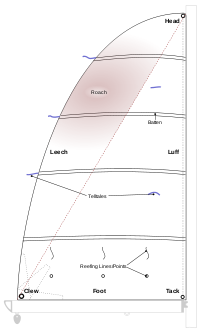
Modern sails are designed such that the warp
Warp (weaving)
In weaving cloth, the warp is the set of lengthwise yarns that are held in tension on a frame or loom. The yarn that is inserted over-and-under the warp threads is called the weft, woof, or filler. Each individual warp thread in a fabric is called a warp end or end. Warp means "that which is thrown...
and the weft
Weft
In weaving, weft or woof is the yarn which is drawn through the warp yarns to create cloth. In North America, it is sometimes referred to as the "fill" or the "filling yarn"....
of the sailcloth are oriented parallel to the luff and foot of the sail. This places the most stretchable axis of the cloth along the diagonal axis (parallel to the leech), and makes it possible for sailors to reduce the draft of the sail by tensioning the sail, mast and boom in various ways.
Often tell-tales, small pieces of yarn, are attached to the sail. They are used as a guide when trimming the sail.
An alternative approach to sail design is that used in junks, originally an oriental design. It uses horizontal sail curving to produce an efficient and easily controlled sail-plan.
Sail types
Modern sails can be classified into three main categories:- MainsailMainsailA mainsail is a sail located behind the main mast of a sailing vessel.On a square rigged vessel, it is the lowest and largest sail on the main mast....
, - HeadsailHeadsailA headsail of a sailing vessel is any sail set forward of the foremost mast. The most common headsails are staysails, a term that includes jibs and the larger genoa...
, - and SpinnakerSpinnakerA spinnaker is a special type of sail that is designed specifically for sailing off the wind from a reaching course to a downwind, i.e. with the wind 90°–180° off the bow. The spinnaker fills with wind and balloons out in front of the boat when it is deployed, called flying. It is constructed of...
or downwind sail (also termed Kite). Special-purpose sails are often a variation of the three main categories.
High-performance yachts, in particular some catamarans such as the International C-Class Catamaran
International C-Class Catamaran
The C-Class Catamaran is a high-performance developmental class sailing catamaran. They are very light boats which use rigid wing sails and can sail at twice the speed of the wind...
, have used or use rigid wing sails, which are said to provide better performance than traditional soft sails. In particular, a rigid wing sail was used by Stars and Stripes, the defender who won the 1988 America's Cup
1988 America's Cup
The 1988 America's Cup was the twenty-eighth running of the America's Cup regatta, and was contested between the defender, San Diego Yacht Club represented by Stars & Stripes, and the challenger, the Mercury Bay Boating Club represented by KZ-1...
, and by USA, the challenger who won the 2010 America's Cup.
Most modern yachts, including bermuda rig
Bermuda rig
The term Bermuda rig refers to a configuration of mast and rigging for a type of sailboat and is also known as a Marconi rig; this is the typical configuration for most modern sailboats...
, ketch
Ketch
A ketch is a sailing craft with two masts: a main mast, and a shorter mizzen mast abaft of the main mast, but forward of the rudder post. Both masts are rigged mainly fore-and-aft. From one to three jibs may be carried forward of the main mast when going to windward...
and yawl
Yawl
A yawl is a two-masted sailing craft similar to a sloop or cutter but with an additional mast located well aft of the main mast, often right on the transom, specifically aft of the rudder post. A yawl (from Dutch Jol) is a two-masted sailing craft similar to a sloop or cutter but with an...
boats, have a sail "inventory" which usually includes more than one of these types of sails. Although the mainsail is “permanently” hoisted while sailing, headsails and spinnakers can be changed depending on the particular weather conditions to allow better handling and speed.
Mainsails, as the name implies, are the main element of the sailplan. A "motor" as well as a rudder for the boat, mainsails can be as simple as a traditional triangle-shaped, cross-cut sail (see Sail Construction below). In most cases, the mainsail isn’t changed while sailing, although there are mechanisms to reduce its surface if the wind is very strong (a technique called reefing
Reefing
Reefing is a sailing manoeuvre intended to reduce the area of a sail on a sailboat or sailing ship, which can improve the ship's stability and reduce the risk of capsizing, broaching, or damaging sails or boat hardware in a strong wind...
). In extreme weather, a mainsail can be folded and a trysail
Trysail
A trysail is small triangular or square fore-and-aft rigged sail hoisted in place of a larger sail when winds are very high....
hoisted to allow steerage without endangering the boat.
Headsails are the main driving sails when going upwind (sailing towards the wind). There are many types of headsails with Genoa
Genoa (sail)
The genoa or jenny was originally referred to as the 'overlapping jib' or the Genoa jib, being named after the city of Genoa as explained below. It is a type of large jib or staysail used on bermuda rigged craft that overlaps the main sail, sometimes eliminating it. It is used on single-masted...
and Jib
Jib
A jib is a triangular staysail set ahead of the foremast of a sailing vessel. Its tack is fixed to the bowsprit, to the bow, or to the deck between the bowsprit and the foremost mast...
being the most commonly used. Both these types have different subtypes depending on their intended use. Headsails are usually classified according to their weight (that is, the relative weight of the sailcloth used) and size or total area of the sail. A common classification is numbering from 1 to 3 (larger to smaller) with a description of the use for example: #1 Heavy or #1 Medium/Light. Special types of headsails include the Gennaker
Gennaker
A gennaker is a sail that was developed around 1990. Used when sailing downwind, it is a cross between a genoa and a spinnaker. It is asymmetric like a genoa, but the gennaker is not attached to the forestay like a jib or genoa. The gennaker is rigged like a spinnaker but the tack is fastened to...
(also named Code 0 by some sailmakers), the drifter (a type of Genoa that is used like an asymmetrical spinnaker), the screecher (essentially a large Genoa), the windseeker and storm jib. Certain Genoas and Jibs also have battens which assist in maintaining an optimal shape for the sail.
Spinnakers are used for reaching and running (downwind sailing). They are very light and have a balloon-like shape. As with headsails, there are many types of spinnakers depending on the shape, area and cloth weight. Symmetrical spinnakers are most efficient on runs and dead runs (sailing with wind coming directly from behind) while asymmetric spinnakers are very efficient in reaching (the wind coming from the rear but at an angle to the boat or from the side).
Sail construction
A sail might look flat when lying on the floor but once it is hoisted, it becomes a three-dimensional curved surface, in essence an airfoilAirfoil
An airfoil or aerofoil is the shape of a wing or blade or sail as seen in cross-section....
. In order for a sail to be "built", it has to be designed in a number of elements (or panels) which are cut and sewn together to form the foil. In older days, this was rightfully considered an art which was later complemented (and arguably overshadowed) by technology. With the advent of computers, sail manufacturers were able to model their sails using special computer-aided design
Computer-aided design
Computer-aided design , also known as computer-aided design and drafting , is the use of computer technology for the process of design and design-documentation. Computer Aided Drafting describes the process of drafting with a computer...
(CAD) programs and directly feed the data to very accurate laser plotters/cutters which cut the panels from rolls of sail cloth, replacing the traditional manual process (scissors).
The key features that distinguish a "fast" from a "slow" sail are its shape related to the particular boat and rig and its ability to consistently maintain that shape. These two features rely mostly on the design of the sail (the way that the panels are placed with one another) and the sail cloth used.
The traditional parallel-panel (cross-cut) gave way to more complex (radial) designs where the panels have different shapes for the top, mid, and lower sections of the sail depending on pressure of the air caused by its flow over the sail surface. Again aided by CAD and special modelling software the sailmakers use cloths of different weight, placing heavier cloth panels where there is more stress and lighter cloth where there is less to make savings in weight.
Older fabrics
Sailcloth
Sails have been made from cloth for all of recorded history. Typically sails were made from flax , hemp or cotton in various forms including canvas. However, modern sails are rarely made from natural fibers. Most sails are made from synthetic fibers ranging from low-cost nylon or polyester to...
(especially cotton and low budget synthetic), have the tendency to stretch with wind pressure which results in distorted and consequently inefficient sail shapes. Moreover, the cloth itself is heavy which adds to the inefficiency. Synthetic materials such as Nylon
Nylon
Nylon is a generic designation for a family of synthetic polymers known generically as polyamides, first produced on February 28, 1935, by Wallace Carothers at DuPont's research facility at the DuPont Experimental Station...
and Dacron were followed by advanced sail cloths made from exotic material yarns such as Aramid
Aramid
Aramid fibers are a class of heat-resistant and strong synthetic fibers. They are used in aerospace and military applications, for ballistic rated body armor fabric and ballistic composites, in bicycle tires, and as an asbestos substitute. The name is a portmanteau of "aromatic polyamide"...
(e.g. Twaron
Twaron
Twaron is the brandname of Teijin Aramid for a para-aramid. It is a heat-resistant and strong synthetic fibre developed in the early 1970s by the Dutch company AKZO, division Enka, later Akzo Industrial Fibers. The research name of the para-aramid fibre was originally Fiber X, but it was soon...
, Technora
Technora
Technora is an Aramid that is useful for a variety of applications that require high strength or chemical resistance. It is a brandname of the company Teijin.-Production:...
or kevlar
Kevlar
Kevlar is the registered trademark for a para-aramid synthetic fiber, related to other aramids such as Nomex and Technora. Developed at DuPont in 1965, this high strength material was first commercially used in the early 1970s as a replacement for steel in racing tires...
), carbon fibre, HMPE (e.g. Spectra/Dyneema)
Ultra high molecular weight polyethylene
Ultra-high-molecular-weight polyethylene , also known as high-modulus polyethylene or high-performance polyethylene , is a subset of the thermoplastic polyethylene. It has extremely long chains, with molecular weight numbering in the millions, usually between 2 and 6 million...
, Zylon (PBO)
Zylon
Zylon is a trademarked name for a range of thermoset liquid crystalline polyoxazole...
and Vectran
Vectran
Vectran is a manufactured fibre, spun from a liquid crystal polymer created by Celanese Acetate LLC and now manufactured by Kuraray Co., Ltd. Chemically it is an aromatic polyester produced by the polycondensation of 4-hydroxybenzoic acid and 6-hydroxynaphthalene-2-carboxylic acid.- Properties...
(see also Sailcloth
Sailcloth
Sails have been made from cloth for all of recorded history. Typically sails were made from flax , hemp or cotton in various forms including canvas. However, modern sails are rarely made from natural fibers. Most sails are made from synthetic fibers ranging from low-cost nylon or polyester to...
). These materials were a breakthrough in sail technology as they provided the raw material in the manufacture of low-stretch, low-weight and long-life sail cloths. Manufacturers were able to use different weights of yarn to weave cloths with exceptional properties.
Once the panels are sewn together (often by triple-stitch method), the sailmakers complete the sail by placing the finishing elements such as the leech and foot lines, protective patches in the areas where the sail will scrape against hardware (stanchions, spreaders), steel rings and straps at the tack and clew, cleats, batten pockets (if required) and sail numbers.
Lamination
Woven cloth or ribbons of high tensile fabric inserts can be "sandwiched" between two layers of PET filmPET film (biaxially oriented)
BoPET is a polyester film made from stretched polyethylene terephthalate and is used for its high tensile strength, chemical and dimensional stability, transparency, reflectivity, gas and aroma barrier properties and electrical insulation.A variety of companies manufacture boPET and other...
and placed in special ovens under pressure to bond into a single body, a process called lamination. The inserts provide the strength and the PET film the continuity and wind resistance. An alternative method is to sandwich a sheet of PET film between two layers of woven cloth. The latter process is popular when using cloth with high strength and UV tolerance, but an open weave. In the latter process the cloth protects the more easily torn PET film. A more complex sail may combine the processes. See also sailcloth
Sailcloth
Sails have been made from cloth for all of recorded history. Typically sails were made from flax , hemp or cotton in various forms including canvas. However, modern sails are rarely made from natural fibers. Most sails are made from synthetic fibers ranging from low-cost nylon or polyester to...
.
Weight
A light-weather generally weighs around 100 gram/m² and a rough-weather sail/try-out weighs around 500 gram/m² although modern laminated sails can weigh considerably less than this depending on the fibres specified.Advances in sail materials and manufacture
In addition to advances in the exotic materials and consequent cloths themselves, manufacturers have also progressed the manufacturing process with the creation of glued, molded and laminated sails.Glued sails are regular paneled sails but instead of sewing the pieces together, the sail maker uses a special, ultra-strong polymer glue which bonds through the use of ultrasound
Ultrasound
Ultrasound is cyclic sound pressure with a frequency greater than the upper limit of human hearing. Ultrasound is thus not separated from "normal" sound based on differences in physical properties, only the fact that humans cannot hear it. Although this limit varies from person to person, it is...
.
In molding, a curved mold is designed and created in the optimum (three dimensional) shape of the sail that the sail maker wants to produce. A film of PET film
PET film (biaxially oriented)
BoPET is a polyester film made from stretched polyethylene terephthalate and is used for its high tensile strength, chemical and dimensional stability, transparency, reflectivity, gas and aroma barrier properties and electrical insulation.A variety of companies manufacture boPET and other...
is placed on the mold and a special gantry hovers over the film laying the yarns based on instructions of a computer that has the model of the sail. Once this is done, a second sheet of PET film is placed on top and the whole mold (with the sail) is placed in a vacuum oven which causes the materials to bond (curing
Curing (chemistry)
Curing is a term in polymer chemistry and process engineering that refers to the toughening or hardening of a polymer material by cross-linking of polymer chains, brought about by chemical additives, ultraviolet radiation, electron beam or heat...
). The result is a smooth sail which is lighter and has a wider effective wind range (the minimum and maximum wind speed that the sail can withstand and be effective).
See also
- SailingSailingSailing is the propulsion of a vehicle and the control of its movement with large foils called sails. By changing the rigging, rudder, and sometimes the keel or centre board, a sailor manages the force of the wind on the sails in order to move the boat relative to its surrounding medium and...
- SailclothSailclothSails have been made from cloth for all of recorded history. Typically sails were made from flax , hemp or cotton in various forms including canvas. However, modern sails are rarely made from natural fibers. Most sails are made from synthetic fibers ranging from low-cost nylon or polyester to...
- Cruising (maritime)Cruising (maritime)Cruising by boat is a lifestyle that involves living for extended time on a boat while traveling from place to place for pleasure. Cruising generally refers to trips of a few days or more, and can extend to round-the-world voyages.- History :...
- Points of sailPoints of sailPoints of sail describes a sailing boat's course in relation to the wind direction.There is a distinction between the port tack and the starboard tack. If the wind is coming from anywhere on the port side, the boat is on port tack. Likewise if the wind is coming from the starboard side, the boat...
- Forces on sails
- Sail-planSail-planA sail-plan is a set of drawings, usually prepared by a naval architect. It shows the various combinations of sail proposed for a sailing ship.The combinations shown in a sail-plan almost always include three configurations:...
- RiggingRiggingRigging is the apparatus through which the force of the wind is used to propel sailboats and sailing ships forward. This includes masts, yards, sails, and cordage.-Terms and classifications:...
- WingWingA wing is an appendage with a surface that produces lift for flight or propulsion through the atmosphere, or through another gaseous or liquid fluid...
- RudderRudderA rudder is a device used to steer a ship, boat, submarine, hovercraft, aircraft or other conveyance that moves through a medium . On an aircraft the rudder is used primarily to counter adverse yaw and p-factor and is not the primary control used to turn the airplane...
- FinFinA fin is a surface used for stability and/or to produce lift and thrust or to steer while traveling in water, air, or other fluid media, . The first use of the word was for the limbs of fish, but has been extended to include other animal limbs and man-made devices...
- Solar sailSolar sailSolar sails are a form of spacecraft propulsion using the radiation pressure of light from a star or laser to push enormous ultra-thin mirrors to high speeds....
- Sail twistSail twistSail twist is a phenomenon in sailing where the head of the sail is at a different angle of incidence from the foot of the sail in order to change the lift distribution with height. Twist is measured by comparing the angle of a straight line between the leading edge and trailing edge with that of...
- Sail Class MarkingsSail Class MarkingsThere are many types, or classes of sailing boat.Many have a distinct marking on the sail.This is a list of sail markings found on both dinghys and larger boats.- External links :*...
- Marine canvasMarine canvasMarine canvas refers to a varied array of materials and substrates used in the fabrication and production of awnings, covers, tarps, sunshades, signs and banners for the advertising, boating,,trucking,,tenting,,structural and medical industry....
- BaggywrinkleBaggywrinkleBaggywrinkle is a soft covering for cables to reduce sail chafe. There are many points in the rig of a large sailing ship where the sails come into contact with the standing rigging; unprotected sails would soon develop holes at the points of contact...
- KiteKiteA kite is a tethered aircraft. The necessary lift that makes the kite wing fly is generated when air flows over and under the kite's wing, producing low pressure above the wing and high pressure below it. This deflection also generates horizontal drag along the direction of the wind...
- Hang glider
Types of sails
- Cruising Shute
- Flanker
- GenoaGenoa (sail)The genoa or jenny was originally referred to as the 'overlapping jib' or the Genoa jib, being named after the city of Genoa as explained below. It is a type of large jib or staysail used on bermuda rigged craft that overlaps the main sail, sometimes eliminating it. It is used on single-masted...
- JibJibA jib is a triangular staysail set ahead of the foremast of a sailing vessel. Its tack is fixed to the bowsprit, to the bow, or to the deck between the bowsprit and the foremost mast...
- LugsailLuggerA lugger is a class of boats, widely used as traditional fishing boats, particularly off the coasts of France, Scotland and England. It is a small sailing vessel with lugsails set on two or more masts and perhaps lug topsails.-Defining the rig:...
- MainsailMainsailA mainsail is a sail located behind the main mast of a sailing vessel.On a square rigged vessel, it is the lowest and largest sail on the main mast....
- Mizzen
- Ringtail
- RoyalRoyal (sail)A royal is a small sail flown immediately above the topgallant on square rigged sailing ships. It was originally called the "topgallant royal" and was used in light and favorable winds....
- SkysailSkysail*A skysail is the uppermost sail in many old square-rigged sail-plans .It was also on the royal mast above the royal sail....
- SpinnakerSpinnakerA spinnaker is a special type of sail that is designed specifically for sailing off the wind from a reaching course to a downwind, i.e. with the wind 90°–180° off the bow. The spinnaker fills with wind and balloons out in front of the boat when it is deployed, called flying. It is constructed of...
- WingsailWingsailA wingsail is a form of marine propulsion similar to conventional sails. However, a wingsail is a built-up structure with airfoil cross-section, like an airplane wing, which shape can provide a much better lift-to-drag ratio than conventional sails....
- TurbosailTurbosail-Concept:In 1980, Jacques Cousteau dreamed of creating a ship with a modern engine that would be powered, at least in part, by the wind, a clean, free, renewable energy source...
- RotorsailFlettner shipA rotor ship, or Flettner ship, is a ship designed to use the Magnus effect for propulsion. To take advantage of this effect, it uses rotorsails which are powered by an engine. The Magnus effect is a force acting on a spinning body in a moving airstream, which acts perpendicularly to the direction...
- Junk (sail)Junk (ship)A junk is an ancient Chinese sailing vessel design still in use today. Junks were developed during the Han Dynasty and were used as sea-going vessels as early as the 2nd century AD. They evolved in the later dynasties, and were used throughout Asia for extensive ocean voyages...
External links
- Puddle Duck Racer including free instruction on making your own sails from alternate materials like polytarp and tyvek
- Sailboats database: sailing yacht data sheets all over the world
- Sail Design Software
- The quest for the perfect sailshape
- FABRIC Sail Design Software
- Laminated Sails: Doyle Stratis