


Black Sea Fleet

Encyclopedia
Russia
Russia or , officially known as both Russia and the Russian Federation , is a country in northern Eurasia. It is a federal semi-presidential republic, comprising 83 federal subjects...
n (and formerly Soviet
Soviet Navy
The Soviet Navy was the naval arm of the Soviet Armed Forces. Often referred to as the Red Fleet, the Soviet Navy would have played an instrumental role in a Warsaw Pact war with NATO, where it would have attempted to prevent naval convoys from bringing reinforcements across the Atlantic Ocean...
) Navy, operating in the Black Sea
Black Sea
The Black Sea is bounded by Europe, Anatolia and the Caucasus and is ultimately connected to the Atlantic Ocean via the Mediterranean and the Aegean seas and various straits. The Bosphorus strait connects it to the Sea of Marmara, and the strait of the Dardanelles connects that sea to the Aegean...
and the Mediterranean Sea
Mediterranean Sea
The Mediterranean Sea is a sea connected to the Atlantic Ocean surrounded by the Mediterranean region and almost completely enclosed by land: on the north by Anatolia and Europe, on the south by North Africa, and on the east by the Levant...
since the late 18th century. It is based in various harbor
Harbor
A harbor or harbour , or haven, is a place where ships, boats, and barges can seek shelter from stormy weather, or else are stored for future use. Harbors can be natural or artificial...
s of the Black Sea and the Sea of Azov
Sea of Azov
The Sea of Azov , known in Classical Antiquity as Lake Maeotis, is a sea on the south of Eastern Europe. It is linked by the narrow Strait of Kerch to the Black Sea to the south and is bounded on the north by Ukraine mainland, on the east by Russia, and on the west by the Ukraine's Crimean...
.
It is considered to have been founded by Prince Potemkin on May 13, 1783, together with its principal base, the city of Sevastopol
Sevastopol
Sevastopol is a city on rights of administrative division of Ukraine, located on the Black Sea coast of the Crimea peninsula. It has a population of 342,451 . Sevastopol is the second largest port in Ukraine, after the Port of Odessa....
. It defeated the Turks in 1790, fought the Ottomans during World War I, the Romanians during World War II, and the Georgians during the 2008 South Ossetia war
2008 South Ossetia war
The 2008 South Ossetia War or Russo-Georgian War was an armed conflict in August 2008 between Georgia on one side, and Russia and separatist governments of South Ossetia and Abkhazia on the other....
.
History
Imperial Russia
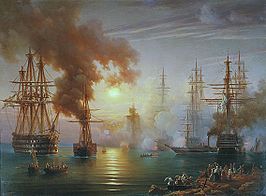
The Black Sea Fleet is considered to have been founded by Prince Potemkin on May 13, 1783, together with its principal base, the city of SevastopolSevastopol
Sevastopol is a city on rights of administrative division of Ukraine, located on the Black Sea coast of the Crimea peninsula. It has a population of 342,451 . Sevastopol is the second largest port in Ukraine, after the Port of Odessa....
. Formerly commanded by such legendary admirals as Dmitriy Senyavin and Pavel Nakhimov
Pavel Nakhimov
Pavel Stepanovich Nakhimov |Siege of Sevastopol]] during the Crimean War.-Biography:Born in the Gorodok village of Vyazma district of Smolensk region. Nakhimov entered the Naval Academy for the Nobility in Saint Petersburg in 1815. He made his first sea voyage in 1817, aboard the frigate Feniks ,...
, it is a fleet of enormous historical and political importance for Russia. In 1790, Russian naval forces under the command of Admiral Fyodor Ushakov
Fyodor Fyodorovich Ushakov
Fyodor Fyodorovich Ushakov was the most illustrious Russian naval commander and admiral of the 18th century.- Life and naval career :...
defeated the Turkish fleet at the Battle of Kerch Strait
Battle of Kerch Strait
The naval Battle of Kerch Strait took place on 19 July 1790 near Kerch, Crimea, and was a slight victory for Imperial Russia over the Ottoman Empire during the Russo-Turkish War, 1787-1792....
.
From 1841 onward, the fleet was confined to the Black Sea by the London Straits Convention
London Straits Convention
In the London Straits Convention concluded on July 13, 1841 between the Great Powers of Europe at the time - Russia, the United Kingdom, France, Austria and Prussia - the "ancient rule" of the Ottoman Empire was re-established by closing the Turkish straits , which link the Black Sea to the...
.
As a result of the Crimean War
Crimean War
The Crimean War was a conflict fought between the Russian Empire and an alliance of the French Empire, the British Empire, the Ottoman Empire, and the Kingdom of Sardinia. The war was part of a long-running contest between the major European powers for influence over territories of the declining...
, one provision of the Treaty of Paris
Treaty of Paris (1856)
The Treaty of Paris of 1856 settled the Crimean War between Russia and an alliance of the Ottoman Empire, the British Empire, Second French Empire, and the Kingdom of Sardinia. The treaty, signed on March 30, 1856 at the Congress of Paris, made the Black Sea neutral territory, closing it to all...
was that the Black Sea was to be a demilitarized zone like the Island of Åland in the Baltic Sea, although Russia subsequently renounced the treaty and reconstituted its naval strength and fortifications in the Black Sea.
The crew of the battleship revolted in 1905 soon after the Navy's defeat in the Russo-Japanese War
Russo-Japanese War
The Russo-Japanese War was "the first great war of the 20th century." It grew out of rival imperial ambitions of the Russian Empire and Japanese Empire over Manchuria and Korea...
. Lenin wrote that the Potemkin uprising had had a huge importance in terms of being the first attempt at creating the nucleus of a revolutionary army.
During World War I
World War I
World War I , which was predominantly called the World War or the Great War from its occurrence until 1939, and the First World War or World War I thereafter, was a major war centred in Europe that began on 28 July 1914 and lasted until 11 November 1918...
, there were a number of encounters between the Russian and Ottoman
Ottoman Navy
The Ottoman Navy was established in the early 14th century. During its long existence it was involved in many conflicts; refer to list of Ottoman sieges and landings and list of Admirals in the Ottoman Empire for a brief chronology.- Pre-Ottoman:...
navies in the Black Sea. The Ottomans initially had the advantage due to their having under command the German battleship , but after the two modern Russian dreadnought
Dreadnought
The dreadnought was the predominant type of 20th-century battleship. The first of the kind, the Royal Navy's had such an impact when launched in 1906 that similar battleships built after her were referred to as "dreadnoughts", and earlier battleships became known as pre-dreadnoughts...
s and had been built in Nikolayev
Mykolaiv
Mykolaiv , also known as Nikolayev , is a city in southern Ukraine, administrative center of the Mykolaiv Oblast. Mykolaiv is the main ship building center of the Black Sea, and, arguably, the whole Eastern Europe.-Name of city:...
, the Russians took command of the sea until the Russian government collapsed in November 1917. German submarines of the Constantinople Flotilla
Constantinople Flotilla
The Constantinople flotilla was an Imperial German Navy formation set up to prosecute the U-boat campaign against Allied shipping in the Mediterranean and the Black Sea in support of Germany’s ally, the Ottoman Empire...
and Turkish light forces would continue to raid and harass Russian shipping until the war's end.
Soviet Navy
During the Russian Civil WarRussian Civil War
The Russian Civil War was a multi-party war that occurred within the former Russian Empire after the Russian provisional government collapsed to the Soviets, under the domination of the Bolshevik party. Soviet forces first assumed power in Petrograd The Russian Civil War (1917–1923) was a...
, the vast majority of the Black Sea Fleet was scuttled or interned by the Western Allies (see Wrangel's fleet
Wrangel's fleet
Wrangel's Fleet, the last remnant of the Black Sea Fleet of the Imperial Russian Navy, existed from 1920 until 1924. This squadron was a "White" unit during the Russian Civil War...
). A few ships were salvaged in the 1920s and a large scale new construction programme began in the 1930s.
The Fleet was commanded by Vice Admiral F.S. Oktyabrskiy
Filipp Oktyabrskiy
Filipp Sergeyevich Oktyabrskiy was a Soviet naval commander and admiral . Hero of the Soviet Union . Began service on the Baltic Fleet in November 1917. From March, 1939 up to April, 1943 and in March, 1944 - November, 1948 he was a commander of the Black Sea Fleet and headed its actions during...
on the outbreak of war with Germany in June 1941. The Fleet gave a credible account of itself, along with the Red Army
Red Army
The Workers' and Peasants' Red Army started out as the Soviet Union's revolutionary communist combat groups during the Russian Civil War of 1918-1922. It grew into the national army of the Soviet Union. By the 1930s the Red Army was among the largest armies in history.The "Red Army" name refers to...
forces that fought alongside it, during the Siege of Odessa and the Battle of Sevastopol
Battle of Sevastopol
The Siege of Sevastopol took place on the Eastern Front of the Second World War. The campaign was fought by the Axis powers of Germany, Romania and Italy against the Soviet Union for control of Sevastopol, a port in Crimea on the Black Sea. On 22 June 1941 the Axis invaded the Soviet Union under...
. (See Black Sea Campaigns (1941–44) for more details.)
In the later post-war period, along with the Northern Fleet
Northern Fleet
The Red Banner Northern Fleet is a unit of the Russian Navy that has access to the Barents and Norwegian Seas, the Arctic and Atlantic Oceans, and is responsible for the defense of northwestern Russia. It was established in 1937 as part of the Soviet Navy...
, the Black Sea Fleet provided ships for the 5th Operational Squadron (:ru:5-я Средиземноморская эскадра кораблей ВМФ) in the Mediterranean, which confronted the United States Navy
United States Navy
The United States Navy is the naval warfare service branch of the United States Armed Forces and one of the seven uniformed services of the United States. The U.S. Navy is the largest in the world; its battle fleet tonnage is greater than that of the next 13 largest navies combined. The U.S...
during the Arab-Israeli wars, notably during the Yom Kippur War
Yom Kippur War
The Yom Kippur War, Ramadan War or October War , also known as the 1973 Arab-Israeli War and the Fourth Arab-Israeli War, was fought from October 6 to 25, 1973, between Israel and a coalition of Arab states led by Egypt and Syria...
in 1973.
However, its military importance has degraded since the collapse of the Soviet Union
Soviet Union
The Soviet Union , officially the Union of Soviet Socialist Republics , was a constitutionally socialist state that existed in Eurasia between 1922 and 1991....
, due to significant funding cuts and, to a degree, the loss of its major missions.
Earlier, Turkey
Turkey
Turkey , known officially as the Republic of Turkey , is a Eurasian country located in Western Asia and in East Thrace in Southeastern Europe...
's decision to join NATO (putting the Bosporus Strait under Western control) and the invention of long-range nuclear weapons had dramatically decreased the strategic
Military strategy
Military strategy is a set of ideas implemented by military organizations to pursue desired strategic goals. Derived from the Greek strategos, strategy when it appeared in use during the 18th century, was seen in its narrow sense as the "art of the general", 'the art of arrangement' of troops...
value of any naval activity in the Black Sea
Black Sea
The Black Sea is bounded by Europe, Anatolia and the Caucasus and is ultimately connected to the Atlantic Ocean via the Mediterranean and the Aegean seas and various straits. The Bosphorus strait connects it to the Sea of Marmara, and the strait of the Dardanelles connects that sea to the Aegean...
. The fleet has been free of nuclear weapons since the early 1990s.
However, recent local conflicts in the Caucasus
Caucasus
The Caucasus, also Caucas or Caucasia , is a geopolitical region at the border of Europe and Asia, and situated between the Black and the Caspian sea...
region (particularly in Georgia
Georgia (country)
Georgia is a sovereign state in the Caucasus region of Eurasia. Located at the crossroads of Western Asia and Eastern Europe, it is bounded to the west by the Black Sea, to the north by Russia, to the southwest by Turkey, to the south by Armenia, and to the southeast by Azerbaijan. The capital of...
), which obliged Moscow to mobilise the Black Sea Fleet off the coast of Georgia, and the development of oil
Oil
An oil is any substance that is liquid at ambient temperatures and does not mix with water but may mix with other oils and organic solvents. This general definition includes vegetable oils, volatile essential oils, petrochemical oils, and synthetic oils....
transit
Transit
-Transportation:* Ford Transit, a van made by the Ford Motor Company* Mass transit, public transport systems in which passengers are carried in large numbers* Navigational transit, when a navigator observes two fixed reference points in line...
in the region are forcing Russia to support the fleet as much as possible.

Partition of the Soviet Black Sea Fleet
In 1992, the major part of the personnel, armaments and coastal facilities of the Fleet fell under formal jurisdiction of the newly independent UkraineUkraine
Ukraine is a country in Eastern Europe. It has an area of 603,628 km², making it the second largest contiguous country on the European continent, after Russia...
as they were situated on Ukrainian territory. Later, the Ukrainian government ordered the establishment of its own Ukrainian Navy
Ukrainian Navy
The Ukrainian Naval Forces is the navy of Ukraine and part of the Armed Forces of Ukraine. It was established in 1992. It consists of 5 branches: surface forces, submarine forces, Navy aviation, coast rocket-artillery and marines...
based on the Black Sea Fleet; several ships and ground formations declared themselves Ukrainian.
However, this immediately led to conflicts with the majority of officers who appeared to be loyal to Russia. Simultaneously, pro-Russian separatist
Separatism
Separatism is the advocacy of a state of cultural, ethnic, tribal, religious, racial, governmental or gender separation from the larger group. While it often refers to full political secession, separatist groups may seek nothing more than greater autonomy...
groups became active in the local politics of Ukraine's Autonomous Republic of Crimea
Crimea
Crimea , or the Autonomous Republic of Crimea , is a sub-national unit, an autonomous republic, of Ukraine. It is located on the northern coast of the Black Sea, occupying a peninsula of the same name...
and the Sevastopol municipality
Sevastopol
Sevastopol is a city on rights of administrative division of Ukraine, located on the Black Sea coast of the Crimea peninsula. It has a population of 342,451 . Sevastopol is the second largest port in Ukraine, after the Port of Odessa....
where the major naval bases were situated, and started coordinating their efforts with pro-Moscow
Moscow
Moscow is the capital, the most populous city, and the most populous federal subject of Russia. The city is a major political, economic, cultural, scientific, religious, financial, educational, and transportation centre of Russia and the continent...
seamen.
Joint Fleet and its partition
To ease the tensions, the two governments signed an interim treaty, establishing a joint Russo-Ukrainian Black Sea Fleet under bilateral command (and Soviet NavySoviet Navy
The Soviet Navy was the naval arm of the Soviet Armed Forces. Often referred to as the Red Fleet, the Soviet Navy would have played an instrumental role in a Warsaw Pact war with NATO, where it would have attempted to prevent naval convoys from bringing reinforcements across the Atlantic Ocean...
flag) until a full-scale partition agreement could be reached. Formally, the Fleet's Commander was to be appointed by a joint order of the two countries' Presidents. However, Russia still dominated the Fleet unofficially, and a Russian admiral was appointed as Commander; the majority of the fleet personnel adopted Russian citizenship. Minor tensions between the Fleet and the new Ukrainian Navy
Ukrainian Navy
The Ukrainian Naval Forces is the navy of Ukraine and part of the Armed Forces of Ukraine. It was established in 1992. It consists of 5 branches: surface forces, submarine forces, Navy aviation, coast rocket-artillery and marines...
(such as electricity cut-offs and sailors' street-fighting) continued.
Military base
A military base is a facility directly owned and operated by or for the military or one of its branches that shelters military equipment and personnel, and facilitates training and operations. In general, a military base provides accommodations for one or more units, but it may also be used as a...
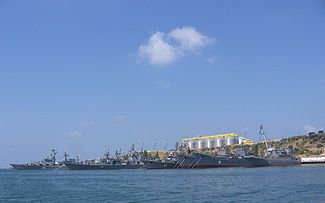
is still situated in the Crimean port city of Sevastopol
Sevastopol
Sevastopol is a city on rights of administrative division of Ukraine, located on the Black Sea coast of the Crimea peninsula. It has a population of 342,451 . Sevastopol is the second largest port in Ukraine, after the Port of Odessa....
. However, the Yushchenko Ukrainian government declared that the lease will not be extended and that the fleet will have to leave Sevastopol by 2017.
Georgia in the Fleet partition
The newly independent nation of GeorgiaGeorgia (country)
Georgia is a sovereign state in the Caucasus region of Eurasia. Located at the crossroads of Western Asia and Eastern Europe, it is bounded to the west by the Black Sea, to the north by Russia, to the southwest by Turkey, to the south by Armenia, and to the southeast by Azerbaijan. The capital of...
, which also hosted several bases of the Soviet Black Sea Fleet when it was the Georgian SSR, also claimed a share of the Fleet, including 32 naval vessels formerly stationed at Georgia's Black Sea port of Poti
Poti
Poti is a port city in Georgia, located on the eastern Black Sea coast in the region of Samegrelo-Zemo Svaneti in the west of the country. Built near the site of the ancient Greek colony of Phasis, the city has become a major port city and industrial center since the early 20th century. It is also...
. Not a CIS
Commonwealth of Independent States
The Commonwealth of Independent States is a regional organization whose participating countries are former Soviet Republics, formed during the breakup of the Soviet Union....
member at that time, Georgia was not, however, included in the initial negotiations in January 1992. Additionally, some low-importance bases situated in the Russian-backed breakaway autonomy of Abkhazia
Abkhazia
Abkhazia is a disputed political entity on the eastern coast of the Black Sea and the south-western flank of the Caucasus.Abkhazia considers itself an independent state, called the Republic of Abkhazia or Apsny...
soon escaped any Georgian control. In 1996, Georgia resumed its demands, and the Russian refusal to allot Georgia a portion of the ex-Soviet navy became another bone of contention in the progressively deteriorating Georgian-Russian relations. This time, Ukraine endorsed Tbilisi
Tbilisi
Tbilisi is the capital and the largest city of Georgia, lying on the banks of the Mt'k'vari River. The name is derived from an early Georgian form T'pilisi and it was officially known as Tiflis until 1936...
's claims, turning over several patrol boats to the Georgian Navy
Georgian Navy
The Georgian Coast Guard is the maritime arm of the Georgian Border Police, within the Ministry for Internal Affairs. It is responsible for the maritime protection of the entire coastline of Georgia, as well as the Georgian territorial waters...
and starting to train Georgian crews, but was unable to include in the final fleet deal a transfer of the formerly Poti-based vessels to Georgia. Later, the rest of the Georgian share was decided to be ceded to Russia in return for diminution of debt.
Since the 2008 South Ossetia war
2008 South Ossetia war
The 2008 South Ossetia War or Russo-Georgian War was an armed conflict in August 2008 between Georgia on one side, and Russia and separatist governments of South Ossetia and Abkhazia on the other....
Russian military officials refused to let the Black Sea Fleet take part in any joint naval exercises involving Georgian warships. However, such a statement has little meaning since the Georgian Navy has ceased to exist (early 2009 it was merged with the Georgian coast guard).
Russia is technically a member of the Black Sea Naval Co-operation Task Group
Black Sea Naval Co-operation Task Group
The Black Sea Naval Force , was created in early 2001 under the leadership of Turkey, with the participation of all other Black Sea littoral states, namely Bulgaria, Romania, Ukraine, Russia and Georgia...
.
Combat operations
Russia mobilised part of the fleet during the 2008 Georgian conflict. Russian units operating off Georgia'sGeorgia (country)
Georgia is a sovereign state in the Caucasus region of Eurasia. Located at the crossroads of Western Asia and Eastern Europe, it is bounded to the west by the Black Sea, to the north by Russia, to the southwest by Turkey, to the south by Armenia, and to the southeast by Azerbaijan. The capital of...
separatist Abkhazia
Abkhazia
Abkhazia is a disputed political entity on the eastern coast of the Black Sea and the south-western flank of the Caucasus.Abkhazia considers itself an independent state, called the Republic of Abkhazia or Apsny...
region resulted in a reported skirmish with the Georgian Navy unconfirmed by Georgia. As a result, Ukraine's President
President of Ukraine
Prior to the formation of the modern Ukrainian presidency, the previous Ukrainian head of state office was officially established in exile by Andriy Livytskyi. At first the de facto leader of nation was the president of the Central Rada at early years of the Ukrainian People's Republic, while the...
Viktor Yushchenko
Viktor Yushchenko
Viktor Andriyovych Yushchenko is a former President of Ukraine. He took office on January 23, 2005, following a period of popular unrest known as the Orange Revolution...
announced that the Black Sea Fleet would henceforth need permission to cross the Ukrainian border to enter and leave to Sevastopol, to which a Russian admiral retorted that the President of the Russian Federation and not Ukraine commands the Black Sea Fleet. Yushchenko's announcement was without force and deployed units of the Russian Black Sea Fleet returned to their home moorings without incident.
Black Sea Fleet and Ukraine
As a consequence of Ukraine's Yushchenko government announcing that the lease of Russian naval bases on the Crimea will not be extended beyond 2017, the Russian Black Fleet initiated the expansion of its base in NovorossiyskNovorossiysk
Novorossiysk is a city in Krasnodar Krai, Russia. It is the country's main port on the Black Sea and the leading Russian port for importing grain. It is one of the few cities honored with the title of the Hero City. Population: -History:...
. In July 2007, the Navy Commander announced that the new base will be ready in 2012. Under the 1997 bilateral treaty, Russia paid annually and the treaty provided for an extension by mutual agreement. Russian officials have repeatedly said they would like to extend the lease.
In June 2009, the head of the Ukrainian Security Service said that after December 13, 2009, all officers from the Russian Federal Security Service (FSB) represented at the (Russian) Black Sea Fleet must leave Ukraine, from then the Security Service of Ukraine will ensure the security of the (Russian) Black Sea Fleet and Russian sailors on Ukrainian territory. According to the Russian Foreign Ministry the employees of the FSB, who are working at the Black Sea Fleet facilities, are staying on the Ukrainian territory "in line with bilateral agreements".
In October–November 2009, the (Russian) Black Sea Fleet complained about inspection of (non-boat) transport vehicles owned by the fleet by the Sevastopol State Auto Inspectorate and Ukrainian security officers, calling them "disrespect for the status of the Russian military units and an unfriendly step aimed at worsening the Russian-Ukrainian relations".
On April 21, 2010, Ukrainian President Yanukovych
Viktor Yanukovych
Viktor Fedorovych Yanukovych is a Ukrainian politician who has been the President of Ukraine since February 2010.Yanukovych served as the Governor of Donetsk Oblast from 1997 to 2002...
and Russian President Medvedev reached an agreement whereby the Russian lease on naval facilities in Crimea would be extended beyond 2017 by 25 years with an additional 5 year renewal option (to 2042–47) in exchange for a multiyear discounted contract to provide Ukraine with Russian natural gas. This deal is controversial in Ukraine.
Joint exercises of the Ukrainian Navy
Ukrainian Navy
The Ukrainian Naval Forces is the navy of Ukraine and part of the Armed Forces of Ukraine. It was established in 1992. It consists of 5 branches: surface forces, submarine forces, Navy aviation, coast rocket-artillery and marines...
and the (Russian) Black Sea Fleet may be resumed after a seven-year interval in June 2010.
In 2010, Russian military counterintelligence officers
Officer (armed forces)
An officer is a member of an armed force or uniformed service who holds a position of authority. Commissioned officers derive authority directly from a sovereign power and, as such, hold a commission charging them with the duties and responsibilities of a specific office or position...
from the Russian Federal Security Service will return to the (Russian) Black Sea Fleet base.
While a Yushchenko administration minister said that Russia cannot unilaterally replace its Black Sea Fleet ships without Ukraine's consent, the recent lease extension also revalidated the agreements of 1997. Those agreements stipulate that the Russian Black Sea Fleet can maintain the same numbers and types of ships that it had based in Sevastopol as a result of the 1997 fleet division without approval by Ukraine. This stipulation permits Russia to increase the current current size of the fleet which has fallen below those numbers.
Additions of ships to the Fleet
Repeated and sometimes contradictory announcements have been made claiming that new ships will join the fleet. On December 3, 2009, First Vice Mayor of Sevastopol Vladimir Kazarin stated that Russia's Black Sea Fleet could lose its combat capability, given a small number of ships and the absence of new ones. Similar doubts has given by the Russian media. The Gazeta newspaper notes that by 2015 the majority of the warships would no longer be fit for duty.Russian Navy sources say that up to four frigates and four diesel-electric submarines will be added to the Black Sea Fleet by 2015. Reportedly the lead ship of the Admiral Sergey Gorshkov class frigate class and the fourth Lada class submarine
Lada class submarine
The Russian Navy's Project 677 Лада is a submarine class designed by the Russian Rubin Design Bureau. The class is also referred to as the Petersburg class, after the lead ship...
are planned to join the fleet. These vessels will partially replace the reported decommissioning of Kerch, Ochakov, several large support ships, and a diesel-electric submarine.
In June 2010, Russian Navy Commander-in-Chief Admiral Vladimir Vysotsky
Vladimir Vysotsky (Admiral)
Vladimir Sergeyevich Vysotskiy , Volodymyr Serhiyovych Vysotskiy; is a Russian admiral and former Commander of the Russian Northern Fleet...
announced that Russia was reviewing plans for the naval modernization of the Black sea fleet. The plans include 15 new warships and submarines by 2020.
Sources from Russian Navy HQ have said that by 2020 six frigates of Project 22350 Gorshkov-class
Admiral Sergei Gorshkov class frigate
The Admiral Gorshkov-class frigates, also known as Project 22350, are a class of frigate of the Russian Navy. They have been designed by the Severnoye Design Bureau, Saint Petersburg, the lead ship being named after Sergey Gorshkov.- Design :...
, six submarines of Project 677 Lada class
Lada class submarine
The Russian Navy's Project 677 Лада is a submarine class designed by the Russian Rubin Design Bureau. The class is also referred to as the Petersburg class, after the lead ship...
, two large landing ships of Project 11711 Ivan Gren-class
Ivan Gren class landing ship
The Ivan Gren, or Project 11711, is a class of landing ship that is being constructed for the Russian Navy.The ship is being built in Yantar shipyard in Kaliningrad. The vessel will have a displacement of 5,000-6,000 tons and will be able to carry up to 13 main battle tanks or 36 armoured personnel...
and four unspecified ships of another project will be delivered. Due to the obsolescence of Beriev Be-12
Beriev Be-12
|-See also:-Bibliography:* Yefim Gordon, Andrey Sal'nikov and Aleksandr Zablotskiy Beriev's Jet Flying Boats. Hinckley, UK: Midland Publishing. ISBN 1-85780-236-5...
by 2015 they will be replaced with Il-38s. Su-24M
Sukhoi Su-24
The Sukhoi Su-24 is a supersonic, all-weather attack aircraft developed in the Soviet Union. This variable-sweep wing, twin-engined two-seater carried the USSR's first integrated digital navigation/attack system...
are planned be upgraded to Su-24M2 at the same time.
The Project 636.3 (Kilo-class) diesel-electric submarine Novorossiysk — the first of three such new submarines — laid down at Admiralty Wharves Shipyard, St. Petersburg, on August 20, 2010 is destined to serve in the Black Sea Fleet. Navy sources also say that Project 11356 Grigorovich class frigate
Admiral Grigorovich class frigate
The Admiral Grigorovich class is the latest class of frigates ordered by the Russian Navy for the Black Sea Fleet. Three ships have been ordered so far to be built by the "Yantar" shipyard in Kaliningrad. The frigates are based on the Talwar-class frigate, six of which were ordered by the Indian...
will be despatched to the Black Sea. Admiral Grigorovich, the lead ship of project, was laid down on December 18, 2010 and is expected to be in service 34 months from that date (Oct 2013). Three ships of this class are to be in service in the Black Sea Fleet before 2015.
Incidents with Ukraine
The Russian Black Sea Fleet's use of leased facilities in SevastopolSevastopol
Sevastopol is a city on rights of administrative division of Ukraine, located on the Black Sea coast of the Crimea peninsula. It has a population of 342,451 . Sevastopol is the second largest port in Ukraine, after the Port of Odessa....
and the Crimea has been controversial. A number of incidents involving official and unofficial Ukrainian individuals and groups have taken place:
- A lighthouseLighthouseA lighthouse is a tower, building, or other type of structure designed to emit light from a system of lamps and lenses or, in older times, from a fire, and used as an aid to navigation for maritime pilots at sea or on inland waterways....
is located on the headland, which from 2005, was the subject of a controversy between Ukraine and RussiaRussiaRussia or , officially known as both Russia and the Russian Federation , is a country in northern Eurasia. It is a federal semi-presidential republic, comprising 83 federal subjects...
. From August 3, 2005, the lighthouse is occupied by the Russian ArmyRussian Ground ForcesThe Russian Ground Forces are the land forces of the Armed Forces of the Russian Federation, formed from parts of the collapsing Soviet Army in 1992. The formation of these forces posed economic challenges after the collapse of the Soviet Union, and required reforms to professionalize the force...
. Not paying attention to the ruling of the Government Court in SevastopolSevastopolSevastopol is a city on rights of administrative division of Ukraine, located on the Black Sea coast of the Crimea peninsula. It has a population of 342,451 . Sevastopol is the second largest port in Ukraine, after the Port of Odessa....
on the subject of the return of 77 geographical objects to Ukraine (including the lighthouse on SarychSarychSarych is a headland located on shore of the Black Sea on the Crimean Peninsula in the Autonomous Republic of Crimea, Ukraine.About 5 kilometers from the Sarych headland is the resort town of Foros. The city of Sevastopol is located about 30 km away and Yalta about 40 km...
), Russian military officials referred to the fact that they only subordinate to the chief of the Russian Navy headquarters and no one else. The Ukrainian public activists state that Sarych is illegally occupied by the Russian Navy. As a military object, the territory around the Sarych headland is closed to trespassers with barbed wireBarbed wireBarbed wire, also known as barb wire , is a type of fencing wire constructed with sharp edges or points arranged at intervals along the strand. It is used to construct inexpensive fences and is used atop walls surrounding secured property...
with the Russian flagFlag of RussiaThe flag of Russia is a tricolour flag of three equal horizontal fields, white on the top, blue in the middle and red on the bottom. The flag was first used as an ensign for Russian merchant and war ships and only became official in 1896...
flying above Sarych.
- In 2006, Ukrainian officials prevented Russian workers from entering the Black Sea Fleet lighthouse in YaltaYaltaYalta is a city in Crimea, southern Ukraine, on the north coast of the Black Sea.The city is located on the site of an ancient Greek colony, said to have been founded by Greek sailors who were looking for a safe shore on which to land. It is situated on a deep bay facing south towards the Black...
.
- During the 2008 South Ossetia War2008 South Ossetia warThe 2008 South Ossetia War or Russo-Georgian War was an armed conflict in August 2008 between Georgia on one side, and Russia and separatist governments of South Ossetia and Abkhazia on the other....
, the Ukrainian NavyUkrainian NavyThe Ukrainian Naval Forces is the navy of Ukraine and part of the Armed Forces of Ukraine. It was established in 1992. It consists of 5 branches: surface forces, submarine forces, Navy aviation, coast rocket-artillery and marines...
was ordered to block the entrance of Russian vessels taking part in hostilities to Sevastopol. However, Russian Navy ships returned to base unimpeded.
- June 20, 2009 — In SevastopolSevastopolSevastopol is a city on rights of administrative division of Ukraine, located on the Black Sea coast of the Crimea peninsula. It has a population of 342,451 . Sevastopol is the second largest port in Ukraine, after the Port of Odessa....
, an incident again took place involving the Black Sea Fleet. In 2007, the administration of this organization was contracted by some 200 citizens of Sevastopol to build four several stories residential buildings. The job was never finished although the financial aspect of the contract was fulfilled as it was a prepaid venture. At this time, there are only two buildings that are only finished at 95% as stated in the local newspaper Novyi Sevastopol. The protesters are being simply kicked out by force without any intention to regulate the conflict. The protesters also sent a letters to the President and the Prime-Minister of the Russian Federation, Dmitry MedvedevDmitry MedvedevDmitry Anatolyevich Medvedev is the third President of the Russian Federation.Born to a family of academics, Medvedev graduated from the Law Department of Leningrad State University in 1987. He defended his dissertation in 1990 and worked as a docent at his alma mater, now renamed to Saint...
and Vladimir PutinVladimir PutinVladimir Vladimirovich Putin served as the second President of the Russian Federation and is the current Prime Minister of Russia, as well as chairman of United Russia and Chairman of the Council of Ministers of the Union of Russia and Belarus. He became acting President on 31 December 1999, when...
, and also to the Minister of Defense of Russia, Anatoliy SerdyukovAnatoliy SerdyukovAnatoliy Eduardovich Serdyukov is a Russian politician and businessman.He has been the Defense Minister of Russia since February 15, 2007. He is known for launching major reforms in the Russian military....
. Those attempts brought no results. UNIAN
- On August 27, 2009, Ukrainians identifying themselves as bailiffs were detained when they attempted to seize a Russian lighthouse. Russia states that Ukrainians may not step onto its bases without permission.
Fleet Commanders
| # | Rank | Name | Year |
|---|---|---|---|
| # | VADM | Fedot A. Klokachev | 1783 |
| # | VADM | Yakov F. Sukhotin | 1784–1785 |
| # | RADM | Nikolay Mordvinov Nikolay Mordvinov Count Nikolay Semyonovich Mordvinov was one of the most reputable Russian political thinkers of Alexander I's reign. He is associated with the reforms of Mikhail Speransky, who he advised on the ways to improve the performance of the national economy.Mordvinov was an admiral's son and started his... |
1785–1789 |
| # | RADM | Marko I. Voynovich | 1789–1790 |
| # | RADM | Fyodor Ushakov | 1790–1792 |
| # | ADM | Nikolay Mordvinov Nikolay Mordvinov Count Nikolay Semyonovich Mordvinov was one of the most reputable Russian political thinkers of Alexander I's reign. He is associated with the reforms of Mikhail Speransky, who he advised on the ways to improve the performance of the national economy.Mordvinov was an admiral's son and started his... |
1792–1799 |
| # | ADM | Vilim Fondezin | 1799–1802 |
| # | ADM | Ivan I. deTravers | 1802–1811 |
| # | ADM | Roman R. Gall | 1811 |
| # | VADM | Nikolay L. Yazykov | 1811–1816 |
| # | ADM | Aleksey S. Greyg | 1816–1833 |
| # | ADM | Mikhail Lazarev | 1834–1851 |
| # | ADM | Verkh | 1851– |
| # | ADM | Aleksandr Menshikov Alexander Sergeyevich Menshikov Prince Aleksandr Sergeyevich Menschikov was a Finnish-Russian nobleman, military commander and statesman. He was made adjutant general in 1817 and admiral in 1833.... |
1854–1855 |
| # | |||
| # | ADM | Nikolay A. Arkas | 1871–1881 |
| # | ADM | Mikhail P. Manganari | 1881–1882 |
| # | VADM | Aleksey A. Peshchurov | 1882–1890 |
| # | RADM | Roman A. Grenkvist | 1890 |
| # | VADM | Nikolay V. Kopytov | 1891–1898 |
| # | VADM | Evgeniy I. Alekseyev | 1898 |
| # | VADM | Sergey P. Tyrtov | 1898–1903 |
| # | VADM | Yakov A. Giltebrandt | 1903 |
| # | VADM | Nikolay I. Skrydlov | 1903–1904 |
| # | VADM | Aleksandr Kh. Kriger | 1904 |
| # | VADM | Grigoriy P. Chukhnin | 1904–1906 |
| # | RADM | Ivan K. Grigorovich | 1906 |
| # | VADM | Nikolay I. Skrydlov | 1906–1907 |
| # | RADM | Genrikh F. Tsyvinskiy | 1907 |
| # | RADM | Robert N. Viren | 1907–1908 |
| # | VADM | Ivan F. Bostrem | 1908–1909 |
| # | VADM | Vladimir S. Sarnavskiy | 1909–1911 |
| # | VADM | Ivan F. Bostrem | 1911 |
| # | RADM | Pavel I. Novitskiy | 1911 |
| # | VADM | Andrey A. Ehbergard | 1911- Jun 1916 |
| # | VADM | Aleksandr V. Kolchak | Jun 1916 – Jun 1917 |
| Acting | RADM | Veniamin K. Lukin | Jun 1917 – Jul 1917 |
| # | RADM | Aleksandr V. Nemitts | Jul 1917 – Dec 1917 |
| # | |||
| # | RADM | Aleksey V. Dombrovskiy | May 1920 – Oct 1920 |
| # | VADM | Ehduard S. Pantserzhanskiy | Nov 1920 – Nov 1921 |
| # | Ship Division Cmdr. | Andrey S. Maksimov | Nov 1921 – Jul 1922 |
| # | Ship Division Cmdr. | Aleksandr Vekman | Jul 1922 – May 1924 |
| # | Ship Division Cmdr. | Mikhail V. Viktorov | May 1924 – Dec 1924 |
| # | FLTCMDR | Ehduard S. Pantserzhanskiy | Dec 1924 – Oct 1926 |
| # | FLTCMDR | Vladimir M. Orlov | Oct 1926 – Jun 1931 |
| # | FLTCMDR | Ivan K. Kozhanov | Jun 1931 – Aug 1937 |
| # | FFO2 | Petr I. Svetlovskiy (Smirnov) | Aug 1937 – Dec 1937 |
| # | ADM | Ivan S. Yumashev Ivan Stepanovich Yumashev Ivan Stepanovich Yumashev was a Soviet Navy admiral, Hero of the Soviet Union , and Commander-in-Chief of the Soviet Naval Forces from January 1947 to July 1951.... |
1938 – Mar 1939 |
| # | VADM | Filipp Oktyabrsky | Mar 1939 – Apr 1943 |
| # | VADM | Lev A. Vladimirskiy | Apr 1943 – Mar 1944 |
| # | VADM | Filipp Oktyabrsky | Mar 1944 – Nov 1948 |
| # | ADM | Nikolay E. Basistyy | Nov 1948 – Aug 1951 |
| # | VADM | Sergey G. Gorshkov Sergey Gorshkov Admiral of the Fleet of the Soviet Union Sergey Georgiyevich Gorshkov was a Soviet naval officer during the Cold War who oversaw the expansion of the Soviet Navy into a global force.... |
Aug 1951 – Jul 1955 |
| # | VADM | Viktor A. Parkhomenko | Jul 1955 – Dec 1955 |
| # | ADM | Vladimir Kasatonov Vladimir Kasatonov Vladimir Afanasyevich Kasatonov was a Soviet military leader, admiral, and Hero of the Soviet Union .... |
Dec 1955 – Feb 1962 |
| # | ADM | Serafim E. Chursin | Feb 1962 – Dec 1968 |
| # | ADM | Viktor Sysoyev | Dec 1968 – Mar 1974 |
| # | ADM | Nikolay Khovrin | Mar 1974 – April 1983 |
| # | ADM | Aleksey Kalinin | Apr 1983 – Jul 1985 |
| # | ADM | Mikhail Khronopulo | Jul 1985 – Oct 1991 |
| # | ADM | Igor Kasatonov | Oct 1991 – Dec 1992 |
| # | ADM | Ehduard Baltin | Dec 1992 – Feb 1996 |
| # | ADM | Viktor Kravchenko | Feb 1996 – Jul 1998 |
| # | ADM | Vladimir Komoyedov | Jul 1998 – Oct 2002 |
| # | ADM | Vladimir Masorin Vladimir Masorin Admiral of the Fleet Vladimir Vasilyevich Masorin is a retired Russian admiral who commanded the Caspian Flotilla in 1996-2002 and the Black Sea Fleet in 2002-2005... |
Oct 2002 – Feb 2005 |
| # | ADM | Aleksandr Tatarinov | Feb 2005 – Jul 2007 |
| # | VADM | Aleksandr Kletskov Aleksandr Kletskov Aleksandr Kletskov is an Uzbekistani international football defender.Kletskov began his playing career with Pakhtakor and has appeared for the club in several editions of the AFC Champions League. He also has played for Jiangsu Sainty and Tianjin Teda in the Chinese Super League.-External links:*... |
Jul 2007 – Jul 2010 |
| # | VADM | Vladimir Korolev | Jul 2010 – Jun 2011 |
| # | RADM | Aleksandr Fedotenkov | Jun 2011 – present |
30th Surface Ship Division
| # | Type | Name | Class | Year | Status |
|---|---|---|---|---|---|
| 121 | Guided Missile Cruiser | Moskva | Slava Slava class cruiser The Slava class cruiser, Soviet designation Project 1164 Atlant, is a large conventionally-powered warship, currently operated by Russia.-Design:... |
1983 | Active |
| 713 | Large ASW Ship | Kerch Russian cruiser Kerch Kerch is a Kara-class missile cruiser of the Soviet and later Russian Navy. The cruiser is in active service with the Russian Black Sea Fleet as of 2011.- History :... |
Kara | 1974 | Scheduled to be decommissioned in 2010/2011 |
| 707 | Large ASW Anti-submarine warfare Anti-submarine warfare is a branch of naval warfare that uses surface warships, aircraft, or other submarines to find, track and deter, damage or destroy enemy submarines.... Ship |
Ochakov Russian cruiser Ochakov Ochakov is a Kara-class cruiser of the Russian Navy. The ship is on paper stationed in the Russian Black Sea Fleet as of 2011. However the cruiser has not been operational since the early 2000s.- History :... |
Kara | 1973 | Not active, to be decommissioned in 2010 |
| 810 | Guided Missile Destroyer | Smetlivy | Kashin Kashin class destroyer The Kashin class destroyers were a group of guided missile destroyers built for the Soviet Navy in the 1960s and early 1970s. Their Soviet designation was Project 61... |
1969 | Active as of 2011 |
| 801 | Guided Missile Frigate | Ladnyy | Krivak-class frigate Krivak class frigate The Project 1135 Burevestnik class were a series of frigates built for the Soviet Navy. These ship are commonly known by their NATO reporting name of Krivak and are divided into Krivak-I, Krivak-II, and Krivak-III classes.These ships were designed as a successor to the Riga class... |
1978 | |
| 808 | Guided Missile Frigate | Pytlivyy | Krivak-class frigate | 1979 | |
| # | Type | Name | Class | Year |
|---|---|---|---|---|
| 152 | Landing Ship | Nikolay Filchenkov | Alligator Alligator class landing ship Project 1171 class landing ship is a class of Soviet / Russian general purpose, beachable amphibious transport docks .... |
1975 |
| 148 | Landing Ship | Orsk | Alligator | 1968 |
| 150 | Landing Ship | Saratov | Alligator | 1966 |
| 151 | Landing Ship | Azov | Ropucha-II Ropucha class landing ship The Ropucha , or Project 775 class landing ships are classified in the Russian Navy as "large landing craft" . They were built in Poland in the Stocznia Północna shipyards, in Gdansk. They are designed for beach landings and can carry a 450 ton cargo... |
1990 |
| 142 | Landing Ship | Novocherkassk | Ropucha-I Ropucha class landing ship The Ropucha , or Project 775 class landing ships are classified in the Russian Navy as "large landing craft" . They were built in Poland in the Stocznia Północna shipyards, in Gdansk. They are designed for beach landings and can carry a 450 ton cargo... |
1987 |
| 158 | Landing Ship | Tsezar Kunikov | Ropucha-I | 1986 |
| 156 | Landing Ship | Yamal | Ropucha-I | 1988 |
247th Independent Submarine Division
| # | Type | Name | Class | Year | Base | Status |
|---|---|---|---|---|---|---|
| 554 | Diesel Attack Submarine | Alrosa (B-871) Soviet submarine B-871 Soviet submarine B-871 Alrosa is an diesel-electric that joined the Soviet Fleet in 1990 and is active with the Russian Black Sea Fleet as of 2011.... |
Kilo Kilo class submarine The Kilo class is the NATO reporting name for a naval diesel-electric submarine that is made in Russia. The original version of the vessels were designated Project 877 Paltus in Russia. There is also a more advanced version, designated as Improved Kilo in the west, and Project 636 Varshavyanka in... |
1990 | Sevastopol Sevastopol Sevastopol is a city on rights of administrative division of Ukraine, located on the Black Sea coast of the Crimea peninsula. It has a population of 342,451 . Sevastopol is the second largest port in Ukraine, after the Port of Odessa.... |
Active |
| 572 | Diesel Attack Submarine | Svyatoy Knyaz Georgiy (B-380) | Tango Tango class submarine The Russian Tango class submarines were the successors to the Foxtrot class submarine based in the Black Sea and Northern Fleet areas. The first of the class was completed in 1972 at Gorky. A total of 18 were built in two slightly different versions... |
1982 | Sevastopol Sevastopol Sevastopol is a city on rights of administrative division of Ukraine, located on the Black Sea coast of the Crimea peninsula. It has a population of 342,451 . Sevastopol is the second largest port in Ukraine, after the Port of Odessa.... |
Out of service, will be decommissioned |
68th Coastal Defense Ship Brigade
| # | Type | Name | Class | Year |
|---|---|---|---|---|
| 059 | ASW Corvette | Alexandrovets | Grisha I | 1982 |
| 053 | ASW Corvette | Povorino | Grisha III | 1989 |
| 071 | ASW Corvette | Suzdalets | Grisha III | 1983 |
| 064 | ASW Corvette | Muromets | Grisha III Grisha class corvette The Albatros class was a series of large anti-submarine corvettes built by the Soviet Union between 1970 and 1990. These ships had a limited range and were used only in coastal waters. They were equipped with a variety of ASW weapons and an SA-N-4 surface-to-air missile launcher... |
1983 |
| 060 | ASW Corvette | Vladimirets | Project 11451 / Mukha-class | 1984 |
| # | Type | Name | Class | Year |
|---|---|---|---|---|
| 913 | Seagoing Minesweeper | Kovrovets | Natya I Natya class minesweeper The Natya class were a group of minesweepers built for the Soviet Navy and export customers during the 1970s and '80s. The Soviet designation was Project 266M Avkvamarin. The ships were used for ocean minesweeping.-Design:... |
1974 |
| 911 | Seagoing Minesweeper | Ivan Golubets | Natya I | 1973 |
| 912 | Seagoing Minesweeper | Turbinist | Natya I | 1972 |
| 909 | Seagoing Minesweeper | Vice Admiral Zhukov | Natya I | 1977 |
41st Missile Boat Brigade
| # | Type | Name | Class | Year |
|---|---|---|---|---|
| 615 | Guided Missile Corvette | Bora Bora Class guided missile hovercraft The Bora-class hoverborne guided missile corvette of the Russian Navy, also bears the NATO class name Dergach, is one of the few types of military surface effect ship built solely for marine combat purposes, rather than troop landing or transport... |
Dergach | 1988 |
| 616 | Guided Missile Corvette | Samum | Dergach | 1991 |
| 620 | Guided Missile Corvette | Shtyl | Nanuchka-III Nanuchka class corvette The Nanuchka class was the NATO reporting name for a series of corvettes or small missile ships built for the Soviet Navy and export customers between 1969 and 1981. The Soviet designation was Project 1234 Ovod Small Missile Ship. These ships were designed around the P-120 Malakhit anti ship... |
1976 |
| 617 | Guided Missile Corvette | Mirazh | Nanuchka-III | 1983 |
| # | Type | Name | Class | Year |
|---|---|---|---|---|
| 966 | Missile Boat | R-44 | Matka Mod Matka class missile boat The Matka class is the NATO reporting name for a group of hydrofoil missile boats built for the Soviet Navy. The Soviet designation is Project 206MR Vikhr.-Design:... |
disc |
| 955 | Missile Boat | R-60 | Tarantul-III Mod Tarantul class corvette The Project 1241.1 Molniya are a class of Soviet missile corvettes. They have the NATO reporting name Tarantul... |
1985 |
| 962 | Missile Boat | R-71 | Tarantul-II Mod Tarantul class corvette The Project 1241.1 Molniya are a class of Soviet missile corvettes. They have the NATO reporting name Tarantul... |
1985 |
| 952 | Missile Boat | R-109 | Tarantul-III Tarantul class corvette The Project 1241.1 Molniya are a class of Soviet missile corvettes. They have the NATO reporting name Tarantul... |
1991 |
| 953 | Missile Boat | R-239 | Tarantul-III | 1991 |
| 954 | Missile Boat | Ivanovets | Tarantul-III | 1988 |
184th Novorossiysk Coastal Defense Brigade
| # | Type | Name | Class | Year |
|---|---|---|---|---|
| 054 | Small Antisubmarine Ship | Eysk | Grisha-III Grisha class corvette The Albatros class was a series of large anti-submarine corvettes built by the Soviet Union between 1970 and 1990. These ships had a limited range and were used only in coastal waters. They were equipped with a variety of ASW weapons and an SA-N-4 surface-to-air missile launcher... |
1987 |
| 055 | Small Antisubmarine Ship | Kasimov | Grisha-III | 1984 |
| 901 | Seagoing Minesweeper | Zheleznyakov | Gorya-class Gorya class minesweeper The Gorya class are a group of minesweepers built for the Soviet Navy in the late 1980s. Three ships were started of which two were completed and are in service with the Russian Navy. The Soviet Designation was Project 1266.-Design:... |
1988 |
| 770 | Seagoing Minesweeper | Valentin Pikul | Natya I Mod | 2001 |
| 426 | Base Minesweeper | Mineralnyye Vody | Sonya-class Sonya class minesweeper The Sonya class were a group of minesweepers built for the Soviet Navy and Soviet allies between 1971 and 1991. The Soviet designation is Project 1265 Yakhont.-Design:... |
1990 |
| 438 | Base Minesweeper | Leytenant Ilyin | Sonya-class | 1982 |
Black Sea Naval Infantry and Coastal Defense Force
11th Independent Coastal Missile-Artillery BrigadeAnapa, Krasnodar region
3x K-300P Bastion-P
K-300P Bastion-P
The K-300P Bastion-P is a Russian mobile coastal defence missile system. The system is developed together with the Belarus company Tekhnosoyuzproekt....
anti-ship missile system
810th Naval Infantry Brigade
382nd Independent Naval Infantry Battalion
Black Sea Fleet Naval Air Force – HQ Sevastopol
- Status in 2010
- 25th Independent Anti-submarine Helicopter Regiment - HQ at KachaKachaKacha may refer to:*Kacha , an urban-type settlement in Crimea, Ukraine*Kacha , a mythological sage in Hinduism*Kacha Bira, one of the 77 woredas in the Southern Nations, Nationalities and Peoples' Region of Ethiopia...
, Crimea - ~20 helicopters of types Ka-27 and Mi-14Mil Mi-14|-See also:-External links:******... - 917th Independent Composite Air Regiment - HQ at KachaKachaKacha may refer to:*Kacha , an urban-type settlement in Crimea, Ukraine*Kacha , a mythological sage in Hinduism*Kacha Bira, one of the 77 woredas in the Southern Nations, Nationalities and Peoples' Region of Ethiopia...
, Crimea - ~10x Antonov transport aircraft of types An-2, An-12 and An-26; 4x Be-12Beriev Be-12|-See also:-Bibliography:* Yefim Gordon, Andrey Sal'nikov and Aleksandr Zablotskiy Beriev's Jet Flying Boats. Hinckley, UK: Midland Publishing. ISBN 1-85780-236-5...
; ~10x Mi-8Mil Mi-8The Mil Mi-8 is a medium twin-turbine transport helicopter that can also act as a gunship. The Mi-8 is the world's most-produced helicopter, and is used by over 50 countries. Russia is the largest operator of the Mi-8/Mi-17 helicopter.... - 43rd Independent Naval Shturmovik (Assault) Air Squadron - HQ at Gvardeyskoye, Crimea - 18x Su-24MSukhoi Su-24The Sukhoi Su-24 is a supersonic, all-weather attack aircraft developed in the Soviet Union. This variable-sweep wing, twin-engined two-seater carried the USSR's first integrated digital navigation/attack system...
; 4x Su-24MRSukhoi Su-24The Sukhoi Su-24 is a supersonic, all-weather attack aircraft developed in the Soviet Union. This variable-sweep wing, twin-engined two-seater carried the USSR's first integrated digital navigation/attack system...
;
- 25th Independent Anti-submarine Helicopter Regiment - HQ at Kacha
See also
- Crimean anti-NATO protests of 2006Crimean anti-NATO protests of 2006The Crimean anti-NATO protests of 2006 were series of political protests in the Autonomous Republic of Crimea against United States military maneuvers during NATO's Sea Breeze 2006 military exercise and in order to prevent Ukraine's possible bid to join the North Atlantic Treaty...
- 1936 Montreux Convention governing the passage of military ships into the Black SeaMontreux Convention Regarding the Regime of the Turkish StraitsThe Montreux Convention Regarding the Regime of the Straits was a 1936 agreement that gives Turkey control over the Bosporus Straits and the Dardanelles and regulates military activity in the region. The Convention gives Turkey full control over the Straits and guarantees the free passage of...
External links
- Russia – Ukraine Lease agreement
- Unofficial site (English version)
- History of the Black Sea Fleet during WWII (in Russian)
- Narodny Oglyadach reports on morale situation in Russian naval base in Sevastopol KOРАБЛІ УKРАЇНСЬKOЇ ФЛOТИ (1917–1918 рр.) – Ukrainian Navy (1917–1918)
- Ukrainian Navy: ferial excursions into the past and present
- Ukraine – Historical Naval Flags (1918)