

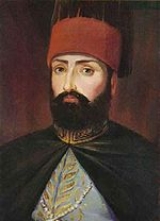
Mahmud II

Encyclopedia
Mahmud II (20 July 1785 – 1 July 1839) was the 30th Sultan
of the Ottoman Empire
from 1808 until his death in 1839. He was born in the Topkapi Palace
, Istanbul
(Constantinople
), the son of Sultan Abdulhamid I. His reign is notable mostly for the extensive administrative, military and fiscal reforms he instituted, which culminated into the Decree of Tanzimat
(Reorganization) that was carried out by his sons Abdülmecid I
and Abdülaziz I.
Naksh-i-Dil Haseki (there have been speculations that she was a cousin of Napoleon's wife Josephine
, but this is now widely regarded as false. In 1808, Mahmud II's predecessor (and half-brother) Mustafa IV
(1807–08) ordered his execution along with his cousin, the deposed Sultan Selim III
(1789–1807), in order to defuse the rebellion. Selim III was killed, but Mahmud was safely kept hidden by his mother and was placed on the throne after the rebels deposed Mustafa IV. The leader of this rebellion, Alemdar Mustafa Pasha, then became Mahmud II's vizier
.
There are many stories surrounding the circumstances of his attempted murder. A version by the 19th century Ottoman historian Cevdet Pasha gives the following account: one of his slaves, a Georgian
girl named Cevri, gathered ashes when she heard the commotion in the palace surrounding the murder of Selim III. When the assassins approached the Harem chambers where Mahmud was staying, she was able to keep them away for a while by throwing ashes into their faces, temporary blinding them. This allowed Mahmud to escape through a window and climb onto the roof of the Harem. He apparently ran to the roof of the Third Court where other pages saw him and helped him come down with pieces of clothes that were quickly tied together as a ladder. By this time one of the leaders of the rebellion, Alemdar Mustafa Pasha
arrived with his armed men and upon seeing the dead body of Selim III proclaimed Mahmud as padishah. The slave girl Cevri Kalfa was awarded for her bravery and loyalty and appointed haznedar usta, the chief treasurer of the imperial Harem, which was the second most important position in the hierarchy. A plain stone staircase at the Altınyol (Golden Way) of the Harem is called Staircase of Cevri (Jevri) Kalfa, since the events apparently happened around there and are associated with her.
of 1807 that had brought Mustafa IV to power. However, soon the vizier was killed by Ibrahim's army, and Mahmud II temporarily abandoned the reforms. Mahmud II's later reformation efforts were more successful.
During the early years of Mahmud II's reign, his governor of Egypt Mehmet Ali Paşa
successfully reconquered the holy cities of Medina
(1812) and Mecca
(1813) from the Nejdi rebels
.
His reign also marked the first breakaway from the Ottoman Empire, with Greece gaining its independence
following a rebellion that started in 1821. In 1827 the combined British, French and Russian navies defeated the Ottoman Navy at the Battle of Navarino
; in the aftermath, the Ottoman Empire was forced to recognize Greece with the Treaty of Constantinople
in July 1832. This event, together with the occupation of the Ottoman province of Algeria
by France
in 1830, marked the beginning of the gradual break-up of the Ottoman Empire. Non-Turkish ethnic groups living in the empire's territories, especially in Europe, started their own independence movements.
Among Mahmud II's most notable acts during his reign was the abolition of the Janissary
corps in 1826, permitting the establishment of a European-style conscript army, recruited largely from Turkish speakers of Rumelia and Asia Minor. Mahmud was also responsible for the subjugation of the Iraqi Mamluks
by Ali Ridha Pasha
in 1831. He ordered the execution of the renowned Ali Pasha
of Tepelena. He sent his Grand Vizier
to execute the Bosnian Muslim hero Husein Gradaščević
and dissolute the Bosnia Eyalet
.
He began preparations for the Tanzimat
reforms in 1839. The Tanzimat marked the beginning of modernization in Turkey
, and had immediate effects on social and legal aspects of life in the Empire, such as European style clothing, architecture, legislation, institutional organization and land reform.
He was concerned also for aspects of tradition. He made great efforts to revive the sport of archery. He ordered his archery student, Mustafa Kani, to write a book about the history, construction, and use of Turkish bow
s, from which comes most of what is now known of Turkish bowyery.
Mahmud II died of tuberculosis
- some say he was murdered - at the Esma Sultana Palace, Çamlıca, in 1839. His funeral was attended by crowds of people who came to bid the Sultan farewell. His son Abdülmecid
succeeded him.
He married secondly HH Valide Sultan Bezmiâlem
, originally named Suzi (1807–1852), a Russian Jew, and had:
He married thirdly an unknown wife and had:
He married fourthly HH Valide Sultan Pertevniyal, originally named Bezime (1812–1883), and had:
The name of his fourth wife is also spelled as "Partav-Nihal". By 1868, Pertevniyal was settled in the Dolmabahçe Palace
. That year Abdülaziz led the visiting Empress Eugénie
of France to see his mother. Pertevniyal perceived the presence of a foreign woman within her quarters of the seraglio
as an insult. She reportedly slap
ped Eugenie across the face, almost resulting in an international incident. The Pertevniyal Valide Sultan Mosque
was built under the patronage of his mother. Construction began in November 1869 and the mosque was finished in 1871.
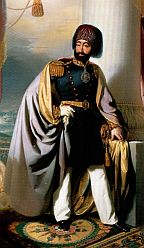 Among his reforms are the edicts (or firmans), by which he closed the Court of Confiscations, and took away much of the power of the Pasha
s.
Previous to the first of the Firmans the property of all persons banished or condemned to death was forfeited to the crown; and a sordid motive for acts of cruelty was thus kept in perpetual operation, besides the encouragement of a host of vile Delator
s.
The second firman removed the ancient rights of Turkish governors to doom men to instant death by their will; the Paşas, the Ağas, and other officers, were enjoined that "they should not presume to inflict, themselves, the punishment of death on any man, whether Raya or Turk, unless authorized by a legal sentence pronounced by the Kadi, and regularly signed by the judge." Mahmud also created an appeal system by a criminal to one of the Kazasker (chief military judge) of Asia or Europe, and finally to the Sultan himself, if the criminal chose to persist in his appeal.
About the same time that Mahmud II ordained these changes, he personally set an example of reform by regularly attending the Divan, or state council, instead of secluding himself from the labors of state. The practice of the Sultan avoiding the Divan had been introduced as long ago as the reign of Suleiman I, and was considered as one of the causes of the decline of the Empire by a Turkish historian nearly two centuries before Mahmud II's time.
Mahmud II also addressed some of the worst abuses connected with the Vakifs, by placing their revenues under state administration. However, he did not venture to apply this vast mass of property to the general purposes of the government.
In his time the financial situation of the Empire was troubling, and certain social classes had long been under oppression under difficult taxes. In dealing with the complicated questions that therefore arose, Mahmud II is considered to have demonstrated the best spirit of the best of the Köprülü
s. A Firman of February 22, 1834 abolished the vexatious charges which public functionaries, when traversing the provinces, had long been accustomed to take from the inhabitants. By the same edict all collection of money, except for the two regular half-yearly periods, was denounced as abuses. "No one is ignorant," said Sultan Mahmud II in this document, "that I am bound to afford support to all my subjects against vexatious proceedings; to endeavour unceasingly to lighten, instead of increasing their burdens, and to ensure peace and tranquility. Therefore, those acts of oppression are at once contrary to the will of God, and to my imperial orders."
The haraç
, or capitation-tax, though moderate and exempting those who paid it from military service, had long been made an engine of gross tyranny through the insolence and misconduct of the government collectors. The Firman of 1834 abolished the old mode of levying it, and ordained that it should be raised by a commission composed of the Kadı, the Muslim governors, and the Ayans, or municipal chiefs of Rayas in each district. Many other financial improvements were effected. By another important series of measures, the administrative government was simplified and strengthened, and a large number of sinecure offices were abolished. Sultan Mahmud II provided a valuable personal example of good sense, and economy, organising the imperial household, suppressing all titles without duties, and all salaried officials without functions.
.jpg) Mahmud II dealt effectively with the military fiefs, the "Tımar
Mahmud II dealt effectively with the military fiefs, the "Tımar
"s and the "Ziamet"s. These had been instituted to furnish the old effective military force, but had long ceased to serve this purpose. By attaching them to the public domains, Mahmud II materially strengthened the resources of the state, and put an end to a host of corruptions. One of the most resolute acts of his ruling was the suppression of the Dere Beys, the hereditary local chiefs (with power to nominate their successors in default of male heirs), which, in one of the worst abuses of the Ottoman feudal system, had made themselves petty princes in almost every province of the empire.
The reduction of these insubordinate feudatories was not effected at once, or without severe struggles and frequent insurrections. Mahmud II steadily persevered in this great measure and ultimately the island of Cyprus
became the only part of empire in which power not emanating from the Sultan was allowed to be retained by Dere Beys.
One of his most notable achievement was the abolition (through use of military force, execution and exile, and banning of the Bektashi
order) of the Janissary
Corps, event known as The Auspicious Incident
, in 1826 and the establishment of a modern Ottoman Army, named the Asakir-i Mansure-i Muhammediye
(meaning 'Victorious Soldiers of Muhammad' in Ottoman Turkish).
Following the loss of Greece
after the Battle of Navarino
against the combined British-French-Russian fleets in 1827, Mahmud II gave top priority to rebuilding a strong Ottoman naval force. The first steam ships of the Ottoman Navy
were acquired in 1828. In 1829 the world's largest warship for many years, the 201 x 56 kadem (1 kadem = 37.887 cm) or 76.15 by 21.22 m (249.8 by 69.6 ft) ship of the line
Mahmudiye, which had 128 cannons on 3 decks and carried 1,280 sailors on board, was built for the Ottoman Navy at the Imperial Naval Arsenal (Tersane-i Amire) on the Golden Horn
in Constantinople
(kadem, which translates as "foot", is often misinterpreted as equivalent in length to one imperial foot, hence the wrongly converted dimensions of "201 x 56 ft, or 62 x 17 m" in some sources.)
" by Jason Goodwin
is set in 1836 Constantinople, with Mahmud II's modernising reforms (and conservative opposition to them) forming the background of the plot. The Sultan himself and his mother appear in several scenes.
Sultan
Sultan is a title with several historical meanings. Originally, it was an Arabic language abstract noun meaning "strength", "authority", "rulership", and "dictatorship", derived from the masdar سلطة , meaning "authority" or "power". Later, it came to be used as the title of certain rulers who...
of the Ottoman Empire
Ottoman Empire
The Ottoman EmpireIt was usually referred to as the "Ottoman Empire", the "Turkish Empire", the "Ottoman Caliphate" or more commonly "Turkey" by its contemporaries...
from 1808 until his death in 1839. He was born in the Topkapi Palace
Topkapi Palace
The Topkapı Palace is a large palace in Istanbul, Turkey, that was the primary residence of the Ottoman Sultans for approximately 400 years of their 624-year reign....
, Istanbul
Istanbul
Istanbul , historically known as Byzantium and Constantinople , is the largest city of Turkey. Istanbul metropolitan province had 13.26 million people living in it as of December, 2010, which is 18% of Turkey's population and the 3rd largest metropolitan area in Europe after London and...
(Constantinople
Constantinople
Constantinople was the capital of the Roman, Eastern Roman, Byzantine, Latin, and Ottoman Empires. Throughout most of the Middle Ages, Constantinople was Europe's largest and wealthiest city.-Names:...
), the son of Sultan Abdulhamid I. His reign is notable mostly for the extensive administrative, military and fiscal reforms he instituted, which culminated into the Decree of Tanzimat
Tanzimat
The Tanzimât , meaning reorganization of the Ottoman Empire, was a period of reformation that began in 1839 and ended with the First Constitutional Era in 1876. The Tanzimât reform era was characterized by various attempts to modernize the Ottoman Empire, to secure its territorial integrity against...
(Reorganization) that was carried out by his sons Abdülmecid I
Abdülmecid I
Sultan Abdülmecid I, Abdul Mejid I, Abd-ul-Mejid I or Abd Al-Majid I Ghazi was the 31st Sultan of the Ottoman Empire and succeeded his father Mahmud II on July 2, 1839. His reign was notable for the rise of nationalist movements within the empire's territories...
and Abdülaziz I.
Accession
His mother was Valide SultanValide Sultan
Valide Sultan was the title held by the mother of a ruling Sultan in the Ottoman Empire. The Turkish pronunciation of the word Valide is . The title is sometimes translated as Queen Mother, although the position of Valide Sultan was quite different.The position was perhaps the most important...
Naksh-i-Dil Haseki (there have been speculations that she was a cousin of Napoleon's wife Josephine
Joséphine de Beauharnais
Joséphine de Beauharnais was the first wife of Napoléon Bonaparte, and thus the first Empress of the French. Her first husband Alexandre de Beauharnais had been guillotined during the Reign of Terror, and she had been imprisoned in the Carmes prison until her release five days after Alexandre's...
, but this is now widely regarded as false. In 1808, Mahmud II's predecessor (and half-brother) Mustafa IV
Mustafa IV
Mustafa IV was sultan of the Ottoman Empire from 1807 to 1808.-Biography:...
(1807–08) ordered his execution along with his cousin, the deposed Sultan Selim III
Selim III
Selim III was the reform-minded Sultan of the Ottoman Empire from 1789 to 1807. The Janissaries eventually deposed and imprisoned him, and placed his cousin Mustafa on the throne as Mustafa IV...
(1789–1807), in order to defuse the rebellion. Selim III was killed, but Mahmud was safely kept hidden by his mother and was placed on the throne after the rebels deposed Mustafa IV. The leader of this rebellion, Alemdar Mustafa Pasha, then became Mahmud II's vizier
Vizier
A vizier or in Arabic script ; ; sometimes spelled vazir, vizir, vasir, wazir, vesir, or vezir) is a high-ranking political advisor or minister in a Muslim government....
.
There are many stories surrounding the circumstances of his attempted murder. A version by the 19th century Ottoman historian Cevdet Pasha gives the following account: one of his slaves, a Georgian
Georgians
The Georgians are an ethnic group that have originated in Georgia, where they constitute a majority of the population. Large Georgian communities are also present throughout Russia, European Union, United States, and South America....
girl named Cevri, gathered ashes when she heard the commotion in the palace surrounding the murder of Selim III. When the assassins approached the Harem chambers where Mahmud was staying, she was able to keep them away for a while by throwing ashes into their faces, temporary blinding them. This allowed Mahmud to escape through a window and climb onto the roof of the Harem. He apparently ran to the roof of the Third Court where other pages saw him and helped him come down with pieces of clothes that were quickly tied together as a ladder. By this time one of the leaders of the rebellion, Alemdar Mustafa Pasha
Alemdar Mustafa Pasha
Alemdar Mustafa Pasha was an Ottoman military commander and a Grand Vizier born in Khotyn in Turkish-occupied Ukraine in 1765...
arrived with his armed men and upon seeing the dead body of Selim III proclaimed Mahmud as padishah. The slave girl Cevri Kalfa was awarded for her bravery and loyalty and appointed haznedar usta, the chief treasurer of the imperial Harem, which was the second most important position in the hierarchy. A plain stone staircase at the Altınyol (Golden Way) of the Harem is called Staircase of Cevri (Jevri) Kalfa, since the events apparently happened around there and are associated with her.
Reign overview
The vizier took the initiative in resuming reforms that had been terminated by the conservative coupCoup d'état
A coup d'état state, literally: strike/blow of state)—also known as a coup, putsch, and overthrow—is the sudden, extrajudicial deposition of a government, usually by a small group of the existing state establishment—typically the military—to replace the deposed government with another body; either...
of 1807 that had brought Mustafa IV to power. However, soon the vizier was killed by Ibrahim's army, and Mahmud II temporarily abandoned the reforms. Mahmud II's later reformation efforts were more successful.
During the early years of Mahmud II's reign, his governor of Egypt Mehmet Ali Paşa
Muhammad Ali of Egypt
Muhammad Ali Pasha al-Mas'ud ibn Agha was a commander in the Ottoman army, who became Wāli, and self-declared Khedive of Egypt and Sudan...
successfully reconquered the holy cities of Medina
Medina
Medina , or ; also transliterated as Madinah, or madinat al-nabi "the city of the prophet") is a city in the Hejaz region of western Saudi Arabia, and serves as the capital of the Al Madinah Province. It is the second holiest city in Islam, and the burial place of the Islamic Prophet Muhammad, and...
(1812) and Mecca
Mecca
Mecca is a city in the Hijaz and the capital of Makkah province in Saudi Arabia. The city is located inland from Jeddah in a narrow valley at a height of above sea level...
(1813) from the Nejdi rebels
First Saudi State
The First Saudi State was established in the year 1744 when imam Muhammad ibn Abd al-Wahhab and Prince Muhammad ibn Saud formed an alliance to establish a religious & political sovereignty determined to cleanse the Arabian Peninsula of heretical practices and deviations from orthodox Islam...
.
His reign also marked the first breakaway from the Ottoman Empire, with Greece gaining its independence
Greek War of Independence
The Greek War of Independence, also known as the Greek Revolution was a successful war of independence waged by the Greek revolutionaries between...
following a rebellion that started in 1821. In 1827 the combined British, French and Russian navies defeated the Ottoman Navy at the Battle of Navarino
Battle of Navarino
The naval Battle of Navarino was fought on 20 October 1827, during the Greek War of Independence in Navarino Bay , on the west coast of the Peloponnese peninsula, in the Ionian Sea. A combined Ottoman and Egyptian armada was destroyed by a combined British, French and Russian naval force...
; in the aftermath, the Ottoman Empire was forced to recognize Greece with the Treaty of Constantinople
Treaty of Constantinople (1832)
The Τreaty of Constantinople was the product of the Constantinople Conference which opened in February 1832 with the participation of the Great Powers on the one hand and the Ottoman Empire on the other. The factors which shaped the treaty included the refusal of Léopold, King of Belgium, to...
in July 1832. This event, together with the occupation of the Ottoman province of Algeria
Algeria
Algeria , officially the People's Democratic Republic of Algeria , also formally referred to as the Democratic and Popular Republic of Algeria, is a country in the Maghreb region of Northwest Africa with Algiers as its capital.In terms of land area, it is the largest country in Africa and the Arab...
by France
France
The French Republic , The French Republic , The French Republic , (commonly known as France , is a unitary semi-presidential republic in Western Europe with several overseas territories and islands located on other continents and in the Indian, Pacific, and Atlantic oceans. Metropolitan France...
in 1830, marked the beginning of the gradual break-up of the Ottoman Empire. Non-Turkish ethnic groups living in the empire's territories, especially in Europe, started their own independence movements.
Among Mahmud II's most notable acts during his reign was the abolition of the Janissary
The Auspicious Incident
The Auspicious Incident was the forced disbandment of the centuries-old Janissary corps by Ottoman sultan Mahmud II in June 1826....
corps in 1826, permitting the establishment of a European-style conscript army, recruited largely from Turkish speakers of Rumelia and Asia Minor. Mahmud was also responsible for the subjugation of the Iraqi Mamluks
Mamluk rule in Iraq
The Mamluks who ruled Iraq in the 18th century were freed Georgian slaves converted to Islam, trained in a special school, and then assigned to military and administrative duties. They presided, with short intermissions, over more than a century in the history of Ottoman Iraq, from 1704 to 1831...
by Ali Ridha Pasha
Ali Ridha Pasha
Ali Ridha Pasha led the Ottoman army in 1831 against the mamluk governor in Baghdad after Da’ud Pasha refused to relinquish his office. Ali Riza Pasha captured the city and mamluk leader Da’ud Pasha ending the mamluk rule in Baghdad...
in 1831. He ordered the execution of the renowned Ali Pasha
Ali Pasha
Ali Pasha of Tepelena or of Yannina, surnamed Aslan, "the Lion", or the "Lion of Yannina", Ali Pashë Tepelena was an Ottoman Albanian ruler of the western part of Rumelia, the Ottoman Empire's European territory which was also called Pashalik of Yanina. His court was in Ioannina...
of Tepelena. He sent his Grand Vizier
Grand Vizier
Grand Vizier, in Turkish Vezir-i Azam or Sadr-ı Azam , deriving from the Arabic word vizier , was the greatest minister of the Sultan, with absolute power of attorney and, in principle, dismissable only by the Sultan himself...
to execute the Bosnian Muslim hero Husein Gradaščević
Husein Gradašcevic
Husein-kapetan Gradaščević was a Bosnian Muslim general who fought for Bosnian autonomy in the Ottoman Empire. He is often referred to as "Zmaj od Bosne", meaning "Dragon of Bosnia"...
and dissolute the Bosnia Eyalet
Bosnia Eyalet
The Eyalet of Bosnia or Bosnia Beylerbeylik was a eyalet and beylerbeylik of the Ottoman Empire, mostly based on the territory of the present-day state of Bosnia and Herzegovina as well as most of Slavonia, Lika, and Dalmatia in present-day Croatia...
.
He began preparations for the Tanzimat
Tanzimat
The Tanzimât , meaning reorganization of the Ottoman Empire, was a period of reformation that began in 1839 and ended with the First Constitutional Era in 1876. The Tanzimât reform era was characterized by various attempts to modernize the Ottoman Empire, to secure its territorial integrity against...
reforms in 1839. The Tanzimat marked the beginning of modernization in Turkey
Turkey
Turkey , known officially as the Republic of Turkey , is a Eurasian country located in Western Asia and in East Thrace in Southeastern Europe...
, and had immediate effects on social and legal aspects of life in the Empire, such as European style clothing, architecture, legislation, institutional organization and land reform.
He was concerned also for aspects of tradition. He made great efforts to revive the sport of archery. He ordered his archery student, Mustafa Kani, to write a book about the history, construction, and use of Turkish bow
Turkish bow
The Turkish bow is a recurved composite bow used in the Ottoman Empire.The construction was that of the classic Asiatic composite bow, with a wooden core , animal horn on the side facing the archer, and sinew on the back. Animal glue held it together...
s, from which comes most of what is now known of Turkish bowyery.
Mahmud II died of tuberculosis
Tuberculosis
Tuberculosis, MTB, or TB is a common, and in many cases lethal, infectious disease caused by various strains of mycobacteria, usually Mycobacterium tuberculosis. Tuberculosis usually attacks the lungs but can also affect other parts of the body...
- some say he was murdered - at the Esma Sultana Palace, Çamlıca, in 1839. His funeral was attended by crowds of people who came to bid the Sultan farewell. His son Abdülmecid
Abdülmecid I
Sultan Abdülmecid I, Abdul Mejid I, Abd-ul-Mejid I or Abd Al-Majid I Ghazi was the 31st Sultan of the Ottoman Empire and succeeded his father Mahmud II on July 2, 1839. His reign was notable for the rise of nationalist movements within the empire's territories...
succeeded him.
Marriages and issue
He married firstly an unknown wife and had:- HIH Prince Şehzade Suleiman Efendi (1818–1819)
He married secondly HH Valide Sultan Bezmiâlem
Bezmiâlem
Bezmiâlem Kadınefendi was the second spouse of Sultan Mahmud II of the Ottoman Empire.-Biography:...
, originally named Suzi (1807–1852), a Russian Jew, and had:
- Abdülmecid IAbdülmecid ISultan Abdülmecid I, Abdul Mejid I, Abd-ul-Mejid I or Abd Al-Majid I Ghazi was the 31st Sultan of the Ottoman Empire and succeeded his father Mahmud II on July 2, 1839. His reign was notable for the rise of nationalist movements within the empire's territories...
He married thirdly an unknown wife and had:
- HIH Prince Şehzade Kemaluddin Efendi, unmarried and without issue
He married fourthly HH Valide Sultan Pertevniyal, originally named Bezime (1812–1883), and had:
- Abdülaziz I
The name of his fourth wife is also spelled as "Partav-Nihal". By 1868, Pertevniyal was settled in the Dolmabahçe Palace
Dolmabahçe Palace
Dolmabahçe Palace located in the Beşiktaş district of Istanbul, Turkey, on the European coastline of the Bosphorus strait, served as the main administrative center of the Ottoman Empire from 1856 to 1922, apart from a 22-year interval in which Yıldız Palace was used.- History :Dolmabahçe Palace...
. That year Abdülaziz led the visiting Empress Eugénie
Eugénie de Montijo
Doña María Eugenia Ignacia Augustina de Palafox-Portocarrero de Guzmán y Kirkpatrick, 16th Countess of Teba and 15th Marquise of Ardales; 5 May 1826 – 11 July 1920), known as Eugénie de Montijo , was the last Empress consort of the French from 1853 to 1871 as the wife of Napoleon III, Emperor of...
of France to see his mother. Pertevniyal perceived the presence of a foreign woman within her quarters of the seraglio
Seraglio
A seraglio or serail is the sequestered living quarters used by wives and concubines in a Turkish household. The word comes from an Italian variant of Turkish saray, from Persian sarai , meaning palace, or the enclosed courts for the wives and concubines of the harem of a house or palace...
as an insult. She reportedly slap
Slap
A slap or "smack" is a broad stroke made with the open hand or the back of the hand, as opposed to a punch that is made with a closed fist. Slaps are frequently made across the face, but can be also made across hands or any other body part, and can use either the palm of the hand or the back of the...
ped Eugenie across the face, almost resulting in an international incident. The Pertevniyal Valide Sultan Mosque
Pertevniyal Valide Sultan Mosque
-External links:*...
was built under the patronage of his mother. Construction began in November 1869 and the mosque was finished in 1871.
Legal reforms
Pasha
Pasha or pascha, formerly bashaw, was a high rank in the Ottoman Empire political system, typically granted to governors, generals and dignitaries. As an honorary title, Pasha, in one of its various ranks, is equivalent to the British title of Lord, and was also one of the highest titles in...
s.
Previous to the first of the Firmans the property of all persons banished or condemned to death was forfeited to the crown; and a sordid motive for acts of cruelty was thus kept in perpetual operation, besides the encouragement of a host of vile Delator
Delator
Delator is Latin for a denouncer, i.e. who indicates to a court another as having committed a punishable deed.-Secular Roman law:...
s.
The second firman removed the ancient rights of Turkish governors to doom men to instant death by their will; the Paşas, the Ağas, and other officers, were enjoined that "they should not presume to inflict, themselves, the punishment of death on any man, whether Raya or Turk, unless authorized by a legal sentence pronounced by the Kadi, and regularly signed by the judge." Mahmud also created an appeal system by a criminal to one of the Kazasker (chief military judge) of Asia or Europe, and finally to the Sultan himself, if the criminal chose to persist in his appeal.
About the same time that Mahmud II ordained these changes, he personally set an example of reform by regularly attending the Divan, or state council, instead of secluding himself from the labors of state. The practice of the Sultan avoiding the Divan had been introduced as long ago as the reign of Suleiman I, and was considered as one of the causes of the decline of the Empire by a Turkish historian nearly two centuries before Mahmud II's time.
Mahmud II also addressed some of the worst abuses connected with the Vakifs, by placing their revenues under state administration. However, he did not venture to apply this vast mass of property to the general purposes of the government.
In his time the financial situation of the Empire was troubling, and certain social classes had long been under oppression under difficult taxes. In dealing with the complicated questions that therefore arose, Mahmud II is considered to have demonstrated the best spirit of the best of the Köprülü
Koprulu
Koprulu refers to:* Köprülü family an Ottoman noble family of Albanian origin* Köprülü era , the period in which the Ottoman Empire's politics were set by the Grand Viziers, mainly the Köprülü family...
s. A Firman of February 22, 1834 abolished the vexatious charges which public functionaries, when traversing the provinces, had long been accustomed to take from the inhabitants. By the same edict all collection of money, except for the two regular half-yearly periods, was denounced as abuses. "No one is ignorant," said Sultan Mahmud II in this document, "that I am bound to afford support to all my subjects against vexatious proceedings; to endeavour unceasingly to lighten, instead of increasing their burdens, and to ensure peace and tranquility. Therefore, those acts of oppression are at once contrary to the will of God, and to my imperial orders."
The haraç
Haraç
The Haraç, or Harač, was a poll-tax in the Ottoman empire.It developed from an earlier form of land taxation and was, in principle, only payable by non-Muslims; it was seen as a counterpart to zakat paid by Muslims...
, or capitation-tax, though moderate and exempting those who paid it from military service, had long been made an engine of gross tyranny through the insolence and misconduct of the government collectors. The Firman of 1834 abolished the old mode of levying it, and ordained that it should be raised by a commission composed of the Kadı, the Muslim governors, and the Ayans, or municipal chiefs of Rayas in each district. Many other financial improvements were effected. By another important series of measures, the administrative government was simplified and strengthened, and a large number of sinecure offices were abolished. Sultan Mahmud II provided a valuable personal example of good sense, and economy, organising the imperial household, suppressing all titles without duties, and all salaried officials without functions.
Military reforms
Timar
Timar is a land granted by the Ottoman sultans between the fourteenth and sixteenth centuries, with a tax revenue annual value of less than 20 000 akçes. The revenues produced from land acted as compensation for military service. A Timar holder was known as a Timariot...
"s and the "Ziamet"s. These had been instituted to furnish the old effective military force, but had long ceased to serve this purpose. By attaching them to the public domains, Mahmud II materially strengthened the resources of the state, and put an end to a host of corruptions. One of the most resolute acts of his ruling was the suppression of the Dere Beys, the hereditary local chiefs (with power to nominate their successors in default of male heirs), which, in one of the worst abuses of the Ottoman feudal system, had made themselves petty princes in almost every province of the empire.
The reduction of these insubordinate feudatories was not effected at once, or without severe struggles and frequent insurrections. Mahmud II steadily persevered in this great measure and ultimately the island of Cyprus
Cyprus
Cyprus , officially the Republic of Cyprus , is a Eurasian island country, member of the European Union, in the Eastern Mediterranean, east of Greece, south of Turkey, west of Syria and north of Egypt. It is the third largest island in the Mediterranean Sea.The earliest known human activity on the...
became the only part of empire in which power not emanating from the Sultan was allowed to be retained by Dere Beys.
One of his most notable achievement was the abolition (through use of military force, execution and exile, and banning of the Bektashi
Bektashi
Bektashi Order or Bektashism is an Islamic Sufi order founded in the 13th century by the Persian saint Haji Bektash Veli. In addition to the spiritual teachings of Haji Bektash Veli the order was significantly influenced during its formative period by both the Hurufis as well as the...
order) of the Janissary
Janissary
The Janissaries were infantry units that formed the Ottoman sultan's household troops and bodyguards...
Corps, event known as The Auspicious Incident
The Auspicious Incident
The Auspicious Incident was the forced disbandment of the centuries-old Janissary corps by Ottoman sultan Mahmud II in June 1826....
, in 1826 and the establishment of a modern Ottoman Army, named the Asakir-i Mansure-i Muhammediye
Asakir-i Mansure-i Muhammediye
The Mansure Army was an ocak of the Ottoman army. It was established by Mahmud II, who also disbanded Janissary Corps.After the Auspicious Incident and the disbandment of the Janissary Corps, Mahmud II established a new military ocak and Agha Hussein Pasha was appointed to the command of the corps...
(meaning 'Victorious Soldiers of Muhammad' in Ottoman Turkish).
Following the loss of Greece
Greece
Greece , officially the Hellenic Republic , and historically Hellas or the Republic of Greece in English, is a country in southeastern Europe....
after the Battle of Navarino
Battle of Navarino
The naval Battle of Navarino was fought on 20 October 1827, during the Greek War of Independence in Navarino Bay , on the west coast of the Peloponnese peninsula, in the Ionian Sea. A combined Ottoman and Egyptian armada was destroyed by a combined British, French and Russian naval force...
against the combined British-French-Russian fleets in 1827, Mahmud II gave top priority to rebuilding a strong Ottoman naval force. The first steam ships of the Ottoman Navy
Ottoman Navy
The Ottoman Navy was established in the early 14th century. During its long existence it was involved in many conflicts; refer to list of Ottoman sieges and landings and list of Admirals in the Ottoman Empire for a brief chronology.- Pre-Ottoman:...
were acquired in 1828. In 1829 the world's largest warship for many years, the 201 x 56 kadem (1 kadem = 37.887 cm) or 76.15 by 21.22 m (249.8 by 69.6 ft) ship of the line
Ship of the line
A ship of the line was a type of naval warship constructed from the 17th through the mid-19th century to take part in the naval tactic known as the line of battle, in which two columns of opposing warships would manoeuvre to bring the greatest weight of broadside guns to bear...
Mahmudiye, which had 128 cannons on 3 decks and carried 1,280 sailors on board, was built for the Ottoman Navy at the Imperial Naval Arsenal (Tersane-i Amire) on the Golden Horn
Golden Horn
The Golden Horn is a historic inlet of the Bosphorus dividing the city of Istanbul and forming the natural harbor that has sheltered Greek, Roman, Byzantine, Ottoman and other ships for thousands of...
in Constantinople
Constantinople
Constantinople was the capital of the Roman, Eastern Roman, Byzantine, Latin, and Ottoman Empires. Throughout most of the Middle Ages, Constantinople was Europe's largest and wealthiest city.-Names:...
(kadem, which translates as "foot", is often misinterpreted as equivalent in length to one imperial foot, hence the wrongly converted dimensions of "201 x 56 ft, or 62 x 17 m" in some sources.)
In fiction
The 2006 historical detective novel, "The Janissary TreeThe Janissary Tree
The Janissary Tree is a crime novel, written by Jason Goodwin. It is set in Istanbul in 1836.The first in a series featuring the eunuch detective Yashim, it deals with the fictional aftermath of a real event in Ottoman history – the so-called Auspicious Event, which took place in June 1826 – the...
" by Jason Goodwin
Jason Goodwin
Jason Goodwin is a British writer and historian. He studied Byzantine history at Cambridge University. Following the success of A Time For Tea: Travels in China and India in Search of Tea, he walked from Poland to Istanbul, Turkey...
is set in 1836 Constantinople, with Mahmud II's modernising reforms (and conservative opposition to them) forming the background of the plot. The Sultan himself and his mother appear in several scenes.
See also
- Peter the Great
- Atçalı Kel Mehmet EfeAtçali Kel Mehmet EfeAtçalı Kel Mehmet Efe was a Zeybek, who led a local revolt against Ottoman authority and established control of the Aydın region for a short period between 1829 and 1830 .-Early Ages:...
- Sened-i İttifak
- Muhammad Ali Muhammad Ali of EgyptMuhammad Ali Pasha al-Mas'ud ibn Agha was a commander in the Ottoman army, who became Wāli, and self-declared Khedive of Egypt and Sudan...
- Husein GradaščevićHusein GradašcevicHusein-kapetan Gradaščević was a Bosnian Muslim general who fought for Bosnian autonomy in the Ottoman Empire. He is often referred to as "Zmaj od Bosne", meaning "Dragon of Bosnia"...
- Ali PashaAli PashaAli Pasha of Tepelena or of Yannina, surnamed Aslan, "the Lion", or the "Lion of Yannina", Ali Pashë Tepelena was an Ottoman Albanian ruler of the western part of Rumelia, the Ottoman Empire's European territory which was also called Pashalik of Yanina. His court was in Ioannina...
- Auspicious Incident