
|
|
|
|
Westland Lynx
|
| |
|
| |
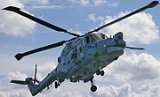
The Westland Lynx is a British helicopter designed by and built Westland Helicopters at its factory in Yeovil. Originally intended as a utility craft for both civil and naval usage, military interest led to the development of both battlefield and naval variants, which went into operational usage in 1977 and were later adopted by the armed forces of over a dozen nations, where it primarily serves in the battlefield utility, search and rescue and anti-submarine warfare roles.

Discussion
Ask a question about 'Westland Lynx'
Start a new discussion about 'Westland Lynx'
Answer questions from other users
|
Encyclopedia
The Westland Lynx is a British helicopter designed by and built Westland Helicopters at its factory in Yeovil. Originally intended as a utility craft for both civil and naval usage, military interest led to the development of both battlefield and naval variants, which went into operational usage in 1977 and were later adopted by the armed forces of over a dozen nations, where it primarily serves in the battlefield utility, search and rescue and anti-submarine warfare roles. The helicopter is now produced and marketed by AgustaWestland.
Development The initial design (then known as the Westland WG.13) was started in the mid-1960s as a replacement for the Westland Scout and Wasp, and a more advanced alternative to the UH-1 Iroquois.
As part of the Anglo-French helicopter agreement signed in February 1967, the French company Aérospatiale were given a work share in the manufacturing programme, it being intended that France buy Lynxes for its Navy and as an armed reconnaissance helicopter for the French Army, with Britain buying Aérospatiale Gazelles and Pumas for its armed forces. The French Army cancelled its requirement for Lynxes in October 1969. The Lynx first flew on 21 March 1971.
In 1972, a Lynx broke the world record over 15 and 25 km by flying at . It also set a new 100 km closed circuit record shortly afterwards, flying at . In 1986, a Lynx specially modified with BERP (British Experimental Rotor Programme) rotor blades, registered G-LYNX and piloted by Trevor Egginton set an absolute speed record for helicopters over a 15 and 25 km course by reaching 400.87 km/h (249.09 mph). The Lynx is an agile helicopter, capable of performing loops and rolls.
The British Army ordered 100 Lynx AH (Army Helicopter) Mk.1 for various roles, including tactical transport, armed escort, anti-tank warfare (with eight TOW missiles), reconnaissance and evacuation. The Army has fitted a Marconi Elliot AFCS system onto the Lynx for automatic stabilisation on three axis.
Future Lynx On 22 June 2006 the UK Ministry of Defence awarded Westland a £1 billion contract for 70 Future Lynx helicopters under a strategic partnering agreement with AgustaWestland. The programme will provide the British Army and Royal Navy with 40 and 30 aircraft respectively, with an option for a further 10, split equally between Army and Navy.
Future Lynx is described as a new aircraft that builds on the dynamic and vehicle systems of the existing design, incorporating advanced technology and providing increased capability. The fatigue problems with the existing airframe and rotor system are to be corrected. Future Lynx will utilise some systems developed for the Super Lynx 300 and will feature a redesigned nose and rear fuselage to give greater space and easier access to avionic units. Future Lynx will be powered by two LHTEC CTS800 engines, offering increased power and endurance over existing Lynx power plants, while retaining economy.
The first Future Lynx is programmed to make its maiden flight in 2009, with initial deliveries in 2011. The Army variant will enter operational service in 2014, with the RN variant following in 2015.
Operational history
In British service it equips the Army Air Corps (AAC) and the Fleet Air Arm (FAA). For the AAC the Lynx AH.7 and AH.9 operate as attack/utility helicopters. The Lynx AH.7 is in service with the FAA where it operates as an attack/utility helicopter in support of the Royal Marines, and the Lynx HMA.8 as anti-submarine warfare helicopter equipped with the Sea Skua anti-ship missile for Royal Navy warships.
The Lynx's most prominent combat role was operating the Sea Skua to devastating effect against the Iraqi Navy during the 1991 Gulf War. The Lynx also saw service with British Army forces during that conflict. The HAS.2 naval ASW variant had already taken part in combat operations in British service during the Falklands War in 1982. None were shot down, but three were lost aboard vessels hit by Argentine bombs or Exocets, one on the MV Atlantic Conveyor and one each on board HMS Coventry and HMS Ardent.
It was used during Operation Barras to rescue 11 British soldiers in Sierra Leone on 10 September 2000.
The most recent wartime mission for the Lynx was during the invasion of Iraq in 2003. It has also seen extensive service during peacekeeping operations and exercises, and it is standard equipment for most Royal Navy surface combatants when they deploy.
A British Lynx from 847 Naval Air Squadron was shot down over Basra, Iraq on 6 May 2006. The helicopter is believed to have been downed by either a missile or more likely, a Rocket Propelled Grenade (RPG). The Lynx crashed into a house and burst into flames, killing all five on board, including the Commanding Officer of 847 NAS. A riot followed with locals celebrating the downing of the helicopter and surrounding the crash site as British troops rushed to the scene. This was the first British helicopter and only the second British aircraft downed (the first was an RAF Hercules) due to enemy fire in the war. A flight of either AAC or RM Lynx AH.7s are based at Basra Air Station under command of the Joint Helicopter Force (Iraq) on a rotational basis, but are restricted operationally during the Summer months due to the very high daytime temperatures which affect lifting capacity and endurance dramatically.
Design The Lynx is a utility type helicopter design with a side by side cockpit for pilot and co-pilot. It features a large sliding and crew door on each side. Its twin turboshaft engines power a four-blade semi-rigid main rotor system.
Variants
Land-based variants Westland WG.13
- Prototype, first flight 21 March 1971.
AH.1
- Initial production version for the British Army Air Corps, with over 100 examples built. Used for a variety of tasks, including tactical transport, armed escort, anti-tank warfare (equipped with eight TOW missiles), reconnaissance and casualty evacuation.
AH.1GT
- Interim conversion of the AH.1 to partial AH.7 standard for the Army Air Corps.
AH.5
- Upgraded version for the Army Air Corps. Only five were built, of which four were later upgraded to AH.7 standard and one was retained for trials work as an AH.5X.
AH.6
- Proposed version for the Royal Marines, not built.
AH.7
- Upgraded version for the Army Air Corps. A small number also used by the Fleet Air Arm in support of the Royal Marines. Now replaced by the WAH-64 Apache as the main attack helicopter.
AH.7(DAS)
- AH.7 with Defensive Aids Subsystem.
Lynx AH.9 ("Battlefield Lynx")
- British Army version of the Super Lynx (AH.7 with wheeled undercarriage).
Naval variants
Lynx HAS.2 / HAS.2(FN)
- Initial production version for the Royal Navy (HAS.2) and the French Navy (HAS.2(FN)). When it is used in the anti-submarine role, it is equipped with two torpedoes or depth charges and a dipping sonar. For anti-surface warfare, it is equipped with either four Sea Skua missiles (Royal Navy) or four AS.12 missiles (French Navy).
Lynx HAS.3
- Improved version of HAS.2.
HAS.3(S)
- Improved version of the HAS.3 for the Royal Navy fitted with secure radio systems.
HAS.3(GM(S))
- Nineteen modified helicopters for the Royal Navy, for service in the Persian Gulf (GM denotes Gulf Modification).
HAS.3(ICE(S))
- Two helicopters for the Royal Navy for use in the Antarctic.
HAS.4(FN)
- Upgraded version for the Aéronavale.
HMA.8 ("Super Lynx")
- Upgraded maritime attack version.
HMA.8(DSP)
- Digital Signal Processor.
HMA.8(DAS)
- Defensive Aids Subsystem. (Incorporates DSP).
HMA.8(SATURN)
- Second-generation Anti-jam Tactical UHF Radio for NATO. (Incorporates DSP).
HMA.8(SIFF)
- Successor to IFF. (Incorporates DSP).
HMA.8(CMP)
- Combined Mods Programme.
CMP aircraft are those that have the DAS, SATURN and SIFF modifications embodied. All Lynx HAS.8 will eventually be at the CMP standard. The first entered service in early 2008.
Export variants Lynx Mk.21
- Export version of the HAS.2 for the Brazilian Navy. Brazilian navy designation "SAH-11".
Super Lynx Mk.21A
- Export version of the Super Lynx for the Brazilian navy.
Lynx Mk.22
- Unbuilt export version for the Egyptian Navy.
Lynx Mk.23
- Export version of the HAS.2 for the Argentine Navy. Later sold to Brazil and Denmark.
Lynx Mk.24
- Unbuilt export version for the Iraqi army.
Lynx Mk.25
- Export version of the HAS.2 for the Royal Netherlands Navy. Designated "UH-14A" in Dutch service.
Lynx Mk.26
- Unbuilt export version for the Iraqi army.
Lynx Mk.27
- Export version for the Royal Netherlands Navy. Designated "SH-14B" in Dutch service.
Lynx Mk.28
- Export version of the AH.1 for the Qatar Police.
Lynx Mk.64
- Export version of the Super Lynx for the South African Air Force.
Lynx Mk.80
- Export version of the HAS.2 for the Royal Danish Navy.
Lynx Mk.81
- Export version for the Royal Netherlands Navy. Designated "SH-14C" in Dutch service.
Lynx SH-14D
- Upgraded helicopters for the Royal Netherlands Navy.
Lynx Mk.82
- Unbuilt export version for the Egyptian army.
Lynx Mk.83
- Unbuilt export version for the Saudi Arabian army.
Lynx Mk 84
- Unbuilt export version for the Qatar army.
Lynx Mk 85
- Unbuilt export version for the United Arab Emirates army.
Lynx Mk.86
- Export version of the HAS.2 for the Royal Norwegian Air Force.
Lynx Mk.87
- Embargoed export version of the Argentine navy.
Lynx Mk.88
- Export version for the German Navy.
Super Lynx Mk.88A
- Upgraded version of the Lynx Mk.88 for the German Navy.
Lynx Mk.89
- Export version for the Nigerian navy.
Lynx Mk.90
- Export version for the Royal Danish Navy.
Lynx Mk.90A
- Upgraded version of the Lynx Mk.80 for the Royal Danish Navy (retro-fitted with BERP-rotors)
Super Lynx Mk.90B
- Upgraded versions of the Mk.90A and Lynx Mk.90 for the Royal Danish Navy.
Lynx Mk.95
- Export version of the HAS.8 for the Portuguese Navy.
Lynx Mk.99
- Export version of the HAS.8 for the South Korean Navy.
Super Lynx Mk.120
- Export version for the Royal Air Force of Oman.
Super Lynx Mk.130
- Export version for the Algerian Navy.
Super Lynx 300
- Export version of the Super Lynx.
Projects Lynx HT.3
- Proposed training version for the Royal Air Force, not built.
Battlefield Lynx
- Proposed export version of Lynx AH.9.
Battlefield Lynx 800
- Proposed export version of Lynx AH.9 with LHTEC T800 engines, the project was abandoned in 1992.
Lynx ACH
- Proposed experimental Advanced Compound Helicopter.
Lynx-3
- Technology prototype, build in 1984. Only one built (serial/registration ZE477 / G-17-24)
Derivatives
Westland 30
- medium helicopter based on the Lynx, using some dynamic systems with a new, enlarged fuselage for up to 22 passengers.
Notes:
- AH: Army Helicopter
- HAS: Helicopter, Anti-Submarine
- HMA: Helicopter, Maritime Attack
- IFF: Identification Friend or Foe
- (GM): Gulf Modification
- (S): Secure speech radio
Operators
Military operators
Law Enforcement Operators
Specifications (Super Lynx Series 100)
See also
External links
Technical information
Photos and videos
|
| |
|
|