

Hippos

Encyclopedia
- "Sussita" redirects here. For the automobile, see Autocars Co.Autocars Co.Sabra of Haifa, Israel, was founded in the 1950s as Israel's first car manufacturer . Among their popular models were the Sussita , Carmel and Gilboa...
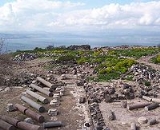
Hippos is an archaeological site
Archaeology
Archaeology, or archeology , is the study of human society, primarily through the recovery and analysis of the material culture and environmental data that they have left behind, which includes artifacts, architecture, biofacts and cultural landscapes...
in Israel
Israel
The State of Israel is a parliamentary republic located in the Middle East, along the eastern shore of the Mediterranean Sea...
, located on a hill overlooking the Sea of Galilee
Sea of Galilee
The Sea of Galilee, also Kinneret, Lake of Gennesaret, or Lake Tiberias , is the largest freshwater lake in Israel, and it is approximately in circumference, about long, and wide. The lake has a total area of , and a maximum depth of approximately 43 m...
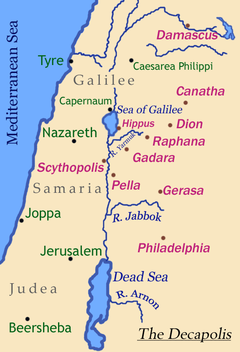
. Between the 3rd century BC and the 7th century AD, Hippos was the site of a Greco-Roman city. Besides the fortified city itself, Hippos controlled two port facilities on the lake and an area of the surrounding countryside. Hippos was part of the Decapolis
Decapolis
The Decapolis was a group of ten cities on the eastern frontier of the Roman Empire in Judea and Syria. The ten cities were not an official league or political unit, but they were grouped together because of their language, culture, location, and political status...
, or Ten Cities, a group of cities in Roman
Roman Empire
The Roman Empire was the post-Republican period of the ancient Roman civilization, characterised by an autocratic form of government and large territorial holdings in Europe and around the Mediterranean....
Palestine that were culturally tied more closely to Greece
Greece
Greece , officially the Hellenic Republic , and historically Hellas or the Republic of Greece in English, is a country in southeastern Europe....
and Rome than to the Near East.
Established as Antiochia Hippos by Seleucid settlers, the city is named after the Greek language
Greek language
Greek is an independent branch of the Indo-European family of languages. Native to the southern Balkans, it has the longest documented history of any Indo-European language, spanning 34 centuries of written records. Its writing system has been the Greek alphabet for the majority of its history;...
word for horse, Hippos, and a common name of Seleucid monarchs, Antiochus
Antiochus
-The Seleucid Empire:* Antiochus , father of Seleucus I Nicator, founder of the Hellenstic Seleucid Empire* Antiochus I Soter , king of the Seleucid Empire...
. The local Aramaic and Hebrew
Hebrew language
Hebrew is a Semitic language of the Afroasiatic language family. Culturally, is it considered by Jews and other religious groups as the language of the Jewish people, though other Jewish languages had originated among diaspora Jews, and the Hebrew language is also used by non-Jewish groups, such...
name, Sussita , also means horse, while the Arabic
Arabic language
Arabic is a name applied to the descendants of the Classical Arabic language of the 6th century AD, used most prominently in the Quran, the Islamic Holy Book...
name, Qal'at el-Husn, means "Fortress of the Horse." Other names include the alternate spelling Hippus and the Latin
Latin
Latin is an Italic language originally spoken in Latium and Ancient Rome. It, along with most European languages, is a descendant of the ancient Proto-Indo-European language. Although it is considered a dead language, a number of scholars and members of the Christian clergy speak it fluently, and...
ized version of the Greek name: Hippum. The precise reason why the city received this name is as yet unknown.
Location
Hippos was built on a flat-topped foothill 2 kilometers east of and 350 meters above the Sea of Galilee, 144 meters above sea level - near modern Kibbutz Ein GevKibbutz Ein Gev
Ein Gev is a kibbutz located on the eastern shore of the Sea of Galilee in northern Israel. It falls under the jurisdiction of Emek HaYarden Regional Council...
. The site is just on the Israeli side of the 1949 UN-demarcated border between Syria
Syria
Syria , officially the Syrian Arab Republic , is a country in Western Asia, bordering Lebanon and the Mediterranean Sea to the West, Turkey to the north, Iraq to the east, Jordan to the south, and Israel to the southwest....
and Israel
Israel
The State of Israel is a parliamentary republic located in the Middle East, along the eastern shore of the Mediterranean Sea...
. Hippos was part of a demilitarized zone
Demilitarized zone
In military terms, a demilitarized zone is an area, usually the frontier or boundary between two or more military powers , where military activity is not permitted, usually by peace treaty, armistice, or other bilateral or multilateral agreement...
between the Golan Heights and Israel proper, until Israel captured the former in the 1967 Arab-Israeli War.
Hellenistic period
Excavations in Hippos have revealed traces of habitation from as early as the NeolithicNeolithic
The Neolithic Age, Era, or Period, or New Stone Age, was a period in the development of human technology, beginning about 9500 BC in some parts of the Middle East, and later in other parts of the world. It is traditionally considered as the last part of the Stone Age...
period. The site was again inhabited in the third century BC by the Ptolemies, though whether it was an urban settlement or a military outpost is still unknown. During this time, Coele-Syria
Coele-Syria
Coele-Syria , or Cœle-Syria or Celesyria, traditionally given the meaning 'hollow' Syria, was the region of southern Syria disputed between the Seleucid dynasty and the Ptolemaic dynasty. Rather than limiting the Greek term to the Beqaa Valley of Lebanon, it is often used to cover the entire area...
served as the battleground between two dynasties descending from Captains of Alexander the Great, the Ptolemies and the Seleucids. It is likely that Hippos, on a very defensible site along the border lines of the 3rd century BC, was founded as a border fortress for the Ptolemies. The city of Hippos itself was established by Seleucid colonists, most likely in the second century BC. Its full name, Antiochia Hippos , reflects a Seleucid founding.
As the Seleucids took possession of all of Coele-Syria, Hippos grew into a full-fledged polis
Polis
Polis , plural poleis , literally means city in Greek. It could also mean citizenship and body of citizens. In modern historiography "polis" is normally used to indicate the ancient Greek city-states, like Classical Athens and its contemporaries, so polis is often translated as "city-state."The...
, a city-state
City-state
A city-state is an independent or autonomous entity whose territory consists of a city which is not administered as a part of another local government.-Historical city-states:...
with control over the surrounding countryside. Antiochia Hippos was improved with all the makings of a Greek polis: a temple, a central market area, and other public structures. The availability of water limited the size of Hellenistic Hippos. The citizens relied on rain-collecting cistern
Cistern
A cistern is a waterproof receptacle for holding liquids, usually water. Cisterns are often built to catch and store rainwater. Cisterns are distinguished from wells by their waterproof linings...
s for all their water; this kept the city from supporting a very large population.
Hasmonean Period
The Maccabean revolt resulted in an independent Jewish kingdom under the HasmoneanHasmonean
The Hasmonean dynasty , was the ruling dynasty of Judea and surrounding regions during classical antiquity. Between c. 140 and c. 116 BCE, the dynasty ruled semi-autonomously from the Seleucids in the region of Judea...
family in 142 BC
142 BC
Year 142 BC was a year of the pre-Julian Roman calendar. At the time it was known as the Year of the Consulship of Calvus and Servilianus...
. In c. 83-80 BC, Alexander Jannaeus
Alexander Jannaeus
Alexander Jannaeus was king of Judea from 103 BC to 76 BC. The son of John Hyrcanus, he inherited the throne from his brother Aristobulus I, and appears to have married his brother's widow, Shlomtzion or "Shelomit", also known as Salome Alexandra, according to the Biblical law of Yibbum...
led a Hasmonean campaign to conquer lands east of the Jordan River. According to the Jewish historian Josephus
Josephus
Titus Flavius Josephus , also called Joseph ben Matityahu , was a 1st-century Romano-Jewish historian and hagiographer of priestly and royal ancestry who recorded Jewish history, with special emphasis on the 1st century AD and the First Jewish–Roman War, which resulted in the Destruction of...
, Alexander forced the entire population of Hippos to convert to Judaism
Judaism
Judaism ) is the "religion, philosophy, and way of life" of the Jewish people...
and be circumcised
Circumcision
Male circumcision is the surgical removal of some or all of the foreskin from the penis. The word "circumcision" comes from Latin and ....
.
Roman period
63 BC
Year 63 BC was a year of the pre-Julian Roman calendar. At the time it was known as the Year of the Consulship of Cicero and Hibrida...
the Roman general Pompey
Pompey
Gnaeus Pompeius Magnus, also known as Pompey or Pompey the Great , was a military and political leader of the late Roman Republic...
conquered Coele-Syria
Coele-Syria
Coele-Syria , or Cœle-Syria or Celesyria, traditionally given the meaning 'hollow' Syria, was the region of southern Syria disputed between the Seleucid dynasty and the Ptolemaic dynasty. Rather than limiting the Greek term to the Beqaa Valley of Lebanon, it is often used to cover the entire area...
, including Judea
Judea
Judea or Judæa was the name of the mountainous southern part of the historic Land of Israel from the 8th century BCE to the 2nd century CE, when Roman Judea was renamed Syria Palaestina following the Jewish Bar Kokhba revolt.-Etymology:The...
, and ended Hasmonean rule. Pompey granted self-rule to roughly ten Greek cities on Coele-Syria's eastern frontier; this group, of which Hippos was one, came to be called the Decapolis
Decapolis
The Decapolis was a group of ten cities on the eastern frontier of the Roman Empire in Judea and Syria. The ten cities were not an official league or political unit, but they were grouped together because of their language, culture, location, and political status...
and was incorporated into the Roman Provincia Syria
Syria (Roman province)
Syria was a Roman province, annexed in 64 BC by Pompey, as a consequence of his military presence after pursuing victory in the Third Mithridatic War. It remained under Roman, and subsequently Byzantine, rule for seven centuries, until 637 when it fell to the Islamic conquests.- Principate :The...
. Under Roman rule, Hippos was granted a certain degree of autonomy. The city minted its own coins, stamped with the image of a horse in honor of the city's name.
Hippos was given to Herod the Great
Herod the Great
Herod , also known as Herod the Great , was a Roman client king of Judea. His epithet of "the Great" is widely disputed as he is described as "a madman who murdered his own family and a great many rabbis." He is also known for his colossal building projects in Jerusalem and elsewhere, including his...
in 37 BC
37 BC
Year 37 BC was either a common year starting on Monday, Tuesday or Wednesday or a leap year starting on Monday or Tuesday of the Julian calendar and a leap year starting on Monday of the Proleptic Julian calendar...
and returned to the Province of Syria
Syria
Syria , officially the Syrian Arab Republic , is a country in Western Asia, bordering Lebanon and the Mediterranean Sea to the West, Turkey to the north, Iraq to the east, Jordan to the south, and Israel to the southwest....
in 4 BC
4 BC
Year 4 BC was a common year starting on Tuesday or Wednesday of the Julian calendar and a common year starting on Monday of the Proleptic Julian calendar...
. According to Josephus, during this time Hippos, a pagan
Greco-Roman religion
Greco-Roman religion is the collective name given to Greek and Roman pre-Christian religions due to the similarity between them.See also:* Religion in ancient Greece* Religion in ancient Rome* Greek mythology* Roman mythology...
city, was the "sworn enemy" of the new Jewish city across the lake, Tiberias. This raises questions, as Tiberius was not founded until approximately 25 years after Herod's death by his son, Herod Antipas, in honor of the Roman Emperor, Tiberius, in AD 20. However, Hippos must have had some Jewish residents in the city. Josephus reports that during the Great Jewish Revolt of AD 66
66
Year 66 was a common year starting on Wednesday of the Julian calendar. At the time, it was known as the Year of the Consulship of Telesinus and Paullinus...
-70
70
Year 70 was a common year starting on Monday of the Julian calendar. At the time, it was known as the Year of the Consulship of Augustus and Vespasianus...
, Hippos persecuted its Jewish population. Other Jews from Sussita participated in attacks on Magdala
Magdala
Magdala is the name of at least two places in ancient Israel mentioned in the Jewish Talmud and one place that may be mentioned in the Christian New Testament...
and elsewhere. Hippos itself fell under attack by rebels at least once.
After the Romans put down the Bar Kokhba revolt
Bar Kokhba's revolt
The Bar Kokhba revolt 132–136 CE; or mered bar kokhba) against the Roman Empire, was the third major rebellion by the Jews of Judaea Province being the last of the Jewish-Roman Wars. Simon bar Kokhba, the commander of the revolt, was acclaimed as a Messiah, a heroic figure who could restore Israel...
, they created the province of Palaestina in 135, of which Hippos was a part. This was the beginning of Hippos' greatest period of prosperity and growth. It was rebuilt along a grid pattern, centered around a long Decumanus Maximus
Decumanus Maximus
In Roman city planning, a decumanus was an east-west-oriented road in a Roman city, castra , or colonia. The main decumanus was the Decumanus Maximus, which normally connected the Porta Praetoria to the Porta Decumana .This name comes from the fact that the via decumana or decimana In Roman city...
running east-west through the city. The streets were lined with hundreds of red granite
Granite
Granite is a common and widely occurring type of intrusive, felsic, igneous rock. Granite usually has a medium- to coarse-grained texture. Occasionally some individual crystals are larger than the groundmass, in which case the texture is known as porphyritic. A granitic rock with a porphyritic...
columns imported from Egypt
Egypt
Egypt , officially the Arab Republic of Egypt, Arabic: , is a country mainly in North Africa, with the Sinai Peninsula forming a land bridge in Southwest Asia. Egypt is thus a transcontinental country, and a major power in Africa, the Mediterranean Basin, the Middle East and the Muslim world...
. The great expense required to haul these columns to Palestine and up the hill is proof of the city's wealth. Other improvements included a Kalybe (a shrine to the Emperor
Imperial cult (Ancient Rome)
The Imperial cult of ancient Rome identified emperors and some members of their families with the divinely sanctioned authority of the Roman State...
), a theatre
Roman theatre
Roman theatre may refer to:*Theatre of ancient Rome, the theatrical styles of Ancient Rome*Roman theatre , the theatre buildings of Ancient Rome...
, an odeon
Odeon (building)
Odeon is the name for several ancient Greek and Roman buildings built for singing exercises, musical shows and poetry competitions. They were generally small in size, especially compared with a full-size ancient Greek theatre....
, a basilica
Basilica
The Latin word basilica , was originally used to describe a Roman public building, usually located in the forum of a Roman town. Public basilicas began to appear in Hellenistic cities in the 2nd century BC.The term was also applied to buildings used for religious purposes...
, and new city walls. The most important improvement, however, was the aqueduct
Aqueduct
An aqueduct is a water supply or navigable channel constructed to convey water. In modern engineering, the term is used for any system of pipes, ditches, canals, tunnels, and other structures used for this purpose....
, which led water into Hippos from springs in the Golan Heights, 50 km away. The water, collected in a large, vaulted
Vault (architecture)
A Vault is an architectural term for an arched form used to provide a space with a ceiling or roof. The parts of a vault exert lateral thrust that require a counter resistance. When vaults are built underground, the ground gives all the resistance required...
cistern, allowed a large population to live in the city.
Byzantine period
The imperial restructuring under the emperor DiocletianDiocletian
Diocletian |latinized]] upon his accession to Diocletian . c. 22 December 244 – 3 December 311), was a Roman Emperor from 284 to 305....
placed Hippos in the province of Palestina Secunda, encompassing Galilee
Galilee
Galilee , is a large region in northern Israel which overlaps with much of the administrative North District of the country. Traditionally divided into Upper Galilee , Lower Galilee , and Western Galilee , extending from Dan to the north, at the base of Mount Hermon, along Mount Lebanon to the...
and the Golan. When Christianity
Christianity
Christianity is a monotheistic religion based on the life and teachings of Jesus as presented in canonical gospels and other New Testament writings...
became officially tolerated in the Roman Empire, Palestine became the target of Imperial subsidies for churches and monasteries, and Christian pilgrims
Pilgrimage
A pilgrimage is a journey or search of great moral or spiritual significance. Typically, it is a journey to a shrine or other location of importance to a person's beliefs and faith...
brought additional revenue. Industry expanded and more luxury goods became available to common people.
Christianity came slowly to Hippos. There is no evidence of any Christian presence before the 4th century. A Byzantine-era pagan tomb of a man named Hermes has been found just outside the city walls, attesting to the relatively late presence of paganism here. Gradually, however, the city was Christianized, becoming the seat of a bishop
Bishop
A bishop is an ordained or consecrated member of the Christian clergy who is generally entrusted with a position of authority and oversight. Within the Catholic Church, Eastern Orthodox, Oriental Orthodox Churches, in the Assyrian Church of the East, in the Independent Catholic Churches, and in the...
by at least 359. One Bishop Peter of Hippos is listed in surviving records of church councils in 359 and 362.
Umayyad period
The UmayyadUmayyad
The Umayyad Caliphate was the second of the four major Arab caliphates established after the death of Muhammad. It was ruled by the Umayyad dynasty, whose name derives from Umayya ibn Abd Shams, the great-grandfather of the first Umayyad caliph. Although the Umayyad family originally came from the...
Caliphate invaded Palestine in the 7th century, completing their conquest by 641. Hippos' new Arab rulers allowed the citizens to continue practicing Christianity. However, the population and economy continued to decline. The Golan earthquake of 749 flattened Hippos. The city was abandoned permanently.
Excavations
The German rail-road engineer and surveyor Gottlieb SchumacherGottlieb Schumacher
Gottlieb Schumacher was a German-American civil engineer, architect and archaeologist who was an important figure in the early archaeological explorations of Palestine....
first surveyed Hippos in 1885, although he incorrectly identified the ruins as those of the town of Gamala.
The first excavations were carried out by Israeli archaeologists Emmanuel Anati
Emmanuel Anati
Emmanuel Anati is an Italian archaeologist.-Biography:Anati Emmanuel was born in Florence in 1930 to Ugo and Elsa Castelnuovo, a family of Jewish origin....
, Claire Epstein, Michael Avi-Yona and others in 1951-1955. They unearthed some domestic buildings, the main city gate at the east and a large Byzantine church that had probably been the seat of Hippos' bishop. After the excavations, the Israel Defense Forces
Israel Defense Forces
The Israel Defense Forces , commonly known in Israel by the Hebrew acronym Tzahal , are the military forces of the State of Israel. They consist of the ground forces, air force and navy. It is the sole military wing of the Israeli security forces, and has no civilian jurisdiction within Israel...
used Mount Sussita for the same purpose as the ancient Greeks: as a fortress. It was used as a border defense against Syria
Syria
Syria , officially the Syrian Arab Republic , is a country in Western Asia, bordering Lebanon and the Mediterranean Sea to the West, Turkey to the north, Iraq to the east, Jordan to the south, and Israel to the southwest....
until the Golan Heights were captured by Israel in the Six Day War.
In 1964 Mt. Sussita was declared a National Park and in 2004 the area around it, including the site itself, were declared a National Reserve. Following an archaeological survey conducted in 1999, it was decided to embark on a large-scale scientific project of excavations and in July 2010 the eleventh season of excavation was conducted.
The research undertaken at Hippos-Sussita is an international project. The first eleven seasons (2000–2010) were an Israeli-Polish-American collaboration, co-directed by Professor Arthur Segal and Dr. Michael Eisenberg from the Zinman Institute of Archaeology, University of Haifa
University of Haifa
The University of Haifa is a university in Haifa, Israel.The University of Haifa was founded in 1963 by Haifa mayor Abba Hushi, to operate under the academic auspices of the Hebrew University of Jerusalem....
; Professor Jolanta Młynarczyk from the Research Centre for Mediterranean Archaeology, Polish Academy of Sciences; Dr. Mariusz Burdajewicz of the National Museum, Warsaw and Professor Mark Schuler from Concordia University
Concordia University, Saint Paul
Concordia University is a liberal arts university located in Saint Paul, Minnesota. Concordia University was founded in 1893 and currently enrolls approximately 2,800 students...
, St. Paul, Minnesota, USA.
In summer 2010 the team embarked on a new session of excavations. The main areas of excavation were the odeion, the basilica, the North-East Church and its surrounding insulae, domestic quarters, two baths, the defensive ditch and fortifications next to it and the necropoleis. The 2011 season is scheduled to run from July 3 to July 30, with the focus on the Roman basilica, the Roman odeion, the Roman-Byzantine southern bathhouse, the north-east insula and the living quarters.
The objective of the expedition is to uncover the entire ancient city, the street network, the main secular and religious public buildings, as well as the domestic quarters. It also hopes to survey and excavate the two necropoleis located to the south and the south-east of the city. The relationship between the city and the surrounding countryside will also be examined in future seasons, especially the area stretching between the city and the lake. Furthermore, it plans to conduct a detailed survey of the lake's shore to establish the exact location of Hippos' port.
Biblical connection
In the New TestamentNew Testament
The New Testament is the second major division of the Christian biblical canon, the first such division being the much longer Old Testament....
, when Jesus
Jesus
Jesus of Nazareth , commonly referred to as Jesus Christ or simply as Jesus or Christ, is the central figure of Christianity...
mentions a "city set upon a hill" that "cannot be hidden" (one of the metaphors of Salt and Light
Salt and Light
Salt and light are metaphors used by Jesus in the Sermon on the Mount, one of the main teachings of Jesus on morality and discipleship. These metaphors in Matthew 5:13-16 immediately follow the Beatitudes and refer to expectations from the disciples....
in the Sermon on the Mount
Sermon on the Mount
The Sermon on the Mount is a collection of sayings and teachings of Jesus, which emphasizes his moral teaching found in the Gospel of Matthew...
) he may have been referring to Hippos. In addition, a miracle of Jesus recounted in Mark
Gospel of Mark
The Gospel According to Mark , commonly shortened to the Gospel of Mark or simply Mark, is the second book of the New Testament. This canonical account of the life of Jesus of Nazareth is one of the three synoptic gospels. It was thought to be an epitome, which accounts for its place as the second...
5 and Luke
Gospel of Luke
The Gospel According to Luke , commonly shortened to the Gospel of Luke or simply Luke, is the third and longest of the four canonical Gospels. This synoptic gospel is an account of the life and ministry of Jesus of Nazareth. It details his story from the events of his birth to his Ascension.The...
8 may also be related to Hippos. See Gergesa
Gergesa
Gergesa, is a place on the eastern side of the Sea of Galilee that is described in the New Testament Gospels of Mark, Matthew, and Luke...
for a discussion of the location of this miracle.
Catholic mystic Maria Valtorta
Maria Valtorta
Maria Valtorta was a Roman Catholic Italian writer and poet, considered by many to be a mystic. Her work centers on Catholic Christian themes...
in her vision-based work "Poem of the Man God
Poem of the Man God
The Poem of the Man God is a multi volume book of about four thousand pages on the life of Jesus Christ written by the Italian mystic Maria Valtorta...
" reports that Jesus Christ visited and preached in Hippos.
External links
- Hippos (Sussita) - Excavation Project, University of Haifa.
- Pictures of Hippos
Additional reading
- Bagatti, Bellarmino. "Hippos-Susita, an Ancient Episcopal See." Ancient Christian Villages of Galilee. Jerusalem: Franciscan Printing Press, 2001. pp. 59–66.
- Chancey, Mark A. and Adam Porter. "The Archaeology of Roman Palestine." Near Eastern Archaeology, Vol. 64, No. 4. December 2001. pp. 164–198.
- Epstein, Claire. "Hippos (Sussita)." The New Encyclopedia of Archaeological Excavations in the Holy Land. Vol. 2. Ed. Ephraim Stern. Jerusalem: Israel Exploration Society & Carta, 1993.
- Parker, S. Thomas. "The Byzantine Period: An Empire’s New Holy Land." Near Eastern Archaeology, Vol. 62, No. 3. September 1999. pp. 134–171.
- Russell, Kenneth W. "The Earthquake Chronology of Palestine and Northwest Arabia from the 2nd through the Mid-8th Century A.D." Bulletin of the American Schools of Oriental Research, No. 260. 1982. pp. 37–53.