


Arabian Plate

Encyclopedia
Crust (geology)
In geology, the crust is the outermost solid shell of a rocky planet or natural satellite, which is chemically distinct from the underlying mantle...
plates
Plate tectonics
Plate tectonics is a scientific theory that describes the large scale motions of Earth's lithosphere...
) which have been moving northward over millions of years and colliding with the Eurasian Plate
Eurasian Plate
The Eurasian Plate is a tectonic plate which includes most of the continent of Eurasia , with the notable exceptions of the Indian subcontinent, the Arabian subcontinent, and the area east of the Chersky Range in East Siberia...
. This is resulting in a mingling of plate pieces and mountain ranges extending in the west from the Pyrenees, crossing southern Europe and the Middle East, to the Himalayas
Himalayas
The Himalaya Range or Himalaya Mountains Sanskrit: Devanagari: हिमालय, literally "abode of snow"), usually called the Himalayas or Himalaya for short, is a mountain range in Asia, separating the Indian subcontinent from the Tibetan Plateau...
and ranges of southeast Asia.
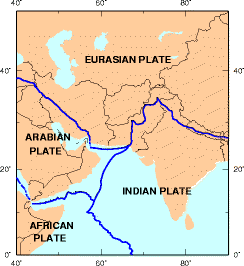
The Arabian Plate consists mostly of the Arabian peninsula
Peninsula
A peninsula is a piece of land that is bordered by water on three sides but connected to mainland. In many Germanic and Celtic languages and also in Baltic, Slavic and Hungarian, peninsulas are called "half-islands"....
; it extends northward to Turkey
Turkey
Turkey , known officially as the Republic of Turkey , is a Eurasian country located in Western Asia and in East Thrace in Southeastern Europe...
. The plate borders are:
- East, with the Indo-Australian PlateIndo-Australian PlateThe Indo-Australian Plate is a major tectonic plate that includes the continent of Australia and surrounding ocean, and extends northwest to include the Indian subcontinent and adjacent waters...
, at the Owen Fracture ZoneOwen Fracture ZoneThe Owen Fracture Zone is a transform fault which runs along the eastern boundary of the Arabian Plate, separating it from the Indo-Australian Plate for most of its length, and from the African Plate for a much shorter distance... - South, with the African PlateAfrican PlateThe African Plate is a tectonic plate which includes the continent of Africa, as well as oceanic crust which lies between the continent and various surrounding ocean ridges.-Boundaries:...
to the west and the Indo-Australian PlateIndo-Australian PlateThe Indo-Australian Plate is a major tectonic plate that includes the continent of Australia and surrounding ocean, and extends northwest to include the Indian subcontinent and adjacent waters...
to the east - West, a left lateral fault boundary with the African PlateAfrican PlateThe African Plate is a tectonic plate which includes the continent of Africa, as well as oceanic crust which lies between the continent and various surrounding ocean ridges.-Boundaries:...
called the Dead Sea TransformDead Sea TransformThe Dead Sea Transform fault system, also sometimes referred to as the Dead Sea Rift, is a geologic fault which runs from the Maras Triple Junction to the northern end of the Red Sea Rift...
(DST), and a divergent boundary with the African Plate called the Red Sea RiftRed Sea RiftThe Red Sea Rift is a spreading center between two tectonic plates, the African Plate and the Arabian Plate. It extends down the length of the Red Sea, stretching from the southern end of the Dead Sea Transform to a triple junction with the Aden Ridge and the East African Rift in the Afar...
which runs the length of the Red Sea; - North, complex convergent boundaryConvergent boundaryIn plate tectonics, a convergent boundary, also known as a destructive plate boundary , is an actively deforming region where two tectonic plates or fragments of lithosphere move toward one another and collide...
with the Anatolian PlateAnatolian PlateThe Anatolian Plate is a continental tectonic plate consisting primarily of the country of Turkey.The easterly side is a boundary with the Arabian Plate, the East Anatolian Fault, a left lateral transform fault....
and Eurasian PlateEurasian PlateThe Eurasian Plate is a tectonic plate which includes most of the continent of Eurasia , with the notable exceptions of the Indian subcontinent, the Arabian subcontinent, and the area east of the Chersky Range in East Siberia...
.
The Arabian Plate was part of the African plate during much of the Phanerozoic
Phanerozoic
The Phanerozoic Eon is the current eon in the geologic timescale, and the one during which abundant animal life has existed. It covers roughly 542 million years and goes back to the time when diverse hard-shelled animals first appeared...
Eon (Paleozoic
Paleozoic
The Paleozoic era is the earliest of three geologic eras of the Phanerozoic eon, spanning from roughly...
- Cenozoic
Cenozoic
The Cenozoic era is the current and most recent of the three Phanerozoic geological eras and covers the period from 65.5 mya to the present. The era began in the wake of the Cretaceous–Tertiary extinction event at the end of the Cretaceous that saw the demise of the last non-avian dinosaurs and...
), until the Oligocene
Oligocene
The Oligocene is a geologic epoch of the Paleogene Period and extends from about 34 million to 23 million years before the present . As with other older geologic periods, the rock beds that define the period are well identified but the exact dates of the start and end of the period are slightly...
Epoch of the Cenozoic Era. Red Sea rifting began in the Eocene
Eocene
The Eocene Epoch, lasting from about 56 to 34 million years ago , is a major division of the geologic timescale and the second epoch of the Paleogene Period in the Cenozoic Era. The Eocene spans the time from the end of the Palaeocene Epoch to the beginning of the Oligocene Epoch. The start of the...
, but the separation of Africa and Arabia occurred in the Oligocene, and since then the Arabian Plate has been slowly moving toward the Eurasian Plate.
The collision between the Arabian Plate and Eurasia is pushing up the Zagros Mountains
Zagros Mountains
The Zagros Mountains are the largest mountain range in Iran and Iraq. With a total length of 1,500 km , from northwestern Iran, and roughly correlating with Iran's western border, the Zagros range spans the whole length of the western and southwestern Iranian plateau and ends at the Strait of...
of Iran.