


Martha

Encyclopedia
Martha of Bethany is a biblical
figure described in the Gospels of Luke
and John
. Together with her siblings Lazarus
and Mary, she is described as living in the village of Bethany near Jerusalem. She was witness to Jesus
' resurrection
of her brother, Lazarus
.
transliteration of the Koine Greek
Μαρθα, itself a translation of the Judæo-Aramaic
מַרְתָּא Martâ, "The mistress" or "the lady", from מרה "mistress", feminine of מר "master". The Aramaic form occurs in a Nabatean inscription found at Puteoli, and now in the Naples Museum; it is dated AD. 5 (Corpus Inscr. Semit., 158); also in a Palmyrene inscription, where the Greek translation has the form Marthein.
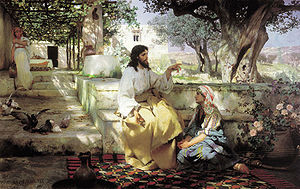
, Jesus visits the home of two sisters named Mary and Martha
. The two sisters are contrasted: Martha was "cumbered about many things" while Jesus was their guest, while Mary had chosen "the better part", that of listening to the master's discourse. The name of their village is not recorded, nor any mention of whether Jesus was near Jerusalem:
In the Gospel of John
, Martha and Mary appear in connection two incidents: the raising from the dead of her brother Lazarus (John 11) and the anointing of Jesus
at the home of Simon the Leper
(John 12:3).
In the account of the raising of Lazarus, Jesus meets with the sisters in turn: Martha followed by Mary. Martha goes immediately to meet Jesus as he arrives, while Mary waits until she is called. As one commentator notes, "Martha, the more aggressive sister, went to meet Jesus, while quiet and contemplative Mary stayed home. This portrayal of the sisters agrees with that found in Luke 10:38-42." In speaking with Jesus, both sisters lament that he did not arrive in time to prevent their brother's death: "Lord, if you had been here, my brother would not have died" . But where Jesus' response to Mary is more emotional, his response to Martha is one of teaching calling her to hope and faith:
As the narrative continues, Martha calls her sister Mary to see Jesus. Jesus has Mary bring him to Lazarus' tomb where he commands the stone to be removed from its entrance. Martha here objects, "But, Lord, by this time there is a bad odor, for he has been there four days", to which Jesus replies, "Did I not tell you that if you believed, you would see the glory of God?" . They then take away the stone and Jesus prays and calls Lazarus forth alive from the tomb.
Martha appears again in , where she serves at a meal held in Jesus' honor at which her brother is also a guest. The narrator only mentions that the meal takes place in Bethany, while the apparently parallel accounts in the Gospels of Matthew
and Mark
specify that it takes place at the home of one Simon the Leper
. As the Catholic Encyclopedia notes, "We are surely justified in arguing that, since Matthew and Mark place the scene in the house of Simon, St. John must be understood to say the same; it remains to be proved that Martha could not 'serve' in Simon's house." It is at this meal that a woman (Martha's sister Mary, according to John) anoints Jesus
with expensive perfume.
. Therefore, additional information is supposed for Martha as well:
after Jesus
's death, around AD 48, and went to Provence
with her sister Mary (conflated with Mary Magdalene
) and her brother Lazarus. With them, Martha first settled in Avignon
(now in France). The Golden Legend
, compiled in the 13th century, records the Provençal tradition:
The Golden Legend also records the grand lifestyle imagined for Martha and her siblings in its entry on Mary Magdalene:
, where a monster
, the Tarasque
, was a constant threat to the population. Martha managed to tame the monster and eventually died in Tarascon, where she was buried. Her tomb is located in the crypt
of the local Collegiate Church. Again, the Golden Legend provides the details:
The dedication of the Collegiate Church at Tarascon to St. Martha is believed to date from the 9th century or earlier. Relics found in the church during a reconstruction in 1187 were identified as hers, and reburied in a new shrine at that time. In the Collegiate Church crypt is a late 15th century cenotaph
, also known as the Gothic Tomb of Saint Martha. It is the work of Francesco Laurana
, a Croatia
n sculptor of the Italian School, commissioned by King René. At its base are two openings through which the relics could be touched. It bears three low reliefs separated by fluted pilasters representing : on the left, Saint Martha and the Tarasque; in the center, Saint Mary Magdalene born aloft by the angels; on the right, Lazarus as Bishop of Marseille with his mitre and staff. There are two figures on either side: on the left, Saint Front, Bishop of Perrigueux, present at the funeral of Saint Martha, and on the right, Saint Marcelle, Martha's servant.
annually in her honor. The 250-year old festival commemorates the attack on Villajoyosa by Berber pirates led by Zalé-Arraez in 1538, when, according to legend, St. Martha came to the rescue of the townsfolk by causing a flash flood which wiped out the enemy fleet, thus preventing the corsairs from reaching the coast.
and later came to his tomb early on the morning following Sabbath
with myrrh
(expensive oil), according to the Jewish tradition, to anoint their Lord's body. The Myrrhbearers became the first witnesses to the Resurrection of Jesus
, finding the empty tomb and hearing the joyful news from an angel.
Orthodox tradition also relates that Martha's brother Lazarus was cast out of Jerusalem in the persecution against the Jerusalem Church following the martyrdom of St. Stephen. His sisters Mary and Martha fled Judea with him, assisting him in the proclaiming of the Gospel in various lands. The three later moved to Cyprus
, where Lazarus became the first Bishop of Kition (modern Larnaca
). All three died in Cyprus
.
. She is instructed by the risen Christ on several of the repentances that must be made in order to have salvation. She also makes several prophetic interpretations of different Psalms
.
 Martha is venerated as a saint
in the Roman Catholic Church
and Eastern Orthodox church
es, and commemorated by the Lutheran Church and the Anglican Communion
.
, became a "Simple" in the General Roman Calendar of Pope Pius XII
, a "Third-Class Feast" in the General Roman Calendar of 1962
, and an obligatory "Memorial" in the Roman Catholic Calendar of Saints
.
In the Eastern Orthodox and Eastern Catholic traditions, Martha and her sister Mary are commemorated on June 4. They are also commemorated collectively among the Myrrh-bearing Women
on the Sunday of the Myrrhbearers (the Third Sunday of Pascha
—i.e., the second Sunday after Easter). She also figures in the commemorations of Lazarus Saturday
(the day before Palm Sunday
).
Martha is commemorated on July 29 in the Calendar of Saints
of the Lutheran Church (together with her siblings Mary and Lazarus) and in the Calendar of saints
of the Episcopal Church
and the Church of England
(together with her sister Mary).
Bible
The Bible refers to any one of the collections of the primary religious texts of Judaism and Christianity. There is no common version of the Bible, as the individual books , their contents and their order vary among denominations...
figure described in the Gospels of Luke
Gospel of Luke
The Gospel According to Luke , commonly shortened to the Gospel of Luke or simply Luke, is the third and longest of the four canonical Gospels. This synoptic gospel is an account of the life and ministry of Jesus of Nazareth. It details his story from the events of his birth to his Ascension.The...
and John
Gospel of John
The Gospel According to John , commonly referred to as the Gospel of John or simply John, and often referred to in New Testament scholarship as the Fourth Gospel, is an account of the public ministry of Jesus...
. Together with her siblings Lazarus
Lazarus of Bethany
Lazarus of Bethany, also known as Saint Lazarus or Lazarus of the Four Days, is the subject of a prominent miracle attributed to Jesus in the Gospel of John, in which Jesus restores him to life four days after his death...
and Mary, she is described as living in the village of Bethany near Jerusalem. She was witness to Jesus
Jesus
Jesus of Nazareth , commonly referred to as Jesus Christ or simply as Jesus or Christ, is the central figure of Christianity...
' resurrection
Resurrection
Resurrection refers to the literal coming back to life of the biologically dead. It is used both with respect to particular individuals or the belief in a General Resurrection of the dead at the end of the world. The General Resurrection is featured prominently in Jewish, Christian, and Muslim...
of her brother, Lazarus
Lazarus of Bethany
Lazarus of Bethany, also known as Saint Lazarus or Lazarus of the Four Days, is the subject of a prominent miracle attributed to Jesus in the Gospel of John, in which Jesus restores him to life four days after his death...
.
Etymology of the name
The name Martha is a LatinLatin
Latin is an Italic language originally spoken in Latium and Ancient Rome. It, along with most European languages, is a descendant of the ancient Proto-Indo-European language. Although it is considered a dead language, a number of scholars and members of the Christian clergy speak it fluently, and...
transliteration of the Koine Greek
Koine Greek
Koine Greek is the universal dialect of the Greek language spoken throughout post-Classical antiquity , developing from the Attic dialect, with admixture of elements especially from Ionic....
Μαρθα, itself a translation of the Judæo-Aramaic
Aramaic language
Aramaic is a group of languages belonging to the Afroasiatic language phylum. The name of the language is based on the name of Aram, an ancient region in central Syria. Within this family, Aramaic belongs to the Semitic family, and more specifically, is a part of the Northwest Semitic subfamily,...
מַרְתָּא Martâ, "The mistress" or "the lady", from מרה "mistress", feminine of מר "master". The Aramaic form occurs in a Nabatean inscription found at Puteoli, and now in the Naples Museum; it is dated AD. 5 (Corpus Inscr. Semit., 158); also in a Palmyrene inscription, where the Greek translation has the form Marthein.
Biblical references
In the Gospel of LukeGospel of Luke
The Gospel According to Luke , commonly shortened to the Gospel of Luke or simply Luke, is the third and longest of the four canonical Gospels. This synoptic gospel is an account of the life and ministry of Jesus of Nazareth. It details his story from the events of his birth to his Ascension.The...
, Jesus visits the home of two sisters named Mary and Martha
Jesus at the home of Martha and Mary
Jesus at the home of Martha and Mary is an episode in the life of Jesus that appears only in the Gospel of Luke, after the Parable of the Good Samaritan:.According to the Gospel of Luke:...
. The two sisters are contrasted: Martha was "cumbered about many things" while Jesus was their guest, while Mary had chosen "the better part", that of listening to the master's discourse. The name of their village is not recorded, nor any mention of whether Jesus was near Jerusalem:
In the Gospel of John
Gospel of John
The Gospel According to John , commonly referred to as the Gospel of John or simply John, and often referred to in New Testament scholarship as the Fourth Gospel, is an account of the public ministry of Jesus...
, Martha and Mary appear in connection two incidents: the raising from the dead of her brother Lazarus (John 11) and the anointing of Jesus
Anointing of Jesus
The anointing of Jesus is an event reported by each of the Canonical gospels, in which a woman pours the entire contents of an alabastron of very expensive perfume over the head or feet of Jesus....
at the home of Simon the Leper
Simon the Leper
Simon the Leper is a biblical figure mentioned by the Gospels according to Matthew and Mark . These two books narrate how Jesus made a visit to the house of Simon the Leper at Bethany during the course of which a woman anoints the head of Jesus with costly ointment. Bethany was the home of Simon...
(John 12:3).
In the account of the raising of Lazarus, Jesus meets with the sisters in turn: Martha followed by Mary. Martha goes immediately to meet Jesus as he arrives, while Mary waits until she is called. As one commentator notes, "Martha, the more aggressive sister, went to meet Jesus, while quiet and contemplative Mary stayed home. This portrayal of the sisters agrees with that found in Luke 10:38-42." In speaking with Jesus, both sisters lament that he did not arrive in time to prevent their brother's death: "Lord, if you had been here, my brother would not have died" . But where Jesus' response to Mary is more emotional, his response to Martha is one of teaching calling her to hope and faith:
As the narrative continues, Martha calls her sister Mary to see Jesus. Jesus has Mary bring him to Lazarus' tomb where he commands the stone to be removed from its entrance. Martha here objects, "But, Lord, by this time there is a bad odor, for he has been there four days", to which Jesus replies, "Did I not tell you that if you believed, you would see the glory of God?" . They then take away the stone and Jesus prays and calls Lazarus forth alive from the tomb.
Martha appears again in , where she serves at a meal held in Jesus' honor at which her brother is also a guest. The narrator only mentions that the meal takes place in Bethany, while the apparently parallel accounts in the Gospels of Matthew
Gospel of Matthew
The Gospel According to Matthew is one of the four canonical gospels, one of the three synoptic gospels, and the first book of the New Testament. It tells of the life, ministry, death, and resurrection of Jesus of Nazareth...
and Mark
Gospel of Mark
The Gospel According to Mark , commonly shortened to the Gospel of Mark or simply Mark, is the second book of the New Testament. This canonical account of the life of Jesus of Nazareth is one of the three synoptic gospels. It was thought to be an epitome, which accounts for its place as the second...
specify that it takes place at the home of one Simon the Leper
Simon the Leper
Simon the Leper is a biblical figure mentioned by the Gospels according to Matthew and Mark . These two books narrate how Jesus made a visit to the house of Simon the Leper at Bethany during the course of which a woman anoints the head of Jesus with costly ointment. Bethany was the home of Simon...
. As the Catholic Encyclopedia notes, "We are surely justified in arguing that, since Matthew and Mark place the scene in the house of Simon, St. John must be understood to say the same; it remains to be proved that Martha could not 'serve' in Simon's house." It is at this meal that a woman (Martha's sister Mary, according to John) anoints Jesus
Anointing of Jesus
The anointing of Jesus is an event reported by each of the Canonical gospels, in which a woman pours the entire contents of an alabastron of very expensive perfume over the head or feet of Jesus....
with expensive perfume.
Catholic traditions
In Roman Catholic tradition, Martha's sister Mary is equated with Mary MagdaleneMary Magdalene
Mary Magdalene was one of Jesus' most celebrated disciples, and the most important woman disciple in the movement of Jesus. Jesus cleansed her of "seven demons", conventionally interpreted as referring to complex illnesses...
. Therefore, additional information is supposed for Martha as well:
Mary, Martha, and Lazarus are represented by St. John as living at Bethania, but St. Luke would seem to imply that they were, at least at one time, living in GalileeGalileeGalilee , is a large region in northern Israel which overlaps with much of the administrative North District of the country. Traditionally divided into Upper Galilee , Lower Galilee , and Western Galilee , extending from Dan to the north, at the base of Mount Hermon, along Mount Lebanon to the...
; he does not mention the name of the town, but it may have been MagdalaMagdalaMagdala is the name of at least two places in ancient Israel mentioned in the Jewish Talmud and one place that may be mentioned in the Christian New Testament...
, and we should thus, supposing Mary of Bethania and Mary Magdalene to be the same person, understand the appellative "Magdalene". The words of St. John (11:1) seem to imply a change of residence for the family. It is possible, too, that St. Luke has displaced the incident referred to in Chapter 10. The likeness between the pictures of Martha presented by Luke and John is very remarkable. The familiar intercourse between the Saviour of the world and the humble family which St. Luke depicts is dwelt on by St. John when he tells us that "Jesus loved Martha, and her sister Mary, and Lazarus" (11:5). Again the picture of Martha's anxiety (John 11:20-21, 39) accords with the picture of her who was "busy about much serving" (Luke 10:40); so also in John 12:2: "They made him a supper there: and Martha served." But St. John has given us a glimpse of the other and deeper side of her character when he depicts her growing faith in Christ's Divinity (11:20-27), a faith which was the occasion of the words: "I am the resurrection and the life." The Evangelist has beautifully indicated the change that came over Martha after that interview: "When she had said these things, she went and called her sister Mary secretly, saying: The Master is come, and calleth for thee."
Golden Legend
According to legend, St Martha left JudeaJudea
Judea or Judæa was the name of the mountainous southern part of the historic Land of Israel from the 8th century BCE to the 2nd century CE, when Roman Judea was renamed Syria Palaestina following the Jewish Bar Kokhba revolt.-Etymology:The...
after Jesus
Jesus
Jesus of Nazareth , commonly referred to as Jesus Christ or simply as Jesus or Christ, is the central figure of Christianity...
's death, around AD 48, and went to Provence
Provence
Provence ; Provençal: Provença in classical norm or Prouvènço in Mistralian norm) is a region of south eastern France on the Mediterranean adjacent to Italy. It is part of the administrative région of Provence-Alpes-Côte d'Azur...
with her sister Mary (conflated with Mary Magdalene
Mary Magdalene
Mary Magdalene was one of Jesus' most celebrated disciples, and the most important woman disciple in the movement of Jesus. Jesus cleansed her of "seven demons", conventionally interpreted as referring to complex illnesses...
) and her brother Lazarus. With them, Martha first settled in Avignon
Avignon
Avignon is a French commune in southeastern France in the départment of the Vaucluse bordered by the left bank of the Rhône river. Of the 94,787 inhabitants of the city on 1 January 2010, 12 000 live in the ancient town centre surrounded by its medieval ramparts.Often referred to as the...
(now in France). The Golden Legend
Golden Legend
The Golden Legend is a collection of hagiographies by Jacobus de Voragine that became a late medieval bestseller. More than a thousand manuscripts of the text have survived, compared to twenty or so of its nearest rivals...
, compiled in the 13th century, records the Provençal tradition:
Saint Martha, hostess of our Lord Jesus Christ, was born of a royal kindred. Her father was named Syro and her mother Encharia. The father of her was duke of SyriaSyriaSyria , officially the Syrian Arab Republic , is a country in Western Asia, bordering Lebanon and the Mediterranean Sea to the West, Turkey to the north, Iraq to the east, Jordan to the south, and Israel to the southwest....
and places maritime, and Martha with her sister possessed by the heritage of their mother three places, that was, the castle Magdalen, and Bethany and a part of Jerusalem. It is nowhere read that Martha had ever any husband ne fellowship of man, but she as a noble hostess ministered and served our Lord, and would also that her sister should serve him and help her, for she thought that all the world was not sufficient to serve such a guest.
After the ascension of our Lord, when the disciples were departed, she with her brother Lazarus and her sister Mary, also Saint MaximinMaximin of TrierSaint Maximin was the fifth bishop of Trier, according to the list provided by the diocese's website, taking his seat in 341/342...
[ actually a 3rd-century figure] which baptized them, and to whom they were committed of the Holy Ghost, and many others, were put into a ship without sail, oars, or rudder governail, of the paynims, which by the conduct of our Lord they came all to Marseilles, and after came to the territory of Aquense or AixAix-en-ProvenceAix , or Aix-en-Provence to distinguish it from other cities built over hot springs, is a city-commune in southern France, some north of Marseille. It is in the region of Provence-Alpes-Côte d'Azur, in the département of Bouches-du-Rhône, of which it is a subprefecture. The population of Aix is...
, and there converted the people to the faith. Martha was right facound of speech, and courteous and gracious to the sight of the people.
The Golden Legend also records the grand lifestyle imagined for Martha and her siblings in its entry on Mary Magdalene:
Mary Magdalene had her surname of Magdalo, a castle, and was born of right noble lineage and parents, which were descended of the lineage of kings. And her father was named Cyrus, and her mother Eucharis. She with her brother Lazarus, and her sister Martha, possessed the castle of Magdalo, which is two miles from Nazareth, and Bethany, the castle which is nigh to Jerusalem, and also a great part of Jerusalem, which, all these things they departed among them. In such wise that Mary had the castle Magdalo, whereof she had her name Magdalene. And Lazarus had the part of the city of Jerusalem, and Martha had to her part Bethany. And when Mary gave herself to all delights of the body, and Lazarus entended all to knighthood, Martha, which was wise, governed nobly her brother's part and also her sister's, and also her own, and administered to knights, and her servants, and to poor men, such necessities as they needed. Nevertheless, after the ascension of our Lord, they sold all these things.
St. Martha in Tarascon
A further legend relates that Martha then went to TarasconTarascon
Tarascon , sometimes referred to as Tarascon-sur-Rhône, is a commune in the Bouches-du-Rhône department in southern France.-Geography:...
, where a monster
Monster
A monster is any fictional creature, usually found in legends or horror fiction, that is somewhat hideous and may produce physical harm or mental fear by either its appearance or its actions...
, the Tarasque
Tarasque
The Tarasque is a fearsome legendary dragon from Provence, in southern France, tamed in a story about Saint Martha. On 25 November 2005 the UNESCO included the Tarasque on the list of Masterpieces of the Oral and Intangible Heritage of Humanity....
, was a constant threat to the population. Martha managed to tame the monster and eventually died in Tarascon, where she was buried. Her tomb is located in the crypt
Crypt
In architecture, a crypt is a stone chamber or vault beneath the floor of a burial vault possibly containing sarcophagi, coffins or relics....
of the local Collegiate Church. Again, the Golden Legend provides the details:
There was that time upon the river of RhoneRhôneRhone can refer to:* Rhone, one of the major rivers of Europe, running through Switzerland and France* Rhône Glacier, the source of the Rhone River and one of the primary contributors to Lake Geneva in the far eastern end of the canton of Valais in Switzerland...
, in a certain wood between ArlesArlesArles is a city and commune in the south of France, in the Bouches-du-Rhône department, of which it is a subprefecture, in the former province of Provence....
and AvignonAvignonAvignon is a French commune in southeastern France in the départment of the Vaucluse bordered by the left bank of the Rhône river. Of the 94,787 inhabitants of the city on 1 January 2010, 12 000 live in the ancient town centre surrounded by its medieval ramparts.Often referred to as the...
, a great dragonDragonA dragon is a legendary creature, typically with serpentine or reptilian traits, that feature in the myths of many cultures. There are two distinct cultural traditions of dragons: the European dragon, derived from European folk traditions and ultimately related to Greek and Middle Eastern...
, half beast and half fish, greater than an ox, longer than an horse, having teeth sharp as a sword, and horned on either side, head like a lion, tail like a serpent, and defended him with two wings on either side, and could not be beaten with cast of stones ne with other armour, and was as strong as twelve lions or bears; which dragon lay hiding and lurking in the river, and perished them that passed by and drowned ships. He came thither by sea from Galicia, and was engendered of LeviathanLeviathanLeviathan , is a sea monster referred to in the Bible. In Demonology, Leviathan is one of the seven princes of Hell and its gatekeeper . The word has become synonymous with any large sea monster or creature...
, which is a serpent of the water and is much wood, and of a beast called Bonacho, that is engendered in Galicia. And when he is pursued he casts out of his belly behind, his ordure, the space of an acre of land on them that follow him, and it is bright as glass, and what it toucheth it burneth as fire. To whom Martha, at the prayer of the people, came into the wood, and found him eating a man. And she cast on him holy waterHoly waterHoly water is water that, in Catholicism, Anglicanism, Eastern Orthodoxy, Lutheranism, Oriental Orthodoxy, and some other churches, has been sanctified by a priest for the purpose of baptism, the blessing of persons, places, and objects; or as a means of repelling evil.The use for baptism and...
, and showed to him the cross, which anon was overcome, and standing still as a sheep, she bound him with her own girdle, and then was slain with spears and glaives of the people. The dragon was called of them that dwelled in the country Tarasconus, whereof, in remembrance of him that place is called Tarasconus, which tofore was called Nerluc, and the Black Lake, because there be woods shadowous and black. And there the blessed Martha, by licence of Maximin her master, and of her sister, dwelled and abode in the same place after, and daily occupied in prayers and in fastings, and thereafter assembled and were gathered together a great convent of sisters, and builded a fair church at the honour of the blessed Mary virgin, where she led a hard and a sharp life. She eschewed flesh and all fat meat, eggs, cheese and wine; she ate but once a day. An hundred times a day and an hundred times a night she kneeled down and bowed her knees.
The dedication of the Collegiate Church at Tarascon to St. Martha is believed to date from the 9th century or earlier. Relics found in the church during a reconstruction in 1187 were identified as hers, and reburied in a new shrine at that time. In the Collegiate Church crypt is a late 15th century cenotaph
Cenotaph
A cenotaph is an "empty tomb" or a monument erected in honour of a person or group of people whose remains are elsewhere. It can also be the initial tomb for a person who has since been interred elsewhere. The word derives from the Greek κενοτάφιον = kenotaphion...
, also known as the Gothic Tomb of Saint Martha. It is the work of Francesco Laurana
Francesco Laurana
Francesco Laurana, also known as Francesco de la Vrana was a Dalmatian-born sculptor and medallist. He is considered as both Croatian and Italian sculptor.-Life and works:...
, a Croatia
Croatia
Croatia , officially the Republic of Croatia , is a unitary democratic parliamentary republic in Europe at the crossroads of the Mitteleuropa, the Balkans, and the Mediterranean. Its capital and largest city is Zagreb. The country is divided into 20 counties and the city of Zagreb. Croatia covers ...
n sculptor of the Italian School, commissioned by King René. At its base are two openings through which the relics could be touched. It bears three low reliefs separated by fluted pilasters representing : on the left, Saint Martha and the Tarasque; in the center, Saint Mary Magdalene born aloft by the angels; on the right, Lazarus as Bishop of Marseille with his mitre and staff. There are two figures on either side: on the left, Saint Front, Bishop of Perrigueux, present at the funeral of Saint Martha, and on the right, Saint Marcelle, Martha's servant.
St. Martha and Villajoyosa
The town of Villajoyosa, Spain honors St. Martha as its patron saint and celebrates The Festival of Moors and ChristiansMoros y cristianos
Moros y Cristianos or Moros i Cristians literally in English Moors and Christians, is a set of festival activities which are celebrated in many towns and cities of Spain, mainly in the southern Valencian Community; according to popular tradition the festivals commemorate the battles, combats and...
annually in her honor. The 250-year old festival commemorates the attack on Villajoyosa by Berber pirates led by Zalé-Arraez in 1538, when, according to legend, St. Martha came to the rescue of the townsfolk by causing a flash flood which wiped out the enemy fleet, thus preventing the corsairs from reaching the coast.
Eastern Orthodox tradition
In Orthodox Church tradition, though not specifically named as such in the gospels, Martha and Mary were among the Myrrh-bearing Women. These faithful followers of Jesus stood at Golgotha during the Crucifixion of JesusCrucifixion of Jesus
The crucifixion of Jesus and his ensuing death is an event that occurred during the 1st century AD. Jesus, who Christians believe is the Son of God as well as the Messiah, was arrested, tried, and sentenced by Pontius Pilate to be scourged, and finally executed on a cross...
and later came to his tomb early on the morning following Sabbath
Biblical Sabbath
Sabbath in the Bible is usually a weekly day of rest and time of worship. The Sabbath is first mentioned in the Genesis creation narrative. The seventh day is there set aside as a day of rest—the Sabbath. It is observed differently in Judaism and Christianity and informs a similar occasion in...
with myrrh
Myrrh
Myrrh is the aromatic oleoresin of a number of small, thorny tree species of the genus Commiphora, which grow in dry, stony soil. An oleoresin is a natural blend of an essential oil and a resin. Myrrh resin is a natural gum....
(expensive oil), according to the Jewish tradition, to anoint their Lord's body. The Myrrhbearers became the first witnesses to the Resurrection of Jesus
Resurrection of Jesus
The Christian belief in the resurrection of Jesus states that Jesus returned to bodily life on the third day following his death by crucifixion. It is a key element of Christian faith and theology and part of the Nicene Creed: "On the third day he rose again in fulfillment of the Scriptures"...
, finding the empty tomb and hearing the joyful news from an angel.
Orthodox tradition also relates that Martha's brother Lazarus was cast out of Jerusalem in the persecution against the Jerusalem Church following the martyrdom of St. Stephen. His sisters Mary and Martha fled Judea with him, assisting him in the proclaiming of the Gospel in various lands. The three later moved to Cyprus
Cyprus
Cyprus , officially the Republic of Cyprus , is a Eurasian island country, member of the European Union, in the Eastern Mediterranean, east of Greece, south of Turkey, west of Syria and north of Egypt. It is the third largest island in the Mediterranean Sea.The earliest known human activity on the...
, where Lazarus became the first Bishop of Kition (modern Larnaca
Larnaca
Larnaca, is the third largest city on the southern coast of Cyprus after Nicosia and Limassol. It has a population of 72,000 and is the island's second largest commercial port and an important tourist resort...
). All three died in Cyprus
Cyprus
Cyprus , officially the Republic of Cyprus , is a Eurasian island country, member of the European Union, in the Eastern Mediterranean, east of Greece, south of Turkey, west of Syria and north of Egypt. It is the third largest island in the Mediterranean Sea.The earliest known human activity on the...
.
Gnostic tradition
Martha appears in the sacred gnostic text Pistis SophiaPistis Sophia
Pistis Sophia is an important Gnostic text, possibly written as early as the 2nd century. The five remaining copies, which scholars place in the 5th or 6th centuries, relate the Gnostic teachings of the transfigured Jesus to the assembled disciples , when the risen Christ had accomplished eleven...
. She is instructed by the risen Christ on several of the repentances that must be made in order to have salvation. She also makes several prophetic interpretations of different Psalms
Psalms
The Book of Psalms , commonly referred to simply as Psalms, is a book of the Hebrew Bible and the Christian Bible...
.
Veneration or commemoration as a saint
Saint
A saint is a holy person. In various religions, saints are people who are believed to have exceptional holiness.In Christian usage, "saint" refers to any believer who is "in Christ", and in whom Christ dwells, whether in heaven or in earth...
in the Roman Catholic Church
Roman Catholic Church
The Catholic Church, also known as the Roman Catholic Church, is the world's largest Christian church, with over a billion members. Led by the Pope, it defines its mission as spreading the gospel of Jesus Christ, administering the sacraments and exercising charity...
and Eastern Orthodox church
Eastern Orthodox Church
The Orthodox Church, officially called the Orthodox Catholic Church and commonly referred to as the Eastern Orthodox Church, is the second largest Christian denomination in the world, with an estimated 300 million adherents mainly in the countries of Belarus, Bulgaria, Cyprus, Georgia, Greece,...
es, and commemorated by the Lutheran Church and the Anglican Communion
Anglican Communion
The Anglican Communion is an international association of national and regional Anglican churches in full communion with the Church of England and specifically with its principal primate, the Archbishop of Canterbury...
.
Feast days
In the Roman Catholic tradition, her feast day is celebrated July 29. Her celebration, classified as a "Semi-Double" in the Tridentine CalendarTridentine Calendar
The Tridentine Calendar is the calendar of saints to be honoured in the course of the liturgical year in the official liturgy of the Roman Rite as reformed by Pope Pius V, implementing a decision of the Council of Trent, which entrusted the task to the Pope....
, became a "Simple" in the General Roman Calendar of Pope Pius XII
General Roman Calendar of Pope Pius XII
In 1955 Pope Pius XII made several changes to the General Roman Calendar of 1954, changes that remained in force only until 1960, when Pope John XXIII, on the basis of further recommendations of the commission that Pius XII had set up, decreed a further revision of the Roman Catholic calendar of...
, a "Third-Class Feast" in the General Roman Calendar of 1962
General Roman Calendar of 1962
This article lists the feast days of the General Roman Calendar as it was in 1962, following the reforms that Pope John XXIII introduced with his motu proprio Rubricarum instructum of 23 July 1960...
, and an obligatory "Memorial" in the Roman Catholic Calendar of Saints
Roman Catholic calendar of saints
The General Roman Calendar indicates the days of the year to which are assigned the liturgical celebrations of saints and of the mysteries of the Lord that are to be observed wherever the Roman Rite is used...
.
In the Eastern Orthodox and Eastern Catholic traditions, Martha and her sister Mary are commemorated on June 4. They are also commemorated collectively among the Myrrh-bearing Women
Myrrhbearers
In Eastern Orthodoxy the Myrrhbearers are the individuals mentioned in the New Testament who were directly involved in the burial or who discovered the empty tomb following the resurrection of Jesus...
on the Sunday of the Myrrhbearers (the Third Sunday of Pascha
Easter
Easter is the central feast in the Christian liturgical year. According to the Canonical gospels, Jesus rose from the dead on the third day after his crucifixion. His resurrection is celebrated on Easter Day or Easter Sunday...
—i.e., the second Sunday after Easter). She also figures in the commemorations of Lazarus Saturday
Lazarus Saturday
Lazarus Saturday, in the Orthodox Church and those Eastern Catholic Churches which follow the Byzantine Rite, is the day before Palm Sunday, and is liturgically linked to it...
(the day before Palm Sunday
Palm Sunday
Palm Sunday is a Christian moveable feast that falls on the Sunday before Easter. The feast commemorates Jesus' triumphal entry into Jerusalem, an event mentioned in all four Canonical Gospels. ....
).
Martha is commemorated on July 29 in the Calendar of Saints
Calendar of Saints (Lutheran)
The Lutheran Calendar of Saints is a listing which details the primary annual festivals and events that are celebrated liturgically by some Lutheran Churches in the United States. The calendars of the Evangelical Lutheran Church in America and the Lutheran Church - Missouri Synod are from the...
of the Lutheran Church (together with her siblings Mary and Lazarus) and in the Calendar of saints
Calendar of saints (Episcopal Church in the United States of America)
The veneration of saints in the Episcopal Church is a continuation of an ancient tradition from the early Church which honors important people of the Christian faith. The usage of the term "saint" is similar to Roman Catholic and Orthodox traditions. Those in the Anglo-Catholic tradition may...
of the Episcopal Church
Episcopal Church (United States)
The Episcopal Church is a mainline Anglican Christian church found mainly in the United States , but also in Honduras, Taiwan, Colombia, Ecuador, Haiti, the Dominican Republic, Venezuela, the British Virgin Islands and parts of Europe...
and the Church of England
Church of England
The Church of England is the officially established Christian church in England and the Mother Church of the worldwide Anglican Communion. The church considers itself within the tradition of Western Christianity and dates its formal establishment principally to the mission to England by St...
(together with her sister Mary).
Churches
A number of churches are dedicated to St. Martha including:- Roman Catholic: TarasconTarasconTarascon , sometimes referred to as Tarascon-sur-Rhône, is a commune in the Bouches-du-Rhône department in southern France.-Geography:...
, France; St. Martha Catholic ChurchSt. Martha Catholic ChurchSt. Martha Catholic Church is a parish in the Archdiocese of Chicago located in Morton Grove, Illinois.- Parish School :St Martha's Church was home to its own elementary school for many years. It was closed for financial reasons. The parish school is now St. John Brebeuf School in Niles, Illinois-...
in Morton Grove, IllinoisMorton Grove, IllinoisMorton Grove is a village in Cook County, Illinois, United States. The population was 22,451 at the 2000 census.The Village President of Morton Grove since April 27, 2009, is Daniel J...
, USA, and others in East Providence, Rhode IslandEast Providence, Rhode IslandEast Providence is a city in Providence County, Rhode Island, United States. The population was 47,037 at the 2010 census, making it the fifth largest city in the state.-Geography:East Providence is located at ....
; Valinda, CaliforniaValinda, CaliforniaValinda is a census-designated place in the San Gabriel Valley, in Los Angeles County, California, in the United States. As of the 2010 census, the population was 22,822, up from 21,776 at the 2000 census.-Geography:...
; Kingwood, Texas; and Harvey, LouisianaHarvey, LouisianaHarvey is a census-designated place in Jefferson Parish, Louisiana, United States. Harvey is on the West Bank of the Mississippi River, within the New Orleans–Metairie–Kenner Metropolitan Statistical Area...
, USA; and Strathfield, New South WalesStrathfield, New South WalesStrathfield is an Inner West suburb of Sydney, in the state of New South Wales, Australia. Strathfield is located 14 kilometres west of the Sydney central business district and is the administrative centre of the local government area of the Municipality of Strathfield...
, Australia. - Church of England: St Martha-on-the-Hill in SurreySurreySurrey is a county in the South East of England and is one of the Home Counties. The county borders Greater London, Kent, East Sussex, West Sussex, Hampshire and Berkshire. The historic county town is Guildford. Surrey County Council sits at Kingston upon Thames, although this has been part of...
and BroxtoweBroxtoweBroxtowe is a local government district with borough status in Nottinghamshire, England, west of the City of Nottingham. It is part of the Greater Nottingham metropolitan area...
, Nottinghamshire, England - Episcopal: St. Martha's Episcopal Church in Papillion, NebraskaPapillion, NebraskaPapillion is a city in Sarpy County in the U.S. state of Nebraska. It is a suburb to the southwest of neighboring Omaha, and is the county seat of Sarpy County. The population of Papillion was 18,894 at the 2010 census. In 2009, Papillion was named the #3 best place to live in the United States by...
, Bethany Beach, DelawareBethany Beach, DelawareBethany Beach is an incorporated town in Sussex County, Delaware, United States. According to the 2010 Census Bureau figures, the population of the town is 1,060; however, during the summer months some 15,000 more populate the town as vacationers...
and Lexington, KentuckyLexington, KentuckyLexington is the second-largest city in Kentucky and the 63rd largest in the US. Known as the "Thoroughbred City" and the "Horse Capital of the World", it is located in the heart of Kentucky's Bluegrass region...
, USA - Methodist: St Martha's Methodist Church in TringTringTring is a small market town and also a civil parish in the Chiltern Hills in Hertfordshire, England. Situated north-west of London and linked to London by the old Roman road of Akeman Street, by the modern A41, by the Grand Union Canal and by rail lines to Euston Station, Tring is now largely a...
, Hertfordshire, UK. - Lutheran: St Mary and St Martha Lutheran Church, San Francisco, CaliforniaSan Francisco, CaliforniaSan Francisco , officially the City and County of San Francisco, is the financial, cultural, and transportation center of the San Francisco Bay Area, a region of 7.15 million people which includes San Jose and Oakland...
, USA
Depictions in art
- Christ in the House of Martha and MaryChrist in the House of Martha and Mary (Velázquez)Kitchen Scene in the House of Martha and Mary is a painting from Spanish artist Diego Velázquez, dating to his Seville period. Housed in the National Gallery, London, United Kingdom, it was painted in 1618, shortly after he completed his apprenticeship with Pacheco...
- an early work by the Spanish painter Velázquez. - Christ in the House of Martha and Mary - by Johannes VermeerJohannes VermeerJohannes, Jan or Johan Vermeer was a Dutch painter who specialized in exquisite, domestic interior scenes of middle class life. Vermeer was a moderately successful provincial genre painter in his lifetime...
- "The Sons of MarthaSons of MarthaThe Sons of Martha is a poem written by Rudyard Kipling. It is inspired by the biblical story of Mary and Martha as told in Luke 10:38-42.It celebrates the careful work done by workers and builders to provide for others' physical needs....
" - A poem by Rudyard KiplingRudyard KiplingJoseph Rudyard Kipling was an English poet, short-story writer, and novelist chiefly remembered for his celebration of British imperialism, tales and poems of British soldiers in India, and his tales for children. Kipling received the 1907 Nobel Prize for Literature...
.
See also
- Jesus at the home of Martha and MaryJesus at the home of Martha and MaryJesus at the home of Martha and Mary is an episode in the life of Jesus that appears only in the Gospel of Luke, after the Parable of the Good Samaritan:.According to the Gospel of Luke:...
- Lazarus of BethanyLazarus of BethanyLazarus of Bethany, also known as Saint Lazarus or Lazarus of the Four Days, is the subject of a prominent miracle attributed to Jesus in the Gospel of John, in which Jesus restores him to life four days after his death...
- Martha and Mary Magdalene (Caravaggio)Martha and Mary Magdalene (Caravaggio)Martha and Mary Magdalene is a painting by the Italian Baroque master Michelangelo Merisi da Caravaggio. It is in the Detroit Institute of Arts. Alternate titles include Martha Reproving Mary, The Conversion of the Magdalene....
- Mary of Bethany
- MyrrhbearersMyrrhbearersIn Eastern Orthodoxy the Myrrhbearers are the individuals mentioned in the New Testament who were directly involved in the burial or who discovered the empty tomb following the resurrection of Jesus...
External links
- "St. Martha, Virgin", Butler's Lives of the Saints
- St. Martha on catholic.org
- Mary & Martha, the sisters of Lazarus, Greek Orthodox Archdiocese of America
- Patron Saints: Martha
- "The Life of Saint Martha", text from the Golden LegendGolden LegendThe Golden Legend is a collection of hagiographies by Jacobus de Voragine that became a late medieval bestseller. More than a thousand manuscripts of the text have survived, compared to twenty or so of its nearest rivals...