
All Topics  
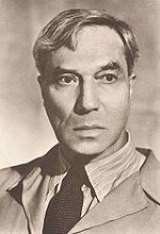
Boris Pasternak

 
Boris Pasternak

   Email Print
   Bookmark   Link


Boris Pasternak


Boris Leonidovich Pasternak ( — May 30, 1960) was a Nobel Prize
Nobel Prize

The Nobel Prize , established in the 1895 will of Swedish chemist Alfred Nobel; it was first awarded in Nobel Prize in Physics, Nobel Prize in Chemistry, Nobel Prize in Physiology or Medicine, Nobel Prize in Literature, and Nobel Peace Prize in 1901....
-winning Russia
Russia

Russia , or the Russian Federation , is a list of countries spanning more than one continent country extending over much of northern Eurasia....
n poet
Poet

A poet is a person who writes poetry....
 and writer
Writer

A writer is anyone who creates a written work, although the word usually designates those who write creatively or professionally, as well as those who have written in many different forms....
. In the West he is best known for his epic novel Doctor Zhivago
Doctor Zhivago (novel)

Doctor Zhivago is a 20th century novel by Boris Pasternak. The novel is named after its protagonist, Yuri Zhivago, a medical doctor and poet....
, a tragedy whose events span the last period of Tsarist Russia and the early days of the Soviet Union
Soviet Union

The Union of Soviet Socialist Republics was a Constitution of the Soviet Union socialist state that existed in Eurasia from 1922 to 1991.The name is a translation of the , romanization of Russian Soyuz Sovetskikh Sotsialisticheskikh Respublik, abbreviated ????, SSSR....
. It was first translated and published in Italy in 1957. In Russia, however, Boris Pasternak is most celebrated as a poet. My Sister Life, written in 1917, is arguably the most influential collection of poetry published in the Russian language
Russian language

Russian is the most geographically widespread language of Eurasia, the most widely spoken of the Slavic languages, and the largest native language in Europe....
 in the 20th century.

ernak was born in Moscow
Moscow

Moscow is the capital and the largest types of inhabited localities in Russia of the Russian Federation. It is also the largest European cities and metropolitan areas, with the Moscow metropolitan area ranking among the largest urban areas in the world....
 on February 10, (Gregorian), 1890 (Julian January 29) into a Jew
Jew

A Jew is a member of the Jewish people, an ethnoreligious group that traces its ancestry to the Israelites or Hebrews of the Ancient Near East....
ish family .


Discussion
Ask a question about 'Boris Pasternak'
Start a new discussion about 'Boris Pasternak'
Answer questions from other users
Full Discussion Forum


Quotations


Even so, one step from my grave, I believe that cruelty, spite, The powers of darkness will in time Be crushed by the spirit of light.

Like a beast in a pen, Im cut off From my friends, freedom, the Sun. But the hunters are gaining ground; Ive nowhere else to run.

Snow, snow over the whole land across all boundaries. The candle burned on the table, the candle burned.

As translated by Richard McKane (1985)

Your health is bound to be affected if, day after day, you say the opposite of what you feel.

Poetry is a rich, full-bodied whistle, cracked ice crunching in pails, the night that numbs the leaf, the duel of two nightingales, the sweet pea that has run wild, Creations tears in shoulder blades.

LIFE magazine (13 June 1960)

It is no longer possible for lyric poetry to express the immensity of our experience. Life has grown too cumbersome, too complicated. We have acquired values which are best expressed in prose.

Interview in Writers at Work, Second Series (1963) edited by George Plimpton.


Encyclopedia


Boris Leonidovich Pasternak ( — May 30, 1960) was a Nobel Prize
Nobel Prize

The Nobel Prize , established in the 1895 will of Swedish chemist Alfred Nobel; it was first awarded in Nobel Prize in Physics, Nobel Prize in Chemistry, Nobel Prize in Physiology or Medicine, Nobel Prize in Literature, and Nobel Peace Prize in 1901....
-winning Russia
Russia

Russia , or the Russian Federation , is a list of countries spanning more than one continent country extending over much of northern Eurasia....
n poet
Poet

A poet is a person who writes poetry....
 and writer
Writer

A writer is anyone who creates a written work, although the word usually designates those who write creatively or professionally, as well as those who have written in many different forms....
. In the West he is best known for his epic novel Doctor Zhivago
Doctor Zhivago (novel)

Doctor Zhivago is a 20th century novel by Boris Pasternak. The novel is named after its protagonist, Yuri Zhivago, a medical doctor and poet....
, a tragedy whose events span the last period of Tsarist Russia and the early days of the Soviet Union
Soviet Union

The Union of Soviet Socialist Republics was a Constitution of the Soviet Union socialist state that existed in Eurasia from 1922 to 1991.The name is a translation of the , romanization of Russian Soyuz Sovetskikh Sotsialisticheskikh Respublik, abbreviated ????, SSSR....
. It was first translated and published in Italy in 1957. In Russia, however, Boris Pasternak is most celebrated as a poet. My Sister Life, written in 1917, is arguably the most influential collection of poetry published in the Russian language
Russian language

Russian is the most geographically widespread language of Eurasia, the most widely spoken of the Slavic languages, and the largest native language in Europe....
 in the 20th century.

Early life

Pasternak was born in Moscow
Moscow

Moscow is the capital and the largest types of inhabited localities in Russia of the Russian Federation. It is also the largest European cities and metropolitan areas, with the Moscow metropolitan area ranking among the largest urban areas in the world....
 on February 10, (Gregorian), 1890 (Julian January 29) into a Jew
Jew

A Jew is a member of the Jewish people, an ethnoreligious group that traces its ancestry to the Israelites or Hebrews of the Ancient Near East....
ish family . His father was a prominent painter, Leonid Pasternak
Leonid Pasternak

Leonid Osipovich Pasternak was a Russian Impressionist Painting. He was also the father of the novelist Boris Pasternak....
, professor at the Moscow School of Painting, Sculpture and Architecture
Moscow School of Painting, Sculpture and Architecture

The Moscow School of Painting, Sculpture and Architecture was one of the largest educational institutions in Russia. The school was formed by the 1865 merger of a private art college, established in Moscow in 1832, and the Palace School of Architecture, established in 1749 by Dmitry Ukhtomsky....
 and his mother was Rosa (Raitza) Kaufman, a concert pianist. Pasternak was brought up in a highly cosmopolitan atmosphere, and visitors to his home included pianist and composer Sergei Rachmaninoff
Sergei Rachmaninoff

Sergei Vasilievich Rachmaninoff was a Russian composer, pianist, and conducting. He was one of the finest pianists of his day and, as a composer, the last great representative of Russian late Romantic music in classical music....
, poet Rainer Maria Rilke
Rainer Maria Rilke

Rainer Maria Rilke is considered one of the German language's greatest 20th century poets. His haunting images focus on the difficulty of communion with the ineffable in an age of disbelief, solitude, and profound anxiety ? themes that tend to position him as a transitional figure between the traditional and the modernist poets....
, and writer Leo Tolstoy
Leo Tolstoy

Leo Tolstoy, or Count Lev Nikolayevich Tolstoy Tolstoy's further talents as essayist, dramatist and Education reform made him the most influential member of the aristocracy Tolstoy....
.

Inspired by his neighbour Alexander Scriabin
Alexander Scriabin

Alexander Nikolayevich Scriabin was a Russian composer and pianist who initially developed a highly lyrical and idiosyncratic tonal language inspired by the music of Chopin....
, Pasternak resolved to become a composer and entered the Moscow Conservatory
Moscow Conservatory

The Moscow Conservatory is a prominent music school in Russia.It was co-founded in 1866 by Nikolai Rubinstein and Prince Nikolai Petrovitch Troubetzkoy....
. In 1910 he abruptly left the conservatory for the University of Marburg, where he studied under Neo-Kantian philosophers Hermann Cohen
Hermann Cohen

Hermann Cohen was a Germany-Jewish philosophy, one of the founders of the University of Marburg School of Neo-Kantianism, and he is often held to be "probably the most important Jewish philosopher of the nineteenth century" ....
 and Nicolai Hartmann
Nicolai Hartmann

Nicolai Hartmann was a Germany philosophy....
. Although invited to become a scholar, he decided against making philosophy a profession and returned to Moscow in 1914. His first poetry collection, influenced by Alexander Blok
Alexander Blok

Aleksandr Aleksandrovich Blok was one of the most gifted lyrical poets produced by Russia after Alexander Pushkin....
 and the Russian Futurists, was published later the same year.

Pasternak's early verse cleverly dissimulates his preoccupation with Kant
KANT

KANT is a computer algebra system for mathematicians interested in algebraic number theory, performing sophisticated computations in algebraic number fields, in Global field function fields, and in local fields....
's ideas. Its fabric includes striking alliterations, wild rhythmic combinations, day-to-day vocabulary, and hidden allusions to his favourite poets like Rilke, Lermontov and German Romantic poets.

During the World War I
World War I

World War I, or the First World War , was a global military conflict which involved the Great powers, organized into two opposing military alliances: the Allies of World War I and the Central Powers....
, he taught and worked at a chemical factory in Vsevolodovo-Vilve near Perm
Perm

Perm is a types of inhabited localities in Russia and administrative center of Perm Krai, Russia. It is situated on the banks of the Kama River, in the European part of Russia near the Ural Mountains....
, which undoubtedly provided him with material for Dr. Zhivago many years later. Unlike many of his relatives and friends, Pasternak did not leave Russia after the revolution. Instead, he was fascinated with the new ideas and possibilities that revolution brought to life.

My Sister Life

Pasternak spent the summer of 1917 living in the steppe country near Saratov
Saratov

Saratov is a major types of inhabited localities in Russia in southern Russia. It is the administrative center of Saratov Oblast and a major port on the Volga River....
, where he fell in love. This passion resulted in the collection My Sister Life, which he wrote over a period of three months, but was too embarrassed to publish for four years because of its novel style. When it finally was published in 1921, the book revolutionised Russian poetry. It made Pasternak the model for younger poets, and decisively changed the poetry of Osip Mandelshtam, Marina Tsvetayeva and others.

Following My Sister Life, Pasternak produced some hermetic pieces of uneven quality, including his masterpiece - the lyric cycle entitled Rupture (1921). Authors such as Vladimir Mayakovsky, Andrey Bely, and Vladimir Nabokov applauded Pasternak's poems as works of pure, unbridled inspiration. In the late 1920s, he also participated in the much celebrated tripartite correspondence with Rilke and Tsvetayeva.

By the end of the 1920s, Pasternak increasingly felt that his colourful modernist style was at odds with the doctrine of Socialist Realism
Socialist realism

Socialist realism is a Teleology-oriented style of realism which has as its purpose the furtherance of the goals of socialism and communism. Although related, it should not be confused with social realism, a type of art that realistically depicts subjects of social concern....
 approved by the Communist party. He attempted to make his poetry more comprehensible to the masses by reworking his earlier pieces and starting two lengthy poems on the Russian Revolution
Russian Revolution of 1917

The Russian Revolution is the series of revolutions in Russia in 1917, which destroyed the Tsarist autocracy and led to the creation of the Soviet Union....
. He also turned to prose and wrote several autobiographical stories, notably The Childhood of Lovers and Safe Conduct.

Second Birth


By 1932, Pasternak had strikingly reshaped his style to make it acceptable to the Soviet public and printed the new collection of poems aptly entitled The Second Birth. Although its Caucasian pieces were as brilliant as the earlier efforts, the book alienated the core of Pasternak's refined audience abroad. He simplified his style even further for his next collection of patriotic verse, Early Trains (1943), which prompted Nabokov to describe Pasternak as a "weeping Bolshevik" and "Emily Dickinson
Emily Dickinson

Emily Elizabeth Dickinson was an American poet. Born in Amherst, Massachusetts to a successful family with strong community ties, she lived a mostly introverted and reclusive life....
 in trousers."

During the great purges of the later 1930s, Pasternak became progressively disillusioned with Communist ideals. Reluctant to publish his own poetry, he turned to translating Shakespeare (Hamlet
Hamlet

Hamlet is a tragedy by William Shakespeare, believed to have been written between 1599 and 1601. The play, set in Denmark, recounts how Prince Hamlet exacts revenge on his uncle King Claudius, who has murdered King Hamlet, the King, and then taken the throne and married Gertrude ....
, Macbeth
Macbeth

Macbeth is a tragedy by William Shakespeare about a regicide and its aftermath. It is Shakespeare's shortest Shakespearean tragedy and is believed to have been written some time between 1603 and 1606, with 1607 being the very latest possible date....
, King Lear
King Lear

King Lear is a tragedy by William Shakespeare, believed to have been written between 1603 and 1606, and is considered one of his greatest works....
), Goethe (Faust
Faust

Faust or Faustus is the protagonist of a classic German folklore who makes a pact with the Devil in exchange for knowledge. Faust's tale is the basis for many literary, artistic, cinematic, and musical works, such as those by Christopher Marlowe, Johann Wolfgang von Goethe, Thomas Mann, Hector Berlioz, Franz Liszt, Charles Gounod, Gu...
), Rilke (Requiem für eine Freundin), Paul Verlaine
Paul Verlaine

Paul-Marie Verlaine was a French poet associated with the Symbolism movement. He is considered one of the greatest representatives of the fin de si?cle in international and French poetry....
, and Georgia
Georgia (country)

Georgia is a transcontinental country in the Caucasus region, located at the dividing line between Europe and Asia. It is bordered by the Russia to the north, Azerbaijan to the east, Armenia to the south, and Turkey to the southwest....
n poets. Pasternak's translations of Shakespeare have proved popular with the Russian public because of their colloquial, modernised dialogues, but critics accused him of "pasternakizing" the English playwright. Although he was widely panned for excessive subjectivism, Stalin is said to have crossed Pasternak's name off an arrest list during the purges
Great Purge

Great Purge was a series of campaigns of political repression and persecution in the Soviet Union orchestrated by Joseph Stalin in 1936-1938. Also described as a "Soviet holocaust" by several authors, it involved the purge of the Communist Party of the Soviet Union, repression of kulaks, Red Army leadership, and the persecution of unaffiliat...
, saying "Don't touch this cloud dweller."Another version of Stalin's remark, possibly on a separate occasion, is "Leave that Holy Fool alone!"

His cousin, Polish poet Leon Pasternak
Leon Pasternak

Leon Pasternak was a Poland poet and satirist. He was Jewish and related to Boris Pasternak the famous Russian poet.In the 1920's Leon was a young idealist and committed communist....
, was not so lucky. As a result of his political activities in Poland — writing satirical verses for socialist revolutionary periodicals - he was imprisoned in 1934 in the Bereza Kartuska detention camp.

Doctor Zhivago

Several years before the start of the Second World War
World War II

World War II, or the Second World War , was a global military conflict which involved a Participants in World War II, including all of the great powers, organised into two opposing military alliances: the Allies of World War II and the Axis powers....
, Pasternak and his wife settled in Peredelkino
Peredelkino

Peredelkino is a dacha complex situated just to the southwest of Moscow, Russia. The settlement originated as the estate of Peredeltsy, owned by the Leontievs , then by Princes Dolgorukov and by the Samarins....
, a village for writers several miles from Moscow
Moscow

Moscow is the capital and the largest types of inhabited localities in Russia of the Russian Federation. It is also the largest European cities and metropolitan areas, with the Moscow metropolitan area ranking among the largest urban areas in the world....
. He was filled with a love of life that gave his poetry a hopeful tone. This is reflected in the name of his autobiographical hero Zhivago, derived from the Russian
Russian language

Russian is the most geographically widespread language of Eurasia, the most widely spoken of the Slavic languages, and the largest native language in Europe....
 word for live. Another famous character, Lara, is said to have been modeled on his mistress, Olga Ivinskaya.

As the book was frowned upon by the Soviet authorities, Doctor Zhivago
Doctor Zhivago (novel)

Doctor Zhivago is a 20th century novel by Boris Pasternak. The novel is named after its protagonist, Yuri Zhivago, a medical doctor and poet....
 was smuggled abroad by his friend Isaiah Berlin
Isaiah Berlin

Sir Isaiah Berlin, Order of Merit was a philosopher and historian of ideas, regarded as one of the leading liberal thinkers of the twentieth century....
 and published in an Italian translation by the Italian publishing house Feltrinelli
Feltrinelli

Feltrinelli may refer to:* Feltrinelli - Italian publishing house* Giangiacomo Feltrinelli - founder of the publishing house* Antonio Feltrinelli Prizes - awarded by the Accademia Nazionale dei Lincei since 1950 in various fields of arts, sciences and "exceptional endeavours of outstanding moral and humanitarian value"....
 in 1957. The novel became an instant sensation, and was subsequently translated and published in many non-Soviet bloc countries. In 1958 and 1959, the American edition spent 26 weeks at the top of The New York Times
The New York Times

The New York Times is an American daily newspaper published in New York City. The largest metropolitan newspaper in the United States, "The Gray Lady"?named for its staid appearance and style?is regarded as a national newspaper of record....
 bestseller list. Although none of his Soviet critics had the chance to read the proscribed novel, some of them publicly demanded, "kick the pig out of our kitchen-garden," i.e., expel Pasternak from the USSR. This led to a jocular Russian saying used to poke fun at illiterate criticism, "I did not read Pasternak, but I condemn him".
Doctor Zhivago was eventually published in the USSR in 1988.

The screen adaptation
Doctor Zhivago (1965 film)

Doctor Zhivago is a 1965 in film Cinema of the United States epic film or drama film-romance film-war film directed by David Lean and loosely based on the famous Doctor Zhivago by Boris Pasternak....
, directed by David Lean
David Lean

Sir David Lean, CBE, was an England filmmaker, film producer, screenwriter and Film editing, best remembered for big-screen epics such as Lawrence of Arabia , The Bridge on the River Kwai, Doctor Zhivago , Ryan's Daughter, and A Passage to India ....
, was of epic proportions, being toured in the roadshow
RoadShow

RoadShow , formerly known as "???????" [paraphrased as Integrated View of Information and Entertainment]) is the first "Multi-Media On Board" service on transit vehicles in the world....
 tradition, and starred Omar Sharif
Omar Sharif

Omar Sharif is an Academy Award-nominated and Golden Globe-winning Egyptian actor who has starred in many Hollywood films. He has acted in List of Egyptian films, List of French films, and English language feature films....
 and Julie Christie
Julie Christie

Julie Frances Christie is a British actor. She was a pop icon of the "swinging London" era of the 1960s, and has won the Academy Award, Golden Globe, British Academy of Film and Television Arts, and Screen Actors Guild Awards....
. Concentrating on the romantic aspects of the tale, it quickly became a worldwide blockbuster, but wasn't released in Russia until near the time of the fall of the Soviet Union.

Nobel Prize

Dommuzejpasternak
Pasternak was named the winner of the Nobel Prize for Literature in 1958. On October 25, two days after hearing that he had won, Pasternak sent the following telegram to the Swedish Academy
Swedish Academy

The Swedish Academy , founded in 1786 by King Gustav III of Sweden, is one of the Swedish Royal Academies of Sweden. Modelled after the Acad?mie fran?aise, it has 18 members....
:

Immensely thankful, touched, proud, astonished, abashed.


However, four days later came another telegram:

Considering the meaning this award has been given in the society to which I belong, I must refuse it. Please do not take offense at my voluntary rejection.


The Swedish Academy announced:

This refusal, of course, in no way alters the validity of the award. There remains only for the Academy, however, to announce with regret that the presentation of the Prize cannot take place.


Pasternak had declined under intense pressure from Soviet authorities. Despite turning down the award, Soviet officials soured on Pasternak, and he was threatened at the very least with expulsion. However, it appears that the Prime Minister of India, Pandit Nehru
Jawaharlal Nehru

Jawaharlal Nehru The son of the wealthy Indian barrister and politician Motilal Nehru, Nehru became a leader of the left-wing of the Indian National Congress at a remarkably young age....
, may also have spoken with Khrushchev about this, and Pasternak was not exiled or imprisoned.

Despite this, a famous Bill Mauldin
Bill Mauldin

William Henry "Bill" Mauldin was a two-time Pulitzer Prize-winning editorial cartoonist from the United States. He was most famous for his World War II cartoons depicting American soldiers, as represented by the archetypal characters Willie and Joe....
 cartoon at the time showed Pasternak and another prisoner in Siberia, splitting trees in the snow. In the caption, Pasternak says, "I won the Nobel Prize for literature. What was your crime?" The cartoon won the Pulitzer Prize for Editorial Cartooning
Pulitzer Prize for Editorial Cartooning

The Pulitzer Prize for Editorial cartooning has been awarded since 1922 for a distinguished cartoon or portfolio of cartoons published during the year, characterized by originality, editorial effectiveness, quality of drawing, and pictorial effect....
 in 1959.

The Nobel medal was finally presented to Pasternak's son, Yevgeny, at a ceremony in Stockholm during the Nobel week of December 1989. At the ceremony, the Russian cellist Mstislav Rostropovich
Mstislav Rostropovich

Mstislav Leopoldovich Rostropovich Knight Commander of the Order of the British Empire , , known to close friends as ?Slava,? was a Russians cellist and conducting....
 played a Bach serenade to honor his deceased countryman.

Death and legacy

Pasternak's post-
Zhivago poetry probes the universal questions of love, immortality, and reconciliation with God.

Pasternak died of lung cancer
Lung cancer

Lung cancer is a disease of uncontrolled cell growth in tissue of the lung. This growth may lead to metastasis, which is the invasion of adjacent tissue and infiltration beyond the lungs....
 on May 30, 1960. Despite only a small notice appearing in the
Literary Gazette, thousands of people traveled from Moscow to his funeral in Peredelkino. "Volunteers carried his open coffin to his burial place and those who were present (including the poet Andrey Voznesensky
Andrey Voznesensky

Andrey Andreyevich Voznesensky is a Russian language poet and writer who has been referred to by Robert Lowell as "one of the greatest living poets in any language." He lives and works in Moscow....
) recited from memory the banned poem 'Hamlet'." The poet and bard
Bard (Soviet Union)

The term bard came to be used in the Soviet Union in the early 1960s, and continues to be used in Russia today, to refer to singer-songwriters who wrote songs outside the Soviet establishment....
 Alexander Galich
Alexander Galich

Alexander Galich , was a Russian poet, screenwriter, playwright, and singer-songwriter. Galich is a pen name, a sort of acronym of his last name, first name, and patronymic: Ginzburg Alexander Arkadievich....
 wrote a politically charged song dedicated to his memory.

A minor planet
Minor planet

An asteroid group or minor planet group is a population of minor planets that have a share broadly similar orbits. Members are generally unrelated to each other, unlike in an asteroid family, which often results from the break-up of a single asteroid....
 3508 Pasternak
3508 Pasternak

3508 Pasternak is a Main-belt Asteroid discovered on February 21, 1980 by L. G. Karachkina at Nauchnyj. It is named after Boris Pasternak, Nobel Prize-winning Russian poet and writer....
, discovered by Soviet
Soviet Union

The Union of Soviet Socialist Republics was a Constitution of the Soviet Union socialist state that existed in Eurasia from 1922 to 1991.The name is a translation of the , romanization of Russian Soyuz Sovetskikh Sotsialisticheskikh Respublik, abbreviated ????, SSSR....
 astronomer Lyudmila Georgievna Karachkina
Lyudmila Georgievna Karachkina

Lyudmila Georgievna Karachkina is a Soviet Union Russian or Ukrainian astronomer.Working at the Crimean Astrophysical Observatory, she has discovered a number of asteroids, including the Amor asteroid 5324 Lyapunov and the Trojan asteroid 3063 Makhaon....
 in 1980 is named after him.

Facts

Musical Artist Regina Spektor
Regina Spektor

Regina Spektor is a Russia-born American singer-songwriter and piano. Her music is associated with the anti-folk scene centered on New York City's East Village, Manhattan....
 recites a verse from a poem written in 1912 by Pasternak in her song "Apres Moi" from her album "Begin to Hope".

Pasternak is the Russian word for parsnip
Parsnip

The parsnip is a root vegetable related to the carrot. Parsnips resemble carrots, but are paler than most of them and have a stronger flavor. Like carrots, parsnips are native to Eurasia and have been eaten there since ancient times....
.

Some of Pasternak's relatives moved to Lithuania
Lithuania

Lithuania , officially the Republic of Lithuania is a country in Northern Europe, the southernmost of the three Baltic states. Situated along the southeastern shore of the Baltic Sea, it shares borders with Latvia to the north, Belarus to the southeast, Poland, and the Russian exclave of Kaliningrad Oblast to the southwest....
 in early 1920s and there are 4 direct descendants left there. Pasternak
Pasternak

Pasternak or Pasternack . Notable people with the last name "Pasternak" include:* Boris Pasternak, poet and writer* Joe Pasternak , Hungarian-US actor...
 cousin's family is burried in Antakalnis
Antakalnis

Antakalnis is an elderate in the Vilnius city municipality. Antakalnis One of the greatest Lithuanian Baroque masterpieces, the Roman Catholic St....
 cemetery, in Vilnius
Vilnius

Vilnius is the largest city and the Capital of Lithuania, with a population of 555,613 as of 2008. It is the seat of the Vilnius city municipality and of the Vilnius district municipality....
.

External links