

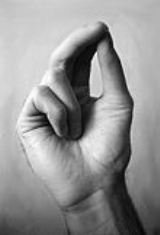
Sign of the cross

Encyclopedia
The Sign of the Cross or crossing oneself, is a ritual hand motion made by members of many branches of Christianity
, often accompanied by spoken or mental recitation of a trinitarian formula
.
 The motion is the tracing of the shape of a cross in the air or on one's own body, echoing the traditional shape of the cross
of the Christian
Crucifixion narrative
. There are two principal forms: the older -- three fingers, right to left -- is exclusively used in the Eastern Orthodox churches and the Eastern Rites of the Catholic Church; the newer -- left to right, other than three fingers -- is the one used in the Latin-Rite Catholic Church, Anglicanism
, Lutheranism
and Oriental Orthodoxy
(see below). The ritual is rare within other Christian traditions.
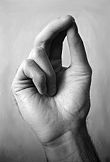 Hand
Hand
The open right hand is used in Western Christianity
. The five open fingers are often said to represent the Five Wounds of Christ, although this symbolism was applied after the more ancient gesture of two or three fingers was simplified. Though this is the most common method of crossing by Western Christians, other forms are sometimes used. The West also employs the "Small Sign of the Cross" in which a small cross is traced with the thumb over the forehead, lips, and breast of the individual while whispering the words "May Christ's words be in my mind, on my lips, and in my heart". This is used at the Proclamation of the Gospel at Holy Mass and also is commonly used when blessing oneself with holy water when leaving or entering a church. In the Eastern Orthodox
and Eastern Catholic Churches, the thumb, index, and middle finger are brought to a point, symbolizing the Trinity
(the Father, Son and the Holy Spirit/Ghost, three persons sharing a single essence), the remaining two fingers (kept pressed together and touching the palm) representing the human and divine natures of Jesus Christ. However, the Russian Orthodox in the past used two fingers brought to a point with the three remaining fingers pressed down. Russian Old Believers
still use this form. The Oriental Orthodox (Armenians, Copts, Ethiopians etc.) generally use the "Western" direction as well, though often with the Byzantine finger formation.
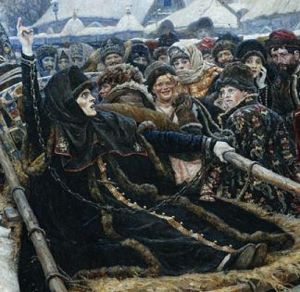 In Russia
, until the reforms of Patriarch Nikon
in the 17th century, it was customary to make the sign of the cross with two fingers (symbolising the dual nature of Christ). The enforcement of the three-finger sign was one of the reasons for the schism
with the Old Believers
whose congregations continue to use the two-finger sign of the cross.
Motion
The sign of the Cross is made by touching the hand sequentially to the forehead, lower chest or navel area, and both shoulders, accompanied by the Trinitarian formula
: at the forehead In the name of the Father (or In nomine Patris in Latin); at the stomach or heart and of the Son (et Filii); across the shoulders and of the Holy Spirit
/Ghost (et Spiritus Sancti); and finally: Amen
.
There are several interpretations, according to Church Fathers
: the forehead symbolizes Heaven; the stomach, the earth; the shoulders, the place and sign of power.
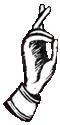 There are some variations: for example a person may first place the right hand in holy water
. After moving the hand from one shoulder to the other, it may be returned to the stomach. It may also be accompanied by the recitation of a prayer e.g. the Jesus Prayer
, or simply "Lord have mercy
". In some cultures it is customary to kiss one's hand or fingers at the conclusion of the gesture.
Sequence
Theodoret
(393–457) gave the following instruction:
Peter of Damascus (12th Century) gave the following instruction:
Pope Innocent III
(1198–1216) gave the following instruction:
Writers such as Herbert Thurston, author of the article "Sign of the Cross" in the Catholic Encyclopedia
interpret this as indicating that at that time both Eastern and Western Christians moved the hand from the right shoulder to the left. However, Thurston confesses that the point is not entirely clear. He quotes another liturgist who inclined to the opinion that in this passage of Innocent III, and in those of Belethus, Sicardus and Durandus, which are usually appealed to in proof of this, these authors had in mind the small cross made upon the forehead or external objects, in which the hand moves naturally from right to left, and not the big cross made from shoulder to shoulder. Andreas Andreopoulos, author of The Sign of the Cross, gives a more detailed description of the development and the symbolism of the placement of the fingers and the direction of the movement.
Today, Western Christians and the Oriental Orthodox touch the left shoulder before the right. Orthodox Christians use the right-to-left movement.
, and by clergy upon others or objects as an act of blessing
. The gesture of blessing is certainly related to the sign of the cross, but the two gestures developed independently after some point. We see that in Eastern Christianity
for instance, the two gestures differ significantly. Priest
s are allowed to bless using the right hand, while bishop
s may bless simultaneously with both, the left mirroring the right. While individuals may make it at any time, clergy must make it at specific times (as in liturgies
), and it is customary to make it on other occasions (see below). In the Catholic Church, a priest blesses with one sign of the cross over an object or person, but a bishop blesses with a triple sign of the cross; ordained bishops and priests are the only people empowered to bless objects and people other than themselves.
During rituals such as the Roman Catholic Mass
, the Sign is required at certain points: the laity sign themselves during the introductory greeting of the service, before the Gospel reading (small Signs on forehead, lips, and heart), and at the final blessing; optionally, other times during the Mass when the laity often cross themselves are during a sprinkling with holy water, when concluding the penitential rite, immediately after receiving Communion, and when concluding private prayer after Communion. The celebrant makes the Sign over the bread and wine before the Words of Institution
(i.e., words of Christ). In the Tridentine Mass
the priest signs the bread and wine 25 times during the Canon of the Mass
, ten times before and fifteen times after they have been consecrated. In the Mass of Paul VI
the priest signs them only once: before the consecration. The priest also uses the Sign of the Cross when blessing a deacon before the deacon reads the Gospel, when sending an Extraordinary Minister of Holy Communion to take the Eucharist to the sick (after Communion, but before the end of the Mass), and when blessing the congregation at the conclusion of the Mass.
Roman Catholic bishops make the Sign of the Cross three times when they are blessing
a large group of people, in the name of the Father, the Son, and the Holy Spirit.
 In the Eastern traditions, both celebrant and congregation make the Sign of the Cross much more frequently than in Western Christianity. It is customary in some Eastern traditions to cross oneself at each petition in a litany
, and to closely associate oneself with a particular intention being prayed for or with a saint being named. The Sign of the Cross is also made upon entering or leaving a church building, at the start and end of personal prayer, when passing the main altar (which represents Christ), whenever all three persons of the Trinity are addressed, and when approaching an icon.
 When an Eastern Orthodox or Eastern Catholic bishop or priest blesses with the sign of the cross, he holds the fingers of his right hand in such a way that they form the Greek abbreviation for Jesus Christ "IC XC". The little finger is extended to make the "I"; the index finger and middle finger are also raised, with the middle finger bent slightly so that the two fingers together form the "X"; the thumb touches the lowered third finger to signify the two "C"s. When a priest blesses in the sign of the cross, he positions the fingers of his right hand in the manner described as he raises his right hand, then moves his hand downwards, then to his left, then to his right. A bishop blesses with both hands (unless he is holding some sacred object such as a blessing cross, chalice
, Gospel Book
, icon
, etc.), holding the fingers of both hands in the same configuration, but when he moves his right hand to the left, he simultaneously moves his left hand to the right, so that the two hands cross, the left in front of the right, and then the right in front of the left. The blessing of both priests and bishops consists of three movements, in honour of the Holy Trinity.
Some Christians make the Sign of the Cross in a way that may seem idiom
atic: for example, in response to perceived blasphemy. Others sign themselves to seek God's blessing before or during an event with uncertain outcome. In Latin countries people often sign themselves in public.
Athletes can be seen crossing themselves before entering the field or while concentrating for competition.
In societies with constant Christian observance the Sign of the Cross is employed during everyday activities. For example the spoon
crosses the newly poured mixture before stirring, housewives bless food when placing it in the oven
, potters bless the clay before creating a vessel, and one slicing bread crosses the bread
with the knife before cutting, as bread is considered to represent the body of Christ
.
During religious persecutions, such as in Communist Romania
, some believers would hide the gesture by moving their tongues in a cross pattern inside their mouths.
(modern Tunisia, Africa), Tertullian
says: "We Christians wear out our foreheads with the sign of the cross". Vestiges of this practice remain: some Christians sign a cross on their forehead before hearing the Gospels during Mass; foreheads are marked with an ash cross on Ash Wednesday
; holy oil (called chrism
) is applied on the forehead for the sacrament
of Confirmation. By the fourth century, the sign of the cross involved other parts of the body beyond the forehead.
. Since the Reformation
it has often been rejected by Protestants and some Low-Church
Anglicans as being a Catholic practice, despite Martin Luther's positive personal view, the prescribed use of the sign in Book of Common Prayer
and the defence of the sign of the cross in Anglican canon law in 1604.
states that it is expected before the morning and evening prayers. Lutheranism never abandoned the practice of making the sign of the cross in principle and it was commonly retained in worship at least until the early 19th century. During the 19th and early 20th centuries it was largely in disuse until the liturgical renewal movement of the 1950s and 1960s. Since then, the sign of the cross has become fairly commonplace among Lutherans at worship. The sign of the cross is now customary in the Divine Service. Rubrics in Contemporary Lutheran worship manuals, including Evangelical Lutheran Worship
, Lutheran Service Book
, Lutheran Book of Worship
and Lutheran Worship
provide for making the sign of the cross at certain points in the liturgy. Most places are the same as the Roman Catholic practice, such as at the trinitarian formula
, the benediction
, at the consecration of the Eucharist, and following reciting the Nicene
or Apostles'
Creed
.
Devotional use of the sign of the cross among Lutherans also includes after receiving the Host and Chalice in the Eucharist, following Holy Absolution. Sometimes there is also holy water font
or baptismal font
at the entrance of the church, where they may dip their fingers in it and make the sign of the cross upon entering.
, are essentially a product of the Protestant Reformation
. Currently the sign of the cross is less common in a Methodist service as opposed to a Catholic Mass, but on Ash Wednesday
it is almost always applied by the elder
on the laity
. However, it is a personal choice whether or not a Methodist uses the sign for personal prayer, and is encouraged by the bishops of the United Methodist Church
. Some United Methodist churches also perform the sign before and after receiving Holy Communion. Some ministers also perform the sign after blessing the congregation at the end of the sermon.
, such as the PCUSA
and the Cumberland Presbyterian Church
, the sign of the cross is used on the foreheads during baptism
or during an Ash Wednesday
service when ashes are imposed on the forehead. In rare instances during a Benediction
, when the minister concludes the service using the trinitarian blessing, a hand is extended and a sign of the cross is made out toward the congregation.
Orthodox
Protestant
Christianity
Christianity is a monotheistic religion based on the life and teachings of Jesus as presented in canonical gospels and other New Testament writings...
, often accompanied by spoken or mental recitation of a trinitarian formula
Trinitarian formula
The trinitarian formula is the phrase "in the name of the Father, and of the Son, and of the Holy Spirit" , or words to that form and effect referring to the three persons of the Christian Trinity.- Biblical origin :...
.
Crucifixion
Crucifixion is an ancient method of painful execution in which the condemned person is tied or nailed to a large wooden cross and left to hang until dead...
of the Christian
Christian
A Christian is a person who adheres to Christianity, an Abrahamic, monotheistic religion based on the life and teachings of Jesus of Nazareth as recorded in the Canonical gospels and the letters of the New Testament...
Crucifixion narrative
Crucifixion of Jesus
The crucifixion of Jesus and his ensuing death is an event that occurred during the 1st century AD. Jesus, who Christians believe is the Son of God as well as the Messiah, was arrested, tried, and sentenced by Pontius Pilate to be scourged, and finally executed on a cross...
. There are two principal forms: the older -- three fingers, right to left -- is exclusively used in the Eastern Orthodox churches and the Eastern Rites of the Catholic Church; the newer -- left to right, other than three fingers -- is the one used in the Latin-Rite Catholic Church, Anglicanism
Anglicanism
Anglicanism is a tradition within Christianity comprising churches with historical connections to the Church of England or similar beliefs, worship and church structures. The word Anglican originates in ecclesia anglicana, a medieval Latin phrase dating to at least 1246 that means the English...
, Lutheranism
Lutheranism
Lutheranism is a major branch of Western Christianity that identifies with the theology of Martin Luther, a German reformer. Luther's efforts to reform the theology and practice of the church launched the Protestant Reformation...
and Oriental Orthodoxy
Oriental Orthodoxy
Oriental Orthodoxy is the faith of those Eastern Christian Churches that recognize only three ecumenical councils — the First Council of Nicaea, the First Council of Constantinople and the First Council of Ephesus. They rejected the dogmatic definitions of the Council of Chalcedon...
(see below). The ritual is rare within other Christian traditions.
Gesture
The open right hand is used in Western Christianity
Western Christianity
Western Christianity is a term used to include the Latin Rite of the Catholic Church and groups historically derivative thereof, including the churches of the Anglican and Protestant traditions, which share common attributes that can be traced back to their medieval heritage...
. The five open fingers are often said to represent the Five Wounds of Christ, although this symbolism was applied after the more ancient gesture of two or three fingers was simplified. Though this is the most common method of crossing by Western Christians, other forms are sometimes used. The West also employs the "Small Sign of the Cross" in which a small cross is traced with the thumb over the forehead, lips, and breast of the individual while whispering the words "May Christ's words be in my mind, on my lips, and in my heart". This is used at the Proclamation of the Gospel at Holy Mass and also is commonly used when blessing oneself with holy water when leaving or entering a church. In the Eastern Orthodox
Eastern Orthodox Church
The Orthodox Church, officially called the Orthodox Catholic Church and commonly referred to as the Eastern Orthodox Church, is the second largest Christian denomination in the world, with an estimated 300 million adherents mainly in the countries of Belarus, Bulgaria, Cyprus, Georgia, Greece,...
and Eastern Catholic Churches, the thumb, index, and middle finger are brought to a point, symbolizing the Trinity
Trinity
The Christian doctrine of the Trinity defines God as three divine persons : the Father, the Son , and the Holy Spirit. The three persons are distinct yet coexist in unity, and are co-equal, co-eternal and consubstantial . Put another way, the three persons of the Trinity are of one being...
(the Father, Son and the Holy Spirit/Ghost, three persons sharing a single essence), the remaining two fingers (kept pressed together and touching the palm) representing the human and divine natures of Jesus Christ. However, the Russian Orthodox in the past used two fingers brought to a point with the three remaining fingers pressed down. Russian Old Believers
Old Believers
In the context of Russian Orthodox church history, the Old Believers separated after 1666 from the official Russian Orthodox Church as a protest against church reforms introduced by Patriarch Nikon between 1652–66...
still use this form. The Oriental Orthodox (Armenians, Copts, Ethiopians etc.) generally use the "Western" direction as well, though often with the Byzantine finger formation.
Russia
Russia or , officially known as both Russia and the Russian Federation , is a country in northern Eurasia. It is a federal semi-presidential republic, comprising 83 federal subjects...
, until the reforms of Patriarch Nikon
Patriarch Nikon
Nikon , born Nikita Minin , was the seventh patriarch of the Russian Orthodox Church...
in the 17th century, it was customary to make the sign of the cross with two fingers (symbolising the dual nature of Christ). The enforcement of the three-finger sign was one of the reasons for the schism
Schism (religion)
A schism , from Greek σχίσμα, skhísma , is a division between people, usually belonging to an organization or movement religious denomination. The word is most frequently applied to a break of communion between two sections of Christianity that were previously a single body, or to a division within...
with the Old Believers
Old Believers
In the context of Russian Orthodox church history, the Old Believers separated after 1666 from the official Russian Orthodox Church as a protest against church reforms introduced by Patriarch Nikon between 1652–66...
whose congregations continue to use the two-finger sign of the cross.
Motion
The sign of the Cross is made by touching the hand sequentially to the forehead, lower chest or navel area, and both shoulders, accompanied by the Trinitarian formula
Trinitarian formula
The trinitarian formula is the phrase "in the name of the Father, and of the Son, and of the Holy Spirit" , or words to that form and effect referring to the three persons of the Christian Trinity.- Biblical origin :...
: at the forehead In the name of the Father (or In nomine Patris in Latin); at the stomach or heart and of the Son (et Filii); across the shoulders and of the Holy Spirit
Holy Spirit
Holy Spirit is a term introduced in English translations of the Hebrew Bible, but understood differently in the main Abrahamic religions.While the general concept of a "Spirit" that permeates the cosmos has been used in various religions Holy Spirit is a term introduced in English translations of...
/Ghost (et Spiritus Sancti); and finally: Amen
Amen
The word amen is a declaration of affirmation found in the Hebrew Bible and New Testament. Its use in Judaism dates back to its earliest texts. It has been generally adopted in Christian worship as a concluding word for prayers and hymns. In Islam, it is the standard ending to Dua and the...
.
There are several interpretations, according to Church Fathers
Church Fathers
The Church Fathers, Early Church Fathers, Christian Fathers, or Fathers of the Church were early and influential theologians, eminent Christian teachers and great bishops. Their scholarly works were used as a precedent for centuries to come...
: the forehead symbolizes Heaven; the stomach, the earth; the shoulders, the place and sign of power.
Holy water
Holy water is water that, in Catholicism, Anglicanism, Eastern Orthodoxy, Lutheranism, Oriental Orthodoxy, and some other churches, has been sanctified by a priest for the purpose of baptism, the blessing of persons, places, and objects; or as a means of repelling evil.The use for baptism and...
. After moving the hand from one shoulder to the other, it may be returned to the stomach. It may also be accompanied by the recitation of a prayer e.g. the Jesus Prayer
Jesus Prayer
The Jesus Prayer or "The Prayer" is a short, formulaic prayer esteemed and advocated within the Eastern Orthodox church:The prayer has been widely taught and discussed throughout the history of the Eastern Churches. It is often repeated continually as a part of personal ascetic practice, its use...
, or simply "Lord have mercy
Kyrie
Kyrie, a transliteration of Greek κύριε , vocative case of κύριος , meaning "Lord", is the common name of an important prayer of Christian liturgy, which is also called the Kýrie, eléison ....
". In some cultures it is customary to kiss one's hand or fingers at the conclusion of the gesture.
Sequence
Theodoret
Theodoret
Theodoret of Cyrus or Cyrrhus was an influential author, theologian, and Christian bishop of Cyrrhus, Syria . He played a pivotal role in many early Byzantine church controversies that led to various ecumenical acts and schisms...
(393–457) gave the following instruction:
This is how to bless someone with your hand and make the sign of the cross over them. Hold three fingers, as equals, together, to represent the Trinity: God the Father, God the Son, and God the Holy Ghost. These are not three gods, but one God in Trinity. The names are separate, but the divinity one. The Father was never incarnate; the Son incarnate, but not created; the Holy Ghost neither incarnate nor created, but issued from the Godhead: three in a single divinity. Divinity is one force and has one honor. They receive on obeisance from all creation, both angels and people. Thus the decree for these three fingers.
You should hold the other two fingers slightly bent, not completely straight. This is because these represent the dual nature of Christ, divine and human. God in His divinity, and human in His incarnation, yet perfect in both. The upper finger represents divinity, and the lower humanity; this way salvation goes from the higher finger to the lower. So is the bending of the fingers interpreted, for the worship of Heaven comes down for our salvation. This is how you must cross yourselves and give a blessing, as the holy fathers have commanded.
Peter of Damascus (12th Century) gave the following instruction:
Then we should also marvel how demons and various diseases are dispelled by the sign of the precious and life-giving Cross, which all can make without cost or effort. Who can number the panegyrics composed in its honor? The holy fathers have handed down to us the inner significance of this sign, so that we can refute heretics and unbelievers. The two fingers and single hand with which it is made represent the Lord Jesus Christ crucified, and He is thereby acknowledged to exist in two natures and one hypostasis or person.
The use of the right hand betokens His infinite power and the fact that He sits at the right hand of the Father. That the sign begins with a downward movement from above signifies His descent to us from heaven. Again, the movement of the hand from the right side to the left drives away our enemies and declares that by His invincible power the Lord overcame the devil, who is on the left side, dark and lacking strength.
Pope Innocent III
Pope Innocent III
Pope Innocent III was Pope from 8 January 1198 until his death. His birth name was Lotario dei Conti di Segni, sometimes anglicised to Lothar of Segni....
(1198–1216) gave the following instruction:
The sign of the cross is made with three fingers, because the signing is done together with the invocation of the Trinity. ... This is how it is done: from above to below, and from the right to the left, because Christ descended from the heavens to the earth, and from the Jews (right) He passed to the Gentiles (left).
Others, however, make the sign of the cross from the left to the right, because from misery (left) we must cross over to glory (right), just as Christ crossed over from death to life, and from Hades to Paradise. [Some priests] do it this way so that they and the people will be signing themselves in the same way. You can easily verify this — picture the priest facing the people for the blessing — when we make the sign of the cross over the people, it is from left to right...
Writers such as Herbert Thurston, author of the article "Sign of the Cross" in the Catholic Encyclopedia
Catholic Encyclopedia
The Catholic Encyclopedia, also referred to as the Old Catholic Encyclopedia and the Original Catholic Encyclopedia, is an English-language encyclopedia published in the United States. The first volume appeared in March 1907 and the last three volumes appeared in 1912, followed by a master index...
interpret this as indicating that at that time both Eastern and Western Christians moved the hand from the right shoulder to the left. However, Thurston confesses that the point is not entirely clear. He quotes another liturgist who inclined to the opinion that in this passage of Innocent III, and in those of Belethus, Sicardus and Durandus, which are usually appealed to in proof of this, these authors had in mind the small cross made upon the forehead or external objects, in which the hand moves naturally from right to left, and not the big cross made from shoulder to shoulder. Andreas Andreopoulos, author of The Sign of the Cross, gives a more detailed description of the development and the symbolism of the placement of the fingers and the direction of the movement.
Today, Western Christians and the Oriental Orthodox touch the left shoulder before the right. Orthodox Christians use the right-to-left movement.
Use
The Sign of the Cross may be made by individuals upon themselves as a form of prayerPrayer in Christianity
Prayer has been an essential part of Christianity since its earliest days. Prayer is an integral element of the Christian faith and permeates all forms of Christian worship...
, and by clergy upon others or objects as an act of blessing
Blessing
A blessing, is the infusion of something with holiness, spiritual redemption, divine will, or one's hope or approval.- Etymology and Germanic paganism :...
. The gesture of blessing is certainly related to the sign of the cross, but the two gestures developed independently after some point. We see that in Eastern Christianity
Eastern Christianity
Eastern Christianity comprises the Christian traditions and churches that developed in the Balkans, Eastern Europe, Asia Minor, the Middle East, Northeastern Africa, India and parts of the Far East over several centuries of religious antiquity. The term is generally used in Western Christianity to...
for instance, the two gestures differ significantly. Priest
Priest
A priest is a person authorized to perform the sacred rites of a religion, especially as a mediatory agent between humans and deities. They also have the authority or power to administer religious rites; in particular, rites of sacrifice to, and propitiation of, a deity or deities...
s are allowed to bless using the right hand, while bishop
Bishop
A bishop is an ordained or consecrated member of the Christian clergy who is generally entrusted with a position of authority and oversight. Within the Catholic Church, Eastern Orthodox, Oriental Orthodox Churches, in the Assyrian Church of the East, in the Independent Catholic Churches, and in the...
s may bless simultaneously with both, the left mirroring the right. While individuals may make it at any time, clergy must make it at specific times (as in liturgies
Christian liturgy
A liturgy is a set form of ceremony or pattern of worship. Christian liturgy is a pattern for worship used by a Christian congregation or denomination on a regular basis....
), and it is customary to make it on other occasions (see below). In the Catholic Church, a priest blesses with one sign of the cross over an object or person, but a bishop blesses with a triple sign of the cross; ordained bishops and priests are the only people empowered to bless objects and people other than themselves.
During rituals such as the Roman Catholic Mass
Mass (liturgy)
"Mass" is one of the names by which the sacrament of the Eucharist is called in the Roman Catholic Church: others are "Eucharist", the "Lord's Supper", the "Breaking of Bread", the "Eucharistic assembly ", the "memorial of the Lord's Passion and Resurrection", the "Holy Sacrifice", the "Holy and...
, the Sign is required at certain points: the laity sign themselves during the introductory greeting of the service, before the Gospel reading (small Signs on forehead, lips, and heart), and at the final blessing; optionally, other times during the Mass when the laity often cross themselves are during a sprinkling with holy water, when concluding the penitential rite, immediately after receiving Communion, and when concluding private prayer after Communion. The celebrant makes the Sign over the bread and wine before the Words of Institution
Words of Institution
The Words of Institution are words echoing those of Jesus himself at his Last Supper that, when consecrating bread and wine, Christian Eucharistic liturgies include in a narrative of that event...
(i.e., words of Christ). In the Tridentine Mass
Tridentine Mass
The Tridentine Mass is the form of the Roman Rite Mass contained in the typical editions of the Roman Missal that were published from 1570 to 1962. It was the most widely celebrated Mass liturgy in the world until the introduction of the Mass of Paul VI in December 1969...
the priest signs the bread and wine 25 times during the Canon of the Mass
Canon of the Mass
Canon of the Mass is the name given in the Roman Missal, from the first typical edition of Pope Pius V in 1570 to that of Pope John XXIII in 1962, to the part of the Mass of the Roman Rite that begins after the Sanctus with the words Te igitur...
, ten times before and fifteen times after they have been consecrated. In the Mass of Paul VI
Mass of Paul VI
The Mass of Pope Paul VI is the liturgy of the Catholic Mass of the Roman Rite promulgated by Paul VI in 1969, after the Second Vatican Council...
the priest signs them only once: before the consecration. The priest also uses the Sign of the Cross when blessing a deacon before the deacon reads the Gospel, when sending an Extraordinary Minister of Holy Communion to take the Eucharist to the sick (after Communion, but before the end of the Mass), and when blessing the congregation at the conclusion of the Mass.
Roman Catholic bishops make the Sign of the Cross three times when they are blessing
Blessing (Roman Catholic Church)
Blessing in Roman Catholicism, in the narrow liturgical sense, is a rite consisting of a ceremony and prayers performed in the name and with the authority of the Church by a duly qualified minister by which persons or things are sanctified as dedicated to Divine service or by which certain marks of...
a large group of people, in the name of the Father, the Son, and the Holy Spirit.
Ektenia
Ektenia , often called simply Litany, is a prayerful petition in the Eastern Orthodox/Eastern Catholic liturgy...
, and to closely associate oneself with a particular intention being prayed for or with a saint being named. The Sign of the Cross is also made upon entering or leaving a church building, at the start and end of personal prayer, when passing the main altar (which represents Christ), whenever all three persons of the Trinity are addressed, and when approaching an icon.
Chalice (cup)
A chalice is a goblet or footed cup intended to hold a drink. In general religious terms, it is intended for drinking during a ceremony.-Christian:...
, Gospel Book
Gospel Book
The Gospel Book, Evangelion, or Book of the Gospels is a codex or bound volume containing one or more of the four Gospels of the Christian New Testament...
, icon
Icon
An icon is a religious work of art, most commonly a painting, from Eastern Christianity and in certain Eastern Catholic churches...
, etc.), holding the fingers of both hands in the same configuration, but when he moves his right hand to the left, he simultaneously moves his left hand to the right, so that the two hands cross, the left in front of the right, and then the right in front of the left. The blessing of both priests and bishops consists of three movements, in honour of the Holy Trinity.
Some Christians make the Sign of the Cross in a way that may seem idiom
Idiom
Idiom is an expression, word, or phrase that has a figurative meaning that is comprehended in regard to a common use of that expression that is separate from the literal meaning or definition of the words of which it is made...
atic: for example, in response to perceived blasphemy. Others sign themselves to seek God's blessing before or during an event with uncertain outcome. In Latin countries people often sign themselves in public.
Athletes can be seen crossing themselves before entering the field or while concentrating for competition.
In societies with constant Christian observance the Sign of the Cross is employed during everyday activities. For example the spoon
Spoon
A spoon is a utensil consisting of a small shallow bowl, oval or round, at the end of a handle. A type of cutlery , especially as part of a place setting, it is used primarily for serving. Spoons are also used in food preparation to measure, mix, stir and toss ingredients...
crosses the newly poured mixture before stirring, housewives bless food when placing it in the oven
Oven
An oven is a thermally insulated chamber used for the heating, baking or drying of a substance. It is most commonly used for cooking. Kilns, and furnaces are special-purpose ovens...
, potters bless the clay before creating a vessel, and one slicing bread crosses the bread
Bread
Bread is a staple food prepared by cooking a dough of flour and water and often additional ingredients. Doughs are usually baked, but in some cuisines breads are steamed , fried , or baked on an unoiled frying pan . It may be leavened or unleavened...
with the knife before cutting, as bread is considered to represent the body of Christ
Christ
Christ is the English term for the Greek meaning "the anointed one". It is a translation of the Hebrew , usually transliterated into English as Messiah or Mashiach...
.
During religious persecutions, such as in Communist Romania
Communist Romania
Communist Romania was the period in Romanian history when that country was a Soviet-aligned communist state in the Eastern Bloc, with the dominant role of Romanian Communist Party enshrined in its successive constitutions...
, some believers would hide the gesture by moving their tongues in a cross pattern inside their mouths.
Origins
The Christian sign of the cross was originally made in some parts of the Christian world with the right-hand thumb across the forehead only. In other parts of the early Christian world it was done with the whole hand or with two fingers. Around the year 200 in CarthageCarthage
Carthage , implying it was a 'new Tyre') is a major urban centre that has existed for nearly 3,000 years on the Gulf of Tunis, developing from a Phoenician colony of the 1st millennium BC...
(modern Tunisia, Africa), Tertullian
Tertullian
Quintus Septimius Florens Tertullianus, anglicised as Tertullian , was a prolific early Christian author from Carthage in the Roman province of Africa. He is the first Christian author to produce an extensive corpus of Latin Christian literature. He also was a notable early Christian apologist and...
says: "We Christians wear out our foreheads with the sign of the cross". Vestiges of this practice remain: some Christians sign a cross on their forehead before hearing the Gospels during Mass; foreheads are marked with an ash cross on Ash Wednesday
Ash Wednesday
Ash Wednesday, in the calendar of Western Christianity, is the first day of Lent and occurs 46 days before Easter. It is a moveable fast, falling on a different date each year because it is dependent on the date of Easter...
; holy oil (called chrism
Chrism
Chrism , also called "Myrrh" , Holy anointing oil, or "Consecrated Oil", is a consecrated oil used in the Roman Catholic, Eastern Orthodox, Eastern Rite Catholic, Oriental Orthodox, in the Assyrian Church of the East, and in Old-Catholic churches, as well as Anglican churches in the administration...
) is applied on the forehead for the sacrament
Sacrament
A sacrament is a sacred rite recognized as of particular importance and significance. There are various views on the existence and meaning of such rites.-General definitions and terms:...
of Confirmation. By the fourth century, the sign of the cross involved other parts of the body beyond the forehead.
Protestant views
Although the Sign of the Cross dates to ante-Nicene Christianity, it was rejected by some of the Reformers, and is absent from most forms of ProtestantismProtestantism
Protestantism is one of the three major groupings within Christianity. It is a movement that began in Germany in the early 16th century as a reaction against medieval Roman Catholic doctrines and practices, especially in regards to salvation, justification, and ecclesiology.The doctrines of the...
. Since the Reformation
Protestant Reformation
The Protestant Reformation was a 16th-century split within Western Christianity initiated by Martin Luther, John Calvin and other early Protestants. The efforts of the self-described "reformers", who objected to the doctrines, rituals and ecclesiastical structure of the Roman Catholic Church, led...
it has often been rejected by Protestants and some Low-Church
Low church
Low church is a term of distinction in the Church of England or other Anglican churches initially designed to be pejorative. During the series of doctrinal and ecclesiastic challenges to the established church in the 16th and 17th centuries, commentators and others began to refer to those groups...
Anglicans as being a Catholic practice, despite Martin Luther's positive personal view, the prescribed use of the sign in Book of Common Prayer
Book of Common Prayer
The Book of Common Prayer is the short title of a number of related prayer books used in the Anglican Communion, as well as by the Continuing Anglican, "Anglican realignment" and other Anglican churches. The original book, published in 1549 , in the reign of Edward VI, was a product of the English...
and the defence of the sign of the cross in Anglican canon law in 1604.
Lutheranism
Among Lutherans the practice was widely retained. For example, Luther's Small CatechismLuther's Small Catechism
Luther's Small Catechism was written by Martin Luther and published in 1529 for the training of children. Luther's Small Catechism reviews The Ten Commandments, The Apostles' Creed, The Lord's Prayer, The Sacrament of Holy Baptism, The Office of the Keys & Confession, and The Sacrament of the...
states that it is expected before the morning and evening prayers. Lutheranism never abandoned the practice of making the sign of the cross in principle and it was commonly retained in worship at least until the early 19th century. During the 19th and early 20th centuries it was largely in disuse until the liturgical renewal movement of the 1950s and 1960s. Since then, the sign of the cross has become fairly commonplace among Lutherans at worship. The sign of the cross is now customary in the Divine Service. Rubrics in Contemporary Lutheran worship manuals, including Evangelical Lutheran Worship
Evangelical Lutheran Worship
Evangelical Lutheran Worship or ELW is the current, primary liturgical and worship guidebook and hymnal for use in the Evangelical Lutheran Church in America and the Evangelical Lutheran Church in Canada, replacing its three predecessors, the Lutheran Book of Worship , the Hymnal Supplemental , and...
, Lutheran Service Book
Lutheran Service Book
Lutheran Service Book is the newest official hymnal of the Lutheran Church–Missouri Synod and the Lutheran Church–Canada . It was prepared by the LCMS Commission on Worship and published by Concordia Publishing House, the official publisher of the LCMS...
, Lutheran Book of Worship
Lutheran Book of Worship
Lutheran Book of Worship is a worship book and hymnal used by several Lutheran denominations in North America. It is often referred to by its initials as the LBW, and in the Evangelical Lutheran Church in America the LBW is sometimes called the "green book" as opposed to With One Voice, a...
and Lutheran Worship
Lutheran Worship
Lutheran Worship is one of the official hymnals of the Lutheran Church - Missouri Synod. Published in 1982 by Concordia Publishing House in St. Louis, Missouri, it is the LCMS' third English-language hymnal and was intended to replace The Lutheran Hymnal...
provide for making the sign of the cross at certain points in the liturgy. Most places are the same as the Roman Catholic practice, such as at the trinitarian formula
Trinitarian formula
The trinitarian formula is the phrase "in the name of the Father, and of the Son, and of the Holy Spirit" , or words to that form and effect referring to the three persons of the Christian Trinity.- Biblical origin :...
, the benediction
Benediction
A benediction is a short invocation for divine help, blessing and guidance, usually at the end of worship service.-Judaism:...
, at the consecration of the Eucharist, and following reciting the Nicene
Nicene Creed
The Nicene Creed is the creed or profession of faith that is most widely used in Christian liturgy. It is called Nicene because, in its original form, it was adopted in the city of Nicaea by the first ecumenical council, which met there in the year 325.The Nicene Creed has been normative to the...
or Apostles'
Apostles' Creed
The Apostles' Creed , sometimes titled Symbol of the Apostles, is an early statement of Christian belief, a creed or "symbol"...
Creed
Creed
A creed is a statement of belief—usually a statement of faith that describes the beliefs shared by a religious community—and is often recited as part of a religious service. When the statement of faith is longer and polemical, as well as didactic, it is not called a creed but a Confession of faith...
.
Devotional use of the sign of the cross among Lutherans also includes after receiving the Host and Chalice in the Eucharist, following Holy Absolution. Sometimes there is also holy water font
Holy water font
A holy water font or stoup is a vessel containing holy water generally placed near the entrance of a church. It is used in Catholic Church and Lutheran churches, as well as some Anglican churches to make the Sign of the Cross using the holy water upon entrance and exit...
or baptismal font
Baptismal font
A baptismal font is an article of church furniture or a fixture used for the baptism of children and adults.-Aspersion and affusion fonts:...
at the entrance of the church, where they may dip their fingers in it and make the sign of the cross upon entering.
Methodism
The Methodist Episcopal churches, such as the United Methodist ChurchUnited Methodist Church
The United Methodist Church is a Methodist Christian denomination which is both mainline Protestant and evangelical. Founded in 1968 by the union of The Methodist Church and the Evangelical United Brethren Church, the UMC traces its roots back to the revival movement of John and Charles Wesley...
, are essentially a product of the Protestant Reformation
Protestant Reformation
The Protestant Reformation was a 16th-century split within Western Christianity initiated by Martin Luther, John Calvin and other early Protestants. The efforts of the self-described "reformers", who objected to the doctrines, rituals and ecclesiastical structure of the Roman Catholic Church, led...
. Currently the sign of the cross is less common in a Methodist service as opposed to a Catholic Mass, but on Ash Wednesday
Ash Wednesday
Ash Wednesday, in the calendar of Western Christianity, is the first day of Lent and occurs 46 days before Easter. It is a moveable fast, falling on a different date each year because it is dependent on the date of Easter...
it is almost always applied by the elder
Elder (Methodism)
An Elder in the Methodist Church — sometimes called a Presbyter or Minister — is someone who has been ordained by a Bishop to the ministry of Word, Sacrament, Order, and Service...
on the laity
Laity
In religious organizations, the laity comprises all people who are not in the clergy. A person who is a member of a religious order who is not ordained legitimate clergy is considered as a member of the laity, even though they are members of a religious order .In the past in Christian cultures, the...
. However, it is a personal choice whether or not a Methodist uses the sign for personal prayer, and is encouraged by the bishops of the United Methodist Church
United Methodist Church
The United Methodist Church is a Methodist Christian denomination which is both mainline Protestant and evangelical. Founded in 1968 by the union of The Methodist Church and the Evangelical United Brethren Church, the UMC traces its roots back to the revival movement of John and Charles Wesley...
. Some United Methodist churches also perform the sign before and after receiving Holy Communion. Some ministers also perform the sign after blessing the congregation at the end of the sermon.
Reformed Tradition
In some Reformed churchesReformed churches
The Reformed churches are a group of Protestant denominations characterized by Calvinist doctrines. They are descended from the Swiss Reformation inaugurated by Huldrych Zwingli but developed more coherently by Martin Bucer, Heinrich Bullinger and especially John Calvin...
, such as the PCUSA
Presbyterian Church (U.S.A.)
The Presbyterian Church , or PC, is a mainline Protestant Christian denomination in the United States. Part of the Reformed tradition, it is the largest Presbyterian denomination in the U.S...
and the Cumberland Presbyterian Church
Cumberland Presbyterian Church
The Cumberland Presbyterian Church is a Presbyterian Christian denomination spawned by the Second Great Awakening. In 2007, it had an active membership of less than 50,000 and about 800 congregations, the majority of which are concentrated in the United States...
, the sign of the cross is used on the foreheads during baptism
or during an Ash Wednesday
Ash Wednesday
Ash Wednesday, in the calendar of Western Christianity, is the first day of Lent and occurs 46 days before Easter. It is a moveable fast, falling on a different date each year because it is dependent on the date of Easter...
service when ashes are imposed on the forehead. In rare instances during a Benediction
Benediction
A benediction is a short invocation for divine help, blessing and guidance, usually at the end of worship service.-Judaism:...
, when the minister concludes the service using the trinitarian blessing, a hand is extended and a sign of the cross is made out toward the congregation.
See also
- Christian crossChristian crossThe Christian cross, seen as a representation of the instrument of the crucifixion of Jesus Christ, is the best-known religious symbol of Christianity...
- Christian symbolismChristian symbolismChristian symbolism invests objects or actions with an inner meaning expressing Christian ideas. Christianity has borrowed from the common stock of significant symbols known to most periods and to all regions of the world. Religious symbolism is effective when it appeals to both the intellect and...
- GenuflectionGenuflectionGenuflection , bending at least one knee to the ground, was from early times a gesture of deep respect for a superior. In 328 BC, Alexander the Great introduced into his court etiquette some form of genuflection already in use in Persia. In the Byzantine Empire even senators were required to...
- Prayer in ChristianityPrayer in ChristianityPrayer has been an essential part of Christianity since its earliest days. Prayer is an integral element of the Christian faith and permeates all forms of Christian worship...
- Trinitarian formulaTrinitarian formulaThe trinitarian formula is the phrase "in the name of the Father, and of the Son, and of the Holy Spirit" , or words to that form and effect referring to the three persons of the Christian Trinity.- Biblical origin :...
- VenerationVenerationVeneration , or veneration of saints, is a special act of honoring a saint: an angel, or a dead person who has been identified by a church committee as singular in the traditions of the religion. It is practiced by the Eastern Orthodox Church, the Roman Catholic, and Eastern Catholic Churches...
- PranāmaPranāmaPranāma or ', the touching of the feet in Indian culture, is a show of respect and it is often an integral part of darshan. When greeting, children touch the feet of their family elders while people of all ages will bend to touch the feet of a great guru, murti or icon of a Deva .It is customary...
External links
Roman Catholic- Sign of the Cross (entry from the Catholic EncyclopediaCatholic EncyclopediaThe Catholic Encyclopedia, also referred to as the Old Catholic Encyclopedia and the Original Catholic Encyclopedia, is an English-language encyclopedia published in the United States. The first volume appeared in March 1907 and the last three volumes appeared in 1912, followed by a master index...
) - Significance of the Sign of the Cross
Orthodox
- Sign of the Cross (orthodoxwiki.org)
- Why do Orthodox Christians "cross themselves" different than Roman Catholics?
- The Church Council of the Hundred Chapters(1551) (Old BelieversOld BelieversIn the context of Russian Orthodox church history, the Old Believers separated after 1666 from the official Russian Orthodox Church as a protest against church reforms introduced by Patriarch Nikon between 1652–66...
) - Sign of the Cross (Old BelieversOld BelieversIn the context of Russian Orthodox church history, the Old Believers separated after 1666 from the official Russian Orthodox Church as a protest against church reforms introduced by Patriarch Nikon between 1652–66...
)
Protestant
- Why Do Lutherans Make the Sign of the Cross? (ELCAEvangelical Lutheran Church in AmericaThe Evangelical Lutheran Church in America is a mainline Protestant denomination headquartered in Chicago, Illinois. The ELCA officially came into existence on January 1, 1988, by the merging of three churches. As of December 31, 2009, it had 4,543,037 baptized members, with 2,527,941 of them...
website) - Sign of the Cross (Lutheran Church - Missouri SynodLutheran Church - Missouri SynodThe Lutheran Church–Missouri Synod is a traditional, confessional Lutheran denomination in the United States. With 2.3 million members, it is both the eighth largest Protestant denomination and the second-largest Lutheran body in the U.S. after the Evangelical Lutheran Church in America. The Synod...
website) - Episcopalian site