
All Topics  
King Lear

 
King Lear

   Email Print
   Bookmark   Link


King Lear


King Lear is a tragedy by William Shakespeare
William Shakespeare

William Shakespeare was an English people poet and playwright, widely regarded as the greatest writer in the English language and the world's preeminent dramatist....
, believed to have been written between 1603 and 1606, and is considered one of his greatest works. The play is based on the legend of Leir of Britain
Leir of Britain

Leir is a legendary prehistoric king of the Brythons, as recounted by Geoffrey of Monmouth. His story is told in much-modified and romanticized form in William Shakespeare's King Lear....
, a mythological pre-Roman
Ancient Rome

Ancient Rome was a civilization that grew out of a small agricultural community founded on the Italian Peninsula as early as the 10th century BC....
 king. It has been widely adapted for stage and screen, with the part of Lear being played by many of the world's most accomplished actors.

There are two distinct versions of the play: The True Chronicle of the History of the Life and Death of King Lear and His Three Daughters, which appeared in quarto
Bookbinding

Bookbinding is the process of physically assembling a book from a number of folded or unfolded sheets of paper or other material. It also usually involves attaching covers to the resulting text-block....
 in 1608, and The Tragedy of King Lear, which appeared in the First Folio
First Folio

Mr. William Shakespeares Comedies, Histories, & Tragedies is the 1623 published collection of William Shakespeare's plays. Modern scholars commonly refer to it as the First Folio....
 in 1623, a more theatrical version.


Discussion
Ask a question about 'King Lear'
Start a new discussion about 'King Lear'
Answer questions from other users
Full Discussion Forum


Recent Posts


Quotations


And worse I may be yet: the worst is not,So long as we can say, This is the worst.

Edgar, scene i

As flies to wanton boys, are we to the gods, —They kill us for their sport.

Gloucester, scene i

Child Rowland to the dark tower came,His word was still, —Fie, foh, and fum,I smell the blood of a British man.

Edgar, scene iv

Come not between the dragon and his wrath.

Lear, scene i

Cry you mercy, I took you for a joint-stool.

Fool, scene vi

Fortune, good-night: smile once more; turn thy wheel!

Kent, scene ii


Encyclopedia


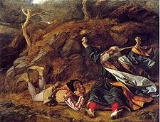
Kinglearpainting
King Lear is a tragedy by William Shakespeare
William Shakespeare

William Shakespeare was an English people poet and playwright, widely regarded as the greatest writer in the English language and the world's preeminent dramatist....
, believed to have been written between 1603 and 1606, and is considered one of his greatest works. The play is based on the legend of Leir of Britain
Leir of Britain

Leir is a legendary prehistoric king of the Brythons, as recounted by Geoffrey of Monmouth. His story is told in much-modified and romanticized form in William Shakespeare's King Lear....
, a mythological pre-Roman
Ancient Rome

Ancient Rome was a civilization that grew out of a small agricultural community founded on the Italian Peninsula as early as the 10th century BC....
 king. It has been widely adapted for stage and screen, with the part of Lear being played by many of the world's most accomplished actors.

There are two distinct versions of the play: The True Chronicle of the History of the Life and Death of King Lear and His Three Daughters, which appeared in quarto
Bookbinding

Bookbinding is the process of physically assembling a book from a number of folded or unfolded sheets of paper or other material. It also usually involves attaching covers to the resulting text-block....
 in 1608, and The Tragedy of King Lear, which appeared in the First Folio
First Folio

Mr. William Shakespeares Comedies, Histories, & Tragedies is the 1623 published collection of William Shakespeare's plays. Modern scholars commonly refer to it as the First Folio....
 in 1623, a more theatrical version. The two texts are commonly printed in a conflated version, although many modern editors have argued that each version has its individual integrity.

After the Restoration
English Restoration

The English Restoration, or simply The Restoration began in 1660 when the English monarchy, Scottish monarchy and Irish monarchy were restored under Charles II of England after the Interregnum that followed the English Civil War....
 the play was often modified by theatre practitioners who disliked its dark and depressing tone, but since the 19th century it has been regarded as one of Shakespeare's supreme achievements. The tragedy is particularly noted for its probing observations on the nature of human suffering and kinship.

Characters

  • Lear, King of Britain
  • Goneril (sometimes written Gonerill), eldest daughter of Lear
  • Regan, second daughter of Lear
  • Cordelia , youngest daughter of Lear
  • Duke of Albany, husband to Goneril
  • Duke of Cornwall, husband to Regan
  • Earl of Gloucester
  • Earl of Kent, who appears throughout much of the play under the guise of Caius
  • Edgar, son of Gloucester
  • Edmund
    Edmund (King Lear)

    Edmund or Edmond is a fictional character in Shakespeare's King Lear. He is the illegitimate son of the Earl of Gloucester, and the younger brother of Edgar, the Earl's legitimate son....
     (sometimes written Edmond), bastard son of Gloucester


  • Oswald , steward to Goneril
  • Fool
    Court jester

    A jester, joker, jokester, fool, wit-cracker, prankster, or buffoon is a member of a profession that came into popularity in the Middle Ages....
  • King of France, suitor and later husband to Cordelia
  • Duke of Burgundy, suitor to Cordelia
  • Curan, a courtier
  • Old man, tenant of Gloucester.
  • A Doctor, an Officer employed by Edmund, a Gentleman attending on Cordelia, a Herald, Servants to Cornwall. Knights of Lear's Train, Officers, Messengers, Soldiers, and Attendants


Synopsis


Lear, who is old, wants to retire from power. He decides to divide his realm among his three daughters, and offers the largest share to the one who loves him best. Goneril and Regan both proclaim in fulsome terms that they love him more than anything in the world, which pleases him. Cordelia speaks temperately and honestly, which annoys him. In his anger he disinherits her, and divides the kingdom between the other two. Kent objects to this unfair treatment, but Lear is further enraged by such contradiction, and banishes him from the country. Cordelia's two suitors enter. Learning that she is disinherited, the Duke of Burgundy
Duchy of Burgundy

The Duchy of Burgundy was a feudal territory once existing within the France in the Middle Ages. It roughly conforms to the modern Bourgogne. Existing between 843 and 1477, the Duchy was ruled by a succession of Duke of Burgundy, whose extinction with the death of Charles the Bold in 1477 led to the Duchy being absorbed into the French crown...
 withdraws his suit, but the King of France
France

France , officially the French Republic , is a country whose Metropolitan France is located in Western Europe and that also comprises various Overseas departments and territories of France....
 is impressed by her honesty and marries her anyway.

Lear announces he will live alternately with Goneril and Regan, and their husbands, the Dukes of Albany and Cornwall. He reserves to himself a retinue of one hundred knights, to be supported by his daughters. Goneril and Regan speak privately, agreeing that Lear is old and foolish.

Edmund resents his bastard status, and plots to supplant his legitimate older brother Edgar. He tricks their father Gloucester with a forged letter, making him think Edgar plans to usurp the estate. Kent returns from exile in disguise, and Lear hires "Caius" as a servant. Lear discovers that now that Goneril has power, she no longer respects him. She orders him to behave better and reduce his retinue. Enraged, Lear departs for Regan's home. The Fool mocks Lear's misfortune. Edmund fakes an attack by Edgar, and Gloucester is completely taken in. He disinherits Edgar and proclaims him outlaw.

Kent meets Oswald at Gloucester's home, quarrels with him, and is put in the stocks by Regan and her husband Cornwall. When Lear arrives, he objects, but Regan takes the same line as Goneril. Lear is enraged but impotent. Goneril arrives and echoes Regan. Lear yields completely to his rage. He rushes out into a storm to rant against his ungrateful daughters, accompanied by the mocking Fool. Kent later follows to protect him. Gloucester protests Lear's mistreatment. Wandering on the heath after the storm, Lear meets Edgar, in the guise of Tom o'Bedlam, that is, a madman. Edgar babbles madly while Lear denounces his daughters. Gloucester leads them all to shelter.

Edmund betrays Gloucester to Cornwall, Regan, and Goneril. He shows a letter from his father to the King of France asking for help against them; and in fact a French army has landed in Britain. Gloucester is arrested, and Cornwall gouges out his eyes. But one of Cornwall's servants is so outraged by this that he attacks and fatally wounds Cornwall. Regan kills the mutinous servant, and tells Gloucester that Edmund tricked him; then she turns him out to wander the heath too. Edgar in his madman's guise meets blinded Gloucester on the heath. Gloucester begs "Tom" to lead him to a cliff, so that he may jump to his death.

Edmund meets Goneril, and she finds him more attractive than her honest husband Albany, whom she regards as "milk-livered". Albany is disgusted by the sisters' treatment of Lear, and the mutilation of Gloucester, and denounces Goneril. Kent leads Lear to the French army, which is accompanied by Cordelia. But Lear is half-mad, and terribly embarassed by his earlier follies. Albany leads the British army to meet the French. Regan too is attracted to Edmund, and the two sisters become jealous. She sends Oswald with letters to Edmund, and also tells Oswald to kill Gloucester if he sees him. Edgar pretends to lead Gloucester to a cliff, then changes his voice and tells Gloucester he has miraculously survived a great fall. They meet Lear, who is now completely mad. Lear rants that the whole world is corrupt and runs off.

Oswald tries to kill Gloucester, but is slain by Edgar. In Oswald's pocket, Edgar finds a letter from Goneril to Edmund suggesting the murder of Albany. Kent and Cordelia take charge of Lear, whose madness largely passes. Regan, Goneril, Albany, and Edmund meet with their forces. Albany insists that they fight the French invaders, but not harm Lear or Cordelia. The two sisters lust for Edmund, who has made promises to both. He considers the dilemma, and plots the deaths of Albany, Lear, and Cordelia. Edgar gives Albany Goneril's letter. The armies meet in battle, the British defeat the French, and Lear and Cordelia are captured. Edmund sends them off with secret orders for execution.

The victorious British leaders meet, and Regan now declares she will marry Edmund. But Albany exposes the intrigues of Edmund and Goneril, and proclaims Edmund a traitor. Regan collapses; Goneril has poisoned her. Edmund defies Albany, who calls for a trial by combat. Edgar appears to fight Edmund, and defeats him. Albany shows Goneril's letter to her; she flees in shame and rage. Edgar reveals himself.

Offstage, Goneril stabs herself, and confesses to poisoning Regan. Edmund, dying, reveals his order to kill Lear and Cordelia. But it is too late: Cordelia is dead, though Lear slew the killer. Lear recognizes Kent. Albany urges Lear to resume his throne, but Lear is too far gone in grief and hardship. He collapses and dies. Albany offers to share power between Kent and Edgar but Kent, overwhelmed with sadness, refuses. The play ends with Edgar crowned as the new King.

Sources


Shakespeare's play is based on various accounts of the semi-legendary Celtic mythological figure Lear/Lir
Lir

In Irish mythology, Lir or Ler was the god of the sea, father of Manannan mac Lir, and a son of Elatha. In early genealogies, he is named All?d, and corresponds to Llyr in Welsh mythology....
. Shakespeare's most important source is thought to be the second edition of The Chronicles of England, Scotlande, and Irelande by Raphael Holinshed
Raphael Holinshed

Raphael Holinshed was an England chronicler, whose work, commonly known as Holinshed's Chronicles, was one of the major sources used by William Shakespeare for a number of Shakespeare's plays....
, published in 1587. Holinshed himself found the story in the earlier Historia Regum Britanniae
Historia Regum Britanniae

The Historia Regum Britanniae is a pseudohistory account of Great Britain history, written c.1136 by Geoffrey of Monmouth. It chronicles the lives of the List of legendary kings of Britain in a chronological narrative spanning a time of two thousand years, beginning with the Troy of Homer's Iliad founding the Brython nation and conti...
 by Geoffrey of Monmouth
Geoffrey of Monmouth

Geoffrey of Monmouth was a clergyman and one of the major figures in the English historians in the Middle Ages and the popularity of tales of King Arthur....
, which was written in the 12th century. Edmund Spenser
Edmund Spenser

Edmund Spenser was an important England poet best known for The Faerie Queene, an epic poem celebrating, through fantastical allegory, the Tudor dynasty and Elizabeth I....
's The Faerie Queene
The Faerie Queene

The Faerie Queene is an English Epic poetry by Edmund Spenser, published first in three books in 1590, and later in six books in 1596. The Faerie Queene is notable for its form: it was the first work written in Spenserian stanza....
, published 1590, also contains a character named Cordelia, who also dies from hanging
Hanging

Hanging is the lethal suspension of a person by a ligature. The Oxford English Dictionary states that hanging in this sense is "specifically to put to death by suspension by the neck", although it formerly also referred to crucifixion and death by impalement in which the body would remain "hanging"....
, as in King Lear.

Other possible sources are A Mirror for Magistrates (1574), by John Higgins; The Malcontent (1604), by John Marston
John Marston

John Marston was an English people poet, playwright and satirist during the late Elizabethan and Literature in English#Jacobean literature periods....
; The London Prodigal (1605); Arcadia (1580-1590), by Sir Philip Sidney, from which Shakespeare took the main outline of the Gloucester subplot; Montaigne's Essays, which were translated into English by John Florio in 1603; An Historical Description of Iland of Britaine, by William Harrison
William Harrison (clergyman)

William Harrison was an England clergyman, whose Description of England was produced as part of the publishing venture of a group of Worshipful Company of Stationers and Newspaper Makers who produced Raphael Holinshed's Chronicles ....
; Remaines Concerning Britaine, by William Camden
William Camden

William Camden was an England antiquarian and historian. He wrote the first topographical survey of the islands of Great Britain and Ireland and the first detailed historical account of the reign of Elizabeth I of England....
 (1606); Albion
Albion

Albion is the oldest known name of the island of Great Britain. Today, it is still sometimes used poetically to refer to the island. It is the basis of the Scottish Gaelic name for Scotland, Alba....
's England
, by William Warner
William Warner (poet)

William Warner, , was an England poet....
, (1589); and A Declaration of egregious Popish Impostures, by Samuel Harsnett
Samuel Harsnett

Samuel Harsnett, or Harsnet , born Samuel Halsnoth, was an English writer on religion and Archbishop of York from 1629....
 (1603), which provided some of the language used by Edgar while he feigns madness. King Lear is also a literary variant of a common fairy tale
Fairy tale

A fairy tale is a fictional story that may feature folklore characters such as Fairy, goblins, Elf, trolls, giant , and talking animals, and usually enchanted, often involving a far-fetched sequence of events....
, in which a father rejects his youngest daughter for a statement of her love that does not please him.

The source of the subplot involving Gloucester, Edgar, and Edmund is a tale in Philip Sidney
Philip Sidney

Sir Philip Sidney became one of the Elizabethan era most prominent figures. Famous in his day in England as a poet, courtier and soldier, he remains known as the author of Astrophel and Stella , The Defence of Poetry , and The Countess of Pembroke's Arcadia ....
's Countess of Pembroke's Arcadia
Countess of Pembroke's Arcadia

The Countess of Pembroke's Arcadia, also known simply as The Arcadia, is a long prose work by Sir Philip Sidney written towards the end of the sixteenth century, and later published in several versions....
, with a blind Paphlagonian king and his two sons, Leonatus and Plexitrus.

Changes from source material

Besides the subplot involving the Earl of Gloucester and his sons, the principal innovation Shakespeare made to this story was the death of Cordelia and Lear at the end. During the eighteenth and nineteenth centuries, this tragic ending was much criticised, and alternative versions were written and performed, in which the leading characters survived and Edgar and Cordelia were married.

Date and text

King Lear Title Page
Although a precise date of composition cannot be given, many editions of the play date King Lear between 1603 and 1606. The latest it could have been written is 1606, because the Stationers' Register
Stationers' Register

The Stationers' Register was a record book maintained by the Worshipful Company of Stationers and Newspaper Makers of London. The company is a trade guild given a royal charter in 1557 to regulate the various professions associated with the publishing industry, including printers, bookbinders, booksellers, and publishers in England....
 notes a performance on December 26, 1606. The 1603 date originates from words in Edgar's speeches which may derive from Samuel Harsnett
Samuel Harsnett

Samuel Harsnett, or Harsnet , born Samuel Halsnoth, was an English writer on religion and Archbishop of York from 1629....
's Declaration of Egregious Popish Impostures (1603). In his Arden edition, R.A. Foakes argues for a date of 1605-6, because one of Shakespeare's sources, The True Chronicle History of King Leir, was not published until 1605; close correspondences between that play and Shakespeare's suggest that he may have been working from a text (rather than from recollections of a performance). On the contrary, Frank Kermode, in the Riverside Shakespeare, considers the publication of Leir to have been a response to performances of Shakespeare's already-written play; noting a sonnet by William Strachey
William Strachey

William Strachey was an English writer whose works are among the primary sources for the early history of the England colonization of North America....
 that may have verbal resemblances with Lear, Kermode concludes that "1604-5 seems the best compromise".

However, before Kenneth Muir
Kenneth Muir (scholar)

Kenneth Arthur Muir was a twentieth-century literary scholar and author, prominent in the fields of William Shakespeare studies and English Renaissance theatre....
 set out the case for the play's indebtedness to Harsnett's 1603 text, a minority of scholars believed the play to be much older. In 1936, A. S. Cairncross argued that "the relationship of the two plays [Leir and Lear] has been inverted": Shakespeare's Lear came first and that the anonymous Leir is an imitation of it. One piece of evidence for this view is that in 1594, King Leir was entered into the Stationers' Register (but never published), while in the same year a play called King Leare was recorded by Philip Henslowe
Philip Henslowe

Philip Henslowe was an Elizabethan era theatrical entrepreneur and impresario. Henslowe's modern reputation rests on the survival of his "Diary", a primary source for information about the theatrical world of Renaissance London....
 as being performed at the Rose theatre
The Rose (theatre)

The Rose was an Elizabethan era Theater . It was the fourth of the public theatres to be built, after The Theatre , the Curtain Theatre , and the theatre at Newington Butts — and the first of several playhouses to be situated in Bankside, Southwark, in a Liberty outside the jurisdiction of the City of London's civic authorities....
. However, the majority view is that these two references are simply variant spellings of the same play, King Leir. In addition, Eva Turner Clark, an Oxfordian denier
Oxfordian theory

The Oxfordian theory of Shakespearean authorship question holds that Edward de Vere, 17th Earl of Oxford , wrote the Play and poems attributed to William Shakespeare of Stratford-upon-Avon....
 of Shakespeare's authorship saw numerous parallels between the play and the events of 1589-90, including the Kent banishment subplot, which she believed to parallel the 1589 banishment of Sir Francis Drake by Queen Elizabeth. The question of dating is further complicated by the question of revision (see below).

The modern text of King Lear derives from three sources: two quartos, published in 1608 (Q1) and 1619 (Q2) respectively, and the version in the First Folio of 1623 (F1). The differences between these versions are significant. Q1 contains 285 lines not in F1; F1 contains around 100 lines not in Q1. Also, at least a thousand individual words are changed between the two texts, each text has a completely different style of punctuation, and about half the verse lines in the F1 are either printed as prose or differently divided in the Q1. The early editors, beginning with Alexander Pope
Alexander Pope

Alexander Pope is generally regarded as the greatest England poet of the eighteenth century, best known for his satirical verse and for his translation of Homer....
, simply conflated the two texts, creating the modern version that has remained nearly universal for centuries. The conflated version is born from the presumption that Shakespeare wrote only one original manuscript, now unfortunately lost, and that the Quarto and Folio versions are distortions of that original.

As early as 1931, Madeleine Doran
Madeleine Doran

Madeleine Doran was an United States literary critic and poet who taught at the University of Wisconsin-Madison from the early 1930s until her retirement in the 1970s....
 suggested that the two texts had basically different provenances, and that these differences between them were critically interesting. This argument, however, was not widely discussed until the late 1970s, when it was revived, principally by Michael Warren and Gary Taylor. Their thesis, while controversial, has gained significant acceptance. It posits, essentially, that the Quarto derives from something close to Shakespeare's foul papers
Foul papers

Foul papers is a term that refers to an author's working drafts, most often applied in the study of the plays of Shakespeare and other dramatists of English Renaissance theatre....
, and the Folio is drawn in some way from a promptbook, prepared for production by Shakespeare's company or someone else. In short, Q1 is "authorial"; F1 is "theatrical." In criticism, the rise of "revision criticism" has been part of the pronounced trend away from mid-century formalism. The New Cambridge Shakespeare has published separate editions of Q and F; the most recent Pelican Shakespeare edition contains both the 1608 Quarto and the 1623 Folio text as well as a conflated version; the New Arden edition edited by R.A. Foakes is not the only recent edition to offer the traditional conflated text.

Performance history

The first recorded performance on December 26, 1606 is the only one known with certainty from Shakespeare's era. The play was revived soon after the theatres re-opened after the 1660 Restoration, and was played in its original form as late as 1675. But the urge to adapt and change that was so liberally applied to Shakespeare's plays in that period eventually settled on Lear as on other works. Nahum Tate
Nahum Tate

Nahum Tate was an Irish poet, hymnist, and lyricist, who became England's poet laureate in 1692....
 produced an adaptation in 1681: he gave the play a happy ending, with Edgar and Cordelia marrying, and Lear restored to kingship. The Fool was eliminated altogether, and Arante, a confidant for Cordelia, was added. This was the version acted by Thomas Betterton
Thomas Betterton

Thomas Patrick Betterton , England actor, son of an under-cook to Charles I of England, was born in London.He was apprenticed to John Holden, William Davenant's publisher, and possibly later to a bookseller named John Rhodes , who had been wardrobe-keeper at the Blackfriars Theatre....
, David Garrick
David Garrick

David Garrick was an English actor, playwright, theatre manager and Theatrical producer who influenced nearly all aspects of theatrical practice throughout the 18th century and was a pupil and friend of Dr Samuel Johnson....
, and Edmund Kean
Edmund Kean

Edmund Kean was an England actor, regarded in his time as the greatest ever. For many years he lived at Keydell House, Horndean....
, and praised by Samuel Johnson
Samuel Johnson

Samuel Johnson was an English author. Beginning as a Grub Street journalist, he made lasting contributions to English literature as a poet, essayist, moralist, novelist, literary critic, biographer, editor and lexicographer....
. The play was suppressed in the late 18th and early 19th century by the British government, which disliked the dramatization of a mad monarch at a time when George III
George III of the United Kingdom

George III was Kingdom of Great Britain and Kingdom of Ireland from 25 October 1760 until the union of these two countries on 1 January 1801, after which he was King of the United Kingdom of Great Britain and Ireland until his death....
 was insane. The original text did not return to the London stage until William Charles Macready
William Charles Macready

William Charles Macready was an England actor....
's production of 1838. Other actors who were famous as King Lear in the nineteenth century were Samuel Phelps
Samuel Phelps

Samuel Phelps was an England actor, born in Devonport, Devon.Phelps made his d?but as Shylock in London at the Haymarket Theatre in 1837 and appeared under the management of William Charles Macready at the Theatre Royal, Drury Lane, who recognized Phelps as a potential rival and gave him little opportunity to display his talents, alth...
 and Edwin Booth
Edwin Booth

Edwin Thomas Booth , was a famous 19th century United States actor. He was born near Bel Air, Harford County, Maryland into the English American theatrical Booth family....
.

The play is among the most popular of Shakespeare’s works to be staged in the 20th century. The most famous staging may be the 1962 production directed by Peter Brook
Peter Brook

Peter Stephen Paul Brook Companion of Honour, Order of the British Empire is a United Kingdom theatre director and film director and innovator....
, with Paul Scofield
Paul Scofield

David Paul Scofield, Order of the Companions of Honour, Order of the British Empire was an England award-winning actor of stage and screen. Noted for his distinctive voice and delivery, Scofield received an Academy Award and a BAFTA Award for his performance as Sir Thomas More in the 1966 in film film A Man for All Seasons , a reprise of...
 as Lear. In a 2004 opinion poll of members of the Royal Shakespeare Company
Royal Shakespeare Company

The Royal Shakespeare Company is a British theatre company. Located primarily at Stratford-upon-Avon, with bases also in London and Theatre Royal, Newcastle, it is one of the United Kingdom's two most prominent publicly-funded theatre companies, alongside the Royal National Theatre....
, Scofield's Lear was voted as the greatest performance in a Shakespearean play in the history of the RSC . and immortalized on film in 1971. The longest Broadway
Broadway theatre

Broadway theatre, commonly called simply Broadway, refers to theatrical performances presented in one of the 39 large professional theaters with 500 seats or more located in the Theatre District, New York in Manhattan, New York City....
 run of King Lear was the 1968 production with Lee J. Cobb
Lee J. Cobb

Lee J. Cobb was an United States actor....
 as Lear, Stacy Keach
Stacy Keach

Stacy Keach is a critically acclaimed United States actor and narrator. He is most famous for his dramatic roles; however, he has done narrator work in educational programming on Public Broadcasting Service and the Discovery Channel, as well as some comedy and musical roles....
 as Edmund, Philip Bosco
Philip Bosco

Philip Michael Bosco is an United States Tony Award- and Daytime Emmy award-winning actor....
 as Kent, and Rene Auberjonois
Rene Auberjonois

Ren? Murat Auberjonois is an United States actor, known for portraying Father Mulcahy in the movie version of M*A*S*H and for creating a number of characters in long-running television series, including Clayton Endicott III on Benson , Odo on Star Trek: Deep Space Nine, and attorney Paul Lewiston on Boston Legal....
 as the Fool. It ran for 72 performances: no other Broadway production of the play has run for as many as 50 performances. A Soviet film adaptation was done by Mosfilm in 1971, directed by Grigori Kozintsev
Grigori Kozintsev

Grigori Mikhailovich Kozintsev was a Soviet Russian Theatre director and film director. He was named People's Artist of the USSR in 1964.He studied in the Imperial Academy of Arts....
, with black-and-white photography and a score by Shostakovich. The script was based on a translation by Boris Pasternak
Boris Pasternak

Boris Leonidovich Pasternak was a Nobel Prize-winning Russian poet and writer. In the West he is best known for his epic novel Doctor Zhivago , a tragedy whose events span the last period of Tsarist Russia and the early days of the Soviet Union....
, and Estonia
Estonia

Estonia , officially the Republic of Estonia is a country in the Baltic region of Northern Europe. It is bordered to the north by Finland across the Gulf of Finland, to the west by Sweden across the Baltic Sea, to the south by Latvia , and to the east by the Russia ....
n actor Jüri Järvet
Jüri Järvet

J?ri J?rvet was an Estonian actor. His name sometimes appears as Yuri Yevgenyevich Yarvet, an incorrect back-transliteration from the Russian transliteration ??? ?????????? ?????....
 played the mad king.

Other famous actors played Lear in the twentieth century.

  • Laurence Olivier
    Laurence Olivier

    Laurence Kerr Olivier, Baron Olivier, Order of Merit was an English people Stage actor, Theatre director, and Theatrical producer. He is one of the most famous and revered actors of the 20th century, along with his contemporaries John Gielgud, Peggy Ashcroft and Ralph Richardson....
     decided to tackle the role for the second time at the age of 75 in a television
    Television

    Television is a widely used telecommunication mass-media for transmitting and receiving moving , either monochrome or color, usually accompanied by sound....
     production in 1983 with an all-star cast that included Diana Rigg
    Diana Rigg

    Dame Enid Diana Elizabeth Rigg Order of the British Empire is an England actor. She is probably best known for her portrayals of Emma Peel in The Avengers and Countess Tracy Bond in the 1969 in film James Bond film On Her Majesty's Secret Service ....
    , John Hurt
    John Hurt

    'John Vincent Hurt', Order of the British Empire is an England actor. Hurt initially came to prominence for his role as Richard Rich, 1st Baron Rich in the 1966 film A Man for All Seasons , and has since retained a career as a leading actor and supporting actor of many popular motion pictures, including: Watership Down , Midnight Exp...
    , and Colin Blakely
    Colin Blakely

    Colin George Blakely was a Northern Irish character actor. He was considered an actor of great power and presence, working chiefly in the theatre but also in television and films....
    . Olivier had played Lear previously in 1946, at the age of 39, at the Old Vic
    Old Vic

    The Old Vic is a theatre located just south-east of Waterloo Station in London on the corner of The Cut and Waterloo Road, London. It became a Grade II* listed building in 1951....
    , but without much success. His 1983 Lear was telecast in the United States
    United States

    The United States of America is a Federal government constitutional republic comprising U.S. state and a federal district. The country is situated mostly in central North America, where its Contiguous United States and Washington, D.C., the Capital districts and territories, lie between the Pacific Ocean and Atlantic Oceans, Borders of the U...
     in 1984 as a two hour and forty minute production, which was widely acclaimed; Olivier received the last of his several Emmy Award
    Emmy Award

    The Emmy Award, also known as the 'Emmy', is a television production award, similar in nature to the Peabody Awards but more focused on entertainment, and is considered the television equivalent to the Academy Awards....
    s as Best Actor for his performance.
  • John Gielgud
    John Gielgud

    Sir Arthur John Gielgud, Order of Merit , Companion of Honour was an England actor and singer, particularly known for his warm and expressive voice, which his colleague Alec Guinness likened to "a silver trumpet muffled in silk"....
     was 26 when he first played Lear at the Old Vic in 1931, and played the part in three additional stage productions. He was 90 when he took on the part for the final time in a 1994 radio production with a cast that included Judi Dench
    Judi Dench

    Dame Judith Olivia Dench, Order of the Companions of Honour, Order of the British Empire, Royal Society of Arts is an England actress. She has won nine BAFTAs, seven Laurence Olivier Awards, two Screen Actors Guild Awards, an Academy Award, two Golden Globe Awards's and a Tony Award....
    , Kenneth Branagh
    Kenneth Branagh

    Kenneth Charles Branagh is an Emmy Award-winning, Academy Award-nominated actor and film director from Northern Ireland....
    , and Derek Jacobi
    Derek Jacobi

    Sir Derek George Jacobi Order of the British Empire is an England actor and film director. Like Laurence Olivier, he bears the distinction of holding two knighthoods, Danish and British....
    .
  • Orson Welles
    Orson Welles

    George Orson Welles , better known as Orson Welles, was an Academy Award-winning United States actor, director, writer and producer, who worked extensively in film, theatre, television, and radio....
     starred in a live television version (now preserved on kinescope
    Kinescope

    Kinescope originally referred to the cathode ray tube used in television receivers, as named by inventor Vladimir Zworykin in 1929. Today it usually means a kinescope film or kinescope recordingkine for short....
    ) in 1953 for CBS
    CBS

    CBS Broadcasting Inc. is an American radio network and television network. The name is derived from the initials of Columbia Broadcasting System, its former legal name....
    , directed by Peter Brook
    Peter Brook

    Peter Stephen Paul Brook Companion of Honour, Order of the British Empire is a United Kingdom theatre director and film director and innovator....
    . This production condensed the play to ninety minutes and eliminated the Edgar-Edmund subplot. Welles played Lear again at the New York Civic Center in 1958, breaking his ankle during previews
    Preview (theatre)

    Previews are a set of public performances of a theatre presentation that precede its official opening. The purpose of previews is to allow the theatre director and crew to identify problems and opportunities for improvement that weren't found during rehearsals and to make adjustments before critics are invited to attend....
     and playing most of the performances in a wheelchair.
  • Donald Wolfit
    Donald Wolfit

    Sir Donald Wolfit, Order of the British Empire was an England actor-manager, knighted in 1957 for his services to the theatre.Wolfit, who was "Woolfitt" at birth, was born in Newark, England, and attended the Magnus Grammar School and made his stage d?but in 1920....
     was considered one of the great Lears, keeping the role in his repertory for over ten years and playing it on Broadway and for the Royal Shakespeare Company.
  • Ian Holm
    Ian Holm

    Sir Ian Holm Order of the British Empire is an England award-winning actor known for his stage work and for many film roles, including the hobbit Bilbo Baggins in the first and third films of the The Lord of the Rings film trilogy, Father Vito Cornelius in The Fifth Element and the android Ash in Alien ....
     won a Laurence Olivier Award for his performance of Lear at the Royal National Theatre
    Royal National Theatre

    The Royal National Theatre, London, England, is generally known as the National Theatre and commonly as The National. It is located on the The South Bank in the London Borough of Lambeth, England, immediately east of the southern end of Waterloo Bridge....
     and an Emmy nomination for the 1997 television version. Minimalist sets put the focus on the acting.
  • James Earl Jones
    James Earl Jones

    James Earl Jones is an United Statesn actor of theater and screen, well known for his deep bass voice....
     played Lear in the New York Shakespeare Festival
    New York Shakespeare Festival

    New York Shakespeare Festival is the traditional name of a sequence of shows organized by the Public Theater in New York City, most often being held at the Delacorte Theater in Central Park....
    , with Raúl Juliá
    Raúl Juliá

    Ra?l Rafael Juli? y Arcelay , better known as Ra?l Juli?, was a Puerto Rican people actor whose career included dramatic, comic, and musical roles in theater, film, and television....
     as Edmund, Paul Sorvino
    Paul Sorvino

    Paul Anthony Sorvino is an American actor whose career has largely been the portrayal of authority figures, on both sides of the law, in television, stage, and film....
     as Gloucester, and Rene Auberjonois
    Rene Auberjonois

    Ren? Murat Auberjonois is an United States actor, known for portraying Father Mulcahy in the movie version of M*A*S*H and for creating a number of characters in long-running television series, including Clayton Endicott III on Benson , Odo on Star Trek: Deep Space Nine, and attorney Paul Lewiston on Boston Legal....
     as Edgar. This production was videotaped and telecast in 1974 by PBS.
  • Michael Hordern
    Michael Hordern

    Sir Michael Murray Hordern was an English actor, knighted in 1983 for his services to the theatre....
     played Lear in the BBC Television Shakespeare
    BBC Television Shakespeare

    The BBC Television Shakespeare was a set of television adaptations of the plays of William Shakespeare, produced by the BBC between 1978 and 1985....
     series.
  • William Devlin
    William Devlin

    William Alexander Devlin was a professional association football, who played for Cowdenbeath F.C., Huddersfield Town F.C. and Liverpool F.C.....
     starred in a drastically shortened live television version in 1948, directed by Royston Morley.
  • David Warner
    David Warner (actor)

    David Warner is an Emmy Award-winning List of English people actor, who is known for playing sinister or villainous characters.Biography...
     starred as Lear in a 2005 production at Minerva Studio, Sussex, UK.


The first great 21st century Lear may be Christopher Plummer
Christopher Plummer

Arthur Christopher Orme Plummer, Order of Canada is a Canadian theater, film and television acting. In a career that spans over five decades and includes substantial roles in film, television, and theater, Plummer is perhaps best known for the iconic role of Georg Ludwig von Trapp in The Sound of Music ....
, who became the first actor to receive a Tony Award
Tony Award

The Antoinette Perry Awards for Excellence in Theatre, more commonly known as the Tony Awards, recognize achievement in live United States theatre and are presented by the American Theatre Wing and The Broadway League at an annual ceremony in New York City....
 nomination for playing Lear in the 2004 Broadway production at the Vivian Beaumont Theatre
Vivian Beaumont Theatre

The Vivian Beaumont Theater is a theatre in New York City in the United States. It is located at Lincoln Center, 150 West 65th Street, on the Upper West Side of Manhattan....
.

Other recent Lears were Stacy Keach
Stacy Keach

Stacy Keach is a critically acclaimed United States actor and narrator. He is most famous for his dramatic roles; however, he has done narrator work in educational programming on Public Broadcasting Service and the Discovery Channel, as well as some comedy and musical roles....
 in a production at the Goodman Theatre
Goodman Theatre

The Goodman Theatre is a theater in Chicago, Illinois's Chicago Loop, and part of Chicago theatre. It is Chicago's oldest, currently active nonprofit organization....
 in Chicago
Chicago

Chicago is the largest city in the U.S. state of Illinois and the Midwestern United States, as well as the List of United States cities by population city in the United States with more than 2.8 million residents....
, and Kevin Kline
Kevin Kline

Kevin Delaney Kline is an Academy Award winning American actor of theatre and film....
 in a critically reviled production at the New York Shakespeare Festival.

Ian McKellen
Ian McKellen

Sir Ian Murray McKellen, Order of the Companions of Honour, Order of the British Empire , is an England actor of theatre and film, the recipient of the Tony Award and two Academy Awards nominations....
 (who had previously appeared as Edgar and Kent, winning a Drama Desk Award
Drama Desk Award

The Drama Desk Award, created in 1955, is an award which recognizes theatres produced on Broadway theatre, off-Broadway, off-off-Broadway, and for legitimate not-for-profit theaters....
 for the former) was also triumphant as Lear in April 2007, with the Royal Shakespeare Company at the Courtyard Theatre in Stratford-Upon-Avon
Stratford-upon-Avon

Stratford-upon-Avon is a market town and civil parish in south Warwickshire, England. It lies on the River Avon, Warwickshire, south east of Birmingham and south west of the county town, Warwick....
. This production was taken on a world tour with a cast that included Romola Garai
Romola Garai

Romola Sadie Garai is an award-winning England - Hungarian actor....
 as Cordelia, Sylvester McCoy
Sylvester McCoy

Sylvester McCoy is a Scotland acting. He is best known for playing the Seventh Doctor of Doctor in the long-running science fiction television series Doctor Who from 1987 to 1989 and a brief return in a television movie in 1996....
 as the Fool, Frances Barber
Frances Barber

Frances Barber is an Olivier Award-nominated English actor with a long and distinguished stage career. She has also worked extensively in BBC, Granada and ITV television drama....
 as Goneril, Monica Dolan as Regan, William Gaunt
William Gaunt

William Charles Anthony Gaunt is an England actor, sometimes credited as Bill Gaunt....
 as Gloucester, and Jonathan Hyde
Jonathan Hyde

Jonathan Hyde is an Australian-born British people actor, well known for his roles as J. Bruce Ismay, the managing director of the White Star Line in the 1997 movie blockbuster Titanic , the Egyptologist in The Mummy and Sam Parrish/Van Pelt the hunter in Jumanji ....
 as Kent. It continued at the New London Theatre
New London Theatre

The New London Theatre is a West End theatre located on the corners of Drury Lane and Parker Street in Covent Garden, in the London Borough of Camden....
, Drury Lane
Drury Lane

Drury Lane is a street in the Covent Garden area of London, running between Aldwych and High Holborn. The northern part is in the borough of London Borough of Camden and the southern part in the City of Westminster....
, where it ended its run on 12 January 2008 and netted McKellen a Laurence Olivier Award nomination. The play was directed by Trevor Nunn
Trevor Nunn

Sir Trevor Robert Nunn Order of the British Empire is an England theatre director and film director....
 and was being played alternatively with The Seagull
The Seagull

The Seagull is the first of what are generally considered to be the four major Play by the Russian dramatist Anton Chekhov. The play was written in 1895 and first produced in 1896 in literature....
.

Points of debate


Opening

Act I, Scene I features a ceremony in which King Lear bequeaths his kingdom to his daughters. The plain sense of the opening is that this is an auction giving his kingdom to the most admiring and flattering of his daughters, taking the form of a 'love test'. It cannot however be taken as an auction from the order of events. In an auction all bids are called and the lot goes to the highest bidder. Lear hears only one of his daughters' "bids" of love before awarding her "lot". If this were an auction
Auction

An auction is a process of trade goods or services by offering them up for bid, taking bids, and then selling the item to the winning bidder....
 or test, it would make most sense for Lear to hear out all three daughters before starting to divide the kingdom. David Ball posits an alternate interpretation. He bases this analysis on the conversation between Kent and Gloucester which are the first seven lines of the play and serve to help the audience understand the context of the drama about to unfold.

Ball interprets this statement to mean that the court already knows how the King is going to divide his kingdom; that the outcome of the ceremony is already decided and publicly known. If the court knows that the outcome of the contest is not going to change, then they must also be aware that it is only a formality, or in Ball's words "a public relations stunt."

There are only two clues from the text on how balanced the king's division of the kingdom is. The first is the above quoted section where Gloucester describes the shares as equal. The second is in Lear's description that while Regan's portion of the kingdom is "No less in space, validity, and pleasure/Than that conferred on Goneril." (Act I/Scene 1) but for Cordelia's "more opulent than [her] sisters" (Act I/Scene 1). There is a contradiction in how the court views the coming action and how the king presents it.

Alternatively, it has been suggested that the King's "contest" has more to do with his control over the unmarried Cordelia. On receiving her proclamations of devout love and loyalty, he plans to force her into a marriage which she could not possibly object to after claiming such stolid obedience. Of course, the trap fails disastrously for all parties. It is not clear whether or not Shakespeare intended his audience to be aware of this subtext
Subtext

Subtext is content of a book, play, musical work, film, video game or television series which is not announced explicitly by the characters but is implicit or becomes something understood by the observer of the work as the production unfolds....
, or whether he assumed the details of the situation were not relevant.

Tragic ending

James Barry 002
The adaptation
Adaptation

Adaptation is the process, which takes place under natural selection, whereby an organism becomes better suited to its habitat. Also, the term may refer to some characteristic which stands out as being especially significant in the organism's survival....
s that Shakespeare made to the legend of King Lear to produce his tragic version are quite telling of the effect they would have had on his contemporary audience. The story of King Lear (or Leir) was familiar to the average English Renaissance theatre
English Renaissance theatre

English Renaissance Theatre is English drama written between the English Reformation and the closure of the theatres in 1642. It may also be called early modern English Theatre....
 goer (as were many of Shakespeare's sources) and any discrepancies between versions would have been immediately apparent.

Shakespeare's tragic conclusion gains its sting from such a discrepancy. The traditional legend and all adaptations preceding Shakespeare's have it that after Lear is restored to the throne, he remains there until "made ripe for death" (Edmund Spenser
Edmund Spenser

Edmund Spenser was an important England poet best known for The Faerie Queene, an epic poem celebrating, through fantastical allegory, the Tudor dynasty and Elizabeth I....
). Cordelia, her sisters also dead, takes the throne as rightful heir, but after a few years is overthrown and imprisoned by nephews, leading to her suicide.

Shakespeare shocks his audience by bringing the worn and haggard Lear onto the stage, carrying his dead youngest daughter. He taunts them with the possibility that she may live yet with Lear saying, "This feather stirs; she lives!" But Cordelia's death is soon confirmed.

This was indeed too bleak for some to take, even many years later. King Lear was at first unsuccessful on the Restoration stage, and it was only with Nahum Tate
Nahum Tate

Nahum Tate was an Irish poet, hymnist, and lyricist, who became England's poet laureate in 1692....
's happy-ending version of 1681 that it became part of the repertory. Tate's Lear, where Lear survives and triumphs, and Edgar and Cordelia get married, held the stage until 1838. Samuel Johnson
Samuel Johnson

Samuel Johnson was an English author. Beginning as a Grub Street journalist, he made lasting contributions to English literature as a poet, essayist, moralist, novelist, literary critic, biographer, editor and lexicographer....
 endorsed the use of Tate's version in his edition of Shakespeare's plays (1765): "Cordelia, from the time of Tate, has always retired with victory and felicity. And, if my sensations could add anything to the general suffrage, I might relate that I was many years ago so shocked by Cordelia's death, that I know not whether I ever endured to read again the last scenes of the play till I undertook to revise them as an editor."

Cordelia and the Fool

The Fool, important in the first act, disappears without explanation in the third act. He appears in Act I, scene four, and disappears in Act III, scene six. His final line is "And I'll to bed at noon", a line that many think might mean that he is to die at the highest point of his life, when he lies in prison separated from his friends.

A popular explanation for the Fool's disappearance is that the actor playing the Fool also played Cordelia. The two characters are never on stage simultaneously, and dual-rolling was common in Shakespeare's time. However, the Fool would have been played by Robert Armin
Robert Armin

Robert Armin was an England actor, a member of the Lord Chamberlain's Men. He became the leading comedy actor with the troupe associated with William Shakespeare following the departure of William Kempe around 1600....
, the regular clown actor of Shakespeare's company, who is unlikely to have been cast as a tragic heroine. Even so, the play does ask us to at least compare the two; Lear chides Cordelia for foolishness in Act I; chides himself as equal in folly in Act V; and as he holds the dead Cordelia in the final scene, says "And my poor fool is hanged" ("fool" could be taken as either a direct reference to the Fool, or an affectionate reference to Cordelia herself, or it could refer to both the fool and Cordelia).

In Elizabethan English, "fool" was a term used to mean "child" (cf. foal). For example, in Hamlet
Hamlet

Hamlet is a tragedy by William Shakespeare, believed to have been written between 1599 and 1601. The play, set in Denmark, recounts how Prince Hamlet exacts revenge on his uncle King Claudius, who has murdered King Hamlet, the King, and then taken the throne and married Gertrude ....
, Polonius warns Ophelia that if she does not keep her distance from Hamlet, she'll "tender me a fool," i.e. present him with a child. As Lear holds the dead body of Cordelia, he remembers holding her in his arms as a baby.

Adaptations and cultural references

  • Portions of a radio performance of the play on BBC Radio 3
    BBC Radio 3

    BBC Radio 3 is a national radio station operated by the BBC within the United Kingdom. Its output centres on European classical music, but jazz, world music, drama and the arts also feature....
     in the UK were used by John Lennon
    John Lennon

    John Winston Ono Lennon, Order of the British Empire was an English Rock music musician, singer, songwriter, artist, and peace activist who gained worldwide fame as one of the founding members of The Beatles....
     in The Beatles
    The Beatles

    The Beatles were a rock music and pop music band from Liverpool, England that formed in 1960. During their career, the group primarily consisted of John Lennon , Paul McCartney , George Harrison and Ringo Starr ....
    ' song "I Am the Walrus
    I Am the Walrus

    "I Am the Walrus" is a 1967 song by The Beatles, written by John Lennon and credited to Lennon/McCartney. Lennon claimed he wrote the first two lines on separate Lysergic acid diethylamide#Psychological....
    ", starting at about the halfway point, but most audible towards the end and during the long fadeout. Lennon added the BBC audio (live as it was being broadcast) on a whim during mixing of the track. The character Oswald's exhortation, "bury my body", as well as his lament, "O, untimely death!" (Act IV, Scene VI) were interpreted by fans as further pieces of evidence that band member Paul McCartney was dead
    Paul Is Dead

    "Paul is dead" is an urban legend alleging that Paul McCartney of the United Kingdom rock music band The Beatles died in 1966 and was replaced by a look-alike and sound-alike....
    .
  • A lake in Watermead Country Park
    Watermead Country Park

    The Watermead Country Park is a network of artificial lakes in the valley of the River Soar and the Grand Union Canal , to the north of Leicester, in Leicestershire....
    , Leicestershire
    Leicestershire

    Leicestershire County Hall, situated in Glenfield, Leicestershire, about 3 miles northwest of Leicester city centre, is the seat of Leicestershire County Council and the headquarters of the county authority....
     is named King Lear's Lake, owing to its proximity of the legendary burial tomb of King Leir. A statue in the lake depicts the final scene of Shakespeare's play.
  • The Liverpool based band The Wombats make reference to the play in their song "Lost in the Post."
  • At the beginning of the video game Final Fantasy IX
    Final Fantasy IX

    is a console role-playing game developed and published by Square Co. as the ninth installment in the Final Fantasy series. It was released in 2000 and is the third and last numbered Final Fantasy game for Sony Computer Entertainment's PlayStation....
    , the play 'I Want To Be Your Canary' played in front of Queen Branet is heavily inspired from King Lear (the two plays share both the characters' names and the plot) .

Adaptations

A number of significant and diverse readings have emerged from eras and societies since the play was first written; evidence of the ability of Shakespeare to encompass many human experiences. The play was poorly received in the 17th century because the theme of fallen royalty was too close to the events of the period; the exile of the court to France. In 1681 Nahum Tate rewrote King Lear to suit a 17th century audience: Tate's The History of King Lear
The History of King Lear

The History of King Lear is an adaptation by Nahum Tate of William Shakespeare's King Lear. It first appeared in 1681, some seventy-five years after Shakespeare's version, and is believed to have replaced Shakespeare's version on the English stage in whole or in part until 1838....
 changed Shakespeare's tragedy into a love story with a happy ending. The King of France and the Fool are omitted; Edgar saves Cordelia from ruffians on the heath; Lear defeats the assassins sent to kill him and Cordelia, and Edgar and Cordelia are betrothed in a final scene, where Edgar declares that "Truth and Virtue shall at last succeed."

As society and time changed to take more notice of pain and suffering, especially in the nineteenth century, Shakespeare's tragic ending was reinstalled, first, briefly, by Edmund Kean
Edmund Kean

Edmund Kean was an England actor, regarded in his time as the greatest ever. For many years he lived at Keydell House, Horndean....
 in 1823, then by William Charles Macready
William Charles Macready

William Charles Macready was an England actor....
 in 1834. Macready removed all traces of Tate in an abridged version of Shakespeare's text in 1838, and Samuel Phelps
Samuel Phelps

Samuel Phelps was an England actor, born in Devonport, Devon.Phelps made his d?but as Shylock in London at the Haymarket Theatre in 1837 and appeared under the management of William Charles Macready at the Theatre Royal, Drury Lane, who recognized Phelps as a potential rival and gave him little opportunity to display his talents, alth...
 restored the complete Shakespearean version in 1845.

The only recent production of Tate's version was staged by the Riverside Shakespeare Company
Riverside Shakespeare Company

The Riverside Shakespeare Company of New York City was founded in 1977 as a professional theatre company on the Upper West Side of New York City by W....
 in 1985, directed by W. Stuart McDowell, at The Shakespeare Center
The Shakespeare Center

The Shakespeare Center was the home of the Riverside Shakespeare Company, an Equity professional theatre company in New York City, beginning in 1982, when the then six-year-old theatre company established its center of theatre production and advanced actor training at the 90 year-old West Park Presbyterian Church on Amsterdam at West 86th St...
 in New York City.

Critical analysis

The twentieth century saw a number of diverse and rich readings of the play emerge as a result of the turbulent social changes of the century. A. C. Bradley saw this play as an individual coming to terms with his personality; that Lear was a great man and therefore the play is almost unfathomable. A feminist reading of the play reveals a number of Lear's misogynist remarks and has fueled the debate over whether the play's chaos occurred because power was given over to women, with order restored only when men were returned to their leadership roles.

The Family Drama reading has also become prevalent in the 20th century. King Lear can be read as being about the dynamics in the relationship between parent and children. Key issues include the relationship between Lear and Goneril/Regan, between Lear and Cordelia and the relationship between Gloucester and his sons.

The play has been interpreted by many societies. Communist Russia emphasised the suffering of the common people and the oppressive nature of the monarch in Korol Lear (1970).

Lear's suffering as a form of purgatory
Purgatory

Purgatory is the condition or process of purification or temporary punishment in which the souls of those who die in a state of grace are made ready for heaven....
, within a shifting religious landscape in contemporary England, has also been put forward and has been extended onto other Shakespeare dramas like Hamlet
Hamlet

Hamlet is a tragedy by William Shakespeare, believed to have been written between 1599 and 1601. The play, set in Denmark, recounts how Prince Hamlet exacts revenge on his uncle King Claudius, who has murdered King Hamlet, the King, and then taken the throne and married Gertrude ....
.

Reworkings


Since the 1950s, there have been various "reworkings" of King Lear. These include:

Novels

  • A Thousand Acres
    A Thousand Acres

    A Thousand Acres is a 1991 novel by United States author Jane Smiley. It won the 1992 Pulitzer Prize for Fiction and was adapted to A Thousand Acres ....
     by Jane Smiley
    Jane Smiley

    Jane Smiley is a Pulitzer Prize-winning United States novelist....
    , set on a large American farm
  • Fool
    Fool (novel)

    Fool is the eleventh novel by Christopher Moore , released on February 10, 2009.The novel takes the premise for the plot from the story of William Shakespeare play King Lear, but is narrated from the perspective of the character of the Fool , whose name in the novel is Pocket....
     by Christopher Moore, a reworking of the story told from the fool's point of view.


Plays
  • The play Lear
    Lear (play)

    Lear is a play in Three Acts by Edward Bond, an epic rewrite of William Shakespeare's King Lear. The play was first produced at the Royal Court Theatre in 1971, featuring Harry Andrews in the title role....
     by Edward Bond
    Edward Bond

    Edward Bond is an England playwright, theatre director, poet, theorist and screenwriter. He is the author of the play Saved , the production of which was instrumental in the abolition of theatre censorship in the United Kingdom....
  • The play Lear's Daughters by W. T. G. and Elaine Feinstein
  • The play Seven Lears by Howard Barker
  • The play Lear Reloaded by Scot Lahaie
  • The play Aspects of Lear directed by Joseph Timko


Films
  • The film The King is Alive
    The King is Alive

    The King Is Alive is the fourth film to be done according to the Dogme 95 rules. It is directed by Kristian Levring....
    , directed by Kristian Levring
    Kristian Levring

    Kristian Levring is a Danish director born in 1957 in Denmark. He was the fourth signatory of Dogme95. He lived eight years in France. He graduated in editing at the National Film School of Denmark and has edited a large number of documentaries and feature films besides directing two feature films, among these, Et skud fra hjertet ....
  • The film Ran
    Ran (film)

    is a 1985 in film Screenwriter and Film director by Japanese people Film director Akira Kurosawa. It is a jidaigeki depicting the fall of Hidetora Ichimonji , an aging Sengoku Period-era warlord who decides to abdication as ruler in favor of his three sons....
    , directed by Akira Kurosawa
    Akira Kurosawa

    was a prominent Japanese people filmmaker, film producer, screenwriter and film editing. His first credited film as director, , was released in 1943, his last as director, , in 1993....
    , set in Sengoku period
    Sengoku period

    The was a time of social upheaval, political intrigue, and nearly constant military conflict in Japan that lasted roughly from the middle of the 15th century to the beginning of the 17th century....
     Japan
    Japan

    Japan is an island country in East Asia. Located in the Pacific Ocean, it lies to the east of the Sea of Japan, People's Republic of China, North Korea, South Korea and Russia, stretching from the Sea of Okhotsk in the north to the East China Sea and Taiwan in the south....
  • The film The Last Lear
    The Last Lear

    The Last Lear is an Cinema of India, English language film directed by Rituparno Ghosh. The film stars Amitabh Bachchan, Preity Zinta, Arjun Rampal, Divya Dutta, Shefali Shah and Jisshu Sengupta....
    , directed by Rituparno Ghosh
    Rituparno Ghosh

    Rituparno Ghosh is a young Bengali people film director whose work has met with considerable critical acclaim in recent years, both in his native India and abroad....
    , based on the life of an aging thespian, set in modern Bollywood
    Bollywood

    Bollywood is the informal term popularly used for the Mumbai-based Hindi film industry in India. The term is often used to refer to the whole of Cinema of India....


Film adaptations


  • 1909 – A silent, black and white film directed by J. Stuart Blackton and William V. Ranous, with William V. Ranous as Lear.
  • 1916 – Directed by Ernest C. Warde, with Frederick Warde
    Frederick Warde

    Frederick Barkham Warde was a Shakespeare actor who moved from UK to the United States in the late 1800s. He had two notable film achievements, one being the "discovery" of Douglas Fairbanks Sr....
     as Lear.
  • 1934 – Der Yidisher Kenig Lear (The Yiddish King Lear
    The Yiddish King Lear

    The Yiddish King Lear was an 1892 play by Jacob Gordin, and is generally seen as ushering in the first great era of Yiddish Theater, in which serious drama gained prominence over operetta....
    ) is an adaptation of Jacob Gordin's play set in Vilna, Lithuania
    Lithuania

    Lithuania , officially the Republic of Lithuania is a country in Northern Europe, the southernmost of the three Baltic states. Situated along the southeastern shore of the Baltic Sea, it shares borders with Latvia to the north, Belarus to the southeast, Poland, and the Russian exclave of Kaliningrad Oblast to the southwest....
    , directed by Harry Thomashefsky.
  • 1971 – Directed by Grigori Kozintsev
    Grigori Kozintsev

    Grigori Mikhailovich Kozintsev was a Soviet Russian Theatre director and film director. He was named People's Artist of the USSR in 1964.He studied in the Imperial Academy of Arts....
    , with Jüri Järvet
    Jüri Järvet

    J?ri J?rvet was an Estonian actor. His name sometimes appears as Yuri Yevgenyevich Yarvet, an incorrect back-transliteration from the Russian transliteration ??? ?????????? ?????....
     as Lear. Russian version; original title Korol Lir.
  • 1971
    King Lear (1971 film)

    King Lear is a 1971 in film film adaptation of the King Lear directed by Peter Brook and starring Paul Scofield. ...
     – Directed by Peter Brook
    Peter Brook

    Peter Stephen Paul Brook Companion of Honour, Order of the British Empire is a United Kingdom theatre director and film director and innovator....
    , with Paul Scofield
    Paul Scofield

    David Paul Scofield, Order of the Companions of Honour, Order of the British Empire was an England award-winning actor of stage and screen. Noted for his distinctive voice and delivery, Scofield received an Academy Award and a BAFTA Award for his performance as Sir Thomas More in the 1966 in film film A Man for All Seasons , a reprise of...
     as Lear, Alan Webb
    Alan Webb (actor)

    Alan Webb was a veteran England stage and film actor....
     as Duke of Gloucester, Irene Worth
    Irene Worth

    Irene Worth, Honorary Order of the British Empire was an American stage and screen actress who became one of the leading stars of the England and USA theatre....
     as Goneril, Susan Engel
    Susan Engel

    Susan Engel is a United Kingdom actress....
     as Regan, Anne-Lise Gabold as Cordelia, Jack MacGowran
    Jack MacGowran

    John Joseph "Jack" MacGowran was an Irish character actor....
     as Fool. The text has been severely cut and the remainder has been reassembled. All is bleak in this black-and-white, existential experience.
  • 1974 – A Thames Television
    Thames Television

    Thames Television was a Broadcast license of the United Kingdom ITV television network, covering Greater London and parts of Home counties on weekdays from 30 July 1968 until 31 December 1992....
     production, directed by Tony Davenall, with Patrick Magee
    Patrick Magee (actor)

    Patrick Magee was a Northern Irish Tony Award-winning actor best known for his collaborations with Samuel Beckett and Harold Pinter, as well as his appearances in horror films....
     as Lear.
  • 1975 – Directed by Jonathan Miller
    Jonathan Miller

    Sir Jonathan Wolfe Miller, Order of the British Empire is a United Kingdom comedian, neurologist, theatre and opera director, author, television presenter, humorist and sculptor....
     for BBC television, as part of the "Play for the Month" series, with Michael Hordern
    Michael Hordern

    Sir Michael Murray Hordern was an English actor, knighted in 1983 for his services to the theatre....
     as Lear.
  • 1982 – Directed by Jonathan Miller
    Jonathan Miller

    Sir Jonathan Wolfe Miller, Order of the British Empire is a United Kingdom comedian, neurologist, theatre and opera director, author, television presenter, humorist and sculptor....
     for BBC television, with Michael Hordern
    Michael Hordern

    Sir Michael Murray Hordern was an English actor, knighted in 1983 for his services to the theatre....
     once again cast as Lear. Part of the Shakespeare Plays
    BBC Television Shakespeare

    The BBC Television Shakespeare was a set of television adaptations of the plays of William Shakespeare, produced by the BBC between 1978 and 1985....
     series, this version follows the text closely.
  • 1984
    King Lear (1984 film)

    King Lear is a 1983 videotaped production that was directed by Michael Elliott. It is an adaptation of William Shakespeare's play of the same name....
     – Directed by Michael Elliott, with Laurence Olivier
    Laurence Olivier

    Laurence Kerr Olivier, Baron Olivier, Order of Merit was an English people Stage actor, Theatre director, and Theatrical producer. He is one of the most famous and revered actors of the 20th century, along with his contemporaries John Gielgud, Peggy Ashcroft and Ralph Richardson....
     as Lear. The film begins and ends at Stonehenge, and features Dorothy Tutin
    Dorothy Tutin

    Dame Dorothy Tutin Order of the British Empire, was a highly-regarded England actor of stage , film, and television.Tutin was "one of the most enchanting, accomplished and intelligent leading ladies on the post-war British stage....
     as Goneril, Diana Rigg
    Diana Rigg

    Dame Enid Diana Elizabeth Rigg Order of the British Empire is an England actor. She is probably best known for her portrayals of Emma Peel in The Avengers and Countess Tracy Bond in the 1969 in film James Bond film On Her Majesty's Secret Service ....
     as Regan, Anna Calder-Marshall
    Anna Calder-Marshall

    Anna Calder-Marshall is a British actress.FilmographyExternal links...
     as Cordelia, John Hurt
    John Hurt

    'John Vincent Hurt', Order of the British Empire is an England actor. Hurt initially came to prominence for his role as Richard Rich, 1st Baron Rich in the 1966 film A Man for All Seasons , and has since retained a career as a leading actor and supporting actor of many popular motion pictures, including: Watership Down , Midnight Exp...
     as the Fool, Colin Blakely
    Colin Blakely

    Colin George Blakely was a Northern Irish character actor. He was considered an actor of great power and presence, working chiefly in the theatre but also in television and films....
     as Kent, Leo McKern
    Leo McKern

    Reginald "Leo" McKern Order of Australia was an Australian actor who appeared in numerous British television programs and film, and more than 200 theater roles....
     as Gloucester, and Robert Lindsay
    Robert Lindsay (actor)

    Robert Lindsay is an award-winning English people actor who is best known for his television work, especially his roles in Citizen Smith, My Family, and Hornblower ....
     as Edmund. . Olivier won the Emmy Award
    Emmy Award

    The Emmy Award, also known as the 'Emmy', is a television production award, similar in nature to the Peabody Awards but more focused on entertainment, and is considered the television equivalent to the Academy Awards....
     for his performance.
  • 1985 – The film Ran
    Ran (film)

    is a 1985 in film Screenwriter and Film director by Japanese people Film director Akira Kurosawa. It is a jidaigeki depicting the fall of Hidetora Ichimonji , an aging Sengoku Period-era warlord who decides to abdication as ruler in favor of his three sons....
     by Akira Kurosawa
    Akira Kurosawa

    was a prominent Japanese people filmmaker, film producer, screenwriter and film editing. His first credited film as director, , was released in 1943, his last as director, , in 1993....
     is loosely based on King Lear, setting the story in Sengoku-period Japan and replacing the three daughters with three sons.
  • 1987
    King Lear (1987 film)

    King Lear is a 1987 in film filmic adaptation of the Shakespeare play of the same title, directed by Jean-Luc Godard. The script is primarily by Peter Sellars and Tom Luddy....
     – Jean-Luc Godard
    Jean-Luc Godard

    Jean-Luc Godard is a French and Swiss filmmaker and one of the founding members of the Nouvelle Vague, or "French New Wave".Godard was born to French people-Swiss parents in Paris....
     directed his own adaptation of King Lear.
  • 1997 – A film version of Jane Smiley's novel, directed by Jocelyn Moorhouse
    Jocelyn Moorhouse

    Jocelyn Denise Moorhouse is an Australian writer and film director born in Victoria, Australia on September 4, 1960.Moorhouse did her HSC year in 1978 at Vermont High School, which is the same high school that Gillian Armstrong attended a few years earlier....
     and starring Jason Robards
    Jason Robards

    Jason Nelson Robards, Jr., was an Academy Award & Emmy Award-winning United States actor and a World War II United States Navy combat veteran. He became famous playing works of United States dramatist Eugene O'Neill, and would regularly play O'Neill's works throughout his career....
    , Jennifer Jason Leigh
    Jennifer Jason Leigh

    Jennifer Jason Leigh is a Golden Globe Awards-nominated and two-time New York Film Critics Circle Awards-winning United States actress.Her work has drawn high critical praise....
    , Jessica Lange
    Jessica Lange

    Jessica Phyllis Lange is an United States stage and screen actress who, among many other accolades, has won two Academy Awards and four Golden Globe Awards....
    , Michelle Pfeiffer
    Michelle Pfeiffer

    Michelle Marie Pfeiffer is an American actress. Over the course of her film career, she has been the recipient of a Golden Globe Award and a BAFTA Award, for her performances in The Fabulous Baker Boys and Dangerous Liaisons respectively, as well as three Academy Award nominations....
    , and Colin Firth
    Colin Firth

    Colin Andrew Firth is an United Kingdom film, television and stage actor. Firth first gained wide public attention, especially in Britain, for his portrayal of Fitzwilliam Darcy in the highly acclaimed Pride and Prejudice of Pride and Prejudice....
    .
  • 1998 – Directed by Richard Eyre
    Richard Eyre

    Sir Richard Charles Hastings Eyre Order of the British Empire is an England theatre director of film, theatre and television....
     and starring Ian Holm
    Ian Holm

    Sir Ian Holm Order of the British Empire is an England award-winning actor known for his stage work and for many film roles, including the hobbit Bilbo Baggins in the first and third films of the The Lord of the Rings film trilogy, Father Vito Cornelius in The Fifth Element and the android Ash in Alien ....
     as Lear. Aired on BBC television and later on PBS as a part of the Masterpiece Theatre series.
  • 1999 – Directed by and starring Brian Blessed
    Brian Blessed

    Brian Blessed is an England actor, author and adventurer....
     as Lear.
  • 2001 – My Kingdom stars Richard Harris and Lynn Redgrave
    Lynn Redgrave

    Lynn Rachel Redgrave Order of British Empire is an English actress.A member of the Redgrave family of actors, Lynn Redgrave trained in London, before making her theatrical debut in 1962....
    . A modern, gangland version of King Lear.
  • 2002 – King of Texas
    King of Texas

    King of Texas is a 2002 made-for-TV film starring Patrick Stewart.The film takes the plot of William Shakespeare's King Lear and places it in the Republic of Texas during the 19th century....
    , a television adaptation set in frontier Texas, directed by Uli Edel
    Uli Edel

    Uli Edel is an Academy Award-nominated Germany film director....
    , with Patrick Stewart
    Patrick Stewart

    Patrick Hewes Stewart, Order of the British Empire is an English film, television and Stage actor. He is also Chancellor of the University of Huddersfield....
     as John Lear.
  • 2007 – Baby Cakes Sees a Play, Brad Neely
    Brad Neely

    Brad Neely is a comic book artist from Fort Smith, Arkansas who now resides in Austin, Texas. Neely attended the Pennsylvania Academy of the Fine Arts....
    's retelling of King Lear through the eyes of Baby Cakes.
  • 2008 - A film version of the 2007 Royal Shakespeare Company
    Royal Shakespeare Company

    The Royal Shakespeare Company is a British theatre company. Located primarily at Stratford-upon-Avon, with bases also in London and Theatre Royal, Newcastle, it is one of the United Kingdom's two most prominent publicly-funded theatre companies, alongside the Royal National Theatre....
     production was released, featuring Ian McKellen
    Ian McKellen

    Sir Ian Murray McKellen, Order of the Companions of Honour, Order of the British Empire , is an England actor of theatre and film, the recipient of the Tony Award and two Academy Awards nominations....
     as Lear.
  • 2010 - A new production with Anthony Hopkins
    Anthony Hopkins

    Sir Philip Anthony Hopkins, Order of the British Empire is a Welsh People film, theater and television actor. Considered by many to be one of film's greatest living actors, he is best known for his portrayal of cannibalism serial killer Hannibal Lecter in the 1991 in film blockbuster The Silence of the Lambs , its sequel, Hannibal ,...
     as Lear, Naomi Watts as Goneril, Gwyneth Paltrow as Regan and Keira Knightley as Cordelia, was to be shot in 2009 and released in 2010. Unfortunately, the production has been cancelled due to lack of funding.


Notable performers as King Lear


M196700880006
*Richard Briers
Richard Briers

Richard David Briers, Order of the British Empire is an English people actor whose career has encompassed the theatre, television, film and radio....
, with Emma Thompson
Emma Thompson

Emma Thompson is a two-time Academy Award-, Emmy Award-, BAFTA Award- and Golden Globe-winning English actress, comedian, and screenwriter. She is also a patron of the Refugee Council....
 as his fool
  • Richard Burbage
    Richard Burbage

    Richard Burbage was an actor and theatre owner. He was the younger brother of Cuthbert Burbage. They were both actors in drama.Burbage came from a poor family and was a popular actor by his early 20s....
  • Brian Cox
    Brian Cox

    Brian Denis Cox, Order of the British Empire is a BAFTA- and Emmy Award-winning and Golden Globe-nominated Scotland actor....
  • Michael Gambon
    Michael Gambon

    Michael John Gambon, Order of the British Empire is a British Academy Television Awards-winning Irish people-born United Kingdom actor who has worked in theatre, television and film....
    , with Antony Sher
    Antony Sher

    Sir Antony Sher Order of the British Empire is a British actor, writer, theatre director and painter....
     as his fool
  • John Gielgud
    John Gielgud

    Sir Arthur John Gielgud, Order of Merit , Companion of Honour was an England actor and singer, particularly known for his warm and expressive voice, which his colleague Alec Guinness likened to "a silver trumpet muffled in silk"....
  • Ian Holm
    Ian Holm

    Sir Ian Holm Order of the British Empire is an England award-winning actor known for his stage work and for many film roles, including the hobbit Bilbo Baggins in the first and third films of the The Lord of the Rings film trilogy, Father Vito Cornelius in The Fifth Element and the android Ash in Alien ....
  • Anthony Hopkins
    Anthony Hopkins

    Sir Philip Anthony Hopkins, Order of the British Empire is a Welsh People film, theater and television actor. Considered by many to be one of film's greatest living actors, he is best known for his portrayal of cannibalism serial killer Hannibal Lecter in the 1991 in film blockbuster The Silence of the Lambs , its sequel, Hannibal ,...
  • Michael Hordern
    Michael Hordern

    Sir Michael Murray Hordern was an English actor, knighted in 1983 for his services to the theatre....
  • William Hutt
    William Hutt (actor)

    William Ian DeWitt Hutt, Order of Canada, Order of Ontario, Military Medal was a Canada actor of stage, television and film. Hutt's distinguished career spanned more than fifty years and won him many accolades and awards....
  • James Earl Jones
    James Earl Jones

    James Earl Jones is an United Statesn actor of theater and screen, well known for his deep bass voice....
  • Stacey Keach
  • Kevin Kline
    Kevin Kline

    Kevin Delaney Kline is an Academy Award winning American actor of theatre and film....
  • Laurence Olivier
    Laurence Olivier

    Laurence Kerr Olivier, Baron Olivier, Order of Merit was an English people Stage actor, Theatre director, and Theatrical producer. He is one of the most famous and revered actors of the 20th century, along with his contemporaries John Gielgud, Peggy Ashcroft and Ralph Richardson....
    , with Alec Guinness
    Alec Guinness

    Sir Alec Guinness, Order of the Companions of Honour, Order of the British Empire was an Academy Award for Best Actor winning English actor....
     as the Fool in one production, and John Hurt
    John Hurt

    'John Vincent Hurt', Order of the British Empire is an England actor. Hurt initially came to prominence for his role as Richard Rich, 1st Baron Rich in the 1966 film A Man for All Seasons , and has since retained a career as a leading actor and supporting actor of many popular motion pictures, including: Watership Down , Midnight Exp...
     in a televised production
  • Samuel Phelps
    Samuel Phelps

    Samuel Phelps was an England actor, born in Devonport, Devon.Phelps made his d?but as Shylock in London at the Haymarket Theatre in 1837 and appeared under the management of William Charles Macready at the Theatre Royal, Drury Lane, who recognized Phelps as a potential rival and gave him little opportunity to display his talents, alth...
  • Christopher Plummer
    Christopher Plummer

    Arthur Christopher Orme Plummer, Order of Canada is a Canadian theater, film and television acting. In a career that spans over five decades and includes substantial roles in film, television, and theater, Plummer is perhaps best known for the iconic role of Georg Ludwig von Trapp in The Sound of Music ....
  • Paul Scofield
    Paul Scofield

    David Paul Scofield, Order of the Companions of Honour, Order of the British Empire was an England award-winning actor of stage and screen. Noted for his distinctive voice and delivery, Scofield received an Academy Award and a BAFTA Award for his performance as Sir Thomas More in the 1966 in film film A Man for All Seasons , a reprise of...
  • Robert Stephens
    Robert Stephens

    Sir Robert Stephens was a leading actor in the early years of England's Royal National Theatre....
  • Orson Welles
    Orson Welles

    George Orson Welles , better known as Orson Welles, was an Academy Award-winning United States actor, director, writer and producer, who worked extensively in film, theatre, television, and radio....
  • Donald Wolfit
    Donald Wolfit

    Sir Donald Wolfit, Order of the British Empire was an England actor-manager, knighted in 1957 for his services to the theatre.Wolfit, who was "Woolfitt" at birth, was born in Newark, England, and attended the Magnus Grammar School and made his stage d?but in 1920....
  • Ian McKellen
    Ian McKellen

    Sir Ian Murray McKellen, Order of the Companions of Honour, Order of the British Empire , is an England actor of theatre and film, the recipient of the Tony Award and two Academy Awards nominations....
    , 24 March - 21 June 2007, Courtyard Theatre, Stratford-upon-Avon
  • Tatsuya Nakadai
    Tatsuya Nakadai

    is a Japanese leading film actor.He became a star after he was discovered working as a Tokyo shop clerk by filmmaker Masaki Kobayashi during the early 1950s....
     in Akira Kurosawa
    Akira Kurosawa

    was a prominent Japanese people filmmaker, film producer, screenwriter and film editing. His first credited film as director, , was released in 1943, his last as director, , in 1993....
    's Ran
    Ran (film)

    is a 1985 in film Screenwriter and Film director by Japanese people Film director Akira Kurosawa. It is a jidaigeki depicting the fall of Hidetora Ichimonji , an aging Sengoku Period-era warlord who decides to abdication as ruler in favor of his three sons....
  • Edward Halstead with Nicholas Briggs as his fool
  • Yehia El-Fakharany
    Yehia El-Fakharany

    Yehia El-Fakharany ???? ???????? is an Egyptians actor born on April 7, 1945 . He graduated from the Faculty of Medicine at Cairo University in 1971 with an MBBS and is married to Dr....
     in an Arabic translated play with the same name.


See also

  • Illegitimacy in fiction
    Illegitimacy in fiction

    This is a list of fictional stories in which illegitimacy features as an important plot element. Passing mentions are omitted from this article. Many of these stories deal with the social pain and exclusion felt by so-called "natural children"....


External links

  • - plaintext file at Project Gutenberg
    Project Gutenberg

    Project Gutenberg, abbreviated as PG, is a volunteer effort to digitize, archive and distribute cultural works, as founder Michael Hart said "To encourage the creation and distribution of eBooks."....
    .
  • - Searchable, online version of the text.
  • - BBC Radio 4
    BBC Radio 4

    BBC Radio 4 is a domestic UK radio station that broadcasts a wide variety of spoken-word programmes, including news, drama, comedy, science and history....
     programme on the Shakespeare play - streaming audio