

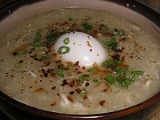
Rice congee

Encyclopedia
Congee is a type of rice
porridge
popular in many Asian countries. It can be eaten alone or served with a side dish. Names for congee are as varied as the style of its preparation. Despite its many variations, it is always a thick porridge or soup of rice which has usually disintegrated after prolonged cooking in copious water.
To prepare the dish, rice is boiled in large amounts of water until it softens significantly. Congee can be made in a pot or in a rice cooker
. Some rice cookers have a "congee" setting, allowing it to be cooked overnight. The rice used can either be sticky or regular depending on the country's common practice. Culture also often dictates the way congee is cooked and eaten.
In other Asian cultures, it is also called kanji (Tamil
/Malayalam/Tulu
), ganji (Kannada/Telugu
), juk (Cantonese
, Korean
), cháo (Vietnamese
), chok (Thai
), kayu (Japanese
), lúgaw (Filipino
), or jaou (Bengali
) which is derived directly from the Chinese character zhou (粥, which means gruel in Mandarin). Zhou is also called xifan in some Chinese provinces.
In some cultures, congee is eaten primarily as a breakfast food or late supper; in others, it is eaten as a substitute for rice at other meals. It is often considered particularly suitable for the sick as a mild, easily digestible food.
, congee, known as konji jaou or kanji jaou (which comes directly from the Chinese character zhōu or gruel), along with panta bhat
, is popular throughout the whole country, more so in rural areas than urban. It is made by repeatedly boiling rice in large quantities of water. The result is a thick white broth. Its consistency and colour are dictated by the water-to-rice ratio (which can be from 5:1 to 13:1) and the various types of rice used. Glutinous rice
is often used in Sylhet
and Khulna
, which makes the broth quite distinct from other types in the country. In some parts of the country, it is smoked while cooking, giving it a unique aroma. It is usually served for breakfast with lime
, salt, chilli and fried shallot. On its own, it is fed to the unwell as it is believed to be beneficial to the digestive system.
, rice congee (babaw) is widely eaten for breakfast. Plain congee is typically eaten with salted eggs, pickled vegetables, or dried fish. Chicken congee, pig's blood congee, and seafood congee are also commonly eaten.
congees . For example, to make Cantonese
congee, white rice
is boiled
in many times its weight of water
for a long time until the rice breaks down and becomes a fairly thick, white porridge (Pinyin
: báizhōu). Congees made in other regions may use different types of rice with different quantities of water, producing congees of different consistencies.
Congee is often eaten with zhacai, salted duck egg
s, lettuce
and dace (Cirrhinus chinensis
) paste, bamboo shoot
s, youtiao, rousong
, pickled tofu
, wheat gluten
, with other condiment
s, meat or century egg
s.
Other seasonings, such as white pepper
and soy sauce
, may be added. Grilled fish may be mixed in to provide a different texture.
Congee is often eaten with fried bread sticks known as youtiao. Congee with youtiao is commonly eaten as breakfast in many areas in China. Congee can be left watery, or can be drained so it has a texture similar to Western oatmeal porridge. Congee can also be made from brown rice
, although this is less common and takes longer to cook.
Besides being an everyday meal, congee is considered to be food therapy
for the unwell. Ingredients can be determined by their supposed therapeutic value as well as flavor.
The origin of congee is unknown, but from many historical accounts, it was usually served during times of famine, or when numerous patrons visited the temples, as a way to stretch the rice supply to feed more people.
In China, congee has also been used to feed young infants. However, the cooking time is much longer than for okayu and, because it is for infants, the congee is not seasoned with salt or any other flavoring. Often it is mixed with steamed and deboned fish.
Congee made from other grains, such as cornmeal, millet, barley, and sorghum, are common in the north of China where rice does not grow as well as other grains suited for a colder climate. Multigrain congee mixes are sold in the health food sections of Chinese supermarkets. Congee with mung beans is usually eaten with sugar, like red bean congee.
, a plain rice porridge, or the thick supernatant water from overcooked rice, is known as kanji. The people of Kerala
also call this preparation of rice in a watery state kanji, and it is eaten as a porridge with green lentils or chutney. Kanji is prepared with rice or ragi. Nuts and spices are added to the kanji depending on the economic status or health requirements. Rice kanji is prepared by boiling rice in large amounts of water. To this preparation either milk and sugar/jaggery or curd(youghurt) and salt are depending. Ragi kanji is prepared by drying raji sprouts in shade, and then grinding them into a smooth powder. This powder is added to water and cooked. Milk and brown sugar is added to this cooked preparation for taste. Ragi kanji can be given to infants after 6 months. There is another kanji preparation - jevvarisi (sago in English) (sabudana in Hindi) kanji. Sago is dry roasted and powdered with/ without sugar. Powdered sago is boiled in water until cooked. This is eaten by adults and infants of 3 months.
According to Madhur Jeffery is well-known British writer "kanji" is, or is derived from, a Tamil word for "boilings", referring to the porridge and also to any water in which rice has been cooked.
In the Goa
, Udupi and Mangalore
districts, people usually eat rice ganji in a variant manner made by Kannada-speaking, Tulu
-speaking or Konkani people
in and around Udupi and Mangalore (Karnataka
, South India
). Here, parboiled rice (kocheel akki in Kannada, oorpel aari black rice bulenta aari white rice in Tulu or ukadey tandool in Konkani) is steamed with a large amount of water. Jain ganji matt are famous in these districts. Usually simple ganji with pickle and milk are served, in Jain matts. Fresh coconut is grated, and the resulting milk skimmed and added to the ganji (called pej in Konkani), which is served hot with fish curry, coconut chutney
, or Indian pickle
s. In Goa, it is normally served with dried or fresh cooked fish, papad or vegetables.
In the state of Andhra Pradesh
, it is called ganji in Telugu
and mostly eaten by the very poor.
“Kanji”. Kanji is an authentic and traditional Oriya dish. People in Orissa like it because of its unique taste. It is a soup based dish like Dal but tastes little sour. This is a very healthy dish as lots of vegetables and curd are used as main ingredients.
, congee, called bubur, is a favourite breakfast food, and many food vendors pass through the streets at dawn, calling "bubur" to sell it to householders. A popular version is bubur ayam, which is congee with shredded chicken meat. It is also served with many condiments, such as green onion, crispy fried shallot, fried soybean, Chinese crullers (youtiao, known as cakwe in Indonesia), both salty and sweet soy sauce, and sometimes it is topped with yellow chicken broth and kerupuk (Indonesian style crackers). Unlike many other Indonesian dishes, it is not spicy; sambal or chili paste is served separately.
The food hawkers sometimes have sate to go with it, made from quail egg or chicken intestine, liver, gizzard, or heart.
In another region of Indonesia, Manado
, it is very popular with Tinutuan
or bubur Manado (Manadonese porridge), another porridge with ample vegetables. A bit different from the one sold in Java Island, it is made from rice porridge and enhanced with water spinach or kangkung, corn kernels, yam or sweet potato, dried salty fish, lemon basil or kemangi leaves, and melinjo or gnetum gnemon leaves.
Sago
flour is made into porridge in eastern Indonesian, as the staple food of Maluku
and Papuan people. The sago congee is called papeda
, and usually is eaten with yellow soup made from tuna
or mubara fish spiced with turmeric and lime.
, which is considerably thicker than congee produced in other cultures. For example, a Cantonese-style
congee typically uses a water-to-rice ratio of 12:1, but okayu typically uses ratios of 5:1 (zen-gayu) or 7:1 (shichibu-gayu). Also, its cooking time is shorter than other types of congee: okayu is cooked for about 30 minutes, while Cantonese congees cook for an hour or more.
Okayu may be made with just rice and water, and is often seasoned with salt. Beaten eggs
could be beaten into it to thicken it into gruel. Toppings may be added to enhance flavour; negi (a type of green onion), salmon
, roe
, ginger
, and umeboshi
(pickled ume
fruit) are among the most common. Miso
or chicken
stock may be used to flavor the broth. Most Japanese electric rice cookers have a setting for okayu.
In Japan, okayu is popularly known as a food served to the ill. Because it is soft and easily digestible, okayu is the first solid food served to Japanese infants; it is used to help with the transition from liquids to the thicker rice dishes which constitute much of the Japanese diet. It is also commonly eaten by the elderly for the same reasons.
A type of okayu called nanakusa-gayu
is traditionally eaten on 7 January with special herbs that some believe protect against evils and invite good luck and longevity in the new year. As a simple, light dish, nanakusagayu serves as a break from the many heavy dishes eaten over the Japanese New Year
.
is a similar dish, which uses already cooked rice, rather than cooking the rice in the soup.
죽 (tɕuk) derived from the Chinese language in which juk [jook] means the same thing. There are more than forty varieties of juk mentioned in old documents. Depending on the ingredients and consistency, juk can be considered as a food for recuperation (much like chicken soup in modern American culture), a delicacy, or food during famine and war.
The most general form of juk is simply called heen juk (흰죽, white juk), which is made from plain white rice. Other varieties include different ingredients, such as milk, vegetables, seafood, nuts and other grains. Being largely unflavored, it is served with a number of more flavorful side dishes, such as jeotgal
, various types of kimchi
, pickled cuttlefish
, spicy octopus, and other side dishes.
Notable varieties include jatjuk
made from finely-ground pine nuts, jeonbokjuk
made with abalones, yulmujuk made from Job's tears
, and patjuk made from red beans.
Juk is considered the ideal choice of food for babies, the ill or elderly as it is easily eaten and digested. It is sold commercially by many chain stores in South Korea
, and is a common takeout dish.
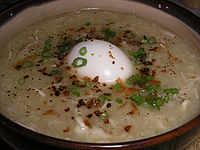
 Lúgaw (alternately spelled lugao or lugau) is the Filipino
name for congee. Otherwise similar to Cantonese-style congee, lúgaw is typically thicker, retaining the shape of the rice, but with a similar texture. It is boiled with strips of fresh ginger
. Other flavors may be added according to taste. Most often it is topped with scallion
s and served with crispy fried garlic
. As with Japanese okayu, fish
or chicken stock may be used to flavor the broth. Lúgaw can also be served with tokwa't baboy
(diced tofu
and pork
), goto (beef tripe), utak (brain [of pig]), dilâ (tongue [of pig]), litid ([beef] ligaments), and with calamansi, patís
, and soy sauce
. It is often served to the ill and the elderly, and is favoured among Filipino
s living abroad in colder climates because it is warm, soft, and easily digestible.
Some provinces prefer the Spanish
-influenced arroz caldo (literally "rice broth"), which is often thought to be a European dish because of its name. Arroz caldo is actually a Chinese congee that was adapted to the tastes of the Spanish colonial settlers who patronised Chinese restaurants in the Philippines.
Arroz caldo is usually spiced with safflower
and black pepper
in place of or in addition to the more traditional ginger and scallion. Arroz caldo more closely resembles risotto
than congee, from which it can be distinguished by its bright yellow saffron
colour and the relatively larger pieces of chicken meat
. Arroz caldo is more popular among people of Ilokano
heritage, although those of other provinces, such as Cebu
, often eat it with the addition of prawns, olive oil
, bay leaf
, and Chinese sausage
.
, a traditional soup made of rice and chicken meat is named canja. The rice is not cooked for as long as in Asian congee, so it is very soft, but not disintegrated. Traditionally, a boiling fowl containing small, immature eggs is used; the eggs are carefully boiled and served in the canja. This soup is sometimes served with a fresh mint
leaf on top. Canja is traditionally given to people recovering from disease, as in Asia, and is strongly valued as comfort food. In some regions of Portugal, there is even an ancient custom of feeding the mother a strict diet of canja in the first weeks after childbirth. It is also eaten traditionally in Brasil and Cabo Verde, formerly Portuguese colonies.
, rice congee is known as kola kanda in Sinhalese, and tends to have various local indigenous herbs and plants mixed in with it. It is traditionally eaten for breakfast, and consists of rice, water and local herbs (gotu kola). It is also eaten by Sri Lankan Muslims
for iftar
during Ramadan
. It is also occasionally made with oats. Tamil
s and Muslim
s in Sri Lanka call it aarisi kanji (rice kanji) and use chicken or beef for it. It is sometimes made with milk (paal kanji), and there are many other combinations with appropriate prefixes in Tamil.
Chinese languages), is often served as breakfast with a raw or partially-cooked egg added. Minced pork or beef and chopped spring onions are usually added, and the dish is optionally topped with a small version of youtiao (called pathongko in Thai), fried garlic, slivered ginger, and spicy pickles such as pickled radish. Although it is more popular as a breakfast dish, many stores specializing in congee sell it throughout the day. Variations in the meat and toppings are also frequently found. It is especially popular during Thailand's cool season.
Plain rice congee, known as khao tom kui in Thailand, is often eaten at specialized restaurants which serve a multitude of side dishes to go with it such as yam kun chiang (a Thai salad made with sliced dried Chinese sausages), mu phalo (pork stewed in soy sauce and five-spice powder
), and mu nam liap (minced pork fried with chopped Chinese olives).
leaves or Asian green beans. In its simplest form (plain rice porridge) it is a food for times of famine and hardship, when rice is not abundant. Or, as is especially common among Buddhist monks, nuns and lay people, it can be a simple breakfast food eaten with pickled vegetables or fermented tofu
. Despite its humble ubiquity among the poor, it is also popular as a main entrée when cooked with a variety of meats. For example, cháo gà is a variety of cháo cooked with chicken, garlic, and ginger. The rice porridge is cooked in the broth in which a whole chicken had been boiled, and once the chicken is cooked, the meat is sliced and layered on a bed of shredded, uncooked cabbage, sliced onions, and drizzled with a vinegar-based sauce, to be eaten as a side dish to the porridge. Other combinations include cháo vịt (duck porridge), which is cooked in the same fashion as the chicken porridge, but with duck. Cháo lòng heo is made with lòng heo (a variety of pork entrails, including sliced cakes of congealed pork blood). It is also common to eat cháo during an illness, as it is believed the porridge is easy to digest while being fortifying. For such purposes, the cháo is sometimes cooked with roasted white rice, giving the porridge broth a more nuanced body and a subtle, nutty flavor. On a related note, in some parts of Vietnam, local customs call for making cháo for death anniversary ceremonies, during which it is offered to fortify the spirits of the dead. (This tradition, however, is not widely practiced and seems to contradict the general principle of providing only the best food for one's ancestors.)
Rice
Rice is the seed of the monocot plants Oryza sativa or Oryza glaberrima . As a cereal grain, it is the most important staple food for a large part of the world's human population, especially in East Asia, Southeast Asia, South Asia, the Middle East, and the West Indies...
porridge
Porridge
Porridge is a dish made by boiling oats or other cereal meals in water, milk, or both. It is usually served hot in a bowl or dish...
popular in many Asian countries. It can be eaten alone or served with a side dish. Names for congee are as varied as the style of its preparation. Despite its many variations, it is always a thick porridge or soup of rice which has usually disintegrated after prolonged cooking in copious water.
To prepare the dish, rice is boiled in large amounts of water until it softens significantly. Congee can be made in a pot or in a rice cooker
Rice cooker
A rice cooker or rice steamer is a container or kitchen appliance dedicated to cooking rice. Rice can also be cooked in general-purpose saucepans.-Overview:...
. Some rice cookers have a "congee" setting, allowing it to be cooked overnight. The rice used can either be sticky or regular depending on the country's common practice. Culture also often dictates the way congee is cooked and eaten.
In other Asian cultures, it is also called kanji (Tamil
Tamil language
Tamil is a Dravidian language spoken predominantly by Tamil people of the Indian subcontinent. It has official status in the Indian state of Tamil Nadu and in the Indian union territory of Pondicherry. Tamil is also an official language of Sri Lanka and Singapore...
/Malayalam/Tulu
Tulu language
The Tulu language |?]]]) is a Dravidian language spoken by 1.95 million native speakers mainly in the southwest part of Indian state Karnataka known as Tulu Nadu. In India, 1.72 million people speak it as their mother tongue , increased by 10 percent over the 1991 census...
), ganji (Kannada/Telugu
Telugu language
Telugu is a Central Dravidian language primarily spoken in the state of Andhra Pradesh, India, where it is an official language. It is also spoken in the neighbouring states of Chattisgarh, Karnataka, Maharashtra, Orissa and Tamil Nadu...
), juk (Cantonese
Cantonese
Cantonese is a dialect spoken primarily in south China.Cantonese may also refer to:* Yue Chinese, the Chinese language that includes Cantonese* Cantonese cuisine, the cuisine of Guangdong province...
, Korean
Korean language
Korean is the official language of the country Korea, in both South and North. It is also one of the two official languages in the Yanbian Korean Autonomous Prefecture in People's Republic of China. There are about 78 million Korean speakers worldwide. In the 15th century, a national writing...
), cháo (Vietnamese
Vietnamese language
Vietnamese is the national and official language of Vietnam. It is the mother tongue of 86% of Vietnam's population, and of about three million overseas Vietnamese. It is also spoken as a second language by many ethnic minorities of Vietnam...
), chok (Thai
Thai language
Thai , also known as Central Thai and Siamese, is the national and official language of Thailand and the native language of the Thai people, Thailand's dominant ethnic group. Thai is a member of the Tai group of the Tai–Kadai language family. Historical linguists have been unable to definitively...
), kayu (Japanese
Japanese language
is a language spoken by over 130 million people in Japan and in Japanese emigrant communities. It is a member of the Japonic language family, which has a number of proposed relationships with other languages, none of which has gained wide acceptance among historical linguists .Japanese is an...
), lúgaw (Filipino
Filipino language
This move has drawn much criticism from other regional groups.In 1987, a new constitution introduced many provisions for the language.Article XIV, Section 6, omits any mention of Tagalog as the basis for Filipino, and states that:...
), or jaou (Bengali
Bengali language
Bengali or Bangla is an eastern Indo-Aryan language. It is native to the region of eastern South Asia known as Bengal, which comprises present day Bangladesh, the Indian state of West Bengal, and parts of the Indian states of Tripura and Assam. It is written with the Bengali script...
) which is derived directly from the Chinese character zhou (粥, which means gruel in Mandarin). Zhou is also called xifan in some Chinese provinces.
In some cultures, congee is eaten primarily as a breakfast food or late supper; in others, it is eaten as a substitute for rice at other meals. It is often considered particularly suitable for the sick as a mild, easily digestible food.
Bangladesh
In BangladeshBangladesh
Bangladesh , officially the People's Republic of Bangladesh is a sovereign state located in South Asia. It is bordered by India on all sides except for a small border with Burma to the far southeast and by the Bay of Bengal to the south...
, congee, known as konji jaou or kanji jaou (which comes directly from the Chinese character zhōu or gruel), along with panta bhat
Panta bhat
Panta bhat is a lightly fermented rice-based dish consumed in Assam, Bangladesh and West Bengal. Panta means "soaked in water" and bhat means "boiled rice". This dish of leftover rice soaked in water to prevent spoiling, is generally served with salt, onion and chili.It is especially popular in...
, is popular throughout the whole country, more so in rural areas than urban. It is made by repeatedly boiling rice in large quantities of water. The result is a thick white broth. Its consistency and colour are dictated by the water-to-rice ratio (which can be from 5:1 to 13:1) and the various types of rice used. Glutinous rice
Glutinous rice
Glutinous rice is a type of short-grained Asian rice that is especially sticky when cooked. It is called glutinous Glutinous rice (Oryza sativa var. glutinosa or Oryza glutinosa; also called sticky rice, sweet rice, waxy rice, botan rice, biroin chal, mochi rice, and pearl rice, and pulut) is a...
is often used in Sylhet
Sylhet
Sylhet , is a major city in north-eastern Bangladesh. It is the main city of Sylhet Division and Sylhet District, and was granted metropolitan city status in March 2009. Sylhet is located on the banks of the Surma Valley and is surrounded by the Jaintia, Khasi and Tripura hills...
and Khulna
Khulna
Khulna is the third largest city in Bangladesh. It is located on the banks of the Rupsha and Bhairab rivers in Khulna District. It is the divisional headquarters of Khulna Division and a major industrial and commercial center. It has a seaport named Mongla on its outskirts, 38 km from Khulna...
, which makes the broth quite distinct from other types in the country. In some parts of the country, it is smoked while cooking, giving it a unique aroma. It is usually served for breakfast with lime
Lime (fruit)
Lime is a term referring to a number of different citrus fruits, both species and hybrids, which are typically round, green to yellow in color, 3–6 cm in diameter, and containing sour and acidic pulp. Limes are a good source of vitamin C. Limes are often used to accent the flavors of foods and...
, salt, chilli and fried shallot. On its own, it is fed to the unwell as it is believed to be beneficial to the digestive system.
Burma
In Burma, rice congee is called san byohk: literally "rice boiled". It is very thin and plain, often made with just rice and water, but sometimes with chicken or pork stock and served with a simple garnish of chopped spring onions and crispy fried onions. As in other Asian countries, san byohk is considered lu ma mar zar ("food for the unwell").Cambodia
In CambodiaCambodia
Cambodia , officially known as the Kingdom of Cambodia, is a country located in the southern portion of the Indochina Peninsula in Southeast Asia...
, rice congee (babaw) is widely eaten for breakfast. Plain congee is typically eaten with salted eggs, pickled vegetables, or dried fish. Chicken congee, pig's blood congee, and seafood congee are also commonly eaten.
China
There are many regional variations of ChineseChinese cuisine
Chinese cuisine is any of several styles originating in the regions of China, some of which have become highly popular in other parts of the world – from Asia to the Americas, Australia, Western Europe and Southern Africa...
congees . For example, to make Cantonese
Cantonese cuisine
Cantonese cuisine comes from Guangdong Province in southern China and is one of 8 superdivisions of Chinese cuisine. Its prominence outside China is due to the great numbers of early emigrants from Guangdong. Cantonese chefs are highly sought after throughout the country...
congee, white rice
Rice
Rice is the seed of the monocot plants Oryza sativa or Oryza glaberrima . As a cereal grain, it is the most important staple food for a large part of the world's human population, especially in East Asia, Southeast Asia, South Asia, the Middle East, and the West Indies...
is boiled
Boiling
Boiling is the rapid vaporization of a liquid, which occurs when a liquid is heated to its boiling point, the temperature at which the vapor pressure of the liquid is equal to the pressure exerted on the liquid by the surrounding environmental pressure. While below the boiling point a liquid...
in many times its weight of water
Water
Water is a chemical substance with the chemical formula H2O. A water molecule contains one oxygen and two hydrogen atoms connected by covalent bonds. Water is a liquid at ambient conditions, but it often co-exists on Earth with its solid state, ice, and gaseous state . Water also exists in a...
for a long time until the rice breaks down and becomes a fairly thick, white porridge (Pinyin
Pinyin
Pinyin is the official system to transcribe Chinese characters into the Roman alphabet in China, Malaysia, Singapore and Taiwan. It is also often used to teach Mandarin Chinese and spell Chinese names in foreign publications and used as an input method to enter Chinese characters into...
: báizhōu). Congees made in other regions may use different types of rice with different quantities of water, producing congees of different consistencies.
Congee is often eaten with zhacai, salted duck egg
Salted duck egg
A salted duck egg is a Chinese preserved food product made by soaking duck eggs in brine, or packing each egg in damp, salted charcoal. In Asian supermarkets, these eggs are sometimes sold covered in a thick layer of salted charcoal paste. The eggs may also be sold with the salted paste removed,...
s, lettuce
Lettuce
Lettuce is a temperate annual or biennial plant of the daisy family Asteraceae. It is most often grown as a leaf vegetable. It is eaten either raw, notably in salads, sandwiches, hamburgers, tacos, and many other dishes, or cooked, as in Chinese cuisine in which the stem becomes just as important...
and dace (Cirrhinus chinensis
Chinese Mud Carp
Chinese mud carp is a species of ray-finned fish in the genus Cirrhinus.-Description:Chinese mud carp are mainly distributed in Pearl River, Min River in People's Republic of China and Red River in Vietnam....
) paste, bamboo shoot
Bamboo shoot
Bamboo shoots or bamboo sprouts are the edible shoots of many bamboo species including Bambusa vulgaris and Phyllostachys edulis. They are used in numerous Asian dishes and broths...
s, youtiao, rousong
Rousong
Rousong , also sometimes called meat wool, meat floss, pork floss, pork sung, is a dried meat product that has a light and fluffy texture similar to coarse cotton, originating from Fujian. Rousong is used as a topping for many foods such as congee, tofu, and savory soy milk. It is also used as...
, pickled tofu
Pickled tofu
Fermented bean curd also called sufu, fermented tofu, tofu cheese, or preserved tofu is a form of processed, preserved tofu used in East Asian cuisine as a condiment made from soybeans...
, wheat gluten
Wheat gluten (food)
Wheat gluten, also called seitan , wheat meat, mock duck, gluten meat, or simply gluten, is a food made from the gluten of wheat...
, with other condiment
Condiment
A condiment is an edible substance, such as sauce or seasoning, added to food to impart a particular flavor, enhance its flavor, or in some cultures, to complement the dish. Many condiments are available packaged in single-serving sachets , like mustard or ketchup, particularly when supplied with...
s, meat or century egg
Century egg
Century egg or pidan , also known as preserved egg, hundred-year egg, thousand-year egg, thousand-year-old egg, and millennium egg, is a Chinese cuisine ingredient made by preserving duck, chicken or quail eggs in a mixture of clay, ash, salt, lime, and rice hulls for several weeks to several...
s.
Other seasonings, such as white pepper
Black pepper
Black pepper is a flowering vine in the family Piperaceae, cultivated for its fruit, which is usually dried and used as a spice and seasoning. The fruit, known as a peppercorn when dried, is approximately in diameter, dark red when fully mature, and, like all drupes, contains a single seed...
and soy sauce
Soy sauce
Soy sauce is a condiment produced by fermenting soybeans with Aspergillus oryzae or Aspergillus sojae molds, along with water and salt...
, may be added. Grilled fish may be mixed in to provide a different texture.
Congee is often eaten with fried bread sticks known as youtiao. Congee with youtiao is commonly eaten as breakfast in many areas in China. Congee can be left watery, or can be drained so it has a texture similar to Western oatmeal porridge. Congee can also be made from brown rice
Brown rice
Brown rice is unmilled or partly milled rice, a kind of whole, natural grain. It has a mild nutty flavor, is chewier and more nutritious than white rice, but goes rancid more quickly because the germ—which is removed to make white rice—contains fats that can spoil...
, although this is less common and takes longer to cook.
Besides being an everyday meal, congee is considered to be food therapy
Chinese food therapy
Chinese food therapy is a practice in the belief of healing through the use of natural foods instead of medications.Chinese food or Nutrition therapy, is a modality of traditional Chinese medicine, as opposed to evidence-based medicine....
for the unwell. Ingredients can be determined by their supposed therapeutic value as well as flavor.
The origin of congee is unknown, but from many historical accounts, it was usually served during times of famine, or when numerous patrons visited the temples, as a way to stretch the rice supply to feed more people.
In China, congee has also been used to feed young infants. However, the cooking time is much longer than for okayu and, because it is for infants, the congee is not seasoned with salt or any other flavoring. Often it is mixed with steamed and deboned fish.
Congee made from other grains, such as cornmeal, millet, barley, and sorghum, are common in the north of China where rice does not grow as well as other grains suited for a colder climate. Multigrain congee mixes are sold in the health food sections of Chinese supermarkets. Congee with mung beans is usually eaten with sugar, like red bean congee.
India
In Tamil NaduTamil Nadu
Tamil Nadu is one of the 28 states of India. Its capital and largest city is Chennai. Tamil Nadu lies in the southernmost part of the Indian Peninsula and is bordered by the union territory of Pondicherry, and the states of Kerala, Karnataka, and Andhra Pradesh...
, a plain rice porridge, or the thick supernatant water from overcooked rice, is known as kanji. The people of Kerala
Kerala
or Keralam is an Indian state located on the Malabar coast of south-west India. It was created on 1 November 1956 by the States Reorganisation Act by combining various Malayalam speaking regions....
also call this preparation of rice in a watery state kanji, and it is eaten as a porridge with green lentils or chutney. Kanji is prepared with rice or ragi. Nuts and spices are added to the kanji depending on the economic status or health requirements. Rice kanji is prepared by boiling rice in large amounts of water. To this preparation either milk and sugar/jaggery or curd(youghurt) and salt are depending. Ragi kanji is prepared by drying raji sprouts in shade, and then grinding them into a smooth powder. This powder is added to water and cooked. Milk and brown sugar is added to this cooked preparation for taste. Ragi kanji can be given to infants after 6 months. There is another kanji preparation - jevvarisi (sago in English) (sabudana in Hindi) kanji. Sago is dry roasted and powdered with/ without sugar. Powdered sago is boiled in water until cooked. This is eaten by adults and infants of 3 months.
According to Madhur Jeffery is well-known British writer "kanji" is, or is derived from, a Tamil word for "boilings", referring to the porridge and also to any water in which rice has been cooked.
In the Goa
Goa
Goa , a former Portuguese colony, is India's smallest state by area and the fourth smallest by population. Located in South West India in the region known as the Konkan, it is bounded by the state of Maharashtra to the north, and by Karnataka to the east and south, while the Arabian Sea forms its...
, Udupi and Mangalore
Mangalore
Mangalore is the chief port city of the Indian state of Karnataka. It is located about west of the state capital, Bangalore. Mangalore lies between the Arabian Sea and the Western Ghat mountain ranges, and is the administrative headquarters of the Dakshina Kannada district in south western...
districts, people usually eat rice ganji in a variant manner made by Kannada-speaking, Tulu
Tulu language
The Tulu language |?]]]) is a Dravidian language spoken by 1.95 million native speakers mainly in the southwest part of Indian state Karnataka known as Tulu Nadu. In India, 1.72 million people speak it as their mother tongue , increased by 10 percent over the 1991 census...
-speaking or Konkani people
Konkani people
Konkani people , form a group of people mainly found in the Konkan Coast of western India whose mother-tongue is the Konkani language....
in and around Udupi and Mangalore (Karnataka
Karnataka
Karnataka , the land of the Kannadigas, is a state in South West India. It was created on 1 November 1956, with the passing of the States Reorganisation Act and this day is annually celebrated as Karnataka Rajyotsava...
, South India
South India
South India is the area encompassing India's states of Andhra Pradesh, Karnataka, Kerala and Tamil Nadu as well as the union territories of Lakshadweep and Pondicherry, occupying 19.31% of India's area...
). Here, parboiled rice (kocheel akki in Kannada, oorpel aari black rice bulenta aari white rice in Tulu or ukadey tandool in Konkani) is steamed with a large amount of water. Jain ganji matt are famous in these districts. Usually simple ganji with pickle and milk are served, in Jain matts. Fresh coconut is grated, and the resulting milk skimmed and added to the ganji (called pej in Konkani), which is served hot with fish curry, coconut chutney
Chutney
Chutney is a a condiment used in South Asian cuisine that usually contains a spice and vegetable mix.Chutneys are wet or dry, having a coarse to fine texture. The Anglo-Indian loan word refers to fresh and pickled preparations indiscriminately, with preserves often sweetened. At least several...
, or Indian pickle
Indian pickle
Indian pickles are made from certain individual varieties of vegetables and fruits that are chopped into small pieces and cooked in edible oils like sesame oil or brine with many different Indian spices like asafetida, red chili powder, turmeric, fenugreek and plenty of salt. Some regions also...
s. In Goa, it is normally served with dried or fresh cooked fish, papad or vegetables.
In the state of Andhra Pradesh
Andhra Pradesh
Andhra Pradesh , is one of the 28 states of India, situated on the southeastern coast of India. It is India's fourth largest state by area and fifth largest by population. Its capital and largest city by population is Hyderabad.The total GDP of Andhra Pradesh is $100 billion and is ranked third...
, it is called ganji in Telugu
Telugu language
Telugu is a Central Dravidian language primarily spoken in the state of Andhra Pradesh, India, where it is an official language. It is also spoken in the neighbouring states of Chattisgarh, Karnataka, Maharashtra, Orissa and Tamil Nadu...
and mostly eaten by the very poor.
“Kanji”. Kanji is an authentic and traditional Oriya dish. People in Orissa like it because of its unique taste. It is a soup based dish like Dal but tastes little sour. This is a very healthy dish as lots of vegetables and curd are used as main ingredients.
Indonesia
In IndonesiaIndonesian language
Indonesian is the official language of Indonesia. Indonesian is a normative form of the Riau Islands dialect of Malay, an Austronesian language which has been used as a lingua franca in the Indonesian archipelago for centuries....
, congee, called bubur, is a favourite breakfast food, and many food vendors pass through the streets at dawn, calling "bubur" to sell it to householders. A popular version is bubur ayam, which is congee with shredded chicken meat. It is also served with many condiments, such as green onion, crispy fried shallot, fried soybean, Chinese crullers (youtiao, known as cakwe in Indonesia), both salty and sweet soy sauce, and sometimes it is topped with yellow chicken broth and kerupuk (Indonesian style crackers). Unlike many other Indonesian dishes, it is not spicy; sambal or chili paste is served separately.
The food hawkers sometimes have sate to go with it, made from quail egg or chicken intestine, liver, gizzard, or heart.
In another region of Indonesia, Manado
Manado
Manado is the capital of the North Sulawesi province of Indonesia. Manado is located at the Bay of Manado, and is surrounded by a mountainous area. The city has about 405,715 inhabitants, making it the second-largest city in Sulawesi after Makassar...
, it is very popular with Tinutuan
Tinutuan
Tinutuan or bubur manado or manadonese porridge is a rice porridge mixed with various vegetables such as spinach, kangkung, corn, pumpkin and sweet potato or cassava....
or bubur Manado (Manadonese porridge), another porridge with ample vegetables. A bit different from the one sold in Java Island, it is made from rice porridge and enhanced with water spinach or kangkung, corn kernels, yam or sweet potato, dried salty fish, lemon basil or kemangi leaves, and melinjo or gnetum gnemon leaves.
Sago
Sago
Sago is a starch extracted in the spongy center or pith, of various tropical palm stems, Metroxylon sagu. It is a major staple food for the lowland peoples of New Guinea and the Moluccas, where it is called saksak and sagu. A type of flour, called sago flour, is made from sago. The largest supply...
flour is made into porridge in eastern Indonesian, as the staple food of Maluku
Maluku Islands
The Maluku Islands are an archipelago that is part of Indonesia, and part of the larger Maritime Southeast Asia region. Tectonically they are located on the Halmahera Plate within the Molucca Sea Collision Zone...
and Papuan people. The sago congee is called papeda
Papeda (food)
Papeda or bubur sagu, is sago congee, the staple food of native people in Maluku and Papua. It is commonly found in eastern Indonesia, as the counterpart of central and western Indonesian cuisines that favour rice as their staple food....
, and usually is eaten with yellow soup made from tuna
Tuna
Tuna is a salt water fish from the family Scombridae, mostly in the genus Thunnus. Tuna are fast swimmers, and some species are capable of speeds of . Unlike most fish, which have white flesh, the muscle tissue of tuna ranges from pink to dark red. The red coloration derives from myoglobin, an...
or mubara fish spiced with turmeric and lime.
Japan
is the name for the type of congee eaten in JapanJapan
Japan is an island nation in East Asia. Located in the Pacific Ocean, it lies to the east of the Sea of Japan, China, North Korea, South Korea and Russia, stretching from the Sea of Okhotsk in the north to the East China Sea and Taiwan in the south...
, which is considerably thicker than congee produced in other cultures. For example, a Cantonese-style
Cantonese cuisine
Cantonese cuisine comes from Guangdong Province in southern China and is one of 8 superdivisions of Chinese cuisine. Its prominence outside China is due to the great numbers of early emigrants from Guangdong. Cantonese chefs are highly sought after throughout the country...
congee typically uses a water-to-rice ratio of 12:1, but okayu typically uses ratios of 5:1 (zen-gayu) or 7:1 (shichibu-gayu). Also, its cooking time is shorter than other types of congee: okayu is cooked for about 30 minutes, while Cantonese congees cook for an hour or more.
Okayu may be made with just rice and water, and is often seasoned with salt. Beaten eggs
Egg (food)
Eggs are laid by females of many different species, including birds, reptiles, amphibians, and fish, and have probably been eaten by mankind for millennia. Bird and reptile eggs consist of a protective eggshell, albumen , and vitellus , contained within various thin membranes...
could be beaten into it to thicken it into gruel. Toppings may be added to enhance flavour; negi (a type of green onion), salmon
Salmon
Salmon is the common name for several species of fish in the family Salmonidae. Several other fish in the same family are called trout; the difference is often said to be that salmon migrate and trout are resident, but this distinction does not strictly hold true...
, roe
Roe
Roe or hard roe is the fully ripe internal egg masses in the ovaries, or the released external egg masses of fish and certain marine animals, such as shrimp, scallop and sea urchins...
, ginger
Ginger
Ginger is the rhizome of the plant Zingiber officinale, consumed as a delicacy, medicine, or spice. It lends its name to its genus and family . Other notable members of this plant family are turmeric, cardamom, and galangal....
, and umeboshi
Umeboshi
Umeboshi are pickled ume fruits common in Japan. Ume is a species of fruit-bearing tree in the genus Prunus, which is often called a plum but is actually more closely related to the apricot. Umeboshi are a popular kind of tsukemono and are extremely sour and salty...
(pickled ume
Ume
Prunus mume, with the common names including Chinese plum and Japanese apricot, is an Asian tree species classified in the Armeniaca section of the genus Prunus. The flower, long a beloved subject in the traditional painting of East Asia, is usually translated as plum blossom. This distinct tree...
fruit) are among the most common. Miso
Miso
is a traditional Japanese seasoning produced by fermenting rice, barley and/or soybeans, with salt and the fungus , the most typical miso being made with soy. The result is a thick paste used for sauces and spreads, pickling vegetables or meats, and mixing with dashi soup stock to serve as miso...
or chicken
Chicken
The chicken is a domesticated fowl, a subspecies of the Red Junglefowl. As one of the most common and widespread domestic animals, and with a population of more than 24 billion in 2003, there are more chickens in the world than any other species of bird...
stock may be used to flavor the broth. Most Japanese electric rice cookers have a setting for okayu.
In Japan, okayu is popularly known as a food served to the ill. Because it is soft and easily digestible, okayu is the first solid food served to Japanese infants; it is used to help with the transition from liquids to the thicker rice dishes which constitute much of the Japanese diet. It is also commonly eaten by the elderly for the same reasons.
A type of okayu called nanakusa-gayu
Nanakusa-no-sekku
The Festival of Seven Herbs, or Nanakusa no sekku , is the long-standing Japanese custom of eating seven-herb rice porridge on January 7 .The nanakusa are seven edible wild herbs of spring...
is traditionally eaten on 7 January with special herbs that some believe protect against evils and invite good luck and longevity in the new year. As a simple, light dish, nanakusagayu serves as a break from the many heavy dishes eaten over the Japanese New Year
Japanese New Year
The is one of the most important annual festivals, with its own unique customs, and has been celebrated for centuries. Due to the importance of the holiday and the preparations required, the preceding days are quite busy, particularly the day before, known as Ōmisoka.The Japanese New Year has been...
.
is a similar dish, which uses already cooked rice, rather than cooking the rice in the soup.
Korea
In Korea, the dish goes by the name jukJuk (food)
Juk is a predominantly Korean porridge made of grains such as cooked rice, beans, sesame, and azuki beans. It is also a common food in other Eastern Asian countries under different names...
죽 (tɕuk) derived from the Chinese language in which juk [jook] means the same thing. There are more than forty varieties of juk mentioned in old documents. Depending on the ingredients and consistency, juk can be considered as a food for recuperation (much like chicken soup in modern American culture), a delicacy, or food during famine and war.
The most general form of juk is simply called heen juk (흰죽, white juk), which is made from plain white rice. Other varieties include different ingredients, such as milk, vegetables, seafood, nuts and other grains. Being largely unflavored, it is served with a number of more flavorful side dishes, such as jeotgal
Jeotgal
Jeotgal or jeot is a salted fermented food in Korean cuisine. It is made with various seafood, such as shrimp, oysters, shellfish, fish, fish eggs, and fish intestines....
, various types of kimchi
Kimchi
Kimchi , also spelled gimchi, kimchee, or kim chee, is a traditional fermented Korean dish made of vegetables with varied seasonings. There are hundreds of varieties of kimchi made with a main vegetable ingredient such as napa cabbage, radish, green onions or cucumber. It is the most common...
, pickled cuttlefish
Cuttlefish
Cuttlefish are marine animals of the order Sepiida. They belong to the class Cephalopoda . Despite their name, cuttlefish are not fish but molluscs....
, spicy octopus, and other side dishes.
Notable varieties include jatjuk
Jatjuk
Jatjuk or jaht jook is a variety of juk , or Korean porridge, made by boiling finely ground pine nuts and rice flour or soaked rice in water. It is seasoned with salt and garnished with pine nuts and sliced jujubes. The dish has been regarded as a quality food in Korea because of its rich and...
made from finely-ground pine nuts, jeonbokjuk
Jeonbokjuk
Jeonbokjuk is a variety of juk , or Korean porridge, made with abalone and white rice. Abalone is regarded as a high quality ingredient in Korean cuisine and was often presented as a gift to the king of Korea.The dish is a local specialty of Jeju Island where abalones are commonly harvested...
made with abalones, yulmujuk made from Job's tears
Job's Tears
Job's Tears , Coixseed, Tear Grass, adlay, or adlai, is a tall grain-bearing tropical plant of the family Poaceae native to Southeast Asia but elsewhere cultivated in gardens as an annual. It has been naturalized in the southern United States and the New World tropics...
, and patjuk made from red beans.
Juk is considered the ideal choice of food for babies, the ill or elderly as it is easily eaten and digested. It is sold commercially by many chain stores in South Korea
South Korea
The Republic of Korea , , is a sovereign state in East Asia, located on the southern portion of the Korean Peninsula. It is neighbored by the People's Republic of China to the west, Japan to the east, North Korea to the north, and the East China Sea and Republic of China to the south...
, and is a common takeout dish.
Philippines
Filipino language
This move has drawn much criticism from other regional groups.In 1987, a new constitution introduced many provisions for the language.Article XIV, Section 6, omits any mention of Tagalog as the basis for Filipino, and states that:...
name for congee. Otherwise similar to Cantonese-style congee, lúgaw is typically thicker, retaining the shape of the rice, but with a similar texture. It is boiled with strips of fresh ginger
Ginger
Ginger is the rhizome of the plant Zingiber officinale, consumed as a delicacy, medicine, or spice. It lends its name to its genus and family . Other notable members of this plant family are turmeric, cardamom, and galangal....
. Other flavors may be added according to taste. Most often it is topped with scallion
Scallion
Scallions , are the edible plants of various Allium species, all of which are "onion-like", having hollow green leaves and lacking a fully developed root bulb.-Etymology:The words...
s and served with crispy fried garlic
Garlic
Allium sativum, commonly known as garlic, is a species in the onion genus, Allium. Its close relatives include the onion, shallot, leek, chive, and rakkyo. Dating back over 6,000 years, garlic is native to central Asia, and has long been a staple in the Mediterranean region, as well as a frequent...
. As with Japanese okayu, fish
Fish
Fish are a paraphyletic group of organisms that consist of all gill-bearing aquatic vertebrate animals that lack limbs with digits. Included in this definition are the living hagfish, lampreys, and cartilaginous and bony fish, as well as various extinct related groups...
or chicken stock may be used to flavor the broth. Lúgaw can also be served with tokwa't baboy
Tokwa at baboy
Tokwa at Baboy or Tokwa't Baboy ' is a typical Filipino appetizer dish. It usually includes pork ears, pork belly and deep-fried tofu, and is dipped in a mixture of soy sauce, pork broth, vinegar, chopped white onions, scallions, and red chili peppers.It is normally eaten with rice porridge as a...
(diced tofu
Tofu
is a food made by coagulating soy milk and then pressing the resulting curds into soft white blocks. It is part of East Asian and Southeast Asian cuisine such as Chinese, Japanese, Korean, Indonesian, Vietnamese, and others. There are many different varieties of tofu, including fresh tofu and tofu...
and pork
Pork
Pork is the culinary name for meat from the domestic pig , which is eaten in many countries. It is one of the most commonly consumed meats worldwide, with evidence of pig husbandry dating back to 5000 BC....
), goto (beef tripe), utak (brain [of pig]), dilâ (tongue [of pig]), litid ([beef] ligaments), and with calamansi, patís
Fish sauce
Fish sauce is a condiment that is derived from fish that have been allowed to ferment. It is an essential ingredient in many curries and sauces. Fish sauce is a staple ingredient in numerous cultures in Southeast Asia and the coastal regions of East Asia, and features heavily in Thai and Vietnamese...
, and soy sauce
Soy sauce
Soy sauce is a condiment produced by fermenting soybeans with Aspergillus oryzae or Aspergillus sojae molds, along with water and salt...
. It is often served to the ill and the elderly, and is favoured among Filipino
Filipino people
The Filipino people or Filipinos are an Austronesian ethnic group native to the islands of the Philippines. There are about 92 million Filipinos in the Philippines, and about 11 million living outside the Philippines ....
s living abroad in colder climates because it is warm, soft, and easily digestible.
Some provinces prefer the Spanish
Spain
Spain , officially the Kingdom of Spain languages]] under the European Charter for Regional or Minority Languages. In each of these, Spain's official name is as follows:;;;;;;), is a country and member state of the European Union located in southwestern Europe on the Iberian Peninsula...
-influenced arroz caldo (literally "rice broth"), which is often thought to be a European dish because of its name. Arroz caldo is actually a Chinese congee that was adapted to the tastes of the Spanish colonial settlers who patronised Chinese restaurants in the Philippines.
Arroz caldo is usually spiced with safflower
Safflower
Safflower is a highly branched, herbaceous, thistle-like annual. It is commercially cultivated for vegetable oil extracted from the seeds. Plants are 30 to 150 cm tall with globular flower heads having yellow, orange or red flowers. Each branch will usually have from one to five flower heads...
and black pepper
Black pepper
Black pepper is a flowering vine in the family Piperaceae, cultivated for its fruit, which is usually dried and used as a spice and seasoning. The fruit, known as a peppercorn when dried, is approximately in diameter, dark red when fully mature, and, like all drupes, contains a single seed...
in place of or in addition to the more traditional ginger and scallion. Arroz caldo more closely resembles risotto
Risotto
Risotto is a class of Italian dishes of rice cooked in broth to a creamy consistency. The broth may be meat-, fish-, or vegetable-based; many kinds include Parmesan cheese, butter, and onion...
than congee, from which it can be distinguished by its bright yellow saffron
Saffron
Saffron is a spice derived from the flower of Crocus sativus, commonly known as the saffron crocus. Crocus is a genus in the family Iridaceae. Each saffron crocus grows to and bears up to four flowers, each with three vivid crimson stigmas, which are each the distal end of a carpel...
colour and the relatively larger pieces of chicken meat
Chicken
The chicken is a domesticated fowl, a subspecies of the Red Junglefowl. As one of the most common and widespread domestic animals, and with a population of more than 24 billion in 2003, there are more chickens in the world than any other species of bird...
. Arroz caldo is more popular among people of Ilokano
Ilocano people
The Ilocano or Ilokano people are the third largest Filipino ethnolinguistic group. Aside from being referred to as Ilocanos, from "i"-from, and "looc"-bay, they also refer to themselves as Samtoy, from the Ilocano phrase "sao mi ditoy", meaning 'our language here.' The word "Ilocano" came from...
heritage, although those of other provinces, such as Cebu
Cebu
Cebu is a province in the Philippines, consisting of Cebu Island and 167 surrounding islands. It is located to the east of Negros, to the west of Leyte and Bohol islands...
, often eat it with the addition of prawns, olive oil
Olive oil
Olive oil is an oil obtained from the olive , a traditional tree crop of the Mediterranean Basin. It is commonly used in cooking, cosmetics, pharmaceuticals, and soaps and as a fuel for traditional oil lamps...
, bay leaf
Bay leaf
Bay leaf refers to the aromatic leaf of the bay laurel . Fresh or dried bay leaves are used in cooking for their distinctive flavor and fragrance. The leaves are often used to flavor soups, stews, braises and pâtés in Mediterranean cuisine...
, and Chinese sausage
Chinese sausage
Chinese sausage is a generic term referring to the many different types of sausages originating in China. It is commonly known by its Cantonese name "Lap Cheong" or "Lap Chong" .-Varieties:...
.
Portugal
In PortugalPortugal
Portugal , officially the Portuguese Republic is a country situated in southwestern Europe on the Iberian Peninsula. Portugal is the westernmost country of Europe, and is bordered by the Atlantic Ocean to the West and South and by Spain to the North and East. The Atlantic archipelagos of the...
, a traditional soup made of rice and chicken meat is named canja. The rice is not cooked for as long as in Asian congee, so it is very soft, but not disintegrated. Traditionally, a boiling fowl containing small, immature eggs is used; the eggs are carefully boiled and served in the canja. This soup is sometimes served with a fresh mint
Lamiaceae
The mints, taxonomically known as Lamiaceae or Labiatae, are a family of flowering plants. They have traditionally been considered closely related to Verbenaceae, but in the 1990s, phylogenetic studies suggested that many genera classified in Verbenaceae belong instead in Lamiaceae...
leaf on top. Canja is traditionally given to people recovering from disease, as in Asia, and is strongly valued as comfort food. In some regions of Portugal, there is even an ancient custom of feeding the mother a strict diet of canja in the first weeks after childbirth. It is also eaten traditionally in Brasil and Cabo Verde, formerly Portuguese colonies.
Sri Lanka
In Sri LankaSri Lanka
Sri Lanka, officially the Democratic Socialist Republic of Sri Lanka is a country off the southern coast of the Indian subcontinent. Known until 1972 as Ceylon , Sri Lanka is an island surrounded by the Indian Ocean, the Gulf of Mannar and the Palk Strait, and lies in the vicinity of India and the...
, rice congee is known as kola kanda in Sinhalese, and tends to have various local indigenous herbs and plants mixed in with it. It is traditionally eaten for breakfast, and consists of rice, water and local herbs (gotu kola). It is also eaten by Sri Lankan Muslims
Sri Lankan Moors
The Sri Lankan Moors are the third largest ethnic group in Sri Lanka comprising 8% of the country's total population . They are predominantly followers of Islam. The Moors trace their ancestry to Arab traders who settled in Sri Lanka some time between the 8th and 15th centuries...
for iftar
Iftar
Iftar , refers to the evening meal when Muslims break their fast during the Islamic month of Ramadan. Iftar is one of the religious observances of Ramadan and is often done as a community, with people gathering to break their fast together. Iftar is done right after Maghrib time...
during Ramadan
Ramadan
Ramadan is the ninth month of the Islamic calendar, which lasts 29 or 30 days. It is the Islamic month of fasting, in which participating Muslims refrain from eating, drinking, smoking and sex during daylight hours and is intended to teach Muslims about patience, spirituality, humility and...
. It is also occasionally made with oats. Tamil
Tamil people
Tamil people , also called Tamils or Tamilians, are an ethnic group native to Tamil Nadu, India and the north-eastern region of Sri Lanka. Historic and post 15th century emigrant communities are also found across the world, notably Malaysia, Singapore, Mauritius, South Africa, Australia, Canada,...
s and Muslim
Muslim
A Muslim, also spelled Moslem, is an adherent of Islam, a monotheistic, Abrahamic religion based on the Quran, which Muslims consider the verbatim word of God as revealed to prophet Muhammad. "Muslim" is the Arabic term for "submitter" .Muslims believe that God is one and incomparable...
s in Sri Lanka call it aarisi kanji (rice kanji) and use chicken or beef for it. It is sometimes made with milk (paal kanji), and there are many other combinations with appropriate prefixes in Tamil.
Taiwan
In Taiwan, congee is prepared in the same way as in Fujian Province, China, and consists of rice and water, with few other ingredients. Sweet potato is often added for taste, and eggs are sometimes beaten into it to thicken it to a gruel. As with most Chinese styles, congee is often served to the ill and those with difficulty chewing. A variety of side dishes are often served with congee as well.Thailand
In Thai cuisine, rice congee, known as chok ' onMouseout='HidePop("61517")' href="/topics/Min_Nan">Min nanMin Nan
The Southern Min languages, or Min Nan , are a family of Chinese languages spoken in southern Fujian, eastern Guangdong, Hainan, Taiwan, and southern Zhejiang provinces of China, and by descendants of emigrants from these areas in diaspora....
Chinese languages), is often served as breakfast with a raw or partially-cooked egg added. Minced pork or beef and chopped spring onions are usually added, and the dish is optionally topped with a small version of youtiao (called pathongko in Thai), fried garlic, slivered ginger, and spicy pickles such as pickled radish. Although it is more popular as a breakfast dish, many stores specializing in congee sell it throughout the day. Variations in the meat and toppings are also frequently found. It is especially popular during Thailand's cool season.
Plain rice congee, known as khao tom kui in Thailand, is often eaten at specialized restaurants which serve a multitude of side dishes to go with it such as yam kun chiang (a Thai salad made with sliced dried Chinese sausages), mu phalo (pork stewed in soy sauce and five-spice powder
Five-spice powder
Five-spice powder is a mixture of five spices endemic to Chinese cuisine, but also used in other Asian cookery as well.-Formulae:The formulae are based on the Chinese philosophy of balancing the yin and yang in food. There are many variants. The most common is bajiao , cloves, cinnamon, huajiao ...
), and mu nam liap (minced pork fried with chopped Chinese olives).
Vietnam
In Vietnam, rice congee, called cháo, is sometimes cooked with pandanPandanus amaryllifolius
Pandanus amaryllifolius is a tropical plant in the screwpine genus which is known commonly as pandan and is used widely in Southeast Asian cooking as a flavoring. The plant is rare in the wild but is widely cultivated. It is an upright green plant with fan-shaped sprays of long, narrow, bladelike...
leaves or Asian green beans. In its simplest form (plain rice porridge) it is a food for times of famine and hardship, when rice is not abundant. Or, as is especially common among Buddhist monks, nuns and lay people, it can be a simple breakfast food eaten with pickled vegetables or fermented tofu
Tofu
is a food made by coagulating soy milk and then pressing the resulting curds into soft white blocks. It is part of East Asian and Southeast Asian cuisine such as Chinese, Japanese, Korean, Indonesian, Vietnamese, and others. There are many different varieties of tofu, including fresh tofu and tofu...
. Despite its humble ubiquity among the poor, it is also popular as a main entrée when cooked with a variety of meats. For example, cháo gà is a variety of cháo cooked with chicken, garlic, and ginger. The rice porridge is cooked in the broth in which a whole chicken had been boiled, and once the chicken is cooked, the meat is sliced and layered on a bed of shredded, uncooked cabbage, sliced onions, and drizzled with a vinegar-based sauce, to be eaten as a side dish to the porridge. Other combinations include cháo vịt (duck porridge), which is cooked in the same fashion as the chicken porridge, but with duck. Cháo lòng heo is made with lòng heo (a variety of pork entrails, including sliced cakes of congealed pork blood). It is also common to eat cháo during an illness, as it is believed the porridge is easy to digest while being fortifying. For such purposes, the cháo is sometimes cooked with roasted white rice, giving the porridge broth a more nuanced body and a subtle, nutty flavor. On a related note, in some parts of Vietnam, local customs call for making cháo for death anniversary ceremonies, during which it is offered to fortify the spirits of the dead. (This tradition, however, is not widely practiced and seems to contradict the general principle of providing only the best food for one's ancestors.)
See also
- Bengali cuisineBengali cuisineBengali cuisine is a culinary style originating in Bengal, a region in the eastern South Asia which is now divided between the Indian state of West Bengal and the independent country of Bangladesh. Other regions, such as Tripura, and Barak Valley region of Assam also have large native Bengali...
- Filipino cuisine
- GruelGruelGruel is a food preparation consisting of some type of cereal—oat, wheat or rye flour, or rice—boiled in water or milk. It is a thinner version of porridge that may be more often drunk than eaten and need not even be cooked...
- Japanese cuisineJapanese cuisineJapanese cuisine has developed over the centuries as a result of many political and social changes throughout Japan. The cuisine eventually changed with the advent of the Medieval age which ushered in a shedding of elitism with the age of shogun rule...
- Red bean soup
- Rice puddingRice puddingRice pudding is a dish made from rice mixed with water or milk and sometimes other ingredients such as cinnamon and raisins. Different variants are used for either desserts or dinners. When used as a dessert, it is commonly combined with a sweetener such as sugar.-Rice pudding around the world:Rice...
- Sago puddingSago puddingSago pudding is a sweet pudding made by boiling sago with either water or milk and adding sugar and sometimes additional flavourings. It is made in many cultures with varying styles, and may be produced in a variety of ways....
- Tamil cuisineTamil cuisineTamil Nadu is famous for its hospitality and its deep belief that serving food to others is a service to humanity, as is common in many regions of India. The region has a rich cuisine involving both traditional vegetarian, as well as non-vegetarian dishes. It is characterized by the use of rice,...
- Tapioca puddingTapioca puddingTapioca pudding is a sweet pudding made with tapioca and either milk, or for lactose intolerant individuals, coconut milk. Coconut milk is also used in cases in which the flavor is preferred or in areas in which it is a commonplace ingredient for cooking...
- Thayir sadamThayir sadamCurd rice also called yogurt rice is a dish of India. The word "curd" as used in India usually refers to a liquidy, sour, unsweetened yoghurt. It is most popular in the Indian states of Karnataka, Kerala, Andhra Pradesh, and Tamil Nadu...
- Udupi cuisineUdupi cuisineUdupi cuisine is a world-renowned cuisine of South India. It forms an important part of the Cuisine of Karnataka and takes its name from Udupi, a town on the southwest coast of India in the state of Karnataka. The Udupi cuisine has its origin in the Ashta mathas of Udupi founded by...