
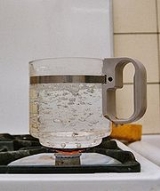
Boiling is the rapid
vaporizationVaporization of an element or compound is a phase transition from the liquid or solid phase to gas phase. There are three types of vaporization: evaporation, boiling and sublimation....
of a
liquidLiquid is one of the three classical states of matter . Like a gas, a liquid is able to flow and take the shape of a container. Some liquids resist compression, while others can be compressed. Unlike a gas, a liquid does not disperse to fill every space of a container, and maintains a fairly...
, which occurs when a liquid is heated to its
boiling pointThe boiling point of an element or a substance is the temperature at which the vapor pressure of the liquid equals the environmental pressure surrounding the liquid....
, the
temperatureTemperature is a physical property of matter that quantitatively expresses the common notions of hot and cold. Objects of low temperature are cold, while various degrees of higher temperatures are referred to as warm or hot...
at which the
vapor pressureVapor pressure or equilibrium vapor pressure is the pressure of a vapor in thermodynamic equilibrium with its condensed phases in a closed system. All liquids have a tendency to evaporate, and some solids can sublimate into a gaseous form...
of the liquid is equal to the pressure exerted on the liquid by the surrounding environmental pressure. While below the boiling point a liquid evaporates from its surface, at the boiling point vapor bubbles come from the bulk of the liquid. For this to be possible, the vapor pressure must be sufficiently high to win the atmospheric pressure, so that the bubbles can be "inflated". Thus, the difference between evaporation and boiling is "mechanical", rather than thermodynamical. The boiling point is lowered when the pressure of the surrounding atmosphere is reduced, for example by the use of a
vacuum pumpA vacuum pump is a device that removes gas molecules from a sealed volume in order to leave behind a partial vacuum. The first vacuum pump was invented in 1650 by Otto von Guericke.- Types :Pumps can be broadly categorized according to three techniques:...
or at high altitudes. Boiling occurs in three characteristic stages, which are
nucleate,
transition and
film boiling. These stages generally take place from low to high heating surface temperatures, respectively.
Boiling stages
Nucleate boiling
Nucleate boilingNucleate boiling is a type of boiling that takes place when the surface temperature is hotter than the saturated fluid temperature by a certain amount but where the heat flux is below the critical heat flux. For water, as shown in the graph below, nucleate boiling occurs when the surface...
is characterized by the growth of bubbles or pops on a heated surface, which rise from discrete points on a surface, whose temperature is only slightly above the liquid’s. In general, the number of
nucleationNucleation is the extremely localized budding of a distinct thermodynamic phase. Some examples of phases that may form by way of nucleation in liquids are gaseous bubbles, crystals or glassy regions. Creation of liquid droplets in saturated vapor is also characterized by nucleation...
sites are increased by an increasing surface temperature.
An irregular surface of the boiling vessel (i.e. increased surface roughness) can create additional nucleation sites, while an exceptionally smooth surface, such as plastic, lends itself to
superheatingIn physics, superheating is the phenomenon in which a liquid is heated to a temperature higher than its boiling point, without boiling...
. Under these conditions, a heated liquid may show boiling delay and the temperature may go somewhat above the boiling point without boiling.
Transition boiling
Transition boiling may be defined as the unstable boiling, which occurs at surface temperatures between the maximum attainable in nucleate and the minimum attainable in film boiling.
The formation of
bubblesA bubble is a globule of one substance in another, usually gas in a liquid.Due to the Marangoni effect, bubbles may remain intact when they reach the surface of the immersive substance.-Common examples:...
in a heated liquid is a complex physical process which often involves
cavitationCavitation is the formation and then immediate implosion of cavities in a liquidi.e. small liquid-free zones that are the consequence of forces acting upon the liquid...
and acoustic effects, such as the broad-spectrum hiss one hears in a kettle not yet heated to the point where bubbles boil to the surface.
Film boiling
If a surface heating the liquid is significantly hotter than the liquid then film boiling will occur, where a thin layer of vapor, which has low
thermal conductivityIn physics, thermal conductivity, k, is the property of a material's ability to conduct heat. It appears primarily in Fourier's Law for heat conduction....
, insulates the surface. This condition of a vapor film insulating the surface from the liquid characterizes
film boiling.
Distillation
In
distillationDistillation is a method of separating mixtures based on differences in volatilities of components in a boiling liquid mixture. Distillation is a unit operation, or a physical separation process, and not a chemical reaction....
, boiling is used in separating mixtures. This is possible because the vapor rising from a boiling fluid generally has a ratio of components different from that in the liquid.
Boiling for water sterilization
Boiling can be used as a method of water disinfection but is only advocated as an emergency water treatment method, or as a method of portable water purification in rural or wilderness settings without access to a potable water infrastructure. Bringing water to the boil is effective in killing or inactivating most bacteria, viruses and pathogens. Boiling is the most certain way of killing all microorganisms. According to the Wilderness Medical Society , water temperatures above 160° F (70° C) kill all pathogens within 30 minutes and above 185° F (85° C) within a few minutes. So in the time it takes for the water to reach the boiling point (212° F or 100° C) from 160° F (70° C), all pathogens will be killed, even at high altitude. To be extra safe, let the water boil rapidly for one minute, especially at higher altitudes since water boils at a lower temperature.
There are 100 degrees between water freezing point and boiling point, thus the name Centigrade.
Boiling in cooking
In cooking,
boiling is the method of
cookingCooking is the process of preparing food by use of heat. Cooking techniques and ingredients vary widely across the world, reflecting unique environmental, economic, and cultural traditions. Cooks themselves also vary widely in skill and training...
food in boiling
waterWater is a chemical substance with the chemical formula H2O. A water molecule contains one oxygen and two hydrogen atoms connected by covalent bonds. Water is a liquid at ambient conditions, but it often co-exists on Earth with its solid state, ice, and gaseous state . Water also exists in a...
, or other water-based liquid such as
stockStock is a flavoured water preparation. It forms the basis of many dishes, particularly soups and sauces.- Preparation :Stock is made by simmering various ingredients in water, including some or all of the following...
or
milkMilk is a white liquid produced by the mammary glands of mammals. It is the primary source of nutrition for young mammals before they are able to digest other types of food. Early-lactation milk contains colostrum, which carries the mother's antibodies to the baby and can reduce the risk of many...
.
SimmeringSimmering is a food preparation technique in which foods are cooked in hot liquids kept at or just below the boiling point of water , but higher than poaching temperature...
is gentle boiling, while in
poachingPoaching is the process of gently simmering food in liquid, generally milk, stock or wine.-Utilization:Poaching is particularly suitable for delicate food, such as eggs, poultry, fish and fruit, which might easily fall apart or dry out...
the cooking liquid moves but scarcely bubbles.
Boiling is a very harsh technique of cooking. Delicate foods such as fish cannot be cooked in this fashion because the bubbles can damage the food. Foods such as red meat, chicken, and root vegetables can be cooked with this technique because of their tough texture.
The boiling point of water is typically considered to be 100 °C or 212 °F. Pressure and a change in composition of the liquid may alter the boiling point of the liquid. For this reason, high
elevationThe elevation of a geographic location is its height above a fixed reference point, most commonly a reference geoid, a mathematical model of the Earth's sea level as an equipotential gravitational surface ....
cooking generally takes longer since boiling point is a function of
atmospheric pressureAtmospheric pressure is the force per unit area exerted into a surface by the weight of air above that surface in the atmosphere of Earth . In most circumstances atmospheric pressure is closely approximated by the hydrostatic pressure caused by the weight of air above the measurement point...
. In
Denver, ColoradoThe City and County of Denver is the capital and the most populous city of the U.S. state of Colorado. Denver is a consolidated city-county, located in the South Platte River Valley on the western edge of the High Plains just east of the Front Range of the Rocky Mountains...
, which is at an elevation of about one mile, water boils at approximately 95 °C. Depending on the type of food and the elevation, the boiling water may not be hot enough to cook the food properly. Similarly, increasing the pressure as in a pressure cooker raises the temperature of the contents above the open air boiling point.
Adding a water
solubleSolubility is the property of a solid, liquid, or gaseous chemical substance called solute to dissolve in a solid, liquid, or gaseous solvent to form a homogeneous solution of the solute in the solvent. The solubility of a substance fundamentally depends on the used solvent as well as on...
substance, such as
saltIn chemistry, salts are ionic compounds that result from the neutralization reaction of an acid and a base. They are composed of cations and anions so that the product is electrically neutral...
or
sugarSugar is a class of edible crystalline carbohydrates, mainly sucrose, lactose, and fructose, characterized by a sweet flavor.Sucrose in its refined form primarily comes from sugar cane and sugar beet...
also increases the boiling point. This is called
boiling-point elevationBoiling-point elevation describes the phenomenon that the boiling point of a liquid will be higher when another compound is added, meaning that a solution has a higher boiling point than a pure solvent. This happens whenever a non-volatile solute, such as a salt, is added to a pure solvent, such...
. However, the effect is very small, and the boiling point will be increased by an insignificant amount. Due to variations in composition and pressure, the boiling point of water is almost never exactly 100 °C, but rather close enough for cooking.
Bringing water to a boil is generally done by applying maximal heat, then shutting off when the water has come to a boil, which is known as bang–bang control. Keeping water at or below a boil requires more careful control of temperature, particularly by using
feedbackFeedback describes the situation when output from an event or phenomenon in the past will influence an occurrence or occurrences of the same Feedback describes the situation when output from (or information about the result of) an event or phenomenon in the past will influence an occurrence or...
.
In places where the available
water supplyWater supply is the provision of water by public utilities, commercial organisations, community endeavours or by individuals, usually via a system of pumps and pipes...
is contaminated with disease-causing
bacteriaBacteria are a large domain of prokaryotic microorganisms. Typically a few micrometres in length, bacteria have a wide range of shapes, ranging from spheres to rods and spirals...
, boiling water and allowing it to cool before drinking it is practiced as a valuable health measure. Boiling is the most certain way of killing all microorganisms in emergency situations.
Foods suitable for boiling include vegetables, starchy foods such as
riceRice is the seed of the monocot plants Oryza sativa or Oryza glaberrima . As a cereal grain, it is the most important staple food for a large part of the world's human population, especially in East Asia, Southeast Asia, South Asia, the Middle East, and the West Indies...
, noodles and potatoes, eggs, meats, sauces, stocks and soups.
Boiling has several advantages. It is safe and simple, and it is appropriate for large-scale cookery. Older, tougher, cheaper cuts of meat and poultry can be made digestible. Nutritious, well flavoured stock is produced. Also, maximum color and nutritive value is retained when cooking green vegetables, provided boiling time is kept to the minimum.
On the other hand, there are several disadvantages. There is a loss of soluble vitamins from foods to the water (if the water is discarded), and some boiled foods can look unattractive. Boiling can also be a slow method of cooking food.
Boiling can be done in several ways: The food can be placed into already rapidly boiling water and left to cook, the heat can be turned down and the food can be simmered; or the food can also be placed into the pot, and cold water may be added to the pot. This may then be boiled until the food is satisfactory.
Water on the outside of a pot, i.e. a wet pot, increases the time it takes the pot of water to boil. The pot will heat at a normal rate once all excess water on the outside of the pot evaporates.
Levels of boiling
In
Chinese cuisineChinese cuisine is any of several styles originating in the regions of China, some of which have become highly popular in other parts of the world – from Asia to the Americas, Australia, Western Europe and Southern Africa...
, particularly tea brewing, one distinguishes five stages of boiling: "
shrimp eyes, the first tiny bubbles that start to appear on the surface of the kettle water,
crab eyes, the secondary, larger bubbles, then
fish eyes, followed by
rope of pearls, and finally
raging torrent [
rolling boil]".
In detail:
shrimp eyes: about 70-80 °C (155–175 °F) – separate bubbles, rising to top
crab eyes: about 80 °C (175 °F) – streams of bubbles
fish eyes: about 80-90 °C (175–195 °F) – larger bubbles
rope of pearls: about 90-95 °C (195–205 °F) – steady streams of large bubbles
raging torrent: rolling boil, swirling and roiling
See also
- Nucleate boiling
Nucleate boiling is a type of boiling that takes place when the surface temperature is hotter than the saturated fluid temperature by a certain amount but where the heat flux is below the critical heat flux. For water, as shown in the graph below, nucleate boiling occurs when the surface...
- Phase diagram
A phase diagram in physical chemistry, engineering, mineralogy, and materials science is a type of chart used to show conditions at which thermodynamically distinct phases can occur at equilibrium...
- Phase transition
A phase transition is the transformation of a thermodynamic system from one phase or state of matter to another.A phase of a thermodynamic system and the states of matter have uniform physical properties....
- Boiling point
The boiling point of an element or a substance is the temperature at which the vapor pressure of the liquid equals the environmental pressure surrounding the liquid....