


Tulu language

Encyclopedia
The Tulu language (ˈt̪uɭu; Tulu: or or തുളു ബാസെ, , ˈt̪uɭu ˈbɒːsæ [?]) is a Dravidian
language spoken by 1.95 million native speakers (1997) mainly in the southwest part of India
n state Karnataka
known as Tulu Nadu
. In India, 1.72 million people speak it as their mother tongue (2001), increased by 10 percent over the 1991 census. According to one estimate reported in 2009, Tulu is currently spoken by three to five million native speakers in the world. The native speakers of Tulu are referred to as Tuluva
or Tulu people.
Separated early from Proto-South Dravidian
, Tulu has several features not found in Tamil–Kannada. For example, it has pluperfect and future perfect
, like French or Spanish, but formed without an auxiliary verb
. Robert Caldwell
in his pioneering work A Comparative Grammar of the Dravidian or South-Indian Family of Languages called this language “peculiar and very interesting”. According to him, “ is one of the most highly developed languages of the Dravidian family. It looks as if it had been cultivated for its own sake”.
The language has a lot of written literature, and also has a rich oral literature
such as the Siri Epic.
It is the primary spoken language in Tulu Nadu, a region which comprises the districts of Udupi
and Dakshina Kannada
in the west of the state of Karnataka
and Kasaragod taluk
of Kerala
. Apart from Tulu Nadu significant emigrant population of Tuluva people is found in Maharashtra
, Bangalore
and Gulf countries
. Non-native speakers like the Konkani
-speaking Mangalorean Catholics, Gowda Saraswath Brahmins and Daivajnas,as well as the Beary
people in Tulu Nadu are generally well-versed in the language. The language was originally written using the Tulu script
, which is an adaptation of Grantha script. From the beginning of the 20th century the original script was abandoned in favour of the Kannada script
.
. It descends directly from Proto Southern Dravidian which in turn descends directly from Proto-Dravidian
, the hypothesised mother language from which all Dravidian languages descend.
and parts of Northern Kerala
.
which was the capital of Tulu Nadu during the Vijayanagar
period. Another group of inscriptions are found in the Ullur Subrahmanya Temple near Kundapura
. Many linguists like S.U. Panniyadi and L.S.U.V. Ramaswamy Iyer as well as P.S. Subrahmanya suggested that Tulu is among the oldest languages in the Dravidian family which branched independently from its Proto-Dravidian roots nearly 2,000 years ago. This assertion is based on the fact that Tulu still preserves many aspects (if not all) of Proto Dravidian language. This dating of Tulu is also based on the fact that region where Tulu is natively spoken was known to the ancient tamils as Tulu Nadu and the Tamil
poet Mamular who belongs to the Sangam Age (200 AD) describes Tulu Nadu and its dancing beauties in one of his poems. In the Halmidi inscriptions one finds mention of the Tulu country as the kingdom of the Alupas
. The region was also known to the Greeks of the 2nd century as Tolokoyra. The history of Tulu would not be complete without the mention of the Charition mime
, a Greek
play belonging to 2nd century BC. The play's plot centres around the coastal Karnataka, where Tulu is mainly spoken. The play is mostly in Greek but the India
n characters in the play are seen speaking a language different from Greek. There is considerable ambiguity regarding the Indian language in the play, though all scholars agree the Indian language is Dravidian, but there is considerable dispute over which one. Noted German Indologist Dr. E. Hultzsch was the first to suggest about the language being Dravidian. The dispute regarding the language in the play is yet to be settled, but scholars agree that the dispute arises from the Fact that Old Kannada, Old Tamil And Tulu during the time when the play was written were perhaps dialectical variations of the Same Proto language and over the years they evolved into their present forms as separate languages.
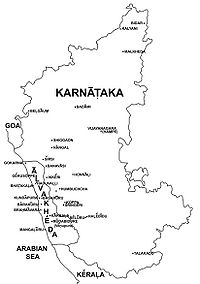 According to Malayalam works like Keralolpathi
and Sangam literature
in Tamil
, the region stretching from the Chandragiri river, now part of the Kasaragod district
of Kerala
, to Gokarna
, now part of Uttara Kannada
district of Karnataka, was ruled by the Alupas
and was known as Alva Kheda. This kingdom was the homeland of the Tulu speaking people. However the present day Tulu linguistic Majority areas is confined to the region of Tulu Nadu
which comprises the districts of Udupi
and Dakshina Kannada
in the Indian state of Karnataka
And the northern part of Kasaragod district
of Kerala up to the river Payaswani also known as Chandragiri.,. The cities of Mangalore
, Udupi and Kasaragod being the cultural centres of Tulu culture.
Tuluva
s have a saying: "Oorudu nanji aanda paarad badkodu". A loose translation would be: "If it's tough at home; run away and survive". Tuluvas are true to this character and have migrated to other places in great numbers. Early migration was to neighbouring regions like Malabar (now Kerala), Mysore kingdom, Madras Presidency ( Tamil Nadu now - areas like salem, attur, chinnasalem, thiruvannamalai, villupuram, vellore, chennai and perambalur). The large scale migration of Tulu speaking people from undivided South Canara
district to other provinces ( regions ) of India happened during World War I, but there is no concrete materialistic evidence to prove. The reason being rationing of food grains by British who where ruling India then and spread of communicable diseases. The next wave of emigration was during World War II, now they settled in interior parts of Karnataka, coastal Andhra Pradesh
and also to far off cities like Mumbai and Chennai. They mostly did business of running restaurants serving Udupi cuisine
. Mumbai
and Thane
in Maharastra state has a sizable population of Tuluva
s.
Even today Tulu is widely spoken in the Dakshina Kannada, Udupi district
of Karnataka state and Kasaragod of Kerala. Efforts are also being made to include Tulu in the list of Official languages of India
.
and contains 46 letters, 11 of which represent the vowels (A, AA, I, II, U, UU, VOCALIC R, E, AI, O), the other 35 represent the consonants. In addition to which there are three signs which represent Virama
, Anusvara
and Visarga
. Additionally, there are signs for all vowels. The numbers 0 to 9 are represented through separate characters. The script was derived from the Grantha
and bears partial similarity to Malayalam script
. Towards the end of the 20th century the practice of writing Tulu in Tulu script faced a decline and was gradually abandoned in favour of the Kannada script which is also an Abugida. This adoption of Kannada script for writing Tulu is mainly attributed to the German missionaries, who had established a printing press in Mangalore
which used the Kannada script. These very missionaries used to publish literature in both Kannada and Tulu. While producing Tulu literature which included a dictionary, short stories as well the Tulu translation of the bible they made use of the Kannada script. Another important factor that worked in favour of the Kannada script was that most Tulu speakers if not all were bilingual in Kannada. Thus the new era of Tulu literary renaissance began with the Kannada script and today the script is the de facto script for Tulu, though many Tulu linguists and Tulu literary personalities have voiced their opinion in favour of reviving the original script of the language.
The four dialects are as follows:
.
Like Kodava Takk
(and also like Konkani
and Sinhala), Tulu also has an [ɛ]- or [æ]-like vowel, generally occurring word-finally. Neither Kannada script
nor Tulu script
has a symbol to specifically represent this vowel, which is often written as a normal e. For example, the first person singular form and the third person singular masculine form of a verb are spelled identically in all tenses, both ending in e, but are pronounced differently: the terminating e in the former sounds nearly like ‘a’ in the English word ‘man’ ( /maɭpuvæ/, “I make”), while that in the latter like ‘e’ in ‘men’ ( /maɭpuve/, “he makes”). Paniyadi in his 1932 grammar used a special vowel sign to denote Tulu /ɛ/ in the Kannada script: according to Bhat, he used two s for this purpose (usually, a means the crest that a Kannada character like has), and the same convention was adopted by Upadhyaya in his 1988 Tulu Lexicon. The long counterpart of this vowel occurs in some words. In all dialects, the pair /e/ and /ɛ/ contrasts.
Additionally, like Kodava Takk
and Toda
, and especially like Malayalam
, Tulu has an [ɯ]-like vowel (or schwa
/ə/) as a phoneme
, which is romanized
as ŭ (ISO), , or . Both J. Brigel and A. Männer say that it is pronounced like e in the French je. If so, its phonetic value may be [œ]. However, if it is like Malayalam “half-u”, [ə] or [ɨ] may be a better description. Bhat describes this phoneme as . In the Kannada script, Brigel and Männer used a virama
(halant), , to denote this vowel. Bhat says a is used for this purpose, but apparently he too means a virama.
The following are consonant phonemes in Tulu:
The contrast between /l/ and /ɭ/ is preserved in the South Common dialect and in the Brahmin dialect, but is lost in several dialects. Additionally, the Brahmin dialect has /ʂ/ and /ɦ/. Aspirated consonants are sometimes used in the Brahmin dialect, but are not phonemic. In the Koraga and Holeya dialects, s /s/ and ś /ʃ/ merge with c /t͡ʃ/ (the Koraga dialect of the Tulu language is different from the Koraga language).
Word-initial consonant clusters are rare and occur mainly in Sanskrit loanwords.
: noun
s (substantives and adjective
s), pronoun
s, numerals, verb
s, and particle
s.
Substantives have three grammatical gender
s (masculine, feminine, and neuter), two numbers
(singular and plural), and eight cases
(nominative, genitive, dative, accusative, locative, ablative or instrumental, communicative, and vocative). According to Bhat, Tulu has two distinct locative cases. The communicative case is used with verbs like “tell”, “speak”, “ask”, “beseech”, “inquire”, and denotes at whom a message, an inquiry, or a request is aimed, as in “I told him.” or “I speak to them.” It is also used to denote relationship with whom it is about, in a context like “I am on good terms with him.” or “I have nothing against him.” Bhat calls it the sociative case
. It is somewhat similar to the comitative case
, but different in that it denotes communication or relationship, not physical companionship. The plural suffix is , , , or ; as, mēji (“table”), (“tables”). The nominative case is unmarked, while the remaining cases are expressed by different suffixes.
The following table shows the declension of a noun, based on Brigel and Bhat ( used by Brigel and used by Bhat are both shown as ŭ for clarity): when two forms are given, the one in parentheses is by Bhat, and the other is by Brigel. Some of these differences may be dialectal variations.
The personal pronouns are irregularly inflected: “I” becomes yen- in oblique case
s. Tulu makes the distinction between the inclusive
and exclusive “we” (See Clusivity: Dravidian languages): nama “we (including you)” as opposed to “we (not including you)”. For verbs, this distinction does not exist. The personal pronouns of the second person are (oblique: nin-) “you (singular)” and “you (plural)”. Three genders are distinguished in the third person, as well as proximate and remote forms. For example, imbe “he (proximate)”, āye “he (remote)”. The suffix makes a polite form of personal pronouns, as in īrŭ “you (respectfully)”, ārŭ “he (remote; respectfully)”.
Postpositions are used usually with a noun in the genitive case, as in “on the hill”.
Tulu verbs have three forms: active
, causative
, and reflexive
(or middle voice).
They conjugate
for person
, number, gender, tense
(present, past, pluperfect, future, and future perfect
), mood (indicative, imperative, conditional, infinitive, potential, and subjunctive), and polarity
(positive and negative).
, Tamil
, Kannada and Malayalam. The earliest available Tulu literature that survives to this date is the Tulu Translation of the great Sanskrit
epic of Mahabharata
called Tulu Mahabharato. It was written by Arunabja, a poet who lived in Kodavur near Udupi around late 14th to early 15th century AD.
The other important literary works in Tulu are as follows
Until the middle of the 19th century, “a modification of the Malayalam alphabet” was used to write Tulu. More specifically, up to about 1600 the Tulu and Malayalam alphabets were identical, and hardly differed from the Tulu hand in the 19th century. This script was used to write Sanskrit, and had seldom, if ever, been applied to write the vernacular language. According to Ethnologue (2009), philosophical texts and religious verses are sometimes written in this script. The Kannada script, on the other hand, was introduced by the Basel Mission Press. Even Today the official script of The eight Tulu monasteries(Ashta Mathas of Udupi
) founded by Madhvacharya
in Udupi is that of Tulu. The pontiff of the monasteries write their names using this script when they are appointed.
Modern day Tulu literature is written using the Kannada script. Mandara Ramayana is the most notable piece of modern Tulu literature. Written by mandara keshava bhatt, it was awarded with the Sahitya Academy award for best poetry. Madipu,Mogaveera,Saphala and Samparka are popular Tulu periodicals published from mangalore.
Tulu Sahitya Academy established by the state government of Karnataka, India in 1994 as also the Kerala Tulu academy established by the Indian State Government of Kerala in Manjeshwaram
in the year 2007 are important Governmental organisations that promote Tulu literature. Nevertheless there are numerous organisations spread all over the world with significant Tulu migrated populations that contribute to Tulu literature. Some notable contributors of Tulu literature are Kayyar Kinhanna Rai, Amruta Someshwara, B. A. Viveka Rai, Kedambadi Jattappa Rai, Venkataraja Puninchattaya, Paltadi Ramakrishna Achar Dr. Sunitha M. Shetty, Dr. Vamana Nandavara, Sri. Balakrishna Shetty Polali.
The following are various forms of Tulu oral tradition and literature.
The longest of them being Siri Paddana, which is about a woman called Siri who shows strength and integrity during adverse times and in turn attains divinity. The paddana greatly depicts the independent nature of the Tulu womenfolk. The entire paddana was written down by Finnish scholar Lauri Honko
of Turku University
and it falls four lines short of Homer
's Iliad
, the world's longest poem.
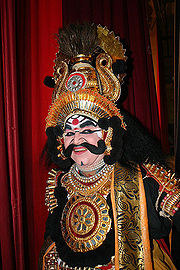 Theatre in form of the Traditional Yakshagana
, prevalent in coastal Karnataka and northern kerala has greatly preserved the finer aspects of the Tulu language. Yakshagana which is conducted in Tulu is pretty popular among the Tuluva people. It can also been seen as a form of temple art, as there are many yakshagana groups that are attached to temples namely that of
Kateel Durga Parameshwari Temple
as also the Udupi Krishna Temple
. At present eight professional Yakshagana troupes perform only Tulu Yakshagana not only during the Yakshagana season but also during the off season in various places of Karnataka and outside. In Mumbai
Tulu Yakshagana is very popular among the Tulu people there. More than 2000 Yakshagana artists take part in the performance in various places in Mumbai annually. Notable performers of Tulu yakshagana include Kalladi Koraga Shetty Pundur Venkatraja Puninchathaya, Guru Bannanje Sanjiva Suvarna and Pathala Venkatramana Bhat. Tulu plays are one among the major entertainment for admirers of art and culture originating and flourishing in the Tulu Nadu
. Tulu plays are generally centered on the comic genre are very popular in Mumbai
and Bangalore
outside Tulu Nadu
Tulu Film industry is pretty small; it produces 2 to 3 films annually. The first fim being Enna Thangadi released in 1971. Usually these films are released in theatres across the Tulu Nadu
region and on DVD. The critically acclaimed Tulu Film Suddha, won the award for the best Indian Film at the Osian
film festival held at New Delhi
in the year 2006. Oriyardori Asal
released in 2011 is the most successful Tulu film till date.
as a language continues to thrive in coastal Karnataka
and Kasaragod
in Kerala
. Tulu Sahitya Academy, an institute established by the state government of Karnataka has introduced Tulu as a language in schools around coastal Karnataka
, including Alva's High School, Moodbidri; Dattanjaneya High School, Odiyoor; Ramakunjeshwara English-medium High School, Ramakunja; and Vani Composite Pre-University College, Belthangady
. The Academy is awaiting government permission to add more schools. Tulu is also thought as a study language in post graduate level in Mangalore University
and there is also a dedicated department for Tulu studies, Translation and research at Dravidian University
in Kuppam
Andhra Pradesh
.The Government Degree College at Kasaragod in Kerala has also introduced a certificate course in Tulu from the academic year 2009-2010. It has introduced Tulu as an optional subject in its Kannada post-graduation course also. It has adopted syllabi from the books published by the Tulu Sahitya Academy.
German misionaries Rev Kammerer and Rev. Männer were the first two people who conducted research on the language. Rev Krammer collected about 3,000 words and their meaning until he died. Later his work was carried on by Rev. Männer, who completed the research and published the first dictionary of Tulu language in 1886 with the help of the then Madras government. The effort was incomplete as it did not cover all the aspects of the language.
The Govinda Pai Research Centre at MGM College, Udupi started an 18-year Tulu lexicon project in the year 1979. Different dialect
s, special vocabularies used for different occupational activities, rituals, and folk literature in the forms of Paād-danāas were included in this project. The Centre has also released a six-volume, trilingual, modestly priced Tulu
-Kannada-English
lexicon. The Tulu lexicon
was awarded the Gundert Award for the best dictionary
in the country in 1996.In September 2011 The Academic Council of Mangalore University accepted a proposal, according to which, the university and the colleges affiliated to it could offer certificate, diploma and postgraduate diploma courses in Tulu, both in regular and correspondence modes
It is not surprising that the Tulu speakers demand for the status of scheduled language. In India Tulu is one of the most-spoken non-scheduled languages after all; then, the general tendency is that if the speakers of the language are in a geographically contiguous place, they also seek a separate state, and then, seek the status of official language in the concerned state. The 44th report of the National Commissioner Linguistic Minorities, presented to the President in 2007, recognizes newly-born websites on the Internet for linguistic minorities, including www.boloji.com for Tulu, and according to their 41st report, Tulu Academy is fairly active. However, it is unclear how intense their demands for separation actually are. Since 2010 Tulu will be taught as a subject at the higher primary level of education in Coastal Karnataka.
Dravidian languages
The Dravidian language family includes approximately 85 genetically related languages, spoken by about 217 million people. They are mainly spoken in southern India and parts of eastern and central India as well as in northeastern Sri Lanka, Pakistan, Nepal, Bangladesh, Afghanistan, Iran, and...
language spoken by 1.95 million native speakers (1997) mainly in the southwest part of India
India
India , officially the Republic of India , is a country in South Asia. It is the seventh-largest country by geographical area, the second-most populous country with over 1.2 billion people, and the most populous democracy in the world...
n state Karnataka
Karnataka
Karnataka , the land of the Kannadigas, is a state in South West India. It was created on 1 November 1956, with the passing of the States Reorganisation Act and this day is annually celebrated as Karnataka Rajyotsava...
known as Tulu Nadu
Tulu Nadu
Tulu Nadu is a Tulu-speaking region spread over to parts of present Karnataka and Kerala States of India. It consists of the Dakshina Kannada and Udupi districts of Karnataka and the northern parts of the Kasaragod district of Kerala up to the Payaswini River...
. In India, 1.72 million people speak it as their mother tongue (2001), increased by 10 percent over the 1991 census. According to one estimate reported in 2009, Tulu is currently spoken by three to five million native speakers in the world. The native speakers of Tulu are referred to as Tuluva
Tuluva
The Tuluva -Geographic Distribution :Though most of the Tuluva population is found in the Tulu Nadu region, migrant poplulations are found the world over. In recent times, the first period of migration started at the beginning of the 20th century to places such as Mumbai and Chennai and other...
or Tulu people.
Separated early from Proto-South Dravidian
Proto-Dravidian
Proto-Dravidian is the proto-language of the Dravidian languages. It is thought to have differentiated into Proto-North Dravidian, Proto-Central Dravidian and Proto-South Dravidian around 500 BC, although some linguists have argued that the degree of differentiation between the sub-families points...
, Tulu has several features not found in Tamil–Kannada. For example, it has pluperfect and future perfect
Future Perfect
-Album Credits:*Produced by T-Bone Burnett*All Songs Written by Autolux*Engineered by Mike Piersante*Mixed by Dave Sardy*Mastered by Stephen Marcussen *Artwork by Carla Azar-Vinyl releases:...
, like French or Spanish, but formed without an auxiliary verb
Agglutination
In contemporary linguistics, agglutination usually refers to the kind of morphological derivation in which there is a one-to-one correspondence between affixes and syntactical categories. Languages that use agglutination widely are called agglutinative languages...
. Robert Caldwell
Robert Caldwell
Bishop Robert Caldwell was an Evangelist missionary and linguist, who academically established the Dravidian family of languages. He served as Assistant Bishop of Tirunelveli from 1877. He was described in The Hindu as a 'pioneering champion of the downtrodden' and an 'avant-garde social reformer'...
in his pioneering work A Comparative Grammar of the Dravidian or South-Indian Family of Languages called this language “peculiar and very interesting”. According to him, “ is one of the most highly developed languages of the Dravidian family. It looks as if it had been cultivated for its own sake”.
The language has a lot of written literature, and also has a rich oral literature
Oral literature
Oral literature corresponds in the sphere of the spoken word to literature as literature operates in the domain of the written word. It thus forms a generally more fundamental component of culture, but operates in many ways as one might expect literature to do...
such as the Siri Epic.
It is the primary spoken language in Tulu Nadu, a region which comprises the districts of Udupi
Udupi district
Udupi district , ಉಡುಪಿ ಜಿಲ್ಲೆ) in the Karnataka state of India was created in August 1997. The three northern taluks, Udupi, Kundapur and Karkal, were separated from Dakshina Kannada District to form Udupi district. Udupi district is surrounded by Uttara Kannada district in north, Dakshina Kannada...
and Dakshina Kannada
Dakshina Kannada
- Geography :The district geography consists of sea shore in the west and Western Ghats in the east. The major rivers are Netravathi, Kumaradhara, Phalguni, Shambhavi, Nandini or Pavanje and Payaswini which all join Arabian sea. Vast areas of evergreen forests which once covered this district, have...
in the west of the state of Karnataka
Karnataka
Karnataka , the land of the Kannadigas, is a state in South West India. It was created on 1 November 1956, with the passing of the States Reorganisation Act and this day is annually celebrated as Karnataka Rajyotsava...
and Kasaragod taluk
Kasaragod taluk
Kasaragod, is a taluk which along with Hosdurg taluk constitute the Kasaragod district, Kerala, India.- External links :* *...
of Kerala
Kerala
or Keralam is an Indian state located on the Malabar coast of south-west India. It was created on 1 November 1956 by the States Reorganisation Act by combining various Malayalam speaking regions....
. Apart from Tulu Nadu significant emigrant population of Tuluva people is found in Maharashtra
Maharashtra
Maharashtra is a state located in India. It is the second most populous after Uttar Pradesh and third largest state by area in India...
, Bangalore
Bangalore
Bengaluru , formerly called Bengaluru is the capital of the Indian state of Karnataka. Bangalore is nicknamed the Garden City and was once called a pensioner's paradise. Located on the Deccan Plateau in the south-eastern part of Karnataka, Bangalore is India's third most populous city and...
and Gulf countries
Arab states of the Persian Gulf
"Arab states of the Persian Gulf" or "Arab Persian Gulf states" or "Persian Gulf Arab states" or "Arabic Persian Gulf states" or "Arab States of The Gulf", are terms that refer to the six Arab states of Saudi Arabia, United Arab Emirates, Qatar, Kuwait, Bahrain and Oman, bordering the Persian Gulf....
. Non-native speakers like the Konkani
Konkani language
KonkaniKonkani is a name given to a group of several cognate dialects spoken along the narrow strip of land called Konkan, on the west coast of India. This is, however, somewhat an over-generalisation. Geographically, Konkan is defined roughly as the area between the river Damanganga to the north...
-speaking Mangalorean Catholics, Gowda Saraswath Brahmins and Daivajnas,as well as the Beary
Beary
The Beary is a small Muslim community concentrated mostly in coastal South Kanara , in the district of Karnataka, a south Indian state. It is an ethnic society, having its own unique traditions and distinct cultural identity...
people in Tulu Nadu are generally well-versed in the language. The language was originally written using the Tulu script
Tulu Script
The Tulu script The Tulu script The Tulu script (Tulu: —written in Tulu script, is the original script of the Tulu language. It evolved from the Grantha script. It bears partial similarity to the Malayalam script, which also evolved from the Grantha....
, which is an adaptation of Grantha script. From the beginning of the 20th century the original script was abandoned in favour of the Kannada script
Kannada script
The Kannada script is an alphasyllabary of the Brahmic family, used primarily to write the Kannada language, one of the Dravidian languages of southern India and also Sanskrit in the past. The Telugu script is derived from Old Kannada, and resembles Kannada script...
.
Classification
Tulu belongs to the southern branch of the family of Dravidian languagesDravidian languages
The Dravidian language family includes approximately 85 genetically related languages, spoken by about 217 million people. They are mainly spoken in southern India and parts of eastern and central India as well as in northeastern Sri Lanka, Pakistan, Nepal, Bangladesh, Afghanistan, Iran, and...
. It descends directly from Proto Southern Dravidian which in turn descends directly from Proto-Dravidian
Proto-Dravidian
Proto-Dravidian is the proto-language of the Dravidian languages. It is thought to have differentiated into Proto-North Dravidian, Proto-Central Dravidian and Proto-South Dravidian around 500 BC, although some linguists have argued that the degree of differentiation between the sub-families points...
, the hypothesised mother language from which all Dravidian languages descend.
Etymology
Linguists have suggested that the word Tulu means that which is connected with water. ‘Tuluve’ (jack fruit) means ‘watery’ in Tulu. The other water-related words in Tulu which mean water or moisture are talipu, teli, teLi, teLpu, tuLipu, tulavu, tamel and, in addition, in Kannada there are words such as tuLuku and toLe. In Tamil tuli means drop of water, and tulli means the same in Malayalam. Thus it is believed that the word Tulu implies ‘related to water’. Therefore Tulu means the language of the waters, as the traditional homeland of the Tulu-speaking people is the coastal region of modern KarnatakaKarnataka
Karnataka , the land of the Kannadigas, is a state in South West India. It was created on 1 November 1956, with the passing of the States Reorganisation Act and this day is annually celebrated as Karnataka Rajyotsava...
and parts of Northern Kerala
Kerala
or Keralam is an Indian state located on the Malabar coast of south-west India. It was created on 1 November 1956 by the States Reorganisation Act by combining various Malayalam speaking regions....
.
History
The oldest available inscriptions in Tulu are from the period between 14th to 15th century AD. These inscriptions are in the Tulu script and are found in areas in and around BarkurBarkur
Barkur is a cluster of 3 villages [Hosala, Hanehalli, Kachoor] in Udupi district of the Karnataka state in South India. The place is located on the bank of river Seeta.-History:...
which was the capital of Tulu Nadu during the Vijayanagar
Vijayanagara Empire
The Vijayanagara Empire , referred as the Kingdom of Bisnaga by the Portuguese, was an empire based in South Indian in the Deccan Plateau region. It was established in 1336 by Harihara I and his brother Bukka Raya I of the Yadava lineage. The empire rose to prominence as a culmination of attempts...
period. Another group of inscriptions are found in the Ullur Subrahmanya Temple near Kundapura
Kundapura
-Languages and culture :The town mainly consists of Kannadigas who speak Kundagannada, Konkanis and Tuluvas. The Goud Saraswat Brahmins who fled Goa during the Portuguese arrival in the 16th century arrived by Boat in Basrur and some settled in Kundapura and surrounding villages. These people and...
. Many linguists like S.U. Panniyadi and L.S.U.V. Ramaswamy Iyer as well as P.S. Subrahmanya suggested that Tulu is among the oldest languages in the Dravidian family which branched independently from its Proto-Dravidian roots nearly 2,000 years ago. This assertion is based on the fact that Tulu still preserves many aspects (if not all) of Proto Dravidian language. This dating of Tulu is also based on the fact that region where Tulu is natively spoken was known to the ancient tamils as Tulu Nadu and the Tamil
Tamil people
Tamil people , also called Tamils or Tamilians, are an ethnic group native to Tamil Nadu, India and the north-eastern region of Sri Lanka. Historic and post 15th century emigrant communities are also found across the world, notably Malaysia, Singapore, Mauritius, South Africa, Australia, Canada,...
poet Mamular who belongs to the Sangam Age (200 AD) describes Tulu Nadu and its dancing beauties in one of his poems. In the Halmidi inscriptions one finds mention of the Tulu country as the kingdom of the Alupas
Alupas
The Alupas kings were a minor dynasty who ruled parts of coastal Karnataka. Later with the dominance of Kadambas in Banavasi, they became feudatory to them. With the changing political scenario, soon they became the feudatories to Chalukyas, Hoysalas and Vijayanagara Rayas...
. The region was also known to the Greeks of the 2nd century as Tolokoyra. The history of Tulu would not be complete without the mention of the Charition mime
Charition mime
The Charition mime is a Greek mime found in Oxyrhynchus Papyrus 413. The manuscript, which is possibly incomplete, is untitled, and the mime's name comes from the name of its protagonist....
, a Greek
Greek language
Greek is an independent branch of the Indo-European family of languages. Native to the southern Balkans, it has the longest documented history of any Indo-European language, spanning 34 centuries of written records. Its writing system has been the Greek alphabet for the majority of its history;...
play belonging to 2nd century BC. The play's plot centres around the coastal Karnataka, where Tulu is mainly spoken. The play is mostly in Greek but the India
India
India , officially the Republic of India , is a country in South Asia. It is the seventh-largest country by geographical area, the second-most populous country with over 1.2 billion people, and the most populous democracy in the world...
n characters in the play are seen speaking a language different from Greek. There is considerable ambiguity regarding the Indian language in the play, though all scholars agree the Indian language is Dravidian, but there is considerable dispute over which one. Noted German Indologist Dr. E. Hultzsch was the first to suggest about the language being Dravidian. The dispute regarding the language in the play is yet to be settled, but scholars agree that the dispute arises from the Fact that Old Kannada, Old Tamil And Tulu during the time when the play was written were perhaps dialectical variations of the Same Proto language and over the years they evolved into their present forms as separate languages.
Geographic distribution
Keralolpathi
The Keralolpathi is a Malayalam work that deals with the origin of the land of Kerala. Shungunny Menon ascribes the authorship of this work to Thunchaththu Ramanujan Ezhuthachan, a 17th century scholar of the Malabar region of India. The Keralolpathi is mostly an expansion from an earlier Sanskrit...
and Sangam literature
Sangam literature
Sangam literature refers to a body of classical Tamil literature created between the years c. 600 BCE to 300 CE. This collection contains 2381 poems composed by 473 poets, some 102 of whom remain anonymous The period during which these poems were composed is commonly referred to as the Sangam...
in Tamil
Tamil language
Tamil is a Dravidian language spoken predominantly by Tamil people of the Indian subcontinent. It has official status in the Indian state of Tamil Nadu and in the Indian union territory of Pondicherry. Tamil is also an official language of Sri Lanka and Singapore...
, the region stretching from the Chandragiri river, now part of the Kasaragod district
Kasaragod district
Kasaragod District is one of the districts of the Indian state of Kerala. Kasaragod District was organised as a separate district on 24 May 1984...
of Kerala
Kerala
or Keralam is an Indian state located on the Malabar coast of south-west India. It was created on 1 November 1956 by the States Reorganisation Act by combining various Malayalam speaking regions....
, to Gokarna
Gokarna, India
Gokarna is a village in the Uttara Kannada district of the Karnataka state, India. It is a Hindu pilgrimage centre as well as a tourist destination in India. Gokarna is a temple town and is referred to in a number of Hindu historical literature pieces. The main deity is Lord Mahabhaleshwara, a...
, now part of Uttara Kannada
Uttara Kannada
Uttara Kannada also known as North Canara or North Kanara, is a district in the southern Indian state of Karnataka. It is bordered by the state of Goa and Belgaum District to the north, Dharwad District and Haveri District to the east, Shimoga District and Udupi District to the south and the...
district of Karnataka, was ruled by the Alupas
Alupas
The Alupas kings were a minor dynasty who ruled parts of coastal Karnataka. Later with the dominance of Kadambas in Banavasi, they became feudatory to them. With the changing political scenario, soon they became the feudatories to Chalukyas, Hoysalas and Vijayanagara Rayas...
and was known as Alva Kheda. This kingdom was the homeland of the Tulu speaking people. However the present day Tulu linguistic Majority areas is confined to the region of Tulu Nadu
Tulu Nadu
Tulu Nadu is a Tulu-speaking region spread over to parts of present Karnataka and Kerala States of India. It consists of the Dakshina Kannada and Udupi districts of Karnataka and the northern parts of the Kasaragod district of Kerala up to the Payaswini River...
which comprises the districts of Udupi
Udupi district
Udupi district , ಉಡುಪಿ ಜಿಲ್ಲೆ) in the Karnataka state of India was created in August 1997. The three northern taluks, Udupi, Kundapur and Karkal, were separated from Dakshina Kannada District to form Udupi district. Udupi district is surrounded by Uttara Kannada district in north, Dakshina Kannada...
and Dakshina Kannada
Dakshina Kannada
- Geography :The district geography consists of sea shore in the west and Western Ghats in the east. The major rivers are Netravathi, Kumaradhara, Phalguni, Shambhavi, Nandini or Pavanje and Payaswini which all join Arabian sea. Vast areas of evergreen forests which once covered this district, have...
in the Indian state of Karnataka
Karnataka
Karnataka , the land of the Kannadigas, is a state in South West India. It was created on 1 November 1956, with the passing of the States Reorganisation Act and this day is annually celebrated as Karnataka Rajyotsava...
And the northern part of Kasaragod district
Kasaragod district
Kasaragod District is one of the districts of the Indian state of Kerala. Kasaragod District was organised as a separate district on 24 May 1984...
of Kerala up to the river Payaswani also known as Chandragiri.,. The cities of Mangalore
Mangalore
Mangalore is the chief port city of the Indian state of Karnataka. It is located about west of the state capital, Bangalore. Mangalore lies between the Arabian Sea and the Western Ghat mountain ranges, and is the administrative headquarters of the Dakshina Kannada district in south western...
, Udupi and Kasaragod being the cultural centres of Tulu culture.
Tuluva
Tuluva
The Tuluva -Geographic Distribution :Though most of the Tuluva population is found in the Tulu Nadu region, migrant poplulations are found the world over. In recent times, the first period of migration started at the beginning of the 20th century to places such as Mumbai and Chennai and other...
s have a saying: "Oorudu nanji aanda paarad badkodu". A loose translation would be: "If it's tough at home; run away and survive". Tuluvas are true to this character and have migrated to other places in great numbers. Early migration was to neighbouring regions like Malabar (now Kerala), Mysore kingdom, Madras Presidency ( Tamil Nadu now - areas like salem, attur, chinnasalem, thiruvannamalai, villupuram, vellore, chennai and perambalur). The large scale migration of Tulu speaking people from undivided South Canara
South Canara
South Canara was a district under the British empire, located at . It was bifurcated in 1859 from Canara district. It was the undivided Dakshina Kannada district...
district to other provinces ( regions ) of India happened during World War I, but there is no concrete materialistic evidence to prove. The reason being rationing of food grains by British who where ruling India then and spread of communicable diseases. The next wave of emigration was during World War II, now they settled in interior parts of Karnataka, coastal Andhra Pradesh
Andhra Pradesh
Andhra Pradesh , is one of the 28 states of India, situated on the southeastern coast of India. It is India's fourth largest state by area and fifth largest by population. Its capital and largest city by population is Hyderabad.The total GDP of Andhra Pradesh is $100 billion and is ranked third...
and also to far off cities like Mumbai and Chennai. They mostly did business of running restaurants serving Udupi cuisine
Udupi cuisine
Udupi cuisine is a world-renowned cuisine of South India. It forms an important part of the Cuisine of Karnataka and takes its name from Udupi, a town on the southwest coast of India in the state of Karnataka. The Udupi cuisine has its origin in the Ashta mathas of Udupi founded by...
. Mumbai
Mumbai
Mumbai , formerly known as Bombay in English, is the capital of the Indian state of Maharashtra. It is the most populous city in India, and the fourth most populous city in the world, with a total metropolitan area population of approximately 20.5 million...
and Thane
Thane
Thane , is a city in Maharashtra, India, part of the Mumbai Metropolitan Region, northeastern suburb of Mumbai at the head of the Thane Creek. It is the administrative headquarters of Thane district. On 16 April 1853, G.I.P...
in Maharastra state has a sizable population of Tuluva
Tuluva
The Tuluva -Geographic Distribution :Though most of the Tuluva population is found in the Tulu Nadu region, migrant poplulations are found the world over. In recent times, the first period of migration started at the beginning of the 20th century to places such as Mumbai and Chennai and other...
s.
Even today Tulu is widely spoken in the Dakshina Kannada, Udupi district
Udupi district
Udupi district , ಉಡುಪಿ ಜಿಲ್ಲೆ) in the Karnataka state of India was created in August 1997. The three northern taluks, Udupi, Kundapur and Karkal, were separated from Dakshina Kannada District to form Udupi district. Udupi district is surrounded by Uttara Kannada district in north, Dakshina Kannada...
of Karnataka state and Kasaragod of Kerala. Efforts are also being made to include Tulu in the list of Official languages of India
Languages of India
The languages of India belong to several language families, the major ones being the Indo-European languages—Indo-Aryan and the Dravidian languages...
.
Script
Tulu was originally written using the Tulu script which is an AbugidaAbugida
An abugida , also called an alphasyllabary, is a segmental writing system in which consonant–vowel sequences are written as a unit: each unit is based on a consonant letter, and vowel notation is obligatory but secondary...
and contains 46 letters, 11 of which represent the vowels (A, AA, I, II, U, UU, VOCALIC R, E, AI, O), the other 35 represent the consonants. In addition to which there are three signs which represent Virama
Virama
Virama is a generic term for the diacritic in many Brahmic scripts, including Devanagari and East Nagari, that is used to suppress the inherent vowel that otherwise occurs with every consonant letter. The name is Sanskrit for "cessation, termination, end"...
, Anusvara
Anusvara
Anusvara is the diacritic used to mark a type of nasalization used in a number of Indic languages. Depending on the location of the anusvara in the word and the language within which it is used, its exact pronunciation can vary greatly....
and Visarga
Visarga
Visarga is a Sanskrit word meaning "sending forth, discharge". In Sanskrit phonology , is the name of a phone, , written as IAST , Harvard-Kyoto , Devanagari . Visarga is an allophone of and in pausa...
. Additionally, there are signs for all vowels. The numbers 0 to 9 are represented through separate characters. The script was derived from the Grantha
Grantha
Grantha script is an ancient script that was widely used between the 6th century and the 19th century CE to write classical Sanskrit and Manipravalam by Tamil speakers in Southern India, particularly in Tamil Nadu and Kerala, and is still in restricted use in traditional vedic schools...
and bears partial similarity to Malayalam script
Malayalam script
The Malayalam script is a Brahmic script used commonly to write the Malayalam language—which is the principal language of the Indian state of Kerala, spoken by 36 million people in the world. Like many other Indic scripts, it is an abugida, or a writing system that is partially “alphabetic” and...
. Towards the end of the 20th century the practice of writing Tulu in Tulu script faced a decline and was gradually abandoned in favour of the Kannada script which is also an Abugida. This adoption of Kannada script for writing Tulu is mainly attributed to the German missionaries, who had established a printing press in Mangalore
Mangalore
Mangalore is the chief port city of the Indian state of Karnataka. It is located about west of the state capital, Bangalore. Mangalore lies between the Arabian Sea and the Western Ghat mountain ranges, and is the administrative headquarters of the Dakshina Kannada district in south western...
which used the Kannada script. These very missionaries used to publish literature in both Kannada and Tulu. While producing Tulu literature which included a dictionary, short stories as well the Tulu translation of the bible they made use of the Kannada script. Another important factor that worked in favour of the Kannada script was that most Tulu speakers if not all were bilingual in Kannada. Thus the new era of Tulu literary renaissance began with the Kannada script and today the script is the de facto script for Tulu, though many Tulu linguists and Tulu literary personalities have voiced their opinion in favour of reviving the original script of the language.
Dialects
Tulu language has namely four dialects. These dialects show slight variations and are more or less similar to each other.The four dialects are as follows:
- Common Tulu: Spoken by the majority includes the BillavaBillavaThe Billava, or Ilava people make up one of the largest Hindu communities of the Tulu ethnic group in India. They are also found in the Kannada-speaking Kundapura region of Karnataka and some parts of Kerala, including Kasaragod district...
, Mogaveera, BuntsBunt (community)Bunt , previously spelled Bant, are a community of erstwhile nobility, feudatory and gentry from the region of Tulu Nadu in the south west of India which comprises the districts of Udupi and Dakshina Kannada in the Indian state of Karnataka and Kasaragod taluk of Kerala...
communities and others. This is the dialect of Commerce Trade and entertainment and is mainly used for inter community communication. It is further subdivided into five groups:- Northwest Tulu: Spoken in Udupi and MangaloreMangaloreMangalore is the chief port city of the Indian state of Karnataka. It is located about west of the state capital, Bangalore. Mangalore lies between the Arabian Sea and the Western Ghat mountain ranges, and is the administrative headquarters of the Dakshina Kannada district in south western...
. - Northeast Tulu: Spoken in KarkalaKarkalaKarkala is a town and the headquarters of Karkala taluk in the Udupi district of Karnataka, India. Located about 380 km from Bangalore, it lies near the Western Ghats....
and Belthangadi. - Southwest Tulu: Spoken in ManjeshwarManjeshwarManjeshwara is the northern tip of Kerala, bordering Karnataka. It is a small coastal village in Kasaragod district in the Indian state of Kerala. It is 21 km from Mangalore town...
and KasaragodKasaragod districtKasaragod District is one of the districts of the Indian state of Kerala. Kasaragod District was organised as a separate district on 24 May 1984...
, known as Kasaragod TuluKasaragod TuluKasaragod Tulu is the variety of Tulu spoken in northern Kasaragod in the state of Kerala, southwestern India. This is the Southwest geographical dialect of Tulu. The Tulu spoken in this region is influenced by Malayalam and differs a little bit from Tulu spoken in Dakshina Kannada and Udupi...
. - Southcentral Tulu: Spoken in BantwalBantwalBantwal is a taluk in Dakshina Kannada district, Karnataka, India. It is also a town by the same name. The adjacent township of B.C.Road serves as the commercial center.- History :...
, Puttur. - Southeast Tulu: Spoken in SulliaSulliaSullia is a taluk in the Dakshina Kannada district of the state of Karnataka, India. It is a small town, surrounded with evergreen wooded mountains in the Western Ghats range in South India. Sullia has plantations of rubber, areca nut, coconut, cashew nut, black pepper and banana...
.
- Northwest Tulu: Spoken in Udupi and Mangalore
- Brahmin Tulu: Spoken by the Tulu Brahmins who are subdivided into Shivalli Brahmins, Sthanika BrahminsSthanika BrahminsSthānika Brāhmins are Smartha Brahmins, and come under the classification of Tuluva Brahmins; The belong to Pancha-Drāvida Brahmin Community. The Kuladevatha of Sthānika Brahmin's is Subramanya...
and Tuluva HebbarsTuluva HebbarsTuluva Hebbars are a Tulu-speaking Brahmin community from Karnataka, India. The name "Hebbar" comes from the Kannada, "hebbu/hiridhu" + "haruva" ....
. It is slightly influenced by SanskritSanskritSanskrit , is a historical Indo-Aryan language and the primary liturgical language of Hinduism, Jainism and Buddhism.Buddhism: besides Pali, see Buddhist Hybrid Sanskrit Today, it is listed as one of the 22 scheduled languages of India and is an official language of the state of Uttarakhand...
. - Jain Dialect: Spoken by the Tulu JainsTulu JainsThe Jain Bunt are a Jain community of erstwhile nobility and gentry from the region of Tulu Nadu in the southwest of India which comprises the districts of Udupi and Dakshina Kannada in the Indian state of Karnataka and the Kasaragod taluk of Kerala. The Jain Bunts are traditionally defined as a...
. It is a dialect where the initial letter 'T' and 'S' have been replaced by letter 'H'. For example, the word Tare is pronounced as Hare, Saadi is pronounced as Haadi. - Harijan Dialect: Spoken by the Mera, Mansa, Harijan and Tribal classes.
Phonology
Five short and five long vowels (a, ā, e, ē, u, ū, i, ī, o, ō) are common in Dravidian languagesDravidian languages
The Dravidian language family includes approximately 85 genetically related languages, spoken by about 217 million people. They are mainly spoken in southern India and parts of eastern and central India as well as in northeastern Sri Lanka, Pakistan, Nepal, Bangladesh, Afghanistan, Iran, and...
.
Like Kodava Takk
Kodava Takk
Kodava Takk or Kodava takka, is the original language of the south Karnataka district of Kodagu. The language is often called Kodava or Coorg language in English. The number of speakers is estimated at up to about 500,000. It is the primary language of Kodavas, but a large portion of other...
(and also like Konkani
Konkani language
KonkaniKonkani is a name given to a group of several cognate dialects spoken along the narrow strip of land called Konkan, on the west coast of India. This is, however, somewhat an over-generalisation. Geographically, Konkan is defined roughly as the area between the river Damanganga to the north...
and Sinhala), Tulu also has an [ɛ]- or [æ]-like vowel, generally occurring word-finally. Neither Kannada script
Kannada script
The Kannada script is an alphasyllabary of the Brahmic family, used primarily to write the Kannada language, one of the Dravidian languages of southern India and also Sanskrit in the past. The Telugu script is derived from Old Kannada, and resembles Kannada script...
nor Tulu script
Tulu Script
The Tulu script The Tulu script The Tulu script (Tulu: —written in Tulu script, is the original script of the Tulu language. It evolved from the Grantha script. It bears partial similarity to the Malayalam script, which also evolved from the Grantha....
has a symbol to specifically represent this vowel, which is often written as a normal e. For example, the first person singular form and the third person singular masculine form of a verb are spelled identically in all tenses, both ending in e, but are pronounced differently: the terminating e in the former sounds nearly like ‘a’ in the English word ‘man’ ( /maɭpuvæ/, “I make”), while that in the latter like ‘e’ in ‘men’ ( /maɭpuve/, “he makes”). Paniyadi in his 1932 grammar used a special vowel sign to denote Tulu /ɛ/ in the Kannada script: according to Bhat, he used two s for this purpose (usually, a means the crest that a Kannada character like has), and the same convention was adopted by Upadhyaya in his 1988 Tulu Lexicon. The long counterpart of this vowel occurs in some words. In all dialects, the pair /e/ and /ɛ/ contrasts.
Additionally, like Kodava Takk
Kodava Takk
Kodava Takk or Kodava takka, is the original language of the south Karnataka district of Kodagu. The language is often called Kodava or Coorg language in English. The number of speakers is estimated at up to about 500,000. It is the primary language of Kodavas, but a large portion of other...
and Toda
Toda language
Toda is a Dravidian language well known for its many fricatives and trills. It is spoken by the Toda people, a population of about one thousand who live in the Nilgiri Hills of southern India.-Vowels:...
, and especially like Malayalam
Malayalam language
Malayalam , is one of the four major Dravidian languages of southern India. It is one of the 22 scheduled languages of India with official language status in the state of Kerala and the union territories of Lakshadweep and Pondicherry. It is spoken by 35.9 million people...
, Tulu has an [ɯ]-like vowel (or schwa
Schwa
In linguistics, specifically phonetics and phonology, schwa can mean the following:*An unstressed and toneless neutral vowel sound in some languages, often but not necessarily a mid-central vowel...
/ə/) as a phoneme
Phoneme
In a language or dialect, a phoneme is the smallest segmental unit of sound employed to form meaningful contrasts between utterances....
, which is romanized
Romanization
In linguistics, romanization or latinization is the representation of a written word or spoken speech with the Roman script, or a system for doing so, where the original word or language uses a different writing system . Methods of romanization include transliteration, for representing written...
as ŭ (ISO), , or . Both J. Brigel and A. Männer say that it is pronounced like e in the French je. If so, its phonetic value may be [œ]. However, if it is like Malayalam “half-u”, [ə] or [ɨ] may be a better description. Bhat describes this phoneme as . In the Kannada script, Brigel and Männer used a virama
Virama
Virama is a generic term for the diacritic in many Brahmic scripts, including Devanagari and East Nagari, that is used to suppress the inherent vowel that otherwise occurs with every consonant letter. The name is Sanskrit for "cessation, termination, end"...
(halant), , to denote this vowel. Bhat says a is used for this purpose, but apparently he too means a virama.
| Front Front vowel A front vowel is a type of vowel sound used in some spoken languages. The defining characteristic of a front vowel is that the tongue is positioned as far in front as possible in the mouth without creating a constriction that would be classified as a consonant. Front vowels are sometimes also... |
Back Back vowel A back vowel is a type of vowel sound used in spoken languages. The defining characteristic of a back vowel is that the tongue is positioned as far back as possible in the mouth without creating a constriction that would be classified as a consonant. Back vowels are sometimes also called dark... |
|||||
|---|---|---|---|---|---|---|
| Rounded Roundedness In phonetics, vowel roundedness refers to the amount of rounding in the lips during the articulation of a vowel. That is, it is vocalic labialization. When pronouncing a rounded vowel, the lips form a circular opening, while unrounded vowels are pronounced with the lips relaxed... |
Unrounded | |||||
| Short Vowel length In linguistics, vowel length is the perceived duration of a vowel sound. Often the chroneme, or the "longness", acts like a consonant, and may etymologically be one, such as in Australian English. While not distinctive in most dialects of English, vowel length is an important phonemic factor in... |
Long | Short | Long | Short | Long | |
| Close Close vowel A close vowel is a type of vowel sound used in many spoken languages. The defining characteristic of a close vowel is that the tongue is positioned as close as possible to the roof of the mouth without creating a constriction that would be classified as a consonant.This term is prescribed by the... |
i | iː | u | uː | ɯ (ə) | |
| Mid Mid vowel A mid vowel is a vowel sound used in some spoken languages. The defining characteristic of a mid vowel is that the tongue is positioned mid-way between an open vowel and a close vowel... |
e | eː | o | oː | ||
| Open Open vowel An open vowel is defined as a vowel sound in which the tongue is positioned as far as possible from the roof of the mouth. Open vowels are sometimes also called low vowels in reference to the low position of the tongue... |
ɛ (æ) | ɛː (æː) | a | aː | ||
The following are consonant phonemes in Tulu:
| Labial Labial consonant Labial consonants are consonants in which one or both lips are the active articulator. This precludes linguolabials, in which the tip of the tongue reaches for the posterior side of the upper lip and which are considered coronals... |
Dental | Retroflex Retroflex consonant A retroflex consonant is a coronal consonant where the tongue has a flat, concave, or even curled shape, and is articulated between the alveolar ridge and the hard palate. They are sometimes referred to as cerebral consonants, especially in Indology... |
Palatal Palatal consonant Palatal consonants are consonants articulated with the body of the tongue raised against the hard palate... |
Velar Velar consonant Velars are consonants articulated with the back part of the tongue against the soft palate, the back part of the roof of the mouth, known also as the velum).... |
||
|---|---|---|---|---|---|---|
| Plosive Stop consonant In phonetics, a plosive, also known as an occlusive or an oral stop, is a stop consonant in which the vocal tract is blocked so that all airflow ceases. The occlusion may be done with the tongue , lips , and &... |
Voiceless Voiceless In linguistics, voicelessness is the property of sounds being pronounced without the larynx vibrating. Phonologically, this is a type of phonation, which contrasts with other states of the larynx, but some object that the word "phonation" implies voicing, and that voicelessness is the lack of... |
p | t | ʈ | c (t͡ʃ) | k |
| Voiced Voice (phonetics) Voice or voicing is a term used in phonetics and phonology to characterize speech sounds, with sounds described as either voiceless or voiced. The term, however, is used to refer to two separate concepts. Voicing can refer to the articulatory process in which the vocal cords vibrate... |
b | d | ɖ | ɟ (d͡ʒ) | ɡ | |
| Nasal Nasal consonant A nasal consonant is a type of consonant produced with a lowered velum in the mouth, allowing air to escape freely through the nose. Examples of nasal consonants in English are and , in words such as nose and mouth.- Definition :... |
m | n | ɳ | ɲ | ŋ | |
| Approximant Approximant consonant Approximants are speech sounds that involve the articulators approaching each other but not narrowly enough or with enough articulatory precision to create turbulent airflow. Therefore, approximants fall between fricatives, which do produce a turbulent airstream, and vowels, which produce no... |
ʋ | j | ||||
| Lateral Lateral consonant A lateral is an el-like consonant, in which airstream proceeds along the sides of the tongue, but is blocked by the tongue from going through the middle of the mouth.... |
l | ( ɭ ) | ||||
| Tap Flap consonant In phonetics, a flap or tap is a type of consonantal sound, which is produced with a single contraction of the muscles so that one articulator is thrown against another.-Contrast with stops and trills:... |
ɾ | |||||
| Fricative Fricative consonant Fricatives are consonants produced by forcing air through a narrow channel made by placing two articulators close together. These may be the lower lip against the upper teeth, in the case of ; the back of the tongue against the soft palate, in the case of German , the final consonant of Bach; or... |
s | ç (ʃ) | ||||
The contrast between /l/ and /ɭ/ is preserved in the South Common dialect and in the Brahmin dialect, but is lost in several dialects. Additionally, the Brahmin dialect has /ʂ/ and /ɦ/. Aspirated consonants are sometimes used in the Brahmin dialect, but are not phonemic. In the Koraga and Holeya dialects, s /s/ and ś /ʃ/ merge with c /t͡ʃ/ (the Koraga dialect of the Tulu language is different from the Koraga language).
Word-initial consonant clusters are rare and occur mainly in Sanskrit loanwords.
Morphology
Tulu has five parts of speechLexical category
In grammar, a part of speech is a linguistic category of words , which is generally defined by the syntactic or morphological behaviour of the lexical item in question. Common linguistic categories include noun and verb, among others...
: noun
Noun
In linguistics, a noun is a member of a large, open lexical category whose members can occur as the main word in the subject of a clause, the object of a verb, or the object of a preposition .Lexical categories are defined in terms of how their members combine with other kinds of...
s (substantives and adjective
Adjective
In grammar, an adjective is a 'describing' word; the main syntactic role of which is to qualify a noun or noun phrase, giving more information about the object signified....
s), pronoun
Pronoun
In linguistics and grammar, a pronoun is a pro-form that substitutes for a noun , such as, in English, the words it and he...
s, numerals, verb
Verb
A verb, from the Latin verbum meaning word, is a word that in syntax conveys an action , or a state of being . In the usual description of English, the basic form, with or without the particle to, is the infinitive...
s, and particle
Grammatical particle
In grammar, a particle is a function word that does not belong to any of the inflected grammatical word classes . It is a catch-all term for a heterogeneous set of words and terms that lack a precise lexical definition...
s.
Substantives have three grammatical gender
Grammatical gender
Grammatical gender is defined linguistically as a system of classes of nouns which trigger specific types of inflections in associated words, such as adjectives, verbs and others. For a system of noun classes to be a gender system, every noun must belong to one of the classes and there should be...
s (masculine, feminine, and neuter), two numbers
Grammatical number
In linguistics, grammatical number is a grammatical category of nouns, pronouns, and adjective and verb agreement that expresses count distinctions ....
(singular and plural), and eight cases
Grammatical case
In grammar, the case of a noun or pronoun is an inflectional form that indicates its grammatical function in a phrase, clause, or sentence. For example, a pronoun may play the role of subject , of direct object , or of possessor...
(nominative, genitive, dative, accusative, locative, ablative or instrumental, communicative, and vocative). According to Bhat, Tulu has two distinct locative cases. The communicative case is used with verbs like “tell”, “speak”, “ask”, “beseech”, “inquire”, and denotes at whom a message, an inquiry, or a request is aimed, as in “I told him.” or “I speak to them.” It is also used to denote relationship with whom it is about, in a context like “I am on good terms with him.” or “I have nothing against him.” Bhat calls it the sociative case
Sociative case
This case in Hungarian language can express the person in whose company the action is carried out, or to any belongings of people which take part in the action . It is denoted by the suffixes "-stul/-stül," depending on vowel harmony. This case is obsolete and nowadays the instrumental-comitative...
. It is somewhat similar to the comitative case
Comitative case
The comitative case , also known as the associative case , is a grammatical case that denotes companionship, and is used where English would use "in company with" or "together with"...
, but different in that it denotes communication or relationship, not physical companionship. The plural suffix is , , , or ; as, mēji (“table”), (“tables”). The nominative case is unmarked, while the remaining cases are expressed by different suffixes.
The following table shows the declension of a noun, based on Brigel and Bhat ( used by Brigel and used by Bhat are both shown as ŭ for clarity): when two forms are given, the one in parentheses is by Bhat, and the other is by Brigel. Some of these differences may be dialectal variations.
| Case Grammatical case In grammar, the case of a noun or pronoun is an inflectional form that indicates its grammatical function in a phrase, clause, or sentence. For example, a pronoun may play the role of subject , of direct object , or of possessor... |
Singular Grammatical number In linguistics, grammatical number is a grammatical category of nouns, pronouns, and adjective and verb agreement that expresses count distinctions .... |
Meaning | Plural | Meaning |
|---|---|---|---|---|
| Nominative Nominative case The nominative case is one of the grammatical cases of a noun or other part of speech, which generally marks the subject of a verb or the predicate noun or predicate adjective, as opposed to its object or other verb arguments... |
mara | a tree | (marakulu) | trees |
| Genitive Genitive case In grammar, genitive is the grammatical case that marks a noun as modifying another noun... |
marata | of a tree | (marakulena) | of trees |
| Dative Dative case The dative case is a grammatical case generally used to indicate the noun to whom something is given, as in "George gave Jamie a drink".... |
maroku (marakŭ) | to a tree | (marakulegŭ) | to trees |
| Accusative Accusative case The accusative case of a noun is the grammatical case used to mark the direct object of a transitive verb. The same case is used in many languages for the objects of prepositions... |
maronu (maranŭ) | a tree (object Object (grammar) An object in grammar is part of a sentence, and often part of the predicate. It denotes somebody or something involved in the subject's "performance" of the verb. Basically, it is what or whom the verb is acting upon... ) |
(marakulenŭ) | trees (object) |
| Locative Locative case Locative is a grammatical case which indicates a location. It corresponds vaguely to the English prepositions "in", "on", "at", and "by"... |
in a tree | in trees | ||
| Locative 2 | — | at or through a tree | — | at or through trees |
| Ablative Ablative case In linguistics, ablative case is a name given to cases in various languages whose common characteristic is that they mark motion away from something, though the details in each language may differ... |
from, by, or through a tree | from, by, or through trees | ||
| Communicative | to a tree | to trees | ||
| Vocative Vocative case The vocative case is the case used for a noun identifying the person being addressed and/or occasionally the determiners of that noun. A vocative expression is an expression of direct address, wherein the identity of the party being spoken to is set forth expressly within a sentence... |
marā | O tree! | O trees! |
The personal pronouns are irregularly inflected: “I” becomes yen- in oblique case
Oblique case
An oblique case in linguistics is a noun case of synthetic languages that is used generally when a noun is the object of a verb or a preposition...
s. Tulu makes the distinction between the inclusive
Clusivity
In linguistics, clusivity is a distinction between inclusive and exclusive first-person pronouns and verbal morphology, also called inclusive "we" and exclusive "we"...
and exclusive “we” (See Clusivity: Dravidian languages): nama “we (including you)” as opposed to “we (not including you)”. For verbs, this distinction does not exist. The personal pronouns of the second person are (oblique: nin-) “you (singular)” and “you (plural)”. Three genders are distinguished in the third person, as well as proximate and remote forms. For example, imbe “he (proximate)”, āye “he (remote)”. The suffix makes a polite form of personal pronouns, as in īrŭ “you (respectfully)”, ārŭ “he (remote; respectfully)”.
Postpositions are used usually with a noun in the genitive case, as in “on the hill”.
Tulu verbs have three forms: active
Voice (grammar)
In grammar, the voice of a verb describes the relationship between the action that the verb expresses and the participants identified by its arguments . When the subject is the agent or doer of the action, the verb is in the active voice...
, causative
Causative
In linguistics, a causative is a form that indicates that a subject causes someone or something else to do or be something, or causes a change in state of a non-volitional event....
, and reflexive
Reflexive verb
In grammar, a reflexive verb is a verb whose semantic agent and patient are the same. For example, the English verb to perjure is reflexive, since one can only perjure oneself...
(or middle voice).
They conjugate
Grammatical conjugation
In linguistics, conjugation is the creation of derived forms of a verb from its principal parts by inflection . Conjugation may be affected by person, number, gender, tense, aspect, mood, voice, or other grammatical categories...
for person
Grammatical person
Grammatical person, in linguistics, is deictic reference to a participant in an event; such as the speaker, the addressee, or others. Grammatical person typically defines a language's set of personal pronouns...
, number, gender, tense
Grammatical tense
A tense is a grammatical category that locates a situation in time, to indicate when the situation takes place.Bernard Comrie, Aspect, 1976:6:...
(present, past, pluperfect, future, and future perfect
Future Perfect
-Album Credits:*Produced by T-Bone Burnett*All Songs Written by Autolux*Engineered by Mike Piersante*Mixed by Dave Sardy*Mastered by Stephen Marcussen *Artwork by Carla Azar-Vinyl releases:...
), mood (indicative, imperative, conditional, infinitive, potential, and subjunctive), and polarity
Grammatical polarity
Grammatical polarity is the distinction of affirmative and negative. In English, grammatical polarity is generally indicated by the presence or absence of the modifier not, which negates the statement. Many other languages contain similar modifiers: Italian and Interlingua have non, Spanish has...
(positive and negative).
Written Literature
The written literature of Tulu is not as large as the literature of other literary Dravidian languages like Tamil. Nevertheless Tulu is one among the only Five literary Dravidian languages, the other four being TeluguTelugu language
Telugu is a Central Dravidian language primarily spoken in the state of Andhra Pradesh, India, where it is an official language. It is also spoken in the neighbouring states of Chattisgarh, Karnataka, Maharashtra, Orissa and Tamil Nadu...
, Tamil
Tamil language
Tamil is a Dravidian language spoken predominantly by Tamil people of the Indian subcontinent. It has official status in the Indian state of Tamil Nadu and in the Indian union territory of Pondicherry. Tamil is also an official language of Sri Lanka and Singapore...
, Kannada and Malayalam. The earliest available Tulu literature that survives to this date is the Tulu Translation of the great Sanskrit
Sanskrit
Sanskrit , is a historical Indo-Aryan language and the primary liturgical language of Hinduism, Jainism and Buddhism.Buddhism: besides Pali, see Buddhist Hybrid Sanskrit Today, it is listed as one of the 22 scheduled languages of India and is an official language of the state of Uttarakhand...
epic of Mahabharata
Mahabharata
The Mahabharata is one of the two major Sanskrit epics of ancient India and Nepal, the other being the Ramayana. The epic is part of itihasa....
called Tulu Mahabharato. It was written by Arunabja, a poet who lived in Kodavur near Udupi around late 14th to early 15th century AD.
The other important literary works in Tulu are as follows
- Sri Bhagavata
- Kaveri
- Devi Mahatmyam's Tulu Translation
Until the middle of the 19th century, “a modification of the Malayalam alphabet” was used to write Tulu. More specifically, up to about 1600 the Tulu and Malayalam alphabets were identical, and hardly differed from the Tulu hand in the 19th century. This script was used to write Sanskrit, and had seldom, if ever, been applied to write the vernacular language. According to Ethnologue (2009), philosophical texts and religious verses are sometimes written in this script. The Kannada script, on the other hand, was introduced by the Basel Mission Press. Even Today the official script of The eight Tulu monasteries(Ashta Mathas of Udupi
Ashta Mathas of Udupi
The Tulu Ashta Mathas of Udupi are a group of eight mathas or monasteries established by Sri Madhvacharya the preceptor of the Dvaita school of Hindu thought. For each of the eight mathas, Sri Madhvacharya also appointed one of his direct disciples to be the first Swamiji...
) founded by Madhvacharya
Madhvacharya
Madhvācārya was the chief proponent of Tattvavāda "Philosophy of Reality", popularly known as the Dvaita school of Hindu philosophy. It is one of the three most influential Vedānta philosophies. Madhvācārya was one of the important philosophers during the Bhakti movement. He was a pioneer in...
in Udupi is that of Tulu. The pontiff of the monasteries write their names using this script when they are appointed.
Modern day Tulu literature is written using the Kannada script. Mandara Ramayana is the most notable piece of modern Tulu literature. Written by mandara keshava bhatt, it was awarded with the Sahitya Academy award for best poetry. Madipu,Mogaveera,Saphala and Samparka are popular Tulu periodicals published from mangalore.
Tulu Sahitya Academy established by the state government of Karnataka, India in 1994 as also the Kerala Tulu academy established by the Indian State Government of Kerala in Manjeshwaram
Manjeshwaram
Manjeshwar is the northern tip of Kerala, bordering Karnataka. It is a small coastal village in Kasaragod district in the Indian state of Kerala. It is 21 km from Mangalore town...
in the year 2007 are important Governmental organisations that promote Tulu literature. Nevertheless there are numerous organisations spread all over the world with significant Tulu migrated populations that contribute to Tulu literature. Some notable contributors of Tulu literature are Kayyar Kinhanna Rai, Amruta Someshwara, B. A. Viveka Rai, Kedambadi Jattappa Rai, Venkataraja Puninchattaya, Paltadi Ramakrishna Achar Dr. Sunitha M. Shetty, Dr. Vamana Nandavara, Sri. Balakrishna Shetty Polali.
Oral Traditions
The Oral Traditions of Tulu are one of the major traditions that greatly show the finer aspects of the language.The following are various forms of Tulu oral tradition and literature.
- PaddanasPaddanasPaād-danāas are songs rendered in Tulu language, describing the origin and the deeds of the holy spirits. Paād-danāas are an integral part of Tulu culture and are sung during the Bhuta Kola ceremony. Some of the well known spirits worshipped by the Tuluvas include Panjurli, Jumādi, Pilichāndi,...
:A form of oral Epic poem sung in a highly stylised manner during the HinduHinduHindu refers to an identity associated with the philosophical, religious and cultural systems that are indigenous to the Indian subcontinent. As used in the Constitution of India, the word "Hindu" is also attributed to all persons professing any Indian religion...
rituals of Bhuta Kola and NagaradhaneNagaradhaneNagaradhane is a form of snake worship which, along with Bhuta Kola, is one of the unique traditions prevalent in coastal districts of Dakshina Kannada , Udupi and Kasaragod alternatively known as Tulu Nadu- Origin of Nagaradhane :...
, which are peculiar to the Tulu people. These paddanas are mostly legends about gods or historical personalities among the people.
The longest of them being Siri Paddana, which is about a woman called Siri who shows strength and integrity during adverse times and in turn attains divinity. The paddana greatly depicts the independent nature of the Tulu womenfolk. The entire paddana was written down by Finnish scholar Lauri Honko
Lauri Honko
Lauri Honko was a professor of folklore studies and comparative religion.- Life and work :Honko was a disciple of Martti Haavio. The title of his doctoral dissertation was Krankheitsprojektile...
of Turku University
Turku University
Turku University may refer to:* Åbo Akademi University* The Royal Academy of Turku* Turku School of Economics* Turku University of Applied Sciences* The University of Turku...
and it falls four lines short of Homer
Homer
In the Western classical tradition Homer , is the author of the Iliad and the Odyssey, and is revered as the greatest ancient Greek epic poet. These epics lie at the beginning of the Western canon of literature, and have had an enormous influence on the history of literature.When he lived is...
's Iliad
Iliad
The Iliad is an epic poem in dactylic hexameters, traditionally attributed to Homer. Set during the Trojan War, the ten-year siege of the city of Troy by a coalition of Greek states, it tells of the battles and events during the weeks of a quarrel between King Agamemnon and the warrior Achilles...
, the world's longest poem.
- Riddles : They are another important aspect of Tulu oral traditions. These riddles are largely tongue twisting and mostly deal with kinship and agriculture.
- BhajanBhajanA Bhajan is any type of Indian devotional song. It has no fixed form: it may be as simple as a mantra or kirtan or as sophisticated as the dhrupad or kriti with music based on classical ragas and talas. It is normally lyrical, expressing love for the Divine...
s: Bhajans sung in numerous temples across the Tulu region are varied and are dedicated to various gods and goddesses. Most of them being of Hindu tradition, others being Jain. They are sung in both the CarnaticCarnatic musicCarnatic music is a system of music commonly associated with the southern part of the Indian subcontinent, with its area roughly confined to four modern states of India: Andhra Pradesh, Karnataka, Kerala, and Tamil Nadu...
style as well a style similar to what is used in YakshaganaYakshaganaYakshagana is a musical theater popular in the coastal and Malenadu regions of Karnataka, India. Yakshagana is the recent scholastic name for what are known as kēḷike, āṭa, bayalāṭa, bayalāṭa, daśāvatāra . It is believed to have evolved from pre-classical music and theatre during Bhakti movement...
- Kabitol: Sung during cultivation of crops, the traditional occupation of the people.O Bele being the finest among them.
Theatre and Films
Yakshagana
Yakshagana is a musical theater popular in the coastal and Malenadu regions of Karnataka, India. Yakshagana is the recent scholastic name for what are known as kēḷike, āṭa, bayalāṭa, bayalāṭa, daśāvatāra . It is believed to have evolved from pre-classical music and theatre during Bhakti movement...
, prevalent in coastal Karnataka and northern kerala has greatly preserved the finer aspects of the Tulu language. Yakshagana which is conducted in Tulu is pretty popular among the Tuluva people. It can also been seen as a form of temple art, as there are many yakshagana groups that are attached to temples namely that of
Kateel Durga Parameshwari Temple
Kateel
Kateel or Kateelu is a temple town in the Dakshina Kannada district of Karnataka, India. It is about 29 kilometers away from Mangaluru and is considered one of the holiest temple towns in Hinduism...
as also the Udupi Krishna Temple
Udupi Krishna Temple
Udupi Sri Krishna Matha is a famous Hindu temple dedicated to god Krishna located in the town of Udupi in Karnataka, India....
. At present eight professional Yakshagana troupes perform only Tulu Yakshagana not only during the Yakshagana season but also during the off season in various places of Karnataka and outside. In Mumbai
Mumbai
Mumbai , formerly known as Bombay in English, is the capital of the Indian state of Maharashtra. It is the most populous city in India, and the fourth most populous city in the world, with a total metropolitan area population of approximately 20.5 million...
Tulu Yakshagana is very popular among the Tulu people there. More than 2000 Yakshagana artists take part in the performance in various places in Mumbai annually. Notable performers of Tulu yakshagana include Kalladi Koraga Shetty Pundur Venkatraja Puninchathaya, Guru Bannanje Sanjiva Suvarna and Pathala Venkatramana Bhat. Tulu plays are one among the major entertainment for admirers of art and culture originating and flourishing in the Tulu Nadu
Tulu Nadu
Tulu Nadu is a Tulu-speaking region spread over to parts of present Karnataka and Kerala States of India. It consists of the Dakshina Kannada and Udupi districts of Karnataka and the northern parts of the Kasaragod district of Kerala up to the Payaswini River...
. Tulu plays are generally centered on the comic genre are very popular in Mumbai
Mumbai
Mumbai , formerly known as Bombay in English, is the capital of the Indian state of Maharashtra. It is the most populous city in India, and the fourth most populous city in the world, with a total metropolitan area population of approximately 20.5 million...
and Bangalore
Bangalore
Bengaluru , formerly called Bengaluru is the capital of the Indian state of Karnataka. Bangalore is nicknamed the Garden City and was once called a pensioner's paradise. Located on the Deccan Plateau in the south-eastern part of Karnataka, Bangalore is India's third most populous city and...
outside Tulu Nadu
Tulu Nadu
Tulu Nadu is a Tulu-speaking region spread over to parts of present Karnataka and Kerala States of India. It consists of the Dakshina Kannada and Udupi districts of Karnataka and the northern parts of the Kasaragod district of Kerala up to the Payaswini River...
Tulu Film industry is pretty small; it produces 2 to 3 films annually. The first fim being Enna Thangadi released in 1971. Usually these films are released in theatres across the Tulu Nadu
Tulu Nadu
Tulu Nadu is a Tulu-speaking region spread over to parts of present Karnataka and Kerala States of India. It consists of the Dakshina Kannada and Udupi districts of Karnataka and the northern parts of the Kasaragod district of Kerala up to the Payaswini River...
region and on DVD. The critically acclaimed Tulu Film Suddha, won the award for the best Indian Film at the Osian
Osian's Cinefan Festival of Asian and Arab Cinema
Osian's-Cinefan, the largest film-festival devoted to Asian and Arab cinema, is part of Osian's Film House Division. The festival celebrated its 10th anniversary in July 2008.-History:...
film festival held at New Delhi
New Delhi
New Delhi is the capital city of India. It serves as the centre of the Government of India and the Government of the National Capital Territory of Delhi. New Delhi is situated within the metropolis of Delhi. It is one of the nine districts of Delhi Union Territory. The total area of the city is...
in the year 2006. Oriyardori Asal
Oriyardori Asal
Oriyardori Asal is a 2011 Tulu film directed by HS Rajashekar and produced by Roopa Vijayakumar Kodialbail, starring Likith Shetty, Ramya Barna, Naveen D. Padil, Aravind Bolar and Rekha Das in the lead roles. It is the most successful Tulu film till date. The film is based on the famous Tulu...
released in 2011 is the most successful Tulu film till date.
Centres of Tulu Study and Research
TuluTulu language
The Tulu language |?]]]) is a Dravidian language spoken by 1.95 million native speakers mainly in the southwest part of Indian state Karnataka known as Tulu Nadu. In India, 1.72 million people speak it as their mother tongue , increased by 10 percent over the 1991 census...
as a language continues to thrive in coastal Karnataka
Karnataka
Karnataka , the land of the Kannadigas, is a state in South West India. It was created on 1 November 1956, with the passing of the States Reorganisation Act and this day is annually celebrated as Karnataka Rajyotsava...
and Kasaragod
Kasaragod district
Kasaragod District is one of the districts of the Indian state of Kerala. Kasaragod District was organised as a separate district on 24 May 1984...
in Kerala
Kerala
or Keralam is an Indian state located on the Malabar coast of south-west India. It was created on 1 November 1956 by the States Reorganisation Act by combining various Malayalam speaking regions....
. Tulu Sahitya Academy, an institute established by the state government of Karnataka has introduced Tulu as a language in schools around coastal Karnataka
Karnataka
Karnataka , the land of the Kannadigas, is a state in South West India. It was created on 1 November 1956, with the passing of the States Reorganisation Act and this day is annually celebrated as Karnataka Rajyotsava...
, including Alva's High School, Moodbidri; Dattanjaneya High School, Odiyoor; Ramakunjeshwara English-medium High School, Ramakunja; and Vani Composite Pre-University College, Belthangady
Belthangady
Belthangady is the headquarters of Belthangady taluk of the Dakshina Kannada district of Karnataka state in India. Belthangady taluk is mostly covered by forests. Western ghats provide scenic beauty, especially during the monsoon season that usually lasts from the month of June to September...
. The Academy is awaiting government permission to add more schools. Tulu is also thought as a study language in post graduate level in Mangalore University
Mangalore University
Mangalore University is a public university located in Konaje, Karnataka State of India. Ranked with a four star by the National Assessment and Accreditation Council in June 2000, this young university offers higher education and conducts research in various fields...
and there is also a dedicated department for Tulu studies, Translation and research at Dravidian University
Dravidian University
The Dravidian University, Kuppam, Chittoor district, Andhra Pradesh, India was founded on October 20, 1997 by the Government of Andhra Pradesh, with the initial support extended by the governments of Tamil Nadu, Karnataka and Kerala for an integrated development of Dravidian...
in Kuppam
Kuppam
Kuppam is a census town in Chittoor district in Andhra Pradesh. It is 105 km from Bangalore and 250 km from Chennai by rail. It is known for its granite quarries and a granite variety, Kuppam Green, is named after the town. Kuppam has now become an educational hub with an engineering...
Andhra Pradesh
Andhra Pradesh
Andhra Pradesh , is one of the 28 states of India, situated on the southeastern coast of India. It is India's fourth largest state by area and fifth largest by population. Its capital and largest city by population is Hyderabad.The total GDP of Andhra Pradesh is $100 billion and is ranked third...
.The Government Degree College at Kasaragod in Kerala has also introduced a certificate course in Tulu from the academic year 2009-2010. It has introduced Tulu as an optional subject in its Kannada post-graduation course also. It has adopted syllabi from the books published by the Tulu Sahitya Academy.
German misionaries Rev Kammerer and Rev. Männer were the first two people who conducted research on the language. Rev Krammer collected about 3,000 words and their meaning until he died. Later his work was carried on by Rev. Männer, who completed the research and published the first dictionary of Tulu language in 1886 with the help of the then Madras government. The effort was incomplete as it did not cover all the aspects of the language.
The Govinda Pai Research Centre at MGM College, Udupi started an 18-year Tulu lexicon project in the year 1979. Different dialect
Dialect
The term dialect is used in two distinct ways, even by linguists. One usage refers to a variety of a language that is a characteristic of a particular group of the language's speakers. The term is applied most often to regional speech patterns, but a dialect may also be defined by other factors,...
s, special vocabularies used for different occupational activities, rituals, and folk literature in the forms of Paād-danāas were included in this project. The Centre has also released a six-volume, trilingual, modestly priced Tulu
Tulu language
The Tulu language |?]]]) is a Dravidian language spoken by 1.95 million native speakers mainly in the southwest part of Indian state Karnataka known as Tulu Nadu. In India, 1.72 million people speak it as their mother tongue , increased by 10 percent over the 1991 census...
-Kannada-English
English language
English is a West Germanic language that arose in the Anglo-Saxon kingdoms of England and spread into what was to become south-east Scotland under the influence of the Anglian medieval kingdom of Northumbria...
lexicon. The Tulu lexicon
Lexicon
In linguistics, the lexicon of a language is its vocabulary, including its words and expressions. A lexicon is also a synonym of the word thesaurus. More formally, it is a language's inventory of lexemes. Coined in English 1603, the word "lexicon" derives from the Greek "λεξικόν" , neut...
was awarded the Gundert Award for the best dictionary
Dictionary
A dictionary is a collection of words in one or more specific languages, often listed alphabetically, with usage information, definitions, etymologies, phonetics, pronunciations, and other information; or a book of words in one language with their equivalents in another, also known as a lexicon...
in the country in 1996.In September 2011 The Academic Council of Mangalore University accepted a proposal, according to which, the university and the colleges affiliated to it could offer certificate, diploma and postgraduate diploma courses in Tulu, both in regular and correspondence modes
Demand for a separate Tulunadu state
The Tulu speakers of Southern India are a separate culture from the Kannadigas within India. From India's independence and following the reorganization of states, the Tuluvas have been demanding official language status for Tulu and a separate state for themselves. Though a bit subdued in between, this demand has grown stronger in recent years. Several organizations like the Tulu Rajya Horata Samiti have taken up the cause of the Tuluvas and frequent meetings and demonstrations are held across towns in Tulunadu (like Mangalore, Udupi etc.) to voice their demands.It is not surprising that the Tulu speakers demand for the status of scheduled language. In India Tulu is one of the most-spoken non-scheduled languages after all; then, the general tendency is that if the speakers of the language are in a geographically contiguous place, they also seek a separate state, and then, seek the status of official language in the concerned state. The 44th report of the National Commissioner Linguistic Minorities, presented to the President in 2007, recognizes newly-born websites on the Internet for linguistic minorities, including www.boloji.com for Tulu, and according to their 41st report, Tulu Academy is fairly active. However, it is unclear how intense their demands for separation actually are. Since 2010 Tulu will be taught as a subject at the higher primary level of education in Coastal Karnataka.
External links
- Official Website of Karnataka Government's Tulu Academy
- Website of World Tulu Conference
- Online Tulu Dictionary
- www.tuluver.com
- The Tulu Script www.yakshagana.com
- Tulu Language: Its Script and Dialects www.boloji.com
- Common Kannada, Tulu and Konkani phrases www.mangalore.com
- Tulu Literature