

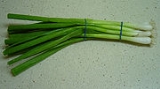
Scallion

Encyclopedia
Scallions are the edible plants of various Allium
species, all of which are "onion-like", having hollow green leaves and lacking a fully developed root bulb.
. This name, in turn, seems to originate from the Philistine town of Ascalon (modern-day Ashkelon
). The shallots themselves apparently came from farther east of Europe.
(Allium fistulosum) does not form bulbs even when mature, and is grown in the West almost exclusively as a scallion or salad onion, although in Asia this species is of primary importance and used both fresh and in cooking. "Scallion" is also used for young plants of the common onion
(A. cepa var. cepa) and shallot
(A. cepa var. aggregatum, formerly A. ascalonicum), harvested before bulbs form, or sometimes when slight bulbing has occurred. Most of the cultivars grown in the West primarily as salad onions or scallions belong to A. cepa var. cepa. Other species sometimes used as scallions include A. ×proliferum
and A. ×wakegi.
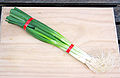 Harvested for their taste, they are milder than most onion
s. They may be cooked or used raw as a part of salads or Asian
recipes. Diced scallions are used in soup, noodle and seafood dishes, as well as sandwiches, curries or as part of a stir fry. To make many Eastern sauces, the bottom quarter-inch of scallions are commonly removed before use. Cut at root level.
In Vietnam
, Welsh onion is important to cook dưa hành ( served for Tết
festival. A kind of sauce, mỡ hành (Welsh onion fried in oil), is used in some dishes such as cơm tấm
, bánh ít, cà tím nướng and others. Welsh onion is the only ingredient in the dish cháo hành (a dish to treat the common cold
).
White Lisbon
White Lisbon Winter Hardy - an extra-hardy variety for overwintering.
Allium
Allium is a monocot genus of flowering plants, informally referred to as the onion genus. The generic name Allium is the Latin word for garlic....
species, all of which are "onion-like", having hollow green leaves and lacking a fully developed root bulb.
Etymology
The words scallion and shallot are related and can be traced back to the Greek askolonion as described by the Greek writer TheophrastusTheophrastus
Theophrastus , a Greek native of Eresos in Lesbos, was the successor to Aristotle in the Peripatetic school. He came to Athens at a young age, and initially studied in Plato's school. After Plato's death he attached himself to Aristotle. Aristotle bequeathed to Theophrastus his writings, and...
. This name, in turn, seems to originate from the Philistine town of Ascalon (modern-day Ashkelon
Ashkelon
Ashkelon is a coastal city in the South District of Israel on the Mediterranean coast, south of Tel Aviv, and north of the border with the Gaza Strip. The ancient seaport of Ashkelon dates back to the Neolithic Age...
). The shallots themselves apparently came from farther east of Europe.
Types
The Welsh onionWelsh onion
Allium fistulosum L. is a perennial onion. Other names that may be applied to this plant include green onion, spring onion, escallion, and salad onion...
(Allium fistulosum) does not form bulbs even when mature, and is grown in the West almost exclusively as a scallion or salad onion, although in Asia this species is of primary importance and used both fresh and in cooking. "Scallion" is also used for young plants of the common onion
Onion
The onion , also known as the bulb onion, common onion and garden onion, is the most widely cultivated species of the genus Allium. The genus Allium also contains a number of other species variously referred to as onions and cultivated for food, such as the Japanese bunching onion The onion...
(A. cepa var. cepa) and shallot
Shallot
The shallot is the botanical variety of Allium cepa to which the multiplier onion also belongs. It was formerly classified as the species A. ascalonicum, a name now considered a synonym of the correct name...
(A. cepa var. aggregatum, formerly A. ascalonicum), harvested before bulbs form, or sometimes when slight bulbing has occurred. Most of the cultivars grown in the West primarily as salad onions or scallions belong to A. cepa var. cepa. Other species sometimes used as scallions include A. ×proliferum
Tree onion
Tree onions, Allium ×proliferum, are similar to common onions, but with a cluster of bulblets where a normal onion would have flowers. Genomic evidence has conclusively shown that they are a hybrid of the common onion and the Welsh onion . However, some sources may still treat the tree onion as A....
and A. ×wakegi.
Uses
Onion
The onion , also known as the bulb onion, common onion and garden onion, is the most widely cultivated species of the genus Allium. The genus Allium also contains a number of other species variously referred to as onions and cultivated for food, such as the Japanese bunching onion The onion...
s. They may be cooked or used raw as a part of salads or Asian
Asian cuisine
Asian cuisine styles can be broken down into several tiny regional styles that have roots in the peoples and cultures of those regions. The major types can be roughly defined as East Asian with its origins in Imperial China and now encompassing modern Japan and the Korean peninsula; Southeast Asian...
recipes. Diced scallions are used in soup, noodle and seafood dishes, as well as sandwiches, curries or as part of a stir fry. To make many Eastern sauces, the bottom quarter-inch of scallions are commonly removed before use. Cut at root level.
In Vietnam
Vietnam
Vietnam – sometimes spelled Viet Nam , officially the Socialist Republic of Vietnam – is the easternmost country on the Indochina Peninsula in Southeast Asia. It is bordered by China to the north, Laos to the northwest, Cambodia to the southwest, and the South China Sea –...
, Welsh onion is important to cook dưa hành ( served for Tết
Tet
Tet can mean:*Tết or Tết Nguyên Đán, the Vietnamese new year**Tet Offensive, a military campaign that began in 1968*Têt in Roussillon, France*Equal temperament, abbreviated as 12-TET, 19-TET and so on...
festival. A kind of sauce, mỡ hành (Welsh onion fried in oil), is used in some dishes such as cơm tấm
Com tam
Cơm tấm in Vietnamese is cooked rice from fractured rice grains. Tấm refers to the broken rice grains, while cơm refers to cooked rice....
, bánh ít, cà tím nướng and others. Welsh onion is the only ingredient in the dish cháo hành (a dish to treat the common cold
Common cold
The common cold is a viral infectious disease of the upper respiratory system, caused primarily by rhinoviruses and coronaviruses. Common symptoms include a cough, sore throat, runny nose, and fever...
).
Varieties
- Allium cepa
White Lisbon
White Lisbon Winter Hardy - an extra-hardy variety for overwintering.
- Allium fistulosum
- Allium ×wakegi(分葱、ワケギ)
- Allium chinenseAllium chinenseAllium chinense is an edible species of wild onion in the Amaryllis family...