


Fish sauce

Encyclopedia
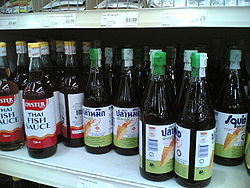
Condiment
A condiment is an edible substance, such as sauce or seasoning, added to food to impart a particular flavor, enhance its flavor, or in some cultures, to complement the dish. Many condiments are available packaged in single-serving sachets , like mustard or ketchup, particularly when supplied with...
that is derived from fish
Fish
Fish are a paraphyletic group of organisms that consist of all gill-bearing aquatic vertebrate animals that lack limbs with digits. Included in this definition are the living hagfish, lampreys, and cartilaginous and bony fish, as well as various extinct related groups...
that have been allowed to ferment
Fermentation (food)
Fermentation in food processing typically is the conversion of carbohydrates to alcohols and carbon dioxide or organic acids using yeasts, bacteria, or a combination thereof, under anaerobic conditions. Fermentation in simple terms is the chemical conversion of sugars into ethanol...
. It is an essential ingredient in many curries and sauces. Fish sauce is a staple ingredient in numerous cultures in Southeast Asia
Southeast Asia
Southeast Asia, South-East Asia, South East Asia or Southeastern Asia is a subregion of Asia, consisting of the countries that are geographically south of China, east of India, west of New Guinea and north of Australia. The region lies on the intersection of geological plates, with heavy seismic...
and the coastal regions of East Asia
East Asia
East Asia or Eastern Asia is a subregion of Asia that can be defined in either geographical or cultural terms...
, and features heavily in Thai
Cuisine of Thailand
Thai cuisine is the national cuisine of Thailand. Blending elements of several Southeast Asian traditions, Thai cooking places emphasis on lightly prepared dishes with strong aromatic components. The spiciness of Thai cuisine is well known. As with other Asian cuisines, balance, detail and variety...
and Vietnamese cuisine. In addition to being added to dishes during the cooking process, fish sauce can also be used in mixed form as a dipping condiment, and it is done in many different ways by each country mentioned for fish
Fish (food)
Fish is a food consumed by many species, including humans. The word "fish" refers to both the animal and to the food prepared from it. Fish has been an important source of protein for humans throughout recorded history.-Terminology:...
, shrimp
Shrimp
Shrimp are swimming, decapod crustaceans classified in the infraorder Caridea, found widely around the world in both fresh and salt water. Adult shrimp are filter feeding benthic animals living close to the bottom. They can live in schools and can swim rapidly backwards. Shrimp are an important...
, pork
Pork
Pork is the culinary name for meat from the domestic pig , which is eaten in many countries. It is one of the most commonly consumed meats worldwide, with evidence of pig husbandry dating back to 5000 BC....
, and chicken
Chicken (food)
Chicken is the most common type of poultry in the world, and is prepared as food in a wide variety of ways, varying by region and culture.- History :...
. In parts of southern China
China
Chinese civilization may refer to:* China for more general discussion of the country.* Chinese culture* Greater China, the transnational community of ethnic Chinese.* History of China* Sinosphere, the area historically affected by Chinese culture...
, it is used as an ingredient for soup
Soup
Soup is a generally warm food that is made by combining ingredients such as meat and vegetables with stock, juice, water, or another liquid. Hot soups are additionally characterized by boiling solid ingredients in liquids in a pot until the flavors are extracted, forming a broth.Traditionally,...
s and casserole
Casserole
A casserole, from the French for "saucepan", is a large, deep dish used both in the oven and as a serving vessel. The word casserole is also used for the food cooked and served in such a vessel, with the cookware itself called a casserole dish or casserole pan...
s.
Fish sauce, and its derivatives, impart an umami
Umami
Umami , popularly referred to as savoriness, is one of the five basic tastes together with sweet, sour, bitter, and salty.-Etymology:Umami is a loanword from the Japanese meaning "pleasant savory taste". This particular writing was chosen by Professor Kikunae Ikeda from umai "delicious" and mi ...
flavor to food due to their glutamate content.
Types
Some fish sauces (extracts) are made from raw fish, others from dried fish; some from only a single speciesSpecies
In biology, a species is one of the basic units of biological classification and a taxonomic rank. A species is often defined as a group of organisms capable of interbreeding and producing fertile offspring. While in many cases this definition is adequate, more precise or differing measures are...
, others from whatever is dredged up in the net, including some shellfish
Shellfish
Shellfish is a culinary and fisheries term for exoskeleton-bearing aquatic invertebrates used as food, including various species of molluscs, crustaceans, and echinoderms. Although most kinds of shellfish are harvested from saltwater environments, some kinds are found only in freshwater...
; some from whole fish, others from only the blood
Blood
Blood is a specialized bodily fluid in animals that delivers necessary substances such as nutrients and oxygen to the cells and transports metabolic waste products away from those same cells....
or viscera. Some fish sauces contain only fish and salt
Edible salt
Salt, also known as table salt, or rock salt, is a mineral that is composed primarily of sodium chloride , a chemical compound belonging to the larger class of ionic salts. It is essential for animal life in small quantities, but is harmful to animals and plants in excess...
, others add a variety of herb
Herb
Except in botanical usage, an herb is "any plant with leaves, seeds, or flowers used for flavoring, food, medicine, or perfume" or "a part of such a plant as used in cooking"...
s and spice
Spice
A spice is a dried seed, fruit, root, bark, or vegetative substance used in nutritionally insignificant quantities as a food additive for flavor, color, or as a preservative that kills harmful bacteria or prevents their growth. It may be used to flavour a dish or to hide other flavours...
s. Fish sauce that has been only briefly fermented has a pronounced fishy taste, while extended fermentation reduces this and gives the product a nuttier
Nut (fruit)
A nut is a hard-shelled fruit of some plants having an indehiscent seed. While a wide variety of dried seeds and fruits are called nuts in English, only a certain number of them are considered by biologists to be true nuts...
, cheesier flavor.
Southeast Asian
Southeast Asian fish sauce is often made from anchoviesAnchovy
Anchovies are a family of small, common salt-water forage fish. There are 144 species in 17 genera, found in the Atlantic, Indian, and Pacific Oceans. Anchovies are usually classified as an oily fish.-Description:...
, salt and water, and is often used in moderation because it is intensely flavoured. Anchovies and salt are arranged in wooden boxes to ferment and are slowly pressed, yielding the salty, fishy liquid. (The salt extracts the liquid via osmosis
Osmosis
Osmosis is the movement of solvent molecules through a selectively permeable membrane into a region of higher solute concentration, aiming to equalize the solute concentrations on the two sides...
.) The variety from Vietnam
Vietnam
Vietnam – sometimes spelled Viet Nam , officially the Socialist Republic of Vietnam – is the easternmost country on the Indochina Peninsula in Southeast Asia. It is bordered by China to the north, Laos to the northwest, Cambodia to the southwest, and the South China Sea –...
is generally called nước mắm (well known by brand names including nước mắm Phú Quốc (Phu Quoc) and nước mắm Phan Thiết (Phan Thiet
Phan Thiết
Phan Thiết town is the capital of Binh Thuan province, in southeastern Vietnam. Phan Thiet is a municipality in central, south central sector, however, the development plan to 2025, it would be municipality Southeast Vietnam. The population of Phan Thiết city in 2005 is roughly 350,000 and is...
)). Nước chấm is a Vietnamese prepared fish sauce condiment dipping sauce. Similar condiments from Thailand
Thailand
Thailand , officially the Kingdom of Thailand , formerly known as Siam , is a country located at the centre of the Indochina peninsula and Southeast Asia. It is bordered to the north by Burma and Laos, to the east by Laos and Cambodia, to the south by the Gulf of Thailand and Malaysia, and to the...
and Burma are called nam pla (น้ำปลา) and ngan bya yay (ငံပြာရည်) respectively. In Lao
Lao language
Lao or Laotian is a tonal language of the Tai–Kadai language family. It is the official language of Laos, and also spoken in the northeast of Thailand, where it is usually referred to as the Isan language. Being the primary language of the Lao people, Lao is also an important second language for...
/Isan
Isan
Isan is the northeastern region of Thailand. It is located on the Khorat Plateau, bordered by the Mekong River to the north and east, by Cambodia to the southeast and the Prachinburi mountains south of Nakhon Ratchasima...
it is called nam pa, but a chunkier, more aromatic version known as padaek
Padaek
Padaek, sometimes Padek, Lao bagoong, is a traditional Laotian condiment made from pickled or fermented fish that has been cured. Often known as Laotian fish sauce, it is a thicker, seasoned fish sauce that often contains chunks of fish in it...
is also used. In Cambodia
Cambodia
Cambodia , officially known as the Kingdom of Cambodia, is a country located in the southern portion of the Indochina Peninsula in Southeast Asia...
, it is known as teuk trei (ទឹកត្រី), of which there are a variety of sauces using fish sauce as a base.
The Indonesia
Indonesia
Indonesia , officially the Republic of Indonesia , is a country in Southeast Asia and Oceania. Indonesia is an archipelago comprising approximately 13,000 islands. It has 33 provinces with over 238 million people, and is the world's fourth most populous country. Indonesia is a republic, with an...
n semi-solid fish paste terasi, the Cambodia
Cambodia
Cambodia , officially known as the Kingdom of Cambodia, is a country located in the southern portion of the Indochina Peninsula in Southeast Asia...
n prahok
Prahok
Prahok is a crushed, salted and fermented fish paste that is used in Cambodian cuisine as a seasoning or a condiment. It originated as a way of preserving fish during the longer months when fresh fish was not available in abundant supply...
and the Malay fermented krill
Krill
Krill is the common name given to the order Euphausiacea of shrimp-like marine crustaceans. Also known as euphausiids, these small invertebrates are found in all oceans of the world...
brick belacan or budu from liquid anchovies are other popular variations of the same theme.
The similar Philippine version common to Indochina
Indochina
The Indochinese peninsula, is a region in Southeast Asia. It lies roughly southwest of China, and east of India. The name has its origins in the French, Indochine, as a combination of the names of "China" and "India", and was adopted when French colonizers in Vietnam began expanding their territory...
is called patis. Patis which is a by-product of bagoong
Bagoong
Bagoong is a Philippine condiment made of partially or completely fermented fish or shrimps and salt. The fermentation process also results in fish sauce .The preparation of bagoong can vary regionally in the Philippines....
is nearly always cooked prior to consumption (even if used as an accent to salads or other raw dishes), or used as a cooking ingredient. It is used in cooking many dishes including a rice porridge called arroz caldo and as a condiment for fried fish. It is also used in place of table salt in meals to enhance the flavor of the food, where it can either be dashed from a dispensing bottle onto the food, or poured into a saucer and mixed with calamansi and used as a dipping sauce.
Southeast Asians generally use fish sauce as a cooking sauce. However, there is a sweet and sour version of this sauce which is used more commonly as a dipping sauce (see nước chấm). In Thailand, fish sauce is used in cooking and is also kept in a jar at the table for use as a condiment. This jar often contains a mixture of fish sauce, lime juice, and chopped hot chilies, called phrik nam pla.
It is mainly the ethnic Chinese (usually Hokkien and Teochew) who cook with fish sauce (鱼露 yǘlù, 虾油 xīayú in Hokkien) in Indonesia and Malaysia. Fish sauce is a staple of many dishes in cuisines such as Vietnamese, Thai and Cambodian.
Japanese
In Japan, it is used as a seasoning of local specialties. Ishiru in the Noto PeninsulaNoto Peninsula
thumb|right|240px|Landsat image with high-resolution data from Space Shuttle.Noto Peninsula is a peninsula that projects north into the Sea of Japan from the coast of Ishikawa prefecture in central Honshū, the main island of Japan...
is made from the sardine
Sardine
Sardines, or pilchards, are several types of small, oily fish related to herrings, family Clupeidae. Sardines are named after the Mediterranean island of Sardinia, around which they were once abundant....
and the squid
Squid
Squid are cephalopods of the order Teuthida, which comprises around 300 species. Like all other cephalopods, squid have a distinct head, bilateral symmetry, a mantle, and arms. Squid, like cuttlefish, have eight arms arranged in pairs and two, usually longer, tentacles...
. Shottsuru of Akita Prefecture
Akita Prefecture
is a prefecture of Japan located in the Tōhoku Region of northern Honshu, the main island of Japan. The capital is the city of Akita.- History :The area of Akita has been created from the ancient provinces of Dewa and Mutsu....
is chiefly made from the sailfin sandfish. Ikanago shoyu of Kagawa Prefecture
Kagawa Prefecture
is a prefecture of Japan located on Shikoku island. The capital is Takamatsu.- History :Kagawa was formerly known as Sanuki Province.For a brief period between August 1876 and December 1888, Kagawa was made a part of Ehime Prefecture.-Battle of Yashima:...
is made from the sand lance
Sand lance
A sand lance or sandlance is a fish belonging to the family Ammodytidae. Several species of sand lance are commonly known as "sand eels" or "sandeels", though they are not related to true eels. Another variant name is launce, and all names of the fish are references to its slender body and...
. They are often reserved for the preparation of nabemono
Nabemono
Nabemono or simply called nabe, is a term referring to all varieties of Japanese steamboat dishes, also known as one pot dishes....
.
Korean
In Korea, it is called aekjeot or jeotgalJeotgal
Jeotgal or jeot is a salted fermented food in Korean cuisine. It is made with various seafood, such as shrimp, oysters, shellfish, fish, fish eggs, and fish intestines....
, and is used as a crucial ingredient in many types of kimchi
Kimchi
Kimchi , also spelled gimchi, kimchee, or kim chee, is a traditional fermented Korean dish made of vegetables with varied seasonings. There are hundreds of varieties of kimchi made with a main vegetable ingredient such as napa cabbage, radish, green onions or cucumber. It is the most common...
(usually from myoelchi, anchovy or kanari which is made from sand lance
Sand lance
A sand lance or sandlance is a fish belonging to the family Ammodytidae. Several species of sand lance are commonly known as "sand eels" or "sandeels", though they are not related to true eels. Another variant name is launce, and all names of the fish are references to its slender body and...
), both for taste and fermentation. The anchovy-based fish sauce lends itself well to the making of radish type kimchi. Kanari type fish sauce is more expensive than the anchovy-based fish sauce and is usually reserved for the preparation of special cabbage (baechu) kimchi. Saewoojeot (shrimp) is also popular as side sauce.
Western
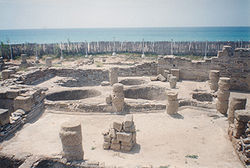
A similar fish sauce was ubiquitous in Classical Roman cooking, where in Latin
Latin
Latin is an Italic language originally spoken in Latium and Ancient Rome. It, along with most European languages, is a descendant of the ancient Proto-Indo-European language. Although it is considered a dead language, a number of scholars and members of the Christian clergy speak it fluently, and...
it is known as garum
Garum
Garum, similar to liquamen, was a type of fermented fish sauce condiment that was an essential flavour in Ancient Roman cooking, the supreme condiment....
or liquamen, and also existed in many varieties such as oenogarum (mixed with wine), oxygarum (mixed with vinegar) and meligarum (mixed with honey
Honey
Honey is a sweet food made by bees using nectar from flowers. The variety produced by honey bees is the one most commonly referred to and is the type of honey collected by beekeepers and consumed by humans...
). It was one of the trade specialties in Hispania Baetica
Hispania Baetica
Hispania Baetica was one of three Imperial Roman provinces in Hispania, . Hispania Baetica was bordered to the west by Lusitania, and to the northeast by Hispania Tarraconensis. Baetica was part of Al-Andalus under the Moors in the 8th century and approximately corresponds to modern Andalucia...
. It was made of a variety of fish including tuna, mackerel, moray eel, and anchovies. Garum was frequently maligned as smelling bad or rotten, being called, for example, "evil-smelling fish sauce."
In English
English language
English is a West Germanic language that arose in the Anglo-Saxon kingdoms of England and spread into what was to become south-east Scotland under the influence of the Anglian medieval kingdom of Northumbria...
it was formerly translated as fishpickle. The original Worcestershire sauce
Worcestershire sauce
Worcestershire sauce , or Worcester sauce is a fermented liquid condiment; primarily used to flavour meat or fish dishes.First made at 60 Broad Street, Worcester, England, by two dispensing chemists, John Wheeley Lea and William Henry Perrins, the Lea & Perrins brand was commercialised in 1837 and...
is a related product because it is fermented and contains anchovies.
See also
- Bagoong terongBagoong TerongBagoong Terong or bagoong, and bugguong in the Ilocano language, is a common ingredient used in the Philippines and particularly in Northern Ilocano cuisine. It is made by salting and fermenting the bonnet mouth fish. This bagoong is coarser than Bagoong Monamon, and contains fragments of the...
- Bagoong monamonBagoong MonamonBagoong monamon, bagoong monamon-dilis, or simply bagoong and bugguong munamon in Ilocano, is a common ingredient used in the Philippines and particularly in Northern Ilocano cuisine. It is made by fermenting salted anchovies which is not designed, nor customarily used for immediate consumption...
- Budu
- ConpoyConpoyConpoy or dried scallop is a type of dried seafood product made from the adductor muscle of scallops. The smell of conpoy is marine, pungent, and reminiscent of certain salt-cured meats. Its taste is rich and umami due to its high content of various free amino acids, such as glycine, alanine, and...
- GarumGarumGarum, similar to liquamen, was a type of fermented fish sauce condiment that was an essential flavour in Ancient Roman cooking, the supreme condiment....
- PadaekPadaekPadaek, sometimes Padek, Lao bagoong, is a traditional Laotian condiment made from pickled or fermented fish that has been cured. Often known as Laotian fish sauce, it is a thicker, seasoned fish sauce that often contains chunks of fish in it...
- Pla raPla raPla ra is fermented fish sauce, popular in Northeastern Thai cuisine.It is made by pickling several varieties of fish, mainly Snakehead Murrel . The fish is cleaned and cut into pieces, after which it is mixed with salt and rice bran...
- SaeujeotSaeujeotSaeujeot is a variety of jeotgal, salted and fermented food made with small shrimp in Korean cuisine. It is the most consumed jeotgal along with myeolchijeot in South Korea. The name consists of the two Korean words, saeu and jeot...
- Shrimp pasteShrimp pasteShrimp paste or shrimp sauce, is a common ingredient used in Southeast Asian and Southern Chinese cuisine. It is known as terasi in Indonesian, ngapi in Burmese, kapi in Thai, Khmer and Lao language, belacan in Malay, mắm ruốc, mắm tép and mắm tôm in...
- Soy sauceSoy sauceSoy sauce is a condiment produced by fermenting soybeans with Aspergillus oryzae or Aspergillus sojae molds, along with water and salt...