
All Topics  
Black pepper

 
Black Pepper

   Email Print
   Bookmark   Link


Black pepper


Black pepper (Piper nigrum) is a flowering
Flowering plant

The flowering plants or angiosperms are the most widespread group of Embryophytes. The flowering plants and the gymnosperms are the only extant groups of Spermatophyte....
 vine
Vine

A vine is any plant of genus Grape or, by extension, any similar climbing or trailing plant. The word, derived from Latin vinea, referred to the grape-bearing variety....
 in the family Piperaceae
Piperaceae

Piperaceae is the botanical name for a family of flowering plants. Such a family has been recognized by most taxonomists: it is sometimes known as the "pepper family"....
, cultivated for its fruit
Fruit

The term fruit has different meanings dependent on context, and the term is not synonymous in food preparation and biology. In botany, which is the scientific study of plants, fruits are the ripened Ovary of flowering plants....
, which is usually dried and used as a spice
Spice

A spice is a dried seed, fruit, root, bark, leaf, or vegetable used in nutritionally insignificant quantities as a food additive for the purpose of flavor, color, or as a preservative that kills harmful bacteria or prevents their growth....
 and seasoning
Seasoning

Seasoning is the process of imparting flavor to, or improving the flavor of, food. Seasonings include herbs, spices, and all other condiments, which are themselves frequently referred to as "seasonings"....
. The fruit, known as a peppercorn when dried, is a small drupe
Drupe

In botany, a drupe is a fruit in which an outer fleshy part surrounds a shell of hardened endocarp with a seed inside. These fruits develop from a single carpel, and mostly from flowers with superior ovary....
 five millimetres in diameter, dark red when fully mature, containing a single seed
Seed

A seed is a small Plant embryogenesis plant enclosed in a covering called the seed coat, usually with some Food storage. It is the product of the ripened ovule of gymnosperm and angiosperm plants which occurs after fertilization and some growth within the mother plant....
. Peppercorns, and the powdered pepper derived from grinding them, may be described as black pepper, white pepper, red/pink pepper, green pepper, and very often simply pepper.


Nutrition Facts


Discussion
Ask a question about 'Black pepper'
Start a new discussion about 'Black pepper'
Answer questions from other users
Full Discussion Forum


Encyclopedia


Black pepper (Piper nigrum) is a flowering
Flowering plant

The flowering plants or angiosperms are the most widespread group of Embryophytes. The flowering plants and the gymnosperms are the only extant groups of Spermatophyte....
 vine
Vine

A vine is any plant of genus Grape or, by extension, any similar climbing or trailing plant. The word, derived from Latin vinea, referred to the grape-bearing variety....
 in the family Piperaceae
Piperaceae

Piperaceae is the botanical name for a family of flowering plants. Such a family has been recognized by most taxonomists: it is sometimes known as the "pepper family"....
, cultivated for its fruit
Fruit

The term fruit has different meanings dependent on context, and the term is not synonymous in food preparation and biology. In botany, which is the scientific study of plants, fruits are the ripened Ovary of flowering plants....
, which is usually dried and used as a spice
Spice

A spice is a dried seed, fruit, root, bark, leaf, or vegetable used in nutritionally insignificant quantities as a food additive for the purpose of flavor, color, or as a preservative that kills harmful bacteria or prevents their growth....
 and seasoning
Seasoning

Seasoning is the process of imparting flavor to, or improving the flavor of, food. Seasonings include herbs, spices, and all other condiments, which are themselves frequently referred to as "seasonings"....
. The fruit, known as a peppercorn when dried, is a small drupe
Drupe

In botany, a drupe is a fruit in which an outer fleshy part surrounds a shell of hardened endocarp with a seed inside. These fruits develop from a single carpel, and mostly from flowers with superior ovary....
 five millimetres in diameter, dark red when fully mature, containing a single seed
Seed

A seed is a small Plant embryogenesis plant enclosed in a covering called the seed coat, usually with some Food storage. It is the product of the ripened ovule of gymnosperm and angiosperm plants which occurs after fertilization and some growth within the mother plant....
. Peppercorns, and the powdered pepper derived from grinding them, may be described as black pepper, white pepper, red/pink pepper, green pepper, and very often simply pepper. The terms pink peppercorns, red pepper, and green pepper are also used to describe the fruits of other, unrelated plants.

Black pepper is native to South India
South India

South India is the area encompassing India's states of Andhra Pradesh, Karnataka, Kerala and Tamil Nadu as well as the Union territories of India of Lakshadweep and Pondicherry, occupying 19.31% of area....
 (Tamil:milagu, ?????; Kannada:meNasu, ?????; Malayalam:kurumulaku, ?????????; Telugu:miriyam, ??????; Konkani:miriya konu;) and is extensively cultivated there and elsewhere in tropical regions. Black pepper is also cultivated in the Coorg area of Karnataka
Karnataka

Karnataka is a States and territories of India in the southern part of India. It was Unification of Karnataka on November 1, 1956, with the passing of the States Reorganisation Act....
.

Dried ground pepper is one of the most common spices in European cuisine
Cuisine

Cuisine is a specific set of cooking traditions and practices, often associated with a specific culture. A cuisine is primarily influenced by the ingredients that are available locally or through trade....
 and its descendants, having been known and prized since antiquity for both its flavour and its use as a medicine
Medicine

Medicine is the art and science of healing. It encompasses a range of health care practices evolved to maintain and restore health by the prevention and treatment of illness....
. The spiciness of black pepper is due to the chemical piperine
Piperine

Piperine is the alkaloid responsible for the pungency of black pepper and long pepper, along with chavicine . It has also been used in some forms of traditional medicine and as an insecticide....
. It may be found on nearly every dinner table in some parts of the world, often alongside table salt
Edible salt

Salt is a dietary mineral composed primarily of sodium chloride that is essential for animal life, but toxic to most land plants. Salt flavor is one of the taste#Basic_tastes, an important Salting_ and a popular food seasoning....
.

The word "pepper" is ultimately derived from the Sanskrit pippali, the word for long pepper
Long pepper

Long pepper , sometimes called Javanese Long Pepper, Indian Long Pepper or Indonesian Long Pepper, is a flowering plant vine in the family Piperaceae, cultivated for its fruit, which is usually dried and used as a spice and seasoning....
 via the Latin
Latin

Latin is an Italic language, historically spoken in Latium and Ancient Rome. Through the Military history of the Roman Empire, Latin spread throughout the Mediterranean and a large part of Europe....
 piper which was used by the Romans to refer both to pepper and long pepper, as the Romans erroneously believed that both of these spices were derived from the same plant. The English word for pepper is derived from the Old English
Old English language

Old English is an early form of the English language that was spoken and written in parts of what are now England and south-eastern Scotland between the mid-5th century and the mid-12th century....
 pipor. The Latin word is also the source of German
German language

German is a West Germanic languages, thus related to and classified alongside English language and Dutch language. It is one of the world's world language and the most widely spoken mother tongue in the European Union....
 Pfeffer, French
French language

French is a Romance language spoken around the world by around 80 million people as first language, by 190 million as second language, and by about another 200 million people as an acquired tongue, with significant speakers in 54 countries....
 poivre, Dutch
Dutch language

Dutch is a West Germanic languages spoken by over 22 million people as a first language, and about 5 million people as a second language."1% of the EU population claims to speak Dutch well enough in order to have a conversation." Outside the European Union the number of second language speakers of Dutch is very small. Most native...
 peper, and other similar forms. In the 16th century, pepper started referring to the unrelated New World
New World

The New World is one of the names used for the non-Eurasian/non-African parts of the Earth, specifically the Americas and Australasia. When the term originated in the late 15th century, the Americas were new to the Europeans, who previously thought of the world as consisting only of Europe, Asia, and Africa ....
 chile peppers as well. "Pepper" was used in a figurative sense to mean "spirit" or "energy" at least as far back as the 1840s; in the early 20th century, this was shortened to pep.

Varieties

Dried Peppercorns
Black pepper is produced from the still-green unripe berries
Berry

In everyday English, a berry is a broad term for any small edible fruit. Most berries are juicy, round or semi-oblong, brightly coloured, sweet or sour, and don't have a stone or pit....
 of the pepper plant. The berries are cooked briefly in hot water, both to clean them and to prepare them for drying. The heat ruptures cell wall
Cell wall

A cell wall is a tough, flexible and sometimes fairly rigid layer that surrounds some types of cell . It is located outside the cell membrane and provides these cells with structural support and protection, and also acts as a filtering mechanism....
s in the fruit, speeding the work of browning enzymes during drying. The berries are dried in the sun or by machine for several days, during which the fruit around the seed shrinks and darkens into a thin, wrinkled black layer. Once dried, the fruits are called black peppercorns.

White pepper consists of the seed only, with the skin of the fruit removed. This is usually accomplished by process known as retting
Retting

Retting is a stage in the manufacturing of fiber crop, especially the bast fibers. It is a process that employs water and microbial action to separate the bast fibers from the woody core , and sometimes from the Epidermis as well....
, where fully ripe berries are soaked in water for about a week, during which the flesh of the fruit softens and decomposes
Decomposition

Decomposition refers to the process by which tissues of dead organisms break down into simpler forms of matter. Such a breakdown of dead organisms is essential for new growth and development of living organisms because it recycles the finite chemical constituents and frees up the limited physical space in the biome....
. Rubbing then removes what remains of the fruit, and the naked seed is dried. Alternative processes are used for removing the outer fruit from the seed, including decortication, the removal of the outer layer from black pepper from berries through mechanical, chemical or biological methods.

In the U.S., white pepper is often used in dishes like light-colored sauce
Sauce

In cooking, a sauce is liquid or sometimes semi-solid food served on or used in preparing other foods. Sauces are not normally consumed by themselves; they add flavor, moisture, and visual appeal to another dish....
s or mashed potatoes, where ground black pepper would visibly stand out. There is disagreement regarding which is generally spicier. They have differing flavors due to the presence of certain compounds in the outer fruit layer of the berry that are not found in the seed.

Green pepper, like black, is made from the unripe berries. Dried green peppercorns are treated in a manner that retains the green colour, such as treatment with sulfur dioxide
Sulfur dioxide

Sulfur dioxide is the chemical compound with the formula SO2. It is produced by volcanoes and in various industrial processes. Since coal and petroleum often contain sulfur compounds, their combustion generates sulfur dioxide....
 or freeze-drying. Pickled peppercorns, also green, are unripe berries preserved in brine
Brine

File:Kissingen-Solepumpe-1848.JPGFile:Kissingen-Solepumpe-1848-2.JPGBrine is water Saturation or nearly saturated with a Salt .It is used to preserve vegetables, fish, and meat, in a process known as brining ....
 or vinegar
Vinegar

Vinegar is an acidic liquid processed from the fermentation of ethanol in a process that yields its key ingredient, acetic acid . It also may come in a diluted form....
. Fresh, unpreserved green pepper berries, largely unknown in the West, are used in some Asian cuisine
Asian cuisine

Asian cuisine styles can be broken down into several regional styles that have roots in the peoples and cultures of those regions. The major types can be roughly defined as East Asian with its origins in Imperial era of Chinese history and now encompassing modern Japan and the Korean peninsula; Southeast Asian which encompasses th...
s, particularly Thai cuisine. Their flavor has been described as piquant and fresh, with a bright aroma. They decay quickly if not dried or preserved.

A product called orange pepper or red pepper consists of ripe red pepper berries preserved in brine and vinegar. Ripe red peppercorns can also be dried using the same colour-preserving techniques used to produce green pepper. Pink pepper from Piper nigrum is distinct from the more-common dried "pink peppercorns", which are the fruits of a plant from a different family, the Peruvian pepper tree, Schinus molle, and its relative the Brazilian pepper tree
Brazilian pepper

Brazilian Pepper is a sprawling shrub or small tree that is native to subtropical and tropical South America, in southeastern Brazil, northern Argentina and Paraguay....
, Schinus terebinthifolius. In years past there was debate as to the health safety of pink peppercorns, which is mostly no longer an issue. Sichuan peppercorn
Sichuan Pepper

Sichuan pepper is the outer pod of the tiny fruit of a number of species in the genus Zanthoxylum , widely grown and consumed in Asia as a spice....
 is another "pepper" that is botanically unrelated to black pepper.

Peppercorns are often categorised under a label describing their region or port of origin. Two well-known types come from India
India

India, officially the Republic of India , is a country in South Asia. It is the List of countries and outlying territories by total area country by geographical area, the List of countries by population country, and the most populous liberal democracy in the world....
's Malabar
Malabar

Malabar is a region of southern India, lying between the Western Ghats and the Arabian Sea.The name is thought to be derived from the Malayalam word Mala and Iranian language word Bar or from the Turkic words Mal and Bar ....
 Coast: Malabar pepper and Tellicherry pepper. Tellicherry is a higher-grade pepper, made from the largest, ripest 10% of berries from Malabar plants grown on Mount Tellicherry. Sarawak
Sarawak

Sarawak is one of two Malaysian states on the island of Borneo. Known as Bumi Kenyalang , it is situated on the north-west of the island. It is the largest state in Malaysia; the second largest, Sabah, lies to the northeast....
 pepper is produced in the Malaysia
Malaysia

Malaysia is a federation that consists of States of Malaysia in Southeast Asia with a total landmass of . The capital city is Kuala Lumpur, while Putrajaya is the seat of the federal government....
n portion of Borneo
Borneo

Borneo is the List of islands by area and is located at the centre of Maritime Southeast Asia. Administratively, this island is divided between Indonesia, Malaysia and Brunei....
, and Lampong pepper on Indonesia
Indonesia

The Republic of Indonesia , is a transcontinental country in Southeast Asia and Oceania. Comprising Islands of Indonesia, it is the world's largest Archipelago state....
's island of Sumatra
Sumatra

Sumatra is an island in western Indonesia, westernmost of the Sunda Islands. It is the largest island entirely in Indonesia , and the list of islands by area in the world ....
. White Muntok
Muntok

Muntok or more commonly known as Mentok. It is a town in the Indonesian province of Bangka-Belitung, Indonesia. Muntok is the capital of the West Bangka Regency....
 pepper is another Indonesian product, from Bangka Island
Bangka Island

Bangka is an island lying east of Sumatra, Indonesia. Population 626,955. Area: c.4,600 sq mi .There is an additional small island named Pulau Bangka in northern Sulawesi, Indonesia....
.

Plant

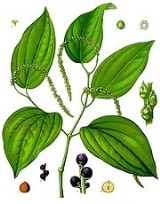
Piper Nigrum Drawing 1832
The pepper plant is a perennial
Perennial plant

A perennial plant or perennial is a plant that lives for more than two years. When used by gardeners or horticulturalists, this term applies specifically to perennial herbaceous plants....
 woody
Woody plant

A woody plant is a Vascular tissue plant that has a Perennial plant Plant stem that is above ground and covered by a layer of thickened bark. Woody plants are adapted to survive from one year to the next; the stem supports continued vegetative growth above ground from one year to next....
 vine
Vine

A vine is any plant of genus Grape or, by extension, any similar climbing or trailing plant. The word, derived from Latin vinea, referred to the grape-bearing variety....
 growing to four metres in height on supporting tree
TREE

TREE was a Boston hardcore punk band formed in the summer of 1990. They were active in the Boston music scene until disbanding in 2002....
s, poles, or trellises. It is a spreading vine, root
Root

In vascular plants, the root is the organ of a plant body that typically lies below the surface of the soil. This is not always the case, however, since a root can also be aerial root or aerating ....
ing readily where trailing stems touch the ground. The leaves
Leaf

In botany, a leaf is an above-ground plant Organ specialized for photosynthesis. For this purpose, a leaf is typically flat and thin, to expose the cells containing chloroplast to light over a broad area, and to allow light to penetrate fully into the tissues....
 are alternate, entire, five to ten centimetres long and three to six centimetres broad. The flower
Flower

A flower, sometimes known as a bloom or blossom, is the reproduction structure found in flowering plants . The biological function of a flower is to mediate the union of male sperm with female ovum in order to produce seeds....
s are small, produced on pendulous spikes four to eight centimetres long at the leaf nodes, the spikes lengthening to seven to 15 centimeters as the fruit matures. Black pepper is grown in soil that is neither too dry nor susceptible to flood
Flood

A flood is an overflow of an expanse of water that submerges land, a deluge. In the sense of "flowing water", the word may also be applied to the inflow of the tide....
ing, moist, well-drained and rich in organic matter. The plants are propagated by cuttings about 40 to 50 centimetres long, tied up to neighbouring trees or climbing frames at distances of about two metres apart; trees with rough bark are favoured over those with smooth bark, as the pepper plants climb rough bark more readily. Competing plants are cleared away, leaving only sufficient trees to provide shade and permit free ventilation. The roots are covered in leaf mulch
Mulch

In agriculture and gardening, is a protective cover placed over the soil, primarily to modify the effects of the local climate. A wide variety of nature and Synthetic fiber materials are used....
 and manure
Manure

Manure is organic matter used as organic fertilizer in agriculture. Manures contribute to the fertility of the soil by adding organic matter and Nutrient#Nutrients and the environment, such as nitrogen that is trapped by bacterium in the soil....
, and the shoots are trimmed twice a year. On dry soils the young plants require watering every other day during the dry season for the first three years. The plants bear fruit from the fourth or fifth year, and typically continue to bear fruit for seven years. The cuttings are usually cultivar
Cultivar

A cultivar is a cultivated plant that has been selected and given a unique name because of its decorative or useful characteristics; it is usually distinct from similar plants and when Plant propagation it retains those characteristics....
s, selected both for yield and quality of fruit. A single stem will bear 20 to 30 fruiting spikes. The harvest begins as soon as one or two berries at the base of the spikes begin to turn red, and before the fruit is mature, but when full grown and still hard; if allowed to ripen, the berries lose pungency, and ultimately fall off and are lost. The spikes are collected and spread out to dry in the sun, then the peppercorns are stripped off the spikes.

Black pepper is native to India. Within the genus Piper
Piper (genus)

Piper, the pepper plants or pepper vines , are an economically and ecologically important genus in the family Piperaceae. It contains about 1,000-2,000 species of shrubs, herbs, and lianas, many of which are keystone species in their native habitat The diversification of this taxon is of interest to understanding the evolutio...
, it is most closely related to other Asian species such as Piper caninum.

History

Pepper has been used as a spice in India since prehistoric times
Prehistory

Prehistory is a term often used to describe the period before Recorded history. Paul Tournal originally coined the term Pr?-historique in describing the finds he had made in the caves of southern France....
. Pepper is native to India
India

India, officially the Republic of India , is a country in South Asia. It is the List of countries and outlying territories by total area country by geographical area, the List of countries by population country, and the most populous liberal democracy in the world....
 and has been known to Indian cooking since at least 2000 BC. J. Innes Miller notes that while pepper was grown in southern Thailand
Thailand

The Kingdom of Thailand is an independent country that lies in the heart of Southeast Asia. It is bordered to the north by Laos and Myanmar, to the east by Laos and Cambodia, to the south by the Gulf of Thailand and Malaysia, and to the west by the Andaman Sea and Myanmar....
 and in Malaysia, its most important source was India
India

India, officially the Republic of India , is a country in South Asia. It is the List of countries and outlying territories by total area country by geographical area, the List of countries by population country, and the most populous liberal democracy in the world....
, particularly the Malabar Coast
Malabar Coast

The Malabar Coast also known as the Malabarian Coast, is a long and narrow south-western shore line of the mainland Indian subcontinent....
, in what is now the state of Kerala
Kerala

Kerala is a Indian Union States and territories of India located in the southwestern part of India. With an Arabian Sea coastline on the west, it is bordered on the north by Karnataka and by Tamil Nadu on the south and east....
. Peppercorns were a much prized trade good, often referred to as "black gold" and used as a form of commodity money
Commodity money

Commodity money is money whose Value comes from a commodity out of which it is made. It is objects that have value in themselves as well as for use as money....
. The term "peppercorn rent" still exists today.

The ancient history of black pepper is often interlinked with (and confused with) that of long pepper
Long pepper

Long pepper , sometimes called Javanese Long Pepper, Indian Long Pepper or Indonesian Long Pepper, is a flowering plant vine in the family Piperaceae, cultivated for its fruit, which is usually dried and used as a spice and seasoning....
, the dried fruit
Dried fruit

Dried fruitis fruit that has been drying , either naturally or through use of a machine, such as a food dehydrator. Raisins, prunes, and Date palm are examples of popular dried fruits....
 of closely related Piper longum. The Romans knew of both and often referred to either as just "piper". In fact, it was not until the discovery of the New World and of chile peppers that the popularity of long pepper entirely declined. Chile peppers, some of which when dried are similar in shape and taste to long pepper, were easier to grow in a variety of locations more convenient to Europe.

Until well after the Middle Ages
Middle Ages

File:Karl 1 mit papst gelasius gregor1 sacramentar v karl d kahlen.jpgThe Middle Ages of European history are a period in history which lasted for roughly a millennium, commonly dated from the fall of the Roman Empire in the 5th century to the beginning of the Early Modern Period in the 16th century, marked by the division of Western Christi...
, virtually all of the black pepper found in Europe, the Middle East, and North Africa traveled there from India's Malabar region. By the 16th century, pepper was also being grown in Java, Sunda
Sunda Islands

The Sunda Islands are a group of islands in the western part of Maritime Southeast Asia.They are divided into two groups, with the Greater Sunda group being referred to much less than the Lesser Sunda....
, Sumatra
Sumatra

Sumatra is an island in western Indonesia, westernmost of the Sunda Islands. It is the largest island entirely in Indonesia , and the list of islands by area in the world ....
, Madagascar
Madagascar

Madagascar, or Republic of Madagascar , is an island nation in the Indian Ocean off the southeastern coast of Africa. The main island, also called Madagascar, is the List of islands by area, and is home to 5% of the world's plant and animal species, of which more than 80% are Endemism to Madagascar....
, Malaysia, and elsewhere in Southeast Asia, but these areas traded mainly with China, or used the pepper locally. Ports in the Malabar area also served as a stop-off point for much of the trade in other spices from farther east in the Indian Ocean.

Black pepper, along with other spices from India and lands farther east, changed the course of world history. It was in some part the preciousness of these spices that led to the European efforts to find a sea route to India and consequently to the European colonial occupation of that country, as well as the European discovery and colonization of the Americas.

Ancient times

Black peppercorns were found stuffed in the nostrils of Ramesses II
Ramesses II

Ramesses II was the third Egyptian pharaoh of the Nineteenth dynasty of Egypt. He is often regarded as Ancient Egypt's greatest, most celebrated, and most powerful pharaoh....
, placed there as part of the mummification
Mummy

A mummy is a corpse whose skin and organs have been preserved by either intentional or incidental exposure to chemicals, extreme coldness, very high humidity, or lack of air when bodies are submerged in bogs....
 rituals shortly after his death in 1213 BC. Little else is known about the use of pepper in ancient Egypt
Ancient Egypt

Ancient Egypt was an Ancient history civilization in eastern North Africa, concentrated along the lower reaches of the Nile in what is now the modern nation of Egypt....
, nor how it reached the Nile
Nile

The Nile is a major north-flowing river in Africa, generally regarded as the List of rivers by length in the world.The Nile has two major tributary, the White Nile and Blue Nile, the latter being the source of most of the Nile's water and silt, but the former being the longer of the two....
 from India.

Pepper (both long and black) was known in Greece at least as early as the 4th century BC, though it was probably an uncommon and expensive item that only the very rich could afford. Trade routes of the time were by land, or in ships which hugged the coastlines of the Arabian Sea
Arabian Sea

The Arabian Sea is a region of the Indian Ocean bounded on the east by India, on the north by Pakistan and Iran, on the west by Arabian Peninsula, on the south, approximately, by a line between Cape Guardafui, the north-east point of Somalia, Socotra, Kanyakumari in India, and the western coast of Sri Lanka....
. Long pepper, growing in the north-western part of India, was more accessible than the black pepper from further south; this trade advantage, plus long pepper's greater spiciness, probably made black pepper less popular at the time.

Italy To India Route
By the time of the early Roman Empire
Roman Empire

The Roman Empire was the Roman Republic phase of the Ancient Rome, characterised by an autocracy form of government and large territorial holdings in Europe and around the Mediterranean....
, especially after Rome's conquest of Egypt in 30 BC, open-ocean crossing of the Arabian Sea directly to southern India's Malabar Coast was near routine. Details of this trading across the Indian Ocean have been passed down in the Periplus of the Erythraean Sea
Periplus of the Erythraean Sea

The Periplus of the Erythraean Sea is a Greek language periplus, describing navigation and Roman commerce from History of Roman Egypt ports like Berenice along the coast of the Red Sea, and others along Horn of Africa and India....
. According to the Roman geographer Strabo
Strabo

Strabo was a Ancient Greeks history, geography and philosophy....
, the early Empire sent a fleet of around 120 ships on an annual one-year trip to India and back. The fleet timed its travel across the Arabian Sea to take advantage of the predictable monsoon
Monsoon

A monsoon is a seasonal prevailing wind that lasts for several months. The term was first used in English in India, Bangladesh, Pakistan, and neighboring countries to refer to the big seasonal winds blowing from the Indian Ocean and Arabian Sea in the southwest bringing heavy rainfall to the region....
 winds. Returning from India, the ships travelled up the Red Sea
Red Sea

The Red Sea is a salt water inlet of the Indian Ocean between Africa and Asia. The connection to the ocean is in the south through the Bab el Mandeb sound and the Gulf of Aden....
, from where the cargo was carried overland or via the Nile Canal to the Nile River, barged to Alexandria
Alexandria

Alexandria , with a population of 4.1 million, is the second-largest city in Egypt, and is the country's largest seaport, serving about 80% of Egypt's imports and exports....
, and shipped from there to Italy and Rome. The rough geographical outlines of this same trade route would dominate the pepper trade into Europe for a millennium and a half to come.

With ships sailing directly to the Malabar coast, black pepper was now travelling a shorter trade route than long pepper, and the prices reflected it. Pliny the Elder
Pliny the Elder

Gaius Plinius Secundus , better known as Pliny the Elder, was an ancient author, naturalist or natural philosopher and naval and military commander of some importance who wrote Natural History ....
's Natural History tells us the prices in Rome around 77 CE
Common Era

Common Era, abbreviated as CE, is a designation for the calendar system most commonly used in the Western world, and also internationally, for numbering the year part of the calendar date....
: "Long pepper ... is fifteen denarii
Denarius

The ancient Roman currency system included the 'denarius' after 211 BC, a small silver coin, and it was the most common coin produced for circulation but was slowly Debasement until its replacement by the antoninianus....
 per pound, while that of white pepper is seven, and of black, four." Pliny also complains "there is no year in which India does not drain the Roman Empire of fifty million sesterces," and further moralises on pepper:
It is quite surprising that the use of pepper has come so much into fashion, seeing that in other substances which we use, it is sometimes their sweetness, and sometimes their appearance that has attracted our notice; whereas, pepper has nothing in it that can plead as a recommendation to either fruit or berry, its only desirable quality being a certain pungency; and yet it is for this that we import it all the way from India! Who was the first to make trial of it as an article of food? and who, I wonder, was the man that was not content to prepare himself by hunger only for the satisfying of a greedy appetite? (N.H. 12.14)


Black pepper was a well-known and widespread, if expensive, seasoning in the Roman Empire
Roman Empire

The Roman Empire was the Roman Republic phase of the Ancient Rome, characterised by an autocracy form of government and large territorial holdings in Europe and around the Mediterranean....
. Apicius
Apicius

Apicius is the title of a collection of Roman cookery recipes, usually thought to have been compiled in the late 4th or early 5th century AD and written in a language that is in many ways closer to Vulgar Latin than to Classical Latin....
' De re coquinaria, a 3rd-century cookbook probably based at least partly on one from the 1st century CE, includes pepper in a majority of its recipes. Edward Gibbon
Edward Gibbon

Edward Gibbon was an English historian and Member of Parliament. His most important work, The History of the Decline and Fall of the Roman Empire, was published in six volumes between 1776 and 1788....
 wrote, in The History of the Decline and Fall of the Roman Empire
The History of the Decline and Fall of the Roman Empire

The History of the Decline and Fall of the Roman Empire was written by England historian Edward Gibbon and published in six volumes. Volume I was published in 1776, and went through six printings....
, that pepper was "a favourite ingredient of the most expensive Roman cookery".

Postclassical Europe

Pepper was so valuable that it was often used as collateral
Collateral (finance)

In loan agreement, collateral is a Borrower Pledge of specific property to a lender, to Secured loan repayment of a loan. The collateral serves as protection for a lender against a borrower's risk of default - that is, any borrower failing to pay the principal sum and interest under the terms of a loan obligation....
 or even currency. The taste for pepper (or the appreciation of its monetary value) was passed on to those who would see Rome fall. It is said that Alaric
Alaric I

Alaric I , was likely born about 370 on an Peuce Island at the mouth of the Danube. He was king of the Visigoths from 395–410 and the first Germanic peoples leader to take the city of Rome....
 the Visigoth and Attila the Hun
Attila the Hun

Attila , also known as Attila the Hun, was leader of the Huns from 434 until his death in 453. He was leader of the Hunnic Empire which stretched from Germany to the Ural River and from the Danube to the Baltic Sea ....
 each demanded from Rome
Rome

Rome is the capital city of Italy and Lazio, and is Italy's largest and most populous city, with 2,724,347 residents in an urban area of some ....
 a ransom of more than a ton of pepper when they besieged the city in 5th century. After the fall of Rome, others took over the middle legs of the spice trade
Spice trade

Spice trade is a commercial activity of ancient origin which involves the merchandising of spices and herbs. Civilizations of Asia were involved in spice trade from the ancient times, and the Greco-Roman world soon followed by trading along the Incense route and the Roman trade with India....
, first the Persians
Persian Empire

The 'Persian Empire' was a series of successive Iranian or Persianization empires that ruled over the Iranian plateau, the original Persian homeland, and beyond in Southwest Asia, South Asia, Central Asia and the Caucasus....
 and then the Arab
Arab

An Arab is a person who Identity as such on linguistic or cultural grounds. The plural form, Arabs , refers to the Ethnocultural group at large....
s; Innes Miller cites the account of Cosmas Indicopleustes
Cosmas Indicopleustes

Cosmas Indicopleustes of Alexandria was a Greeks merchant and later monk probably of Nestorian tendencies. He was a 6th century traveller, who made several voyages to India during the reign of emperor Justinian....
, who travelled east to India, as proof that "pepper was still being exported from India in the sixth century". By the end of the Dark Ages
Dark Ages

Dark Age or Dark Ages is a term in historiography referring to a period of cultural decline or societal collapse that took place in Western Europe between the Decline of the Roman Empire and the eventual recovery of learning....
, the central portions of the spice trade were firmly under Islamic control. Once into the Mediterranean, the trade was largely monopolised by Italian powers, especially Venice
Republic of Venice

The Most Serene Republic of Venice or Venetian Republic was a state originating from the city of Venice . It existed for over a millennium, from the late 7th century AD until the year 1797....
 and Genoa
Republic of Genoa

The Most Serene Republic of Genoa was an independent state in Liguria on the northwestern Italy coast from the 11th century to 1797, when it was invaded by armies of First French Republic under Napoleon I of France....
. The rise of these city-state
City-state

A city-state is an independent country whose territory consists solely of a single major city and the area immediately surrounding it. Examples include the city-states of ancient Greece , the Phoenician cities of Canaan , the Sumerian cities of Mesopotamia , the Mayans of pre-Columbian Mesoamerica , the central Asian cities along the Silk Roa...
s was funded in large part by the spice trade.

A riddle
Riddle

A riddle is a statement or question having a double or veiled meaning, put forth as a puzzle to be solved. Riddles are of two types: enigmas, which are problems generally expressed in metaphorical or allegorical language that require ingenuity and careful thinking for their solution, and conundrums, which are questions relying for the...
 authored by Saint Aldhelm, a 7th-century Bishop of Sherborne
Bishop of Sherborne

The Bishop of Sherborne is an Episcopal polity title used by a suffragan bishop of the Church of England Diocese of Salisbury, in the Province of Canterbury, England....
, sheds some light on black pepper's role in England
England

native_name =|conventional_long_name = England|common_name = England|image_flag = Flag of England.svg|image_coat = England COA.svg|symbol_type = Royal Coat of Arms...
 at that time:

I am black on the outside, clad in a wrinkled cover, Yet within I bear a burning marrow. I season delicacies, the banquets of kings, and the luxuries of the table, Both the sauces and the tenderized meats of the kitchen. But you will find in me no quality of any worth, Unless your bowels have been rattled by my gleaming marrow.

It is commonly believed that during the Middle Ages
Middle Ages

File:Karl 1 mit papst gelasius gregor1 sacramentar v karl d kahlen.jpgThe Middle Ages of European history are a period in history which lasted for roughly a millennium, commonly dated from the fall of the Roman Empire in the 5th century to the beginning of the Early Modern Period in the 16th century, marked by the division of Western Christi...
, pepper was used to conceal the taste of partially rotten meat. There is no evidence to support this claim, and historians view it as highly unlikely: in the Middle Ages, pepper was a luxury item, affordable only to the wealthy, who certainly had unspoiled meat available as well. In addition, people of the time certainly knew that eating spoiled food would make them sick. Similarly, the belief that pepper was widely used as a preservative is questionable: it is true that piperine
Piperine

Piperine is the alkaloid responsible for the pungency of black pepper and long pepper, along with chavicine . It has also been used in some forms of traditional medicine and as an insecticide....
, the compound that gives pepper its spiciness, has some antimicrobial properties, but at the concentrations present when pepper is used as a spice, the effect is small. Salt is a much more effective preservative, and salt-cured meat
Salt-cured meat

Salt-cured meat or salted meat, for example bacon and Kipper, is meat or fish preserved or Curing with salt. Salting , either with edible salt or brine, was the only widely available method of food preservation until the 19th century....
s were common fare, especially in winter. However, pepper and other spices probably did play a role in improving the taste of long-preserved meats.

Calicut 1572
Its exorbitant price during the Middle Ages—and the monopoly on the trade held by Italy—was one of the inducements which led the Portuguese
Portugal

Portugal , officially the Portuguese Republic , is a country on the Iberian Peninsula. Located in southwestern Europe, Portugal is the westernmost country of mainland Europe and is bordered by the Atlantic Ocean to the west and south and by Spain to the north and east....
 to seek a sea route to India. In 1498, Vasco da Gama
Vasco da Gama

D. Vasco da Gama, 1st Count of Vidigueira was a Portugal in the Age of Discovery, one of the most successful in the European Age of Discovery and the commander of the first ships to sail directly from Europe to India....
 became the first European to reach India by sea; asked by Arabs in Calicut
Kozhikode

Kozhikode in , also known as Calicut, is a city in the southern Indian States and territories of India of Kerala. It is the third largest city in Kerala and the headquarters of Kozhikode District....
 (who spoke Spanish and Italian) why they had come, his representative replied, "we seek Christian
Christian

A Christian is a person who adheres to Christianity, a Monotheism#Christian view religion centered on the life and teachings of Jesus and interpreted by Christians to have been prophesied in the Hebrew Bible/Old Testament....
s and spices." Though this first trip to India by way of the southern tip of Africa
Africa

Africa is the world's second-largest and second most-populous continent, after Asia. At about 30.2 million km? including adjacent islands, it covers 6% of the Earth's total surface area and 20.4% of the total land area....
 was only a modest success, the Portuguese quickly returned in greater numbers and used their superior naval firepower to eventually gain complete control of trade on the Arabian sea. It was given additional legitimacy (at least from a European perspective) by the 1494 Treaty of Tordesillas
Treaty of Tordesillas

The Treaty of Tordesillas , signed at Tordesillas , June 7, 1494, divided the "newly discovered" lands outside Europe between Spanish Empire and Portuguese Empire along a north-south meridian 370 league west of the Cape Verde islands ....
, which granted Portugal exclusive rights to the half of the world where black pepper originated.

The Portuguese proved unable to maintain their stranglehold on the spice trade for long. The old Arab and Venetian trade networks successfully smuggled enormous quantities of spices through the patchy Portuguese blockade, and pepper once again flowed through Alexandria and Italy, as well as around Africa. In the 17th century, the Portuguese lost almost all of their valuable Indian Ocean possessions to the Dutch
Netherlands

The Netherlands is a country that is part of the Kingdom of the Netherlands. It is a parliamentary democratic constitutional monarchy. The Netherlands is located in North-West Europe, and bordered by the North Sea to the north and west, Belgium to the south, and Germany to the east....
 and the English
England

native_name =|conventional_long_name = England|common_name = England|image_flag = Flag of England.svg|image_coat = England COA.svg|symbol_type = Royal Coat of Arms...
. The pepper ports of Malabar fell to the Dutch in the period 1661–1663.
Le Livre Des Merveilles De Marco Polo Pepper
As pepper supplies into Europe increased, the price of pepper declined (though the total value of the import trade generally did not). Pepper, which in the early Middle Ages had been an item exclusively for the rich, started to become more of an everyday seasoning among those of more average means. Today, pepper accounts for one-fifth of the world's spice trade.

China

It is possible that black pepper was known in China
China

China is a Culture of China, an ancient civilization, and, depending on perspective, a national or multinational entity extending over a large area in East Asia....
 in the 2nd century BC, if poetic reports regarding an explorer named Tang Meng are correct. Sent by Emperor Wu to what is now south-west China, Tang Meng is said to have come across something called jujiang or "sauce-betel". He was told it came from the markets of Shu
Shu (state)

Shu was an ancient state in what is now Sichuan, China. Shu derived its power from the Chengdu Plain, with its territory primarily in the central and western Sichuan basin, as well as in the upper Han River ....
, an area in what is now the Sichuan
Sichuan

is a Province in western China proper with its capital in Chengdu. The current name of the province, ?? , is an abbreviation of ??? , or "Four circuit #Circuits in East Asia of rivers", which is itself abbreviated from ???? , or "Four circuits of rivers and gorges", named after the division of the existing circuit into four during the Song...
 province. The traditional view among historians is that "sauce-betel" is a sauce made from betel
Betel

The Betel is the leaf of a vine belonging to the Piperaceae family, which includes Black pepper and Kava. It is valued both as a mild stimulant and for its medicinal properties....
 leaves, but arguments have been made that it actually refers to pepper, either long or black.

In the 3rd century CE, black pepper made its first definite appearance in Chinese texts, as hujiao or "foreign pepper". It does not appear to have been widely known at the time, failing to appear in a 4th-century work describing a wide variety of spices from beyond China's southern border, including long pepper. By the 12th century, however, black pepper had become a popular ingredient in the cuisine of the wealthy and powerful, sometimes taking the place of China's native Sichuan pepper
Sichuan Pepper

Sichuan pepper is the outer pod of the tiny fruit of a number of species in the genus Zanthoxylum , widely grown and consumed in Asia as a spice....
 (the tongue-numbing dried fruit of an unrelated plant).

Marco Polo
Marco Polo

Marco Polo was a trader and exploration from the Venetian Republic who gained fame for his worldwide travels, recorded in the book Il Milione also known as Oriente Poliano and the Description of the World....
 testifies to pepper's popularity in 13th-century China when he relates what he is told of its consumption in the city of Kinsay (Zhejiang
Zhejiang

Zhejiang is an eastern coastal province of China of the People's Republic of China. The word Zhejiang was the old name of the Qiantang River, which passes through Hangzhou, the provincial capital....
): "... Messer Marco heard it stated by one of the Great Kaan's officers of customs that the quantity of pepper introduced daily for consumption into the city of Kinsay amounted to 43 loads, each load being equal to 223 lbs." Marco Polo is not considered a very reliable source regarding China, and this second-hand data may be even more suspect, but if this estimated 10,000 pounds (4,500 kg) a day for one city is anywhere near the truth, China's pepper imports may have dwarfed Europe's.

As medicine

Alice Pig and Pepper
Like many eastern spices, pepper was historically both a seasoning and a medicine. Long pepper, being stronger, was often the preferred medication, but both were used.

Black peppercorns figure in remedies in Ayurveda
Ayurveda

Ayurveda is a system of traditional medicine native to India, and practiced in other parts of the world as a form of alternative medicine. In Sanskrit, the word Ayurveda comprises the words , meaning 'life' and , meaning 'science'....
, Siddha
Siddha

A siddha ?????? in Tamil means "one who is accomplished" and refers to perfected masters who according to Hindu belief have transcended the ahamkara , have subdued their minds to be subservient to their Awareness, and have transformed their bodies composed mainly of dense Rajo-tama gunas into a different kind of bodies dominated by sa...
 and Unani
Unani

Unani IPA: means "Greek ". It derives from the Greek word Ionia, the Greek name of the Anatolia coastline, from the Arabic word for Greece: "al-Yunaan"....
 medicine in India
India

India, officially the Republic of India , is a country in South Asia. It is the List of countries and outlying territories by total area country by geographical area, the List of countries by population country, and the most populous liberal democracy in the world....
. The 5th century Syriac Book of Medicines prescribes pepper (or perhaps long pepper) for such illnesses as constipation
Constipation

Constipation, costiveness, or irregularity, is a condition of the digestive system in which a person experiences hard feces that are difficult to expel....
, diarrhea
Diarrhea

In medicine, diarrhea, also spelled diarrhoea , is characterized by frequent loose or liquid bowel movements. The spelling of "diarrhea" is an appropriation of the Greek "diarrhoia" meaning "a flowing through." ....
, earache, gangrene
Gangrene

For the American football team nicknamed "Gang Green," see New York Jets.Gangrene is a complication of necrosis characterized by the decay of biological tissues, which become black and malodorous....
, heart disease
Heart disease

Heart disease is an umbrella term for a variety for different diseases affecting the heart. As of 2007, it is the leading cause of death in the United States, England, Canada and Wales, killing one person every 34 seconds in the United States alone....
, hernia
Hernia

A hernia is a wiktionary:protrusion of a Biological tissue, structure, or part of an organ through the muscle tissue or the biological membrane by which it is normally contained....
, hoarseness, indigestion, insect bites, insomnia
Insomnia

Insomnia is a symptom of a sleep disorder characterized by persistent difficulty falling sleep or staying asleep despite the opportunity. Insomnia is a symptom, not a stand-alone diagnosis or a disease....
, joint pain, liver
Liver

The liver is a vital organ present in vertebrates and some other animals; it has a wide range of functions, a few of which are detoxification, protein synthesis, and production of biochemicals necessary for digestion....
 problems, lung
Lung

The lung is the essential respiration organ in air-breathing animals, including most tetrapods, a few fish and a few snails. In mammals and the more complex life forms, the two lungs are located in the chest on either side of the heart....
 disease, oral abscess
Abscess

An abscess is a collection of pus that has accumulated in a cavity formed by the tissue on the basis of an infection process or other foreign materials ....
es, sunburn
SunBurn

SunBurn is a regional event held in Florida. Although SunBurn has its roots in the annual Burning Man festival in Nevada, it is not an official Burning Man event, because the organizers of SunBurn do not condone the direction that the Burning Man Organization has taken over the years....
, tooth decay, and toothache
Toothache

A toothache, also known as odontalgia or, less frequently, as odontalgy, is an aching pain in or around a tooth. In most cases toothaches are caused by problems in the tooth or jaw, such as Dental caries, gingivitis, the emergence of wisdom teeth, a cracked tooth, infected dental pulp , jaw disease, or exposed root canal....
s. Various sources from the 5th century onward also recommend pepper to treat eye problems, often by applying salves or poultices made with pepper directly to the eye. There is no current medical evidence that any of these treatments has any benefit; pepper applied directly to the eye would be quite uncomfortable and possibly damaging.

Pepper has long been believed to cause sneezing
Sneeze

A sneeze is a semi-autonomous, convulsive expulsion of air from the lungs, most commonly caused by foreign particles irritating the nasal mucosa....
; this is still believed true today. Some sources say that piperine
Piperine

Piperine is the alkaloid responsible for the pungency of black pepper and long pepper, along with chavicine . It has also been used in some forms of traditional medicine and as an insecticide....
, a substance present in black pepper, irritates the nostrils, causing the sneezing; some say that it is just the effect of the fine dust in ground pepper, and some say that pepper is not in fact a very effective sneeze-producer at all. Few, if any, controlled studies have been carried out to answer the question. It has been shown that piperine can dramatically increase absorption of selenium
Selenium

Selenium is a chemical element with the atomic number 34, represented by the chemical symbol Se, an atomic mass of 78.96. It is a nonmetal, chemically related to sulfur and tellurium, and rarely occurs in its elemental state in nature....
, vitamin B and beta-carotene
Beta-carotene

?-Carotene is an organic compound - a terpenoid, a red-orange pigment abundant in plants and fruits. As a carotene with ?-rings at both ends, it is the most common form of carotene....
 as well as other nutrients.

As a medicine, Pepper appears in the Buddhist Samaññaphala Sutta
Samaññaphala Sutta

The Sama??aphala Sutta is the second discourse of all 34 Digha Nikaya discourses. The title means, "The Fruit of Contemplative Life Discourse."...
, chapter five, as one of the few medicines allowed to be carried by a monk.

Pepper contains small amounts of safrole
Safrole

Safrole is a colorless or slightly yellow oily liquid. It is typically extracted from the root-bark or the fruit of sassafras plants in the form of sassafras oil, or synthesized from other related methylenedioxy compounds....
, a mildly carcinogen
Carcinogen

The term carcinogen refers to any substance, radionuclide or radiation that is an agent directly involved in the promotion of cancer or in the increase of its propagation....
ic compound. Also, it is eliminated from the diet of patients having abdominal surgery and ulcers because of its irritating effect upon the intestines, being replaced by what is referred to as a bland diet.

Flavor

Pepper gets its spicy heat mostly from the piperine
Piperine

Piperine is the alkaloid responsible for the pungency of black pepper and long pepper, along with chavicine . It has also been used in some forms of traditional medicine and as an insecticide....
 compound, which is found both in the outer fruit and in the seed. Refined piperine, milligram-for-milligram, is about one percent as hot as the capsaicin
Capsaicin

Capsaicin is the active component of chili peppers, which are plants belonging to the genus Capsicum. It is an Irritation for mammals, including humans, and produces a sensation of burning in any Biological tissue with which it comes into contact....
 in chilli peppers. The outer fruit layer, left on black pepper, also contains important odour-contributing terpene
Terpene

Terpenes are a large and varied class of hydrocarbons, produced primarily by a wide variety of plants, particularly conifers, though also by some insects such as termites or swallowtail butterflies, which emit terpenes from their osmeterium....
s including pinene
Pinene

The chemical compound pinene is a bicyclic terpene known as a monoterpene . There are two structural isomers found in nature: Alpha-Pinene and Beta-pinene....
, sabinene
Sabinene

Sabinene is a natural bicyclic terpene with the molecular formula C10H16. It is isolated from the essential oils of a variety of plants, e.g....
, limonene
Limonene

Limonene is a hydrocarbon, classified as a cyclic terpene. It is a colourless liquid at room temperatures with an extremely strong smell of Orange ....
, caryophyllene
Caryophyllene

Caryophyllene , or -?-caryophyllene, is a natural bicyclic terpene that is a constituent of many essential oils, especially clove oil, the oil from the stems and flowers of Syzygium aromaticum , the essential oil of hemp Cannabis sativa, and rosemary Rosemary....
, and linalool
Linalool

Linalool is a naturally-occurring terpene alcohol chemical found in many flowers and spice plants with many commercial applications, the majority of which are based on its pleasant scent ....
, which give citrusy, woody, and floral notes. These scents are mostly missing in white pepper, which is stripped of the fruit layer. White pepper can gain some different odours (including musty notes) from its longer fermentation stage.

Pepper loses flavour and aroma through evaporation, so airtight storage helps preserve pepper's original spiciness longer. Pepper can also lose flavour when exposed to light, which can transform piperine into nearly tasteless isochavicine. Once ground, pepper's aromatics can evaporate quickly; most culinary sources recommend grinding whole peppercorns immediately before use for this reason. Handheld pepper mills (or "pepper grinders"), which mechanically grind or crush whole peppercorns, are used for this, sometimes instead of pepper shakers, dispensers of pre-ground pepper. Spice mills such as pepper mills were found in European kitchens as early as the 14th century, but the mortar and pestle
Mortar and pestle

A mortar and pestle is a tool used to crush, grind, and mix substances. The pestle is a heavy stick whose end is used for pounding and grinding, and the mortar is a bowl....
 used earlier for crushing pepper remained a popular method for centuries after as well.

World trade

Peppercorns are, by monetary value, the most widely traded spice in the world, accounting for 20 percent of all spice imports in 2002. The price of pepper can be volatile, and this figure fluctuates a great deal year to year; for example, pepper made up 39 percent of all spice imports in 1998. By weight, slightly more chilli peppers are traded worldwide than peppercorns. The International Pepper Exchange
International Pepper Exchange

International Pepper Exchange is an organisation headquartered in Kochi , India, that deals with the global trade of black pepper. It is the world's only pepper exchange....
 is located in Kochi, India.

As of 2008, Vietnam
Vietnam

Vietnam , officially the Socialist Republic of Vietnam , is the easternmost country on the Indochina Peninsula in Southeast Asia. It is bordered by People's Republic of China to the north, Laos to the northwest, Cambodia to the southwest, and the South China Sea to the east....
 is the world's largest producer and exporter of pepper, producing 34% of the worlds
Piper nigrum crop as of 2008. Other major producers include Indonesia (9%), India (19%), Brazil
Brazil

Brazil , officially the Federative Republic of Brazil , is a country in South America. It is the List of countries and outlying territories by total area country by geographical area, occupying nearly half of South America, the List of countries by population country, and the fourth most populous democracy in the world....
 (13%), Malaysia (8%), Sri Lanka (6%), Thailand (4%), and China (6%). Global pepper production peaked in 2003 with over , but has fallen to just over by 2008 due to a series of issues including poor crop management, disease and weather. Vietnam dominates the export market, using almost none of its production domestically; however its 2007 crop fell by nearly 10% from the previous year to about . Similar crop yields occurred in 2007 across the other pepper producing nations as well.

Further reading

  • , a collaboration between NYKRIS and Kew Gardens
  • Ravindran, P.N. (2000). Black pepper: piper nigrum. Amsterdam: Harwood Academic, CRC. ISBN 9789057024535.


.