

Japanese New Year

Encyclopedia
The is one of the most important annual festival
s, with its own unique customs, and has been celebrated for centuries. Due to the importance of the holiday and the preparations required, the preceding days are quite busy, particularly the day before, known as Ōmisoka
.
The Japanese New Year has been celebrated since 1873 according to the Gregorian calendar
, on January 1 of each year (New Year's Day
where the Gregorian calendar is used).
, the date of the Japanese New Year was based on the Chinese lunar calendar
, as are the contemporary Chinese
, Korean
, and Vietnamese New Year
s. However, in 1873, five years after the Meiji Restoration
, Japan
adopted the Gregorian calendar
and the first day of January became the official and cultural New Year's Day.
and sushi
are often eaten, as well as non-Japanese foods. To let the overworked stomach rest, is prepared on the seventh day of January, a day known as .
 The end of December and the beginning of January are the busiest times for the Japanese post offices. The Japanese have a custom of sending to their friends and relatives, similar to the Western custom of sending Christmas
cards. Their original purpose was to give your faraway friends and relatives tidings of yourself and your immediate family. In other words, this custom existed for people to tell others whom they did not often meet that they were alive and well.
Japanese people send these postcards so that they arrive on the 1st of January. The post office guarantees to deliver the greeting postcards on the first of January if they are posted within a time limit, from mid-December to near the end of the month and are marked with the word nengajō. To deliver these cards on time, the post office usually hires students part-time to help deliver the letters.
It is customary not to send these postcards when one has had a death
in the family during the year. In this case, a family member sends a simple postcard called 喪中葉書 (mochyuu hagaki もちゅうはがき, eng: mourning postcards) to inform friends and relatives they should not send New Year's cards, out of respect for the deceased.
People get their nengajō from many sources. Stationers sell preprinted cards. Most of these have the Chinese zodiac
sign of the New Year as their design, or conventional greetings, or both. The Chinese zodiac has a cycle of 12 years. Each year is represented by an animal. The animals are, in order: rat, ox, tiger, rabbit, dragon, snake, horse, sheep, monkey, rooster, dog, and boar. 2007 was the year of the boar, 2008 was the year of the rat, 2009 was the year of the ox, 2010 was the year of the tiger, and 2011 is the year of the rabbit and 2012 will be the year of the dragon. Famous characters like Snoopy
, (2006) and other cartoon characters like Mickey and Minnie Mouse, (2008) have been especially popular in their celebrated years.
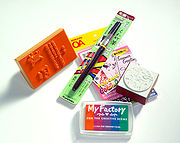
The postcards may have spaces for the sender to write a personal message. Blank cards are available, so people can hand-write or draw their own. Rubber stamps with conventional messages and with the annual animal are on sale at department stores and other outlets, and many people buy ink brushes for personal greetings. Special printing devices are popular, especially among people who practice crafts. Software also lets artists create their own designs and output them using their computer's color printer. Because a gregarious individual might have hundreds to write, print shops offer a wide variety of sample postcards with short messages so that the sender has only to write addresses. Even with the rise in popularity of email, the nengajō remains very popular in Japan.
Conventional nengajō greetings include: (I hope for your favour again in the coming year) (Happiness to you on the dawn [of a New Year]) (Happy New Year) (literally "early spring")
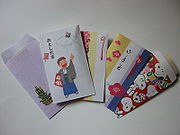 On New Year's Day, Japanese people have a custom of giving money to children. This is known as . It is handed out in small decorated envelopes called 'pochibukuro,' similar to Goshugi bukuro
or Chinese red envelopes and to the Scottish handsel. In the Edo period large stores and wealthy families gave out a small bag of mochi and a Mandarin orange
to spread happiness all around. The amount of money given depends on the age of the child but is usually the same if there is more than one child so that no one feels slighted. It is not uncommon for amounts greater than 10,000¥($100) to be given.
. This is made before New Year's Day and eaten during the beginning of January.
Mochi is made into a New Year's decoration called , formed from two round cakes of mochi with a placed on top. The name daidai is supposed to be auspicious since it means "several generations."
Because of mochi's extremely sticky texture, there is usually a small number of choking
deaths around New Year in Japan, particularly amongst the elderly. The death toll is reported in newspapers in the days after New Year.
, including haiku
(3 line poems) and renga
. All of the traditions above would be appropriate to include in haiku as kigo
(season words). There are also haiku that celebrate many of the "first" of the New Year, such as the "first sun
" (hatsuhi) or "first sunrise
", "first laughter
" (waraizome—starting the New Year with a smile is considered a good sign), and first dream
(hatsuyume
). Since the traditional New Year was later in the year than the current date, many of these mention the beginning of spring.
Along with the New Year's Day postcard, haiku might mention "first letter" (hatsudayori—meaning the first exchange of letters), "first calligraphy
" (kakizome
), and "first brush" (fude hajime).
, takoage (kite flying), koma (top
), sugoroku
, fukuwarai
(whereby a blindfolded person places paper parts of a face, such as eyes, eyebrows, a nose and a mouth, on a paper face), and karuta
.
aired on NHK on New Year's Eve. The show features two teams, red and white, of popular music artists competing against each other.
, with accompanying chorus, is traditionally performed throughout Japan during the New Years season. In December 2009, for example, there were 55 performances of the symphony by various major orchestras and choirs in Japan.
The Ninth was introduced to Japan by German prisoners-of-war held in Japan during World War I
. Japanese orchestras, notably the NHK Symphony Orchestra
, began performing the symphony in 1925. During World War II
, the Imperial government
promoted performances of the symphony, including on New Year's Eve, to encourage allegiance to Japanese nationalism. The symphony was considered appropriate in this regard because Nazi Germany
was an ally of Japan. After the war, orchestras and choruses, undergoing economic hard times during the reconstruction of Japan, promoted performances of the piece around New Years because of the popularity of the music with the public. In the 1960s, performances of the symphony at New Years became more widespread, including participation by local choirs and orchestras, and established the tradition which continues to this day.
Hatsuhinode (初日の出) is the first sunrise of the year. Before sunrise on January 1, people often drive to the coast or climb a mountain so that they can see the first sunrise of the new year.
Hatsumōde
is the first trip to a shrine or temple. Many people visit a shrine after midnight on December 31 or sometime during the day on January 1. If the weather is good, people often dress up or wear kimono
.
In addition to the other firsts mentioned above ("first sun
" (hatsuhi) or "first sunrise
", "first laughter
" (waraizome—starting the New Year with a smile is considered a good sign), first dream
(初夢, hatsuyume
), and "first letter" (hatsudayori—meaning the first exchange of letters) – in addition to haiku-specific ones), other "firsts" that are marked as special events include shigoto-hajime (仕事始め, the first work of the new year), keiko-hajime (稽古始め, the first practice of the new year), hatsugama (the first tea ceremony
of the new year), and the hatsu-uri (the first shopping sale of the new year).
Festival
A festival or gala is an event, usually and ordinarily staged by a local community, which centers on and celebrates some unique aspect of that community and the Festival....
s, with its own unique customs, and has been celebrated for centuries. Due to the importance of the holiday and the preparations required, the preceding days are quite busy, particularly the day before, known as Ōmisoka
Omisoka
, New Year's Eve, is the second-most important day in Japanese tradition because it is the final day of the old year and the eve of New Year's Day, which is the most important day of the year....
.
The Japanese New Year has been celebrated since 1873 according to the Gregorian calendar
Gregorian calendar
The Gregorian calendar, also known as the Western calendar, or Christian calendar, is the internationally accepted civil calendar. It was introduced by Pope Gregory XIII, after whom the calendar was named, by a decree signed on 24 February 1582, a papal bull known by its opening words Inter...
, on January 1 of each year (New Year's Day
New Year's Day
New Year's Day is observed on January 1, the first day of the year on the modern Gregorian calendar as well as the Julian calendar used in ancient Rome...
where the Gregorian calendar is used).
History
Prior to the Meiji PeriodMeiji period
The , also known as the Meiji era, is a Japanese era which extended from September 1868 through July 1912. This period represents the first half of the Empire of Japan.- Meiji Restoration and the emperor :...
, the date of the Japanese New Year was based on the Chinese lunar calendar
Chinese calendar
The Chinese calendar is a lunisolar calendar, incorporating elements of a lunar calendar with those of a solar calendar. It is not exclusive to China, but followed by many other Asian cultures as well...
, as are the contemporary Chinese
Chinese New Year
Chinese New Year – often called Chinese Lunar New Year although it actually is lunisolar – is the most important of the traditional Chinese holidays. It is an all East and South-East-Asia celebration...
, Korean
Korean New Year
Korean New Year, commonly known as Seollal , is the first day of the lunar calendar. It is the most important of the traditional Korean holidays. It consists of a period of celebrations, starting on New Year's Day. Koreans also celebrate solar New Year's Day on January 1 each year, following the...
, and Vietnamese New Year
Tet
Tet can mean:*Tết or Tết Nguyên Đán, the Vietnamese new year**Tet Offensive, a military campaign that began in 1968*Têt in Roussillon, France*Equal temperament, abbreviated as 12-TET, 19-TET and so on...
s. However, in 1873, five years after the Meiji Restoration
Meiji Restoration
The , also known as the Meiji Ishin, Revolution, Reform or Renewal, was a chain of events that restored imperial rule to Japan in 1868...
, Japan
Japan
Japan is an island nation in East Asia. Located in the Pacific Ocean, it lies to the east of the Sea of Japan, China, North Korea, South Korea and Russia, stretching from the Sea of Okhotsk in the north to the East China Sea and Taiwan in the south...
adopted the Gregorian calendar
Gregorian calendar
The Gregorian calendar, also known as the Western calendar, or Christian calendar, is the internationally accepted civil calendar. It was introduced by Pope Gregory XIII, after whom the calendar was named, by a decree signed on 24 February 1582, a papal bull known by its opening words Inter...
and the first day of January became the official and cultural New Year's Day.
Traditional food
Japanese people eat a special selection of dishes during the New Year celebration called , typically shortened to osechi. This consists of , , , , and . Many of these dishes are sweet, sour, or dried, so they can keep without refrigeration—the culinary traditions date to a time before households had refrigerators, when most stores closed for the holidays. There are many variations of osechi, and some foods eaten in one region are not eaten in other places (or are considered unfortunate or even banned) on New Year's Day. Another popular dish is , a soup with and other ingredients that differ based on various regions of Japan. Today, sashimiSashimi
Sashimi is a Japanese delicacy. It consists of very fresh raw meat, most commonly fish, sliced into thin pieces.-Origin:The word sashimi means "pierced body", i.e...
and sushi
Sushi
is a Japanese food consisting of cooked vinegared rice combined with other ingredients . Neta and forms of sushi presentation vary, but the ingredient which all sushi have in common is shari...
are often eaten, as well as non-Japanese foods. To let the overworked stomach rest, is prepared on the seventh day of January, a day known as .
Bell ringing
At midnight on December 31, Buddhist temples all over Japan ring their bells a total of 108 times to symbolize the 108 human sins in Buddhist belief, and to get rid of the 108 worldly desires regarding sense and feeling in every Japanese citizen. A major attraction is The Watched Night bell, in Tokyo. Japanese believe that the ringing of bells can rid off their sins during the previous year. After they are done ringing the bells, they celebrate and feast on soba noodles.Postcards
Christmas
Christmas or Christmas Day is an annual holiday generally celebrated on December 25 by billions of people around the world. It is a Christian feast that commemorates the birth of Jesus Christ, liturgically closing the Advent season and initiating the season of Christmastide, which lasts twelve days...
cards. Their original purpose was to give your faraway friends and relatives tidings of yourself and your immediate family. In other words, this custom existed for people to tell others whom they did not often meet that they were alive and well.
Japanese people send these postcards so that they arrive on the 1st of January. The post office guarantees to deliver the greeting postcards on the first of January if they are posted within a time limit, from mid-December to near the end of the month and are marked with the word nengajō. To deliver these cards on time, the post office usually hires students part-time to help deliver the letters.
It is customary not to send these postcards when one has had a death
Death
Death is the permanent termination of the biological functions that sustain a living organism. Phenomena which commonly bring about death include old age, predation, malnutrition, disease, and accidents or trauma resulting in terminal injury....
in the family during the year. In this case, a family member sends a simple postcard called 喪中葉書 (mochyuu hagaki もちゅうはがき, eng: mourning postcards) to inform friends and relatives they should not send New Year's cards, out of respect for the deceased.
People get their nengajō from many sources. Stationers sell preprinted cards. Most of these have the Chinese zodiac
Chinese zodiac
The Shēngxiào , better known in English as the Chinese Zodiac, is a scheme that relates each year to an animal and its reputed attributes, according to a 12-year mathematical cycle...
sign of the New Year as their design, or conventional greetings, or both. The Chinese zodiac has a cycle of 12 years. Each year is represented by an animal. The animals are, in order: rat, ox, tiger, rabbit, dragon, snake, horse, sheep, monkey, rooster, dog, and boar. 2007 was the year of the boar, 2008 was the year of the rat, 2009 was the year of the ox, 2010 was the year of the tiger, and 2011 is the year of the rabbit and 2012 will be the year of the dragon. Famous characters like Snoopy
Snoopy
Snoopy is an fictional character in the long-running comic strip Peanuts, by Charles M. Schulz. He is Charlie Brown's pet beagle. Snoopy began his life in the strip as a fairly conventional dog, but eventually evolved into perhaps the strip's most dynamic character—and among the most recognizable...
, (2006) and other cartoon characters like Mickey and Minnie Mouse, (2008) have been especially popular in their celebrated years.
The postcards may have spaces for the sender to write a personal message. Blank cards are available, so people can hand-write or draw their own. Rubber stamps with conventional messages and with the annual animal are on sale at department stores and other outlets, and many people buy ink brushes for personal greetings. Special printing devices are popular, especially among people who practice crafts. Software also lets artists create their own designs and output them using their computer's color printer. Because a gregarious individual might have hundreds to write, print shops offer a wide variety of sample postcards with short messages so that the sender has only to write addresses. Even with the rise in popularity of email, the nengajō remains very popular in Japan.
Conventional nengajō greetings include: (I hope for your favour again in the coming year) (Happiness to you on the dawn [of a New Year]) (Happy New Year) (literally "early spring")
Otoshidama
Goshugi bukuro
A is a special envelope in which money is given as a gift at weddings in Japan.It is very common in Japan to give a gift of money at weddings. The giver inserts the money into a shūgi-bukuro on which they have written their name. The shūgi-bukuro is handed to the receptionist of the reception party...
or Chinese red envelopes and to the Scottish handsel. In the Edo period large stores and wealthy families gave out a small bag of mochi and a Mandarin orange
Mandarin orange
The orange, also known as the ' or mandarine , is a small citrus tree with fruit resembling other oranges. Mandarin oranges are usually eaten plain or in fruit salads...
to spread happiness all around. The amount of money given depends on the age of the child but is usually the same if there is more than one child so that no one feels slighted. It is not uncommon for amounts greater than 10,000¥($100) to be given.
Mochi
Another custom is creating . Boiled is put into a wooden shallow bucket-like container and patted with water by one person while another person hits it with a large wooden mallet. Mashing the rice, it forms a sticky white dumplingDumpling
Dumplings are cooked balls of dough. They are based on flour, potatoes or bread, and may include meat, fish, vegetables, or sweets. They may be cooked by boiling, steaming, simmering, frying, or baking. They may have a filling, or there may be other ingredients mixed into the dough. Dumplings may...
. This is made before New Year's Day and eaten during the beginning of January.
Mochi is made into a New Year's decoration called , formed from two round cakes of mochi with a placed on top. The name daidai is supposed to be auspicious since it means "several generations."
Because of mochi's extremely sticky texture, there is usually a small number of choking
Choking
Choking is the mechanical obstruction of the flow of air from the environment into the lungs. Choking prevents breathing, and can be partial or complete, with partial choking allowing some, although inadequate, flow of air into the lungs. Prolonged or complete choking results in asphyxia which...
deaths around New Year in Japan, particularly amongst the elderly. The death toll is reported in newspapers in the days after New Year.
Poetry
The New Year traditions are also a part of Japanese poetryJapanese poetry
Japanese poets first encountered Chinese poetry during the Tang Dynasty. It took them several hundred years to digest the foreign impact, make it a part of their culture and merge it with their literary tradition in their mother tongue, and begin to develop the diversity of their native poetry. For...
, including haiku
Haiku
' , plural haiku, is a very short form of Japanese poetry typically characterised by three qualities:* The essence of haiku is "cutting"...
(3 line poems) and renga
Renga
' is a genre of Japanese collaborative poetry. A renga consists of at least two or stanzas, usually many more. The opening stanza of the renga, called the , became the basis for the modern haiku form of poetry....
. All of the traditions above would be appropriate to include in haiku as kigo
Kigo
is a word or phrase associated with a particular season, used in Japanese poetry. Kigo are used in the collaborative linked-verse forms renga and renku, as well as in haiku, to indicate the season referred to in the stanza...
(season words). There are also haiku that celebrate many of the "first" of the New Year, such as the "first sun
Sun
The Sun is the star at the center of the Solar System. It is almost perfectly spherical and consists of hot plasma interwoven with magnetic fields...
" (hatsuhi) or "first sunrise
Sunrise
Sunrise is the instant at which the upper edge of the Sun appears above the horizon in the east. Sunrise should not be confused with dawn, which is the point at which the sky begins to lighten, some time before the sun itself appears, ending twilight...
", "first laughter
Laughter
Laughing is a reaction to certain stimuli, fundamentally stress, which serves as an emotional balancing mechanism. Traditionally, it is considered a visual expression of happiness, or an inward feeling of joy. It may ensue from hearing a joke, being tickled, or other stimuli...
" (waraizome—starting the New Year with a smile is considered a good sign), and first dream
Dream
Dreams are successions of images, ideas, emotions, and sensations that occur involuntarily in the mind during certain stages of sleep. The content and purpose of dreams are not definitively understood, though they have been a topic of scientific speculation, philosophical intrigue and religious...
(hatsuyume
Hatsuyume
Hatsuyume is the Japanese word for the first dream had in the new year. Traditionally, the contents of the dream would foretell the luck of the dreamer in the ensuing year. In Japan, the night of December 31 was often passed without sleeping, thus the hatsuyume was often the dream seen the night...
). Since the traditional New Year was later in the year than the current date, many of these mention the beginning of spring.
Along with the New Year's Day postcard, haiku might mention "first letter" (hatsudayori—meaning the first exchange of letters), "first calligraphy
Calligraphy
Calligraphy is a type of visual art. It is often called the art of fancy lettering . A contemporary definition of calligraphic practice is "the art of giving form to signs in an expressive, harmonious and skillful manner"...
" (kakizome
Kakizome
Kakizome is a Japanese term for the first calligraphy written at the beginning of a year, traditionally on January 2. Other terms include 吉書(kissho), 試筆(shihitsu)and 初硯(hatsusuzuri)....
), and "first brush" (fude hajime).
Games
It was also customary to play many New Year's games. These include hanetsukiHanetsuki
Hanetsuki is a Japanese traditional game, similar to badminton without a net, played with a rectangular wooden paddle called a hagoita and a brightly-coloured shuttlecock. Often played by girls at the New Year, the game can be played in two fashions: by one person attempting to keep the...
, takoage (kite flying), koma (top
Top
A top is a toy that can be spun on an axis, balancing on a point. This motion is produced in the most simple forms of top by twirling the stem using the fingers. More sophisticated tops are spun by by holding the axis firmly while pulling a string or twisting a stick or pushing an auger as shown...
), sugoroku
Sugoroku
refers to two different forms of Japanese board game, one similar to western backgammon and the other similar to western Snakes and ladders.Sugoroku plays identically to backgammon , except for the following differences:...
, fukuwarai
Fukuwarai
, or in English, "Lucky Laugh", is a Japanese game played around New Year's . The game is usually played by children, but adults may sometimes play also...
(whereby a blindfolded person places paper parts of a face, such as eyes, eyebrows, a nose and a mouth, on a paper face), and karuta
Karuta
is a Japanese card game.The basic idea of any karuta game is to be able to quickly determine which card out of an array of cards is required and then to grab the card before it is grabbed by an opponent. There are various types of cards which can be used to play karuta...
.
Entertainment
There are many shows created as the end-of-year, and beginning-of-year entertainment, and some being a special edition of the regular shows. For many decades, it has been customary to watch the TV show Kōhaku Uta GassenKohaku Uta Gassen
, more commonly known as simply Kōhaku, is an annual music show on New Year's Eve produced by Japanese public broadcaster NHK and broadcast on both television and radio, nationally and internationally by NHK's networks and some overseas broadcasters which bought the program...
aired on NHK on New Year's Eve. The show features two teams, red and white, of popular music artists competing against each other.
Beethoven's Ninth
Beethoven's Ninth SymphonySymphony No. 9 (Beethoven)
The Symphony No. 9 in D minor, Op. 125, is the final complete symphony of Ludwig van Beethoven. Completed in 1824, the symphony is one of the best known works of the Western classical repertoire, and has been adapted for use as the European Anthem...
, with accompanying chorus, is traditionally performed throughout Japan during the New Years season. In December 2009, for example, there were 55 performances of the symphony by various major orchestras and choirs in Japan.
The Ninth was introduced to Japan by German prisoners-of-war held in Japan during World War I
World War I
World War I , which was predominantly called the World War or the Great War from its occurrence until 1939, and the First World War or World War I thereafter, was a major war centred in Europe that began on 28 July 1914 and lasted until 11 November 1918...
. Japanese orchestras, notably the NHK Symphony Orchestra
NHK Symphony Orchestra
The in Tokyo, Japan began as the New Symphony Orchestra on October 5, 1926 and was the country's first professional symphony orchestra. Later, it changed its name to Japan Symphony Orchestra and in 1951, after receiving financial support from NHK, it took its current name...
, began performing the symphony in 1925. During World War II
World War II
World War II, or the Second World War , was a global conflict lasting from 1939 to 1945, involving most of the world's nations—including all of the great powers—eventually forming two opposing military alliances: the Allies and the Axis...
, the Imperial government
Empire of Japan
The Empire of Japan is the name of the state of Japan that existed from the Meiji Restoration on 3 January 1868 to the enactment of the post-World War II Constitution of...
promoted performances of the symphony, including on New Year's Eve, to encourage allegiance to Japanese nationalism. The symphony was considered appropriate in this regard because Nazi Germany
Nazi Germany
Nazi Germany , also known as the Third Reich , but officially called German Reich from 1933 to 1943 and Greater German Reich from 26 June 1943 onward, is the name commonly used to refer to the state of Germany from 1933 to 1945, when it was a totalitarian dictatorship ruled by...
was an ally of Japan. After the war, orchestras and choruses, undergoing economic hard times during the reconstruction of Japan, promoted performances of the piece around New Years because of the popularity of the music with the public. In the 1960s, performances of the symphony at New Years became more widespread, including participation by local choirs and orchestras, and established the tradition which continues to this day.
Hatsumōde, hatsuhinode, the "firsts" of the year
Celebrating the new year in Japan also means paying special attention to the first time something is done in the new year.Hatsuhinode (初日の出) is the first sunrise of the year. Before sunrise on January 1, people often drive to the coast or climb a mountain so that they can see the first sunrise of the new year.
Hatsumōde
Hatsumode
is the first shrine visit of the New Year in Japan. Some people visit a Buddhist temple instead. Many visit on the first, second, or third day of the year as most are off work on those days. Generally, wishes for the new year are made, new o-mamori are bought, and the old ones are returned to the...
is the first trip to a shrine or temple. Many people visit a shrine after midnight on December 31 or sometime during the day on January 1. If the weather is good, people often dress up or wear kimono
Kimono
The is a Japanese traditional garment worn by men, women and children. The word "kimono", which literally means a "thing to wear" , has come to denote these full-length robes...
.
In addition to the other firsts mentioned above ("first sun
Sun
The Sun is the star at the center of the Solar System. It is almost perfectly spherical and consists of hot plasma interwoven with magnetic fields...
" (hatsuhi) or "first sunrise
Sunrise
Sunrise is the instant at which the upper edge of the Sun appears above the horizon in the east. Sunrise should not be confused with dawn, which is the point at which the sky begins to lighten, some time before the sun itself appears, ending twilight...
", "first laughter
Laughter
Laughing is a reaction to certain stimuli, fundamentally stress, which serves as an emotional balancing mechanism. Traditionally, it is considered a visual expression of happiness, or an inward feeling of joy. It may ensue from hearing a joke, being tickled, or other stimuli...
" (waraizome—starting the New Year with a smile is considered a good sign), first dream
Dream
Dreams are successions of images, ideas, emotions, and sensations that occur involuntarily in the mind during certain stages of sleep. The content and purpose of dreams are not definitively understood, though they have been a topic of scientific speculation, philosophical intrigue and religious...
(初夢, hatsuyume
Hatsuyume
Hatsuyume is the Japanese word for the first dream had in the new year. Traditionally, the contents of the dream would foretell the luck of the dreamer in the ensuing year. In Japan, the night of December 31 was often passed without sleeping, thus the hatsuyume was often the dream seen the night...
), and "first letter" (hatsudayori—meaning the first exchange of letters) – in addition to haiku-specific ones), other "firsts" that are marked as special events include shigoto-hajime (仕事始め, the first work of the new year), keiko-hajime (稽古始め, the first practice of the new year), hatsugama (the first tea ceremony
Japanese tea ceremony
The Japanese tea ceremony, also called the Way of Tea, is a Japanese cultural activity involving the ceremonial preparation and presentation of matcha, powdered green tea. In Japanese, it is called . The manner in which it is performed, or the art of its performance, is called...
of the new year), and the hatsu-uri (the first shopping sale of the new year).
See also
- Customs and etiquette of JapanCustoms and etiquette of JapanThe code of etiquette in Japan governs the expectations of social behavior in the country and is considered very important. Like many social cultures, etiquette varies greatly depending on your status with the person in question. Many books instruct readers on its minutiae.Some conventions may be...
- Japanese festivalsJapanese festivalsJapanese festivals are traditional festive occasions. Some festivals have their roots in Chinese festivals but have undergone dramatic changes as they mixed with local customs....
- Japanese calendarJapanese calendarOn January 1, 1873, Japan adopted the Gregorian calendar. Before 1873, the Chinese style lunisolar calendar had been in use since 7th century. Japanese eras are still in use.-System:...
- Japanese cuisineJapanese cuisineJapanese cuisine has developed over the centuries as a result of many political and social changes throughout Japan. The cuisine eventually changed with the advent of the Medieval age which ushered in a shedding of elitism with the age of shogun rule...
- New YearNew YearThe New Year is the day that marks the time of the beginning of a new calendar year, and is the day on which the year count of the specific calendar used is incremented. For many cultures, the event is celebrated in some manner....
- TosoToso, or o-toso, is spiced medicinal sake traditionally drunk during New Year celebrations in Japan.-Culture:Toso is drunk to flush away the previous year's maladies and to aspire to lead a long life...
Spiced medicinal sake