

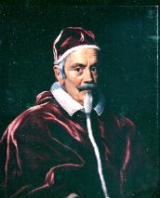
Pope Clement X

Encyclopedia
Pope Clement X born Emilio Bonaventura Altieri, was Pope
from 29 April 1670 to 22 July 1676.
lady. The Altieri family belonged to the ancient Roman nobility and had enjoyed the highest consideration at Rome for several centuries; they had occasionally contracted alliances with the Colonnas and the Orsinis. During earlier pontificates, Altieri held many important offices and had been entrusted with several delicate missions.
of Poland
. On his return to Rome, he was named Bishop of Camerino, then governor of Loreto
and of all Umbria
. Pope Urban VIII
(1623–44) gave him charge of the works designed to protect the territory of Ravenna
from the unruly Po River
.
Pope Innocent X
(1644–55) sent him as nuncio to Naples
, where he remained for eight years. He is credited with the re-establishment of peace after the stormy days of Masaniello
. Pope Alexander VII
(1655–67) confided to him a mission to Poland.
Pope Clement IX
(1667–69) named him Superintendent of the Papal Exchequer (in charge of the Church's finances), and in 1667 his maestro di camera, and he was made Secretary of the Congregation of Bishops and Regulars. Just before his death, Clement IX made him a Cardinal
. He was then about seventy-nine years of age; and Clement IX, when making him a member of the Sacred College
, said to him: "You will be our successor."
After the funeral of Pope Clement IX
, sixty-two electors entered into conclave
on 20 December 1669. Forty-two votes were necessary, and heated discussion prevailed for four months; Giovanni Cardinal Conti was supported by twenty-two votes; Cardinal Rospigliosi, nephew of the late Pope, had thirty, or, as some say, thirty-three, with two at the accesso, so that he needed only seven more votes to gain the tiara
. Cardinal Cerri obtained twenty-three votes.
At length the cardinals agreed to resort to the old expedient of electing a cardinal of advanced years, and proposed Cardinal Altieri, an octogenarian, whose long life had been spent in the service of the Church, and whom Clement IX, on the eve of his death, had raised to the dignity of the purple. The reason a prelate
of such transcendent merits received the cardinalate so late in life seems to have been that he had waived his claims to the elevation in favour of an older brother.
on 11 May. With tears he accepted, and out of gratitude to his benefactor, by ten years his junior, he assumed the name of Clement X.
All but one of the male scions of the Altieri family had chosen the ecclesiastical career. On his accession to the papacy, Clement X, in order to save the Altieri name from extinction, adopted the Paluzzi family, and proposed that one of the Paluzzi should marry Laura Caterina Altieri, the sole heiress of the family. In exchange for adopting the Altieri surname he would make one of the Paluzzi a Cardinal. Following the wedding, which he officiated, he appointed his relative by marriage Cardinal Paluzzi-Altieri, the uncle of Laura's new husband, to the Office of Cardinal Nephew to take on the duties which he was prevented from doing by age. The main activity was to invest the Church's money, and with advancing years gradually entrusted to him the management of affairs, to such an extent that the Romans said he had reserved to himself only the episcopal functions of benedicere et sanctificare, resigning in favour of the Cardinal the administrative duties of regere et gubernare.
On the 8th of June Clement X took possession of St. John Lateran. On 11 June, he confirmed the Minor Observantines in the Holy Land
in the privileges and indulgences granted to those who visit the holy places, according to the decree of Popes Alexander VII and Clement IX. In the same month he granted to the prelate-clerks of the chamber the use of the violet-coloured band around their hats.
Like all the pontiffs, Clement X advised the Christian princes to love each other, and to prove it by an entire confidence, by generous measures, and by a prudent and scrupulous conduct. It was especially between Spain
and France
that the pope desired to witness a renewal of feelings of good understanding.
In 1671, the Pope published an edict by which he declared that a noble might be a merchant without loss of his nobility, provided always that he did not sell by retail".
Clement X confirmed the exemptions granted by Pope Gregory XIII
(1572–85) to the German College at Rome in 1671; and then, on 16 October 1672, he ordered the pupils to swear that at the close of their studies they would set out for Germany
without a day's delay.
On 13 January 1672, Clement X regulated the formalities to be observed in removing the relic
s of saints from sacred cemeteries. No one was to remove such relics without the permission of the cardinal-vicar. They were not to be exposed for the veneration of the faithful, unless previously examined by the same cardinal. The principal relics of the martyr–that is to say, the head, the legs, the arms, and the part in which they suffered–were to be exposed only in the churches, and they were not to be given to private persons, but only to princes and high prelates; and even to them but rarely, lest the too great profusion should deprive relics of the respect which they ought to inspire. The Holy Father decreed severe penalties against all who gave a relic any name but that given by the cardinal-vicar. The pain of excommunication
was pronounced against all who should demand any sum whatever for sealed and authentic relics. These decrees, and others made by preceding Popes, were confirmed by Pope Clement XI
(1700–21) in 1704. He beatified
Pope Pius V
(1566–72), Francis Solano, and John of the Cross
, all subsequently canonized by Clement XI and Pope Benedict XIII
(1724–30).
Clement X, on the 24th of November, 1673, beatified nineteen Martyrs of Gorkum
, taken prisoner at Gorcum
, the Netherlands
, and put to death in Brielle
on the 9th of July, 1572, in hatred of the Catholic faith, the primacy of the Pope, the Roman Church, and the Holy Sacrament of the Eucharist
. Of the nineteen Gorcum martyrs, eleven were Franciscan
priests; Peter Ascanius and Cornelius Vican, laymen; one Dominican, two Premonstratensian
monks, a regular canon of Saint Augustine
, and four secular parish priests.
Fernando III
called El Santo (the Saint), (1198/1199 – 30 May 1252) was a king of Castile (1217–1252) and Leon (1230–1252). He was the son of Alfonso IX and Berenguela of Castile, daughter of Alfonso VIII. In 1231 he united Castile and Leon permanently. Fernando was canonized by Pope Clement X in 1671. Several places named San Fernando were founded across the Spanish Empire
.
Clement X also had declared Venerable
one of the famous spanish mystics
, Sister María de Jesús de Ágreda
.
, the number of the faithful, and the wide field of labour, resolved to give the Church an independent organisation, and erected a see
at Quebec
, the bishop to depend directly on the Holy See
; this provision would later secure its permanence after Quebec passed into the hands of England
. The first bishop was Monsignor
Francois de Montmorency-Laval.
In 1673, there arrived at Rome ambassadors from the Grand Duke of Muscovy, Alexei not John Basilowitz. He solicited from the Pope the title of Czar, which, however, he had already conferred upon himself. At the same time it could not be forgotten that he gave strong financial aid to King John Sobieski of Poland
in their fight against the Turkish
invaders. But Paul Menesius
, a Scotsman, who was the ambassador, could not obtain the grant or sanction of that title, though he was received with great magnificence and had many precious gifts to carry back to his master. The Grand Duke of Muscovy did not profess the Catholic faith in such a manner as to give any assurance of his intentions, and the King of Poland had looked upon the embassy with displeasure.
Another edict confirmed the first, and ordered the confiscation without distinction of all goods that did not pay the new tax. The cardinals at first complained, though with moderation. But the ambassadors didn't speak Clement X's language.
The Cardinal nephew maintained that Clement X, within his own State, might make what rules he pleased. Then the ambassadors of the empire, of France
, Spain
, and Venice
, sent their secretaries to demand an audience of the Pope. The chief chamberlain replied that the Pope was engaged that day. And for four days in succession the chamberlain gave the same answer to the same applicants. Clement X, learning at length what had occurred, declared that he had given no such order. The ambassadors then sent their secretaries to ask an audience of Cardinal Altieri. He not only refused to admit them, but closed his doors and increased the guard at the pontifical palace, so that the offence could go no further. Subsequently the Cardinal nephew wrote to the nuncios who resided in the courts of Europe, stating that the excesses committed by the ambassadors had induced the pope to publish the edict. The ambassadors, on the contrary, assured their sovereigns that the accusation was a pretext.
The conflict lasted for more than a year; and Clement X, who loved peace, at length referred the matter to a congregation. Some time after, Cardinal Altieri declared that he had not intended to comprise the ambassadors among those for whom the edict was intended, and that the pope had never contemplated subjecting them to it.
Queen Christina of Sweden
, who had become a Catholic and moved to Rome in December 1655, made Clement X prohibit the custom of chasing Jews
through the streets during the carnival
. In 1686 she issued a declaration that Roman Jews stood under her protection, signed la Regina - the queen.
prevented him from making that holy visit more than five times. He went twelve times to Trinity hospital to wash the feet of the pilgrims, and after the ceremony gave them liberal alms.
 However, Rome made some complaints, and said that, though Clement X was Pope in name, Cardinal Altieri was Pope in fact.
(1643–1715), an imperious monarch over ecclesiastical matters (the struggle concerned the régale, or revenues of vacant diocese
s and abbey
s, which resulted in continued tension with France
). He decorated the bridge of Sant'Angelo with the ten statues of angels in Carrara marble still to be seen there.
To Pope Clement X we owe the two beautiful fountains which adorn the Piazza of St. Peter's church near the tribune, where a monument has been erected to his memory. During his papacy, the Palazzo Altieri
in central Rome was refurbished.
Clement X appointed Francesco Lorenzo Brancati di Lauria
head of the Vatican library
.
Pope
The Pope is the Bishop of Rome, a position that makes him the leader of the worldwide Catholic Church . In the Catholic Church, the Pope is regarded as the successor of Saint Peter, the Apostle...
from 29 April 1670 to 22 July 1676.
Early life
Emilio Altieri was born in Rome, the son of Lorenzo Altieri and Victoria Delphini, a VenetianVenice
Venice is a city in northern Italy which is renowned for the beauty of its setting, its architecture and its artworks. It is the capital of the Veneto region...
lady. The Altieri family belonged to the ancient Roman nobility and had enjoyed the highest consideration at Rome for several centuries; they had occasionally contracted alliances with the Colonnas and the Orsinis. During earlier pontificates, Altieri held many important offices and had been entrusted with several delicate missions.
Early work
After finishing his studies, Altieri was named auditor of Giovanni Battista Lancellotti in 1623, in the nunciatureNuncio
Nuncio is an ecclesiastical diplomatic title, derived from the ancient Latin word, Nuntius, meaning "envoy." This article addresses this title as well as derived similar titles, all within the structure of the Roman Catholic Church...
of Poland
Poland
Poland , officially the Republic of Poland , is a country in Central Europe bordered by Germany to the west; the Czech Republic and Slovakia to the south; Ukraine, Belarus and Lithuania to the east; and the Baltic Sea and Kaliningrad Oblast, a Russian exclave, to the north...
. On his return to Rome, he was named Bishop of Camerino, then governor of Loreto
Loreto (AN)
Loreto is a hilltown and comune of the Italian province of Ancona, in the Marche. It is mostly famous as the seat of the Basilica della Santa Casa, a popular Catholic pilgrimage site.-Location:...
and of all Umbria
Umbria
Umbria is a region of modern central Italy. It is one of the smallest Italian regions and the only peninsular region that is landlocked.Its capital is Perugia.Assisi and Norcia are historical towns associated with St. Francis of Assisi, and St...
. Pope Urban VIII
Pope Urban VIII
Pope Urban VIII , born Maffeo Barberini, was pope from 1623 to 1644. He was the last pope to expand the papal territory by force of arms, and was a prominent patron of the arts and reformer of Church missions...
(1623–44) gave him charge of the works designed to protect the territory of Ravenna
Ravenna
Ravenna is the capital city of the Province of Ravenna in the Emilia-Romagna region of Italy and the second largest comune in Italy by land area, although, at , it is little more than half the size of the largest comune, Rome...
from the unruly Po River
Po River
The Po |Ligurian]]: Bodincus or Bodencus) is a river that flows either or – considering the length of the Maira, a right bank tributary – eastward across northern Italy, from a spring seeping from a stony hillside at Pian del Re, a flat place at the head of the Val Po under the northwest face...
.
Pope Innocent X
Pope Innocent X
Pope Innocent X , born Giovanni Battista Pamphilj , was Pope from 1644 to 1655. Born in Rome of a family from Gubbio in Umbria who had come to Rome during the pontificate of Pope Innocent IX, he graduated from the Collegio Romano and followed a conventional cursus honorum, following his uncle...
(1644–55) sent him as nuncio to Naples
Naples
Naples is a city in Southern Italy, situated on the country's west coast by the Gulf of Naples. Lying between two notable volcanic regions, Mount Vesuvius and the Phlegraean Fields, it is the capital of the region of Campania and of the province of Naples...
, where he remained for eight years. He is credited with the re-establishment of peace after the stormy days of Masaniello
Masaniello
Masaniello was a Neapolitan fisherman, who became leader of the revolt against Spanish Habsburg rule in Naples in 1647.-Name and place of birth:...
. Pope Alexander VII
Pope Alexander VII
Pope Alexander VII , born Fabio Chigi, was Pope from 7 April 1655, until his death.- Early life :Born in Siena, a member of the illustrious banking family of Chigi and a great-nephew of Pope Paul V , he was privately tutored and eventually received doctorates of philosophy, law, and theology from...
(1655–67) confided to him a mission to Poland.
Pope Clement IX
Pope Clement IX
Pope Clement IX , born Giulio Rospigliosi, was Pope from 1667 to 1669.-Early life:Born Giulio Rospigliosi to a noble family of Pistoia, Grand Duchy of Tuscany, he was a pupil of the Jesuits. After receiving his doctorate in philosophy at the University of Pisa, he taught theology there...
(1667–69) named him Superintendent of the Papal Exchequer (in charge of the Church's finances), and in 1667 his maestro di camera, and he was made Secretary of the Congregation of Bishops and Regulars. Just before his death, Clement IX made him a Cardinal
Cardinal (Catholicism)
A cardinal is a senior ecclesiastical official, usually an ordained bishop, and ecclesiastical prince of the Catholic Church. They are collectively known as the College of Cardinals, which as a body elects a new pope. The duties of the cardinals include attending the meetings of the College and...
. He was then about seventy-nine years of age; and Clement IX, when making him a member of the Sacred College
College of Cardinals
The College of Cardinals is the body of all cardinals of the Catholic Church.A function of the college is to advise the pope about church matters when he summons them to an ordinary consistory. It also convenes on the death or abdication of a pope as a papal conclave to elect a successor...
, said to him: "You will be our successor."
After the funeral of Pope Clement IX
Pope Clement IX
Pope Clement IX , born Giulio Rospigliosi, was Pope from 1667 to 1669.-Early life:Born Giulio Rospigliosi to a noble family of Pistoia, Grand Duchy of Tuscany, he was a pupil of the Jesuits. After receiving his doctorate in philosophy at the University of Pisa, he taught theology there...
, sixty-two electors entered into conclave
Papal conclave, 1669–1670
The papal conclave from December 20, 1669 to April 29, 1670 elected Cardinal Emilio Altieri as Pope Clement X.- Cardinal electors :-Absentee cardinals:...
on 20 December 1669. Forty-two votes were necessary, and heated discussion prevailed for four months; Giovanni Cardinal Conti was supported by twenty-two votes; Cardinal Rospigliosi, nephew of the late Pope, had thirty, or, as some say, thirty-three, with two at the accesso, so that he needed only seven more votes to gain the tiara
Papal Tiara
The Papal Tiara, also known incorrectly as the Triple Tiara, or in Latin as the Triregnum, in Italian as the Triregno and as the Trirègne in French, is the three-tiered jewelled papal crown, supposedly of Byzantine and Persian origin, that is a prominent symbol of the papacy...
. Cardinal Cerri obtained twenty-three votes.
At length the cardinals agreed to resort to the old expedient of electing a cardinal of advanced years, and proposed Cardinal Altieri, an octogenarian, whose long life had been spent in the service of the Church, and whom Clement IX, on the eve of his death, had raised to the dignity of the purple. The reason a prelate
Prelate
A prelate is a high-ranking member of the clergy who is an ordinary or who ranks in precedence with ordinaries. The word derives from the Latin prælatus, the past participle of præferre, which means "carry before", "be set above or over" or "prefer"; hence, a prelate is one set over others.-Related...
of such transcendent merits received the cardinalate so late in life seems to have been that he had waived his claims to the elevation in favour of an older brother.
Pontificate
On 29 April 1670, the papacy was offered to him by fifty-nine Cardinals present at the election; only two being against him. He, however, objected because of his age, for he was almost eighty, and exclaimed, "I am too old to bear such a burden." Pointing to Cardinal Brancacci, Altieri said he was the Cardinal whom they ought to elect. He persisted in refusing, protesting that he no longer had strength or memory; but he was crownedPapal Coronation
A papal coronation was the ceremony of the placing of the Papal Tiara on a newly elected pope. The first recorded papal coronation was that of Pope Celestine II in 1143. Soon after his coronation in 1963, Pope Paul VI abandoned the practice of wearing the tiara. His successors have chosen not to...
on 11 May. With tears he accepted, and out of gratitude to his benefactor, by ten years his junior, he assumed the name of Clement X.
All but one of the male scions of the Altieri family had chosen the ecclesiastical career. On his accession to the papacy, Clement X, in order to save the Altieri name from extinction, adopted the Paluzzi family, and proposed that one of the Paluzzi should marry Laura Caterina Altieri, the sole heiress of the family. In exchange for adopting the Altieri surname he would make one of the Paluzzi a Cardinal. Following the wedding, which he officiated, he appointed his relative by marriage Cardinal Paluzzi-Altieri, the uncle of Laura's new husband, to the Office of Cardinal Nephew to take on the duties which he was prevented from doing by age. The main activity was to invest the Church's money, and with advancing years gradually entrusted to him the management of affairs, to such an extent that the Romans said he had reserved to himself only the episcopal functions of benedicere et sanctificare, resigning in favour of the Cardinal the administrative duties of regere et gubernare.
On the 8th of June Clement X took possession of St. John Lateran. On 11 June, he confirmed the Minor Observantines in the Holy Land
Holy Land
The Holy Land is a term which in Judaism refers to the Kingdom of Israel as defined in the Tanakh. For Jews, the Land's identifiction of being Holy is defined in Judaism by its differentiation from other lands by virtue of the practice of Judaism often possible only in the Land of Israel...
in the privileges and indulgences granted to those who visit the holy places, according to the decree of Popes Alexander VII and Clement IX. In the same month he granted to the prelate-clerks of the chamber the use of the violet-coloured band around their hats.
Like all the pontiffs, Clement X advised the Christian princes to love each other, and to prove it by an entire confidence, by generous measures, and by a prudent and scrupulous conduct. It was especially between Spain
Spain
Spain , officially the Kingdom of Spain languages]] under the European Charter for Regional or Minority Languages. In each of these, Spain's official name is as follows:;;;;;;), is a country and member state of the European Union located in southwestern Europe on the Iberian Peninsula...
and France
France
The French Republic , The French Republic , The French Republic , (commonly known as France , is a unitary semi-presidential republic in Western Europe with several overseas territories and islands located on other continents and in the Indian, Pacific, and Atlantic oceans. Metropolitan France...
that the pope desired to witness a renewal of feelings of good understanding.
In 1671, the Pope published an edict by which he declared that a noble might be a merchant without loss of his nobility, provided always that he did not sell by retail".
Canonizations and beatifications
On 12 April 1671, Clement X canonised five new saints:- Saint Gaetan of Thiene, founder of the Clerks of Divine Providence, better known by their other title of TheatinesTheatinesThe Theatines or the Congregation of Clerks Regular of the Divine Providence are a male religious order of the Catholic Church, with the post-nominal initials "C.R."-Foundation:...
. - Saint Francis Borgia, fourth Duke of GandiaDuke of GandiaThe hereditary Spanish title duke of Gandía was created in 1485 by Ferdinand II of Aragon from the original Italian title "duke of Candia" belonging to the Italian Stato di Mare or Italian Kingdoms of the Mediterranean Sea; originally granted around 1206 to a Genoan marquis member of the House of...
, Marquis of Lombay, and viceroy of CataloniaCataloniaCatalonia is an autonomous community in northeastern Spain, with the official status of a "nationality" of Spain. Catalonia comprises four provinces: Barcelona, Girona, Lleida, and Tarragona. Its capital and largest city is Barcelona. Catalonia covers an area of 32,114 km² and has an...
, born in 1510. He took the habit of the Jesuits in 1547, and became generalSuperior General of the Society of JesusThe Superior General of the Society of Jesus is the official title of the leader of the Society of Jesus—the Roman Catholic religious order, also known as the Jesuits. He is generally addressed as Father General. The position carries the nickname of Black Pope, after his simple black priest's...
and one of the most illustrious ornaments of that religious order. - Saint Philip Benizi, a noble Florentine, a religious of the order of the Servants of Mary, of which he was the reviver, and not, as has been stated by some, the founder. Pope Leo XPope Leo XPope Leo X , born Giovanni di Lorenzo de' Medici, was the Pope from 1513 to his death in 1521. He was the last non-priest to be elected Pope. He is known for granting indulgences for those who donated to reconstruct St. Peter's Basilica and his challenging of Martin Luther's 95 Theses...
(1513–21) had beatified him in 1516. - Saint Louis Beltran, or Bertrand, a Spaniard, of the family of Saint Vincent Ferrer, and like him a DominicanDominican OrderThe Order of Preachers , after the 15th century more commonly known as the Dominican Order or Dominicans, is a Catholic religious order founded by Saint Dominic and approved by Pope Honorius III on 22 December 1216 in France...
. - Saint Rose of Lima, of the third order of Saint DominicSaint DominicSaint Dominic , also known as Dominic of Osma, often called Dominic de Guzmán and Domingo Félix de Guzmán was the founder of the Friars Preachers, popularly called the Dominicans or Order of Preachers , a Catholic religious order...
, born at LimaLimaLima is the capital and the largest city of Peru. It is located in the valleys of the Chillón, Rímac and Lurín rivers, in the central part of the country, on a desert coast overlooking the Pacific Ocean. Together with the seaport of Callao, it forms a contiguous urban area known as the Lima...
, PeruPeruPeru , officially the Republic of Peru , is a country in western South America. It is bordered on the north by Ecuador and Colombia, on the east by Brazil, on the southeast by Bolivia, on the south by Chile, and on the west by the Pacific Ocean....
in 1586. Saint Rose, beatified by Clement IX, was the first American saint.
Clement X confirmed the exemptions granted by Pope Gregory XIII
Pope Gregory XIII
Pope Gregory XIII , born Ugo Boncompagni, was Pope from 1572 to 1585. He is best known for commissioning and being the namesake for the Gregorian calendar, which remains the internationally-accepted civil calendar to this date.-Youth:He was born the son of Cristoforo Boncompagni and wife Angela...
(1572–85) to the German College at Rome in 1671; and then, on 16 October 1672, he ordered the pupils to swear that at the close of their studies they would set out for Germany
Germany
Germany , officially the Federal Republic of Germany , is a federal parliamentary republic in Europe. The country consists of 16 states while the capital and largest city is Berlin. Germany covers an area of 357,021 km2 and has a largely temperate seasonal climate...
without a day's delay.
On 13 January 1672, Clement X regulated the formalities to be observed in removing the relic
Relic
In religion, a relic is a part of the body of a saint or a venerated person, or else another type of ancient religious object, carefully preserved for purposes of veneration or as a tangible memorial...
s of saints from sacred cemeteries. No one was to remove such relics without the permission of the cardinal-vicar. They were not to be exposed for the veneration of the faithful, unless previously examined by the same cardinal. The principal relics of the martyr–that is to say, the head, the legs, the arms, and the part in which they suffered–were to be exposed only in the churches, and they were not to be given to private persons, but only to princes and high prelates; and even to them but rarely, lest the too great profusion should deprive relics of the respect which they ought to inspire. The Holy Father decreed severe penalties against all who gave a relic any name but that given by the cardinal-vicar. The pain of excommunication
Excommunication
Excommunication is a religious censure used to deprive, suspend or limit membership in a religious community. The word means putting [someone] out of communion. In some religions, excommunication includes spiritual condemnation of the member or group...
was pronounced against all who should demand any sum whatever for sealed and authentic relics. These decrees, and others made by preceding Popes, were confirmed by Pope Clement XI
Pope Clement XI
Pope Clement XI , born Giovanni Francesco Albani, was Pope from 1700 until his death in 1721.-Early life:...
(1700–21) in 1704. He beatified
Beatification
Beatification is a recognition accorded by the Catholic Church of a dead person's entrance into Heaven and capacity to intercede on behalf of individuals who pray in his or her name . Beatification is the third of the four steps in the canonization process...
Pope Pius V
Pope Pius V
Pope Saint Pius V , born Antonio Ghislieri , was Pope from 1566 to 1572 and is a saint of the Catholic Church. He is chiefly notable for his role in the Council of Trent, the Counter-Reformation, and the standardization of the Roman liturgy within the Latin Church...
(1566–72), Francis Solano, and John of the Cross
John of the Cross
John of the Cross , born Juan de Yepes Álvarez, was a major figure of the Counter-Reformation, a Spanish mystic, Catholic saint, Carmelite friar and priest, born at Fontiveros, Old Castile....
, all subsequently canonized by Clement XI and Pope Benedict XIII
Pope Benedict XIII
-Footnotes:...
(1724–30).
Clement X, on the 24th of November, 1673, beatified nineteen Martyrs of Gorkum
Martyrs of Gorkum
The Martyrs of Gorkum were a group of 19 Dutch Catholic clergy and friars who suffered martyrdom in the sixteenth century for their faith in the town of Gorinchem .-Events:...
, taken prisoner at Gorcum
Gorinchem
Gorinchem , also called Gorkum , is a city and municipality in the western Netherlands, in the province of South Holland. The municipality covers an area of 21.99 km² of which 3.03 km² is water...
, the Netherlands
Netherlands
The Netherlands is a constituent country of the Kingdom of the Netherlands, located mainly in North-West Europe and with several islands in the Caribbean. Mainland Netherlands borders the North Sea to the north and west, Belgium to the south, and Germany to the east, and shares maritime borders...
, and put to death in Brielle
Brielle
Brielle , also called Den Briel is a town and municipality in the western Netherlands, in the province of South Holland, on the north side of the island of Voorne-Putten, at the mouth of the New Maas. The municipality covers an area of 31.12 km² of which 3.63 km² is water...
on the 9th of July, 1572, in hatred of the Catholic faith, the primacy of the Pope, the Roman Church, and the Holy Sacrament of the Eucharist
Eucharist
The Eucharist , also called Holy Communion, the Sacrament of the Altar, the Blessed Sacrament, the Lord's Supper, and other names, is a Christian sacrament or ordinance...
. Of the nineteen Gorcum martyrs, eleven were Franciscan
Franciscan
Most Franciscans are members of Roman Catholic religious orders founded by Saint Francis of Assisi. Besides Roman Catholic communities, there are also Old Catholic, Anglican, Lutheran, ecumenical and Non-denominational Franciscan communities....
priests; Peter Ascanius and Cornelius Vican, laymen; one Dominican, two Premonstratensian
Premonstratensian
The Order of Canons Regular of Prémontré, also known as the Premonstratensians, the Norbertines, or in Britain and Ireland as the White Canons , are a Catholic religious order of canons regular founded at Prémontré near Laon in 1120 by Saint Norbert, who later became Archbishop of Magdeburg...
monks, a regular canon of Saint Augustine
Augustine of Hippo
Augustine of Hippo , also known as Augustine, St. Augustine, St. Austin, St. Augoustinos, Blessed Augustine, or St. Augustine the Blessed, was Bishop of Hippo Regius . He was a Latin-speaking philosopher and theologian who lived in the Roman Africa Province...
, and four secular parish priests.
Fernando III
Ferdinand III of Castile
Saint Ferdinand III, T.O.S.F., was the King of Castile from 1217 and León from 1230. He was the son of Alfonso IX of León and Berenguela of Castile. Through his second marriage he was also Count of Aumale. He finished the work done by his maternal grandfather Alfonso VIII and consolidated the...
called El Santo (the Saint), (1198/1199 – 30 May 1252) was a king of Castile (1217–1252) and Leon (1230–1252). He was the son of Alfonso IX and Berenguela of Castile, daughter of Alfonso VIII. In 1231 he united Castile and Leon permanently. Fernando was canonized by Pope Clement X in 1671. Several places named San Fernando were founded across the Spanish Empire
Spanish Empire
The Spanish Empire comprised territories and colonies administered directly by Spain in Europe, in America, Africa, Asia and Oceania. It originated during the Age of Exploration and was therefore one of the first global empires. At the time of Habsburgs, Spain reached the peak of its world power....
.
Clement X also had declared Venerable
Venerable
The Venerable is used as a style or epithet in several Christian churches. It is also the common English-language translation of a number of Buddhist titles.-Roman Catholic:...
one of the famous spanish mystics
Spanish mystics
The Spanish Mystics are major figures in the Catholic Reformation of 16th and 17th century Spain. The goal of this movement was to reform the Church structurally and to renew it spiritually...
, Sister María de Jesús de Ágreda
Maria de Agreda
María Fernández Coronel y Arana, Abbess of Ágreda or, known in religion as Sor María de Jesús de Ágreda , also known as the Lady in Blue and the Blue Nun, was born, and died, in Ágreda, a town located in the province of Soria, Castile and León, Spain...
.
Foreign Affairs
Clement X, seeing the results of the apostolic labours of the early French missionaries in CanadaCanada
Canada is a North American country consisting of ten provinces and three territories. Located in the northern part of the continent, it extends from the Atlantic Ocean in the east to the Pacific Ocean in the west, and northward into the Arctic Ocean...
, the number of the faithful, and the wide field of labour, resolved to give the Church an independent organisation, and erected a see
Episcopal See
An episcopal see is, in the original sense, the official seat of a bishop. This seat, which is also referred to as the bishop's cathedra, is placed in the bishop's principal church, which is therefore called the bishop's cathedral...
at Quebec
Quebec
Quebec or is a province in east-central Canada. It is the only Canadian province with a predominantly French-speaking population and the only one whose sole official language is French at the provincial level....
, the bishop to depend directly on the Holy See
Holy See
The Holy See is the episcopal jurisdiction of the Catholic Church in Rome, in which its Bishop is commonly known as the Pope. It is the preeminent episcopal see of the Catholic Church, forming the central government of the Church. As such, diplomatically, and in other spheres the Holy See acts and...
; this provision would later secure its permanence after Quebec passed into the hands of England
England
England is a country that is part of the United Kingdom. It shares land borders with Scotland to the north and Wales to the west; the Irish Sea is to the north west, the Celtic Sea to the south west, with the North Sea to the east and the English Channel to the south separating it from continental...
. The first bishop was Monsignor
Monsignor
Monsignor, pl. monsignori, is the form of address for those members of the clergy of the Catholic Church holding certain ecclesiastical honorific titles. Monsignor is the apocopic form of the Italian monsignore, from the French mon seigneur, meaning "my lord"...
Francois de Montmorency-Laval.
In 1673, there arrived at Rome ambassadors from the Grand Duke of Muscovy, Alexei not John Basilowitz. He solicited from the Pope the title of Czar, which, however, he had already conferred upon himself. At the same time it could not be forgotten that he gave strong financial aid to King John Sobieski of Poland
Poland
Poland , officially the Republic of Poland , is a country in Central Europe bordered by Germany to the west; the Czech Republic and Slovakia to the south; Ukraine, Belarus and Lithuania to the east; and the Baltic Sea and Kaliningrad Oblast, a Russian exclave, to the north...
in their fight against the Turkish
Ottoman Empire
The Ottoman EmpireIt was usually referred to as the "Ottoman Empire", the "Turkish Empire", the "Ottoman Caliphate" or more commonly "Turkey" by its contemporaries...
invaders. But Paul Menesius
Paul Menesius
Paul Menesius was a Scottish soldier and diplomat, who spent most of his life in the service of the Russian Tsar Alexei.-Life:...
, a Scotsman, who was the ambassador, could not obtain the grant or sanction of that title, though he was received with great magnificence and had many precious gifts to carry back to his master. The Grand Duke of Muscovy did not profess the Catholic faith in such a manner as to give any assurance of his intentions, and the King of Poland had looked upon the embassy with displeasure.
Local Administration
Meantime Rome had reason to fear trouble. Cardinal Altieri, who was at the head of the government, determined to increase the revenues, and he established a new tax of three percent upon all merchandise entering the city, including even goods for cardinals and ambassadors. Although the government complained that ambassadors had abused their privilege, the diplomatic corps showed discontent that they were not expressly exempted in the new tax law.Another edict confirmed the first, and ordered the confiscation without distinction of all goods that did not pay the new tax. The cardinals at first complained, though with moderation. But the ambassadors didn't speak Clement X's language.
The Cardinal nephew maintained that Clement X, within his own State, might make what rules he pleased. Then the ambassadors of the empire, of France
France
The French Republic , The French Republic , The French Republic , (commonly known as France , is a unitary semi-presidential republic in Western Europe with several overseas territories and islands located on other continents and in the Indian, Pacific, and Atlantic oceans. Metropolitan France...
, Spain
Spain
Spain , officially the Kingdom of Spain languages]] under the European Charter for Regional or Minority Languages. In each of these, Spain's official name is as follows:;;;;;;), is a country and member state of the European Union located in southwestern Europe on the Iberian Peninsula...
, and Venice
Venice
Venice is a city in northern Italy which is renowned for the beauty of its setting, its architecture and its artworks. It is the capital of the Veneto region...
, sent their secretaries to demand an audience of the Pope. The chief chamberlain replied that the Pope was engaged that day. And for four days in succession the chamberlain gave the same answer to the same applicants. Clement X, learning at length what had occurred, declared that he had given no such order. The ambassadors then sent their secretaries to ask an audience of Cardinal Altieri. He not only refused to admit them, but closed his doors and increased the guard at the pontifical palace, so that the offence could go no further. Subsequently the Cardinal nephew wrote to the nuncios who resided in the courts of Europe, stating that the excesses committed by the ambassadors had induced the pope to publish the edict. The ambassadors, on the contrary, assured their sovereigns that the accusation was a pretext.
The conflict lasted for more than a year; and Clement X, who loved peace, at length referred the matter to a congregation. Some time after, Cardinal Altieri declared that he had not intended to comprise the ambassadors among those for whom the edict was intended, and that the pope had never contemplated subjecting them to it.
Queen Christina of Sweden
Christina of Sweden
Christina , later adopted the name Christina Alexandra, was Queen regnant of Swedes, Goths and Vandals, Grand Princess of Finland, and Duchess of Ingria, Estonia, Livonia and Karelia, from 1633 to 1654. She was the only surviving legitimate child of King Gustav II Adolph and his wife Maria Eleonora...
, who had become a Catholic and moved to Rome in December 1655, made Clement X prohibit the custom of chasing Jews
Jews
The Jews , also known as the Jewish people, are a nation and ethnoreligious group originating in the Israelites or Hebrews of the Ancient Near East. The Jewish ethnicity, nationality, and religion are strongly interrelated, as Judaism is the traditional faith of the Jewish nation...
through the streets during the carnival
Carnival
Carnaval is a festive season which occurs immediately before Lent; the main events are usually during February. Carnaval typically involves a public celebration or parade combining some elements of a circus, mask and public street party...
. In 1686 she issued a declaration that Roman Jews stood under her protection, signed la Regina - the queen.
Jubilee
In the year 1675 Clement X celebrated the fourteenth jubilee of the holy year. Notwithstanding his age, he visited the churches, regretting that the goutGout
Gout is a medical condition usually characterized by recurrent attacks of acute inflammatory arthritis—a red, tender, hot, swollen joint. The metatarsal-phalangeal joint at the base of the big toe is the most commonly affected . However, it may also present as tophi, kidney stones, or urate...
prevented him from making that holy visit more than five times. He went twelve times to Trinity hospital to wash the feet of the pilgrims, and after the ceremony gave them liberal alms.
Death
On the 22 July 1676, the agonies of the gout became so violent that Clement X died under them. He was eighty-six years old, and had governed the Church six years, two months, and twenty-four days. His tomb is in St. Peter's Basilica.Other accomplishments
He laboured to preserve the peace of Europe even though he was menaced by the ambition of Louis XIV of FranceLouis XIV of France
Louis XIV , known as Louis the Great or the Sun King , was a Bourbon monarch who ruled as King of France and Navarre. His reign, from 1643 to his death in 1715, began at the age of four and lasted seventy-two years, three months, and eighteen days...
(1643–1715), an imperious monarch over ecclesiastical matters (the struggle concerned the régale, or revenues of vacant diocese
Diocese
A diocese is the district or see under the supervision of a bishop. It is divided into parishes.An archdiocese is more significant than a diocese. An archdiocese is presided over by an archbishop whose see may have or had importance due to size or historical significance...
s and abbey
Abbey
An abbey is a Catholic monastery or convent, under the authority of an Abbot or an Abbess, who serves as the spiritual father or mother of the community.The term can also refer to an establishment which has long ceased to function as an abbey,...
s, which resulted in continued tension with France
France
The French Republic , The French Republic , The French Republic , (commonly known as France , is a unitary semi-presidential republic in Western Europe with several overseas territories and islands located on other continents and in the Indian, Pacific, and Atlantic oceans. Metropolitan France...
). He decorated the bridge of Sant'Angelo with the ten statues of angels in Carrara marble still to be seen there.
To Pope Clement X we owe the two beautiful fountains which adorn the Piazza of St. Peter's church near the tribune, where a monument has been erected to his memory. During his papacy, the Palazzo Altieri
Palazzo Altieri
thumb|300 px|The Palazzo AltieriPalazzo Altieri is a palace in Rome, which was the home of the Altieri family in the city. The palace faces the square in front of the Church of the Gesù.-The Altieri:...
in central Rome was refurbished.
Clement X appointed Francesco Lorenzo Brancati di Lauria
Francesco Lorenzo Brancati di Lauria
Francesco Lorenzo Brancati di Lauria was an Italian cardinal and theologian.-Life and career:...
head of the Vatican library
Vatican Library
The Vatican Library is the library of the Holy See, currently located in Vatican City. It is one of the oldest libraries in the world and contains one of the most significant collections of historical texts. Formally established in 1475, though in fact much older, it has 75,000 codices from...
.