

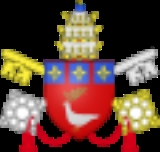
Pope Innocent X

Encyclopedia
Pope Innocent X born Giovanni Battista Pamphilj (or Pamphili
), was Pope
from 1644 to 1655. Born in Rome
of a family from Gubbio
in Umbria
who had come to Rome during the pontificate of Pope Innocent IX
, he graduated from the Collegio Romano and followed a conventional cursus honorum
, following his uncle Girolamo Pamphilj as auditor of the Rota, and like him, attaining the dignity of Cardinal-Priest of Sant'Eusebio
, in 1629. Trained as a lawyer
, he succeeded Pope Urban VIII
(1623–44) on 15 September 1644, as one of the most politically shrewd pontiffs of the era, who much increased the temporal power of the Holy See
. He was a great-great-great-grandson of Pope Alexander VI
.
(1621–23) sent him as nuncio
to the court of Naples
. Urban VIII sent him to accompany his nephew, Francesco Barberini
, whom he had accredited as nuncio, first in France and then in Spain, where Pamphilj had the first-hand opportunities to form an intense animosity towards the Barberini
. In reward for his labors, Giovanni Battista was made apostolic nuncio
at the court of Philip IV of Spain
(1621–65). The position led to a life-long association with the Spaniards which was of great use during the Papal Conclave of 1644
.
for the election of a successor to Urban VIII was long and stormy, lasting from 9 August to 15 September. The French faction objected to the Spanish candidate, as an enemy of Cardinal Mazarin – who guided French policy – but found Pamphilj an acceptable compromise, though he had served as legate to Spain. Mazarin himself, bearing the French veto of Cardinal Pamphilj, arrived too late, and the election was accomplished.
for misappropriation of public funds, an easily demonstrated crime in 17th-century courts anywhere. Brothers Francesco Barberini
, Antonio Barberini
and Taddeo Barberini
fled to Paris, where they found a powerful protector in Cardinal Mazarin. Innocent X confiscated their property, and on 19 February 1646, issued a bull
ordaining that all cardinals who might leave the Papal States
for six months without express papal permission would be deprived of their benefice
s and eventually of their cardinalate itself. The French parliament declared the papal ordinance void in France, but Innocent X did not yield until Mazarin prepared to send troops to Italy. Henceforth the papal policy towards France became more friendly, and somewhat later the Barberini were rehabilitated when the son of Taddeo Barberini, Maffeo Barberini, married Olimpia Giustiniani
, a niece of Innocent X.
In 1653, Innocent X with the Cum Occasione papal bull
condemned 5 propositions of Jansenius's Augustinus, inspired by St. Augustine
, as heretical and close to Lutheranism
. This led to the formulary controversy
, Blaise Pascal
's writing of the Lettres Provinciales
, and finally to the rasing of the Jansenist convent of Port-Royal and the subsequent dissolving of its community.
, a war
he had undertaken against Odoardo Farnese
, the Duke of Parma
. Hostilities between the papacy and the Duchy of Parma
resumed in 1649, and forces loyal to Pope Innocent X destroyed the city of Castro
on 2 September 1649.
Innocent X objected to the conclusion of the Peace of Westphalia
, against which his nuncio
, Fabio Chigi
, in his name vainly protested, and against which in 1650 he issued the bull Zelo Domus Dei backdated to November 1648, which was ignored by the European Powers. The most important of his doctrinal decisions was his condemnation of five disputed Jansenist
propositions, in his Papal Bull, Cum occasione issued, May 31, 1653.
(1642–49) in England and Ireland, Innocent X strongly supported the independent (and Catholic) Confederate Ireland
, over the objections of Mazarin and the former British Queen and at that time Queen Mother
, Henrietta Maria, exiled in Paris. The Pope sent as nuncio extraordinary to Ireland, Giovanni Battista Rinuccini
, archbishop of Fermo, who arrived at Kilkenny with a large quantity of arms and military supplies including twenty thousand pounds of gunpowder with a very large sum of money. At Kilkenny Rinuccini was received with great honours, asserting in his Latin declaration that the object of his mission was to sustain the King, but above all to rescue from pains and penalties the Catholic people of Ireland in securing the free and public exercise of the Catholic religion, and the restoration of the churches and church property. But in the end Oliver Cromwell
restored Ireland to the Parliamentarian side, with great bloodshed, and Rinuccini returned to Rome in 1649, after four fruitless years.
, who had been married to his late brother, was accounted Innocent X's mistress because her influence with him in matters of promotion and politics was so complete, a state of affairs alluded to in the Encyclopædia Britannica 9th edition (1880):
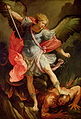 A measure of the rivalry between two arriviste papal families, the Barberini
and the Pamphilj, can be judged from Guido Reni
's painting of the Archangel Michael, trampling Satan
in which the features of the Pamphilj are immediately recognized. The less-than-subtle political statement still hangs in a side chapel of the Capuchin friars' Church of the Conception (Santa Maria della Concezione) in Rome. During the papacy of Pope Urban VIII
, whose princely rival among the College of Cardinals
was Giovanni Battista Pamphilj. Antonio Barberini, the Pope's brother, was a Cardinal who had begun his career with the Capuchin brothers. About 1635, at the height of the Thirty Years' War
in Germany
, in which the Papacy was intricately involved, Cardinal Antonio commissioned a painting of the combative archangel Michael, trampling Satan (the source of heresy
and error) for the church of his old Order.
The legend that the high-living patrician painter Guido Reni
, whose personal dash was at least as great as his brilliant drawing and brushwork, had been insulted by rumors circulated, he thought, by Cardinal Pamphilj, serves to place on the painter's shoulders the vengeful act that could not have been overlooked – or discouraged – by his Barberini patron. Though when a few years later Pamphilj was raised to the Papacy, Antonio Barberini fled to France on the embezzlement charges that have been mentioned, the Capuchins held fast to their chapel altarpiece. Innocent was responsible for raising the then Colegio de Santo Tomas de la Nuestra Senora del Santissimo Rosario into the rank of a University and now the University of Santo Tomas
in Manila, the oldest existing in Asia.
In 1650, Innocent X celebrated a Jubilee
. He embellished Rome with inlaid floors and Bas-relief in Saint Peter's, erected Bernini's Fontana dei Quattro Fiumi
in Piazza Navona
, the Pamphilj stronghold in Rome, and ordered the construction of Palazzo Nuovo at the Campidoglio.
Innocent X is also the subject of Portrait of Innocent X
, a famous painting by Diego Velázquez
housed in the family gallery of Palazzo Doria (Galleria Doria Pamphilj). This portrait inspired the "Screaming Pope" paintings by 20th century painter Francis Bacon, the most famous of which is Bacon's Study after Velázquez's Portrait of Pope Innocent X
.
Innocent X died 7 January 1655, and at the conclave of 1655
was succeeded by Pope Alexander VII
.
Pamphili
The Pamphili are one of the papal families deeply entrenched in Roman Catholic Church, Roman and Italian politics of the 16th and 17th centuries ....
), was Pope
Pope
The Pope is the Bishop of Rome, a position that makes him the leader of the worldwide Catholic Church . In the Catholic Church, the Pope is regarded as the successor of Saint Peter, the Apostle...
from 1644 to 1655. Born in Rome
Rome
Rome is the capital of Italy and the country's largest and most populated city and comune, with over 2.7 million residents in . The city is located in the central-western portion of the Italian Peninsula, on the Tiber River within the Lazio region of Italy.Rome's history spans two and a half...
of a family from Gubbio
Gubbio
Gubbio is a town and comune in the far northeastern part of the Italian province of Perugia . It is located on the lowest slope of Mt. Ingino, a small mountain of the Apennines. See also Mount Ingino Christmas Tree.-History:...
in Umbria
Umbria
Umbria is a region of modern central Italy. It is one of the smallest Italian regions and the only peninsular region that is landlocked.Its capital is Perugia.Assisi and Norcia are historical towns associated with St. Francis of Assisi, and St...
who had come to Rome during the pontificate of Pope Innocent IX
Pope Innocent IX
Pope Innocent IX , born Giovanni Antonio Facchinetti, was Pope from 29 October 1591 to his death on 30 December of the same year...
, he graduated from the Collegio Romano and followed a conventional cursus honorum
Cursus honorum
The cursus honorum was the sequential order of public offices held by aspiring politicians in both the Roman Republic and the early Empire. It was designed for men of senatorial rank. The cursus honorum comprised a mixture of military and political administration posts. Each office had a minimum...
, following his uncle Girolamo Pamphilj as auditor of the Rota, and like him, attaining the dignity of Cardinal-Priest of Sant'Eusebio
Sant'Eusebio
Sant'Eusebio is a basilica church in Rome, devoted to Saint Eusebius of Rome, a 4th century martyr, and built in the Monti rione.The church is first mentioned in 474, by an inscription in the catacombs of Saints Marcellino e Pietro ad duas Lauros, and recorded as the Titulus Eusebii in the acts of...
, in 1629. Trained as a lawyer
Lawyer
A lawyer, according to Black's Law Dictionary, is "a person learned in the law; as an attorney, counsel or solicitor; a person who is practicing law." Law is the system of rules of conduct established by the sovereign government of a society to correct wrongs, maintain the stability of political...
, he succeeded Pope Urban VIII
Pope Urban VIII
Pope Urban VIII , born Maffeo Barberini, was pope from 1623 to 1644. He was the last pope to expand the papal territory by force of arms, and was a prominent patron of the arts and reformer of Church missions...
(1623–44) on 15 September 1644, as one of the most politically shrewd pontiffs of the era, who much increased the temporal power of the Holy See
Holy See
The Holy See is the episcopal jurisdiction of the Catholic Church in Rome, in which its Bishop is commonly known as the Pope. It is the preeminent episcopal see of the Catholic Church, forming the central government of the Church. As such, diplomatically, and in other spheres the Holy See acts and...
. He was a great-great-great-grandson of Pope Alexander VI
Pope Alexander VI
Pope Alexander VI , born Roderic Llançol i Borja was Pope from 1492 until his death on 18 August 1503. He is one of the most controversial of the Renaissance popes, and his Italianized surname—Borgia—became a byword for the debased standards of the Papacy of that era, most notoriously the Banquet...
.
Papal nuncio
Pope Gregory XVPope Gregory XV
Pope Gregory XV , born Alessandro Ludovisi, was pope from 1621, succeeding Paul V on 9 February 1621...
(1621–23) sent him as nuncio
Nuncio
Nuncio is an ecclesiastical diplomatic title, derived from the ancient Latin word, Nuntius, meaning "envoy." This article addresses this title as well as derived similar titles, all within the structure of the Roman Catholic Church...
to the court of Naples
Naples
Naples is a city in Southern Italy, situated on the country's west coast by the Gulf of Naples. Lying between two notable volcanic regions, Mount Vesuvius and the Phlegraean Fields, it is the capital of the region of Campania and of the province of Naples...
. Urban VIII sent him to accompany his nephew, Francesco Barberini
Francesco Barberini (seniore)
Francesco Barberini was an Italian Catholic Cardinal. The nephew of Pope Urban VIII , he benefited immensely from the nepotism practiced by his uncle...
, whom he had accredited as nuncio, first in France and then in Spain, where Pamphilj had the first-hand opportunities to form an intense animosity towards the Barberini
Barberini
The Barberini are a family of the Italian nobility that rose to prominence in 17th century Rome. Their influence peaked with the election of Cardinal Maffeo Barberini to the papal throne in 1623, as Pope Urban VIII...
. In reward for his labors, Giovanni Battista was made apostolic nuncio
Nuncio
Nuncio is an ecclesiastical diplomatic title, derived from the ancient Latin word, Nuntius, meaning "envoy." This article addresses this title as well as derived similar titles, all within the structure of the Roman Catholic Church...
at the court of Philip IV of Spain
Philip IV of Spain
Philip IV was King of Spain between 1621 and 1665, sovereign of the Spanish Netherlands, and King of Portugal until 1640...
(1621–65). The position led to a life-long association with the Spaniards which was of great use during the Papal Conclave of 1644
Papal conclave, 1644
The papal conclave of 1644 was the papal conclave of Cardinals called on the death of Pope Urban VIII. It lasted from 9 August to 15 September 1644 and eventually chose Giovanni Battista Pamphili, who took office as Pope Innocent X.- Urban's influence :...
.
Election
The 1644 conclavePapal conclave, 1644
The papal conclave of 1644 was the papal conclave of Cardinals called on the death of Pope Urban VIII. It lasted from 9 August to 15 September 1644 and eventually chose Giovanni Battista Pamphili, who took office as Pope Innocent X.- Urban's influence :...
for the election of a successor to Urban VIII was long and stormy, lasting from 9 August to 15 September. The French faction objected to the Spanish candidate, as an enemy of Cardinal Mazarin – who guided French policy – but found Pamphilj an acceptable compromise, though he had served as legate to Spain. Mazarin himself, bearing the French veto of Cardinal Pamphilj, arrived too late, and the election was accomplished.
Relations with France
Soon after his accession, Innocent X (as he chose to be called) initiated legal action against the BarberiniBarberini
The Barberini are a family of the Italian nobility that rose to prominence in 17th century Rome. Their influence peaked with the election of Cardinal Maffeo Barberini to the papal throne in 1623, as Pope Urban VIII...
for misappropriation of public funds, an easily demonstrated crime in 17th-century courts anywhere. Brothers Francesco Barberini
Francesco Barberini (seniore)
Francesco Barberini was an Italian Catholic Cardinal. The nephew of Pope Urban VIII , he benefited immensely from the nepotism practiced by his uncle...
, Antonio Barberini
Antonio Barberini
Antonio Barberini was an Italian Catholic cardinal, Archbishop of Reims, military leader, patron of the arts and a prominent member of the House of Barberini. As one of the cardinal-nephews of Pope Urban VIII and a supporter of France, he played a significant role at a number of the papal...
and Taddeo Barberini
Taddeo Barberini
Taddeo Barberini was an Italian nobleman of the House of Barberini who became Prince of Palestrina and Gonfalonier of the Church; commander of the Papal Army. He was a nephew of Pope Urban VIII and brother of Cardinals Francesco Barberini and Antonio Barberini...
fled to Paris, where they found a powerful protector in Cardinal Mazarin. Innocent X confiscated their property, and on 19 February 1646, issued a bull
Papal bull
A Papal bull is a particular type of letters patent or charter issued by a Pope of the Catholic Church. It is named after the bulla that was appended to the end in order to authenticate it....
ordaining that all cardinals who might leave the Papal States
Papal States
The Papal State, State of the Church, or Pontifical States were among the major historical states of Italy from roughly the 6th century until the Italian peninsula was unified in 1861 by the Kingdom of Piedmont-Sardinia .The Papal States comprised territories under...
for six months without express papal permission would be deprived of their benefice
Benefice
A benefice is a reward received in exchange for services rendered and as a retainer for future services. The term is now almost obsolete.-Church of England:...
s and eventually of their cardinalate itself. The French parliament declared the papal ordinance void in France, but Innocent X did not yield until Mazarin prepared to send troops to Italy. Henceforth the papal policy towards France became more friendly, and somewhat later the Barberini were rehabilitated when the son of Taddeo Barberini, Maffeo Barberini, married Olimpia Giustiniani
Olimpia Giustiniani
Olimpia Giustiniani was an Italian noblewoman of the houses of Giustiniani and Barberini. She was the grand-daughter of Olimpia Maidalchini, niece of Pope Innocent X and wife of Maffeo Barberini, Prince of Palestrina....
, a niece of Innocent X.
In 1653, Innocent X with the Cum Occasione papal bull
Papal bull
A Papal bull is a particular type of letters patent or charter issued by a Pope of the Catholic Church. It is named after the bulla that was appended to the end in order to authenticate it....
condemned 5 propositions of Jansenius's Augustinus, inspired by St. Augustine
St. Augustine
-People:* Augustine of Hippo or Augustine of Hippo , father of the Latin church* Augustine of Canterbury , first Archbishop of Canterbury* Augustine Webster, an English Catholic martyr.-Places:*St. Augustine, Florida, United States...
, as heretical and close to Lutheranism
Lutheranism
Lutheranism is a major branch of Western Christianity that identifies with the theology of Martin Luther, a German reformer. Luther's efforts to reform the theology and practice of the church launched the Protestant Reformation...
. This led to the formulary controversy
Formulary controversy
The Formulary Controversy, in 17th century France, pitted the Jansenists against the Jesuits. It gave rise to Blaise Pascal's Lettres Provinciales, the condemnation by the Vatican of Casuistry, and the final dissolution of organised Jansenism.- Context :...
, Blaise Pascal
Blaise Pascal
Blaise Pascal , was a French mathematician, physicist, inventor, writer and Catholic philosopher. He was a child prodigy who was educated by his father, a tax collector in Rouen...
's writing of the Lettres Provinciales
Lettres provinciales
The Lettres provinciales are a series of eighteen letters written by French philosopher and theologian Blaise Pascal under the pseudonym Louis de Montalte...
, and finally to the rasing of the Jansenist convent of Port-Royal and the subsequent dissolving of its community.
Relations with Parma
The death of Pope Urban VIII is said to have been hastened by chagrin at the result of the First War of CastroWars of Castro
The Wars of Castro is a term referring to a series of events in the mid-17th century revolving around the ancient city of Castro , which eventually resulted in the city's destruction on 2 September 1649...
, a war
War
War is a state of organized, armed, and often prolonged conflict carried on between states, nations, or other parties typified by extreme aggression, social disruption, and usually high mortality. War should be understood as an actual, intentional and widespread armed conflict between political...
he had undertaken against Odoardo Farnese
Odoardo Farnese
Odoardo Farnese was Duke of Parma and Piacenza from 1622 to 1646.-Biography:Odoardo was the sole legitimate son of Ranuccio I Farnese and Margherita Aldobrandini...
, the Duke of Parma
Duchy of Parma
The Duchy of Parma was created in 1545 from that part of the Duchy of Milan south of the Po River, as a fief for Pope Paul III's illegitimate son, Pier Luigi Farnese, centered on the city of Parma....
. Hostilities between the papacy and the Duchy of Parma
Duchy of Parma
The Duchy of Parma was created in 1545 from that part of the Duchy of Milan south of the Po River, as a fief for Pope Paul III's illegitimate son, Pier Luigi Farnese, centered on the city of Parma....
resumed in 1649, and forces loyal to Pope Innocent X destroyed the city of Castro
Castro (city)
Castro was an ancient city on the west side of Lake Bolsena in the present-day comune of Ischia di Castro, northern Lazio, Italy. It was destroyed at the conclusion of the Wars of Castro in the 17th century.-Early history:...
on 2 September 1649.
Innocent X objected to the conclusion of the Peace of Westphalia
Peace of Westphalia
The Peace of Westphalia was a series of peace treaties signed between May and October of 1648 in Osnabrück and Münster. These treaties ended the Thirty Years' War in the Holy Roman Empire, and the Eighty Years' War between Spain and the Dutch Republic, with Spain formally recognizing the...
, against which his nuncio
Nuncio
Nuncio is an ecclesiastical diplomatic title, derived from the ancient Latin word, Nuntius, meaning "envoy." This article addresses this title as well as derived similar titles, all within the structure of the Roman Catholic Church...
, Fabio Chigi
Pope Alexander VII
Pope Alexander VII , born Fabio Chigi, was Pope from 7 April 1655, until his death.- Early life :Born in Siena, a member of the illustrious banking family of Chigi and a great-nephew of Pope Paul V , he was privately tutored and eventually received doctorates of philosophy, law, and theology from...
, in his name vainly protested, and against which in 1650 he issued the bull Zelo Domus Dei backdated to November 1648, which was ignored by the European Powers. The most important of his doctrinal decisions was his condemnation of five disputed Jansenist
Jansenism
Jansenism was a Christian theological movement, primarily in France, that emphasized original sin, human depravity, the necessity of divine grace, and predestination. The movement originated from the posthumously published work of the Dutch theologian Cornelius Otto Jansen, who died in 1638...
propositions, in his Papal Bull, Cum occasione issued, May 31, 1653.
English Civil War
During the Civil WarEnglish Civil War
The English Civil War was a series of armed conflicts and political machinations between Parliamentarians and Royalists...
(1642–49) in England and Ireland, Innocent X strongly supported the independent (and Catholic) Confederate Ireland
Confederate Ireland
Confederate Ireland refers to the period of Irish self-government between the Rebellion of 1641 and the Cromwellian conquest of Ireland in 1649. During this time, two-thirds of Ireland was governed by the Irish Catholic Confederation, also known as the "Confederation of Kilkenny"...
, over the objections of Mazarin and the former British Queen and at that time Queen Mother
Queen mother
Queen Mother is a title or position reserved for a widowed queen consort whose son or daughter from that marriage is the reigning monarch. The term has been used in English since at least 1577...
, Henrietta Maria, exiled in Paris. The Pope sent as nuncio extraordinary to Ireland, Giovanni Battista Rinuccini
Giovanni Battista Rinuccini
Giovanni Battista Rinuccini was a Roman Catholic archbishop in the mid seventeenth century. He was a noted legal scholar who became chamberlain to Pope Gregory XV, who made him the Archbishop of Fermo in Italy...
, archbishop of Fermo, who arrived at Kilkenny with a large quantity of arms and military supplies including twenty thousand pounds of gunpowder with a very large sum of money. At Kilkenny Rinuccini was received with great honours, asserting in his Latin declaration that the object of his mission was to sustain the King, but above all to rescue from pains and penalties the Catholic people of Ireland in securing the free and public exercise of the Catholic religion, and the restoration of the churches and church property. But in the end Oliver Cromwell
Oliver Cromwell
Oliver Cromwell was an English military and political leader who overthrew the English monarchy and temporarily turned England into a republican Commonwealth, and served as Lord Protector of England, Scotland, and Ireland....
restored Ireland to the Parliamentarian side, with great bloodshed, and Rinuccini returned to Rome in 1649, after four fruitless years.
Olimpia Maidalchini
Olimpia MaidalchiniOlimpia Maidalchini
Olimpia Maidalchini , also spelled Olympia and known as Donna Olimpia, was the sister-in-law of Pope Innocent X .- Early life :...
, who had been married to his late brother, was accounted Innocent X's mistress because her influence with him in matters of promotion and politics was so complete, a state of affairs alluded to in the Encyclopædia Britannica 9th edition (1880):
Death and legacy
Barberini
The Barberini are a family of the Italian nobility that rose to prominence in 17th century Rome. Their influence peaked with the election of Cardinal Maffeo Barberini to the papal throne in 1623, as Pope Urban VIII...
and the Pamphilj, can be judged from Guido Reni
Guido Reni
Guido Reni was an Italian painter of high-Baroque style.-Biography:Born in Bologna into a family of musicians, Guido Reni was the son of Daniele Reni and Ginevra de’ Pozzi. As a child of nine, he was apprenticed under the Bolognese studio of Denis Calvaert. Soon after, he was joined in that...
's painting of the Archangel Michael, trampling Satan
Satan
Satan , "the opposer", is the title of various entities, both human and divine, who challenge the faith of humans in the Hebrew Bible...
in which the features of the Pamphilj are immediately recognized. The less-than-subtle political statement still hangs in a side chapel of the Capuchin friars' Church of the Conception (Santa Maria della Concezione) in Rome. During the papacy of Pope Urban VIII
Pope Urban VIII
Pope Urban VIII , born Maffeo Barberini, was pope from 1623 to 1644. He was the last pope to expand the papal territory by force of arms, and was a prominent patron of the arts and reformer of Church missions...
, whose princely rival among the College of Cardinals
College of Cardinals
The College of Cardinals is the body of all cardinals of the Catholic Church.A function of the college is to advise the pope about church matters when he summons them to an ordinary consistory. It also convenes on the death or abdication of a pope as a papal conclave to elect a successor...
was Giovanni Battista Pamphilj. Antonio Barberini, the Pope's brother, was a Cardinal who had begun his career with the Capuchin brothers. About 1635, at the height of the Thirty Years' War
Thirty Years' War
The Thirty Years' War was fought primarily in what is now Germany, and at various points involved most countries in Europe. It was one of the most destructive conflicts in European history....
in Germany
Germany
Germany , officially the Federal Republic of Germany , is a federal parliamentary republic in Europe. The country consists of 16 states while the capital and largest city is Berlin. Germany covers an area of 357,021 km2 and has a largely temperate seasonal climate...
, in which the Papacy was intricately involved, Cardinal Antonio commissioned a painting of the combative archangel Michael, trampling Satan (the source of heresy
Christian heresy
Christian heresy refers to non-orthodox practices and beliefs that were deemed to be heretical by one or more of the Christian churches. In Western Christianity, the term "heresy" most commonly refers to those beliefs which were declared to be anathema by the Catholic Church prior to the schism of...
and error) for the church of his old Order.
The legend that the high-living patrician painter Guido Reni
Guido Reni
Guido Reni was an Italian painter of high-Baroque style.-Biography:Born in Bologna into a family of musicians, Guido Reni was the son of Daniele Reni and Ginevra de’ Pozzi. As a child of nine, he was apprenticed under the Bolognese studio of Denis Calvaert. Soon after, he was joined in that...
, whose personal dash was at least as great as his brilliant drawing and brushwork, had been insulted by rumors circulated, he thought, by Cardinal Pamphilj, serves to place on the painter's shoulders the vengeful act that could not have been overlooked – or discouraged – by his Barberini patron. Though when a few years later Pamphilj was raised to the Papacy, Antonio Barberini fled to France on the embezzlement charges that have been mentioned, the Capuchins held fast to their chapel altarpiece. Innocent was responsible for raising the then Colegio de Santo Tomas de la Nuestra Senora del Santissimo Rosario into the rank of a University and now the University of Santo Tomas
University of Santo Tomas
The Pontifical and Royal University of Santo Tomas, The Catholic University of the Philippines , is a private Roman Catholic university run by the Order of Preachers in Manila. Founded on April 28, 1611 by archbishop of Manila Miguel de Benavides, it has the oldest extant university charter in the...
in Manila, the oldest existing in Asia.
In 1650, Innocent X celebrated a Jubilee
Jubilee (Christian)
The concept of the Jubilee is a special year of remission of sins and universal pardon. In the Biblical Book of Leviticus, a Jubilee year is mentioned to occur every fifty years, in which slaves and prisoners would be freed, debts would be forgiven and the mercies of God would be particularly...
. He embellished Rome with inlaid floors and Bas-relief in Saint Peter's, erected Bernini's Fontana dei Quattro Fiumi
Fontana dei Quattro Fiumi
The Fontana dei Quattro Fiumi or "Fountain of the Four Rivers" is a fountain in Rome, Italy, located in the urban square of the Piazza Navona...
in Piazza Navona
Piazza Navona
Piazza Navona is a city square in Rome, Italy. It is built on the site of the Stadium of Domitian, built in 1st century AD, and follows the form of the open space of the stadium. The ancient Romans came there to watch the agones , and hence it was known as 'Circus Agonalis'...
, the Pamphilj stronghold in Rome, and ordered the construction of Palazzo Nuovo at the Campidoglio.
Innocent X is also the subject of Portrait of Innocent X
Portrait of Innocent X
The Portrait of Pope Innocent X is an oil on canvas portrait by the Spanish painter Diego Velázquez, finished during a trip to Italy around 1650. Many artists and art critics consider it the finest portrait ever created. It is housed in the Galleria Doria Pamphilj in Rome...
, a famous painting by Diego Velázquez
Diego Velázquez
Diego Rodríguez de Silva y Velázquez was a Spanish painter who was the leading artist in the court of King Philip IV. He was an individualistic artist of the contemporary Baroque period, important as a portrait artist...
housed in the family gallery of Palazzo Doria (Galleria Doria Pamphilj). This portrait inspired the "Screaming Pope" paintings by 20th century painter Francis Bacon, the most famous of which is Bacon's Study after Velázquez's Portrait of Pope Innocent X
Study after Velázquez's Portrait of Pope Innocent X
Study after Velázquez's Portrait of Pope Innocent X is a 1953 painting by the Irish artist Francis Bacon. The work shows a distorted version of the Portrait of Innocent X painted by the Spanish artist Diego Velázquez in 1650. The work is one of a series of variants of the Velázquez painting which...
.
Innocent X died 7 January 1655, and at the conclave of 1655
Papal conclave, 1655
The Papal conclave of 1655 was the papal conclave of Cardinals called on the death of Pope Innocent X. The conclave elected Fabio Chigi, who took office as Alexander VII.- History :...
was succeeded by Pope Alexander VII
Pope Alexander VII
Pope Alexander VII , born Fabio Chigi, was Pope from 7 April 1655, until his death.- Early life :Born in Siena, a member of the illustrious banking family of Chigi and a great-nephew of Pope Paul V , he was privately tutored and eventually received doctorates of philosophy, law, and theology from...
.
See also
- Cardinals created by Innocent XCardinals created by Innocent XPope Innocent X created 40 cardinals in 8 consistories:- 14 November 1644 :* Camillo Francesco Maria Pamphilj, nephew of the Pope – cardinal-deacon of S...
- List of popes from the Borgia family
- PamphiliPamphiliThe Pamphili are one of the papal families deeply entrenched in Roman Catholic Church, Roman and Italian politics of the 16th and 17th centuries ....
, with Innocent X's family tree - Portrait of Innocent XPortrait of Innocent XThe Portrait of Pope Innocent X is an oil on canvas portrait by the Spanish painter Diego Velázquez, finished during a trip to Italy around 1650. Many artists and art critics consider it the finest portrait ever created. It is housed in the Galleria Doria Pamphilj in Rome...
- Study after Velázquez's Portrait of Pope Innocent XStudy after Velázquez's Portrait of Pope Innocent XStudy after Velázquez's Portrait of Pope Innocent X is a 1953 painting by the Irish artist Francis Bacon. The work shows a distorted version of the Portrait of Innocent X painted by the Spanish artist Diego Velázquez in 1650. The work is one of a series of variants of the Velázquez painting which...
External links
- Catholic Encyclopedia: Innocent X
- Encyclopaedia Britannica, 1911: Innocent X
- Chev. Artaud De Montor, 1911. The Lives and Times of the Popes
- "The Cardinals of the Holy Roman Church": conclave of 1644