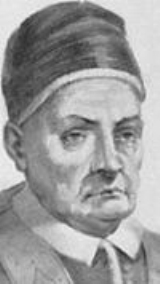
Pope Benedict XIII (February 2, 1649 – February 21, 1730), born
Pietro Francesco Orsini, later
Vincenzo Maria Orsini, was
popeThe pope is the Bishop of Rome and, as such, is leader of the worldwide Catholic Church...
from 1724 until his death. He succeeded
Pope Innocent XIIIPope Innocent XIII was pope from 1721 until his death.He was born Michelangelo Conti in Poli, near Rome. Like Pope Innocent III , Pope Gregory IX and Pope Alexander IV , he was a member of the family of the Conti, counts and dukes of Segni...
(1721–1724).
He was born in
Gravina in PugliaGravina in Puglia is an Italian municipality in the Southern Italian Province of Bari, site along a river of the same name in the Western Murgia geographical area of Apulia....
to Ferdinando III Orsini, duke of Gravina, and Giovanna Frangipani della Tolfa, from
TorittoToritto is a town and comune in the province of Bari, Puglia, Italy.It lies in an agricultural area, with cultivation of mainly almond and olive trees.This city was once a wonderful and industrious city. It was where many great athletes came from...
. He was a member of the
OrsiniThe Orsini family was one of the most celebrated princely families in medieval Italy and renaissance Rome. Members of the Orsini include popes Celestine III , Nicholas III , and Benedict XIII , numerous condottieri and other relevant political and religious figures.-Origins:According to their...
of
RomeRome is the capital of Italy and the country's largest and most populated municipality , with over 2.7 million residents in , while the population of the urban area is estimated by Eurostat to be 3.46 million. The metropolitan area of Rome is estimated by OECD to have a population of 3.7 million...
, the third and last member of that family to become Pope.
Pope Benedict XIII (February 2, 1649 – February 21, 1730), born
Pietro Francesco Orsini, later
Vincenzo Maria Orsini, was
popeThe pope is the Bishop of Rome and, as such, is leader of the worldwide Catholic Church...
from 1724 until his death. He succeeded
Pope Innocent XIIIPope Innocent XIII was pope from 1721 until his death.He was born Michelangelo Conti in Poli, near Rome. Like Pope Innocent III , Pope Gregory IX and Pope Alexander IV , he was a member of the family of the Conti, counts and dukes of Segni...
(1721–1724).
He was born in
Gravina in PugliaGravina in Puglia is an Italian municipality in the Southern Italian Province of Bari, site along a river of the same name in the Western Murgia geographical area of Apulia....
to Ferdinando III Orsini, duke of Gravina, and Giovanna Frangipani della Tolfa, from
TorittoToritto is a town and comune in the province of Bari, Puglia, Italy.It lies in an agricultural area, with cultivation of mainly almond and olive trees.This city was once a wonderful and industrious city. It was where many great athletes came from...
. He was a member of the
OrsiniThe Orsini family was one of the most celebrated princely families in medieval Italy and renaissance Rome. Members of the Orsini include popes Celestine III , Nicholas III , and Benedict XIII , numerous condottieri and other relevant political and religious figures.-Origins:According to their...
of
RomeRome is the capital of Italy and the country's largest and most populated municipality , with over 2.7 million residents in , while the population of the urban area is estimated by Eurostat to be 3.46 million. The metropolitan area of Rome is estimated by OECD to have a population of 3.7 million...
, the third and last member of that family to become Pope. He entered the
Dominican OrderThe Order of Preachers , after the 15th century more commonly known as the Dominican Order or Dominicans, is a Catholic religious order founded by Saint Dominic in the early 13th century in France...
and received the name Vincenzo Maria. He was named cardinal on February 22 1672 (allegedly, against his will); later he was bishop of Manfredonia, bishop of Cesena and then archbishop of Benevento.
At first, he called himself Benedict XIV, but afterwards altered the title to Benedict XIII (the previous Benedict XIII having been considered an antipope).
He endeavoured to put a stop to the decadent lifestyles of the
ItalianItaly , officially the Italian Republic , is a country located on the Italian Peninsula in Southern Europe and on the two largest islands in the Mediterranean Sea, Sicily and Sardinia. Italy shares its northern, Alpine boundary with France, Switzerland, Austria and Slovenia...
priestA priest or priestess is a person having the authority or power to administer religious rites; in particular, rites of sacrifice to, and propitiation of, a deity or deities. Their office or position is the priesthood, a term which may also apply to such persons collectively.Priests and priestesses...
hood and of the
cardinalateA cardinal is a senior ecclesiastical official, usually a bishop, of the Catholic Church. They are collectively known as the College of Cardinals, which as a body elects a new pope. The duties of the cardinals include attending the meetings of the College and making themselves available...
. He also abolished the
lotteryA lottery is a form of gambling which involves the drawing of lots for a prize. Some governments outlaw it, while others endorse it to the extent of organizing a national or state lottery...
in Rome. A man fond above all of asceticism and religious celebrations, according to Cardinal Lambertini (later Pope as Benedict XIV) he "did not have any idea about how to rule". The government was effectively held in his lieu by Cardinal
Niccolò CosciaNiccolò Coscia was an Italian Roman Catholic cardinal.He was born at Pietradefusi, near Avellino. In 1725 he was appointed as Cardinal of Santa Maria in Domnica by Pope Benedict XIII, whose secretary he had been when the future pope was Archbishop of Benevento.Coscia held the effective government...
, who had been Benedict's secretary when he was archbishop of Benevento, and who committed a long series of financial abuses at his own advantage, causing the ruin of the Papal treasure. According to Montesquieu, "All the money of Rome go to Benevento... as the Beneventani direct [Benedict's] weakness".
In foreign politics, he struggled with
John V of Portugalalign=right|-|Fidelíssimus John V the Magnanimous , 24th king of Portugal and the Algarves, was born John-Francis-Anthony in Lisbon and succeeded his father Peter II in December 1706, and was proclaimed on January 1, 1707.His father had long suffered...
and the Jansenists
Pope Benedict XIII repealed the world wide smoking ban set by Pope Urban VIII.
Benedict XIII, whose orders were descended from
Scipione RebibaScipione Rebiba was an Italian Cardinal of the Roman Catholic Church. He was appointed Auxiliary Bishop of Chieti on 16 March 1541, created a Cardinal on 20 December 1555, appointed Archbishop of Pisa in 1566, Bishop of Albano in 1573 and Bishop of Sabina e Poggio Mirteto in 1574.Cardinal Rebiba...
, personally consecrated at least 139 bishops for various important European sees, including German, French, English and New World bishops. These bishops in turn consecrated bishops almost exclusively for their respective countries causing other episcopal lineages to die. As a result, more than 90% of present-day bishops trace their episcopal lineage through him to Cardinal Rebiba
http://mysite.verizon.net/res7gdmc/aposccs/ http://www.catholic-hierarchy.org/.
In 1727 he inaugurated the famous
Spanish StepsThe Spanish Steps are a set of steps in Rome, Italy, climbing a steep slope between the Piazza di Spagna at the base and Piazza Trinità dei Monti, dominated by the church of Trinità dei Monti...
and founded the University of
CamerinoCamerino is small town of 7,000 inhabitants in the Marches , in the province of Macerata, Italy. It is located in the Apennines bordering Umbria, between the valleys of the rivers Potenza and Chienti, about 40 miles from Ancona.-History:...
.
Benedict died in 1730 and was buried in a tomb in
Santa Maria sopra MinervaThe Basilica of Saint Mary Above Minerva is a titular minor basilica and one of the most important churches of the Roman Catholic Dominican order in Rome, Italy. The church, located in the Piazza della Minerva in the Campus Martius region, is considered the only Gothic church in Rome. It houses...
completed by
Pietro BracciPietro Bracci was an Italian sculptor working in the Late Baroque manner.-Biography:He was born in Rome and became a student of Giuseppe Bartolomeo Chiari and Camillo Rusconi...
and others. Coscia fled from the city in the circumstance, being excommunicated under the new Pope Clement XII. He was later restored and took part in the conclaves of 1730 and 1740.
The comment to Benedict's death by Pasquino, the popular satirist of Rome, was:
- "This tomb encloses
- the bones of a little friar:
- more than a saint's lover
- a protector of brigands"
Episcopal succession
Footnotes