

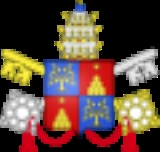
Pope Alexander VII

Encyclopedia
Pope Alexander VII born Fabio Chigi, was Pope
from 7 April 1655, until his death.
, a member of the illustrious banking family of Chigi and a great-nephew of Pope Paul V
(1605–1621), he was privately tutored and eventually received doctorates of philosophy, law, and theology from the University of Siena
.
at Ferrara
, and on recommendations from two cardinals he was appointed successively Inquisitor
of Malta
and nuncio in Cologne
(1639–1651). There, he supported Urban VIII's condemnation of Jansenius' Augustinus by the papal bull In eminenti of 1642.
Though expected to take part in the negotiations which led in 1648 to the Peace of Westphalia
, he declined to deliberate with persons whom the Catholic Church considered heretics
, and protested, when it was finally completed, against the Treaty of Westphalia that ended the Thirty Years' War
(1618–1648) and established the balance of European power that lasted until the wars of the French Revolution
(1789).
Pope Innocent X
(1644–1655) recalled Chigi to Rome and subsequently made him Cardinal Secretary of State
and Cardinal-Priest of Santa Maria del Popolo
.
, was elected pope after eighty days in the conclave, on 7 April 1655, taking the name of Alexander VII.
then prevalent. Indeed, in the first year of his reign, Alexander VII lived simply and forbade his relations even to visit Rome; but in consistory
, 24 April 1656, he announced that his brother and nephews would be coming to assist him in Rome
. The administration was given largely into the hands of his relatives, and nepotism
became as luxuriously entrenched as it even had been in the Baroque Papacy: he gave them the best-paid civil and ecclesiastical offices, and princely palaces and estates suitable to the Chigi of Siena.
Central to Alexander’s urbanism was the idea of teatro or urban theatre whereby his urban interventions became the grand settings or showpieces appropriate to the dignity of Rome and the Head of the Catholic Church. Therefore, and although the scales are vastly different, the small Santa Maria della Pace
and its piazza are as much a teatro as the imposing monumental colonnade that forms Piazza San Pietro in front of St. Peters basilica.
The various urban and architectural projects carried out during Alexander’s reign were recorded in engravings by Giovanni Battista Falda
and the first volume was published in 1665. The volumes appeared under the title of Il Nuovo Teatro ....
His preferred architect was the sculptor and architect Gianlorenzo Bernini but he also gave architectural commissions to the painter and architect Pietro da Cortona
. Of the three leading architects of the Roman High Baroque
, only Francesco Borromini
fared not so well under Alexander; this may be because he thought Borromini’s architectural forms willful but also Borromini could be notoriously difficult. Nonetheless, Alexander’s family heraldic emblems of the mons or mountains with stars and oak leaves, adorn Borromini’s church of Sant’Ivo alla Sapienza and many other works of his reign
Alexander took a keen personal interest in his urban and architectural projects and made notes of these in his diaries. His projects in Rome included: the church and piazza at Santa Maria della Pace
; the Via del Corso
, Piazza Colonna
and associated buildings; reworking of the Porta del Popolo, the Piazza del Popolo
and Santa Maria del Popolo
; Piazza San Pietro, the Scala Regia
and interior embellishments in the Vatican Palace and St Peters; Sant'Andrea al Quirinale
; part of the Palazzo del Quirinale; the obelisk and elephant in Piazza della Minerva
.
(1632–1654) occurred during Alexander VII's reign. After her abdication the queen came to reside in Rome, where she was confirmed in her baptism
by the Pope, in whom she found a generous friend and benefactor, on Christmas Day, 1655.
or as successful. Alexander VII's pontificate was shadowed by continual friction with Cardinal Mazarin, adviser to Louis XIV of France
(1643–1715), who had opposed him during the negotiations that led to the Peace of Westphalia and who defended the prerogatives of the Gallican Church
. During the conclave, he had been hostile to Chigi's election, but was in the end compelled to accept him as a compromise. However, he prevented Louis XIV from sending the usual embassy of obedience to Alexander VII, and, while he lived, he foiled the appointment of a French ambassador to Rome, diplomatic affairs being meantime conducted by cardinal protectors, generally personal enemies of the Pope. In 1662, the equally hostile Duc de Crequi was made ambassador. By his abuse of the traditional right of asylum granted to ambassadorial precincts in Rome, he precipitated a quarrel between France and the papacy, which resulted in Alexander VII's temporary loss of Avignon
and his forced acceptance of the humiliating treaty of Pisa in 1664.
in their claims against Portugal
, which had reestablished its traditional independence in 1640.
His pontificate was also marked by protracted controversies with Portugal.
called for help in Crete
against the Ottoman Turks
, the Pope extracted in return a promise that the Jesuits should be permitted back in Venetian territory, from which they had been expelled in 1606. He also continued to take the Jesuit part in their conflict with the Jansenists
, whose condemnation he had vigorously supported as advisor to Pope Innocent X
. The French Jansenists professed that the propositions condemned in 1653 were not in fact to be found in Augustinus, written by Cornelius Jansen
. Alexander VII confirmed that they were too, by the bull Ad Sanctam Beati Petri Sedem (16 October 1656) declaring that five propositions extracted by a group of theologians from the Sorbonne
out of Jansen's work, mostly concerning grace
and the fallen nature of man, were heretical
including the proposition "that Christ
died, or shed His blood for all men". He also sent to France his famous "formulary
", that was to be signed by all the clergy as a means of detecting and extirpating Jansenism and which inflamed public opinion, leading to Blaise Pascal
's defense of Jansenism.
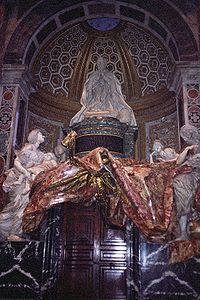 He died in 1667, was memorialised in a spectacular tomb
by Bernini, and was succeeded by Pope Clement IX
(1667–69).
and philosophy
; a collection of his Latin
poems appeared at Paris in 1656 under the title Philomathi Labores Juveniles. He also encouraged architecture, and the general improvement of Rome, where houses were razed to straighten and widen streets and where he had the opportunity to be a great patron for Gian Lorenzo Bernini
: the decorations of the church of Santa Maria del Popolo
, titular churches for several of the Chigi cardinals, the Scala Regia
, the Chair of St. Peter in the Vatican Basilica. In particular, he sponsored Bernini's construction of the beautiful colonnade in the piazza
of St. Peter's Basilica
.
issue. He published his Index Librorum Prohibitorum Alexandri VII Pontificis Maximi jussu editus which presented anew the contents of the Index of Forbidden Books. According to Rev. William Roberts, he prefaced this with the bull
Speculatores Domus Israel, stating his reasons: "in order that the whole history of each case may be known. 'For this purpose,' pursues the Pontiff, 'we have caused the Tridentine and Clementine Indices to be added to this general Index, and also all the relevant decrees up to the present time, that have been issued since the Index of our predecessor Clement, that nothing profitable to the faithful interested in such matters might seem omitted." Among those included were the previous decrees placing various heliocentric works on the Index ("...which we will should be considered as though it were inserted in these presents, together with all, and singular, the things contained therein...") and using his Apostolic authority he bound the faithful to its contents ("...and approve with Apostolic authority by the tenor of these presents, and: command and enjoin all persons everywhere to yield this Index a constant and complete obedience...") Subsequent to Alexander VII's pontificate, the Index underwent a number of revisions. "In 1758 the general prohibition against works advocating heliocentrism was removed from the Index of prohibited books, although the specific ban on uncensored versions of the Dialogue and Copernicus's De Revolutionibus remained. All traces of official opposition to heliocentrism by the church disappeared in 1835 when these works were finally dropped from the Index". The Index was abolished entirely in 1966.
Alexander VII's Apostolic Constitution
Sollicitudo Omnium Ecclesiarum
laid out the doctrine of the Immaculate Conception
of the Blessed Virgin Mary in terms almost identical to those utilized by Pope Pius IX
when he issued his infallible definition Inffabilis Deus and the former work is cited in footnote 11 of the latter.
Pope
The Pope is the Bishop of Rome, a position that makes him the leader of the worldwide Catholic Church . In the Catholic Church, the Pope is regarded as the successor of Saint Peter, the Apostle...
from 7 April 1655, until his death.
Early life
Born in SienaSiena
Siena is a city in Tuscany, Italy. It is the capital of the province of Siena.The historic centre of Siena has been declared by UNESCO a World Heritage Site. It is one of the nation's most visited tourist attractions, with over 163,000 international arrivals in 2008...
, a member of the illustrious banking family of Chigi and a great-nephew of Pope Paul V
Pope Paul V
-Theology:Paul met with Galileo Galilei in 1616 after Cardinal Bellarmine had, on his orders, warned Galileo not to hold or defend the heliocentric ideas of Copernicus. Whether there was also an order not to teach those ideas in any way has been a matter for controversy...
(1605–1621), he was privately tutored and eventually received doctorates of philosophy, law, and theology from the University of Siena
University of Siena
The University of Siena in Siena, Tuscany is one of the oldest and first publicly funded universities in Italy. Originally called Studium Senese, the University of Siena was founded in 1240. The University has around 20,000 students, nearly half of Siena's total population of around 54,000...
.
Papal legate and Secretary of State
In 1627 he began his apprenticeship as vice-papal legatePapal legate
A papal legate – from the Latin, authentic Roman title Legatus – is a personal representative of the pope to foreign nations, or to some part of the Catholic Church. He is empowered on matters of Catholic Faith and for the settlement of ecclesiastical matters....
at Ferrara
Ferrara
Ferrara is a city and comune in Emilia-Romagna, northern Italy, capital city of the Province of Ferrara. It is situated 50 km north-northeast of Bologna, on the Po di Volano, a branch channel of the main stream of the Po River, located 5 km north...
, and on recommendations from two cardinals he was appointed successively Inquisitor
Inquisitor
An inquisitor was an official in an Inquisition, an organisation or program intended to eliminate heresy and other things frowned on by the Roman Catholic Church...
of Malta
Malta
Malta , officially known as the Republic of Malta , is a Southern European country consisting of an archipelago situated in the centre of the Mediterranean, south of Sicily, east of Tunisia and north of Libya, with Gibraltar to the west and Alexandria to the east.Malta covers just over in...
and nuncio in Cologne
Apostolic Nuncio to Cologne
The Apostolic Nunciature to Cologne was an ecclesiastical office of the Roman Catholic Church established in 1584. The nuncios were accredited to the Achbishop-Electorates of Cologne, Mainz and Trier...
(1639–1651). There, he supported Urban VIII's condemnation of Jansenius' Augustinus by the papal bull In eminenti of 1642.
Though expected to take part in the negotiations which led in 1648 to the Peace of Westphalia
Peace of Westphalia
The Peace of Westphalia was a series of peace treaties signed between May and October of 1648 in Osnabrück and Münster. These treaties ended the Thirty Years' War in the Holy Roman Empire, and the Eighty Years' War between Spain and the Dutch Republic, with Spain formally recognizing the...
, he declined to deliberate with persons whom the Catholic Church considered heretics
Christian heresy
Christian heresy refers to non-orthodox practices and beliefs that were deemed to be heretical by one or more of the Christian churches. In Western Christianity, the term "heresy" most commonly refers to those beliefs which were declared to be anathema by the Catholic Church prior to the schism of...
, and protested, when it was finally completed, against the Treaty of Westphalia that ended the Thirty Years' War
Thirty Years' War
The Thirty Years' War was fought primarily in what is now Germany, and at various points involved most countries in Europe. It was one of the most destructive conflicts in European history....
(1618–1648) and established the balance of European power that lasted until the wars of the French Revolution
French Revolution
The French Revolution , sometimes distinguished as the 'Great French Revolution' , was a period of radical social and political upheaval in France and Europe. The absolute monarchy that had ruled France for centuries collapsed in three years...
(1789).
Pope Innocent X
Pope Innocent X
Pope Innocent X , born Giovanni Battista Pamphilj , was Pope from 1644 to 1655. Born in Rome of a family from Gubbio in Umbria who had come to Rome during the pontificate of Pope Innocent IX, he graduated from the Collegio Romano and followed a conventional cursus honorum, following his uncle...
(1644–1655) recalled Chigi to Rome and subsequently made him Cardinal Secretary of State
Cardinal Secretary of State
The Cardinal Secretary of State—officially Secretary of State of His Holiness The Pope—presides over the Holy See, usually known as the "Vatican", Secretariat of State, which is the oldest and most important dicastery of the Roman Curia...
and Cardinal-Priest of Santa Maria del Popolo
Santa Maria del Popolo
Santa Maria del Popolo is an Augustinian church located in Rome, Italy.It stands to the north side of the Piazza del Popolo, one of the most famous squares in the city. The Piazza is situated between the ancient Porta Flaminia and the park of the Pincio...
.
Election as Pope
When Innocent X died, Chigi, the candidate favoured by SpainSpain
Spain , officially the Kingdom of Spain languages]] under the European Charter for Regional or Minority Languages. In each of these, Spain's official name is as follows:;;;;;;), is a country and member state of the European Union located in southwestern Europe on the Iberian Peninsula...
, was elected pope after eighty days in the conclave, on 7 April 1655, taking the name of Alexander VII.
Nepotism
The conclave believed he was strongly opposed to the nepotismNepotism
Nepotism is favoritism granted to relatives regardless of merit. The word nepotism is from the Latin word nepos, nepotis , from which modern Romanian nepot and Italian nipote, "nephew" or "grandchild" are also descended....
then prevalent. Indeed, in the first year of his reign, Alexander VII lived simply and forbade his relations even to visit Rome; but in consistory
Consistory
-Antiquity:Originally, the Latin word consistorium meant simply 'sitting together', just as the Greek synedrion ....
, 24 April 1656, he announced that his brother and nephews would be coming to assist him in Rome
Cardinal-nephew
A cardinal-nephew is a cardinal elevated by a Pope who is that cardinal's uncle, or, more generally, his relative. The practice of creating cardinal-nephews originated in the Middle Ages, and reached its apex during the 16th and 17th centuries. The word nepotism originally referred specifically to...
. The administration was given largely into the hands of his relatives, and nepotism
Nepotism
Nepotism is favoritism granted to relatives regardless of merit. The word nepotism is from the Latin word nepos, nepotis , from which modern Romanian nepot and Italian nipote, "nephew" or "grandchild" are also descended....
became as luxuriously entrenched as it even had been in the Baroque Papacy: he gave them the best-paid civil and ecclesiastical offices, and princely palaces and estates suitable to the Chigi of Siena.
Urban and architectural projects in Rome
A number of pontifs are renowned for their urban planning in the city of Rome, but Alexander VII’s numerous urban interventions were not only diverse in scope and scale but demonstrated a consistent planning and architectural vision that the glorification and embellishment of the city, ancient and modern, sacred and secular, should be governed by order and decorum.Central to Alexander’s urbanism was the idea of teatro or urban theatre whereby his urban interventions became the grand settings or showpieces appropriate to the dignity of Rome and the Head of the Catholic Church. Therefore, and although the scales are vastly different, the small Santa Maria della Pace
Santa Maria della Pace
Santa Maria della Pace is a church in Rome, central Italy, not far from Piazza Navona.The current building was built on the foundations of the pre-existing church of Sant'Andrea de Aquarizariis in 1482, commissioned by Pope Sixtus IV. The church was rededicated to the Virgin Mary to remember a...
and its piazza are as much a teatro as the imposing monumental colonnade that forms Piazza San Pietro in front of St. Peters basilica.
The various urban and architectural projects carried out during Alexander’s reign were recorded in engravings by Giovanni Battista Falda
Giovanni Battista Falda
Giovanni Battista Falda was an Italian architect and engraver. He is mainly known for his engravings of contemporary and antique structures in Rome....
and the first volume was published in 1665. The volumes appeared under the title of Il Nuovo Teatro ....
His preferred architect was the sculptor and architect Gianlorenzo Bernini but he also gave architectural commissions to the painter and architect Pietro da Cortona
Pietro da Cortona
Pietro da Cortona, by the name of Pietro Berrettini, born Pietro Berrettini da Cortona, was the leading Italian Baroque painter of his time and also one of the key architects in the emergence of Roman Baroque architecture. He was also an important decorator...
. Of the three leading architects of the Roman High Baroque
Baroque
The Baroque is a period and the style that used exaggerated motion and clear, easily interpreted detail to produce drama, tension, exuberance, and grandeur in sculpture, painting, literature, dance, and music...
, only Francesco Borromini
Francesco Borromini
Francesco Borromini, byname of Francesco Castelli was an architect from Ticino who, with his contemporaries, Gian Lorenzo Bernini and Pietro da Cortona, was a leading figure in the emergence of Roman Baroque architecture.A keen student of the architecture of Michelangelo and the ruins of...
fared not so well under Alexander; this may be because he thought Borromini’s architectural forms willful but also Borromini could be notoriously difficult. Nonetheless, Alexander’s family heraldic emblems of the mons or mountains with stars and oak leaves, adorn Borromini’s church of Sant’Ivo alla Sapienza and many other works of his reign
Alexander took a keen personal interest in his urban and architectural projects and made notes of these in his diaries. His projects in Rome included: the church and piazza at Santa Maria della Pace
Santa Maria della Pace
Santa Maria della Pace is a church in Rome, central Italy, not far from Piazza Navona.The current building was built on the foundations of the pre-existing church of Sant'Andrea de Aquarizariis in 1482, commissioned by Pope Sixtus IV. The church was rededicated to the Virgin Mary to remember a...
; the Via del Corso
Via del Corso
The Via del Corso , commonly known as the Corso, is a main street in the historical centre of Rome. It is remarkable for being absolutely straight in an area characterized by narrow meandering alleys and small piazzas...
, Piazza Colonna
Piazza Colonna
Piazza Colonna is a piazza at the center of the Rione of Colonna in the historic heart of Rome, Italy. It is named for the marble Column of Marcus Aurelius which has stood there since 193 CE. The bronze statue of Saint Paul that crowns the column was placed in 1589, by order of Pope Sixtus V...
and associated buildings; reworking of the Porta del Popolo, the Piazza del Popolo
Piazza del Popolo
Piazza del Popolo is a large urban square in Rome. The name in modern Italian literally means "People's Square", but historically it derives from the poplars after which the church of Santa Maria del Popolo, in the northeast corner of the piazza, takes its name.The piazza lies inside the northern...
and Santa Maria del Popolo
Santa Maria del Popolo
Santa Maria del Popolo is an Augustinian church located in Rome, Italy.It stands to the north side of the Piazza del Popolo, one of the most famous squares in the city. The Piazza is situated between the ancient Porta Flaminia and the park of the Pincio...
; Piazza San Pietro, the Scala Regia
Scala Regia
Scala Regia is a term referring to a number of majestic entrance staircases, including:* The Scala Regia of the Vatican, a flight of steps designed by Gian Lorenzo Bernini to connect the Vatican Palace to St...
and interior embellishments in the Vatican Palace and St Peters; Sant'Andrea al Quirinale
Sant'Andrea al Quirinale
The Church of Saint Andrew's at the Quirinal is a Roman Catholic titular church in Rome, built for of the Jesuit seminary on the Quirinal Hill....
; part of the Palazzo del Quirinale; the obelisk and elephant in Piazza della Minerva
Piazza della Minerva
Piazza della Minerva is a piazza in Rome, Italy, near the Pantheon. Its name derives from the existence of a temple built on the site by Pompey dedicated to Minerva Calcidica, whose statue is now in the Vatican Museums.-Features:Facing this piazza are:...
.
Malta
Before being elected as Pontiff, Chigi served as Inquisitor on the Island of Malta where he resided mostly at The Inquisitor's Palace in Birgu (alias Citta' Vittoriosa). At that time Malta was a fiefdom of the Knights Hospitallers of the Sovereign Order of Saint John of Jerusalem, Knights of Malta.Sweden
The conversion of Queen Christina of SwedenChristina of Sweden
Christina , later adopted the name Christina Alexandra, was Queen regnant of Swedes, Goths and Vandals, Grand Princess of Finland, and Duchess of Ingria, Estonia, Livonia and Karelia, from 1633 to 1654. She was the only surviving legitimate child of King Gustav II Adolph and his wife Maria Eleonora...
(1632–1654) occurred during Alexander VII's reign. After her abdication the queen came to reside in Rome, where she was confirmed in her baptism
Baptism
In Christianity, baptism is for the majority the rite of admission , almost invariably with the use of water, into the Christian Church generally and also membership of a particular church tradition...
by the Pope, in whom she found a generous friend and benefactor, on Christmas Day, 1655.
France
In foreign policy his instincts were not as humanistHumanism
Humanism is an approach in study, philosophy, world view or practice that focuses on human values and concerns. In philosophy and social science, humanism is a perspective which affirms some notion of human nature, and is contrasted with anti-humanism....
or as successful. Alexander VII's pontificate was shadowed by continual friction with Cardinal Mazarin, adviser to Louis XIV of France
Louis XIV of France
Louis XIV , known as Louis the Great or the Sun King , was a Bourbon monarch who ruled as King of France and Navarre. His reign, from 1643 to his death in 1715, began at the age of four and lasted seventy-two years, three months, and eighteen days...
(1643–1715), who had opposed him during the negotiations that led to the Peace of Westphalia and who defended the prerogatives of the Gallican Church
Gallican Church
The Gallican Church was the Catholic Church in France from the time of the Declaration of the Clergy of France to that of the Civil Constitution of the Clergy during the French Revolution....
. During the conclave, he had been hostile to Chigi's election, but was in the end compelled to accept him as a compromise. However, he prevented Louis XIV from sending the usual embassy of obedience to Alexander VII, and, while he lived, he foiled the appointment of a French ambassador to Rome, diplomatic affairs being meantime conducted by cardinal protectors, generally personal enemies of the Pope. In 1662, the equally hostile Duc de Crequi was made ambassador. By his abuse of the traditional right of asylum granted to ambassadorial precincts in Rome, he precipitated a quarrel between France and the papacy, which resulted in Alexander VII's temporary loss of Avignon
Avignon
Avignon is a French commune in southeastern France in the départment of the Vaucluse bordered by the left bank of the Rhône river. Of the 94,787 inhabitants of the city on 1 January 2010, 12 000 live in the ancient town centre surrounded by its medieval ramparts.Often referred to as the...
and his forced acceptance of the humiliating treaty of Pisa in 1664.
Spain and Portugal
He favored the SpanishSpain
Spain , officially the Kingdom of Spain languages]] under the European Charter for Regional or Minority Languages. In each of these, Spain's official name is as follows:;;;;;;), is a country and member state of the European Union located in southwestern Europe on the Iberian Peninsula...
in their claims against Portugal
Portugal
Portugal , officially the Portuguese Republic is a country situated in southwestern Europe on the Iberian Peninsula. Portugal is the westernmost country of Europe, and is bordered by the Atlantic Ocean to the West and South and by Spain to the North and East. The Atlantic archipelagos of the...
, which had reestablished its traditional independence in 1640.
His pontificate was also marked by protracted controversies with Portugal.
Jesuits and Jansenism
Alexander VII favoured the Jesuits. When the VenetiansRepublic of Venice
The Republic of Venice or Venetian Republic was a state originating from the city of Venice in Northeastern Italy. It existed for over a millennium, from the late 7th century until 1797. It was formally known as the Most Serene Republic of Venice and is often referred to as La Serenissima, in...
called for help in Crete
Crete
Crete is the largest and most populous of the Greek islands, the fifth largest island in the Mediterranean Sea, and one of the thirteen administrative regions of Greece. It forms a significant part of the economy and cultural heritage of Greece while retaining its own local cultural traits...
against the Ottoman Turks
Ottoman Turks
The Ottoman Turks were the Turkish-speaking population of the Ottoman Empire who formed the base of the state's military and ruling classes. Reliable information about the early history of Ottoman Turks is scarce, but they take their Turkish name, Osmanlı , from the house of Osman I The Ottoman...
, the Pope extracted in return a promise that the Jesuits should be permitted back in Venetian territory, from which they had been expelled in 1606. He also continued to take the Jesuit part in their conflict with the Jansenists
Jansenism
Jansenism was a Christian theological movement, primarily in France, that emphasized original sin, human depravity, the necessity of divine grace, and predestination. The movement originated from the posthumously published work of the Dutch theologian Cornelius Otto Jansen, who died in 1638...
, whose condemnation he had vigorously supported as advisor to Pope Innocent X
Pope Innocent X
Pope Innocent X , born Giovanni Battista Pamphilj , was Pope from 1644 to 1655. Born in Rome of a family from Gubbio in Umbria who had come to Rome during the pontificate of Pope Innocent IX, he graduated from the Collegio Romano and followed a conventional cursus honorum, following his uncle...
. The French Jansenists professed that the propositions condemned in 1653 were not in fact to be found in Augustinus, written by Cornelius Jansen
Cornelius Jansen
Corneille Janssens, commonly known by the Latinized name Cornelius Jansen or Jansenius, was Catholic bishop of Ypres and the father of a theological movement known as Jansenism.-Biography:...
. Alexander VII confirmed that they were too, by the bull Ad Sanctam Beati Petri Sedem (16 October 1656) declaring that five propositions extracted by a group of theologians from the Sorbonne
Sorbonne
The Sorbonne is an edifice of the Latin Quarter, in Paris, France, which has been the historical house of the former University of Paris...
out of Jansen's work, mostly concerning grace
Divine grace
In Christian theology, grace is God’s gift of God’s self to humankind. It is understood by Christians to be a spontaneous gift from God to man - "generous, free and totally unexpected and undeserved" - that takes the form of divine favour, love and clemency. It is an attribute of God that is most...
and the fallen nature of man, were heretical
Christian heresy
Christian heresy refers to non-orthodox practices and beliefs that were deemed to be heretical by one or more of the Christian churches. In Western Christianity, the term "heresy" most commonly refers to those beliefs which were declared to be anathema by the Catholic Church prior to the schism of...
including the proposition "that Christ
Christ
Christ is the English term for the Greek meaning "the anointed one". It is a translation of the Hebrew , usually transliterated into English as Messiah or Mashiach...
died, or shed His blood for all men". He also sent to France his famous "formulary
Formulary controversy
The Formulary Controversy, in 17th century France, pitted the Jansenists against the Jesuits. It gave rise to Blaise Pascal's Lettres Provinciales, the condemnation by the Vatican of Casuistry, and the final dissolution of organised Jansenism.- Context :...
", that was to be signed by all the clergy as a means of detecting and extirpating Jansenism and which inflamed public opinion, leading to Blaise Pascal
Blaise Pascal
Blaise Pascal , was a French mathematician, physicist, inventor, writer and Catholic philosopher. He was a child prodigy who was educated by his father, a tax collector in Rouen...
's defense of Jansenism.
Death
Tomb of Pope Alexander VII
The tomb of Alexander VII is a sculptural monument designed and partially executed by the Italian artist Gianlorenzo Bernini. It is in the basilica of St Peter's in the Vatican City....
by Bernini, and was succeeded by Pope Clement IX
Pope Clement IX
Pope Clement IX , born Giulio Rospigliosi, was Pope from 1667 to 1669.-Early life:Born Giulio Rospigliosi to a noble family of Pistoia, Grand Duchy of Tuscany, he was a pupil of the Jesuits. After receiving his doctorate in philosophy at the University of Pisa, he taught theology there...
(1667–69).
Works
Alexander VII disliked the business of state, preferring literatureLiterature
Literature is the art of written works, and is not bound to published sources...
and philosophy
Philosophy
Philosophy is the study of general and fundamental problems, such as those connected with existence, knowledge, values, reason, mind, and language. Philosophy is distinguished from other ways of addressing such problems by its critical, generally systematic approach and its reliance on rational...
; a collection of his Latin
Latin
Latin is an Italic language originally spoken in Latium and Ancient Rome. It, along with most European languages, is a descendant of the ancient Proto-Indo-European language. Although it is considered a dead language, a number of scholars and members of the Christian clergy speak it fluently, and...
poems appeared at Paris in 1656 under the title Philomathi Labores Juveniles. He also encouraged architecture, and the general improvement of Rome, where houses were razed to straighten and widen streets and where he had the opportunity to be a great patron for Gian Lorenzo Bernini
Gian Lorenzo Bernini
Gian Lorenzo Bernini was an Italian artist who worked principally in Rome. He was the leading sculptor of his age and also a prominent architect...
: the decorations of the church of Santa Maria del Popolo
Santa Maria del Popolo
Santa Maria del Popolo is an Augustinian church located in Rome, Italy.It stands to the north side of the Piazza del Popolo, one of the most famous squares in the city. The Piazza is situated between the ancient Porta Flaminia and the park of the Pincio...
, titular churches for several of the Chigi cardinals, the Scala Regia
Scala Regia
Scala Regia is a term referring to a number of majestic entrance staircases, including:* The Scala Regia of the Vatican, a flight of steps designed by Gian Lorenzo Bernini to connect the Vatican Palace to St...
, the Chair of St. Peter in the Vatican Basilica. In particular, he sponsored Bernini's construction of the beautiful colonnade in the piazza
Piazza
A piazza is a city square in Italy, Malta, along the Dalmatian coast and in surrounding regions. The term is roughly equivalent to the Spanish plaza...
of St. Peter's Basilica
St. Peter's Basilica
The Papal Basilica of Saint Peter , officially known in Italian as ' and commonly known as Saint Peter's Basilica, is a Late Renaissance church located within the Vatican City. Saint Peter's Basilica has the largest interior of any Christian church in the world...
.
Theology
Alexander VII wrote one of the most authoritative documents related to the heliocentrismHeliocentrism
Heliocentrism, or heliocentricism, is the astronomical model in which the Earth and planets revolve around a stationary Sun at the center of the universe. The word comes from the Greek . Historically, heliocentrism was opposed to geocentrism, which placed the Earth at the center...
issue. He published his Index Librorum Prohibitorum Alexandri VII Pontificis Maximi jussu editus which presented anew the contents of the Index of Forbidden Books. According to Rev. William Roberts, he prefaced this with the bull
Papal bull
A Papal bull is a particular type of letters patent or charter issued by a Pope of the Catholic Church. It is named after the bulla that was appended to the end in order to authenticate it....
Speculatores Domus Israel, stating his reasons: "in order that the whole history of each case may be known. 'For this purpose,' pursues the Pontiff, 'we have caused the Tridentine and Clementine Indices to be added to this general Index, and also all the relevant decrees up to the present time, that have been issued since the Index of our predecessor Clement, that nothing profitable to the faithful interested in such matters might seem omitted." Among those included were the previous decrees placing various heliocentric works on the Index ("...which we will should be considered as though it were inserted in these presents, together with all, and singular, the things contained therein...") and using his Apostolic authority he bound the faithful to its contents ("...and approve with Apostolic authority by the tenor of these presents, and: command and enjoin all persons everywhere to yield this Index a constant and complete obedience...") Subsequent to Alexander VII's pontificate, the Index underwent a number of revisions. "In 1758 the general prohibition against works advocating heliocentrism was removed from the Index of prohibited books, although the specific ban on uncensored versions of the Dialogue and Copernicus's De Revolutionibus remained. All traces of official opposition to heliocentrism by the church disappeared in 1835 when these works were finally dropped from the Index". The Index was abolished entirely in 1966.
Alexander VII's Apostolic Constitution
Apostolic constitution
An apostolic constitution is the highest level of decree issued by the Pope. The use of the term constitution comes from Latin constitutio, which referred to any important law issued by the Roman emperor, and is retained in church documents because of the inheritance that the canon law of the...
Sollicitudo Omnium Ecclesiarum
Sollicitudo omnium ecclesiarum
The papal bull Sollicitudo omnium ecclesiarum issued in 1814 by Pope Pius VII reestablished the Society of Jesus . Pius VII had earlier, with the brief Catholicae Fidei , approved the existence of the Society of Jesus in Russia...
laid out the doctrine of the Immaculate Conception
Immaculate Conception
The Immaculate Conception of Mary is a dogma of the Roman Catholic Church, according to which the Virgin Mary was conceived without any stain of original sin. It is one of the four dogmata in Roman Catholic Mariology...
of the Blessed Virgin Mary in terms almost identical to those utilized by Pope Pius IX
Pope Pius IX
Blessed Pope Pius IX , born Giovanni Maria Mastai-Ferretti, was the longest-reigning elected Pope in the history of the Catholic Church, serving from 16 June 1846 until his death, a period of nearly 32 years. During his pontificate, he convened the First Vatican Council in 1869, which decreed papal...
when he issued his infallible definition Inffabilis Deus and the former work is cited in footnote 11 of the latter.
External links
- Monument to Alexander VII by Bernini in St Peter's Basilica
- biography by Montor (from the Lives and Times of the Popes, 10 vols., 1911)