Opposition to the Vietnam War

Encyclopedia
The movement against US involvment in the in Vietnam War
began in the United States with demonstrations in 1964 and grew in strength in later years. The US became polarized between those who advocated continued involvement in Vietnam, and those who wanted peace. Peace movements consisted largely of college and graduate students, and mothers, as well as anti-establishment "hippies". Their opposition events ranged from peaceful nonviolent demonstrations to radical displays of violence.
William L. Lunch and Peter W. Sperlich collected public opinion data measuring support for the war from 1965–1971. Support for the war was measured by a negative response to the question: "In view of developments since we entered the fighting in Vietnam, do you think the U.S. made a mistake sending troops to fight in Vietnam?" They found the following results.
Conscientious objector
Vietnam War
The Vietnam War was a Cold War-era military conflict that occurred in Vietnam, Laos, and Cambodia from 1 November 1955 to the fall of Saigon on 30 April 1975. This war followed the First Indochina War and was fought between North Vietnam, supported by its communist allies, and the government of...
began in the United States with demonstrations in 1964 and grew in strength in later years. The US became polarized between those who advocated continued involvement in Vietnam, and those who wanted peace. Peace movements consisted largely of college and graduate students, and mothers, as well as anti-establishment "hippies". Their opposition events ranged from peaceful nonviolent demonstrations to radical displays of violence.
1945
- First protests against U.S. involvement in Vietnam take place in 1945, when United States Merchant MarineUnited States Merchant MarineThe United States Merchant Marine refers to the fleet of U.S. civilian-owned merchant vessels, operated by either the government or the private sector, that engage in commerce or transportation of goods and services in and out of the navigable waters of the United States. The Merchant Marine is...
sailors condemn the U.S. government for the use of U.S. merchant ships to transport French troops whose express purpose is to "subjugate the native population" of Vietnam. These protesters oppose the "recolonization" of Vietnam.
1963
- May 1963, the first coordinated Vietnam War protests occur in London and Denmark. These protests are mounted by American pacifists during the annual remembrance of the Hiroshima and Nagasaki atomic bombings.
1964
- May 2, In the first major student demonstration against the war, hundreds of students march through Times SquareTimes SquareTimes Square is a major commercial intersection in the borough of Manhattan in New York City, at the junction of Broadway and Seventh Avenue and stretching from West 42nd to West 47th Streets...
in New York City, while another 700 march in San Francisco. Smaller numbers also protest in New York; Seattle; and Madison, Wisconsin. - May 12, twelve young men in New York publicly burn their draft cardsDraft-card burningDraft-card burning was a symbol of protest performed by thousands of young American men as part of the opposition to the involvement of the United States in the Vietnam War. Beginning in May 1964, some activists burned their draft cards at anti-war rallies and demonstrations. By May 1965 it was...
to protest the war. - August: the Gulf of Tonkin IncidentGulf of Tonkin IncidentThe Gulf of Tonkin Incident, or the USS Maddox Incident, are the names given to two incidents, one fabricated, involving North Vietnam and the United States in the waters of the Gulf of Tonkin...
and Gulf of Tonkin ResolutionGulf of Tonkin ResolutionThe Tonkin Gulf Resolution was a joint resolution which the United States Congress passed on August 10, 1964 in response to a sea battle between the North Vietnamese Navy's Torpedo Squadron 10135 and the destroyer on August 2 and an alleged second naval engagement between North Vietnamese boats...
. - In December 1964, Joan BaezJoan BaezJoan Chandos Baez is an American folk singer, songwriter, musician and a prominent activist in the fields of human rights, peace and environmental justice....
leads six hundred people in an antiwar demonstration in San Francisco.
1965
- January 29, organized by professors against the war at the University of MichiganUniversity of MichiganThe University of Michigan is a public research university located in Ann Arbor, Michigan in the United States. It is the state's oldest university and the flagship campus of the University of Michigan...
, the protest was attended by 2,500 participants. This model was to be repeated at 35 campuses across the country. - April 17, the Students for a Democratic SocietyStudents for a Democratic SocietyStudents for a Democratic Society was a student activist movement in the United States that was one of the main iconic representations of the country's New Left. The organization developed and expanded rapidly in the mid-1960s before dissolving at its last convention in 1969...
(SDS) and the Student Nonviolent Coordinating CommitteeStudent Nonviolent Coordinating CommitteeThe Student Nonviolent Coordinating Committee ' was one of the principal organizations of the American Civil Rights Movement in the 1960s. It emerged from a series of student meetings led by Ella Baker held at Shaw University in Raleigh, North Carolina in April 1960...
(SNCC), a civil rightsCivil rightsCivil and political rights are a class of rights that protect individuals' freedom from unwarranted infringement by governments and private organizations, and ensure one's ability to participate in the civil and political life of the state without discrimination or repression.Civil rights include...
activist group, led the first of several anti-war marchesMarch Against the Vietnam WarThe March Against the Vietnam War was held April 17, 1965. The student activist group Students for a Democratic Society held its first anti-Vietnam War protest rally in Washington, DC. 25,000 attended, including Joan Baez, Judy Collins, and Phil Ochs....
in Washington, D.C., with about 25,000 protesters. - Draft-card burnings took place at University of California, BerkeleyUniversity of California, BerkeleyThe University of California, Berkeley , is a teaching and research university established in 1868 and located in Berkeley, California, USA...
at student demonstrations in May organized by a new anti-war group, the Vietnam Day CommitteeVietnam Day CommitteeThe Vietnam Day Committee was a coalition of left-wing political groups, student groups, labour organizations, and pacifist religions in the United States of America that opposed the Vietnam War...
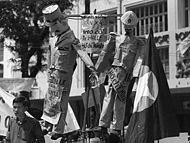
; events included a teach-in attended by 30,000, and the burning in effigyEffigyAn effigy is a representation of a person, especially in the form of sculpture or some other three-dimensional form.The term is usually associated with full-length figures of a deceased person depicted in stone or wood on church monuments. These most often lie supine with hands together in prayer,...
of president Lyndon Johnson. - A Gallup poll in May showed 48% of U.S. respondents felt the Government was handling the war effectively; 28% felt the situation was being handled badly; the rest, no opinion.
- May – First anti-Vietnam War demonstration in London outside the U.S. embassy.
- Protests were held in June on the steps of the PentagonThe PentagonThe Pentagon is the headquarters of the United States Department of Defense, located in Arlington County, Virginia. As a symbol of the U.S. military, "the Pentagon" is often used metonymically to refer to the Department of Defense rather than the building itself.Designed by the American architect...
, and in August, attempts were made by activists at Berkeley to stop the movement of trains carrying troops. - A Gallup poll in late August shows that 24% of Americans view sending troops to Vietnam as a mistake versus 60% who do not.
- By mid-October, the anti-war movement had significantly expanded to become a national and even global phenomenon, as anti-war protests drawing 100,000 were held simultaneously in as many as 80 major cities around the US, London, Paris and Rome.
- On November 2, Norman MorrisonNorman MorrisonNorman Morrison , born in Erie, Pennsylvania, was a Baltimore Quaker best known for committing suicide at age 31 in an act of self-immolation to protest United States involvement in the Vietnam War....
, a 31-year-old pacifist, set himself on fire below the third-floor window of Secretary of Defense Robert McNamaraRobert McNamaraRobert Strange McNamara was an American business executive and the eighth Secretary of Defense, serving under Presidents John F. Kennedy and Lyndon B. Johnson from 1961 to 1968, during which time he played a large role in escalating the United States involvement in the Vietnam War...
at the Pentagon, emulating the actions of the Vietnamese monk Thích Quảng Đức. - On November 27, Coretta Scott KingCoretta Scott KingCoretta Scott King was an American author, activist, and civil rights leader. The widow of Martin Luther King, Jr., Coretta Scott King helped lead the African-American Civil Rights Movement in the 1960s.Mrs...
, SDS President Carl OglesbyCarl OglesbyCarl Oglesby was an American writer, academic, and political activist. He was the President of the leftist student organization Students for a Democratic Society from 1965 to 1966.-Early years:...
, and Dr. Benjamin Spock, among others, spoke at an anti-war rally of about 30,000 in D.C. in the largest demonstration to date. Parallel protests occurred elsewhere around the nation. On that same day, President Johnson announced a significant escalation of U.S. involvement in Indochina, from 120,000 to 400,000 troops.
1966
- In February, a group of about 100 veterans attempted to return their decorations to the White House in protest of the war, but were turned back.
- Anti-war demonstrations were again held around the country and the world March 26 with 20,000 taking part in New York City.
- A Gallup poll shows that 59% believe that sending troops to Vietnam was not a mistake. Among the age group of 21–29, 71% believe it was not a mistake compared to 48% of those over 50.
- On May 15, another large demonstration, with 10,000 picketers calling for an end to the war, took place outside the White House and the Washington Monument.
- June – The Gallup poll respondents supporting the U.S. handling of the war slipped to 41%; 37% expressed disapproval; the rest, no opinion.
- A crowd of 4,000 demonstrated against the U.S. war in London on July 3 and scuffled with police outside the U.S. Embassy; 33 protesters were arrested.
- Joan Baez and A.J. Muste organized over 3000 people across the nation in an antiwar tax protest. Participants refused to pay their taxes or did not pay the amount designated for funding the war.
- Protests, strikes and sit-ins continued at Berkeley and across other campuses throughout the year, and also, three army privates known as the 'Fort Hood Three" refused to deploy in Vietnam, calling the war "illegal and immoral", and were sentenced to prison terms.
- Heavyweight boxing champion Muhammad AliMuhammad AliMuhammad Ali is an American former professional boxer, philanthropist and social activist...
– formerly known as Cassius Clay– declared himself a conscientious objectorConscientious objectorA conscientious objector is an "individual who has claimed the right to refuse to perform military service" on the grounds of freedom of thought, conscience, and/or religion....
and refused to go to war. According to a writer for Sports IllustratedSports IllustratedSports Illustrated is an American sports media company owned by media conglomerate Time Warner. Its self titled magazine has over 3.5 million subscribers and is read by 23 million adults each week, including over 18 million men. It was the first magazine with circulation over one million to win the...
, the governor of Illinois called Ali "disgusting" and the governor of Maine said that Ali "should be held in utter contempt by every patriotic American." In 1967 Ali was sentenced to 5 years in prison for draft evasion, but his conviction was later overturned on appeal. In addition, he was stripped of his title and banned from professional boxing for more than three years.
1967
- January 14 – 20,000–30,000 people staged a "Human Be-InHuman Be-InThe Human Be-In was a happening in San Francisco's Golden Gate Park, the afternoon and evening of January 14, 1967. It was a prelude to San Francisco's Summer of Love, which made the Haight-Ashbury district a symbol as the center of an American counterculture and introduced the word 'psychedelic'...
" in Golden Gate ParkGolden Gate ParkGolden Gate Park, located in San Francisco, California, is a large urban park consisting of of public grounds. Configured as a rectangle, it is similar in shape but 20% larger than Central Park in New York, to which it is often compared. It is over three miles long east to west, and about half a...
in San Francisco, near the Haight Ashbury neighborhood that had become the center of hippieHippieThe hippie subculture was originally a youth movement that arose in the United States during the mid-1960s and spread to other countries around the world. The etymology of the term 'hippie' is from hipster, and was initially used to describe beatniks who had moved into San Francisco's...
activity. - In February, about 2500 members of Women Strike for PeaceWomen Strike for PeaceWomen Strike for Peace is a United States women's peace activist group.-History:Women Strike for Peace was founded by Bella Abzug and Dagmar Wilson in 1961, and was initially part of the movement for a ban on nuclear testing and to end the Vietnam war, first demanding a negotiated settlement,...
(WSPWomen Strike for PeaceWomen Strike for Peace is a United States women's peace activist group.-History:Women Strike for Peace was founded by Bella Abzug and Dagmar Wilson in 1961, and was initially part of the movement for a ban on nuclear testing and to end the Vietnam war, first demanding a negotiated settlement,...
) marched to the Pentagon. This was a peaceful protest that became rowdier when the demonstrators were denied a meeting with Secretary of Defense Robert McNamara. - February 8 – Christian groups opposed to the war staged a nationwide "Fast for Peace".
- February 23 – The New York Review of BooksThe New York Review of BooksThe New York Review of Books is a fortnightly magazine with articles on literature, culture and current affairs. Published in New York City, it takes as its point of departure that the discussion of important books is itself an indispensable literary activity...
published "The Responsibility of IntellectualsThe Responsibility of Intellectuals"The Responsibility of Intellectuals" is an essay by the US academic Noam Chomsky which was published as a special supplement by The New York Review of Books on the 23 February 1967....
" by Noam ChomskyNoam ChomskyAvram Noam Chomsky is an American linguist, philosopher, cognitive scientist, and activist. He is an Institute Professor and Professor in the Department of Linguistics & Philosophy at MIT, where he has worked for over 50 years. Chomsky has been described as the "father of modern linguistics" and...
as a special supplement. - March 12 – A three page anti-war ad appeared in The New York TimesThe New York TimesThe New York Times is an American daily newspaper founded and continuously published in New York City since 1851. The New York Times has won 106 Pulitzer Prizes, the most of any news organization...
bearing the signatures of 6,766 teachers and professors. The advertisement spanned two and a quarter pages in Section 4, The Week in Review. The advertisement itself cost around $16,500 and was sponsored by the Inter-University Committee for Debate on Foreign Policy. - March 17 – a group of antiwar citizens marched to the PentagonThe PentagonThe Pentagon is the headquarters of the United States Department of Defense, located in Arlington County, Virginia. As a symbol of the U.S. military, "the Pentagon" is often used metonymically to refer to the Department of Defense rather than the building itself.Designed by the American architect...
to protest American involvement in Vietnam - March 25 – Civil rightsCivil rightsCivil and political rights are a class of rights that protect individuals' freedom from unwarranted infringement by governments and private organizations, and ensure one's ability to participate in the civil and political life of the state without discrimination or repression.Civil rights include...
leader Martin Luther King led a march of 5,000 against the war in ChicagoChicagoChicago is the largest city in the US state of Illinois. With nearly 2.7 million residents, it is the most populous city in the Midwestern United States and the third most populous in the US, after New York City and Los Angeles...
, IllinoisIllinoisIllinois is the fifth-most populous state of the United States of America, and is often noted for being a microcosm of the entire country. With Chicago in the northeast, small industrial cities and great agricultural productivity in central and northern Illinois, and natural resources like coal,...
. - On April 15, 400,000 people marched from Central Park to the UN building in New York City to protest the war, where they were addressed by critics of the war such as Benjamin SpockBenjamin SpockBenjamin McLane Spock was an American pediatrician whose book Baby and Child Care, published in 1946, is one of the biggest best-sellers of all time. Its message to mothers is that "you know more than you think you do."Spock was the first pediatrician to study psychoanalysis to try to understand...
, Martin Luther King, James BevelJames BevelJames L. Bevel was an American minister and leader of the 1960s Civil Rights Movement who, as the Director of Direct Action and Director of Nonviolent Education of the Southern Christian Leadership Conference initiated, strategized, directed, and developed SCLC's three major successes of the era:...
, and Jan Barry Crumb, a veteran of the war. On the same date 100,000 marched in San Francisco. - On April 24, Abbie HoffmanAbbie HoffmanAbbot Howard "Abbie" Hoffman was a political and social activist who co-founded the Youth International Party ....
led a small group of protesters against both the war and capitalismCapitalismCapitalism is an economic system that became dominant in the Western world following the demise of feudalism. There is no consensus on the precise definition nor on how the term should be used as a historical category...
who interrupted the New York Stock ExchangeNew York Stock ExchangeThe New York Stock Exchange is a stock exchange located at 11 Wall Street in Lower Manhattan, New York City, USA. It is by far the world's largest stock exchange by market capitalization of its listed companies at 13.39 trillion as of Dec 2010...
, causing chaos by throwing fistfuls of both real and fake dollars down from the gallery. - May 2 – British philosopher Bertrand RussellBertrand RussellBertrand Arthur William Russell, 3rd Earl Russell, OM, FRS was a British philosopher, logician, mathematician, historian, and social critic. At various points in his life he considered himself a liberal, a socialist, and a pacifist, but he also admitted that he had never been any of these things...
presided over the "Russell TribunalRussell TribunalThe Russell Tribunal, also known as the International War Crimes Tribunal or Russell-Sartre Tribunal, was a public body organized by British philosopher Bertrand Russell and hosted by French philosopher and playwright Jean-Paul Sartre...
" in StockholmStockholmStockholm is the capital and the largest city of Sweden and constitutes the most populated urban area in Scandinavia. Stockholm is the most populous city in Sweden, with a population of 851,155 in the municipality , 1.37 million in the urban area , and around 2.1 million in the metropolitan area...
, a mock war crimes tribunalTribunalA tribunal in the general sense is any person or institution with the authority to judge, adjudicate on, or determine claims or disputes—whether or not it is called a tribunal in its title....
, which ruled that the U.S. and its allies had committed war crimes in Vietnam. The proceedings were criticized as being a "show trialShow trialThe term show trial is a pejorative description of a type of highly public trial in which there is a strong connotation that the judicial authorities have already determined the guilt of the defendant. The actual trial has as its only goal to present the accusation and the verdict to the public as...
". - On May 30 Jan Crumb and ten like-minded men attended a peace demonstration in Washington, D.C.Washington, D.C.Washington, D.C., formally the District of Columbia and commonly referred to as Washington, "the District", or simply D.C., is the capital of the United States. On July 16, 1790, the United States Congress approved the creation of a permanent national capital as permitted by the U.S. Constitution....
, and on June 1 Vietnam Veterans Against the WarVietnam Veterans Against the WarVietnam Veterans Against the War is a tax-exempt non-profit organization and corporation, originally created to oppose the Vietnam War. VVAW describes itself as a national veterans' organization that campaigns for peace, justice, and the rights of all United States military veterans...
was born. - In the summer of 1967, Neil ArmstrongNeil ArmstrongNeil Alden Armstrong is an American former astronaut, test pilot, aerospace engineer, university professor, United States Naval Aviator, and the first person to set foot upon the Moon....
and various other NASA officials began a tour of South America to raise awareness for space travel. According to First Man, a biography of Armstrong's life, during the tour, several college students protested the astronaut, and shouted such phrases as "Murderers get out of Vietnam!" and other anti-Vietnam War messages. - July 30 – Gallup poll reported 52% of Americans disapproved of Johnson's handling of the war; 41% thought the U.S. made a mistake in sending troops; over 56% thought U.S. was losing the war or at an impasse.
- On August 28, 1967, U.S. representative Tim Lee CarterTim Lee CarterTim Lee Carter was a Republican member of the United States House of Representatives for the commonwealth of Kentucky from 1965 till 1981.-Background:...
R-KY stated before congress: "Let us now, while we are yet strong, bring our men home, every man jack of them. The Vietcong fight fiercely and tenaciously because it is their land and we are foreigners intervening in their civil war. If we must fight, let us fight in defense of our homeland and our own hemisphere." - On September 20, over one thousand members of WSPWomen Strike for PeaceWomen Strike for Peace is a United States women's peace activist group.-History:Women Strike for Peace was founded by Bella Abzug and Dagmar Wilson in 1961, and was initially part of the movement for a ban on nuclear testing and to end the Vietnam war, first demanding a negotiated settlement,...
rallied at the White House. The police used brutal tactics to try to limit it to 100 people (as per the law) or stop the demonstration, and the event tarnished the wholesome and nonviolent reputation of the WSPWomen Strike for PeaceWomen Strike for Peace is a United States women's peace activist group.-History:Women Strike for Peace was founded by Bella Abzug and Dagmar Wilson in 1961, and was initially part of the movement for a ban on nuclear testing and to end the Vietnam war, first demanding a negotiated settlement,...
. - In October 1967, Stop the Draft Week resulted in major clashes at the Oakland, CaliforniaOakland, CaliforniaOakland is a major West Coast port city on San Francisco Bay in the U.S. state of California. It is the eighth-largest city in the state with a 2010 population of 390,724...
induction center, and saw more than a thousand registrants return their draft cards in events across the country. The cards were delivered to the Justice Department on October 20. - In October 1967, three hundred students at the University of Wisconsin attempted to prevent Dow Chemical Company, the maker of napalmNapalmNapalm is a thickening/gelling agent generally mixed with gasoline or a similar fuel for use in an incendiary device, primarily as an anti-personnel weapon...
, from holding a job fair on campus. The police eventually forced the demonstration to end, but Dow Chemical Company was banned from going on the campus. Three police officers and 65 students were injured in the two-day event. - The next day, October 21, 1967, a large demonstration took place at the Lincoln MemorialLincoln MemorialThe Lincoln Memorial is an American memorial built to honor the 16th President of the United States, Abraham Lincoln. It is located on the National Mall in Washington, D.C. The architect was Henry Bacon, the sculptor of the main statue was Daniel Chester French, and the painter of the interior...
in Washington. As many as 100,000 demonstrators attended the event, and at least 30,000 later marched to the PentagonThe PentagonThe Pentagon is the headquarters of the United States Department of Defense, located in Arlington County, Virginia. As a symbol of the U.S. military, "the Pentagon" is often used metonymically to refer to the Department of Defense rather than the building itself.Designed by the American architect...
for another rally and an all night vigil. Some, including Abbie HoffmanAbbie HoffmanAbbot Howard "Abbie" Hoffman was a political and social activist who co-founded the Youth International Party ....
and Jerry RubinJerry RubinJerry Rubin was an American social activist during the 1960s and 1970s. During the 1980s, he became a successful businessman.-Early life:...
, attempted to "exorcise" and "levitate" the building, while others engaged in civil disobedienceCivil disobedienceCivil disobedience is the active, professed refusal to obey certain laws, demands, and commands of a government, or of an occupying international power. Civil disobedience is commonly, though not always, defined as being nonviolent resistance. It is one form of civil resistance...
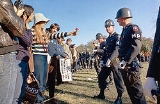
on the steps of the Pentagon, interrupted by clashes with soldiers and police. In all, 647 arrests were made. When a plot to airdrop 10,000 flowers on the Pentagon was foiled by undercover agents, these flowers ended up being placed in the barrels of MP's rifles, as seen in some famous photographs. Norman MailerNorman MailerNorman Kingsley Mailer was an American novelist, journalist, essayist, poet, playwright, screenwriter, and film director.Along with Truman Capote, Joan Didion, Hunter S...
documented the events surrounding the march on the Pentagon in his novel, Armies of the NightArmies of the NightThe Armies of the Night is a Pulitzer Prize and National Book Award-winning nonfiction novel written by Norman Mailer and sub-titled History as a Novel/The Novel as History. Mailer essentially creates his own genre for the narrative, split into historicized and novelized accounts of the October...
.
1968
- On January 15, 1968, over five thousand women rallied in D.C. in the Jeannette Rankin Brigade protest. This was the first all female antiwar protest intended to get Congress to withdrawal troops from Vietnam.
- On January 18, 1968, while in the White House for a conference about juvenile delinquency, black singer-entertainer Eartha Kitt yelled at Lady Bird Johnson about the generation of young men dying in the war.
- February – Gallup poll showed 35% approved of Johnson's handling of the war; 50% disapproved; the rest, no opinion. [NYT, 2/14/68] In another poll that month, 23% of Americans defined themselves as "doves" and 61% "hawks".
- March 12 – anti-war candidate Eugene McCarthyEugene McCarthyEugene Joseph "Gene" McCarthy was an American politician, poet, and a long-time member of the United States Congress from Minnesota. He served in the U.S. House of Representatives from 1949 to 1959 and the U.S. Senate from 1959 to 1971.In the 1968 presidential election, McCarthy was the first...
received more votes than expected in the New Hampshire primaryNew Hampshire primaryThe New Hampshire primary is the first in a series of nationwide political party primary elections held in the United States every four years , as part of the process of choosing the Democratic and Republican nominees for the presidential elections to be held the subsequent November.Although only a...
, leading to more expressions of opposition against the war. McCarthy urged his supporters to exchange the 'unkempt lookHippieThe hippie subculture was originally a youth movement that arose in the United States during the mid-1960s and spread to other countries around the world. The etymology of the term 'hippie' is from hipster, and was initially used to describe beatniks who had moved into San Francisco's...
' rapidly becoming fashionable among war opponents for a more clean-cut style to in order not to scare voters. These were known as "Clean Genes". - March 17 – Major rally outside the U.S. Embassy in London's Grosvenor Square turned to a riot with 86 people injured and over 200 arrested. Over 10,000 had rallied peacefully in Trafalgar Square but met a police barricade outside the embassy. A UK Foreign Office report claimed that the rioting had been organized by 100 members of the German SDS who were "acknowledged experts in methods of riot against the police".
- In March, Gallup poll reported that 49% of respondents felt involvement in the war was an error.
- April 17 – National media films the anti-war riot that breaks out in Berkeley, California. The over-reaction by the police in Berkeley is shown in Berlin and Paris, sparking reactions in those cities.
- On April 26, 1968, a million college and high school students boycotted class to show opposition to the war.
- During the 1968 Democratic National Convention1968 Democratic National ConventionThe 1968 Democratic National Convention of the U.S. Democratic Party was held at the International Amphitheatre in Chicago, Illinois, from August 26 to August 29, 1968. Because Democratic President Lyndon Johnson had announced he would not seek a second term, the purpose of the convention was to...
, held August 26 – August 29 in ChicagoChicagoChicago is the largest city in the US state of Illinois. With nearly 2.7 million residents, it is the most populous city in the Midwestern United States and the third most populous in the US, after New York City and Los Angeles...
, anti-war protesters marched and demonstrated throughout the city. Tensions between police and protesters quickly escalated, resulting in a "police riot". Eight leading anti-war activists were indicted by the U.S. AttorneyUnited States AttorneyUnited States Attorneys represent the United States federal government in United States district court and United States court of appeals. There are 93 U.S. Attorneys stationed throughout the United States, Puerto Rico, the U.S. Virgin Islands, Guam, and the Northern Mariana Islands...
and prosecuted for conspiracy to riot; their convictions were subsequently overturned on appeal. (See Chicago SevenChicago SevenThe Chicago Seven were seven defendants—Abbie Hoffman, Jerry Rubin, David Dellinger, Tom Hayden, Rennie Davis, John Froines, and Lee Weiner—charged with conspiracy, inciting to riot, and other charges related to protests that took place in Chicago, Illinois on the occasion of the 1968...
). Chicago mayor Richard J. DaleyRichard J. DaleyRichard Joseph Daley served for 21 years as the mayor and undisputed Democratic boss of Chicago and is considered by historians to be the "last of the big city bosses." He played a major role in the history of the Democratic Party, especially with his support of John F...
brought to bear 23,000 police and National Guardsman upon 10,000 protestors. - August – Gallup poll shows 53% said it was a mistake to send troops to Vietnam.
- Among the academic or scholarly groups was the Committee of Concerned Asian ScholarsCommittee of Concerned Asian ScholarsThe Committee of Concerned Asian Scholars was founded in 1968 by a group of graduate students and younger faculty as part of the opposition to the American war in Vietnam...
, founded in 1968 by graduate students and junior faculty in Asian studies.
1969
- March polls indicate that 19% of Americans want the war to end as soon as possible, 26% want South Vietnam to take over responsibility for the war from the U.S., 19% favor the current policy and 33% want total military victory.
- In March, students at SUNY Buffalo destroyed a Themis construction site.
- On May 22, 1969, Ottawa announced that immigration officials would not and could not ask about immigration applicants’ military status if they showed up at the border seeking permanent residence in Canada.
- July 1969: A Gallup poll indicates that 53% of the respondents approve of Nixon's handling of the war; 30% disapprove; the balance have no opinion. [New York Times, 7/31/69]
- The Moratorium to End the War in VietnamMoratorium to End the War in VietnamThe Moratorium to End the War in Vietnam was a large demonstration against the United States involvement in the Vietnam War that took place across the United States on October 15, 1969. The Moratorium developed from Jerome Grossman's April 20, 1969, call for a general strike if the war had not...
demonstrations took place on October 15, 1969. Millions of Americans took the day off from work and school to participate in local demonstrations against the war. These were the first major demonstrations against the Nixon administration's handling of the war. On November 15, 1969 crowds estimated up to half a million people participated in an anti-war demonstration in Washington, D.C. and a similar demonstration was held in San Francisco. These protests were organized by the New Mobilization Committee to End the War in Vietnam (New Mobe) and the Student Mobilization Committee to End the War in Vietnam (SMC). - In October, 58% of Gallup respondents said U.S. entry into the war was a mistake.
- In November, Sam MelvilleSam MelvilleSamuel Joseph Melville , was the principal conspirator and bomb setter in the 1969 bombings of eight government and commercial office buildings in New York City. Melville cited his opposition to the Vietnam War and U.S. imperialism as the motivation for the bombings...
, Jane Alpert, and several others bombed several corporate offices and military installations (including the Whitehall Army Induction Center) in and around New York City in opposition to the war in Vietnam. - On November 15, 1969, Howard University students protested the war in Washington, D.C.
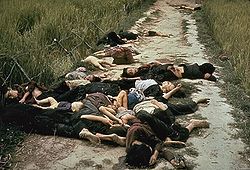
- In late December the And babiesAnd babiesAnd babies is an iconic anti-Vietnam War poster. It is a famous example of "propaganda art" from the Vietnam conflict that uses the now infamous color photograph of the My Lai Massacre taken by U.S. combat photographer Ronald L. Haeberle in March 1968...
anti-war poster is published, "easily the most successful poster to vent the outrage that so many felt about the war in Southeast Asia." - By end of 1969, 69% of students identified themselves as doves.
1970
- Kent State/Cambodia Incursion Protest, Washington, D.C.: A week after the Kent State shootingsKent State shootingsThe Kent State shootings—also known as the May 4 massacre or the Kent State massacre—occurred at Kent State University in the city of Kent, Ohio, and involved the shooting of unarmed college students by members of the Ohio National Guard on Monday, May 4, 1970...
, on May 4, 100,000 anti-warAnti-warAn anti-war movement is a social movement, usually in opposition to a particular nation's decision to start or carry on an armed conflict, unconditional of a maybe-existing just cause. The term can also refer to pacifism, which is the opposition to all use of military force during conflicts. Many...
demonstrators converged on Washington, D.C. to protest the shooting of the students in Ohio and the Nixon administration's incursion into CambodiaCambodiaCambodia , officially known as the Kingdom of Cambodia, is a country located in the southern portion of the Indochina Peninsula in Southeast Asia...
. Even though the demonstration was quickly put together, protesters were still able to bring out thousands to march in the Capital. It was an almost spontaneous response to the events of the previous week. Police ringed the White House with buses to block the demonstrators from getting too close to the executive mansion. Early in the morning before the march, Nixon met with protesters briefly at the Lincoln MemorialLincoln MemorialThe Lincoln Memorial is an American memorial built to honor the 16th President of the United States, Abraham Lincoln. It is located on the National Mall in Washington, D.C. The architect was Henry Bacon, the sculptor of the main statue was Daniel Chester French, and the painter of the interior...
but nothing was resolved and the protest went on as planned. - National Student StrikeStudent Strike of 1970In the aftermath of the American Invasion of Cambodia on April 30, 1970, four students were killed at Kent State University on May 4, 1970 in Ohio, as well as two students at Jackson State College in Mississippi on May 14/15...
: more than 450 university, college and high school campuses across the country were shut by student strikes and both violent and non-violent protests that involved more than 4 million students, in the only nationwide student strike in U.S. history. - A Gallup poll in May shows that 56% of the public believed that sending troops to Vietnam was a mistake, 61% of those over 50 expressed that belief compared to 49% of those between the ages of 21–29.
- On June 13, President Nixon established the President's Commission on Campus UnrestPresident's Commission on Campus UnrestOn June 13, 1970, President Richard Nixon established the President's Commission on Campus Unrest, which became known as the Scranton Commission after its chairman, former Pennsylvania governor William Scranton....
. The commission was directed to study the dissent, disorder, and violence breaking out on college and university campuses.
- On August 24, 1970, near 3:40 a.m., a van filled with ammonium nitrate and fuel oil mixture was detonated on the University of Wisconsin-Madison in the Sterling Hall bombingSterling Hall bombingThe Sterling Hall Bombing that occurred on the University of Wisconsin–Madison campus on August 24, 1970 was committed by four young people as a protest against the University's research connections with the US military during the Vietnam War...
.
- Vortex I: A Biodegradable Festival of LifeVortex IVortex I: A Biodegradable Festival of Life, more commonly known as just Vortex I, was a week-long rock festival sponsored by the Portland counterculture community with help from the U.S. state of Oregon, and held in 1970 in Clackamas County near Portland...
: To avert potential violence arising from planned anti-war protests, a government-sponsored rock festivalRock festivalA rock festival, or a rock fest, is a large-scale rock music concert, featuring multiple acts.The first rock festivals were put on in the late 1960s and were important socio-cultural milestones. In the 1980s a minor resurgence of festivals occurred with charity as the goal.Today, they are often...
was held near Portland, OregonPortland, OregonPortland is a city located in the Pacific Northwest, near the confluence of the Willamette and Columbia rivers in the U.S. state of Oregon. As of the 2010 Census, it had a population of 583,776, making it the 29th most populous city in the United States...
from August 28 to September 3, attracting 100,000 participants. The festival, arranged by the People's Army Jamboree (an ad hocAd hocAd hoc is a Latin phrase meaning "for this". It generally signifies a solution designed for a specific problem or task, non-generalizable, and not intended to be able to be adapted to other purposes. Compare A priori....
group) and Oregon governor Tom McCallTom McCallThomas Lawson McCall was an American politician and journalist in the state of Oregon. A Republican, he was the 30th Governor of Oregon from 1967 to 1975. A native of Massachusetts, he grew up there and in Central Oregon before attending the University of Oregon...
, was set up when the FBI told the governor that President Nixon's planned appearance at an American LegionAmerican LegionThe American Legion is a mutual-aid organization of veterans of the United States armed forces chartered by the United States Congress. It was founded to benefit those veterans who served during a wartime period as defined by Congress...
convention in Portland could lead to violence worse than that seen at 1968 Democratic National Convention1968 Democratic National ConventionThe 1968 Democratic National Convention of the U.S. Democratic Party was held at the International Amphitheatre in Chicago, Illinois, from August 26 to August 29, 1968. Because Democratic President Lyndon Johnson had announced he would not seek a second term, the purpose of the convention was to...
in Chicago.
- The Chicano MoratoriumChicano MoratoriumThe Chicano Moratorium, formally known as the National Chicano Moratorium Committee, was a movement of Chicano anti-war activists that built a broad-based coalition of Mexican-American groups to organize opposition to the Vietnam War...
: on August 29, some 25,000 Mexican-Americans participated in the largest anti-war demonstration in Los Angeles. Police attacked the crowd with billyclubsClub (weapon)A club is among the simplest of all weapons. A club is essentially a short staff, or stick, usually made of wood, and wielded as a weapon since prehistoric times....
and tear gas; two people were killed. Immediately after the marchers were dispersed, sheriff's deputies raided a nearby bar, where they shot and killed Rubén SalazarRuben SalazarRubén Salazar was a Mexican-American journalist killed by a Los Angeles County Sheriff's deputy during the National Chicano Moratorium March against the Vietnam War on August 29, 1970 in East Los Angeles, California. During the 1970s, his killing was often cited as a symbol of unjust treatment of...
, KMEX news director and Los Angeles TimesLos Angeles TimesThe Los Angeles Times is a daily newspaper published in Los Angeles, California, since 1881. It was the second-largest metropolitan newspaper in circulation in the United States in 2008 and the fourth most widely distributed newspaper in the country....
columnist, with a tear-gas projectile.
1971 and after
- On April 23, 1971, Vietnam veterans threw away over 700 medals on the West Steps of the Capitol building. The next day, antiwar organizers claimed that 500,000 marched, making this the largest demonstration since the November, 1969 march.
- Two weeks later, on May 5, 1971, 1,146 people were arrested on the Capitol grounds trying to shut down Congress. This brought the total arrested during the protest to over 12,000. Abbie HoffmanAbbie HoffmanAbbot Howard "Abbie" Hoffman was a political and social activist who co-founded the Youth International Party ....
was arrested on charges of interstate travel to incite a riot and assaulting a police officer.
- In August, 1971, The Camden 28 conducted a raid on the Camden, New Jersey draft board offices. The 28 included five or more members of the clergy, as well as a number of local blue-collar workers.
- On March 29, 1972, 166 people, many of them seminarians, were arrested in Harrisburg, PAHarrisburg, PennsylvaniaHarrisburg is the capital of Pennsylvania. As of the 2010 census, the city had a population of 49,528, making it the ninth largest city in Pennsylvania...
for encircling the Federal Courthouse with a chain, to protest the trial of the Harrisburg SevenHarrisburg SevenThe Harrisburg Seven were a group of religious anti-war activists led by Philip Berrigan. The "Seven" were Berrigan, Sister Elizabeth McAlister, Rev. Neil McLaughlin, Rev. Joseph Wenderoth, Eqbal Ahmed, Anthony Scoblick, and Mary Cain Scoblick....
.
- On April 19, 1972, in response to renewed escalation of bombing, students at many colleges and universities around the country broke into campus buildings and threatened strikes. The following weekend, protests were held in New York, San Francisco, Los Angeles, and elsewhere.
- On May 13, 1972, protests again spread across the country in response to President Nixon's decision to mine harbors in North Vietnam and renewed bombing of North Vietnam (Operation LinebackerOperation LinebackerOperation Linebacker was the title of a U.S. Seventh Air Force and U.S. Navy Task Force 77 aerial interdiction campaign conducted against the Democratic Republic of Vietnam from 9 May to 23 October 1972, during the Vietnam War....
).
- On July 6, 1973, four Sisters of Norte Dame de Namur on a White House Tour stopped and began praying to protest the war. In the next six weeks, such kneel-ins became a popular form of protest and led to over 158 protestors arrests.
Public opinion
Public support for the war decreased as the war waged on throughout the sixties and beginning part of the 1970s.William L. Lunch and Peter W. Sperlich collected public opinion data measuring support for the war from 1965–1971. Support for the war was measured by a negative response to the question: "In view of developments since we entered the fighting in Vietnam, do you think the U.S. made a mistake sending troops to fight in Vietnam?" They found the following results.