


Free Speech Movement

Encyclopedia
Student protest
Student protest encompasses a wide range of activities that indicate student dissatisfaction with a given political or academic issue and mobilization to communicate this dissatisfaction to the authorities and society in general and hopefully remedy the problem...
which took place during the 1964–1965 academic year on the campus of the University of California, Berkeley
University of California, Berkeley
The University of California, Berkeley , is a teaching and research university established in 1868 and located in Berkeley, California, USA...
under the informal leadership of students Mario Savio
Mario Savio
""...But we're a bunch of raw materials that don't mean to be - have any process upon us. Don't mean to be made into any product! Don't mean - Don't mean to end up being bought by some clients of the University, be they the government, be they industry, be they organized labor, be they anyone!...
, Brian Turner, Bettina Aptheker
Bettina Aptheker
Bettina Fay Aptheker is an American activist, author, feminist, and professor.-Early years and education:Aptheker was born in Fort Bragg, North Carolina to the first cousins Fay Philippa Aptheker and Herbert Aptheker, a radical activist and Marxist historian. She was raised in Brooklyn, New York....
, Steve Weissman, Art Goldberg, Jackie Goldberg
Jackie Goldberg
Jackie Goldberg is an American politician and teacher, and a member of the Democratic Party. She is a former member of the California State Assembly....
, and others. In protests unprecedented in this scope at the time, students insisted that the university administration lift the ban of on-campus political activities and acknowledge the students' right to free speech and academic freedom
Academic freedom
Academic freedom is the belief that the freedom of inquiry by students and faculty members is essential to the mission of the academy, and that scholars should have freedom to teach or communicate ideas or facts without being targeted for repression, job loss, or imprisonment.Academic freedom is a...
.
Background
In 1958, activist students organized SLATESLATE
SLATE, a pioneer organization of the New Left and precursor of the Free Speech Movement, was a campus political party at the University of California, Berkeley from 1958 to 1966.-Origins:...
, a campus political party, to promote the right of student groups to support off-campus issues. In the fall of 1964, student activists, some of whom had traveled with the Freedom Riders and worked to register African American
African American
African Americans are citizens or residents of the United States who have at least partial ancestry from any of the native populations of Sub-Saharan Africa and are the direct descendants of enslaved Africans within the boundaries of the present United States...
voters in Mississippi in the Freedom Summer
Freedom Summer
Freedom Summer was a campaign in the United States launched in June 1964 to attempt to register as many African American voters as possible in Mississippi which had historically excluded most blacks from voting...
project, set up information tables on campus and were soliciting donations for civil rights
African-American Civil Rights Movement (1955-1968)
The African-American Civil Rights Movement refers to the movements in the United States aimed at outlawing racial discrimination against African Americans and restoring voting rights to them. This article covers the phase of the movement between 1955 and 1968, particularly in the South...
causes. According to existing rules at the time, fundraising for political parties was limited exclusively to the Democratic and Republican school clubs. There was also a mandatory "loyalty oath
Loyalty oath
A loyalty oath is an oath of loyalty to an organization, institution, or state of which an individual is a member.In this context, a loyalty oath is distinct from pledge or oath of allegiance...
" required of faculty, which had led to dismissals and ongoing controversy over academic freedom. On September 14, 1964, Dean Katherine Towle announced that existing University regulations prohibiting advocacy of political causes or candidates, outside political speakers, recruitment of members, and fundraising by student organizations at the intersection of Bancroft and Telegraph
Telegraph Avenue
Telegraph Avenue is a street that begins, at its southernmost point, in the midst of the historic downtown district of Oakland, California, USA, and ends, at its northernmost point, at the southern edge of the University of California campus in Berkeley, California...
Avenues would be "strictly enforced." (This strip was until then thought to be city property, not campus property.)
Jack Weinberg and sit-in
On October 1, former graduate student Jack Weinberg was sitting at the CORECongress of Racial Equality
The Congress of Racial Equality or CORE was a U.S. civil rights organization that originally played a pivotal role for African-Americans in the Civil Rights Movement...
table. He refused to show his identification to the campus police and was arrested. There was a spontaneous movement of students to surround the police
Police
The police is a personification of the state designated to put in practice the enforced law, protect property and reduce civil disorder in civilian matters. Their powers include the legitimized use of force...
car in which he was to be transported. Weinberg did not leave the police car, nor did the car move for 32 hours. At one point, there may have been 3,000 students around the car.
The car was used as a speaker's podium and a continuous public discussion was held which continued until the charges against Weinberg were dropped.
On December 2nd, between 1,500 and 4,000 students went in to Sproul Hall as a last resort in order to re-open negotiations with the administration on the subject of restrictions on political speech and action on campus. Among other grievances was the fact that four of their leaders were being singled out for punishment. The demonstration was orderly. Some students studied, some watched movies, some sang folk songs. Joan Baez
Joan Baez
Joan Chandos Baez is an American folk singer, songwriter, musician and a prominent activist in the fields of human rights, peace and environmental justice....
was there to lead in the singing, and to lend moral support. "Freedom classes" were held by teaching assistants on one floor, and a special Channukah service took place in the main lobby. On the steps of Sproul Hall Mario Savio
Mario Savio
""...But we're a bunch of raw materials that don't mean to be - have any process upon us. Don't mean to be made into any product! Don't mean - Don't mean to end up being bought by some clients of the University, be they the government, be they industry, be they organized labor, be they anyone!...
gave a famous speech: "...But we're a bunch of raw materials that don't mean to be - have any process upon us. Don't mean to be made into any product! Don't mean - Don't mean to end up being bought by some clients of the University, be they the government, be they industry, be they organized labor, be they anyone! We're human beings!...There's a time when the operation of the machine becomes so odious—makes you so sick at heart—that you can't take part. You can't even passively take part. And you've got to put your bodies upon the gears and upon the wheels, upon the levers, upon all the apparatus, and you've got to make it stop. And you've got to indicate to the people who run it, to the people who own it, that unless you're free, the machine will be prevented from working at all."
At midnight, Alameda County deputy district attorney Edwin Meese III
Edwin Meese
Edwin "Ed" Meese, III is an attorney, law professor, and author who served in official capacities within the Ronald Reagan Gubernatorial Administration , the Reagan Presidential Transition Team , and the Reagan White House , eventually rising to hold the position of the 75th Attorney General of...
telephoned Governor Edmund Brown, Sr
Pat Brown
Edmund Gerald "Pat" Brown, Sr. was the 32nd Governor of California, serving from 1959 to 1967, and the father of current Governor of California Jerry Brown.-Background:...
, asking for authority to proceed with a mass arrest
Mass arrest
A mass arrest occurs when the police apprehend large numbers of suspects at once. This sometimes occurs at illegal protests. Some mass arrests are also used in an effort combat gang activity. This is sometimes controversial, and lawsuits sometimes result...
. Shortly after 2 am on December 4th, police cordoned off the building, and at 3:30 am began arresting close to 800 students. Most of the arrestees were bussed to Santa Rita Jail in Dublin
Dublin, California
Dublin is a suburban city of the East Bay region of Alameda County, California, United States. Located along the north side of Interstate 580 at the intersection with Interstate 680, roughly east of Hayward, west of Livermore and north of San Jose, it was named after the city of Dublin in...
, about 25 miles away. They were released on their own recognizance after a few hours behind bars. About a month later, the university brought charges against the students who organized the sit-in
Sit-in
A sit-in or sit-down is a form of protest that involves occupying seats or sitting down on the floor of an establishment.-Process:In a sit-in, protesters remain until they are evicted, usually by force, or arrested, or until their requests have been met...
, resulting in an even larger student protest that all but shut down the university.
Aftermath
After much disturbance, the University officials slowly backed down. By January 3, 1965, the new acting chancellor, Martin MeyersonMartin Meyerson
Martin Meyerson was a United States city planner and academic leader best known as the President of the University of Pennsylvania between 1970 and 1981....
, established provisional rules for political activity on the Berkeley campus, designating the Sproul Hall steps an open discussion area during certain hours of the day and permitting tables. This applied to the entire student political spectrum, not just the liberal elements that drove the FSM.
Most outsiders, however, identified the Free Speech Movement as a movement of the Left. Students and others opposed to U.S. foreign policy did indeed increase their visibility on campus following the FSM's initial victory. In the spring of 1965, the FSM was followed by the Vietnam Day Committee
Vietnam Day Committee
The Vietnam Day Committee was a coalition of left-wing political groups, student groups, labour organizations, and pacifist religions in the United States of America that opposed the Vietnam War...
, a major starting point for the anti-Vietnam war
Opposition to the Vietnam War
The movement against US involvment in the in Vietnam War began in the United States with demonstrations in 1964 and grew in strength in later years. The US became polarized between those who advocated continued involvement in Vietnam, and those who wanted peace. Peace movements consisted largely of...
movement.
1966–1970
The Free Speech Movement had long-lasting effects at the Berkeley campus and was a pivotal moment for the civil liberties movement in The Sixties. It was seen as the beginning of the famous student activism that existed on the campus in the 1960s, and continues to a lesser degree today. There was a substantial voter backlash against the players involved in the Free Speech Movement. Ronald ReaganRonald Reagan
Ronald Wilson Reagan was the 40th President of the United States , the 33rd Governor of California and, prior to that, a radio, film and television actor....
won an unexpected victory in the fall of 1966 and was elected Governor
Governor of California
The Governor of California is the chief executive of the California state government, whose responsibilities include making annual State of the State addresses to the California State Legislature, submitting the budget, and ensuring that state laws are enforced...
; the newly elected governor directed the UC Board of Regents
Regents of the University of California
The Regents of the University of California make up the governing board of the University of California. The Board has 26 full members:* The majority are appointed by the Governor of California for 12-year terms....
to dismiss UC President Clark Kerr
Clark Kerr
Clark Kerr was an American professor of economics and academic administrator. He was the first chancellor of the University of California, Berkeley and twelfth president of the University of California.- Early years :...
because of the perception that he had been too soft on the protesters. The FBI
Federal Bureau of Investigation
The Federal Bureau of Investigation is an agency of the United States Department of Justice that serves as both a federal criminal investigative body and an internal intelligence agency . The FBI has investigative jurisdiction over violations of more than 200 categories of federal crime...
had kept a secret file on Kerr.
Reagan had gained political traction by campaigning on a platform to "clean up the mess in Berkeley". In the minds of those involved in the backlash, a wide variety of protests and a wide variety of concerned citizens and activists were lumped together. Furthermore, television news and documentary film
Documentary film
Documentary films constitute a broad category of nonfictional motion pictures intended to document some aspect of reality, primarily for the purposes of instruction or maintaining a historical record...
making had made it possible to photograph and broadcast moving images of protest activity. Much of this media is available today as part of the permanent collection of the Bancroft Library at Berkeley, including iconic photographs of the protest activity by student Ron Enfield (then chief photographer for the Berkeley campus newspaper, the Daily Cal
The Daily Californian
The Daily Californian is an independent, student-run newspaper that serves the University of California, Berkeley campus and its surrounding community. It is published Monday through Friday during the academic year, and twice a week during the summer...
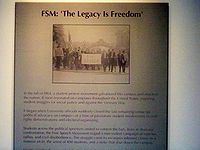
). A reproduction of what may be considered the most recognizable and iconic photograph of the movement, a shot of suit-clad students carrying the Free Speech banner through the University's Sather Gate
Sather Gate
Sather Gate is a prominent landmark separating Sproul Plaza from the bridge over Strawberry Creek, leading to the center of the University of California, Berkeley campus. The gate was donated by Jane K. Sather, a benefactor of the university, in memory of her late husband Peder Sather, a trustee of...
in Fall 1964, now stands at the entrance to the college's Free Speech Movement Cafe.
Earlier protests against the House Committee on Un-American Activities meeting in San Francisco in 1960 had included an iconic scene as protesters were literally washed down the steps inside the Rotunda of San Francisco City Hall
San Francisco City Hall
San Francisco City Hall, re-opened in 1915, in its open space area in the city's Civic Center, is a Beaux-Arts monument to the City Beautiful movement that epitomized the high-minded American Renaissance of the 1880s to 1917. The structure's dome is the fifth largest in the world...
with fire hoses. The conservative film Operation Abolition, which depicted this scene, became an organizing tool for the protesters.
Reunions
The 20th anniversary reunion of the FSM was held during the first week of October, 1984, to considerable media attention. A rally in Sproul Plaza featured FSM veterans Mario Savio, who ended a long self-imposed silence, Jack Weinberg, and Jackie Goldberg. The week continued with a series of panels open to the public on the movement and its impact. The 30th anniversary reunion, held during the first weekend of December, 1994, was also a public event, with another Sproul Plaza rally featuring Savio, Weinberg and Goldberg, and panels on the FSM and current free speech issues. In April 2001, UC's Bancroft LibraryBancroft Library
The Bancroft Library is the primary special collections library of the University of California, Berkeley. It was acquired as a gift/purchase from its founder, Hubert Howe Bancroft, with the proviso that it retain the name Bancroft Library in perpetuity...
held a symposium celebrating the opening of the Free Speech Movement Digital Archive. Although not a formal FSM reunion, many FSM leaders were on the panels and other participants were in the audience. The 40th anniversary reunion, the first after Savio's death in 1996, was held in October 2004, and featuring columnist Molly Ivins
Molly Ivins
Mary Tyler "Molly" Ivins was an American newspaper columnist, populist, political commentator, humorist and author.-Early life and education:Ivins was born in Monterey, California, and raised in Houston, Texas...
giving the annual Mario Savio Memorial Lecture, followed later in the week by the customary rally in Sproul Plaza and panels on civil liberties issues. A Sunday meeting was a more private event, primarily a gathering for the veterans of the movement, in remembrance of Savio and of a close FSM ally, professor Reginald Zelnik, who had died in an accident in May.
Today
Today, Sproul Hall and the surrounding Sproul PlazaSproul Plaza
Sproul Plaza is a major center of student activity at the University of California, Berkeley. It is divided into two sections: Upper Sproul and Lower Sproul. They are separated by 12 vertical feet and a set of stairs.-History:...
are active locations for protests and marches, as well as the ordinary daily tables with free literature from anyone who wishes to appear, of any political orientation. A wide variety of groups of all political, religious and social persuasions set up tables at Sproul Plaza. The Sproul steps, now officially known as the "Mario Savio Steps," may be reserved by anyone for a speech or rally. An on-campus restaurant commemorating the event, the Mario Savio Free Speech Movement Cafe, resides in a portion of the Moffitt Undergraduate Library
Moffitt Library
Moffitt Library is UC Berkeley's undergraduate library. It was named after James K. Moffitt.Moffitt Library used to have a two-week check out period for patrons regardless of status. Due to a new catalogue system and restructuring, however, many books can now be checked out under the same...
.
The Free Speech Monument, commemorating the movement, was created in 1991 by artist Mark Brest van Kempen. It is located, appropriately, in Sproul Plaza. The monument consists of a six-inch hole in the ground filled with soil and a granite ring surrounding that hole. The granite ring bears the inscription, "This soil and the air space extending above it shall not be a part of any nation and shall not be subject to any entity's jurisdiction." The monument makes no explicit reference to the movement, but it evokes notions of free speech and its implications through its rhetoric.http://greenmuseum.org/content/work_index/work_id-99__artist_id-51.html
See also
- Berkeley, CaliforniaBerkeley, CaliforniaBerkeley is a city on the east shore of the San Francisco Bay in Northern California, United States. Its neighbors to the south are the cities of Oakland and Emeryville. To the north is the city of Albany and the unincorporated community of Kensington...
- Congress of Racial EqualityCongress of Racial EqualityThe Congress of Racial Equality or CORE was a U.S. civil rights organization that originally played a pivotal role for African-Americans in the Civil Rights Movement...
(CORE) - William E. ForbesWilliam E. ForbesWilliam E. Forbes was a member of the Board of Regents of the University of California and owner of the Southern California Music Co...
, chairman of a Regents' committee investigating student activities in this era. - Freedom SummerFreedom SummerFreedom Summer was a campaign in the United States launched in June 1964 to attempt to register as many African American voters as possible in Mississippi which had historically excluded most blacks from voting...
- Free speech fightsFree speech fightsFree speech fights are conflicts over the right to speak freely, particularly involving the Industrial Workers of the World efforts in the early twentieth century to organize workers and publicly speak about labor issues...
- HippieHippieThe hippie subculture was originally a youth movement that arose in the United States during the mid-1960s and spread to other countries around the world. The etymology of the term 'hippie' is from hipster, and was initially used to describe beatniks who had moved into San Francisco's...
- New LeftNew LeftThe New Left was a term used mainly in the United Kingdom and United States in reference to activists, educators, agitators and others in the 1960s and 1970s who sought to implement a broad range of reforms, in contrast to earlier leftist or Marxist movements that had taken a more vanguardist...
- Mario SavioMario Savio""...But we're a bunch of raw materials that don't mean to be - have any process upon us. Don't mean to be made into any product! Don't mean - Don't mean to end up being bought by some clients of the University, be they the government, be they industry, be they organized labor, be they anyone!...
- The Sixties
- Student Nonviolent Coordinating CommitteeStudent Nonviolent Coordinating CommitteeThe Student Nonviolent Coordinating Committee ' was one of the principal organizations of the American Civil Rights Movement in the 1960s. It emerged from a series of student meetings led by Ella Baker held at Shaw University in Raleigh, North Carolina in April 1960...
(SNCC) - Students for a Democratic Society (1960 organization)Students for a Democratic Society (1960 organization)Students for a Democratic Society was a student activist movement in the United States that was one of the main iconic representations of the country's New Left. The organization developed and expanded rapidly in the mid-1960s before dissolving at its last convention in 1969...
- Town and gownTown and gownTown and gown are two distinct communities of a university town; "town" being the non-academic population and "gown" metonymically being the university community, especially in ancient seats of learning such as Oxford, Cambridge, Durham and St Andrews, although the term is also used to describe...
External links
- articles by Jo FreemanJo FreemanJo Freeman is an American feminist, political scientist, writer and attorney. As a student at the University of California, Berkeley in the 1960s, she became active in organizations working for civil liberties and the civil rights movement...
on social protest at Berkeleyhttp://www.jofreeman.com/sixtiesprotest/sixties.htm
- documents from SLATESLATESLATE, a pioneer organization of the New Left and precursor of the Free Speech Movement, was a campus political party at the University of California, Berkeley from 1958 to 1966.-Origins:...
— the UC Berkeley student political party (1958–1966) and the first of the student organizations in the rising New Left and student movements http://www.slatearchives.org/
- John Searle account of FSM; some photos on John SearleJohn SearleJohn Rogers Searle is an American philosopher and currently the Slusser Professor of Philosophy at the University of California, Berkeley.-Biography:...
's site. - "People's History of Berkeley" — extensive history at the Barrington Collective's Wiki
- Online Sound Recordings from the Free Speech Movement — UC Berkeley Library
- Free Speech Movement Archives
- Free Speech Movement Digital Archives from UC Berkeley
- http://home.att.net/~enfield/index.html Free Speech Movement Photograph Gallery 1964–1965 by Student & Chief Photographer of The Daily Californian Ron Enfield — includes the iconic photograph of the Free Speech Movements student march through the college gates and photographs of Mario Savio, Joan Baez, Phil Ochs, and more.
- FSM@40: Free Speech in a Dangerous Time
- Text, Audio, Video of Mario Savio's Sproul Hall Sit-in Address delivered 2 December 1964
- "Berkeley in the '60s"
- Photos taken in Sproul Hall during the sit in, including the police take-over of the building
- California State Senator John F. McCarthy's speech 'The Situation at the Universities' to the Commonwealth Club of California
- Former Chancellor Edward Strong's speech 'What's Ahead for the University' to the Commonwealth Club of California
- Chancellor Roger W. Heyn's speech 'University Tradition and Social Change' to the Commonwealth Club of California