

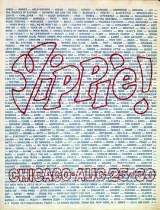
Youth International Party

Encyclopedia
The Youth International Party, whose members were commonly called Yippies, was a radically youth-oriented and countercultural
revolutionary
offshoot of the free speech
and anti-war movements of the 1960s. It was founded on Dec. 31, 1967. They employed theatrical gestures, such as advancing a pig ("Pigasus
the Immortal") as a candidate for President in 1968, to mock the social status quo. They have been described as a highly theatrical, anti-authoritarian
and anarchist youth movement of "symbolic politics".
Since they were well known for street theater and politically-themed pranks, many of the "old school" political left either ignored or denounced them. According to ABC News
, "The group was known for street theater pranks and was once referred to as the 'Groucho
Marxists
'."
, Anita Hoffman
, Jerry Rubin
, Nancy Kurshan
, and Paul Krassner
founded the Yippies (according to his own account, Krassner coined the name) at a meeting in Abbie and Anita's New York flat on Dec. 31, 1967. "If the press had created 'hippie,' could not we five hatch the 'yippie'?" Abbie Hoffman wrote. Other activists associated with the Yippies include Stew Albert
, Ed Rosenthal
, Allen Ginsberg
, Ed Sanders
, Robin Morgan
, Sharon Krebs, Phil Ochs
, William Kunstler
, Jonah Raskin
, Steve Conliff
, John Sinclair
, Aron Kay, Dana Beal
, Kathie Streem, Coca Crystal, Ben Masel, Tom Forcade
, Judy Gumbo, David Peel, Cindy Ornsteen, Jim Fouratt, Daisy Deadhead, Kate Coleman, Jill Johnston
, Keith Lampe and Bob Fass
.
A Yippie flag was frequently seen at anti-war demonstrations. The flag had a black background with a five pointed red star
in the center, and a green cannabis
leaf superimposed over it. This flag is also mentioned in Hoffman's Steal This Book
.
Abbie Hoffman and Jerry Rubin became the most famous Yippies — and best-selling authors — in part due to publicity surrounding the five-month Chicago Seven
Conspiracy trial of 1969. They both used the phrase "ideology is a brain disease" to separate the Yippies from political parties who at the time were more serious. Hoffman and Rubin were arguably the most colorful of the seven defendants accused of criminal conspiracy and inciting
to riot
at the August 1968 Democratic National Convention
. Hoffman and Rubin used the trial as a platform for Yippie antics — at one point, they showed up in court attired in judicial robes.
 The term Yippie was invented by Krassner and Hoffman on New Year's Eve 1967. Paul Krassner
wrote in a January 2007 article in the Los Angeles Times
:
Anita Hoffman liked the word, but felt The New York Times
and other "strait-laced types" needed a more formal name to take the movement seriously. That same night she came up with Youth International Party, because it symbolized the movement and made for a good play on words.
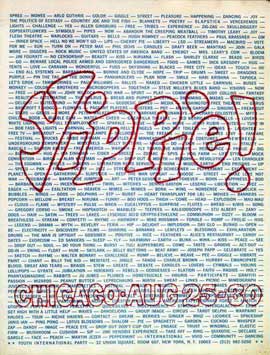
Along with the name Youth International Party, the organization was also simply called Yippie!, as in a shout for joy (with an exclamation mark to express exhilaration).
"What does Yippie! mean?" Abbie Hoffman wrote. "Energy - fun - fierceness - exclamation point!"
in Chicago. Judy Collins
sang at the press conference. The Chicago Sun-Times
reported it with an article titled: "Yipes! The Yippies Are Coming!"
s, underground newspapers
, free clinic
s, etc.). Yippies believed these cooperative institutions and a radicalized hippie culture would spread until they supplanted the existing system.
"We are a people. We are a new nation," YIP's New Nation Statement said of the burgeoning hippie
movement. "We want everyone to control their own life and to care for one another... We cannot tolerate attitudes, institutions, and machines whose purpose is the destruction of life, the accumulation of profit."
The goal was a decentralized, collective, anarchistic
nation rooted in the borderless hippie counterculture and its communal ethos. Abbie Hoffman wrote:
The flag for the "new nation" consisted of a black background with a red five pointed star in the center and a green marijuana leaf superimposed over it (same as the YIP flag).
, James Dean
and Lenny Bruce
. Many Yippies used nicknames which contained Baby Boomer
television or pop references, such as Pogo or Gumby
. Pogo is famous for creating the chant "No More Mindless Chants" in the mid-'70s. At demonstrations and parades, Yippies often wore face paint or colorful bandannas to keep from being identified in photographs. Other Yippies reveled in the spotlight, allowing their stealthier comrades the anonymity they needed for their pranks.
One cultural intervention that misfired was at Woodstock
, with Abbie Hoffman
's attempt to use the stage as a soapbox immediately prior to a performance by The Who
. Guitarist Pete Townshend
used his guitar to bat Hoffman off the stage.
The Yippies were the first on the New Left
to make a point of exploiting mass media
. Colorful, theatrical Yippie actions were tailored to attract media coverage, and also to provide a stage where people could express the "repressed" Yippie inside them. "We believe every nonyippie is a repressed yippie," Jerry Rubin wrote in Do it! "We try to bring out the yippie in everybody."
s were often satirical and elaborate prank
s or put-ons. An application to levitate The Pentagon
and a mass protest/mock levitation at the building — organized by Rubin, Hoffman and company in October 1967 — helped to set the tone for Yippie when it was established a couple of months later. Another famous prank just before Yippie was coined was a guerrilla theater event in New York City in 1967.
Abbie Hoffman
and a group of future Yippies managed to get into a tour of the New York Stock Exchange
, where they threw fistfuls of real and fake dollars
from the balcony of the visitors' gallery down to the trader
s below, some of whom booed, while others began to scramble frantically to grab the money as fast as they could.
The visitors' gallery was closed until a glass barrier could be installed, to prevent similar incidents.
There was a clash with police on March 22, 1968, where a large group of countercultural youths led by the Yippies descended into Grand Central Station
for a "Yip-In." The night erupted into a violent clash with police that Don McNeill of The Village Voice
christened a "pointless confrontation in a box canyon
." A month after the Grand Central Station Yip-In, Yippies organized a "Yip-Out," a be-in style event in Central Park that went off peacefully and drew 20,000 people.
subpoenaed Jerry Rubin
and Abbie Hoffman
of the Yippies in 1967, and again in the aftermath of the 1968 Democratic National Convention
. The Yippies used media attention to make a mockery of the proceedings: Rubin came to one session dressed as an American Revolutionary War
soldier, and passed out copies of the United States Declaration of Independence
to people in attendance. Then Rubin "blew giant gum bubbles while his co-witnesses taunted the committee with Nazi salutes." Rubin also attended HUAC dressed as Santa Claus
and a Viet Cong soldier.
On another occasion, police stopped Hoffman at the building entrance and arrested him for wearing an American flag. Hoffman quipped for the press, "I regret that I have but one shirt to give for my country," paraphrasing the last words of revolutionary patriot Nathan Hale
; meanwhile Rubin, who was wearing a matching Viet Cong flag, shouted that the police were Communists for not arresting him also.
According to The Harvard Crimson
:
in Chicago
. YIP planned a six-day Festival of Life — a celebration of the counterculture
and a protest against the state of the nation. This was supposed to counter the "Convention of Death." This promised to be "the blending of pot and politics into a political grass leaves movement — a cross-fertilization of the hippie and New Left
philosophies." Yippies' sensational statements before the convention were part of the theatrics, including a tongue-in-cheek
threat to put LSD
in Chicago's water supply. "We will fuck on the beaches! ... We demand the Politics of Ecstasy! ... Abandon the Creeping Meatball! ... And all the time 'Yippie! Chicago — August 25–30.'" First on a list of Yippie demands: "An immediate end to the war in Vietnam."
Yippie organizers hoped that well-known musicians would participate in the Festival of Life and draw a crowd of tens if not hundreds of thousands from across the country. The city of Chicago refused to issue any permits for the festival and most musicians withdrew from the project. Of the rock bands who had agreed to perform, only the MC5
came to Chicago to play and their set was cut short by a clash between the audience of a couple thousand and police. Phil Ochs
and several other singer-songwriter
s also performed during the festival.
In response to the Festival of Life and other anti-war
demonstrations during the Democratic convention
, Chicago police repeatedly clashed with protesters, as many millions of viewers watched the extensive TV coverage of the events. "The whole world is watching," protesters chanted. "A police riot," concluded the National Commission on the Causes and Prevention of Violence. "On the part of the police there was enough wild club swinging, enough cries of hatred, enough gratuitous beating to make the conclusion inescapable that individual policemen, and lots of them, committed violent acts far in excess of the requisite force for crowd dispersal or arrest."
represented a cross-section of the New Left, including three Yippie defendants: Abbie Hoffman
, Jerry Rubin
, and Lee Weiner
. Several other Yippies — including Stew Albert
, Wolfe Lowenthal, Brad Fox and Robin Palmer — were among another 18 activists named as "unindicted co-conspirators" in the case. While five of the defendants were initially convicted of crossing state lines to incite a riot, all convictions were soon reversed in appeal court. Defendants Hoffman and Rubin became popular authors and public speakers, spreading Yippie militancy and comedy wherever they appeared. When Hoffman appeared on The Merv Griffin Show
, for example, he wore a shirt with an American flag design, prompting CBS
to black out his image when the show aired.
, Vancouver
, Milwaukee, Los Angeles
, Columbus
, Chicago
and Madison
. There were YIP conferences through the 1970s, beginning with a "New Nation Conference" in Madison, Wisconsin in 1971.
building. On August 6, 1970, L.A. Yippies invaded Disneyland, hoisting the New Nation flag at City Hall and taking over Tom Sawyer's Island. While riot police confronted the Yippies, the theme park was closed early for the day. Vancouver Yippies invaded the U.S. border town of Blaine, Washington
, on May 9, 1970, to protest Richard Nixon
's invasion of Cambodia and the shooting of students at Kent State. Columbus Yippies were charged with inciting the rioting that occurred in the city on May 11, 1972, in response to Nixon's mining of North Vietnam's Haiphong harbor. They were acquitted. Chicago organized local events and hosted national events well into the '80s. A frequent complaint was that New York acted as if other chapters did not exist and kept them out of the decision making process.
YIP was a member of the coalition of anti-Vietnam War activists who, over several days in early May 1971, tried to shut down the U.S. government by occupying intersections and bridges in Washington, D.C. The May Day protests
resulted in the largest mass arrest
in American history.
In 1972, Yippies and Zippies (a younger YIP offshoot whose "guiding spirit" was Tom Forcade
) staged protests at the Republican convention in Miami. Some of the Miami protests were larger and more militant than the ones in Chicago in 1968. After Miami, the Zippies evolved back into Yippies.
Yippies organized marijuana "smoke-ins" across North America
through the 1970s and into the '80s. The first YIP smoke-in was attended by 25,000 in Washington, D.C. on July 4, 1970. There was a culture clash when many of the hippie protesters strolled en masse into the nearby "Honor America Day" festivities with Billy Graham and Bob Hope. On Aug. 7, 1971, a Yippie smoke-in in Vancouver was attacked by police, resulting in the Gastown Riot, one of the most famous protests in Canadian history. The annual July 4 Yippie smoke-in in Washington, D.C., became a counterculture tradition.
Yippies were active in alternative music and movies. Singer-songwriters Phil Ochs and David Peel were Yippies. "I helped design the party, formulate the idea of what Yippie was going to be, in the early part of 1968," Ochs testified at the Chicago Eight trial. The Youth International Party founded the U.S. branch of the Rock Against Racism movement in 1979. YIP-affiliated John Sinclair managed Detroit's proto-punk band the MC5. Vancouver Yippies Ken Lester and David Spaner were the managers of Canada's two most notorious political punk bands, D.O.A. (Lester) and The Subhumans (Spaner). New York Yippie Tom Forcade was the producer of one of the first movies about punk rock, D.O.A., featuring footage of the Sex Pistols' 1978 tour of America. Baltimore Yippie John Waters became a renowned independent filmmaker.
Some Yippies, including Robin Morgan
, Nancy Kurshan, Sharon Krebs and Judy Gumbo, were active in the guerrilla-theater feminist group W.I.T.C.H. (Women's International Terrorist Conspiracy from Hell), which combined "theatricality, humor, and activism."
On Nov. 7, 1970, Jerry Rubin and London Yippies took over The Frost Programme when he was the guest on the popular British TV program. In all the chaos, a Yippie fired a water pistol into host David Frost's open mouth, the broadcaster called for a commercial break and the show was over. The Daily Mirrors banner headline: "THE FROST FREAKOUT."
Pie-throwing
as a political act was invented by Yippies. The first political pieing was carried out by Tom Forcade, when he pied a member of the President's Commission on Obscenity and Pornography in 1970. Columbus Yippie Steve Conliff pied Ohio Governor James Rhodes in 1977 to protest the Kent State shootings. Milwaukee Yippie Pat Small was the first person to be arrested for a pieing, following a hit on a Miami alderman prior to the convention protests in 1972. Aron "The Pieman" Kay became the best-known Yippie pie-thrower, with his targets including Sen. Daniel Moynihan, conservative activist Phyllis Schlafly
, ex-CIA head William Colby
and conservative columnist William F. Buckley.
magazine The Youth International Party Line (YIPL). Later, the name was changed to TAP for Technological American Party or Technological Assistance Program.
A YIP-related newspaper, The Yipster Times, was founded by Dana Beal
in 1972 and published in New York City
. It changed its name to Overthrow in 1979. The Open Road, an internationally-known journal of the anti-authoritarian left, was founded by a core of Vancouver Yippies. Milwaukee Yippies published Street Sheet, the first of the anarchist zines later to become so popular in many cities. Tom Forcade founded High Times magazine. The New Yippie Press Collective published Blacklisted News: Secret Histories from Chicago to 1984 in 1983. It is still in print.
The most famous writing to come out of the Yippie movement is Abbie Hoffman’s Steal This Book
, which is considered to be a guidebook in causing general mischief and capturing the spirit of the Yippie movement. Hoffman is also the author of Revolution for the Hell of It which has been called the original Yippie book. This book claims that there were no actual yippies, and that the name was just a term used to create a myth.
Jerry Rubin published his account of the Yippie movement in his book Do IT!: Scenarios of Revolution.
Books on Yippie by Yippies include Woodstock Nation and Soon to Be a Major Motion Picture (Abbie Hoffman), We Are Everywhere (Jerry Rubin), Trashing (Anita Hoffman), Who the Hell is Stew Albert? (Stew Albert), Confessions of a Raving, Unconfined Nut (Paul Krassner) and Shards of God (Ed Sanders). Some other related books by Yippies: Woodstock Census: The Nationwide Survey of the Sixties Generation (Deanne Stillman and Rex Weiner), The Panama Hat Trail (Tom Miller), Medicine Ball Caravan (Tom Forcade), The Ballad of Ken and Emily: or, Tales from the Counterculture (Ken Wachsberger).
Vancouver Yippie Bob Sarti's play "Yippies in Love" premiered in June 2011.
. Dana Beal
, of New York City, started the Global Marijuana March
in 1999. Beal also crusades for the use of Ibogaine
to treat heroin addicts. Another Yippie, A.J. Weberman, deconstructs the poetry of Bob Dylan
and speculates about the tramps on the Grassy Knoll through his various websites. Weberman is also active in the Jewish Defense Organization
.
Two of the best-known original Yippies met untimely ends. Abbie Hoffman
committed suicide in 1989 with alcohol and about 150 phenobarbital
pills, while Jerry Rubin
became a stockbroker
, and in 1994 was fatally injured by a car while jaywalking
. By the age of 50, Rubin had broken with many of his previous countercultural views; he was interviewed by the New York Times, which described him as a "yippie-turned-conspicuous-yuppie." In the interview, he stated that "Until me, nobody had really taken off their clothes and screamed out loud, 'It's O.K. to make money!'"
for their headquarters in New York City for $1.2 million. It has since been converted into the "Yippie Museum/Café and Gift Shop". It houses an independently-operated café that features live music on scheduled nights. Performers at the café have included both nationally-known figures and local bands, including Roseanne Barr
, Ed Rosenthal
, The Fiction Circus
, and Joel Landy. The museum is chartered by the Board of Regents
of the University of the State of New York
. According to the curator's message at the official website the museum "exists to preserve the history of the Youth International Party and all of its offshoots." The Board of Directors consists of Dana Beal, Aron Kay, David Peel, William Propp, Paul DeRienzo, and A. J. Weberman.
Counterculture
Counterculture is a sociological term used to describe the values and norms of behavior of a cultural group, or subculture, that run counter to those of the social mainstream of the day, the cultural equivalent of political opposition. Counterculture can also be described as a group whose behavior...
revolutionary
Revolutionary
A revolutionary is a person who either actively participates in, or advocates revolution. Also, when used as an adjective, the term revolutionary refers to something that has a major, sudden impact on society or on some aspect of human endeavor.-Definition:...
offshoot of the free speech
Free Speech Movement
The Free Speech Movement was a student protest which took place during the 1964–1965 academic year on the campus of the University of California, Berkeley under the informal leadership of students Mario Savio, Brian Turner, Bettina Aptheker, Steve Weissman, Art Goldberg, Jackie Goldberg, and...
and anti-war movements of the 1960s. It was founded on Dec. 31, 1967. They employed theatrical gestures, such as advancing a pig ("Pigasus
Pigasus (politics)
Pigasus was a pig and was a satiric candidate for President of the United States for the Youth International Party . The pig's name was a play on Pegasus, the winged horse in Greek mythology. Led by Abbie Hoffman and Jerry Rubin, Pigasus was purchased by Phil Ochs and the candidacy was announced...
the Immortal") as a candidate for President in 1968, to mock the social status quo. They have been described as a highly theatrical, anti-authoritarian
Anti-authoritarian
Anti-authoritarianism is opposition to authoritarianism, which is defined as a "political doctrine advocating the principle of absolute rule: absolutism, autocracy, despotism, dictatorship, totalitarianism." Anti-authoritarians usually believe in full equality before the law and strong civil...
and anarchist youth movement of "symbolic politics".
Since they were well known for street theater and politically-themed pranks, many of the "old school" political left either ignored or denounced them. According to ABC News
ABC News
ABC News is the news gathering and broadcasting division of American broadcast television network ABC, a subsidiary of The Walt Disney Company...
, "The group was known for street theater pranks and was once referred to as the 'Groucho
Groucho Marx
Julius Henry "Groucho" Marx was an American comedian and film star famed as a master of wit. His rapid-fire delivery of innuendo-laden patter earned him many admirers. He made 13 feature films with his siblings the Marx Brothers, of whom he was the third-born...
Marxists
Marxism
Marxism is an economic and sociopolitical worldview and method of socioeconomic inquiry that centers upon a materialist interpretation of history, a dialectical view of social change, and an analysis and critique of the development of capitalism. Marxism was pioneered in the early to mid 19th...
'."
Background
The Yippies had no formal membership or hierarchy. Abbie HoffmanAbbie Hoffman
Abbot Howard "Abbie" Hoffman was a political and social activist who co-founded the Youth International Party ....
, Anita Hoffman
Anita Hoffman
Anita Hoffman , born Anita Kushner, and was a Yippie activist, writer, prankster, and the wife of Abbie Hoffman.Hoffman helped her husband plan some of the most memorable pranks of the Yippie movement...
, Jerry Rubin
Jerry Rubin
Jerry Rubin was an American social activist during the 1960s and 1970s. During the 1980s, he became a successful businessman.-Early life:...
, Nancy Kurshan
Nancy Kurshan
Nancy Kurshan was born in Brooklyn, NY on February 4, 1944, was raised as a “red diaper baby” and is best known for being a founder of the Youth International Party . She was a participant in the civil rights and peace movements as far back as high school...
, and Paul Krassner
Paul Krassner
Paul Krassner is an author, journalist, stand-up comedian, and the founder, editor and a frequent contributor to the freethought magazine The Realist, first published in 1958...
founded the Yippies (according to his own account, Krassner coined the name) at a meeting in Abbie and Anita's New York flat on Dec. 31, 1967. "If the press had created 'hippie,' could not we five hatch the 'yippie'?" Abbie Hoffman wrote. Other activists associated with the Yippies include Stew Albert
Stew Albert
Stewart Edward "Stew" Albert was an early member of the Yippies, an anti-Vietnam War political activist, and an important figure in the New Left movement of the 1960s....
, Ed Rosenthal
Ed Rosenthal
Ed Rosenthal is a California horticulturist, author, publisher, and Cannabis grower known for his advocacy for the legalization of marijuana use. He served as a columnist for High Times Magazine during the 80's and 90's...
, Allen Ginsberg
Allen Ginsberg
Irwin Allen Ginsberg was an American poet and one of the leading figures of the Beat Generation in the 1950s. He vigorously opposed militarism, materialism and sexual repression...
, Ed Sanders
Ed Sanders
Ed Sanders is an American poet, singer, social activist, environmentalist, author and publisher and has been a longtime member of the band The Fugs. He has been called a bridge between the Beat and Hippie generations.-Biography:...
, Robin Morgan
Robin Morgan
Robin Morgan is a former child actor turned American radical feminist activist, writer, poet, and editor of Sisterhood is Powerful and Ms. Magazine....
, Sharon Krebs, Phil Ochs
Phil Ochs
Philip David Ochs was an American protest singer and songwriter who was known for his sharp wit, sardonic humor, earnest humanism, political activism, insightful and alliterative lyrics, and haunting voice...
, William Kunstler
William Kunstler
William Moses Kunstler was an American self-described "radical lawyer" and civil rights activist, known for his controversial clients...
, Jonah Raskin
Jonah Raskin
Jonah Raskin is an American writer who left an East Coast university teaching position to participate in the 1970s radical counterculture as a free-lance journalist, then returned to the academy in California in the 1980s to write probing studies of Abbie Hoffman and Allen Ginsberg and reviews of...
, Steve Conliff
Steve Conliff
Steven Conliff was a Midwestern-based, Native American writer, historian, social satirist and political activist in the 1960s and 1970s. He is chiefly remembered for throwing a banana cream pie at James A...
, John Sinclair
John Sinclair (poet)
John Sinclair is a Detroit poet, one-time manager of the band MC5, and leader of the White Panther Party — a militantly anti-racist countercultural group of white socialists seeking to assist the Black Panthers in the Civil Rights movement — from November 1968 to July 1969...
, Aron Kay, Dana Beal
Dana Beal
Irvin Dana Beal is an American social and political activist, best known for his efforts to legalize marijuana...
, Kathie Streem, Coca Crystal, Ben Masel, Tom Forcade
Tom Forcade
Thomas King Forçade , aka John Thomas Moore and Kenneth Goodson Jr., was an American underground journalist and activist in the 1970s...
, Judy Gumbo, David Peel, Cindy Ornsteen, Jim Fouratt, Daisy Deadhead, Kate Coleman, Jill Johnston
Jill Johnston
Jill Johnston was an American feminist author and cultural critic who wrote Lesbian Nation in 1973 and was a longtime writer for The Village Voice. She was also a leader of the lesbian separatist movement of the 1970s. Johnston also wrote under the pen name F. J...
, Keith Lampe and Bob Fass
Bob Fass
Bob Fass is an American radio personality and pioneer of free-form radio, who has broadcast in the New York region for 40 years....
.
A Yippie flag was frequently seen at anti-war demonstrations. The flag had a black background with a five pointed red star
Red star
A red star, five-pointed and filled, is an important ideological and religious symbol which has been used for various purposes, such as: state emblems, flags, monuments, ornaments, and logos.- Symbol of communism :...
in the center, and a green cannabis
Cannabis (drug)
Cannabis, also known as marijuana among many other names, refers to any number of preparations of the Cannabis plant intended for use as a psychoactive drug or for medicinal purposes. The English term marijuana comes from the Mexican Spanish word marihuana...
leaf superimposed over it. This flag is also mentioned in Hoffman's Steal This Book
Steal This Book
-Advice on dissidence:The book includes advice on such topics as growing cannabis, starting a pirate radio station, living in a commune, stealing food, shoplifting, stealing credit cards, preparing a legal defense, making pipe bombs, and obtaining a free buffalo from the Department of the Interior...
.
Abbie Hoffman and Jerry Rubin became the most famous Yippies — and best-selling authors — in part due to publicity surrounding the five-month Chicago Seven
Chicago Seven
The Chicago Seven were seven defendants—Abbie Hoffman, Jerry Rubin, David Dellinger, Tom Hayden, Rennie Davis, John Froines, and Lee Weiner—charged with conspiracy, inciting to riot, and other charges related to protests that took place in Chicago, Illinois on the occasion of the 1968...
Conspiracy trial of 1969. They both used the phrase "ideology is a brain disease" to separate the Yippies from political parties who at the time were more serious. Hoffman and Rubin were arguably the most colorful of the seven defendants accused of criminal conspiracy and inciting
Incitement
In English criminal law, incitement was an anticipatory common law offence and was the act of persuading, encouraging, instigating, pressuring, or threatening so as to cause another to commit a crime....
to riot
Riot
A riot is a form of civil disorder characterized often by what is thought of as disorganized groups lashing out in a sudden and intense rash of violence against authority, property or people. While individuals may attempt to lead or control a riot, riots are thought to be typically chaotic and...
at the August 1968 Democratic National Convention
1968 Democratic National Convention
The 1968 Democratic National Convention of the U.S. Democratic Party was held at the International Amphitheatre in Chicago, Illinois, from August 26 to August 29, 1968. Because Democratic President Lyndon Johnson had announced he would not seek a second term, the purpose of the convention was to...
. Hoffman and Rubin used the trial as a platform for Yippie antics — at one point, they showed up in court attired in judicial robes.
Origins
Paul Krassner
Paul Krassner is an author, journalist, stand-up comedian, and the founder, editor and a frequent contributor to the freethought magazine The Realist, first published in 1958...
wrote in a January 2007 article in the Los Angeles Times
Los Angeles Times
The Los Angeles Times is a daily newspaper published in Los Angeles, California, since 1881. It was the second-largest metropolitan newspaper in circulation in the United States in 2008 and the fourth most widely distributed newspaper in the country....
:
Anita Hoffman liked the word, but felt The New York Times
The New York Times
The New York Times is an American daily newspaper founded and continuously published in New York City since 1851. The New York Times has won 106 Pulitzer Prizes, the most of any news organization...
and other "strait-laced types" needed a more formal name to take the movement seriously. That same night she came up with Youth International Party, because it symbolized the movement and made for a good play on words.
Along with the name Youth International Party, the organization was also simply called Yippie!, as in a shout for joy (with an exclamation mark to express exhilaration).
"What does Yippie! mean?" Abbie Hoffman wrote. "Energy - fun - fierceness - exclamation point!"
First press conference
The Yippies held their first press conference in New York at the Americana Hotel March 17, 1968, five months before the August 1968 Democratic National Convention1968 Democratic National Convention
The 1968 Democratic National Convention of the U.S. Democratic Party was held at the International Amphitheatre in Chicago, Illinois, from August 26 to August 29, 1968. Because Democratic President Lyndon Johnson had announced he would not seek a second term, the purpose of the convention was to...
in Chicago. Judy Collins
Judy Collins
Judith Marjorie "Judy" Collins is an American singer and songwriter, known for her eclectic tastes in the material she records ; and for her social activism. She is an alumna of the University of Colorado.-Musical career:Collins was born and raised in Seattle, Washington...
sang at the press conference. The Chicago Sun-Times
Chicago Sun-Times
The Chicago Sun-Times is an American daily newspaper published in Chicago, Illinois. It is the flagship paper of the Sun-Times Media Group.-History:The Chicago Sun-Times is the oldest continuously published daily newspaper in the city...
reported it with an article titled: "Yipes! The Yippies Are Coming!"
The New Nation concept
The Yippie "New Nation" concept called for the creation of alternative, counterculture institutions (food co-opFood co-op
A food cooperative or food co-op is a grocery store organized as a cooperative. Food cooperatives are usually consumers' cooperatives and are owned by their members. Food cooperatives follow the 7 Cooperative Principles and typically offer natural foods...
s, underground newspapers
Underground press
The underground press were the independently published and distributed underground papers associated with the counterculture of the late 1960s and early 1970s in the United States, Canada, United Kingdom, and other western nations....
, free clinic
Free clinic
A free clinic is a medical facility offering community healthcare on a free or very low-cost basis in countries with marginal or no universal health care. Care is generally provided in these clinics to persons who have lower or limited income and no health insurance, including persons who are not...
s, etc.). Yippies believed these cooperative institutions and a radicalized hippie culture would spread until they supplanted the existing system.
"We are a people. We are a new nation," YIP's New Nation Statement said of the burgeoning hippie
Hippie
The hippie subculture was originally a youth movement that arose in the United States during the mid-1960s and spread to other countries around the world. The etymology of the term 'hippie' is from hipster, and was initially used to describe beatniks who had moved into San Francisco's...
movement. "We want everyone to control their own life and to care for one another... We cannot tolerate attitudes, institutions, and machines whose purpose is the destruction of life, the accumulation of profit."
The goal was a decentralized, collective, anarchistic
Anarchism
Anarchism is generally defined as the political philosophy which holds the state to be undesirable, unnecessary, and harmful, or alternatively as opposing authority in the conduct of human relations...
nation rooted in the borderless hippie counterculture and its communal ethos. Abbie Hoffman wrote:
We shall not defeat Amerika by organizing a political party. We shall do it by building a new nation — a nation as rugged as the marijuana leaf.
The flag for the "new nation" consisted of a black background with a red five pointed star in the center and a green marijuana leaf superimposed over it (same as the YIP flag).
Culture and activism
The Yippies often paid tribute to rock 'n' roll and irreverent pop-culture figures such as the Marx BrothersMarx Brothers
The Marx Brothers were an American family comedy act, originally from New York City, that enjoyed success in Vaudeville, Broadway, and motion pictures from the early 1900s to around 1950...
, James Dean
James Dean
James Byron Dean was an American film actor. He is a cultural icon, best embodied in the title of his most celebrated film, Rebel Without a Cause , in which he starred as troubled Los Angeles teenager Jim Stark...
and Lenny Bruce
Lenny Bruce
Leonard Alfred Schneider , better known by the stage name Lenny Bruce, was a Jewish-American comedian, social critic and satirist...
. Many Yippies used nicknames which contained Baby Boomer
Baby boomer
A baby boomer is a person who was born during the demographic Post-World War II baby boom and who grew up during the period between 1946 and 1964. The term "baby boomer" is sometimes used in a cultural context. Therefore, it is impossible to achieve broad consensus of a precise definition, even...
television or pop references, such as Pogo or Gumby
Gumby
Gumby is a green clay humanoid character created and modeled by Art Clokey, who also created Davey and Goliath. Gumby has been the subject of a 233-episode series of American television as well as a feature-length film and other media...
. Pogo is famous for creating the chant "No More Mindless Chants" in the mid-'70s. At demonstrations and parades, Yippies often wore face paint or colorful bandannas to keep from being identified in photographs. Other Yippies reveled in the spotlight, allowing their stealthier comrades the anonymity they needed for their pranks.
One cultural intervention that misfired was at Woodstock
Woodstock Festival
Woodstock Music & Art Fair was a music festival, billed as "An Aquarian Exposition: 3 Days of Peace & Music". It was held at Max Yasgur's 600-acre dairy farm in the Catskills near the hamlet of White Lake in the town of Bethel, New York, from August 15 to August 18, 1969...
, with Abbie Hoffman
Abbie Hoffman
Abbot Howard "Abbie" Hoffman was a political and social activist who co-founded the Youth International Party ....
's attempt to use the stage as a soapbox immediately prior to a performance by The Who
The Who
The Who are an English rock band formed in 1964 by Roger Daltrey , Pete Townshend , John Entwistle and Keith Moon . They became known for energetic live performances which often included instrument destruction...
. Guitarist Pete Townshend
Pete Townshend
Peter Dennis Blandford "Pete" Townshend is an English rock guitarist, vocalist, songwriter and author, known principally as the guitarist and songwriter for the rock group The Who, as well as for his own solo career...
used his guitar to bat Hoffman off the stage.
The Yippies were the first on the New Left
New Left
The New Left was a term used mainly in the United Kingdom and United States in reference to activists, educators, agitators and others in the 1960s and 1970s who sought to implement a broad range of reforms, in contrast to earlier leftist or Marxist movements that had taken a more vanguardist...
to make a point of exploiting mass media
Mass media
Mass media refers collectively to all media technologies which are intended to reach a large audience via mass communication. Broadcast media transmit their information electronically and comprise of television, film and radio, movies, CDs, DVDs and some other gadgets like cameras or video consoles...
. Colorful, theatrical Yippie actions were tailored to attract media coverage, and also to provide a stage where people could express the "repressed" Yippie inside them. "We believe every nonyippie is a repressed yippie," Jerry Rubin wrote in Do it! "We try to bring out the yippie in everybody."
Early Yippie actions
Yippies were famous for their sense of humor. Many direct actionDirect action
Direct action is activity undertaken by individuals, groups, or governments to achieve political, economic, or social goals outside of normal social/political channels. This can include nonviolent and violent activities which target persons, groups, or property deemed offensive to the direct action...
s were often satirical and elaborate prank
Practical joke
A practical joke is a mischievous trick played on someone, typically causing the victim to experience embarrassment, indignity, or discomfort. Practical jokes differ from confidence tricks in that the victim finds out, or is let in on the joke, rather than being fooled into handing over money or...
s or put-ons. An application to levitate The Pentagon
The Pentagon
The Pentagon is the headquarters of the United States Department of Defense, located in Arlington County, Virginia. As a symbol of the U.S. military, "the Pentagon" is often used metonymically to refer to the Department of Defense rather than the building itself.Designed by the American architect...
and a mass protest/mock levitation at the building — organized by Rubin, Hoffman and company in October 1967 — helped to set the tone for Yippie when it was established a couple of months later. Another famous prank just before Yippie was coined was a guerrilla theater event in New York City in 1967.
Abbie Hoffman
Abbie Hoffman
Abbot Howard "Abbie" Hoffman was a political and social activist who co-founded the Youth International Party ....
and a group of future Yippies managed to get into a tour of the New York Stock Exchange
New York Stock Exchange
The New York Stock Exchange is a stock exchange located at 11 Wall Street in Lower Manhattan, New York City, USA. It is by far the world's largest stock exchange by market capitalization of its listed companies at 13.39 trillion as of Dec 2010...
, where they threw fistfuls of real and fake dollars
United States dollar
The United States dollar , also referred to as the American dollar, is the official currency of the United States of America. It is divided into 100 smaller units called cents or pennies....
from the balcony of the visitors' gallery down to the trader
Trader (finance)
A trader is someone in finance who buys and sells financial instruments such as stocks, bonds, commodities and derivatives. A broker who simply fills buy or sell orders is not a trader, as they are merely executing instructions given to them. According to the Wall Street Journal in 2004, a managing...
s below, some of whom booed, while others began to scramble frantically to grab the money as fast as they could.
The visitors' gallery was closed until a glass barrier could be installed, to prevent similar incidents.
There was a clash with police on March 22, 1968, where a large group of countercultural youths led by the Yippies descended into Grand Central Station
Grand Central Terminal
Grand Central Terminal —often incorrectly called Grand Central Station, or shortened to simply Grand Central—is a terminal station at 42nd Street and Park Avenue in Midtown Manhattan in New York City, United States...
for a "Yip-In." The night erupted into a violent clash with police that Don McNeill of The Village Voice
The Village Voice
The Village Voice is a free weekly newspaper and news and features website in New York City that features investigative articles, analysis of current affairs and culture, arts and music coverage, and events listings for New York City...
christened a "pointless confrontation in a box canyon
Box canyon
Box Canyon is a Box canyon in Ouray County, Colorado, United States. It was originally founded as a mining camp and helped the city of Ouray establish itself as a permanent community. Box Canyon is home to Box Canyon Falls, a 285-foot waterfall, with quartzite walls that extend almost one hundred...
." A month after the Grand Central Station Yip-In, Yippies organized a "Yip-Out," a be-in style event in Central Park that went off peacefully and drew 20,000 people.
House Un-American Activities Committee
The House Un-American Activities CommitteeHouse Un-American Activities Committee
The House Committee on Un-American Activities or House Un-American Activities Committee was an investigative committee of the United States House of Representatives. In 1969, the House changed the committee's name to "House Committee on Internal Security"...
subpoenaed Jerry Rubin
Jerry Rubin
Jerry Rubin was an American social activist during the 1960s and 1970s. During the 1980s, he became a successful businessman.-Early life:...
and Abbie Hoffman
Abbie Hoffman
Abbot Howard "Abbie" Hoffman was a political and social activist who co-founded the Youth International Party ....
of the Yippies in 1967, and again in the aftermath of the 1968 Democratic National Convention
1968 Democratic National Convention
The 1968 Democratic National Convention of the U.S. Democratic Party was held at the International Amphitheatre in Chicago, Illinois, from August 26 to August 29, 1968. Because Democratic President Lyndon Johnson had announced he would not seek a second term, the purpose of the convention was to...
. The Yippies used media attention to make a mockery of the proceedings: Rubin came to one session dressed as an American Revolutionary War
American Revolutionary War
The American Revolutionary War , the American War of Independence, or simply the Revolutionary War, began as a war between the Kingdom of Great Britain and thirteen British colonies in North America, and ended in a global war between several European great powers.The war was the result of the...
soldier, and passed out copies of the United States Declaration of Independence
United States Declaration of Independence
The Declaration of Independence was a statement adopted by the Continental Congress on July 4, 1776, which announced that the thirteen American colonies then at war with Great Britain regarded themselves as independent states, and no longer a part of the British Empire. John Adams put forth a...
to people in attendance. Then Rubin "blew giant gum bubbles while his co-witnesses taunted the committee with Nazi salutes." Rubin also attended HUAC dressed as Santa Claus
Santa Claus
Santa Claus is a folklore figure in various cultures who distributes gifts to children, normally on Christmas Eve. Each name is a variation of Saint Nicholas, but refers to Santa Claus...
and a Viet Cong soldier.
On another occasion, police stopped Hoffman at the building entrance and arrested him for wearing an American flag. Hoffman quipped for the press, "I regret that I have but one shirt to give for my country," paraphrasing the last words of revolutionary patriot Nathan Hale
Nathan Hale
Nathan Hale was a soldier for the Continental Army during the American Revolutionary War. He volunteered for an intelligence-gathering mission in New York City but was captured by the British...
; meanwhile Rubin, who was wearing a matching Viet Cong flag, shouted that the police were Communists for not arresting him also.
According to The Harvard Crimson
The Harvard Crimson
The Harvard Crimson, the daily student newspaper of Harvard University, was founded in 1873. It is the only daily newspaper in Cambridge, Massachusetts, and is run entirely by Harvard College undergraduates...
:
Chicago '68
Yippie theatrics culminated at the 1968 Democratic National Convention1968 Democratic National Convention
The 1968 Democratic National Convention of the U.S. Democratic Party was held at the International Amphitheatre in Chicago, Illinois, from August 26 to August 29, 1968. Because Democratic President Lyndon Johnson had announced he would not seek a second term, the purpose of the convention was to...
in Chicago
Chicago
Chicago is the largest city in the US state of Illinois. With nearly 2.7 million residents, it is the most populous city in the Midwestern United States and the third most populous in the US, after New York City and Los Angeles...
. YIP planned a six-day Festival of Life — a celebration of the counterculture
Counterculture
Counterculture is a sociological term used to describe the values and norms of behavior of a cultural group, or subculture, that run counter to those of the social mainstream of the day, the cultural equivalent of political opposition. Counterculture can also be described as a group whose behavior...
and a protest against the state of the nation. This was supposed to counter the "Convention of Death." This promised to be "the blending of pot and politics into a political grass leaves movement — a cross-fertilization of the hippie and New Left
New Left
The New Left was a term used mainly in the United Kingdom and United States in reference to activists, educators, agitators and others in the 1960s and 1970s who sought to implement a broad range of reforms, in contrast to earlier leftist or Marxist movements that had taken a more vanguardist...
philosophies." Yippies' sensational statements before the convention were part of the theatrics, including a tongue-in-cheek
Tongue-in-cheek
Tongue-in-cheek is a phrase used as a figure of speech to imply that a statement or other production is humorously intended and it should not be taken at face value. The facial expression typically indicates that one is joking or making a mental effort. In the past, it may also have indicated...
threat to put LSD
LSD
Lysergic acid diethylamide, abbreviated LSD or LSD-25, also known as lysergide and colloquially as acid, is a semisynthetic psychedelic drug of the ergoline family, well known for its psychological effects which can include altered thinking processes, closed and open eye visuals, synaesthesia, an...
in Chicago's water supply. "We will fuck on the beaches! ... We demand the Politics of Ecstasy! ... Abandon the Creeping Meatball! ... And all the time 'Yippie! Chicago — August 25–30.'" First on a list of Yippie demands: "An immediate end to the war in Vietnam."
Yippie organizers hoped that well-known musicians would participate in the Festival of Life and draw a crowd of tens if not hundreds of thousands from across the country. The city of Chicago refused to issue any permits for the festival and most musicians withdrew from the project. Of the rock bands who had agreed to perform, only the MC5
MC5
The MC5 is an American rock band formed in Lincoln Park, Michigan and originally active from 1964 to 1972. The original band line-up consisted of vocalist Rob Tyner, guitarists Wayne Kramer and Fred "Sonic" Smith, bassist Michael Davis, and drummer Dennis Thompson...
came to Chicago to play and their set was cut short by a clash between the audience of a couple thousand and police. Phil Ochs
Phil Ochs
Philip David Ochs was an American protest singer and songwriter who was known for his sharp wit, sardonic humor, earnest humanism, political activism, insightful and alliterative lyrics, and haunting voice...
and several other singer-songwriter
Singer-songwriter
Singer-songwriters are musicians who write, compose and sing their own musical material including lyrics and melodies. As opposed to contemporary popular music singers who write their own songs, the term singer-songwriter describes a distinct form of artistry, closely associated with the...
s also performed during the festival.
In response to the Festival of Life and other anti-war
Anti-war
An anti-war movement is a social movement, usually in opposition to a particular nation's decision to start or carry on an armed conflict, unconditional of a maybe-existing just cause. The term can also refer to pacifism, which is the opposition to all use of military force during conflicts. Many...
demonstrations during the Democratic convention
1968 Democratic National Convention
The 1968 Democratic National Convention of the U.S. Democratic Party was held at the International Amphitheatre in Chicago, Illinois, from August 26 to August 29, 1968. Because Democratic President Lyndon Johnson had announced he would not seek a second term, the purpose of the convention was to...
, Chicago police repeatedly clashed with protesters, as many millions of viewers watched the extensive TV coverage of the events. "The whole world is watching," protesters chanted. "A police riot," concluded the National Commission on the Causes and Prevention of Violence. "On the part of the police there was enough wild club swinging, enough cries of hatred, enough gratuitous beating to make the conclusion inescapable that individual policemen, and lots of them, committed violent acts far in excess of the requisite force for crowd dispersal or arrest."
The Conspiracy Trial
Following the convention, eight protesters were charged with conspiracy to incite the riots, and there was a heavily publicized, five-month trial. The Chicago SevenChicago Seven
The Chicago Seven were seven defendants—Abbie Hoffman, Jerry Rubin, David Dellinger, Tom Hayden, Rennie Davis, John Froines, and Lee Weiner—charged with conspiracy, inciting to riot, and other charges related to protests that took place in Chicago, Illinois on the occasion of the 1968...
represented a cross-section of the New Left, including three Yippie defendants: Abbie Hoffman
Abbie Hoffman
Abbot Howard "Abbie" Hoffman was a political and social activist who co-founded the Youth International Party ....
, Jerry Rubin
Jerry Rubin
Jerry Rubin was an American social activist during the 1960s and 1970s. During the 1980s, he became a successful businessman.-Early life:...
, and Lee Weiner
Lee Weiner
Lee Weiner , a member of the Chicago Seven, was charged with conspiracy and making incendiary devices for his part in the demonstrations that surrounded the 1968 Democratic National Convention.J...
. Several other Yippies — including Stew Albert
Stew Albert
Stewart Edward "Stew" Albert was an early member of the Yippies, an anti-Vietnam War political activist, and an important figure in the New Left movement of the 1960s....
, Wolfe Lowenthal, Brad Fox and Robin Palmer — were among another 18 activists named as "unindicted co-conspirators" in the case. While five of the defendants were initially convicted of crossing state lines to incite a riot, all convictions were soon reversed in appeal court. Defendants Hoffman and Rubin became popular authors and public speakers, spreading Yippie militancy and comedy wherever they appeared. When Hoffman appeared on The Merv Griffin Show
The Merv Griffin Show
The Merv Griffin Show is an American television talk show, starring Merv Griffin. The series ran from October 1, 1962 to March 29, 1963 on NBC, September 20, 1965 to September 26, 1969 in first-run syndication, from August 18, 1969 to February 11, 1972 at 11:30 PM ET weeknights on CBS and again in...
, for example, he wore a shirt with an American flag design, prompting CBS
CBS
CBS Broadcasting Inc. is a major US commercial broadcasting television network, which started as a radio network. The name is derived from the initials of the network's former name, Columbia Broadcasting System. The network is sometimes referred to as the "Eye Network" in reference to the shape of...
to black out his image when the show aired.
The Yippie movement
The Youth International Party quickly spread beyond Rubin, Hoffman and the other founders. YIP had chapters all over the US and in other countries, with particularly active groups in New YorkNew York City
New York is the most populous city in the United States and the center of the New York Metropolitan Area, one of the most populous metropolitan areas in the world. New York exerts a significant impact upon global commerce, finance, media, art, fashion, research, technology, education, and...
, Vancouver
Vancouver
Vancouver is a coastal seaport city on the mainland of British Columbia, Canada. It is the hub of Greater Vancouver, which, with over 2.3 million residents, is the third most populous metropolitan area in the country,...
, Milwaukee, Los Angeles
Los Ángeles
Los Ángeles is the capital of the province of Biobío, in the commune of the same name, in Region VIII , in the center-south of Chile. It is located between the Laja and Biobío rivers. The population is 123,445 inhabitants...
, Columbus
Columbus, Ohio
Columbus is the capital of and the largest city in the U.S. state of Ohio. The broader metropolitan area encompasses several counties and is the third largest in Ohio behind those of Cleveland and Cincinnati. Columbus is the third largest city in the American Midwest, and the fifteenth largest city...
, Chicago
Chicago
Chicago is the largest city in the US state of Illinois. With nearly 2.7 million residents, it is the most populous city in the Midwestern United States and the third most populous in the US, after New York City and Los Angeles...
and Madison
Madison, Wisconsin
Madison is the capital of the U.S. state of Wisconsin and the county seat of Dane County. It is also home to the University of Wisconsin–Madison....
. There were YIP conferences through the 1970s, beginning with a "New Nation Conference" in Madison, Wisconsin in 1971.
Street protests
On the final day of the Madison conference, April 4, 1971, hundreds of riot police broke up a block party organized by local Yippies to cap the event, resulting in a street clash between Yippies and police. During an anti-war protest in Washington, D.C., on November 15, 1969, East Coast Yippies led thousands of youths in the storming of the Justice DepartmentUnited States Department of Justice
The United States Department of Justice , is the United States federal executive department responsible for the enforcement of the law and administration of justice, equivalent to the justice or interior ministries of other countries.The Department is led by the Attorney General, who is nominated...
building. On August 6, 1970, L.A. Yippies invaded Disneyland, hoisting the New Nation flag at City Hall and taking over Tom Sawyer's Island. While riot police confronted the Yippies, the theme park was closed early for the day. Vancouver Yippies invaded the U.S. border town of Blaine, Washington
Blaine, Washington
Blaine is a city in Whatcom County, Washington, United States. The city's northern boundary is the Canadian border. Blaine is the shared home of the Peace Arch international monument...
, on May 9, 1970, to protest Richard Nixon
Richard Nixon
Richard Milhous Nixon was the 37th President of the United States, serving from 1969 to 1974. The only president to resign the office, Nixon had previously served as a US representative and senator from California and as the 36th Vice President of the United States from 1953 to 1961 under...
's invasion of Cambodia and the shooting of students at Kent State. Columbus Yippies were charged with inciting the rioting that occurred in the city on May 11, 1972, in response to Nixon's mining of North Vietnam's Haiphong harbor. They were acquitted. Chicago organized local events and hosted national events well into the '80s. A frequent complaint was that New York acted as if other chapters did not exist and kept them out of the decision making process.
YIP was a member of the coalition of anti-Vietnam War activists who, over several days in early May 1971, tried to shut down the U.S. government by occupying intersections and bridges in Washington, D.C. The May Day protests
1971 May Day Protests
The 1971 May Day Protests were a series of large-scale civil disobedience actions in Washington, D.C., in protest against the Vietnam War. These began on May Day of that year, continued with similar intensity into the morning of the third day, then rapidly diminished through several following days...
resulted in the largest mass arrest
Mass arrest
A mass arrest occurs when the police apprehend large numbers of suspects at once. This sometimes occurs at illegal protests. Some mass arrests are also used in an effort combat gang activity. This is sometimes controversial, and lawsuits sometimes result...
in American history.
In 1972, Yippies and Zippies (a younger YIP offshoot whose "guiding spirit" was Tom Forcade
Tom Forcade
Thomas King Forçade , aka John Thomas Moore and Kenneth Goodson Jr., was an American underground journalist and activist in the 1970s...
) staged protests at the Republican convention in Miami. Some of the Miami protests were larger and more militant than the ones in Chicago in 1968. After Miami, the Zippies evolved back into Yippies.
Yippies organized marijuana "smoke-ins" across North America
North America
North America is a continent wholly within the Northern Hemisphere and almost wholly within the Western Hemisphere. It is also considered a northern subcontinent of the Americas...
through the 1970s and into the '80s. The first YIP smoke-in was attended by 25,000 in Washington, D.C. on July 4, 1970. There was a culture clash when many of the hippie protesters strolled en masse into the nearby "Honor America Day" festivities with Billy Graham and Bob Hope. On Aug. 7, 1971, a Yippie smoke-in in Vancouver was attacked by police, resulting in the Gastown Riot, one of the most famous protests in Canadian history. The annual July 4 Yippie smoke-in in Washington, D.C., became a counterculture tradition.
Alternative culture
Yippies organized alternative institutions in their counterculture communities. In Tucson, Yippies operated a free store; in Vancouver, Yippies established the People's Defense Fund to provide legal help for the often-harassed hippie community; in Milwaukee, Yippies helped launch the city's first food co-op. Many Yippies were involved in the underground press. Some were the editors of major underground newspapers or alternative magazines, including Yippies Abe Peck (Chicago Seed), Jeff Shero Nightbyrd (New York's Rat), Paul Krassner (The Realist), Robin Morgan (Ms. Magazine), Mayer Vishner (L.A. Weekly), and Gabrielle Schang (Alternative Media). New York Yippie Coca Crystal hosted the popular cable TV program If I Can't Dance You Can Keep Your Revolution.Yippies were active in alternative music and movies. Singer-songwriters Phil Ochs and David Peel were Yippies. "I helped design the party, formulate the idea of what Yippie was going to be, in the early part of 1968," Ochs testified at the Chicago Eight trial. The Youth International Party founded the U.S. branch of the Rock Against Racism movement in 1979. YIP-affiliated John Sinclair managed Detroit's proto-punk band the MC5. Vancouver Yippies Ken Lester and David Spaner were the managers of Canada's two most notorious political punk bands, D.O.A. (Lester) and The Subhumans (Spaner). New York Yippie Tom Forcade was the producer of one of the first movies about punk rock, D.O.A., featuring footage of the Sex Pistols' 1978 tour of America. Baltimore Yippie John Waters became a renowned independent filmmaker.
Pranking the system
Yippies mocked the system and its authority. The Youth International Party, having nominated a pig for U.S. president in 1968, ran "Nobody" as its presidential candidate in 1976. The Yippie campaign slogan: "Nobody's perfect." When Vancouver Yippie Betty "Zaria" Andrew ran as the Youth International Party's candidate for mayor in 1970, one of her campaign promises was to repeal every law, including the law of gravity so everyone can get high. That year, Berkeley Yippie Stew Albert ran for sheriff of Alameda County, challenging the incumbent sheriff to a high-noon duel and receiving 65,000 votes. Detroit Yippies went to city hall and applied for a permit to blow up the General Motors building in 1970. After the permit was denied, the Yippies said that it just goes to show you can't work within the system to change the system. "This destroys my last hope for legal channels," said Detroit Yippie Jumpin' Jack Flash.Some Yippies, including Robin Morgan
Robin Morgan
Robin Morgan is a former child actor turned American radical feminist activist, writer, poet, and editor of Sisterhood is Powerful and Ms. Magazine....
, Nancy Kurshan, Sharon Krebs and Judy Gumbo, were active in the guerrilla-theater feminist group W.I.T.C.H. (Women's International Terrorist Conspiracy from Hell), which combined "theatricality, humor, and activism."
On Nov. 7, 1970, Jerry Rubin and London Yippies took over The Frost Programme when he was the guest on the popular British TV program. In all the chaos, a Yippie fired a water pistol into host David Frost's open mouth, the broadcaster called for a commercial break and the show was over. The Daily Mirrors banner headline: "THE FROST FREAKOUT."
Pie-throwing
Pieing
Pieing is the act of throwing a pie at a person or persons. This can be a political action when the target is an authority figure, politician, or celebrity and can be used as a means of protesting against the target's political beliefs, or against perceived arrogance or vanity. Perpetrators...
as a political act was invented by Yippies. The first political pieing was carried out by Tom Forcade, when he pied a member of the President's Commission on Obscenity and Pornography in 1970. Columbus Yippie Steve Conliff pied Ohio Governor James Rhodes in 1977 to protest the Kent State shootings. Milwaukee Yippie Pat Small was the first person to be arrested for a pieing, following a hit on a Miami alderman prior to the convention protests in 1972. Aron "The Pieman" Kay became the best-known Yippie pie-thrower, with his targets including Sen. Daniel Moynihan, conservative activist Phyllis Schlafly
Phyllis Schlafly
Phyllis McAlpin Stewart Schlafly is a Constitutional lawyer and an American politically conservative activist and author who founded the Eagle Forum. She is known for her opposition to modern feminism ideas and for her campaign against the proposed Equal Rights Amendment...
, ex-CIA head William Colby
William Colby
William Egan Colby spent a career in intelligence for the United States, culminating in holding the post of Director of Central Intelligence from September 1973, to January 1976....
and conservative columnist William F. Buckley.
Writings
In June 1971 Abbie Hoffman and Al Bell started the pioneer phreakPhreaking
Phreaking is a slang term coined to describe the activity of a culture of people who study, experiment with, or explore telecommunication systems, such as equipment and systems connected to public telephone networks. As telephone networks have become computerized, phreaking has become closely...
magazine The Youth International Party Line (YIPL). Later, the name was changed to TAP for Technological American Party or Technological Assistance Program.
A YIP-related newspaper, The Yipster Times, was founded by Dana Beal
Dana Beal
Irvin Dana Beal is an American social and political activist, best known for his efforts to legalize marijuana...
in 1972 and published in New York City
New York City
New York is the most populous city in the United States and the center of the New York Metropolitan Area, one of the most populous metropolitan areas in the world. New York exerts a significant impact upon global commerce, finance, media, art, fashion, research, technology, education, and...
. It changed its name to Overthrow in 1979. The Open Road, an internationally-known journal of the anti-authoritarian left, was founded by a core of Vancouver Yippies. Milwaukee Yippies published Street Sheet, the first of the anarchist zines later to become so popular in many cities. Tom Forcade founded High Times magazine. The New Yippie Press Collective published Blacklisted News: Secret Histories from Chicago to 1984 in 1983. It is still in print.
The most famous writing to come out of the Yippie movement is Abbie Hoffman’s Steal This Book
Steal This Book
-Advice on dissidence:The book includes advice on such topics as growing cannabis, starting a pirate radio station, living in a commune, stealing food, shoplifting, stealing credit cards, preparing a legal defense, making pipe bombs, and obtaining a free buffalo from the Department of the Interior...
, which is considered to be a guidebook in causing general mischief and capturing the spirit of the Yippie movement. Hoffman is also the author of Revolution for the Hell of It which has been called the original Yippie book. This book claims that there were no actual yippies, and that the name was just a term used to create a myth.
Jerry Rubin published his account of the Yippie movement in his book Do IT!: Scenarios of Revolution.
Books on Yippie by Yippies include Woodstock Nation and Soon to Be a Major Motion Picture (Abbie Hoffman), We Are Everywhere (Jerry Rubin), Trashing (Anita Hoffman), Who the Hell is Stew Albert? (Stew Albert), Confessions of a Raving, Unconfined Nut (Paul Krassner) and Shards of God (Ed Sanders). Some other related books by Yippies: Woodstock Census: The Nationwide Survey of the Sixties Generation (Deanne Stillman and Rex Weiner), The Panama Hat Trail (Tom Miller), Medicine Ball Caravan (Tom Forcade), The Ballad of Ken and Emily: or, Tales from the Counterculture (Ken Wachsberger).
Vancouver Yippie Bob Sarti's play "Yippies in Love" premiered in June 2011.
In the 2000s
The Yippies have continued as a small movement into the early 2000s. The New York chapter no longer publishes a newspaper, but is known for their annual marches for decades in New York City to legalize marijuanaCannabis (drug)
Cannabis, also known as marijuana among many other names, refers to any number of preparations of the Cannabis plant intended for use as a psychoactive drug or for medicinal purposes. The English term marijuana comes from the Mexican Spanish word marihuana...
. Dana Beal
Dana Beal
Irvin Dana Beal is an American social and political activist, best known for his efforts to legalize marijuana...
, of New York City, started the Global Marijuana March
Global Marijuana March
The Global Marijuana March is an annual rally held at different locations across the planet. It refers to cannabis-related events that occur on the first Saturday in May, or thereabouts, and may include marches, meetings, rallies, raves, concerts, festivals and information tables.The Global...
in 1999. Beal also crusades for the use of Ibogaine
Ibogaine
Ibogaine is a naturally occurring psychoactive substance found in a number of plants, principally in a member of the Apocynaceae family known as Iboga . A hallucinogen with both psychedelic and dissociative properties, the substance is banned in some countries; in other countries it is being used...
to treat heroin addicts. Another Yippie, A.J. Weberman, deconstructs the poetry of Bob Dylan
Bob Dylan
Bob Dylan is an American singer-songwriter, musician, poet, film director and painter. He has been a major and profoundly influential figure in popular music and culture for five decades. Much of his most celebrated work dates from the 1960s when he was an informal chronicler and a seemingly...
and speculates about the tramps on the Grassy Knoll through his various websites. Weberman is also active in the Jewish Defense Organization
Jewish Defense Organization
The Jewish Defense Organization is a militant Jewish organization in the United States.-Background and ideology:The JDO was founded in the early 1980s by Mordechai Levy after a violent feud with the Jewish Defense League's former leader Irv Rubin, who was killed or committed suicide in jail in 2002...
.
Two of the best-known original Yippies met untimely ends. Abbie Hoffman
Abbie Hoffman
Abbot Howard "Abbie" Hoffman was a political and social activist who co-founded the Youth International Party ....
committed suicide in 1989 with alcohol and about 150 phenobarbital
Phenobarbital
Phenobarbital or phenobarbitone is a barbiturate, first marketed as Luminal by Friedr. Bayer et comp. It is the most widely used anticonvulsant worldwide, and the oldest still commonly used. It also has sedative and hypnotic properties but, as with other barbiturates, has been superseded by the...
pills, while Jerry Rubin
Jerry Rubin
Jerry Rubin was an American social activist during the 1960s and 1970s. During the 1980s, he became a successful businessman.-Early life:...
became a stockbroker
Stock market
A stock market or equity market is a public entity for the trading of company stock and derivatives at an agreed price; these are securities listed on a stock exchange as well as those only traded privately.The size of the world stock market was estimated at about $36.6 trillion...
, and in 1994 was fatally injured by a car while jaywalking
Jaywalking
Jaywalking is an informal term commonly used in North America to refer to illegal or reckless pedestrian crossing of a roadway. Examples include a pedestrian crossing between intersections without yielding to drivers and starting to cross a crosswalk at a signalized intersection without waiting...
. By the age of 50, Rubin had broken with many of his previous countercultural views; he was interviewed by the New York Times, which described him as a "yippie-turned-conspicuous-yuppie." In the interview, he stated that "Until me, nobody had really taken off their clothes and screamed out loud, 'It's O.K. to make money!'"
Yippie Museum/Café
In 2004, the Yippies, along with the National AIDS Brigade, purchased 9 Bleecker StreetBleecker Street
Bleecker Street is a street in New York City's Manhattan borough. It is perhaps most famous today as a Greenwich Village nightclub district. The street is a spine that connects a neighborhood today popular for music venues and comedy, but which was once a major center for American bohemia.Bleecker...
for their headquarters in New York City for $1.2 million. It has since been converted into the "Yippie Museum/Café and Gift Shop". It houses an independently-operated café that features live music on scheduled nights. Performers at the café have included both nationally-known figures and local bands, including Roseanne Barr
Roseanne Barr
Roseanne Cherrie Barr is an American actress, comedian, writer, television producer and director. Barr began her career in stand-up comedy at clubs before gaining fame for her role in the sitcom Roseanne. The show was a hit and lasted nine seasons, from 1988 to 1997...
, Ed Rosenthal
Ed Rosenthal
Ed Rosenthal is a California horticulturist, author, publisher, and Cannabis grower known for his advocacy for the legalization of marijuana use. He served as a columnist for High Times Magazine during the 80's and 90's...
, The Fiction Circus
The Fiction Circus
The Fiction Circus is a Brooklyn-based online literary magazine that currently publishes short fiction and essays on the arts. The group also holds staged multimedia fiction readings accompanied by electronic music and incorporating visual art and theater as a frame narrative...
, and Joel Landy. The museum is chartered by the Board of Regents
Board of Regents
In the United States, a board often governs public institutions of higher education, which include both state universities and community colleges. In each US state, such boards may govern either the state university system, individual colleges and universities, or both. In general they operate as...
of the University of the State of New York
University of the State of New York
The University of the State of New York is the State of New York's governmental umbrella organization responsible for most institutions and people in any way connected with formal educational functions, public and private, in New York State...
. According to the curator's message at the official website the museum "exists to preserve the history of the Youth International Party and all of its offshoots." The Board of Directors consists of Dana Beal, Aron Kay, David Peel, William Propp, Paul DeRienzo, and A. J. Weberman.
See also
- May Day Protests 1971
- Gastown RiotsGastown RiotsThe Gastown Riot, also known as "The Battle of Maple TreeSquare," occurred in Vancouver, Canada, on August 7, 1971.Following weeks of arrests by undercover drug squad members in...
- Summer of LoveSummer of LoveThe Summer of Love was a social phenomenon that occurred during the summer of 1967, when as many as 100,000 people converged on the Haight-Ashbury neighborhood of San Francisco, creating a cultural and political rebellion...
- Human Be-InHuman Be-InThe Human Be-In was a happening in San Francisco's Golden Gate Park, the afternoon and evening of January 14, 1967. It was a prelude to San Francisco's Summer of Love, which made the Haight-Ashbury district a symbol as the center of an American counterculture and introduced the word 'psychedelic'...
- Yuppies, a term coined in 1980 and popularized by newspaper article From Yippie to Yuppie about Jerry RubinJerry RubinJerry Rubin was an American social activist during the 1960s and 1970s. During the 1980s, he became a successful businessman.-Early life:...
External links
- Stew Albert's Yippie Reading Room!
- Pieman's Homepage (Aron Kay)
- Abbie Hoffman's Wakeup Amerika
- Yippie Speakers Bureau
- Cures not Wars
- Deoxyribonucleic Yippie!
- The Chicago Seven Trial
- Archive of the YIPL and TAP Newsletters
- A 10 minute documentary on the Yippies, created as a National History Day entry.
- Steve Conliff (1949–2006)
- Flags of the World – Listing for the Youth International Party Flag
- The Yippie Revolution
- Vancouver Yippie
- Yippies at 1980 Republican convention in Detroit, Michigan.
- "Making Yippie!" an excerpt from Chicago '68 by David Farber.