
Encyclopedia
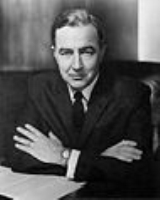
Eugene Joseph "Gene" McCarthy was an American politician and a longtime member of the
U.S. Congress. He served in the
U.S. House of Representatives from 1949 to 1959 and the
U.S. Senate from 1959 to 1971.
In the
1968 presidential election, McCarthy unsuccessfully sought the
Democratic nomination for
president of the United States to succeed incumbent
Lyndon B. Johnson on an anti-
Vietnam War platform. He would unsuccessfully seek the presidency five times altogether.
Biography
The son of a deeply religious mother of German descent and strong-willed father of Irish descent who was a postmaster and cattle buyer known for his earthy wit, McCarthy grew up in
Watkins, Minnesota, as one of four children. A bright student who spent hours reading his aunt’s Harvard Classics, he was deeply influenced by the monks at nearby St. John’s Abbey and University. As part of the oldest religious order in the Western world, the St. John’s Benedictines have been among the most progressive forces in American Catholicism. McCarthy spent nine months as a novice before deciding he didn’t have a religious calling and left the monastery, causing a fellow novice to say, “It was like losing a 20-game winner.”
He was a 1935 graduate of
St. John's University in Collegeville, Minnesota, McCarthy earned his master's degree from the
University of Minnesota in 1939. He taught in various public schools in
Minnesota and
North Dakota from 1935 to 1940, when he became a
professor of
economics and
education at St. John's, working there from 1940 to 1943.
He was a civilian technical assistant in the Military Intelligence Division of the
War Department in 1944 and an instructor in
sociology and economics at the College of St. Thomas,
St. Paul, Minnesota from 1946 to 1949.
McCarthy was a member of the
Minnesota Democratic-Farmer-Labor Party. Representing Minnesota's Fourth
Congressional District, McCarthy served as a member of the
United States House of Representatives from 1949 to 1959. He was not a candidate for renomination in 1958.
He went on to serve in the U.S. Senate from 1959 to 1971, and was a member of the powerful Senate Foreign Relations Committee. A resident of the small
community of Woodville, Virginia for about 20 years in later life, Eugene McCarthy died in a retirement home in
Georgetown, Washington, D.C. on December 10, 2005, where he had lived for the previous few years.
The 1968 campaign
In 1968, McCarthy ran against incumbent President
Lyndon Johnson in the New Hampshire Democratic primary, with the intention of influencing the
federal government—then controlled by
Democrats—to curtail its involvement in the Vietnam War. A number of anti-war
college students and other activists from around the county traveled to
New Hampshire to support McCarthy's campaign. Some anti-war students who had the long-haired appearance of
hippies chose to cut their long hair and shave off their beards, in order to campaign for McCarthy door-to-door, a phenomenon that led to the informal slogan "Get clean for Gene."
When McCarthy scored 42% to Johnson's 49% on March 12, it was clear that deep division existed among Democrats on the war issue. By this time, Johnson had become inextricably defined by
Vietnam, and this demonstration of divided support within his party meant his reelection was unlikely. On March 31, Johnson announced that he would not seek reelection.
Despite strong showings in several primaries, McCarthy garnered only 23 percent of the delegates at the 1968 Democratic National Convention, largely due to the control of state party organizations over the delegate selection process. Other factors that contributed to the attrition of delegates for McCarthy included the entrance into the contest of
Robert Kennedy as an anti-war candidate a few days after McCarthy's strong showing in New Hampshire.
Kennedy was shot after his victory speech at the Ambassador Hotel in Los Angeles, a speech he had delivered after midnight on June 5, after learning of his victory in the June 4
California Democratic primary; he died earlier on the morning of June 6. After the
assassination, many delegates for Kennedy chose to support
George McGovern rather than McCarthy. Moreover, although the eventual nominee,
Vice President Hubert H. Humphrey, was not a clearly anti-war candidate, there was hope among some anti-war Democrats that Humphrey as President might succeed where Johnson had failed—in extricating the United States from Vietnam.
Although McCarthy did not win the Democratic nomination, the anti-war "New Party," which ran several candidates for President that year, listed him as their nominee on the ballot in
Arizona, where he received 2,751 votes. He also received 20,721 votes as a write-in candidate in
California.
In the aftermath of their chaotic 1968 convention in
Chicago, Democrats convened the McGovern-Fraser Commission to reexamine the manner in which delegates were chosen. The commission made a number of recommendations to reform the process, prompting widespread changes in Democratic state organizations and continual democratization of the nominating process for more than a decade. In response, the
Republicans also formed a similar commission. Because of these changes, the practical role of
national party conventions diminished dramatically. The most immediately visible effect of the reforms was the eventual nomination of national unknown
Jimmy Carter by the Democrats in
1976. Some have argued that the increased significance of primaries, which tend to not be dominated by party activists, has resulted in candidates who are more nationally palatable than those that might have been chosen in a "smoke-filled room."
Subsequent campaigns and career
McCarthy left his wife, Abigail, and family in 1969. They never divorced. McCarthy was rumored to be having a longterm affair with prominent columnist and journalist Shana Alexander.
After leaving the Senate in 1971, McCarthy became a senior editor at Harcourt, Brace, Jovanovich Publishing and a syndicated
newspaper columnist.
McCarthy would return to politics as a candidate for the Democratic Presidential nomination in 1972, but he faired poorly in
New Hampshire and
Wisconsin and soon dropped out.
After the 1972 campaign, he left the Democratic Party, and ran as an Independent candidate for President in 1976. During that campaign, he took a
libertarian stance on
civil liberties, promised to create full employment by shortening the
work week, came out in favor of nuclear disarmament, and declared who he would nominate to various
Cabinet postings if elected. Mainly, however, he battled ballot access laws that he deemed too restrictive and encouraged voters to reject the two-party system.
His numerous legal battles during the course of the election, along with a strong grassroots effort in friendly states, allowed him to appear on the ballot in 30 states and eased ballot access for later third party candidates. His party affiliation was listed on ballots, variously, as "Independent," "McCarthy '76," "Non-Partisan," "Nom. Petition," "Nomination," "Not Designated," and "Court Order." Although he was not listed on the ballot in
California and
Wyoming, he was recognized as a write-in candidate in those states. In many states, he did not run with a
vice presidential nominee, but he came to have a grand total of 15 running mates in states where he was required to have one. At least eight of his running mates were women.
He opposed Watergate-era campaign finance laws, becoming a plaintiff in the landmark case of
Buckley v. Valeo, 424 U.S. 1 , in which the
U.S. Supreme Court held that certain provisions of federal campaign finance laws were unconstitutional.
In 1988, his name appeared on the ballot as the Presidential candidate of a handful of left-wing state parties, such as the Consumer Party in
Pennsylvania and the Minnesota Progressive Party in Minnesota. In his campaign he supported trade protectionism, Reagan's
Strategic Defense Initiative and the abolition of the two-party system. He received a grand total of 24,561 votes.
In 1992, returning to the Democratic Party, he entered the New Hampshire primary and campaigned for the Democratic Presidential nomination, but was excluded from most debates by party officials. McCarthy, along with other candidates excluded from the 1992 Democratic debates staged protests and unsuccessfully took legal action in an attempt to be included in the debates. In 2000, McCarthy was active in the movement to include
Green candidate
Ralph Nader in the Presidential debates. In 2005, he was listed as a member of the board of advisors of the Federation for American Immigration Reform, a largely honorary post. He remained a prolific writer, and authored several books on a variety of subjects. He was also a published poet.
McCarthy died at the age of 89 on December 10, 2005 at Georgetown Retirement Residence in
Washington, DC of complications from
Parkinson's disease. His eulogy was given by former President
Bill Clinton.
Books by Eugene McCarthy
- Frontiers in American Democracy
- Dictionary of American Politics
- A Liberal Answer to the Conservative Challenge
- The Limits of Power: America's Role in the World
- The Year of the People
- A Political Bestiary, by Eugene J. McCarthy and James J. Kilpatrick
- Gene McCarthy's Minnesota: Memories of a Native Son
- Complexities and Contrarities
- Up Til Now: A Memoir
- Required Reading: A Decade of Political Wit and Wisdom
- Nonfictional Economics: The Case for Shorter Hours of Work, by Eugene McCarthy and William McGaughey
- A Colony of the World: The United States Today
- Eugene J. McCarthy: Selected Poems by Eugene J. McCarthy, Ray Howe
- No-Fault Politics
- 1968: War and Democracy
- Hard Years: Antidotes to Authoritarians
- Parting Shots from My Brittle Brow: Reflections on American Politics and Life
External links
- -- The New York Times is a newspaper [i] published in New York City [i] by Arthur Ochs Sulzberger Jr. [i] ...
- --Star Tribune of Minneapolis
- Minnesota State Highway 65 [i] follows Central Avenue through Northeast Minneapolis, and ...
- -- The Washington Post is the largest newspaper [i] in Washington, D.C. [i], the capital of the United States [i] ...
- -- The Economist is a weekly news and international affairs publication of The Economist Newspaper Ltd ...
- Article by George McGovern in the The Nation, .
- from the National Catholic Reporter
Sources