


Student activism

Encyclopedia
Japan
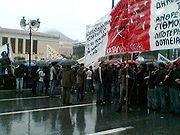
Japanese student movement began during the Taishō Democracy, and grew in activity after World War II. They were mostly carried out by activist students. One such event was the Anpo opposition movement, which occurred during 1960, and again in 1968 – 1970, in opposition to Anpo. During the second riots, leftist activists barricaded themselves in Universities, resulting in armed conflict with the Japanese police force. Activists organized in places known as "agitating points". Some wider causes were supported including opposition to the Vietnam WarVietnam War
The Vietnam War was a Cold War-era military conflict that occurred in Vietnam, Laos, and Cambodia from 1 November 1955 to the fall of Saigon on 30 April 1975. This war followed the First Indochina War and was fought between North Vietnam, supported by its communist allies, and the government of...
and apartheid, and for the acceptance of the hippie
Hippie
The hippie subculture was originally a youth movement that arose in the United States during the mid-1960s and spread to other countries around the world. The etymology of the term 'hippie' is from hipster, and was initially used to describe beatniks who had moved into San Francisco's...
lifestyle.
Germany
Jena
Jena is a university city in central Germany on the river Saale. It has a population of approx. 103,000 and is the second largest city in the federal state of Thuringia, after Erfurt.-History:Jena was first mentioned in an 1182 document...
(Germany
Germany
Germany , officially the Federal Republic of Germany , is a federal parliamentary republic in Europe. The country consists of 16 states while the capital and largest city is Berlin. Germany covers an area of 357,021 km2 and has a largely temperate seasonal climate...
) the "Urburschenschaft"
Burschenschaft
German Burschenschaften are a special type of Studentenverbindungen . Burschenschaften were founded in the 19th century as associations of university students inspired by liberal and nationalistic ideas.-History:-Beginnings 1815–c...
was founded. That was a Studentenverbindung
Studentenverbindung
A Studentenverbindung is a student corporation in a German-speaking country somewhat comparable to fraternities in the US or Canada, but mostly older and going back to other kinds of...
that was concentrated on national and democratic ideas.
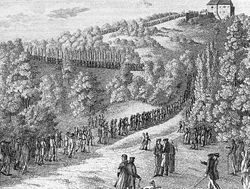
In 1817, inspired by liberal and patriotic ideas of a united Germany, student organisations gathered for the Wartburg festival
Wartburg festival
The first Wartburg festival on 18 October 1817 was an important event in German history that took place at the Wartburg Castle near Eisenach....
at Wartburg Castle
Wartburg Castle
The Wartburg is a castle situated on a 1230-foot precipice to the southwest of, and overlooking the town of Eisenach, in the state of Thuringia, Germany...
, at Eisenach
Eisenach
Eisenach is a city in Thuringia, Germany. It is situated between the northern foothills of the Thuringian Forest and the Hainich National Park. Its population in 2006 was 43,626.-History:...
in Thuringia
Thuringia
The Free State of Thuringia is a state of Germany, located in the central part of the country.It has an area of and 2.29 million inhabitants, making it the sixth smallest by area and the fifth smallest by population of Germany's sixteen states....
, on the occasion of which reactionary books were burnt.
In 1819 the student Karl Ludwig Sand
Karl Ludwig Sand
Karl Ludwig Sand was a German university student and member of a liberal Burschenschaft . He was executed in 1820 for the murder of the conservative dramatist August von Kotzebue the previous year in Mannheim...
murdered the writer August von Kotzebue, who had scoffed at liberal student organisations.
In May 1832 the Hambacher Fest
Hambacher Fest
The Hambacher Fest was a German national democratic festival—disguised as a non-political county fair—that was celebrated from 27 May to 30 May 1832 at Hambach Castle near Neustadt an der Weinstraße ....
was celebrated at Hambach Castle
Hambach Castle
Hambach Castle near the urban district Hambach of Neustadt an der Weinstraße in Rhineland-Palatinate, Germany, is considered to be the symbol of the German democracy movement because of the Hambacher Fest which occurred here in 1832.- Location :...
near Neustadt an der Weinstraße
Neustadt an der Weinstraße
Neustadt an der Weinstraße is a town located in Rhineland-Palatinate, Germany. With 53,892 inhabitants as of 2002, it is the largest town called Neustadt.-Etymology:...
with about 30 000 participants, amongst them many students. Together with the Frankfurter Wachensturm
Frankfurter Wachensturm
The Frankfurter Wachensturm on April 3rd 1833 was a failed attempt to start a revolution in Germany.-Events:...
in 1833 planned to free students held in prison at Frankfurt and Georg Büchner's
Georg Büchner
Karl Georg Büchner was a German dramatist and writer of poetry and prose. He was the brother of physician and philosopher Ludwig Büchner. Büchner's talent is generally held in great esteem in Germany...
revolutionary pamphlet
Pamphlet
A pamphlet is an unbound booklet . It may consist of a single sheet of paper that is printed on both sides and folded in half, in thirds, or in fourths , or it may consist of a few pages that are folded in half and saddle stapled at the crease to make a simple book...
Der Hessische Landbote that were events that led to the revolutions in the German states in 1848.
In the 1960s, the worldwide upswing in student and youth radicalism manifested itself through the German student movement
German student movement
The German student movement was a protest movement that took place during the late 1960s in West Germany. It was largely a reaction against the perceived authoritarianism and hypocrisy of the German government and other Western governments, and the poor living conditions of students...
and organisations such as the German Socialist Student Union. The movement in Germany shared many concerns of similar groups elsewhere, such as the democratisation of society and opposing the Vietnam War
Vietnam War
The Vietnam War was a Cold War-era military conflict that occurred in Vietnam, Laos, and Cambodia from 1 November 1955 to the fall of Saigon on 30 April 1975. This war followed the First Indochina War and was fought between North Vietnam, supported by its communist allies, and the government of...
, but also stressed more nationally specific issues such as coming to terms with the legacy of the Nazi regime and opposing the German Emergency Acts
German Emergency Acts
The German Emergency Acts were passed on 30 May 1968 at the time of the First Grand Coalition between the Social Democratic Party of Germany and the Christian Democratic Union of Germany. The Emergency Acts faced opposition from outside the German parliament...
.
Canada
In CanadaCanada
Canada is a North American country consisting of ten provinces and three territories. Located in the northern part of the continent, it extends from the Atlantic Ocean in the east to the Pacific Ocean in the west, and northward into the Arctic Ocean...
, several New Left
New Left
The New Left was a term used mainly in the United Kingdom and United States in reference to activists, educators, agitators and others in the 1960s and 1970s who sought to implement a broad range of reforms, in contrast to earlier leftist or Marxist movements that had taken a more vanguardist...
student organizations emerged in the late 1950s and 1960s. There were several dominant New Left groups in Canada, the two main political organizations being the Student Union for Peace Action (SUPA) and the Company of Young Canadians (CYC). SUPA grew out of the pacifistic and moralistic Combined Universities Campaign for Nuclear Disarmament (CUCND) in December, 1965, at a conference at the University of Saskatchewan, and expanded its scope of affairs to include grass-roots politics in disadvantaged communities and ‘consciousness raising’ to radicalize and raise awareness of the ‘generation gap’ experienced by Canadian youth. SUPA was a decentralized organization, rooted in local university campuses, and thus inherited the distinctly middle-class orientation of Canadian students. After SUPA disintegrated in late 1967, its members either moved to the CYC or became active leaders in the Canadian Union of Students (CUS), leading the CUS to assume the mantle of New Left student agitation. The organizations were marked by widespread intellectual debates. For example, with respect to the working class, the idea that the traditional ‘working class’ had been bought off and integrated into the system was widespread in these discussions, leaving the question of who now represented the most important actor in the struggle for a new and better socialist society. Indeed, SUPA fell apart over these debates over the role of the working class and the 'Old Left'. In 1968 Students for a Democratic University (SDU) was formed in McGill and Simon Fraser University. The SFU SDU was originally composed of former SUPA members and New Democratic Youth but also absorbed members from the campus Liberal Club and Young Socialists. SDU was prominent in the Administration Occupation of that year and the student strike in 1969. After the failure of the student strike SDU broke up. Some members joined the IWW and the Youth International Party. (Yippies) Other members helped form the Vancouver Liberation Front in 1970.
Since the 1970s Public Interest Research Groups
Public Interest Research Groups
The US Public Interest Research Group is a political lobby non-profit organization in the United States and Canada, composed of self-governing affiliates at the state and province level. Its fundraising arm is the Fund for Public Interest Research...
(PIRG's) have been created as a result of Student's Union referendums across Canada eg. Ontario Public Interest Research Group
Ontario Public Interest Research Group
Ontario Public Interest Research Group is a campus-based student activist non-profit organization based in Ontario, Canada.OPIRG is broken into eleven distinct chapters, and serves as a hub organization, allowing the organizing committees of the local chapters to exchange ideas, better educate...
, the Alberta Public Interest Research Group (APIRG) and the Nova Scotia Public Interest Research Group
NSPIRG
NSPIRG is a student activist organization with a focus on environmental and social justice issues. It is funded by students at Dalhousie University in Halifax, Nova Scotia, and functions as a referendum-mandated society of the Dalhousie Student Union...
. For a more complete list of PIRGs in Canada see pirg.ca .
Canadian PIRG's are unique from their American counterparts in that, in principle, the projects are student directed and run. Most, if not all, Canadian PIRG's operate on a consensus decision making model. Canadian PIRGs are student run and the majority of their funding comes directly from students. Although some efforts have been made towards collaboration Canadian PIRGs are independent of each other.
The Student Coalition Against War
Student Coalition Against War
The Students Coalition Against War is a Canadian organization with members in Halifax, Nova Scotia, Edmonton, Alberta, Victoria, British Columbia, Ottawa, Ontario and Gatineau, Quebec. The Students Coalition Against War - SCAW - is a grassroots social movement dedicated to creating and fostering...
was formed to focus on public education, non-violent activism, organizing, advocacy and above all, reform.
Eastern Europe and the post-Soviet Union states
During communist rule, students in Eastern EuropeEastern Europe
Eastern Europe is the eastern part of Europe. The term has widely disparate geopolitical, geographical, cultural and socioeconomic readings, which makes it highly context-dependent and even volatile, and there are "almost as many definitions of Eastern Europe as there are scholars of the region"...
were the force behind several of the best-known instances of protest. The chain of events leading to the 1956 Hungarian Revolution
1956 Hungarian Revolution
The Hungarian Revolution or Uprising of 1956 was a spontaneous nationwide revolt against the government of the People's Republic of Hungary and its Soviet-imposed policies, lasting from 23 October until 10 November 1956....
was started by peaceful student demonstrations in the streets of Budapest
Budapest
Budapest is the capital of Hungary. As the largest city of Hungary, it is the country's principal political, cultural, commercial, industrial, and transportation centre. In 2011, Budapest had 1,733,685 inhabitants, down from its 1989 peak of 2,113,645 due to suburbanization. The Budapest Commuter...
, later attracting workers and other Hungarians. In Czechoslovakia
Czechoslovakia
Czechoslovakia or Czecho-Slovakia was a sovereign state in Central Europe which existed from October 1918, when it declared its independence from the Austro-Hungarian Empire, until 1992...
, one of the most known faces of the protests following the Soviet
Soviet Union
The Soviet Union , officially the Union of Soviet Socialist Republics , was a constitutionally socialist state that existed in Eurasia between 1922 and 1991....
-led invasion that ended the Prague Spring
Prague Spring
The Prague Spring was a period of political liberalization in Czechoslovakia during the era of its domination by the Soviet Union after World War II...
was Jan Palach
Jan Palach
Jan Palach was a Czech student who committed suicide by self-immolation as a political protest.- Death :...
, a student who committed suicide
Suicide
Suicide is the act of intentionally causing one's own death. Suicide is often committed out of despair or attributed to some underlying mental disorder, such as depression, bipolar disorder, schizophrenia, alcoholism, or drug abuse...
by setting fire to himself on January 16, 1969. The act triggered a major protest against the occupation.
Student-dominated youth movements have also played a central role in the "color revolutions" seen in post-communist societies in recent years. The first example of this was the Serbia
Serbia
Serbia , officially the Republic of Serbia , is a landlocked country located at the crossroads of Central and Southeast Europe, covering the southern part of the Carpathian basin and the central part of the Balkans...
n Otpor
Otpor
Otpor! was a civic youth movement that existed as such from 1998 until 2003 in Serbia , employing nonviolent struggle against the regime of Slobodan Milošević as their course of action. In the course of two-year nonviolent struggle against Milosevic, Otpor spread across Serbia and attracted more...
("Resistance" in Serbian
Serbian language
Serbian is a form of Serbo-Croatian, a South Slavic language, spoken by Serbs in Serbia, Bosnia and Herzegovina, Montenegro, Croatia and neighbouring countries....
), formed in October 1998 as a response to repressive university and media laws that were introduced that year. In the presidential campaign in September 2000, the organisation engineered the "Gotov je" ("He's finished") campaign that galvanized Serbian discontent with Slobodan Milošević
Slobodan Milošević
Slobodan Milošević was President of Serbia and Yugoslavia. He served as the President of Socialist Republic of Serbia and Republic of Serbia from 1989 until 1997 in three terms and as President of the Federal Republic of Yugoslavia from 1997 to 2000...
, ultimately resulting in his defeat.
Otpor has inspired other youth movements in Eastern Europe
Eastern Europe
Eastern Europe is the eastern part of Europe. The term has widely disparate geopolitical, geographical, cultural and socioeconomic readings, which makes it highly context-dependent and even volatile, and there are "almost as many definitions of Eastern Europe as there are scholars of the region"...
, such as Kmara
Kmara
Kmara is a civic resistance movement in the republic of Georgia which undermined the government of Eduard Shevardnadze. After international observers condemned his government's conduct of the November 2003 parliamentary elections, Kmara led the protests which precipitated his downfall in what...
in Georgia, that played an important role in the Rose Revolution
Rose Revolution
The "Revolution of Roses" was a change of power in Georgia in November 2003, which took place after having widespread protests over the disputed parliamentary elections...
, and Pora
Pora
PORA! , meaning IT'S TIME! in Ukrainian, is a civic youth organization and political party in Ukraine espousing nonviolent resistance and advocating increased national democracy...
in Ukraine
Ukraine
Ukraine is a country in Eastern Europe. It has an area of 603,628 km², making it the second largest contiguous country on the European continent, after Russia...
, the most important movement organising the demonstrations that led to the Orange Revolution
Orange Revolution
The Orange Revolution was a series of protests and political events that took place in Ukraine from late November 2004 to January 2005, in the immediate aftermath of the run-off vote of the 2004 Ukrainian presidential election which was claimed to be marred by massive corruption, voter...
. Like Otpor, these organisations have consequently practiced non-violent resistance and used ridiculing humor in opposing authoritarian leaders. Similar movements include KelKel
KelKel
KelKel is a youth movement in Kyrgyzstan that gained some prominence during the Tulip Revolution of March 2005 that culminated in the ousting of President Askar Akayev. Translated from the Kyrgyz language, KelKel means "renaissance and shining of the good"....
in Kyrgyzstan
Kyrgyzstan
Kyrgyzstan , officially the Kyrgyz Republic is one of the world's six independent Turkic states . Located in Central Asia, landlocked and mountainous, Kyrgyzstan is bordered by Kazakhstan to the north, Uzbekistan to the west, Tajikistan to the southwest and China to the east...
, Zubr
Zubr (political organization)
Zubr was a civic youth organization in Belarus backed by the United States and western powers in opposition to President Alyaksandr Lukashenka. The organization drew inspiration from Otpor student movement which contributed to the overthrow of Slobodan Milošević in 2000, and from Gene Sharp's...
in Belarus
Belarus
Belarus , officially the Republic of Belarus, is a landlocked country in Eastern Europe, bordered clockwise by Russia to the northeast, Ukraine to the south, Poland to the west, and Lithuania and Latvia to the northwest. Its capital is Minsk; other major cities include Brest, Grodno , Gomel ,...
and MJAFT!
MJAFT!
MJAFT! is a non governmental organisation in Albania that aims to raise awareness of the many political and social problems facing Albania. MJAFT! grew out of a grassroots effort by students and other volunteers. The organisation is partly funded by the U.S...
in Albania
Albania
Albania , officially known as the Republic of Albania , is a country in Southeastern Europe, in the Balkans region. It is bordered by Montenegro to the northwest, Kosovo to the northeast, the Republic of Macedonia to the east and Greece to the south and southeast. It has a coast on the Adriatic Sea...
.
Opponents of the "color revolutions" have accused the Soros Foundation
Soros Foundation
A Soros Foundation is one of a network of national foundations, mostly in Central and Eastern Europe, which fund volunteer socio-political activity, created by George Soros, international financier and self-proclaimed philanthropist, and coordinated since early 1994 by a management team called the...
s and/or the United States
United States
The United States of America is a federal constitutional republic comprising fifty states and a federal district...
government of supporting and even planning the revolutions in order to serve western interests. Supporters of the revolutions have argued that these allegations are greatly exaggerated, and that the revolutions were positive events, morally justified, whether or not Western support had an influence on the events.
Australia
Australian Students have a long history of being active in political debates. This is particularly true in the newer universities that have been established in suburban areas. The National Union of StudentsNational Union of Students (Australia)
The National Union of Students is the peak representative body for Australian university students. Most student unions in Australian campuses are affiliated to NUS...
has often been at the forefront of campus activism in Australia.
Malaysia
Since the amendment of Section 15 of the Universities and University Colleges Act 1971 (UUCA) in 1975, students were barred from being members of, and expressing support or opposition to, any political parties or "any organization, body or group of persons which the Minister, after consultation with the Board, has specified in writing to the Vice-Chancellor to be unsuitable to the interests and well-being of the students or the University." However, in October 2011, the Court of Appeal ruled that the relevant provision in Section 15 UUCA was unconstitutional due to Article 10 of the Federal ConstitutionConstitution of Malaysia
The Federal Constitution of Malaysia, which came into force in 1957, is the supreme law of Malaysia. The Federation was initially called the Federation of Malaya and it adopted its present name, Malaysia, when the States of Sabah, Sarawak and Singapore joined the Federation...
pertaining to freedom of expression.
France
In FranceFrance
The French Republic , The French Republic , The French Republic , (commonly known as France , is a unitary semi-presidential republic in Western Europe with several overseas territories and islands located on other continents and in the Indian, Pacific, and Atlantic oceans. Metropolitan France...
, student activists have been influential in shaping public debate. In May 1968 the University of Paris
University of Paris
The University of Paris was a university located in Paris, France and one of the earliest to be established in Europe. It was founded in the mid 12th century, and officially recognized as a university probably between 1160 and 1250...
at Nanterre
Nanterre
Nanterre is a commune in the western suburbs of Paris, France. It is located west of the center of Paris.Nanterre is the capital of the Hauts-de-Seine department as well as the seat of the Arrondissement of Nanterre....
was closed due to problems between the students and the administration. In protest of the closure and the expulsion of Nanterre students, students of the Sorbonne
University of Paris
The University of Paris was a university located in Paris, France and one of the earliest to be established in Europe. It was founded in the mid 12th century, and officially recognized as a university probably between 1160 and 1250...
in Paris
Paris
Paris is the capital and largest city in France, situated on the river Seine, in northern France, at the heart of the Île-de-France region...
began their own demonstration. The situation escalated into a nation-wide insurrection during which a variety of groups, including communists, anarchists, and right-wing libertarian
Libertarianism
Libertarianism, in the strictest sense, is the political philosophy that holds individual liberty as the basic moral principle of society. In the broadest sense, it is any political philosophy which approximates this view...
activists, used the tension to advocate their own causes.
The events in Paris were followed by student protests throughout the world. The German student movement
German student movement
The German student movement was a protest movement that took place during the late 1960s in West Germany. It was largely a reaction against the perceived authoritarianism and hypocrisy of the German government and other Western governments, and the poor living conditions of students...
participated in major demonstrations against proposed emergency legislation
German Emergency Acts
The German Emergency Acts were passed on 30 May 1968 at the time of the First Grand Coalition between the Social Democratic Party of Germany and the Christian Democratic Union of Germany. The Emergency Acts faced opposition from outside the German parliament...
. In many countries, the student protests caused authorities to respond with violence. In Spain
Spain
Spain , officially the Kingdom of Spain languages]] under the European Charter for Regional or Minority Languages. In each of these, Spain's official name is as follows:;;;;;;), is a country and member state of the European Union located in southwestern Europe on the Iberian Peninsula...
, student demonstrations against Franco's
Francisco Franco
Francisco Franco y Bahamonde was a Spanish general, dictator and head of state of Spain from October 1936 , and de facto regent of the nominally restored Kingdom of Spain from 1947 until his death in November, 1975...
dictatorship led to clashes with police. A student demonstration in Mexico City
Mexico City
Mexico City is the Federal District , capital of Mexico and seat of the federal powers of the Mexican Union. It is a federal entity within Mexico which is not part of any one of the 31 Mexican states but belongs to the federation as a whole...
ended in a storm of bullets on the night of October 2, 1968, an event known as the Tlatelolco massacre
Tlatelolco massacre
The Tlatelolco massacre, also known as The Night of Tlatelolco , was a government massacre of student and civilian protesters and bystanders that took place during the afternoon and night of October 2, 1968, in the Plaza de las Tres Culturas in the Tlatelolco section of Mexico City...
. Even in Pakistan
Pakistan
Pakistan , officially the Islamic Republic of Pakistan is a sovereign state in South Asia. It has a coastline along the Arabian Sea and the Gulf of Oman in the south and is bordered by Afghanistan and Iran in the west, India in the east and China in the far northeast. In the north, Tajikistan...
, students took to the streets to protest changes in education policy, and on November 7 a college student was shot dead as police opened fire on a demonstration.
China
Qing Dynasty
The Qing Dynasty was the last dynasty of China, ruling from 1644 to 1912 with a brief, abortive restoration in 1917. It was preceded by the Ming Dynasty and followed by the Republic of China....
during the First
First Opium War
The First Anglo-Chinese War , known popularly as the First Opium War or simply the Opium War, was fought between the United Kingdom and the Qing Dynasty of China over their conflicting viewpoints on diplomatic relations, trade, and the administration of justice...
(1839-1842) and Second Opium War
Second Opium War
The Second Opium War, the Second Anglo-Chinese War, the Second China War, the Arrow War, or the Anglo-French expedition to China, was a war pitting the British Empire and the Second French Empire against the Qing Dynasty of China, lasting from 1856 to 1860...
s (1856-1860), student activism has played a significant role in the modern Chinese history. Fueled mostly by Chinese nationalism
Chinese nationalism
Chinese nationalism , sometimes synonymous with Chinese patriotism refers to cultural, historiographical, and political theories, movements and beliefs that assert the idea of a cohesive, unified Chinese people and culture in a unified country known as China...
, Chinese student activism strongly believes that young people are responsible for China's future. This strong nationalistic belief has been able to manifest in several forms such as democracy, Anti-Americanism
Anti-Americanism
The term Anti-Americanism, or Anti-American Sentiment, refers to broad opposition or hostility to the people, policies, culture or government of the United States...
and Communism
Communism
Communism is a social, political and economic ideology that aims at the establishment of a classless, moneyless, revolutionary and stateless socialist society structured upon common ownership of the means of production...
.
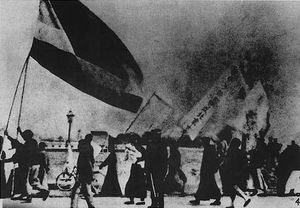
One of the most important acts of student activism in Chinese history is the May Fourth Movement
May Fourth Movement
The May Fourth Movement was an anti-imperialist, cultural, and political movement growing out of student demonstrations in Beijing on May 4, 1919, protesting the Chinese government's weak response to the Treaty of Versailles, especially the Shandong Problem...
, which over 3000 students of Peking University
Peking University
Peking University , colloquially known in Chinese as Beida , is a major research university located in Beijing, China, and a member of the C9 League. It is the first established modern national university of China. It was founded as Imperial University of Peking in 1898 as a replacement of the...
and other schools gathered together in front of Tiananmen
Tiananmen
The Tiananmen, Tian'anmen or Gate of Heavenly Peace is a famous monument in Beijing, the capital of the People's Republic of China. It is widely used as a national symbol. First built during the Ming Dynasty in 1420, Tian'anmen is often referred to as the front entrance to the Forbidden City...
and held a demonstration. It is regarded as an essential step of the democratic revolution in China, and it had also give birth to Chinese Communism. Anti-Americanism movements led by the students during the Chinese Civil War
Chinese Civil War
The Chinese Civil War was a civil war fought between the Kuomintang , the governing party of the Republic of China, and the Communist Party of China , for the control of China which eventually led to China's division into two Chinas, Republic of China and People's Republic of...
were also instrumental in discrediting the KMT
Kuomintang
The Kuomintang of China , sometimes romanized as Guomindang via the Pinyin transcription system or GMD for short, and translated as the Chinese Nationalist Party is a founding and ruling political party of the Republic of China . Its guiding ideology is the Three Principles of the People, espoused...
government and bring the Communist victory in China. In 1989, the democracy movement led by the students at the Tiananmen Square protests
Tiananmen Square protests of 1989
The Tiananmen Square protests of 1989, also known as the June Fourth Incident in Chinese , were a series of demonstrations in and near Tiananmen Square in Beijing in the People's Republic of China beginning on 15 April 1989...
ended in a brutal government crackdown which would later be called a massacre.
Indonesia
In IndonesiaIndonesia
Indonesia , officially the Republic of Indonesia , is a country in Southeast Asia and Oceania. Indonesia is an archipelago comprising approximately 13,000 islands. It has 33 provinces with over 238 million people, and is the world's fourth most populous country. Indonesia is a republic, with an...
, university student groups have repeatedly been the first groups to stage street demonstrations calling for governmental change at key points in the nation's history, and other organizations from across the political spectrum have sought to align themselves with student groups.
In 1928, the Youth Pledge (Sumpah Pemuda
Sumpah Pemuda
The Youth Pledge , was a declaration made on 28 October 1928 by young Indonesian nationalists at a conference in the then-Dutch East Indies. They proclaimed three ideals, one motherland, one nation and one language.-Background:...
) helped to give voice to anti-colonial sentiments.
During the political turmoil of the 1960s, right-wing student groups staged demonstrations calling for then-President Sukarno
Sukarno
Sukarno, born Kusno Sosrodihardjo was the first President of Indonesia.Sukarno was the leader of his country's struggle for independence from the Netherlands and was Indonesia's first President from 1945 to 1967...
to eliminate alleged Communists from his government, and later demanding that he resign. Sukarno did step down in 1967, and was replaced by Army general Suharto.
Student groups also played a key role in Suharto's 1998 fall by initiating large demonstrations that gave voice to widespread popular discontent with the president. High school and university students in Jakarta
Jakarta
Jakarta is the capital and largest city of Indonesia. Officially known as the Special Capital Territory of Jakarta, it is located on the northwest coast of Java, has an area of , and a population of 9,580,000. Jakarta is the country's economic, cultural and political centre...
, Yogyakarta
Yogyakarta (city)
Yogyakarta is a city in the Yogyakarta Special Region, Indonesia. It is renowned as a centre of classical Javanese fine art and culture such as batik, ballet, drama, music, poetry, and puppet shows. Yogyakarta was the Indonesian capital during the Indonesian National Revolution from 1945 to...
, Medan, and elsewhere were some of the first groups willing to speak out publicly against the military government. Student groups were a key part of the political scene during this period. For example, upon taking office after Suharto stepped down, B. J. Habibie made numerous mostly unsuccessful overtures to placate the student groups that had brought down his predecessor, meeting with student leaders and the families of students killed by security forces during demonstrations.
Further reading
- O'Rourke, Kevin. 2002. Reformasi: the struggle for power in post-Soeharto Indonesia. Crows Nest, NSW: Allen & Unwin. ISBN 1-86508-754-8.
- Details the role of student groups in Suharto's fall, including first-hand discussion of events in Jakarta in 1997 and 1998.
Documentary Movie
- Student Movement in Indonesia, Jakarta Media Syndication, 1999.
- Indonesian Student Revolt. Don’t Follow Leaders, Offstream http://www.offstream.net/, 2001.
Iran
In IranIran
Iran , officially the Islamic Republic of Iran , is a country in Southern and Western Asia. The name "Iran" has been in use natively since the Sassanian era and came into use internationally in 1935, before which the country was known to the Western world as Persia...
, students have been at the forefront of protests both against the pre-1979 secular monarchy and, in recent years, against the theocratic islamic republic
Islamic republic
Islamic republic is the name given to several states in the Muslim world including the Islamic Republics of Pakistan, Iran, Afghanistan, and Mauritania. Pakistan adopted the title under the constitution of 1956. Mauritania adopted it on 28 November 1958. Iran adopted it after the 1979 Iranian...
. Both religious and more moderate students played a major part in Ruhollah Khomeini
Ruhollah Khomeini
Grand Ayatollah Sayyed Ruhollah Musavi Khomeini was an Iranian religious leader and politician, and leader of the 1979 Iranian Revolution which saw the overthrow of Mohammad Reza Pahlavi, the Shah of Iran...
's opposition network against the Shah
Shah
Shāh is the title of the ruler of certain Southwest Asian and Central Asian countries, especially Persia , and derives from the Persian word shah, meaning "king".-History:...
Mohammad Reza Pahlavi
Mohammad Reza Pahlavi
Mohammad Rezā Shāh Pahlavi, Shah of Iran, Shah of Persia , ruled Iran from 16 September 1941 until his overthrow by the Iranian Revolution on 11 February 1979...
. In January 1978 the army dispersed demonstrating students and religious leaders, killing several students and sparking a series of widespread protests that ultimately led to the Iranian Revolution
Iranian Revolution
The Iranian Revolution refers to events involving the overthrow of Iran's monarchy under Shah Mohammad Reza Pahlavi and its replacement with an Islamic republic under Ayatollah Ruhollah Khomeini, the leader of the...
the following year. On November 4, 1979, militant Iranian students calling themselves the Muslim Students Following the Line of the Imam seized the U.S. embassy in Tehran
Tehran
Tehran , sometimes spelled Teheran, is the capital of Iran and Tehran Province. With an estimated population of 8,429,807; it is also Iran's largest urban area and city, one of the largest cities in Western Asia, and is the world's 19th largest city.In the 20th century, Tehran was subject to...
holding 52 embassy employees hostage for a 444 days (see Iran hostage crisis
Iran hostage crisis
The Iran hostage crisis was a diplomatic crisis between Iran and the United States where 52 Americans were held hostage for 444 days from November 4, 1979 to January 20, 1981, after a group of Islamist students and militants took over the American Embassy in Tehran in support of the Iranian...
).
Recent years have seen several incidents when liberal students have clashed with the Iranian regime, most notably the Iranian student riots of July 1999
Iran student riots, July 1999
Iranian Student Protests of July, 1999 were, before the 2009 Iranian election protests, the most widespread and violent public protests to occur in Iran since the early years of the Iranian Revolution.The protests began on July 8 with peaceful demonstrations in Tehran against the closure of the...
. Several people were killed in a week of violent confrontations that started with a police raid on a university dormitory, a response to demonstrations by a group of students of Tehran University against the closure of a reformist newspaper. Akbar Mohammadi
Akbar Mohammadi
Akbar Mohammadi was an Iranian student at Tehran University involved in the 18th of Tir crisis, also known as the July 1999 Iran student protests, Iran's biggest pro-democracy demonstrations since the 1979 Islamic Revolution...
was given a death sentence
Capital punishment
Capital punishment, the death penalty, or execution is the sentence of death upon a person by the state as a punishment for an offence. Crimes that can result in a death penalty are known as capital crimes or capital offences. The term capital originates from the Latin capitalis, literally...
, later reduced to 15 years in prison, for his role in the protests. In 2006, he died at Evin prison
Evin Prison
Evin House of Detention is a prison in Iran, located in Evin, northwestern Tehran. It is noted for its political prisoners' wing, where prisoners have been held both before and after the 1979 Iranian Revolution...
after a hunger strike protesting the refusal to allow him to seek medical treatment for injuries suffered as a result of torture.
At the end of 2002, students held mass demonstrations protesting the death sentence of reformist lecturer Hashem Aghajari
Hashem Aghajari
Hashem Aghajari also Seyyed Hashem Aghajari is an Iranian historian, university professor and a critic of the Islamic Republic's government who was sentenced to death in 2002 for apostasy for a speech he gave on Islam urging Iranians to "not blindly follow" Islamic clerics...
for alleged blasphemy. In June 2003, several thousand students took to the streets of Tehran in anti-government protests sparked by government plans to privatise some universities.
In the May 2005 Iranian presidential election
Iranian presidential election, 2005
Iran's ninth presidential election took place in two rounds, the first on June 17, 2005, the run-off on June 24. Mohammad Khatami, the previous President of Iran, stepped down on August 2, 2005, after serving his maximum two consecutive four-year terms according to the Islamic Republic's constitution...
, Iran's largest student organization, The Office to Consolidate Unity, advocated a voting boycott
Boycott
A boycott is an act of voluntarily abstaining from using, buying, or dealing with a person, organization, or country as an expression of protest, usually for political reasons...
. After the election of President Mahmoud Ahmadinejad, student protests against the government has continued. In May 2006, up to 40 police officers were injured in clashes with demonstrating students in Tehran. At the same time, the Iranian regime has called for student action in line with its own political agenda. In 2006, President Ahmadinejad urged students to organize campaigns to demand that liberal and secular university teachers be removed. In 2009, after the disputed presidential election, a series of student protests broke out. The violent measures used by the Iranian regime to suppress these protests have been the subject of widespread international condemnation.
United States
In the United StatesUnited States
The United States of America is a federal constitutional republic comprising fifty states and a federal district...
, student activism is often understood as a form of youth activism
Youth activism
Youth activism is when the youth voice is engaged in community organizing for social change. Around the world, young people are engaged in activism as planners, researchers, teachers, evaluators, social workers, decision-makers, advocates and leading actors in the environmental movement, social...
that is specifically oriented toward change in the American educational system
Education in the United States
Education in the United States is mainly provided by the public sector, with control and funding coming from three levels: federal, state, and local. Child education is compulsory.Public education is universally available...
. Student activism in the United States dates to the beginning of public education, if not before. The best early historical documentation comes from the 1930s. The American Youth Congress
American Youth Congress
American Youth Congress was an early youth voice organization composed of youth from all across the country to discuss the problems facing youth as a whole in the 1930s. It met several years in a row - one year it notably met on the lawn of the White House. The delegates are known to have caused...
was a student-led organization in Washington, DC, which lobbied the US Congress against racial discrimination and for youth programs. It was heavily supported by First Lady Eleanor Roosevelt
Eleanor Roosevelt
Anna Eleanor Roosevelt was the First Lady of the United States from 1933 to 1945. She supported the New Deal policies of her husband, distant cousin Franklin Delano Roosevelt, and became an advocate for civil rights. After her husband's death in 1945, Roosevelt continued to be an international...
.
The 1960s saw student activists gaining increased political prominence. One highlight of this period was Students for a Democratic Society
Students for a Democratic Society (1960 organization)
Students for a Democratic Society was a student activist movement in the United States that was one of the main iconic representations of the country's New Left. The organization developed and expanded rapidly in the mid-1960s before dissolving at its last convention in 1969...
(SDS) launched in Ann Arbor, Michigan
Ann Arbor, Michigan
Ann Arbor is a city in the U.S. state of Michigan and the county seat of Washtenaw County. The 2010 census places the population at 113,934, making it the sixth largest city in Michigan. The Ann Arbor Metropolitan Statistical Area had a population of 344,791 as of 2010...
, a student-led organization that focused on schools as a social agent that simultaneously oppresses and potentially uplifts society. SDS eventually spun off the Weather Underground
Weatherman (organization)
Weatherman, known colloquially as the Weathermen and later the Weather Underground Organization , was an American radical left organization. It originated in 1969 as a faction of Students for a Democratic Society composed for the most part of the national office leadership of SDS and their...
. Another successful group was Ann Arbor Youth Liberation, which featured students calling for an end to state-led education. Also notable was the Student Nonviolent Coordinating Committee
Student Nonviolent Coordinating Committee
The Student Nonviolent Coordinating Committee ' was one of the principal organizations of the American Civil Rights Movement in the 1960s. It emerged from a series of student meetings led by Ella Baker held at Shaw University in Raleigh, North Carolina in April 1960...
, which fought against racism and for integration of public schools across the US. These specific organizations closed in the mid-1970s.
The largest student strike
Student Strike of 1970
In the aftermath of the American Invasion of Cambodia on April 30, 1970, four students were killed at Kent State University on May 4, 1970 in Ohio, as well as two students at Jackson State College in Mississippi on May 14/15...
in American history took place in May and June 1970, in response to the Kent State shootings
Kent State shootings
The Kent State shootings—also known as the May 4 massacre or the Kent State massacre—occurred at Kent State University in the city of Kent, Ohio, and involved the shooting of unarmed college students by members of the Ohio National Guard on Monday, May 4, 1970...
and the American invasion of Cambodia.
In the early 1980s several formalized organizations brought neoliberal models of student activism to campuses across the nation, especially the Campus Outreach Opportunity League (C.O.O.L.). They claim large responsibility for identifying and championing the interest in service
Community service
Community service is donated service or activity that is performed by someone or a group of people for the benefit of the public or its institutions....
among higher education
Higher education
Higher, post-secondary, tertiary, or third level education refers to the stage of learning that occurs at universities, academies, colleges, seminaries, and institutes of technology...
students.
American society saw an increase in student activism again in the 1990s with the ushering in of the neoliberal community service
Community service
Community service is donated service or activity that is performed by someone or a group of people for the benefit of the public or its institutions....
policies of Bill Clinton
Bill Clinton
William Jefferson "Bill" Clinton is an American politician who served as the 42nd President of the United States from 1993 to 2001. Inaugurated at age 46, he was the third-youngest president. He took office at the end of the Cold War, and was the first president of the baby boomer generation...
. The popular education reform movement has led to a resurgence of populist
Populism
Populism can be defined as an ideology, political philosophy, or type of discourse. Generally, a common theme compares "the people" against "the elite", and urges social and political system changes. It can also be defined as a rhetorical style employed by members of various political or social...
student activism against standardized testing and teaching, as well as more complex issues including military/industrial/prison complex and the influence of the military and corporations in education There is also increased emphasis on ensuring that changes that are made are sustainable, by pushing for better education funding and policy or leadership changes that engage students as decision-makers in schools. Major contemporary campaigns include work for funding of public schools, against increased tuitions at colleges or the use of sweatshop labor
Sweatshop
Sweatshop is a negatively connoted term for any working environment considered to be unacceptably difficult or dangerous. Sweatshop workers often work long hours for very low pay, regardless of laws mandating overtime pay or a minimum wage. Child labour laws may be violated. Sweatshops may have...
in manufacturing school apparel (e.g. United students against sweatshops
United Students Against Sweatshops
United Students Against Sweatshops is a student organization with chapters at over 250 colleges and universities in the United States and Canada. In April 2000, USAS founded the Worker Rights Consortium , an independent monitoring organization that investigates labor conditions in factories that...
), for increased student voice throughout education planning, delivery, and policy-making (e.g. The Roosevelt Institution
Roosevelt Institution
The Roosevelt Institute Campus Network, formerly the Roosevelt Institution, is the first student-run policy organization in the United States...
), and to raise national and local awareness of the humanitarian consequences of the Darfur Conflict
Darfur conflict
The Darfur Conflict was a guerrilla conflict or civil war centered on the Darfur region of Sudan. It began in February 2003 when the Sudan Liberation Movement/Army and Justice and Equality Movement groups in Darfur took up arms, accusing the Sudanese government of oppressing non-Arab Sudanese in...
There is also increasing activism around the issue of global warming. Antiwar activism has also increased leading to the creation of the Campus Antiwar Network
Campus Antiwar Network
Campus Antiwar Network is an American independent grassroots network of students opposing the occupation of Iraq and military recruiters in US schools...
and the refounding of SDS
Students for a Democratic Society (2006 organization)
Students for a Democratic Society is a United States student organization representing left wing beliefs. It takes its name and inspiration from the original SDS of 1960-1969, then the largest radical student organization in US history...
in 2006.
United Kingdom
Student politics has existed in U.K since the 1880s with the formation of the student representative councils, precursors of union organisations designed to present students interests. These later evolved into unions, many of which became part of the National Union of Students formed in 1921. However, the NUS was designed to be specifically outside of "political and religious interests", reducing its importance as a centre for student activism. During the 1930s students began to become more politically involved with the formation of many socialist societies at universities, ranging from social democratic to marxist-leninist and trotskyite, even leading to Brian SimonBrian Simon
Professor the Hon. Brian Simon , was an English educationist and historian.-Background and early life:The younger son of Ernest Darwin Simon, 1st Baron Simon of Wythenshawe and Shena, Lady Simon, he was the brother of the second Baron Simon of Wythenshawe, Roger Simon, the solicitor and writer on...
, a communist, becoming head of the NUS.
However, it was not until the 1960s that student activism became important in British universities. Here, like many other countries, the Vietnam war and issues of Racism became a focus for many other local frustrations, such as fees and student representation. In 1962, the first student protest against the Vietnam War was held, with CND. However, student activism did not begin on a large scale until the mid-1960s. In 1965, a student protest of 250 students was held outside Edinburgh
Edinburgh
Edinburgh is the capital city of Scotland, the second largest city in Scotland, and the eighth most populous in the United Kingdom. The City of Edinburgh Council governs one of Scotland's 32 local government council areas. The council area includes urban Edinburgh and a rural area...
's American embassy and the beginning of protests against the Vietnam war in Grovesnor square
Embassy of the United States in London
The Embassy of the United States of America to the Court of St. James's has been located since 1960 in the American Embassy London Chancery Building, in Grosvenor Square, Westminster, London...
. It also saw the first student teach-in at Oxford, where students debated alternative non-violent means of protest and protests at the London School of Economics
London School of Economics
The London School of Economics and Political Science is a public research university specialised in the social sciences located in London, United Kingdom, and a constituent college of the federal University of London...
against the government of Ian Smith
Ian Smith
Ian Douglas Smith GCLM ID was a politician active in the government of Southern Rhodesia, the Federation of Rhodesia and Nyasaland, Rhodesia, Zimbabwe Rhodesia and Zimbabwe from 1948 to 1987, most notably serving as Prime Minister of Rhodesia from 13 April 1964 to 1 June 1979...
in Rhodesia
Rhodesia
Rhodesia , officially the Republic of Rhodesia from 1970, was an unrecognised state located in southern Africa that existed between 1965 and 1979 following its Unilateral Declaration of Independence from the United Kingdom on 11 November 1965...
.
In 1966 the Radical Student Alliance and Vietnam Solidarity Campaign
Vietnam Solidarity Campaign
The Vietnam Solidarity Campaign was originally set up in 1966 by activists around the International Group with the personal and financial support of Bertrand Russell....
were formed, both of which became centres for the protest movement. However, the first student sit-in was held at the London School of Economics in 1967 by their Student's Union over the suspension of two students. Its success and a national student rally of 100,000 held in the same year is usually considered to mark the start of the movement. Up until the mid 1970's student activities were held including a protest of up to 80,000 strong in Grovesnor square, anti-racist protests and occupations in Newcastle, the breaking down of riot control gates and forced closure of the London School of Economics and Jack Straw
Jack Straw
Jack Straw , British politician.Jack Straw may also refer to:* Jack Straw , English* "Jack Straw" , 1971 song by the Grateful Dead* Jack Straw by W...
becoming the head of the NUS for the RSA. However, two important things should be noted about the student activisim in the UK. Firstly, most British students still had faith in the democratic system and the authorities knew not to be too heavy handed with the protestors. Secondly, many protests were over more local issues, such as student representation in college governance, better accommodation, lower fees or even canteen prices. Student protests erupted again in 2010 during the Premiership of David Cameron
Premiership of David Cameron
The premiership of David Cameron began on 11 May 2010 when Cameron accepted the Queen's invitation to form a government. This occurred upon the resignation of Cameron's predecessor as Prime Minister of the United Kingdom, Gordon Brown...
over the issue of Tuition fees, higher education funding cuts and withdrawal of the Education Maintenance Allowance. Though largely non-violent, some students and police were injured in a few isolated incidents.
Current activities
Modern student activist movements vary widely in subject, size, and success, with all kinds of students in all kinds of educational settings participating, including public and private school students; elementary, middle, senior, undergraduate, and graduate students; and all races, socio-economic backgrounds, and political perspectives. Popular issues include youth voiceYouth voice
Youth voice refers to the distinct ideas, opinions, attitudes, knowledge, and actions of young people as a collective body. The term youth voice often groups together a diversity of perspectives and experiences, regardless of backgrounds, identities, and cultural differences...
, student rights
Student rights
Student rights are those rights which protect students, here meaning those persons attending schools, universities and other educational institutions...
, school funding, drug policy reform
Drug policy reform
Drug policy reform, also known as drug law reform, is a term used to describe proposed changes to the way most governments respond to the socio-cultural influence on perception of psychoactive substance use...
, anti-racism
Anti-racism
Anti-racism includes beliefs, actions, movements, and policies adopted or developed to oppose racism. In general, anti-racism is intended to promote an egalitarian society in which people do not face discrimination on the basis of their race, however defined...
in education, tuition increases (in colleges), supporting campus workers' struggles, and many other areas. For more information, see youth activism
Youth activism
Youth activism is when the youth voice is engaged in community organizing for social change. Around the world, young people are engaged in activism as planners, researchers, teachers, evaluators, social workers, decision-makers, advocates and leading actors in the environmental movement, social...
.
Criticisms
A contemporary challenge of student activism comes from the late Brazilian educator Paulo FreirePaulo Freire
Paulo Reglus Neves Freire was a Brazilian educator and influential theorist of critical pedagogy.-Biography:...
, who identified the crisis of the "pure activist" who operates without critical reflection
- "The leaders [should not] treat the oppressed as mere activists to be denied the opportunity of reflection and allowed merely the illusion of acting, whereas in fact they would continue to be manipulated - and in this case by the presumed foes of the manipulation."
Thus Freire believed that by eliminating the reflective process from activism, organizers may actually perpetuate the very problems they purport to address.
See also
- Youth voiceYouth voiceYouth voice refers to the distinct ideas, opinions, attitudes, knowledge, and actions of young people as a collective body. The term youth voice often groups together a diversity of perspectives and experiences, regardless of backgrounds, identities, and cultural differences...
- Youth activismYouth activismYouth activism is when the youth voice is engaged in community organizing for social change. Around the world, young people are engaged in activism as planners, researchers, teachers, evaluators, social workers, decision-makers, advocates and leading actors in the environmental movement, social...
- Youth empowermentYouth empowermentYouth empowerment is an attitudinal, structural, and cultural process whereby young people gain the ability, authority, and agency to make decisions and implement change in their own lives and the lives of other people, including youth and adults....
- Youth participationYouth participationYouth participation is the active engagement of young people throughout their communities. It is often used as a short-hand for youth participation in any many forms, including decision-making, sports, schools and any activity where young people are not historically engaged.-Coinage:Youth...
- Youth rightsYouth rightsYouth rights refers to a set of philosophies intended to enhance civil rights for young people. They are a response to the oppression of young people, with advocates challenging ephebiphobia, adultism and ageism through youth participation, youth/adult partnerships, and promoting, ultimately,...
- International Students Day
- LGBT Student MovementLGBT Student MovementThe origin of the LGBT student movement can be linked to other progressive and activist movements from the mid-20th century. The civil rights movement, women's rights movement all have the similarity of Identity politics linking them to modern LGBT movements.- Florida :In the state of Florida, a...
- Town and gownTown and gownTown and gown are two distinct communities of a university town; "town" being the non-academic population and "gown" metonymically being the university community, especially in ancient seats of learning such as Oxford, Cambridge, Durham and St Andrews, although the term is also used to describe...
- JeltoqsanJeltoqsanThe Jeltoqsan or "December" of 1986 were riots that took place in Alma-Ata, Kazakhstan in response to General Secretary Mikhail Gorbachev's dismissal of Dinmukhamed Konayev, the First Secretary of the Communist Party of Kazakhstan and an ethnic Kazakh, and the subsequent appointment of Gennady...
Organizations
- 180/Movement for Democracy and Education180/Movement for Democracy and Education180/Movement for Democracy and Education or MDE was a U.S. national campus activist organization active from 1998-2004. Its mission was "dedicated to helping build a campus-based movement for political empowerment and participatory democracy...
- Australian Student Environment NetworkAustralian Student Environment NetworkThe Australian Student Environment Network is the national network of many campus environment collectives in Australia. People from ASEN facilitate communication between campus environment collectives and co-ordinate national projects and campaigns. ASEN was formed at the 1997 Students and...
- Campus Antiwar NetworkCampus Antiwar NetworkCampus Antiwar Network is an American independent grassroots network of students opposing the occupation of Iraq and military recruiters in US schools...
- Canadian Federation of StudentsCanadian Federation of StudentsThe Canadian Federation of Students is the largest student organization in Canada. Founded in 1981, the stated goal of the CFS is to work at the federal level for high quality, accessible post-secondary education.-Structure:...
- Dreams for KidsDreams for KidsDreams for Kids is a 501 non-profit, charitable organization founded in 1989.The organization empowers at-risk youth and those with disabilities through a variety of programs.- Mission :...
- Energy Action CoalitionEnergy Action CoalitionThe Energy Action Coalition is a North American non-profit organization made up of 50 partner organizations in the U.S. and Canada that runs campaigns to build the youth and student clean energy movement and advocate for tangible changes on local, state, national and international levels in North...
- The Freechild Project
- Federation of Student NationalistsFederation of Student NationalistsThe Federation of Student Nationalists is the student wing of the Scottish National Party , representing students in Scottish higher education...
- Idealist on Campus, a program of Action Without BordersAction Without BordersAction Without Borders is an international nonprofit organization founded in 1995 and based in the USA. The organization currently runs the Idealist.org, Idealistas.org and Idéaliste.org websites...
- Kyoto Now!Kyoto Now!Kyoto Now! is a student-led movement at colleges and universities across the USA , through which students hope to make American universities commit to reducing carbon dioxide emissions...
- National Youth Rights AssociationNational Youth Rights AssociationThe National Youth Rights Association is the largest youth-led civil rights organization in the United States promoting youth rights, with approximately ten thousand members...
- North American Students of CooperationNorth American Students of CooperationThe North American Students of Cooperation is a federation of housing cooperatives in Canada and the United States, started in 1968. Traditionally, NASCO has been associated with student housing cooperatives, though non-student cooperatives are included in its network...
- New York Public Interest Research GroupNew York Public Interest Research GroupThe New York Public Interest Research Group is a New York State-wide non-partisan political organization. It has existed since 1973. Its current executive director is Rebecca Weber and its founding director was Donald K. Ross. Blair Horner was its Legislative Director for many years.NYPIRG is...
- Muslim Arab Youth Association
- Muslim Students' AssociationMuslim Students' AssociationThe Muslim Students Association, or Muslim Student Union, of the U.S. and Canada, also known as MSA National, is a religious organization dedicated to establishing and maintaining Islamic societies on college campuses in Canada and the United States. It serves to provide coordination and support...
- People & Planet (UK's biggest student campaigning network)People & PlanetPeople & Planet is a network of student campaign groups in the UK. It claims to be "the largest student campaigning organization in the country campaigning to alleviate world poverty, defend human rights and protect the environment."-Organization:...
- Secular Student AllianceSecular Student AllianceThe Secular Student Alliance , founded in May 2000, is an independent, democratically structured organization in the U.S. that aims to serve the needs of freethinking high school and college students. The Secular Student Alliance is based in Columbus, Ohio...
- Students Coalition Against War
- Students for a Democratic SocietyStudents for a Democratic Society (1960 organization)Students for a Democratic Society was a student activist movement in the United States that was one of the main iconic representations of the country's New Left. The organization developed and expanded rapidly in the mid-1960s before dissolving at its last convention in 1969...
- Students for a Free TibetStudents for a Free TibetStudents For a Free Tibet is a global grassroots network of students and activists working in solidarity with the Tibetan people for human rights and freedom. The group uses education, advocacy, and nonviolent direct action with the goal of achieving Tibetan independence...
- Students for Justice in PalestineStudents for Justice in PalestineStudents for Justice in Palestine is a student organization which was first established at the University of California, Berkeley in 2001...
- Students for PalestineStudents for PalestineStudents for Palestine is a network of pro-Palestinian student activists based on various Australian university campuses. The group was set up in response to the 2008–2009 Israel–Gaza conflict...
- Student/Farmworker AllianceStudent/Farmworker AllianceStudent/Farmworker Alliance is a national network of students and youth formally organized in 2000. SFA organizes in direct partnership and solidarity with farmworkers, working to eliminate sweatshop conditions and modern-day slavery in the agricultural fields of the United States...
- Students for Sensible Drug PolicyStudents for Sensible Drug PolicyStudents for Sensible Drug Policy is an international non-profit advocacy and education organization based in Washington D.C., with offices in both Washington D.C. and San Francisco, CA...
- Student Struggle for Soviet JewryStudent Struggle for Soviet JewryThe Student Struggle for Soviet Jewry, also known by its acronym SSSJ, was founded in 1964 by Jacob Birnbaum to be a spearhead of the US movement for rights of the Soviet Jewry.-“Let My People Go” foundation period in 1960s:...
- United Students Against SweatshopsUnited Students Against SweatshopsUnited Students Against Sweatshops is a student organization with chapters at over 250 colleges and universities in the United States and Canada. In April 2000, USAS founded the Worker Rights Consortium , an independent monitoring organization that investigates labor conditions in factories that...
- Students for Concealed Carry on CampusStudents for Concealed Carry on CampusStudents for Concealed Carry on Campus is a national grassroots, non-partisan organization of U.S. college students, faculty, staff, and others who support allowing law-abiding citizens with concealed carry permits to bring their legal guns to campus for the purpose of self-defense...
- National Students FederationNational Students FederationNational Students Federation is a Left-wing students federation in Pakistan.Its predecessor, the DSF , had links to the Communist Party of Pakistan. It had power base among progressive students from Dow Medical and DJ Science Colleges. It dominated student politics in Karachi, the then Federal...
Pakistan
Baloch Students Organization
Baloch Students Organization
The Baloch Students Organization, or BSO was founded in 26 November 1967 as nationalist student organization in Pakistani part of occupied Balochistan. The main objectives of BSO were to organize and educate Baloch youth politically for the liberation of Balochistan.It this time BSO is divided into...
baloch studants orgenization azad
Further reading
- Still the Earth Jumps Back: Student Uprisings Then and Now Santa Barbara, CA, SBDisorientation Collective, 2006.
- Guide to Social Change Led By and With Young People Olympia, WA: CommonAction, 2006.
- Student activists become more media-savvy by David Linhardt, The New York Times (NYTimes.com).
- History of Student Activism from Campus Compact.
- Brax, Ralph S. "The first student movement." Port Washington, NY : Kennikat Press, 1980.
- Carson, Claybourne. "In Struggle, SNCC and the Black Awakening of the 1960's." Cambridge Massachusetts: Harvard University Press., 1981
- Cohen, Robert. "When the old left was young." New York : Oxford University Press, 1993.
- Fletcher, Adam. (2005) "Meaningful Student Involvement Series." HumanLinks Foundation.
- Kreider, Aaron ed. "The SEAC Organizing Guide." Student Environmental Action Coalition, 2004.
- Loeb, Paul. "Generation at the Crossroads: Apathy and Action on the American Campus." New Brunswick, N.J. : Rutgers University Press, 1994.
- McGhan, Barry. "The Student Movement: Where do you stand?" Time Magazine, 1971.
- Sale, Kirkpatrick. "SDS: Ten Years Towards a Revolution." New York, Random House, 1973.
- Students for a Democratic Society. "Port Huron Statement." Author, 1962.
- Vellela, Tony. "New Voices: Student Activism in the 80s and 90s." Boston, MA: South End Press, 1988.
- Manabu MiyazakiManabu Miyazakiis a Japanese writer, social critic and public figure known for his underworld ties.While not a member of any particular yakuza syndicate, Miyazaki describes himself as a "freelance yakuza" and has the credentials to prove it. He was born in Kyoto, Japan; his father was a yakuza boss in Kyoto, and...
; Toppamono: Outlaw. Radical. Suspect. My Life in Japan's Underworld (2005, Kotan Publishing, ISBN 0-9701716-2-5) - Student Movements in India, An AICUF Publication, Chennai 1999
External links
- University of Washington Libraries Digital Collections - Vietnam Era Ephemera This collection contains leaflets and newspapers that were distributed on the University of Washington campus during the decades of the 1960s and 1970s. They reflect the social environment and political activities of the youth movement in Seattle during that period.
- Student Activism Map (United States)
- Campus Activism (Networking site with resources for student activists)
- Student World Assembly