

The New York Review of Books

Encyclopedia
The New York Review of Books (or NYREV or NYRB) is a fortnight
ly magazine with articles on literature
, culture
and current affairs
. Published in New York City
, it takes as its point of departure that the discussion of important books
is itself an indispensable literary activity. Esquire
called it "the premier literary-intellectual magazine in the English language." In 1970 Tom Wolfe
described it as "the chief theoretical organ of Radical Chic
".
Robert B. Silvers
has edited the paper since its founding in 1963, together with Barbara Epstein
until her death in 2006. The Review has a book publishing division, established in 1999, called New York Review Books
.
and Barbara Epstein
, together with publisher A. Whitney Ellsworth
. and writer Elizabeth Hardwick, and with the backing of Barbara's husband Jason Epstein
, a vice president at Random House
and editor of Vintage Books. Hardwick had published an essay in Harpers in 1959 called "The Decline of Book Reviewing", a scornful look at the failure of criticism in reviews of the time that inspired Silvers and Epstein. During the New York printing strike of 1963, when The New York Times
had ceased publication, the founders of The Review seized the opportunity to establish a vigorous book review. They knew that book publishers would advertise their books in the new publication, since they had no other outlet for promoting new books. The first idea was to make Norman Podhoretz
editor, but he chose to stay at Commentary
magazine. The group then turned to Silvers, a friend of Jason Epstein's, who had been an editor at The Paris Review and was then at Harper's. Barbara Epstein had become known as the editor at Doubleday of Anne Frank
's Diary of a Young Girl, among other books, and then worked at Dutton, McGraw-Hill
and The Partisan Review.
The first issue of the Review was published on February 1, 1963 and sold out. Silvers says of the editors' philosophy, "We felt you had to have a political analysis of the nature of power in America - who had it, who was affected". The editors also "had one thing in common, it was this feeling of intense admiration for wonderful writers". Early issues included articles by such writers as Hardwick, Hannah Arendt
, W. H. Auden
, Saul Bellow
, John Berryman
, Truman Capote
, Paul Goodman
, Lillian Hellman
, Irving Howe
, Alfred Kazin
, Robert Lowell
, Dwight Macdonald
, Norman Mailer
, Mary McCarthy
, Norman Podhoretz
, Philip Rahv
, Susan Sontag
, William Styron
, Gore Vidal
, Robert Penn Warren
and Edmund Wilson
. The Review pointedly published interviews with political dissidents, including Alexander Solzhenitsyn, Andrei Sakharov
and Václav Havel
.
During the year-long lock-out at The Times
in London in 1979, the Review founded a daughter publication, the London Review of Books
. For the first six months, this journal appeared as an insert in the New York Review of Books, but it became an independent publication in 1980.
gave a brief historical overview of the New York Review of Books, writing:
Over the years, the Review has featured reviews and articles by such writers and thinkers as Timothy Garton Ash
, Margaret Atwood
, Russell Baker
, Saul Bellow
, Isaiah Berlin
, Harold Bloom
, Joseph Brodsky
, Noam Chomsky
, J. M. Coetzee, Frederick Crews, Ronald Dworkin
, John Kenneth Galbraith
, Nadine Gordimer
, Stephen Jay Gould
, Murray Kempton
, Richard Lewontin
, Alison Lurie
, Peter Medawar
, Daniel Mendelsohn
, Vladimir Nabokov
, V. S. Naipaul
, Peter G. Peterson, John Searle
, I. F. Stone
, Desmond Tutu
, John Updike
, Derek Walcott
, Steven Weinberg
, Garry Wills
and Tony Judt
. According to the National Book Foundation
: "From Mary McCarthy and Edmund Wilson to Gore Vidal and Joan Didion
, The New York Review of Books has consistently employed the liveliest minds in America to think about, write about, and debate books and the issues they raise." In addition to domestic issues, the Review covers issues of international concern, including an often-critical view of Israeli policy and the American Israel lobby "from a Jewish place". The Review also devotes space in most issues to poetry and has featured the work of such poets as Robert Lowell
, John Berryman
, Ted Hughes
, John Ashbery
and Richard Wilbur
.
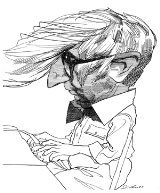
Caricaturist David Levine
illustrated The New York Review of Books from 1963 to 2007. During that time, he contributed more than 3,800 pen-and-ink caricatures of famous writers, artists and politicians for the publication. The New York Times
described Levine's illustrations as "macro-headed, somberly expressive, astringently probing and hardly ever flattering caricatures of intellectuals and athletes, politicians and potentates" that were "replete with exaggeratedly bad haircuts, 5 o'clock shadows, ill-conceived mustaches and other grooming foibles ... to make the famous seem peculiar-looking in order to take them down a peg". John Updike
, whom Levine drew many times, wrote in the 1970s: "Besides offering us the delight of recognition, his drawings comfort us, in an exacerbated and potentially desperate age, with the sense of a watching presence, an eye informed by an intelligence that has not panicked, a comic art ready to encapsulate the latest apparitions of publicity as well as those historical devils who haunt our unease."
In addition to reviews, interviews and articles, the Review features extensive advertising from publishers promoting newly published books. The Washington Post described the "lively literary disputes" conducted in its letters to the editor columns as "the closest thing the intellectual world has to bare-knuckle boxing". It also includes a popular "personals" section and, in 2008, it began hosting podcasts. In 2010, it launched a blog section of its website. Several of the magazine's editorial assistants have become prominent in journalism, academia and literature, including Jean Strouse
, Deborah Eisenberg, Mark Danner
and A. O. Scott
.
stated: "With The New York Review of Books, Robert Silvers and Barbara Epstein raised book reviewing to an art and made the discussion of books a lively, provocative and intellectual activity."
Since Epstein's death, Silvers has been the sole editor. Asked in December 2007 about who might succeed him as editor, the 78-year-old Silvers demurred, "It's not a question that's posing itself". By 2007, illustrator David Levine's failing eyesight forced the Review to turn to other artists and to increase its use of photographs. Levine had provided a distinctive visual image to the Review since 1963. In 2008, the paper moved its headquarters from Midtown Manhattan
to 435 Hudson Street, located in the West Village.
On November 10, 2008, the Review celebrated its 45th anniversary with a panel discussion at the New York Public Library
, moderated by Silvers, discussing "What Happens Now" in America after the 2008 presidential election. Panelists included Review contributors such as Didion, novelist and literary critic Darryl Pinckney
, political commentator Michael Tomasky
, historian Garry Wills
, and Columbia University
professor Andrew Delbanco
. The 45th anniversary edition of the Review (November 20, 2008) began with a posthumous piece by Edmund Wilson
, who wrote for the paper's first issue in 1963. It also featured two key topics of the paper's historical focus: First, an analysis by Yale University
professor David Bromwich
of the vice presidency of Dick Cheney
; and second, British author Zadie Smith
's essay that "dismantles the status quo in the form of a review of two new novels – Netherland and Remainder – that she holds up as representing where the novel's been and where it's going".
calls the Review "a journal of ideas that has helped define intellectual discourse in the English-speaking world for the past four decades.... By publishing long, thoughtful articles on politics, books and culture, [the editors] defied trends toward glibness, superficiality and the cult of celebrity". In a 2006 New York magazine feature, James Atlas
stated: "It's an eclectic but impressive mix [of articles] that has made The New York Review of Books the premier journal of the American intellectual elite". In celebrating the 35th birthday of the Review in 1998, The New York Times
commented, "The N.Y.R. gives off rogue intimations of being fun to put out. It hasn't lost its sneaky nip of mischief".
In 2008, Britain's The Guardian
deemed the Review "scholarly without being pedantic, scrupulous without being dry". The same newspaper wrote in 2004, "The ... issues of the Review to date provide a history of the cultural life of the east coast since 1963. It manages to be ... serious with a fierce democratic edge. ... It is one of the last places in the English-speaking world that will publish long essays ... and possibly the very last to combine academic rigour – even the letters to the editor are footnoted – with great clarity of language." In New York magazine, in February 2011, Oliver Sacks
stated that the Review is "one of the great institutions of intellectual life here or anywhere."
Known throughout its history as a left-liberal journal, what Tom Wolfe
called "the chief theoretical organ of radical chic
", the Review has, perhaps, had its most effective voice in wartime. According to a 2004 feature in The Nation
,
Sometimes accused of insularity, the Review has been called "The New York Review of Each Other's Books". Philip Nobile
voiced a mordant criticism along these lines in his book Intellectual Skywriting: Literary Politics and the New York Review of Books. The Guardian called these accusations "sour grapes". In 2008, the San Francisco Chronicle wrote, "the pages of the 45th anniversary issue, in fact, reveal the actuality of [the paper's] willfully panoramic view".
, which has three imprints, "NYRB Classics", "NYRB Collections" and "NYR Children's Collection". The NYRB Classics imprint reissues books that have gone out of print in the United States and translations of classics. NYRB Collections publishes collections of articles from frequent Review contributors.
Fortnight
The fortnight is a unit of time equal to fourteen days, or two weeks. The word derives from the Old English fēowertyne niht, meaning "fourteen nights"....
ly magazine with articles on literature
Literature
Literature is the art of written works, and is not bound to published sources...
, culture
Culture
Culture is a term that has many different inter-related meanings. For example, in 1952, Alfred Kroeber and Clyde Kluckhohn compiled a list of 164 definitions of "culture" in Culture: A Critical Review of Concepts and Definitions...
and current affairs
Current affairs (news format)
Current Affairs is a genre of broadcast journalism where the emphasis is on detailed analysis and discussion of news stories that have recently occurred or are ongoing at the time of broadcast....
. Published in New York City
New York City
New York is the most populous city in the United States and the center of the New York Metropolitan Area, one of the most populous metropolitan areas in the world. New York exerts a significant impact upon global commerce, finance, media, art, fashion, research, technology, education, and...
, it takes as its point of departure that the discussion of important books
Book review
A book review is a form of literary criticism in which a book is analyzed based on content, style, and merit. A book review could be a primary source opinion piece, summary review or scholarly review. It is often carried out in periodicals, as school work, or on the internet. Reviews are also often...
is itself an indispensable literary activity. Esquire
Esquire (magazine)
Esquire is a men's magazine, published in the U.S. by the Hearst Corporation. Founded in 1932, it flourished during the Great Depression under the guidance of founder and editor Arnold Gingrich.-History:...
called it "the premier literary-intellectual magazine in the English language." In 1970 Tom Wolfe
Tom Wolfe
Thomas Kennerly "Tom" Wolfe, Jr. is a best-selling American author and journalist. He is one of the founders of the New Journalism movement of the 1960s and 1970s.-Early life and education:...
described it as "the chief theoretical organ of Radical Chic
Radical chic
Radical chic is a term coined by journalist Tom Wolfe in his 1970 essay "Radical Chic: That Party at Lenny's," to describe the adoption and promotion of radical political causes by celebrities, socialites, and high society...
".
Robert B. Silvers
Robert B. Silvers
Robert Benjamin Silvers is an American editor who has served as editor of The New York Review of Books since 1963. According to a 2007 Vanity Fair article, "Jason Epstein's assessment of Silvers as 'The most brilliant editor of a magazine ever to have worked in this country' has been 'shared by...
has edited the paper since its founding in 1963, together with Barbara Epstein
Barbara Epstein
Barbara Epstein was a literary editor and a founding co-editor of the New York Review of Books.Epstein, née Zimmerman, was born in Boston, Massachusetts, United States, to a Jewish-American family, and graduated from Radcliffe College in 1949.Ms...
until her death in 2006. The Review has a book publishing division, established in 1999, called New York Review Books
New York Review Books
New York Review Books is the publishing house of The New York Review of Books. Its imprints are New York Review Books Classics, New York Review Books Collections, and The New York Review Children's Collection....
.
Early years
The New York Review was founded by Robert B. SilversRobert B. Silvers
Robert Benjamin Silvers is an American editor who has served as editor of The New York Review of Books since 1963. According to a 2007 Vanity Fair article, "Jason Epstein's assessment of Silvers as 'The most brilliant editor of a magazine ever to have worked in this country' has been 'shared by...
and Barbara Epstein
Barbara Epstein
Barbara Epstein was a literary editor and a founding co-editor of the New York Review of Books.Epstein, née Zimmerman, was born in Boston, Massachusetts, United States, to a Jewish-American family, and graduated from Radcliffe College in 1949.Ms...
, together with publisher A. Whitney Ellsworth
A. Whitney Ellsworth
Arthur Whitney Ellsworth was an American editor and publisher best known as the first publisher of The New York Review of Books.In 1957, Ellsworth was President of The Harvard Advocate...
. and writer Elizabeth Hardwick, and with the backing of Barbara's husband Jason Epstein
Jason Epstein
Jason Epstein is an American editor and publisher.A 1949 graduate of Columbia College of Columbia University, Epstein was hired by Bennett Cerf at Random House, where he was the editorial director for forty years. He was responsible for the Vintage paperbacks, which published such authors as...
, a vice president at Random House
Random House
Random House, Inc. is the largest general-interest trade book publisher in the world. It has been owned since 1998 by the German private media corporation Bertelsmann and has become the umbrella brand for Bertelsmann book publishing. Random House also has a movie production arm, Random House Films,...
and editor of Vintage Books. Hardwick had published an essay in Harpers in 1959 called "The Decline of Book Reviewing", a scornful look at the failure of criticism in reviews of the time that inspired Silvers and Epstein. During the New York printing strike of 1963, when The New York Times
The New York Times
The New York Times is an American daily newspaper founded and continuously published in New York City since 1851. The New York Times has won 106 Pulitzer Prizes, the most of any news organization...
had ceased publication, the founders of The Review seized the opportunity to establish a vigorous book review. They knew that book publishers would advertise their books in the new publication, since they had no other outlet for promoting new books. The first idea was to make Norman Podhoretz
Norman Podhoretz
Norman B. Podhoretz is an American neoconservative pundit and writer for Commentary magazine.-Early life:The son of Julius and Helen Podhoretz, Jewish immigrants from the Central European region of Galicia, Podhoretz was born and raised in Brownsville, Brooklyn...
editor, but he chose to stay at Commentary
Commentary (magazine)
Commentary is a monthly American magazine on politics, Judaism, social and cultural issues. It was founded by the American Jewish Committee in 1945. By 1960 its editor was Norman Podhoretz, a liberal at the time who moved sharply to the right in the 1970s and 1980s becoming a strong voice for the...
magazine. The group then turned to Silvers, a friend of Jason Epstein's, who had been an editor at The Paris Review and was then at Harper's. Barbara Epstein had become known as the editor at Doubleday of Anne Frank
Anne Frank
Annelies Marie "Anne" Frank is one of the most renowned and most discussed Jewish victims of the Holocaust. Acknowledged for the quality of her writing, her diary has become one of the world's most widely read books, and has been the basis for several plays and films.Born in the city of Frankfurt...
's Diary of a Young Girl, among other books, and then worked at Dutton, McGraw-Hill
McGraw-Hill
The McGraw-Hill Companies, Inc., is a publicly traded corporation headquartered in Rockefeller Center in New York City. Its primary areas of business are financial, education, publishing, broadcasting, and business services...
and The Partisan Review.
The first issue of the Review was published on February 1, 1963 and sold out. Silvers says of the editors' philosophy, "We felt you had to have a political analysis of the nature of power in America - who had it, who was affected". The editors also "had one thing in common, it was this feeling of intense admiration for wonderful writers". Early issues included articles by such writers as Hardwick, Hannah Arendt
Hannah Arendt
Hannah Arendt was a German American political theorist. She has often been described as a philosopher, although she refused that label on the grounds that philosophy is concerned with "man in the singular." She described herself instead as a political theorist because her work centers on the fact...
, W. H. Auden
W. H. Auden
Wystan Hugh Auden , who published as W. H. Auden, was an Anglo-American poet,The first definition of "Anglo-American" in the OED is: "Of, belonging to, or involving both England and America." See also the definition "English in origin or birth, American by settlement or citizenship" in See also...
, Saul Bellow
Saul Bellow
Saul Bellow was a Canadian-born Jewish American writer. For his literary contributions, Bellow was awarded the Pulitzer Prize, the Nobel Prize for Literature, and the National Medal of Arts...
, John Berryman
John Berryman
John Allyn Berryman was an American poet and scholar, born in McAlester, Oklahoma. He was a major figure in American poetry in the second half of the 20th century and was considered a key figure in the Confessional school of poetry...
, Truman Capote
Truman Capote
Truman Streckfus Persons , known as Truman Capote , was an American author, many of whose short stories, novels, plays, and nonfiction are recognized literary classics, including the novella Breakfast at Tiffany's and the true crime novel In Cold Blood , which he labeled a "nonfiction novel." At...
, Paul Goodman
Paul Goodman (writer)
Paul Goodman was an American sociologist, poet, writer, anarchist, and public intellectual. Goodman is now mainly remembered as the author of Growing Up Absurd and an activist on the pacifist Left in the 1960s and an inspiration to that era's student movement...
, Lillian Hellman
Lillian Hellman
Lillian Florence "Lily" Hellman was an American playwright, linked throughout her life with many left-wing causes...
, Irving Howe
Irving Howe
Irving Howe was an American literary and social critic and a prominent figure of the Democratic Socialists of America.-Life and career:...
, Alfred Kazin
Alfred Kazin
Alfred Kazin was an American writer and literary critic, many of whose writings depicted the immigrant experience in early twentieth century America....
, Robert Lowell
Robert Lowell
Robert Traill Spence Lowell IV was an American poet, considered the founder of the confessional poetry movement. He was appointed the sixth Poet Laureate Consultant in Poetry to the Library of Congress where he served from 1947 until 1948...
, Dwight Macdonald
Dwight Macdonald
Dwight Macdonald was an American writer, editor, film critic, social critic, philosopher, and political radical.-Early life and career:...
, Norman Mailer
Norman Mailer
Norman Kingsley Mailer was an American novelist, journalist, essayist, poet, playwright, screenwriter, and film director.Along with Truman Capote, Joan Didion, Hunter S...
, Mary McCarthy
Mary McCarthy (author)
Mary Therese McCarthy was an American author, critic and political activist.- Early life :Born in Seattle, Washington, to Roy Winfield McCarthy and his wife, the former Therese Preston, McCarthy was orphaned at the age of six when both her parents died in the great flu epidemic of 1918...
, Norman Podhoretz
Norman Podhoretz
Norman B. Podhoretz is an American neoconservative pundit and writer for Commentary magazine.-Early life:The son of Julius and Helen Podhoretz, Jewish immigrants from the Central European region of Galicia, Podhoretz was born and raised in Brownsville, Brooklyn...
, Philip Rahv
Philip Rahv
Philip Rahv was an American literary critic and essayist.-Life:...
, Susan Sontag
Susan Sontag
Susan Sontag was an American author, literary theorist, feminist and political activist whose works include On Photography and Against Interpretation.-Life:...
, William Styron
William Styron
William Clark Styron, Jr. was an American novelist and essayist who won major literary awards for his work.For much of his career, Styron was best known for his novels, which included...
, Gore Vidal
Gore Vidal
Gore Vidal is an American author, playwright, essayist, screenwriter, and political activist. His third novel, The City and the Pillar , outraged mainstream critics as one of the first major American novels to feature unambiguous homosexuality...
, Robert Penn Warren
Robert Penn Warren
Robert Penn Warren was an American poet, novelist, and literary critic and was one of the founders of New Criticism. He was also a charter member of the Fellowship of Southern Writers. He founded the influential literary journal The Southern Review with Cleanth Brooks in 1935...
and Edmund Wilson
Edmund Wilson
Edmund Wilson was an American writer and literary and social critic and noted man of letters.-Early life:Wilson was born in Red Bank, New Jersey. His father, Edmund Wilson, Sr., was a lawyer and served as New Jersey Attorney General. Wilson attended The Hill School, a college preparatory...
. The Review pointedly published interviews with political dissidents, including Alexander Solzhenitsyn, Andrei Sakharov
Andrei Sakharov
Andrei Dmitrievich Sakharov was a Soviet nuclear physicist, dissident and human rights activist. He earned renown as the designer of the Soviet Union's Third Idea, a codename for Soviet development of thermonuclear weapons. Sakharov was an advocate of civil liberties and civil reforms in the...
and Václav Havel
Václav Havel
Václav Havel is a Czech playwright, essayist, poet, dissident and politician. He was the tenth and last President of Czechoslovakia and the first President of the Czech Republic . He has written over twenty plays and numerous non-fiction works, translated internationally...
.
During the year-long lock-out at The Times
The Times
The Times is a British daily national newspaper, first published in London in 1785 under the title The Daily Universal Register . The Times and its sister paper The Sunday Times are published by Times Newspapers Limited, a subsidiary since 1981 of News International...
in London in 1979, the Review founded a daughter publication, the London Review of Books
London Review of Books
The London Review of Books is a fortnightly British magazine of literary and intellectual essays.-History:The LRB was founded in 1979, during the year-long lock-out at The Times, by publisher A...
. For the first six months, this journal appeared as an insert in the New York Review of Books, but it became an independent publication in 1980.
Description
The Review has been described as a "kind of magazine ... in which the most interesting and qualified minds of our time would discuss current books and issues in depth ... a literary and critical journal based on the assumption that the discussion of important books was itself an indispensable literary activity." In 2004, The NationThe Nation
The Nation is the oldest continuously published weekly magazine in the United States. The periodical, devoted to politics and culture, is self-described as "the flagship of the left." Founded on July 6, 1865, It is published by The Nation Company, L.P., at 33 Irving Place, New York City.The Nation...
gave a brief historical overview of the New York Review of Books, writing:
- the Review took a vocal role in contesting the Vietnam WarVietnam WarThe Vietnam War was a Cold War-era military conflict that occurred in Vietnam, Laos, and Cambodia from 1 November 1955 to the fall of Saigon on 30 April 1975. This war followed the First Indochina War and was fought between North Vietnam, supported by its communist allies, and the government of...
. ... Around 1970, a sturdy liberalism began to supplant left-wing radicalism at the paper. As Philip NobilePhilip NobilePhilip Nobile is an American freelance writer, historian, and social critic/commentator based in New York City.Nobile's original career was not that of a journalist, but of a seminarian; however, he left religious life to become a journalist...
observed in ... 1974 ... the Review returned to its roots and became "a literary magazine on the British nineteenth-century model, which would mix politics and literature in a tough but gentlemanly fashion." ... The publication has always been erudite and authoritative – and because of its analytical rigor and seriousness, frequently essential – but it hasn't always been lively, pungent and readable. ... But the election of George W. BushGeorge W. BushGeorge Walker Bush is an American politician who served as the 43rd President of the United States, from 2001 to 2009. Before that, he was the 46th Governor of Texas, having served from 1995 to 2000....
, combined with the furies of 9/11, jolted the editors. Since 2001, the Review's temperature has risen and its political outlook has sharpened. ... Prominent [writers for] the Review ... charged into battle not only against the White House but against the lethargic press corps and the "liberal hawk" intellectuals. ... In stark contrast to The New YorkerThe New YorkerThe New Yorker is an American magazine of reportage, commentary, criticism, essays, fiction, satire, cartoons and poetry published by Condé Nast...
... or The New York Times Magazine ... the Review opposed the Iraq war in a voice that was remarkably consistent and unified.
Over the years, the Review has featured reviews and articles by such writers and thinkers as Timothy Garton Ash
Timothy Garton Ash
Timothy Garton Ash is a British historian, author and commentator. He is currently serving as Professor of European Studies at Oxford University. Much of his work has been concerned with the late modern and contemporary history of Central and Eastern Europe...
, Margaret Atwood
Margaret Atwood
Margaret Eleanor Atwood, is a Canadian poet, novelist, literary critic, essayist, and environmental activist. She is among the most-honoured authors of fiction in recent history; she is a winner of the Arthur C...
, Russell Baker
Russell Baker
Russell Wayne Baker is an American Pulitzer Prize-winning writer known for his satirical commentary and self-critical prose, as well as for his autobiography, Growing Up.-His career:...
, Saul Bellow
Saul Bellow
Saul Bellow was a Canadian-born Jewish American writer. For his literary contributions, Bellow was awarded the Pulitzer Prize, the Nobel Prize for Literature, and the National Medal of Arts...
, Isaiah Berlin
Isaiah Berlin
Sir Isaiah Berlin OM, FBA was a British social and political theorist, philosopher and historian of ideas of Russian-Jewish origin, regarded as one of the leading thinkers of the twentieth century and a dominant liberal scholar of his generation...
, Harold Bloom
Harold Bloom
Harold Bloom is an American writer and literary critic, and is Sterling Professor of Humanities at Yale University. He is known for his defense of 19th-century Romantic poets, his unique and controversial theories of poetic influence, and his prodigious literary output, particularly for a literary...
, Joseph Brodsky
Joseph Brodsky
Iosif Aleksandrovich Brodsky , was a Russian poet and essayist.In 1964, 23-year-old Brodsky was arrested and charged with the crime of "social parasitism" He was expelled from the Soviet Union in 1972 and settled in America with the help of W. H. Auden and other supporters...
, Noam Chomsky
Noam Chomsky
Avram Noam Chomsky is an American linguist, philosopher, cognitive scientist, and activist. He is an Institute Professor and Professor in the Department of Linguistics & Philosophy at MIT, where he has worked for over 50 years. Chomsky has been described as the "father of modern linguistics" and...
, J. M. Coetzee, Frederick Crews, Ronald Dworkin
Ronald Dworkin
Ronald Myles Dworkin, QC, FBA is an American philosopher and scholar of constitutional law. He is Frank Henry Sommer Professor of Law and Philosophy at New York University and Emeritus Professor of Jurisprudence at University College London, and has taught previously at Yale Law School and the...
, John Kenneth Galbraith
John Kenneth Galbraith
John Kenneth "Ken" Galbraith , OC was a Canadian-American economist. He was a Keynesian and an institutionalist, a leading proponent of 20th-century American liberalism...
, Nadine Gordimer
Nadine Gordimer
Nadine Gordimer is a South African writer and political activist. She was awarded the 1991 Nobel Prize in Literature when she was recognised as a woman "who through her magnificent epic writing has – in the words of Alfred Nobel – been of very great benefit to humanity".Her writing has long dealt...
, Stephen Jay Gould
Stephen Jay Gould
Stephen Jay Gould was an American paleontologist, evolutionary biologist, and historian of science. He was also one of the most influential and widely read writers of popular science of his generation....
, Murray Kempton
Murray Kempton
James Murray Kempton was an influential, Pulitzer Prize-winning American journalist.-Biography:Kempton was born in Baltimore on December 16, 1917. His mother was Sally Ambler and his father was James Branson Kempton, a stock broker...
, Richard Lewontin
Richard Lewontin
Richard Charles "Dick" Lewontin is an American evolutionary biologist, geneticist and social commentator. A leader in developing the mathematical basis of population genetics and evolutionary theory, he pioneered the notion of using techniques from molecular biology such as gel electrophoresis to...
, Alison Lurie
Alison Lurie
Alison Lurie is an American novelist and academic. She won the Pulitzer Prize for her 1984 novel Foreign Affairs. Although better known as a novelist, she has also written numerous non-fiction books and articles, particularly on children's literature and the semiotics of dress.-Personal...
, Peter Medawar
Peter Medawar
Sir Peter Brian Medawar OM CBE FRS was a British biologist, whose work on graft rejection and the discovery of acquired immune tolerance was fundamental to the practice of tissue and organ transplants...
, Daniel Mendelsohn
Daniel Mendelsohn
-Life and career:Mendelsohn was born on Long Island. He graduated with a B. A. in Classics from the University of Virginia, which he attended from 1978 to 1982 as an Echols Scholar, and received his M. A. and Ph. D. in Classics from Princeton University, where he was a Mellon Fellow in the...
, Vladimir Nabokov
Vladimir Nabokov
Vladimir Vladimirovich Nabokov was a multilingual Russian novelist and short story writer. Nabokov wrote his first nine novels in Russian, then rose to international prominence as a master English prose stylist...
, V. S. Naipaul
V. S. Naipaul
Sir Vidiadhar Surajprasad "V. S." Naipaul, TC is a Nobel prize-winning Indo-Trinidadian-British writer who is known for his novels focusing on the legacy of the British Empire's colonialism...
, Peter G. Peterson, John Searle
John Searle
John Rogers Searle is an American philosopher and currently the Slusser Professor of Philosophy at the University of California, Berkeley.-Biography:...
, I. F. Stone
I. F. Stone
Isidor Feinstein Stone was an iconoclastic American investigative journalist. He is best remembered for his self-published newsletter, I. F...
, Desmond Tutu
Desmond Tutu
Desmond Mpilo Tutu is a South African activist and retired Anglican bishop who rose to worldwide fame during the 1980s as an opponent of apartheid...
, John Updike
John Updike
John Hoyer Updike was an American novelist, poet, short story writer, art critic, and literary critic....
, Derek Walcott
Derek Walcott
Derek Alton Walcott, OBE OCC is a Saint Lucian poet, playwright, writer and visual artist who was awarded the Nobel Prize for Literature in 1992 and the T. S. Eliot Prize in 2011 for White Egrets. His works include the Homeric epic Omeros...
, Steven Weinberg
Steven Weinberg
Steven Weinberg is an American theoretical physicist and Nobel laureate in Physics for his contributions with Abdus Salam and Sheldon Glashow to the unification of the weak force and electromagnetic interaction between elementary particles....
, Garry Wills
Garry Wills
Garry Wills is a Pulitzer Prize-winning and prolific author, journalist, and historian, specializing in American politics, American political history and ideology and the Roman Catholic Church. Classically trained at a Jesuit high school and two universities, he is proficient in Greek and Latin...
and Tony Judt
Tony Judt
Tony Robert Judt FBA was a British historian, essayist, and university professor who specialized in European history. Judt moved to New York and served as the Erich Maria Remarque Professor in European Studies at New York University, and Director of NYU's Erich Maria Remarque Institute...
. According to the National Book Foundation
National Book Foundation
The National Book Foundation, founded in 1989, is an American nonprofit literary organization established "to raise the cultural appreciation of great writing in America." It achieves this through sponsoring the National Book Award, as well as the medal for Distinguished Contribution to American...
: "From Mary McCarthy and Edmund Wilson to Gore Vidal and Joan Didion
Joan Didion
Joan Didion is an American author best known for her novels and her literary journalism. Her novels and essays explore the disintegration of American morals and cultural chaos, where the overriding theme is individual and social fragmentation...
, The New York Review of Books has consistently employed the liveliest minds in America to think about, write about, and debate books and the issues they raise." In addition to domestic issues, the Review covers issues of international concern, including an often-critical view of Israeli policy and the American Israel lobby "from a Jewish place". The Review also devotes space in most issues to poetry and has featured the work of such poets as Robert Lowell
Robert Lowell
Robert Traill Spence Lowell IV was an American poet, considered the founder of the confessional poetry movement. He was appointed the sixth Poet Laureate Consultant in Poetry to the Library of Congress where he served from 1947 until 1948...
, John Berryman
John Berryman
John Allyn Berryman was an American poet and scholar, born in McAlester, Oklahoma. He was a major figure in American poetry in the second half of the 20th century and was considered a key figure in the Confessional school of poetry...
, Ted Hughes
Ted Hughes
Edward James Hughes OM , more commonly known as Ted Hughes, was an English poet and children's writer. Critics routinely rank him as one of the best poets of his generation. Hughes was British Poet Laureate from 1984 until his death.Hughes was married to American poet Sylvia Plath, from 1956 until...
, John Ashbery
John Ashbery
John Lawrence Ashbery is an American poet. He has published more than twenty volumes of poetry and won nearly every major American award for poetry, including a Pulitzer Prize in 1976 for his collection Self-Portrait in a Convex Mirror. But Ashbery's work still proves controversial...
and Richard Wilbur
Richard Wilbur
Richard Purdy Wilbur is an American poet and literary translator. He was appointed the second Poet Laureate Consultant in Poetry to the Library of Congress in 1987, and twice received the Pulitzer Prize for Poetry, in 1957 and again in 1989....
.
Caricaturist David Levine
David Levine
David Levine was an American artist and illustrator best known for his caricatures in The New York Review of Books. Jules Feiffer has called him "the greatest caricaturist of the last half of the 20th Century".-Early life and education:Levine was born in Brooklyn, where his father Harry ran a...
illustrated The New York Review of Books from 1963 to 2007. During that time, he contributed more than 3,800 pen-and-ink caricatures of famous writers, artists and politicians for the publication. The New York Times
The New York Times
The New York Times is an American daily newspaper founded and continuously published in New York City since 1851. The New York Times has won 106 Pulitzer Prizes, the most of any news organization...
described Levine's illustrations as "macro-headed, somberly expressive, astringently probing and hardly ever flattering caricatures of intellectuals and athletes, politicians and potentates" that were "replete with exaggeratedly bad haircuts, 5 o'clock shadows, ill-conceived mustaches and other grooming foibles ... to make the famous seem peculiar-looking in order to take them down a peg". John Updike
John Updike
John Hoyer Updike was an American novelist, poet, short story writer, art critic, and literary critic....
, whom Levine drew many times, wrote in the 1970s: "Besides offering us the delight of recognition, his drawings comfort us, in an exacerbated and potentially desperate age, with the sense of a watching presence, an eye informed by an intelligence that has not panicked, a comic art ready to encapsulate the latest apparitions of publicity as well as those historical devils who haunt our unease."
In addition to reviews, interviews and articles, the Review features extensive advertising from publishers promoting newly published books. The Washington Post described the "lively literary disputes" conducted in its letters to the editor columns as "the closest thing the intellectual world has to bare-knuckle boxing". It also includes a popular "personals" section and, in 2008, it began hosting podcasts. In 2010, it launched a blog section of its website. Several of the magazine's editorial assistants have become prominent in journalism, academia and literature, including Jean Strouse
Jean Strouse
Jean Strouse is an American biographer, editor and critic. She is best known for her biographies of diarist Alice James and financier J. Pierpont Morgan....
, Deborah Eisenberg, Mark Danner
Mark Danner
Mark David Danner is a prominent American writer, journalist, and educator. He is a former staff writer for The New Yorker and frequent contributor to The New York Review of Books. Danner specializes in U.S. foreign affairs, war and politics, and has written extensively on Haiti, Central America,...
and A. O. Scott
A. O. Scott
Anthony Oliver Scott, known as A. O. Scott , is an American journalist and critic. He is a chief film critic for The New York Times, along with Manohla Dargis.-Background and education:...
.
Recent years
For over 40 years, Silvers and Epstein edited the Review together. In 1984, Silvers, Epstein and their partners sold the Review to publisher Rea S. Hederman, who still owns the paper, but the two continued as its editors. In 2006, Epstein died of cancer at the age of 77. In awarding to Epstein and Silvers its Literarian Award for Outstanding Service to the American Literary Community in 2006, the National Book FoundationNational Book Foundation
The National Book Foundation, founded in 1989, is an American nonprofit literary organization established "to raise the cultural appreciation of great writing in America." It achieves this through sponsoring the National Book Award, as well as the medal for Distinguished Contribution to American...
stated: "With The New York Review of Books, Robert Silvers and Barbara Epstein raised book reviewing to an art and made the discussion of books a lively, provocative and intellectual activity."
Since Epstein's death, Silvers has been the sole editor. Asked in December 2007 about who might succeed him as editor, the 78-year-old Silvers demurred, "It's not a question that's posing itself". By 2007, illustrator David Levine's failing eyesight forced the Review to turn to other artists and to increase its use of photographs. Levine had provided a distinctive visual image to the Review since 1963. In 2008, the paper moved its headquarters from Midtown Manhattan
Midtown Manhattan
Midtown Manhattan, or simply Midtown, is an area of Manhattan, New York City home to world-famous commercial zones such as Rockefeller Center, Broadway, and Times Square...
to 435 Hudson Street, located in the West Village.
On November 10, 2008, the Review celebrated its 45th anniversary with a panel discussion at the New York Public Library
New York Public Library
The New York Public Library is the largest public library in North America and is one of the United States' most significant research libraries...
, moderated by Silvers, discussing "What Happens Now" in America after the 2008 presidential election. Panelists included Review contributors such as Didion, novelist and literary critic Darryl Pinckney
Darryl Pinckney
Darryl Pinckney is an American novelist, playwright, and essayist. He grew up in a middle class African-American family in the midwest and was educated at Columbia University. He is a frequent contributor to the New York Review of Books, Granta, Slate, and The Nation...
, political commentator Michael Tomasky
Michael Tomasky
Michael Tomasky is a liberal American columnist, journalist and author. He is the editor in chief of Democracy, a special correspondent for Newsweek / The Daily Beast, a contributing editor for The American Prospect, and a contributor to The New York Review of Books.-Biography:Tomasky was born...
, historian Garry Wills
Garry Wills
Garry Wills is a Pulitzer Prize-winning and prolific author, journalist, and historian, specializing in American politics, American political history and ideology and the Roman Catholic Church. Classically trained at a Jesuit high school and two universities, he is proficient in Greek and Latin...
, and Columbia University
Columbia University
Columbia University in the City of New York is a private, Ivy League university in Manhattan, New York City. Columbia is the oldest institution of higher learning in the state of New York, the fifth oldest in the United States, and one of the country's nine Colonial Colleges founded before the...
professor Andrew Delbanco
Andrew Delbanco
Dr. Andrew H. Delbanco is Director of American Studies at Columbia University and has been Columbia's Julian Clarence Levi Professor in the Humanities since 1995...
. The 45th anniversary edition of the Review (November 20, 2008) began with a posthumous piece by Edmund Wilson
Edmund Wilson
Edmund Wilson was an American writer and literary and social critic and noted man of letters.-Early life:Wilson was born in Red Bank, New Jersey. His father, Edmund Wilson, Sr., was a lawyer and served as New Jersey Attorney General. Wilson attended The Hill School, a college preparatory...
, who wrote for the paper's first issue in 1963. It also featured two key topics of the paper's historical focus: First, an analysis by Yale University
Yale University
Yale University is a private, Ivy League university located in New Haven, Connecticut, United States. Founded in 1701 in the Colony of Connecticut, the university is the third-oldest institution of higher education in the United States...
professor David Bromwich
David Bromwich
-Career:Having graduated from Yale with a B.A. in 1973 and a Ph.D. four years later, he became an instructor at Princeton University, where he was promoted to Mellon Professor of English before returning to Yale in 1988. From 1995 he served as the Housum Professor of English at Yale...
of the vice presidency of Dick Cheney
Dick Cheney
Richard Bruce "Dick" Cheney served as the 46th Vice President of the United States , under George W. Bush....
; and second, British author Zadie Smith
Zadie Smith
Zadie Smith is a British novelist. To date she has written three novels. In 2003, she was included on Granta's list of 20 best young authors...
's essay that "dismantles the status quo in the form of a review of two new novels – Netherland and Remainder – that she holds up as representing where the novel's been and where it's going".
Critical reaction
The Washington PostThe Washington Post
The Washington Post is Washington, D.C.'s largest newspaper and its oldest still-existing paper, founded in 1877. Located in the capital of the United States, The Post has a particular emphasis on national politics. D.C., Maryland, and Virginia editions are printed for daily circulation...
calls the Review "a journal of ideas that has helped define intellectual discourse in the English-speaking world for the past four decades.... By publishing long, thoughtful articles on politics, books and culture, [the editors] defied trends toward glibness, superficiality and the cult of celebrity". In a 2006 New York magazine feature, James Atlas
James Atlas
James Atlas , is the president of Atlas & Company, publishers, and founding editor of the Penguin Lives Series.A Harvard graduate, Rhodes Scholar, and onetime contributor to The New Yorker, he was an editor at The New York Times Magazine for many years.He has edited volumes of poetry and has...
stated: "It's an eclectic but impressive mix [of articles] that has made The New York Review of Books the premier journal of the American intellectual elite". In celebrating the 35th birthday of the Review in 1998, The New York Times
The New York Times
The New York Times is an American daily newspaper founded and continuously published in New York City since 1851. The New York Times has won 106 Pulitzer Prizes, the most of any news organization...
commented, "The N.Y.R. gives off rogue intimations of being fun to put out. It hasn't lost its sneaky nip of mischief".
In 2008, Britain's The Guardian
The Guardian
The Guardian, formerly known as The Manchester Guardian , is a British national daily newspaper in the Berliner format...
deemed the Review "scholarly without being pedantic, scrupulous without being dry". The same newspaper wrote in 2004, "The ... issues of the Review to date provide a history of the cultural life of the east coast since 1963. It manages to be ... serious with a fierce democratic edge. ... It is one of the last places in the English-speaking world that will publish long essays ... and possibly the very last to combine academic rigour – even the letters to the editor are footnoted – with great clarity of language." In New York magazine, in February 2011, Oliver Sacks
Oliver Sacks
Oliver Wolf Sacks, CBE , is a British neurologist and psychologist residing in New York City. He is a professor of neurology and psychiatry at Columbia University, where he also holds the position of Columbia Artist...
stated that the Review is "one of the great institutions of intellectual life here or anywhere."
Known throughout its history as a left-liberal journal, what Tom Wolfe
Tom Wolfe
Thomas Kennerly "Tom" Wolfe, Jr. is a best-selling American author and journalist. He is one of the founders of the New Journalism movement of the 1960s and 1970s.-Early life and education:...
called "the chief theoretical organ of radical chic
Radical chic
Radical chic is a term coined by journalist Tom Wolfe in his 1970 essay "Radical Chic: That Party at Lenny's," to describe the adoption and promotion of radical political causes by celebrities, socialites, and high society...
", the Review has, perhaps, had its most effective voice in wartime. According to a 2004 feature in The Nation
The Nation
The Nation is the oldest continuously published weekly magazine in the United States. The periodical, devoted to politics and culture, is self-described as "the flagship of the left." Founded on July 6, 1865, It is published by The Nation Company, L.P., at 33 Irving Place, New York City.The Nation...
,
- "One suspects they yearn for the day when they can return to their normal publishing routine – that gentlemanly pastichePasticheA pastiche is a literary or other artistic genre or technique that is a "hodge-podge" or imitation. The word is also a linguistic term used to describe an early stage in the development of a pidgin language.-Hodge-podge:...
of philosophy, art, classical music, photography, German and Russian history, East European politics, literary fiction – unencumbered by political duties of a confrontational or oppositional nature. That day has not yet arrived. If and when it does, let it be said that the editors met the challenges of the post-9/11 era in a way that most other leading American publications did not, and that The New York Review of Books ... was there when we needed it most." Editor Bob Silvers asserted in 2004: "The pieces we have published by such writers as Brian UrquhartBrian UrquhartSir Brian Urquhart, KCMG, MBE is a former Undersecretary-General of the United Nations. He is also a World War II veteran and an author.-Early life:...
, Thomas PowersThomas PowersThomas Powers is an author, and an intelligence expert.He was awarded the Pulitzer Prize for National Reporting in 1971 together with Lucinda Franks for his articles on Weatherman member Diana Oughton...
, Mark DannerMark DannerMark David Danner is a prominent American writer, journalist, and educator. He is a former staff writer for The New Yorker and frequent contributor to The New York Review of Books. Danner specializes in U.S. foreign affairs, war and politics, and has written extensively on Haiti, Central America,...
and Ronald Dworkin have been reactions to a genuine crisis concerning American destructiveness, American relations with its allies, American protections of its traditions of liberties.... The aura of patriotic defiance cultivated by the [Bush] Administration, in a fearful atmosphere, had the effect of muffling dissent."
Sometimes accused of insularity, the Review has been called "The New York Review of Each Other's Books". Philip Nobile
Philip Nobile
Philip Nobile is an American freelance writer, historian, and social critic/commentator based in New York City.Nobile's original career was not that of a journalist, but of a seminarian; however, he left religious life to become a journalist...
voiced a mordant criticism along these lines in his book Intellectual Skywriting: Literary Politics and the New York Review of Books. The Guardian called these accusations "sour grapes". In 2008, the San Francisco Chronicle wrote, "the pages of the 45th anniversary issue, in fact, reveal the actuality of [the paper's] willfully panoramic view".
Other publications
The Review also publishes an Italian edition, la Rivista dei Libri. The book publishing arm of the Review, established in 1999, is New York Review BooksNew York Review Books
New York Review Books is the publishing house of The New York Review of Books. Its imprints are New York Review Books Classics, New York Review Books Collections, and The New York Review Children's Collection....
, which has three imprints, "NYRB Classics", "NYRB Collections" and "NYR Children's Collection". The NYRB Classics imprint reissues books that have gone out of print in the United States and translations of classics. NYRB Collections publishes collections of articles from frequent Review contributors.
See also
- The New York Times Book ReviewThe New York Times Book ReviewThe New York Times Book Review is a weekly paper-magazine supplement to The New York Times in which current non-fiction and fiction books are reviewed. It is one of the most influential and widely read book review publications in the industry. The offices are located near Times Square in New York...
- Media in New York City
- The Paris Review
- GrantaGrantaGranta is a literary magazine and publisher in the United Kingdom whose mission centers on its "belief in the power and urgency of the story, both in fiction and non-fiction, and the story’s supreme ability to describe, illuminate and make real." In 2007, The Observer stated, "In its blend of...
External links
- The New York Review of Books official site
- Columbia Journalism review on "Ten Best Editors"
- Neyfakh, Leon. "Mr. Silvers, Will You Peek at My Books?" New York ObserverNew York ObserverThe New York Observer is a weekly newspaper first published in New York City on September 22, 1987, by Arthur L. Carter, a very successful former investment banker with publishing interests. The Observer focuses on the city's culture, real estate, the media, politics and the entertainment and...
, February 6, 2008 - 2008 Thoughtcast interview of Silvers for NRB's 45th anniversary
- 2010 NPR interview of Silvers about the founding and history of the NY Review
- 2011 review of Silvers by the Kindle Daily Post