
All Topics  
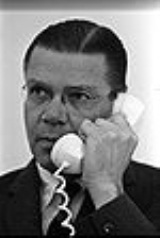
Robert McNamara

 
Robert McNamara

   Email Print
   Bookmark   Link


Robert McNamara


Robert Strange McNamara (born June 9, 1916, in Oakland
Oakland, California

Oakland , founded in 1852, is the eighth-largest city in the U.S. state of California and the county seat of Alameda County, California. Oakland is approximately 8 miles east of San Francisco and the cities are separated by San Francisco Bay....
, California
California

California is a U.S. state on the West Coast of the United States of the United States, along the Pacific Ocean. It is bordered by Oregon to the north, Nevada to the east, Arizona to the southeast, and to the south the Mexico state of Baja California....
) is an American
United States

The United States of America is a Federal government constitutional republic comprising U.S. state and a federal district. The country is situated mostly in central North America, where its Contiguous United States and Washington, D.C., the Capital districts and territories, lie between the Pacific Ocean and Atlantic Oceans, Borders of the U...
 business executive and the 8th United States Secretary of Defense
United States Secretary of Defense

File:USSecDefflag.PNGThe United States Secretary of Defense is the head of the United States Department of Defense , concerned with the Military of the United States and Military of the United States....
. McNamara served as Defense Secretary during the Vietnam War
Vietnam War

The Vietnam War, also known as the Second Indochina Wars, the Vietnam Conflict, or often in Vietnam the American War occurred in Vietnam, Laos and Cambodia from 1959 to April 30, 1975....
 from 1961 to 1968. After holding that position he served as President of the World Bank
World Bank

The World Bank is a bank that provides financial and technical assistance to developing countries for development programs with the stated goal of reducing poverty....
 from 1968 until 1981. McNamara was responsible for the institution of systems analysis
Systems analysis

Systems analysis is the interdisciplinary part of Science, dealing with analysis of sets of interacting or entities, the systems, often prior to their automation as computer systems, and the interactions within those systems....
 in public policy, which developed into the discipline known today as policy analysis
Policy analysis

Policy analysis can be defined as "determining which of various alternative policies will most achieve a given set of goals in light of the relations between the policies and the goals" ....
.

rt Strange McNamara was born in Oakland, California
California

California is a U.S. state on the West Coast of the United States of the United States, along the Pacific Ocean. It is bordered by Oregon to the north, Nevada to the east, Arizona to the southeast, and to the south the Mexico state of Baja California....
, where his father was the sales manager of a wholesale shoe company; he got his middle name "Strange" from his mother's maiden name.


Discussion
Ask a question about 'Robert McNamara'
Start a new discussion about 'Robert McNamara'
Answer questions from other users
Full Discussion Forum


Encyclopedia


Robert Strange McNamara (born June 9, 1916, in Oakland
Oakland, California

Oakland , founded in 1852, is the eighth-largest city in the U.S. state of California and the county seat of Alameda County, California. Oakland is approximately 8 miles east of San Francisco and the cities are separated by San Francisco Bay....
, California
California

California is a U.S. state on the West Coast of the United States of the United States, along the Pacific Ocean. It is bordered by Oregon to the north, Nevada to the east, Arizona to the southeast, and to the south the Mexico state of Baja California....
) is an American
United States

The United States of America is a Federal government constitutional republic comprising U.S. state and a federal district. The country is situated mostly in central North America, where its Contiguous United States and Washington, D.C., the Capital districts and territories, lie between the Pacific Ocean and Atlantic Oceans, Borders of the U...
 business executive and the 8th United States Secretary of Defense
United States Secretary of Defense

File:USSecDefflag.PNGThe United States Secretary of Defense is the head of the United States Department of Defense , concerned with the Military of the United States and Military of the United States....
. McNamara served as Defense Secretary during the Vietnam War
Vietnam War

The Vietnam War, also known as the Second Indochina Wars, the Vietnam Conflict, or often in Vietnam the American War occurred in Vietnam, Laos and Cambodia from 1959 to April 30, 1975....
 from 1961 to 1968. After holding that position he served as President of the World Bank
World Bank

The World Bank is a bank that provides financial and technical assistance to developing countries for development programs with the stated goal of reducing poverty....
 from 1968 until 1981. McNamara was responsible for the institution of systems analysis
Systems analysis

Systems analysis is the interdisciplinary part of Science, dealing with analysis of sets of interacting or entities, the systems, often prior to their automation as computer systems, and the interactions within those systems....
 in public policy, which developed into the discipline known today as policy analysis
Policy analysis

Policy analysis can be defined as "determining which of various alternative policies will most achieve a given set of goals in light of the relations between the policies and the goals" ....
.

Early life and career

Robert Strange McNamara was born in Oakland, California
California

California is a U.S. state on the West Coast of the United States of the United States, along the Pacific Ocean. It is bordered by Oregon to the north, Nevada to the east, Arizona to the southeast, and to the south the Mexico state of Baja California....
, where his father was the sales manager of a wholesale shoe company; he got his middle name "Strange" from his mother's maiden name. He attended Piedmont High School
Piedmont High School

Piedmont High School is a public high school located in Piedmont, California, United States. It is noted for its strong academics and nationally-known Piedmont High School#Bird Calling Contest, and the A-11 offense football offense....
 in Piedmont, California
Piedmont, California

Piedmont is a small affluent city in Alameda County, California, California, United States. It is surrounded by the city of Oakland, California....
, where he was president of the Rigma Lions boys club in 1933. He became an Eagle Scout, and graduated in 1937 from the University of California, Berkeley
University of California, Berkeley

The University of California, Berkeley is a public university research university located in Berkeley, California, California, United States. The oldest of the ten major campuses affiliated with the University of California, Berkeley offers some 300 undergraduate and graduate degree programs in a wide range of disciplines....
, with a Bachelor of Arts
Bachelor of Arts

Bachelor of Arts , from the Latin language Artium Baccalaureus, is an Undergraduate education bachelor's degree awarded for either a course or a program in either the liberal arts, the sciences or both....
 in economics
Economics

File:Ballard Farmers' Market - vegetables.jpgEconomics is the Social sciences that studies the Production theory basics, Distribution , and Consumption of Good and Service ....
 with minors in mathematics
Mathematics

Mathematics is the study of quantity, structure, space, change, and related topics of pattern and form. Mathematicians seek out patterns whether found in numbers, space, natural science, computers, imaginary abstractions, or elsewhere....
 and philosophy
Philosophy

Philosophy is the study of general problems concerning matters such as existence, knowledge, truth, beauty, justice, validity, mind, and language....
, was elected to Phi Beta Kappa in his sophomore year, and earned a varsity letter in crew. He was a member of the UC Berkeley Golden Bear Battalion, Army ROTC. He then earned a master's degree
Master's degree

A master's degree provides a mastery or high-order overview of a specific field of study or area of profession. Within the area studied, graduates possess advanced knowledge of a specialized body of theory and applied topics; high order skills in analysis, Critical thinking and/or professional application; and the ability to problem solving a...
 from the Harvard Graduate School of Business Administration in 1939.

After earning his MBA
Master of Business Administration

The Master of Business Administration is a master's degree in business administration, which attracts people from a wide range of academic disciplines....
, McNamara worked a year for the accounting firm Price Waterhouse
PricewaterhouseCoopers

PricewaterhouseCoopers is the world's largest professional services firm. It was formed in 1998 from a merger between Price Waterhouse and Coopers & Lybrand, both formed in London....
 in San Francisco. In August 1940 he returned to Harvard to teach in the Business School
Harvard Business School

Harvard Business School is a business school in the United States. It is one of the graduate schools of Harvard University.Founded in 1908, Harvard Business School started with 59 students....
 and became the highest paid and youngest Assistant Professor at the time. Following his involvement there in a program to teach the analytical approaches used in business to officers of the Army Air Forces
United States Army Air Forces

The United States Army Air Forces was the military aviation arm of the United States of America during and immediately after World War II. The direct precursor to the United States Air Force, its peak size was over 2.4 million men and women in service and nearly 80,000 aircraft in 1944, and 783 domestic bases in December 1943....
 (AAF), he entered the Army as a captain in early 1943, serving most of the war with the AAF's Office of Statistical Control. One major responsibility was the analysis of U.S. bombers' efficiency and effectiveness, especially the B-29
B-29 Superfortress

The Boeing B-29 Superfortress was a four-engine Fixed-wing aircraft#Propeller aircraft heavy bomber that was flown by the United States Military in World War II and the Korean War, and by other nations afterwards....
 forces commanded by Major General Curtis LeMay in China
China

China is a Culture of China, an ancient civilization, and, depending on perspective, a national or multinational entity extending over a large area in East Asia....
 and the Mariana Islands
Mariana Islands

The Mariana Islands are an archipelago made up by the summits of 15 volcanic mountains in the north-western Pacific Ocean between the 12th and 21st parallels north and along the 145th meridian east....
. He left active duty in 1946 with the rank of lieutenant colonel
Lieutenant Colonel (United States)

In the United States Army, United States Air Force, and United States Marine Corps, lieutenant colonel is a field officer United States Military Officer military rank just above the rank of Major and just below the rank of Colonel ....
 and with a Legion of Merit
Legion of Merit

The Legion of Merit is a Awards and decorations of the United States military of the United States armed forces that is awarded for exceptionally meritorious conduct in the performance of outstanding services and achievements....
.

From "Whiz Kid" to President at Ford Motor Company

In 1946 McNamara joined Ford Motor Company
Ford Motor Company

The Ford Motor Company is an United States multinational corporation and the world's List of automobile manufacturers#World Motor Vehicle Production by Manufacturer based on worldwide vehicle sales, following Toyota, General Motors, and Volkswagen Group....
, due to the influence of a Colonel he worked under named Charles "Tex" Thornton
Tex Thornton

Charles Bates "Tex" Thornton was an American business executive who was the founder of Litton Industries.He served in the United States Army Air Forces during World War II, reaching the rank of colonel and commanding a staff of officers in the office of statistical control....
. Thornton had read an article in Life magazine which reported that the company was in dire need of reform.

McNamara was one of ten former World War II officers known within Ford as the "Whiz Kids
Whiz Kids

The Whiz Kids were ten United States Army Air Forces veterans of World War II who became Ford Motor Company executives in 1946.They were led by their commanding officer, Tex Thornton....
", who helped the company to stop its losses and administrative chaos by implementing modern planning, organization, and management control systems. Starting as manager of planning
Planning

Planning in organizations and public policy is both the organizational process of creating and maintaining a plan; and the psychological process of thinking about the activities required to create a desired goal on some scale....
 and financial analysis, he advanced rapidly through a series of top-level management positions.

In the mid-1950s, McNamara opposed Ford's planned Edsel
Edsel

The Edsel was a marque of the Ford Motor Company during the 1958, 1959, and 1960 model years. The brand is known best as one of the biggest Failure#Commercial failures in the history of American business....
 automobile and worked to stop the program even before the first car rolled off the assembly line. He eventually succeeded in ending the program, which continues to be seen as one of the largest blunders in automotive history, in November 1959.

McNamara was also a force behind the wildly popular Ford Falcon sedan, which was introduced in the fall of 1959 as a 1960 model. He saw the Falcon, which was small, simple and inexpensive to produce, as a much better alternative to the large, expensive-to-build cars which proliferated in Detroit in the late Fifties. During his time as an executive, McNamara placed a high emphasis on safety standards, introducing in the Lifeguard
Lifeguard (Automobile safety)

Lifeguard was the name of a 1956 Automobile safety package marketed by the Ford Motor Company.Spurred by Robert McNamara, the University of Cornell crash research program and the first year of Ford own Crash test the Lifeguard package included:...
 package both the seat belt, and a dished steering wheel that reduced the chances of a driver being impaled by the steering column.

McNamara also came close to terminating the Lincoln
Lincoln (automobile)

Lincoln is a brand of Ford Motor Company. Founded in 1917 by Henry M. Leland and acquired by Ford in 1922, Lincoln has manufactured vehicles since the 1920s....
 after the very large 1958 through 1960 models proved unpopular, forcing product planners to reinvent the car for 1961. His new, smaller Lincoln Continental
Lincoln Continental

The Lincoln Continental, an automobile produced by the Lincoln division of Ford Motor Company, began for the 1939 model year. Over the next 63 years, despite these cars sharing underpinnings with less-expensive Ford automobiles, Continental was usually a distinctively styled, highly equipped luxury car....
, which debuted as a 1961 model in four-door sedan and four-door convertible form, was an instant hit and remains an icon among Sixties automobiles today.

On November 9, 1960, McNamara became the first president of Ford
Ford Motor Company

The Ford Motor Company is an United States multinational corporation and the world's List of automobile manufacturers#World Motor Vehicle Production by Manufacturer based on worldwide vehicle sales, following Toyota, General Motors, and Volkswagen Group....
 from outside the family of Henry Ford
Henry Ford

Henry Ford was the United States founder of the Ford Motor Company and father of modern assembly lines used in mass production. His introduction of the Model T History of the automobile revolutionized transportation and American industry....
. He received substantial credit for Ford
Ford Motor Company

The Ford Motor Company is an United States multinational corporation and the world's List of automobile manufacturers#World Motor Vehicle Production by Manufacturer based on worldwide vehicle sales, following Toyota, General Motors, and Volkswagen Group....
's expansion and success in the postwar period.

Secretary of Defense

President Kennedy and Secretary Mcnamara 1962
Falloutprotection
President-elect
President-elect

A president-elect is a political candidate who has been election president but who has not yet been Inauguration, or officially taken office, as it is still occupied by the current outgoing president....
 John F. Kennedy
John F. Kennedy

John Fitzgerald "Jack" Kennedy , often referred to by his initials JFK, was the List of Presidents of the United States President of the United States, serving from 1961 until John F....
 first offered the post of secretary of defense to former secretary Robert A. Lovett
Robert A. Lovett

Robert Abercrombie Lovett was the fourth United States United States Secretary of Defense, serving in the cabinet of President of the United States Harry S....
. Lovett declined but recommended McNamara; Kennedy had him approached by Sargent Shriver
Sargent Shriver

Robert Sargent Shriver, Jr. is an United States of America Democratic Party politician and activist. Known as "Sargent," Shriver is best-known as part of the Kennedy political family, the driving force behind the creation of the Peace Corps, and the Democratic Party's United States presidential election, 1972 vice President of the United St...
 regarding either the Treasury or the Defense cabinet post less than five weeks after McNamara had become president at Ford
Ford Motor Company

The Ford Motor Company is an United States multinational corporation and the world's List of automobile manufacturers#World Motor Vehicle Production by Manufacturer based on worldwide vehicle sales, following Toyota, General Motors, and Volkswagen Group....
. At first McNamara turned down the Treasury position; but eventually, after discussions with his family, McNamara accepted Kennedy's invitation to serve as Secretary of Defense.

Although not especially knowledgeable about defense matters, McNamara immersed himself in the subject, learned quickly, and soon began to apply an "active role" management philosophy, in his own words "providing aggressive leadership questioning, suggesting alternatives, proposing objectives and stimulating progress." He rejected radical organizational changes, such as those proposed by a group Kennedy had appointed, headed by Sen. W. Stuart Symington, which would have abolished the military departments, replaced the Joint Chiefs of Staff
Joint Chiefs of Staff

The Joint Chiefs of Staff is a group of military leaders in the United States armed forces who advise the civilian government of the United States....
 (JCS) with a single chief of staff, and established three functional unified commands. McNamara accepted the need for separate services but argued that "at the end we must have one defense policy, not three conflicting defense policies. And it is the job of the Secretary and his staff to make sure that this is the case."

Initially, the basic policies outlined by President Kennedy in a message to Congress
United States Congress

The United States Congress is the Bicameralism legislature of the Federal government of the United States of the United States of America, consisting of two houses, the United States Senate and the United States House of Representatives....
 on March 28, 1961 guided McNamara in the reorientation of the defense program. Kennedy rejected the concept of first-strike attack and emphasized the need for adequate strategic arms and defense to deter nuclear attack on the United States and its allies. U.S. arms, he maintained, must constantly be under civilian command and control
Civilian control of the military

Civilian control of the military is a doctrine in military science and political science that places ultimate command responsibility for a Country military strategy Group decision making in the hands of the civilian politics leadership, rather than professional military Officer ....
, and the nation's defense posture had to be "designed to reduce the danger of irrational or unpremeditated general war." The primary mission of U.S. overseas forces, in cooperation with allies, was "to prevent the steady erosion of the Free World through limited wars." Kennedy and McNamara rejected massive retaliation for a posture of flexible response
Flexible response

Flexible response was a defense strategy implemented by John F. Kennedy in 1961 to address the Kennedy administration's skepticism of Dwight Eisenhower's New Look and its policy of Massive Retaliation....
. The United States wanted choices in an emergency other than "inglorious retreat or unlimited retaliation", as the president put it. Out of a major review of the military challenges confronting the United States initiated by McNamara in 1961 came a decision to increase the nation's "limited warfare" capabilities. These moves were significant because McNamara was abandoning President Dwight D. Eisenhower
Dwight D. Eisenhower

Dwight David ?Ike? Eisenhower was the List of Presidents of the United States President of the United States from 1953 until 1961 and a General of the Army in the United States Army....
's policy of massive retaliation in favor of a flexible response strategy that relied on increased U.S. capacity to conduct limited, non-nuclear warfare.

He also created the Defense Intelligence Agency
Defense Intelligence Agency

The Defense Intelligence Agency, or DIA, is a major producer and manager of military intelligence for the United States Department of Defense, employing over 11,000 military and civilian employees worldwide....
 and the Defense Supply Agency.

Anti-communism

The Kennedy administration placed particular emphasis on improving ability to counter communist
Communism

Communism is a socioeconomic structure and political ideology that promotes the establishment of an egalitarianism, classlessness, stateless society based on common ownership and control of the means of production and property in general....
 "wars of national liberation", in which the enemy avoided head-on military confrontation and resorted to political subversion and guerrilla tactics
Guerrilla warfare

Guerrilla warfare is the Irregular warfare warfare and combat with which a small group of combatants use mobile Military tactics to combat a larger and less mobile formal army....
. As McNamara said in his 1962 annual report, "The military tactics are those of the sniper, the ambush, and the raid. The political tactics are terror, extortion, and assassination." In practical terms, this meant training and equipping U.S. military personnel, as well as such allies as South Vietnam
South Vietnam

South Vietnam refers to an internationally recognized state which governed Vietnam south of the Vietnamese Demilitarized Zone until 1975. Its capital was Saigon and its origin can be traced to the French colony of Cochinchina, which consisted of the southern third of Vietnam....
, for counterinsurgency operations.

Increased attention to conventional strength complemented these special forces preparations. In this instance he called up reserves and also proceeded to expand the regular armed forces. Whereas active duty strength had declined from approximately 3,555,000 to 2,483,000 between 1953 (the end of the Korean conflict) and 1961, it increased to nearly 2,808,000 by June 30, 1962. Then the forces leveled off at around 2,700,000 until the Vietnam military buildup began in 1965, reaching a peak of nearly 3,550,000 by mid-1968, just after McNamara left office.

Other steps

McNamara took other steps to improve U.S. deterrence posture and military capabilities. He raised the proportion of Strategic Air Command
Strategic Air Command

The Strategic Air Command was both a major command in the United States Air Force and a "specified command" in the United States Department of Defense....
 (SAC) strategic bombers on 15-minute ground alert from 25 percent to 50 percent, thus lessening their vulnerability to missile attack. In December 1961 he established the Strike Command
Strike Command

Strike Command, a military formation, can mean either:*RAF Strike Command *United States Strike Command ...
 (STRICOM). Authorized to draw forces when needed from the Strategic Army Corps
Strategic Army Corps

The Strategic Army Corps was a command of the United States Army, with a mission of high readiness, active in the 1960s, but later inactivated....
 (STRAC), the Tactical Air Command
Tactical Air Command

Tactical Air Command is an inactive United States Air Force organization. It was a List of Major Commands of the United States Air Force of the United States Air Force, established on March 21, 1946 being headquartered at Langley Air Force Base, Virginia....
, and the airlift units of the Military Air Transport Service
Military Air Transport Service

Military Air Transport Service was a command of the United States Air Force from 1948-65, which superseded the Army Air Force's Air Transport Command, its direct predecessor shortly after the Air Force became an independent service branch in 1947....
 and the military services, Strike Command had the mission "to respond swiftly and with whatever force necessary to threats against the peace in any part of the world, reinforcing unified commands or… carrying out separate contingency operations." McNamara also increased long-range airlift and sealift
Sealift

Sealift is a term used predominantly in military logistics and refers to the use of cargo ships for the Military deployment of military assets, such as weaponry, military personnel, and materiel supplies....
 capabilities and funds for space research and development. After reviewing the separate and often uncoordinated service efforts in intelligence and communications, McNamara in 1961 consolidated these functions in the Defense Intelligence Agency
Defense Intelligence Agency

The Defense Intelligence Agency, or DIA, is a major producer and manager of military intelligence for the United States Department of Defense, employing over 11,000 military and civilian employees worldwide....
 and the Defense Communications Agency (the latter originally established by Secretary Gates in 1960), having both report to the secretary of defense through the JCS. The end effect was to remove the Intelligence function from the control of the military and to put it under the control of the Secretary of Defense. In the same year, he set up the Defense Supply Agency to work toward unified supply procurement, distribution, and inventory management under the control of the Secretary of Defense rather than the uniformed military.

McNamara's institution of systems analysis
Systems analysis

Systems analysis is the interdisciplinary part of Science, dealing with analysis of sets of interacting or entities, the systems, often prior to their automation as computer systems, and the interactions within those systems....
 as a basis for making key decisions on force requirements, weapon systems, and other matters occasioned much debate. Two of its main practitioners during the McNamara era, Alain C. Enthoven and K. Wayne Smith, described the concept as follows: "First, the word 'systems' indicates that every decision should be considered in as broad a context as necessary… The word 'analysis' emphasizes the need to reduce a complex problem to its component parts for better understanding. Systems analysis takes a complex problem and sorts out the tangle of significant factors so that each can be studied by the method most appropriate to it." Enthoven and Smith said they used mainly civilians as systems analysts because they could apply independent points of view to force planning. McNamara's tendency to take military advice into account less than had previous secretaries and to override military opinions contributed to his unpopularity with service leaders. It was also generally thought that Systems Analysis, rather than being objective, was tailored by the civilians to support decisions that McNamara had already made.

The most notable example of systems analysis was the Planning, Programming and Budgeting System (PPBS) instituted by United States Department of Defense
United States Department of Defense

The United States Department of Defense is the federal department charged with coordinating and supervising all agencies and functions of the government relating directly to national security and the Military of the United States....
 Comptroller
Comptroller

A comptroller or controller is a person who supervises accounting and financial reporting within an organization. A controller is an accountant in a business who oversees accounting and the implementation and monitoring of internal controls....
 Charles J. Hitch
Charles J. Hitch

Charles J. Hitch was Assistant Secretary of Defense from 1961 to 1965. He was president of the University of California from 1967 to 1975.Hitch was born in Boonville, Missouri to Arthur M....
. McNamara directed Hitch to analyze defense requirements systematically and produce a long-term, program-oriented Defense budget. PPBS evolved to become the heart of the McNamara management program. According to Enthoven and Smith, the basic ideas of PPBS were: "the attempt to put defense program issues into a broader context and to search for explicit measures of national need and adequacy"; "consideration of military needs and costs together"; "explicit consideration of alternatives at the top decision level"; "the active use of an analytical staff at the top policymaking levels"; "a plan combining both forces and costs which projected into the future the foreseeable implications of current decisions"; and "open and explicit analysis, that is, each analysis should be made available to all interested parties, so that they can examine the calculations, data, and assumptions and retrace the steps leading to the conclusions." In practice, the data produced by the analysis was so large and so complex that while it was available to all interested parties, none of them could challenge the conclusions.

Among the management tools developed to implement PPBS were the Five Year Defense Plan (FYDP), the Draft Presidential Memorandum (DPM), the Readiness, Information and Control Tables, and the Development Concept Paper (DCP). The annual FYDP was a series of tables projecting forces for eight years and costs and manpower for five years in mission-oriented, rather than individual service, programs. By 1968, the FYDP covered ten military areas: strategic forces, general purpose forces, intelligence and communications, airlift and sealift, guard and reserve forces, research and development, central supply and maintenance, training and medical services, administration and related activities, and support of other nations.

The DPM, intended for the White House and usually prepared by the systems analysis office, was a method to study and analyze major defense issues. Sixteen DPMs appeared between 1961 and 1968 on such topics as strategic offensive and defensive forces, NATO
NATO

The North Atlantic Treaty Organization , also called the Atlantic Alliance, is a military alliance established by the signing of the North Atlantic Treaty on 4 April 1949....
 strategy and force structure, military assistance, and tactical air forces. OSD sent the DPMs to the services and the JCS for comment; in making decisions, McNamara included in the DPM a statement of alternative approaches, force levels, and other factors. The DPM in its final form became a decision document. The DPM was hated by the JCS and uniformed military in that it cut their ability to communicate directly to the White House. The DPMs were also disliked because the systems analysis process was so heavyweight that it was impossible for any service to effectively challenge its conclusions.

The Development Concept Paper examined performance, schedule, cost estimates, and technical risks to provide a basis for determining whether to begin or continue a research and development program. But in practice, what it proved to be was a cost burden that became a barrier to entry for companies attempting to deal with the military. It aided the trend toward a few large non-competitive defense contractors serving the military. Rather than serving any useful purpose, the overhead necessary to generate information that was often in practice ignored resulted in increased costs throughout the system.

The Readiness, Information, and Control Tables provided data on specific projects, more detailed than in the FYDP, such as the tables for the Southeast Asia Deployment Plan, which recorded by month and quarter the schedule for deployment, consumption rates, and future projections of U.S. forces in Southeast Asia.

ABM

Toward the end of his term McNamara also opposed an anti-ballistic missile
Anti-ballistic missile

An anti-ballistic missile is a missile designed to counter ballistic missiles . A ballistic missile is used to deliver nuclear weapon, Chemical warfare, Biological warfare or conventional warheads in a ballistics flight trajectory....
 (ABM) system proposed for installation in the United States, arguing that it would be too expensive (at least $40 billion) and ultimately ineffective because the Soviets would increase their offensive capability to offset the defensive advantage of the United States. Under pressure to proceed with the ABM program after it became clear that the Soviets had begun a similar project, McNamara finally agreed to a "thin" system, but he never believed it wise for the United States to move in that direction.

He always believed that the best defense strategy for the US was a parity of mutually assured destruction with the Soviet Union. An ABM system would be an ineffective weapon as compared to an increase in deployed nuclear missile capacity.

Cost reductions

McNamara's staff stressed systems analysis as an aid in decision making on weapon development and many other budget issues. The secretary believed that the United States could afford any amount needed for national security, but that "this ability does not excuse us from applying strict standards of effectiveness and efficiency to the way we spend our defense dollars…. You have to make a judgment on how much is enough." Acting on these principles, McNamara instituted a much-publicized cost reduction program, which, he reported, saved $14 billion in the five-year period beginning in 1961. Although he had to withstand a storm of criticism from senators and representatives from affected congressional districts, he closed many military bases and installations that he judged unnecessary to national security. He was equally determined about other cost-saving measures. But in the end, most of the cost savings were illusionary. Every base he closed resulted in a new construction project elsewhere to expand another base, relocation of forces projects and other related spending. The actual cost savings through consolidation of installations was often minimal or in some cases negative.

Due to the nuclear arms race, the Vietnam War buildup and other projects, total obligational authority increased greatly during the McNamara years. Fiscal year TOA increased from $48.4 billion in 1962 to $49.5 billion in 1965 (before the major Vietnam increases) to $74.9 billion in 1968, McNamara's last year in office. Not until FY 1984 did DoD's total obligational authority surpass that of FY 1968 in constant dollars
Constant dollars

The term Constant dollars refers to a metric for valuing the price of something over time, without that metric changing due to inflation or deflation....
.

Program consolidation
One major hallmark of McNamara's cost reductions was the consolidation of programs from different services, most visibly in aircraft acquisition, believing that the redundancy created waste and unnecessary spending. McNamara directed the Air Force to adopt the Navy's F-4 Phantom and A-7
A-7 Corsair II

The Ling-Temco-Vought A-7 Corsair II is a carrier-based subsonic light attack aircraft introduced to replace the United States Navy's A-4 Skyhawk, initially entering service during the Vietnam War....
 combat aircraft, a consolidation that was quite successful. Conversely, his actions in mandating a premature across-the-board adoption of the untested M16 rifle
M16 rifle

M16 is the Military of the United States designation for a family of rifles derived from the ArmaLite AR-15 and further developed by Colt's Manufacturing Company starting in the mid-20th century....
 proved catastrophic when the weapons began to fail in combat. McNamara tried to extend his success by merging development programs as well, resulting in the TFX dual service F-111
General Dynamics F-111

The General Dynamics F-111 is a medium-range interdictor and fighter bomber aircraft that also fills the roles of strategic bomber, reconnaissance and electronic warfare in its various versions....
 project. It was to combine Air Force requirements for an air superiority fighter
Air superiority fighter

An air superiority fighter is a type of fighter aircraft intended to enter and seize control of enemy airspace. Air superiority fighters are usually more expensive and procured in lesser numbers than multi-role fighters while being lighter, smaller, and more agile than interceptor aircraft....
 and tactical bomber. His experience in the corporate world led him to believe that adopting a single type for different missions and service would save money. He insisted on the General Dynamics entry over the DOD's preference for Boeing because of commonality issues. Though heralded as a fighter that could do everything — fast supersonic dash, slow carrier and short airfield landings, tactical strike, and even close air support, in the end it involved too many compromises to succeed at any of them. The Navy version was drastically overweight and difficult to land, and eventually killed after a Grumman study showed it was incapable of matching the abilities of the newly revealed MiG-23 and MiG-25. The F-111 would eventually find its niche as a tactical bomber and electronic warfare aircraft with the Air Force.

However, many analysts believe that even though the TFX project itself was a failure, McNamara was ahead of his time as the trend in fighter design has continued toward consolidation — the F-16
F-16 Fighting Falcon

The Lockheed Martin F-16 Fighting Falcon is a Multirole combat aircraft jet aircraft fighter aircraft originally developed by General Dynamics for the United States Air Force....
 and F/A-18 were developed as multi-role fighters, and most modern designs combine many of the roles the TFX would have had. In many ways, the JSF
F-35 Lightning II

The Lockheed Martin F-35 Lightning II is a Fighter aircraft#Fifth generation jet fighters , single-seat, single-engine, Stealth aircraft-capable military aviation strike fighter, a Multirole combat aircraft that can perform close air support, tactical bombing, and Aerial warfare missions....
 is seen as a rebirth of the TFX project, in that it purports to satisfy the needs of three American Air arms (as well as several foreign customers), fulfilling the roles of strike fighter, carrier-launched fighter, VSTOL, and CAS (and drawing many criticisms similar to those leveled against the TFX).

Vietnam War

During President John F. Kennedy's term, while McNamara was Secretary of Defense, America's troops in Vietnam increased from 500 to 16,000

The Vietnam conflict came to claim most of McNamara's time and energy. The Truman
Harry S. Truman

Harry S. Truman was the List of Presidents of the United States President of the United States . As the List of Vice Presidents of the United States Vice President of the United States, he succeeded Franklin D....
 and Eisenhower
Dwight D. Eisenhower

Dwight David ?Ike? Eisenhower was the List of Presidents of the United States President of the United States from 1953 until 1961 and a General of the Army in the United States Army....
 administrations had committed the United States to support the French and native anti-Communist forces in Vietnam in resisting efforts by the Communists in the North to control the country, though neither administration established actual combat forces in the conflict. The U.S. role, initially limited to financial support, military advice and covert intelligence gathering, expanded after 1954 when the French withdrew. During the Kennedy administration, the U.S. military advisory group in South Vietnam steadily increased, with McNamara's concurrence, from just a few hundred to about 17,000. U.S. involvement escalated after the Gulf of Tonkin Incident
Gulf of Tonkin Incident

The Gulf of Tonkin Incident is the name given to two separate incidents involving naval forces of the Democratic Republic of Vietnam and the United States in the waters of the Gulf of Tonkin....
 in August 1964 when North Vietnamese naval vessels were reported as firing on two U.S. destroyers. McNamara was instrumental in selling this event to Congress and the public as a pretext for escalation.

President Johnson ordered retaliatory air strikes on North Vietnamese naval bases and Congress approved almost unanimously the Gulf of Tonkin Resolution
Gulf of Tonkin Resolution

The Gulf of Tonkin Resolution was addressed by President Lyndon B. Johnson as a joint resolution of the United States Congress passed on August 10, 1964 in direct response to a reported minor naval engagement known as the Gulf of Tonkin Incident....
, authorizing the president "to take all necessary measures to repel any armed attack against the forces of the U.S. and to prevent further aggression."

In 1965, in response to stepped up military activity by the nationalist
Nationalism

Nationalism refers to an ideology, a feeling, a form of culture, or a social movement that focuses on the nation. While there is significant debate over the historical origins of nations, nearly all Expert accept that nationalism, at least as an ideology and social movement, is a Modernity phenomenon originating in Europe....
 Viet Cong in South Vietnam and their North Vietnamese allies, the United States began bombing North Vietnam, deployed large military forces, and entered into combat in South Vietnam. McNamara's plan, supported by requests from top U.S. military commanders in Vietnam, led to the commitment of 485,000 troops by the end of 1967 and almost 535,000 by June 30, 1968. The casualty lists mounted as the number of troops and the intensity of fighting escalated. McNamara put in place a statistical strategy for victory in Vietnam. He concluded that there were a limited number of Viet Cong fighters in Vietnam and that a war of attrition would destroy them. He applied metrics (body counts) to determine how close to success his plan was.

Although he was a prime architect of the Vietnam War and repeatedly overruled the JCS on strategic matters, McNamara gradually became skeptical about whether the war could be won by deploying more troops to South Vietnam and intensifying the bombing of North Vietnam, a claim he would publish in a book years later. He also stated later that his support of the Vietnam war was given out of loyalty to administration policy. He traveled to Vietnam many times to study the situation firsthand and became increasingly reluctant to approve the large force increments requested by the military commanders.

Some argue that McNamara knew about the potential deadly effects of Dow Chemical’s Agent Orange
Agent Orange

Agent Orange is the code name for a powerful herbicide and defoliant used by the United States armed forces in its Herbicidal Warfare program during the Vietnam War....
 even as it was being used in Vietnam, and long before veterans came home to die or waste away from the herbicide's after effects. McNamara denies that he was aware of these dangers, and does not recall whether he was involved in the decision to use Agent Orange.

McNamara has said that the Domino Theory
Domino theory

The domino theory was a foreign policy theory, promoted by the government of the United States, that speculated that if one land in a region came under the influence of communism, then the surrounding countries would follow in a domino effect....
 was the main reason for entering the Vietnam War
Vietnam War

The Vietnam War, also known as the Second Indochina Wars, the Vietnam Conflict, or often in Vietnam the American War occurred in Vietnam, Laos and Cambodia from 1959 to April 30, 1975....
. In the same interview he states, "Kennedy hadn't said before he died whether, faced with the loss of Vietnam, he would [completely] withdraw; but I believe today that had he faced that choice, he would have withdrawn."[1]

Social Equity

To commemorate President Harry S Truman's signing an order to end segregation in the military
Executive Order 9981

Executive Order 9981 is an Executive order issued on July 26, 1948 by President of the United States Harry S. Truman. It expanded on Executive Order 8802 by establishing equality of treatment and opportunity in the Military of the United States for people of all Race , religions, or national origins....
 on July 26, 1948, McNamara issued Directive 5120.36
Directive 5120.36

Department of Defense Directive 5120.36 was issued in July 1963 by Robert S. McNamara, then Secretary of Defense of the United States. This directive dealt directly with the issue of racism in areas surrounding military communities....
 on July 26, 1963. This directive, Equal Opportunity in the Armed Forces, dealt directly with the issue of racial and gender discrimination in areas surrounding military communities. The directive declared, “Every military commander has the responsibility to oppose discriminatory practices affecting his men and their dependents and to foster equal opportunity for them, not only in areas under his immediate control, but also in nearby communities where they may live or gather in off-duty hours.” (para. II.C.) Under the directive commanding officers were obligated to use the economic power of the military to influence local businesses in their treatment of minorities and women. With the approval of the Secretary of Defense, the commanding officer could declare areas off-limits to military personnel for discriminatory practices.

Departure

As McNamara grew more and more controversial after 1966 and his differences with the President and the Joint Chiefs of Staff
Joint Chiefs of Staff

The Joint Chiefs of Staff is a group of military leaders in the United States armed forces who advise the civilian government of the United States....
 over Vietnam
Vietnam

Vietnam , officially the Socialist Republic of Vietnam , is the easternmost country on the Indochina Peninsula in Southeast Asia. It is bordered by People's Republic of China to the north, Laos to the northwest, Cambodia to the southwest, and the South China Sea to the east....
 strategy became the subject of public speculation, frequent rumors surfaced that he would leave office. In early November 1967, McNamara's recommendation to freeze troop levels, stop bombing North Vietnam
North Vietnam

The Democratic Republic of Vietnam , or less commonly, Vietnamese Democratic Republic was an effective state all over Vietnam from 1945 until the partition of Vietnam in 1954....
 and for the US to hand over ground fighting to South Vietnam
South Vietnam

South Vietnam refers to an internationally recognized state which governed Vietnam south of the Vietnamese Demilitarized Zone until 1975. Its capital was Saigon and its origin can be traced to the French colony of Cochinchina, which consisted of the southern third of Vietnam....
 was rejected outright by President Lyndon B. Johnson
Lyndon B. Johnson

Lyndon Baines Johnson , often referred to as LBJ, was the List of Presidents of the United States President of the United States and List of Vice Presidents of the United States Vice President of the United States ....
. McNamara's recommendations amounted to his saying that the strategy of the United States in Vietnam which had been pursued to date had failed. Largely as a result, on November 29 of that year, McNamara announced his pending resignation and that he would become President of the World Bank
World Bank

The World Bank is a bank that provides financial and technical assistance to developing countries for development programs with the stated goal of reducing poverty....
. Other factors were the increasing intensity of the anti-war movement in the United States, the approaching presidential campaign in which Johnson was expected to seek re-election, and McNamara's support - over the opposition by the Joint Chiefs of Staff
Joint Chiefs of Staff

The Joint Chiefs of Staff is a group of military leaders in the United States armed forces who advise the civilian government of the United States....
 - of construction along the 17th parallel separating South and North Vietnam of a line of fortifications running from the coast of Vietnam into Laos. The President's announcement of McNamara's move to the World Bank stressed his stated interest in the job and that he deserved a change after seven years as Secretary of Defense, much longer than any of his predecessors (and longer than any of his successors, to date).

Others give a different view of McNamara's departure from office. For example, Stanley Karnow
Stanley Karnow

Stanley Karnow is a Pulitzer Prize-winning author who covered Asia from 1959 as chief correspondent for Time and Life magazines. Until 1974 he was in southeast Asia reporting for the Saturday Evening Post, the London Observer, the Washington Post, and NBC News....
 in his book "Vietnam: A History" strongly suggests that McNamara was asked to leave by the President. McNamara himself has expressed lack of certainty about the question.

McNamara left office on February 29, 1968; for his efforts, the President awarded him both the Medal of Freedom and the Distinguished Service Medal
Defense Distinguished Service Medal

The Defense Distinguished Service Medal is a Awards and decorations of the United States military which is presented for exceptionally distinguished performance of duty contributing to national security or defense of the United States....
.

Shortly after McNamara departed the Pentagon, he published "The Essence of Security", discussing various aspects of his tenure and position on basic national security issues. He did not speak out again on defense issues or Vietnam until after he left the World Bank
World Bank

The World Bank is a bank that provides financial and technical assistance to developing countries for development programs with the stated goal of reducing poverty....
.

World Bank


McNamara served as head of the World Bank
World Bank

The World Bank is a bank that provides financial and technical assistance to developing countries for development programs with the stated goal of reducing poverty....
 from April 1968 to June 1981, when he turned 65. In his thirteen years at the Bank, he introduced key changes, most notably from shifting the Bank's focus towards targeted poverty reduction. He negotiated, with the conflicting countries represented on the Board, a spectacular growth in funds to channel credits for development, in the form of health, food, and education projects. He also instituted new methods of evaluating the effectiveness of funded projects. One notable project started during McNamara's tenure was the effort to prevent river blindness.

The World Bank currently has a scholarship
World Bank scholarship

The World Bank Scholarship programme began in 1982. Students are able to undertake graduate studies in subjects related to economic development....
 program under his name.

Post-World Bank activities

In 1982 McNamara joined several other former national security officials in urging that the United States pledge not to use nuclear weapons first in Europe
Europe

Europe is, conventionally, one of the world's seven continents. Comprising the westernmost peninsula of Eurasia, Europe is generally divided from Asia to its east by the water divide of the Ural Mountains, the Ural , the Caspian Sea, and by the Caucasus Mountains to the southeast....
 in the event of hostilities; subsequently he proposed the elimination of nuclear weapons as an element of NATO's defense posture. His memoir, In Retrospect, published in 1995, presented an account and analysis of the Vietnam War
Vietnam War

The Vietnam War, also known as the Second Indochina Wars, the Vietnam Conflict, or often in Vietnam the American War occurred in Vietnam, Laos and Cambodia from 1959 to April 30, 1975....
 from his point of view. Reviews were very mixed. The book was viewed as McNamara's attempt to apologize for his role in the war, but it also has been seen as shifting blame to other people and as an attempt to transform his image from an architect of the war into a virtual opponent.

McNamara has maintained his involvement in politics during recent years, delivering statements critical of the Bush
George W. Bush

George Walker Bush served as the List of Presidents of the United States President of the United States from 2001 to 2009. He was the 46th List of Governors of Texas from 1995 to 2000 before being United States presidential inauguration as President on January 20, 2001....
 administration's 2003 invasion of Iraq
2003 invasion of Iraq

The 2003 invasion of Iraq, from March 20 to May 1, 2003, was spearheaded by the United States, backed by United Kingdom forces and smaller contingents from Australia, Spain, Poland and Denmark....
. On January 5, 2006, McNamara and most living former Secretaries of Defense and Secretaries of State
Secretary of State

Secretary of State is a commonly used title for a member of government. The role varies between countries, and in some cases there are multiple Secretaries of State in the government....
 met briefly at the White House with President Bush to discuss the War in Iraq.

Promise and Power

In 1993, the respected Washington journalist Deborah Shapley published a 615-page biography of Robert McNamara, called Promise and Power: the Life and Times of Robert McNamara. The last pages of her book made clear that while Ms. Shapley deeply admired certain aspects of McNamara the man, and the public servant, she had seen first-hand his need to manipulate the truth, as well as to tell it.

Shapley concluded her book with these words: "For better and worse McNamara shaped much in today's world -- and imprisoned himself. A little-known nineteenth century writer, P.W. Bornum, offers a summation: `We make our decisions. And then our decisions turn around and make us.'"

The Fog of War

The Fog of War: Eleven Lessons from the Life of Robert S. McNamara
The Fog of War

The Fog of War: Eleven Lessons from the Life of Robert S. McNamara , directed by Errol Morris, is an American documentary film about the life and times of former United States Secretary of Defense Robert S....
 is a 2003 Errol Morris
Errol Morris

Errol Morris is an United States Academy Awards winning documentary film director. In 2003 The Guardian listed him as number seven in their of the world's 40 best directors....
 documentary
Documentary film

Documentary film is a broad category of visual expression that is based on the attempt, in one fashion or another, to "document" reality. Although "documentary film" originally referred to movies shot on film stock, it has subsequently expanded to include video and new media productions that can be either direct-to-video or made for a televis...
 consisting mostly of interviews with Robert McNamara and archival footage. It won an Academy Award for Documentary Feature
Academy Award for Documentary Feature

The Academy Awards for Documentary Feature is among the most prestigious awards for documentary films....
. The particular structure of this personal account is accomplished with the characteristics of an intimate dialogue. As McNamara explains, it is a process of examining the experiences of his long and controversial period as the United States Secretary of Defense
United States Secretary of Defense

File:USSecDefflag.PNGThe United States Secretary of Defense is the head of the United States Department of Defense , concerned with the Military of the United States and Military of the United States....
, as well as other periods of his personal and public life.

Personal information

McNamara married Margaret Craig, his teenage sweetheart, in 1940. The couple had two daughters and a son. Margaret McNamara
Margaret McNamara

Margaret McNamara attended University of California, Berkeley where she was a member of the Alpha Phi sorority. She was a teacher from California and wife of then-Defense Secretary Robert McNamara....
, a former teacher, used her position as a Cabinet spouse to launch a reading program for young children, Reading Is Fundamental
Reading Is Fundamental

Reading is Fundamental is a literacy organization based in the United States, with affiliated programs in the United Kingdom and Argentina. It was founded in 1966 by Margaret McNamara in Washington, D.C....
, which became the largest literacy program in the country. She died of cancer in 1981.

In the Errol Morris documentary, McNamara reports that both he and his wife were stricken with polio shortly after the end of World War II. Although McNamara had a relatively short stay in the hospital, his wife's case was more serious and it was concern over meeting her medical bills that led to his decision to not return to Harvard but to enter private industry as a consultant at Ford Motor Company.

When working at Ford Motor Company
Ford Motor Company

The Ford Motor Company is an United States multinational corporation and the world's List of automobile manufacturers#World Motor Vehicle Production by Manufacturer based on worldwide vehicle sales, following Toyota, General Motors, and Volkswagen Group....
, McNamara resided in Ann Arbor, Michigan
Michigan

Michigan is a Midwestern United States U.S. state of the United States of America. It was named after Lake Michigan, whose name is a French adaptation of the Anishinaabe language term mishigama, meaning "large water" or "large lake"....
 rather than the usual auto executive domains of Grosse Pointe
Grosse Pointe

Grosse Pointe refers to an area of Metro Detroit, Michigan, United States that comprises five adjacent individual communities. From southwest to northeast, they are:...
, Birmingham
Birmingham, Michigan

Birmingham is a city in Oakland County, Michigan of the U.S. state of Michigan. As of the United States Census, 2000, the total population was 19,291....
, and Bloomfield Hills. He and his wife sought to remain connected with a university town (the University of Michigan
University of Michigan

The University of Michigan, Ann Arbor, Michigan is a public university research university located in the state of Michigan. It is the state's oldest university and the flagship campus of the University of Michigan, which also includes two regional campuses in University of Michigan-Flint and University of Michigan-Dearborn....
) after their hopes of returning to Harvard after the war were put on hold.

On September 29, 1972, a passenger on the ferry to Martha's Vineyard
Martha's Vineyard

Martha's Vineyard is an island off the United States east coast, to the south of Cape Cod, both forming a part of the Outer Lands region. It is often called just "the Vineyard"....
 recognized McNamara on board and attempted to throw him into the ocean. McNamara declined to press charges. The man remained anonymous, but was interviewed years later by author Paul Hendrickson, who quoted the attacker as saying, "I just wanted to confront (McNamara) on Vietnam."

After his wife's death, McNamara dated Katharine Graham
Katharine Graham

Katharine Meyer Graham was an American publisher. She led her family's newspaper, The Washington Post, for more than two decades, overseeing its most famous period, the Watergate scandal coverage that eventually led to the resignation of President of the United States Richard Nixon....
, with whom he had been friends since the early 1960s. According to Graham's autobiography, she and McNamara had planned to be traveling in California with two other friends (a married couple) on her 70th birthday, in 1987, so she could avoid any birthday celebration in Washington. Graham died in 2001.

In September 2004, McNamara wed Diana Masieri Byfield, an Italian-born widow who had lived in the United States for more than 40 years. It was her second marriage.

As of February 2009, Robert McNamara is one of only four members of John F. Kennedy's cabinet who are still alive. The others are former Special Counsel Theodore Sorensen, former Secretary of Labor W. Willard Wirtz
W. Willard Wirtz

William Willard Wirtz is a former United States of America independent agencies of the United States government, Cabinet of the United States, attorney, and law professor....
 and former Secretary of the Interior
United States Secretary of the Interior

The United States Secretary of the Interior is the head of the United States Department of the Interior.The US Department of the Interior should not be confused with the concept of Interior Ministry as used in other countries....
 Stewart Udall
Stewart Udall

Stewart Lee Udall is a former United States politician....
.

Other affiliations

  • McNamara is a life trustee on the Board of Trustees of the California Institute of Technology
    California Institute of Technology

    The California Institute of Technology is a private university research university located in Pasadena, California, United States. Caltech maintains a strong emphasis on the natural sciences and engineering....
     (Caltech).


  • McNamara is a trustee of the Economists for Peace and Security.


  • McNamara is an honorary trustee for the Brookings Institution
    Brookings Institution

    The Brookings Institution is a Non-profit organization public policy organization based in Washington, D.C. One of Washington's oldest think tanks, Brookings conducts research and education in the social sciences, primarily in economics, metropolitan policy, governance, foreign policy, and global economy and development....
    .


See also

  • General Dynamics F-111
    General Dynamics F-111

    The General Dynamics F-111 is a medium-range interdictor and fighter bomber aircraft that also fills the roles of strategic bomber, reconnaissance and electronic warfare in its various versions....
     TFX fighter
  • Operation Northwoods
    Operation Northwoods

    Operation Northwoods, or Northwoods, was a false flag Conspiracy plan, proposed within the United States of America government in 1962....
  • List of United States political appointments that crossed party lines
    List of United States political appointments that crossed party lines

    This is a list of people appointed to political positions in the United States Government, whose party was different from that of the President of the United States who made the appointment....
  • Living former cabinet members


Books by Robert S. McNamara

  • (1968) The Essence of Security: Reflections in Office. New York, Harper & Row, 1968; London, Hodder & Stoughton, 1968. ISBN 0-340-10950-5.
  • (1973) One hundred countries, two billion people: the dimensions of development. New York, Praeger Publishers, 1973.
  • (1981) The McNamara years at the World Bank: major policy addresses of Robert S. McNamara, 1968-1981; with forewords by Helmut Schmidt and Léopold Senghor. Baltimore: Published for the World Bank by the Johns Hopkins University Press, 1981. ISBN 0-8018-2685-3.
  • (1985) The challenges for sub-Saharan Africa. Washington, DC: 1985.
  • (1986) Blundering into disaster: surviving the first century of the nuclear age. New York: Pantheon Books, 1986. ISBN 0-394-55850-2 (hardcover); ISBN 0-394-74987-1 (pbk.).
  • (1989) Out of the cold: new thinking for American foreign and defense policy in the 21st century. New York: Simon and Schuster, 1989. ISBN 0-671-68983-5.
  • (1992) The changing nature of global security and its impact on South Asia. Washington, DC: Washington Council on Non-Proliferation, 1992.
  • (1995) In Retrospect: The Tragedy and Lessons of Vietnam. (with Brian VanDeMark.) New York: Times Books, 1995. ISBN 0-8129-2523-8; New York: Vintage Books, 1996. ISBN 0-679-76749-5.
  • (1999) Argument without end: in search of answers to the Vietnam tragedy. (Robert S. McNamara, James G. Blight, and Robert K. Brigham.) New York: Public Affairs, 1999. ISBN 1-891620-22-3 (hc).
  • (2001) Wilson’s ghost: reducing the risk of conflict, killing, and catastrophe in the 21st century. (Robert S. McNamara and James G. Blight.) New York: Public Affairs, 2001. ISBN 1-891620-89-4.


External links

  • for the WGBH series, War and Peace in the Nuclear Age
    War and Peace in the Nuclear Age

    War and Peace in the Nuclear Age is a 1989 PBS television series focusing on the effect of nuclear weapons development on international relations and warfare during the Cold War....
  • for War and Peace in the Nuclear Age
    War and Peace in the Nuclear Age

    War and Peace in the Nuclear Age is a 1989 PBS television series focusing on the effect of nuclear weapons development on international relations and warfare during the Cold War....
  • (article about McNamara's time at Ford Motor Company)