


John II Casimir of Poland

Encyclopedia
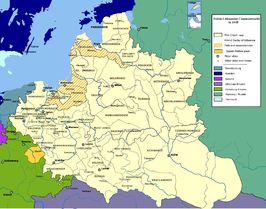
and Vandals
Vandals
The Vandals were an East Germanic tribe that entered the late Roman Empire during the 5th century. The Vandals under king Genseric entered Africa in 429 and by 439 established a kingdom which included the Roman Africa province, besides the islands of Sicily, Corsica, Sardinia and the Balearics....
.
Biography
His father Sigismund, grandson of Gustav I of SwedenGustav I of Sweden
Gustav I of Sweden, born Gustav Eriksson of the Vasa noble family and later known simply as Gustav Vasa , was King of Sweden from 1523 until his death....
, had in 1592 succeeded his own father to the Swedish throne, only to be deposed in 1599 by his uncle, Charles IX of Sweden
Charles IX of Sweden
Charles IX of Sweden also Carl, was King of Sweden from 1604 until his death. He was the youngest son of King Gustav I of Sweden and his second wife, Margaret Leijonhufvud, brother of Eric XIV and John III of Sweden, and uncle of Sigismund III Vasa king of both Sweden and Poland...
. This led to a long-standing feud wherein the Polish kings of the House of Vasa
House of Vasa
The House of Vasa was the Royal House of Sweden 1523-1654 and of Poland 1587-1668. It originated from a noble family in Uppland of which several members had high offices during the 15th century....
claimed the Swedish throne, resulting in the Polish–Swedish War
Polish–Swedish War (1600–1629)
The Polish–Swedish War was twice interrupted by periods of truce and thus can be divided into:* Polish–Swedish War * Polish–Swedish War...
of 1600–1629. Poland and Sweden were also on opposite sides in the Thirty Years' War
Thirty Years' War
The Thirty Years' War was fought primarily in what is now Germany, and at various points involved most countries in Europe. It was one of the most destructive conflicts in European history....
(1618–1648), although in that war Poland for the most part avoided taking part in any major military actions.
John Casimir for most of his life remained in the shadow of his brother, Władysław IV Waza. He had few friends among the Polish nobility (szlachta
Szlachta
The szlachta was a legally privileged noble class with origins in the Kingdom of Poland. It gained considerable institutional privileges during the 1333-1370 reign of Casimir the Great. In 1413, following a series of tentative personal unions between the Grand Duchy of Lithuania and the Kingdom of...
), as he openly sympathized with Austria and showed disregard and contempt for Polish culture
Sarmatism
"Sarmatism" is a term designating the dominant lifestyle, culture and ideology of the szlachta of the Polish-Lithuanian Commonwealth from the 16th to the 19th centuries. Together with "Golden Liberty," it formed a central aspect of the Commonwealth's culture...
. Unfriendly, secretive, dividing his time between lavish partying and religious contemplation, and disliking politics, he did not have a strong power base nor influence at the Polish court. He did display talent as a military commander, showing his abilities in the Smolensk War
Smolensk War
The Smolensk War was a conflict fought between the Polish-Lithuanian Commonwealth and Russia.Hostilities began in October 1632 when Tsar forces tried to recapture the city of Smolensk, a former Russian possession. Small military engagements produced mixed results for both sides, but the surrender...
against Muscovy (1633).
Between 1632 and 1635, Władysław IV sought to enhance his brother's influence by negotiating a marriage for John Casimir to Christina of Sweden
Christina of Sweden
Christina , later adopted the name Christina Alexandra, was Queen regnant of Swedes, Goths and Vandals, Grand Princess of Finland, and Duchess of Ingria, Estonia, Livonia and Karelia, from 1633 to 1654. She was the only surviving legitimate child of King Gustav II Adolph and his wife Maria Eleonora...
, then to an Italian princess, but to no avail. In 1637 John Casimir undertook a diplomatic mission
Diplomatic mission
A diplomatic mission is a group of people from one state or an international inter-governmental organisation present in another state to represent the sending state/organisation in the receiving state...
to Vienna
Vienna
Vienna is the capital and largest city of the Republic of Austria and one of the nine states of Austria. Vienna is Austria's primary city, with a population of about 1.723 million , and is by far the largest city in Austria, as well as its cultural, economic, and political centre...
, which he abandoned to join the army of the Holy Roman Empire
Holy Roman Empire
The Holy Roman Empire was a realm that existed from 962 to 1806 in Central Europe.It was ruled by the Holy Roman Emperor. Its character changed during the Middle Ages and the Early Modern period, when the power of the emperor gradually weakened in favour of the princes...
and fight against the French. After his regiment was defeated in battle, he spent a year living lavishly at the Viennese court.
In 1636 he returned to the Polish–Lithuanian Commonwealth and fell in love with Baroness Guldentern, but his desire to marry her was thwarted by King Władysław. In return, Władysław attempted to make him the sovereign of Courland
Courland
Courland is one of the historical and cultural regions of Latvia. The regions of Semigallia and Selonia are sometimes considered as part of Courland.- Geography and climate :...
, but this was vetoed by the Commonwealth parliament (Sejm
Sejm
The Sejm is the lower house of the Polish parliament. The Sejm is made up of 460 deputies, or Poseł in Polish . It is elected by universal ballot and is presided over by a speaker called the Marshal of the Sejm ....
). Taking offence at this, John Casimir in 1638 left for Spain to become Viceroy
Viceroy
A viceroy is a royal official who runs a country, colony, or province in the name of and as representative of the monarch. The term derives from the Latin prefix vice-, meaning "in the place of" and the French word roi, meaning king. A viceroy's province or larger territory is called a viceroyalty...
of Portugal, but was captured by French agents and imprisoned by order of Cardinal Richelieu until 1640. He was then freed by a diplomatic mission of the Voivod of Smolensk
Smolensk
Smolensk is a city and the administrative center of Smolensk Oblast, Russia, located on the Dnieper River. Situated west-southwest of Moscow, this walled city was destroyed several times throughout its long history since it was on the invasion routes of both Napoleon and Hitler. Today, Smolensk...
, Aleksander Gosiewski.
In 1641 John Casimir decided to become a Jesuit
Society of Jesus
The Society of Jesus is a Catholic male religious order that follows the teachings of the Catholic Church. The members are called Jesuits, and are also known colloquially as "God's Army" and as "The Company," these being references to founder Ignatius of Loyola's military background and a...
. In 1642 he again left the Polish–Lithuanian Commonwealth, accompanying his sister to Germany. In 1643 he joined the Jesuits, against vocal opposition from King Władysław, causing a diplomatic rift between the Commonwealth and the Pope. John Casimir was made a cardinal
Cardinal (Catholicism)
A cardinal is a senior ecclesiastical official, usually an ordained bishop, and ecclesiastical prince of the Catholic Church. They are collectively known as the College of Cardinals, which as a body elects a new pope. The duties of the cardinals include attending the meetings of the College and...
, but in December 1646, finding himself unsuited to ecclesiastical life, he returned to Poland. In October 1647 he resigned as cardinal to stand in elections for the Polish throne. He attempted to gain the support of the Habsburg
Habsburg
The House of Habsburg , also found as Hapsburg, and also known as House of Austria is one of the most important royal houses of Europe and is best known for being an origin of all of the formally elected Holy Roman Emperors between 1438 and 1740, as well as rulers of the Austrian Empire and...
s and marry an Austrian princess.
In 1648 John Casimir was elected to succeed his nephew-by-second-marriage on the Polish throne. The reign of the last of the Vasas in the Polish–Lithuanian Commonwealth would be dominated by the Russo-Polish War (1654–1667)
Russo-Polish War (1654–1667)
The Russo-Polish War of 1654–1667, also called Thirteen Years' War, First Northern War, War for Ukraine was the last major conflict between Tsardom of Russia and the Polish-Lithuanian Commonwealth. Between 1655 and 1660, the Second Northern War was also fought in the Polish-Lithuanian Commonwealth,...
, followed by the war with Sweden ("The Deluge
The Deluge (Polish history)
The term Deluge denotes a series of mid-17th century campaigns in the Polish–Lithuanian Commonwealth. In a wider sense it applies to the period between the Khmelnytsky Uprising of 1648 and the Truce of Andrusovo in 1667, thus comprising the Polish–Lithuanian theaters of the Russo-Polish and...
"), the scene for which had been set by the Commonwealth's two previous Vasa kings. Most of Poland was invaded by the Swedish army during the Deluge without much of a fight, due to the conspiratorial complicity of Polish and Lithuanian governors and nobility. In the course of a few years, the Commonwealth rose to force the Swedes out of Poland, ending the short-lived intrusions and campaigns.
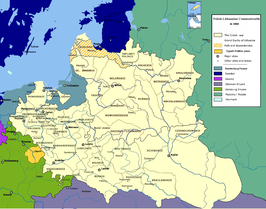
Livonia
Livonia is a historic region along the eastern shores of the Baltic Sea. It was once the land of the Finnic Livonians inhabiting the principal ancient Livonian County Metsepole with its center at Turaida...
and the city of Riga
Riga
Riga is the capital and largest city of Latvia. With 702,891 inhabitants Riga is the largest city of the Baltic states, one of the largest cities in Northern Europe and home to more than one third of Latvia's population. The city is an important seaport and a major industrial, commercial,...
.
John Casimir had married his brother's widow, Marie Louise Gonzaga , who was a major support to the King. Marie Louise died in 1667.
On 16 September 1668, John II Casimir abdicated the Polish–Lithuanian throne, and returned to France, where he joined the Jesuits and became abbot of Abbey of Saint-Germain-des-Prés
Abbey of Saint-Germain-des-Prés
The Benedictine Abbey of Saint-Germain-des-Prés, just beyond the outskirts of early medieval Paris, was the burial place of Merovingian kings of Neustria...
in Paris
Paris
Paris is the capital and largest city in France, situated on the river Seine, in northern France, at the heart of the Île-de-France region...
. He died in 1672.
Legacy
John Casimir left no surviving children. All his brothers and sisters having predeceased him without surviving issue, he was the last of the line of Bona SforzaBona Sforza
Bona Sforza was a member of the powerful Milanese House of Sforza. In 1518, she became the second wife of Sigismund I the Old, the King of Poland and Grand Duke of Lithuania, and became the Queen of Poland and Grand Duchess of Lithuania.She was the third child of Gian Galeazzo Sforza and his wife...
. With him, all the legitimate issue of Alfonso II of Naples
Alfonso II of Naples
Alfonso II of Naples , also called Alfonso II d'Aragon, was King of Naples from 25 January 1494 to 22 February 1495 with the title King of Naples and Jerusalem...
died out. His heir in Ferdinand I of Naples and in the Brienne
Brienne claim to the Kingdom of Jerusalem
Hugh, Count of Brienne claimed the regency of Jerusalem in 1264 as senior heir of Hugh I of Cyprus and Alice of Jerusalem, being the son of their eldest daughter, but was passed over by the Haute Cour in favor of his cousin Hugh III of Cyprus. This claim fell to his son Walter V of Brienne and...
succession was his distant cousin, Henry de La Tremoille, Prince of Talmond and Taranto, the heir-general of Frederick IV of Naples
Frederick IV of Naples
Frederick IV , sometimes known as Frederick I or Federico d'Aragona, was the last King of Naples of the House of Trastámara, ruling from 1496 to 1501...
(second son of Ferdinand I of Naples
Ferdinand I of Naples
Ferdinand I , also called Don Ferrante, was the King of Naples from 1458 to 1494. He was the natural son of Alfonso V of Aragon by Giraldona Carlino.-Biography:...
and Isabella of Taranto
Isabella of Taranto
Isabella of Taranto , born Isabella of Clermont, was a Princess of Taranto in her own right and first Queen consort of Ferdinand I of Naples.-Family:...
), who also was the heir-general of Federigo's first wife, Anne of Savoy
Anne of Savoy
Anne of Savoy, Princess of Squillace, Altamura, and Taranto was the first wife of King Frederick IV. She died 16 years before he succeeded to the Neopolitan throne, so she was never queen consort...
.
John Casimir was, after his brother, the head of the genealogical line of St.Bridget of Sweden, descending in primogeniture from Bridget's sister. After his death, the headship was inherited by his second cousin, the already-abdicated Christina I of Sweden.
Patron of arts
House of Vasa
The House of Vasa was the Royal House of Sweden 1523-1654 and of Poland 1587-1668. It originated from a noble family in Uppland of which several members had high offices during the 15th century....
was looted by Swedes and Germans of Brandenburg
Brandenburg
Brandenburg is one of the sixteen federal-states of Germany. It lies in the east of the country and is one of the new federal states that were re-created in 1990 upon the reunification of the former West Germany and East Germany. The capital is Potsdam...
who brutally sacked Warsaw
Warsaw
Warsaw is the capital and largest city of Poland. It is located on the Vistula River, roughly from the Baltic Sea and from the Carpathian Mountains. Its population in 2010 was estimated at 1,716,855 residents with a greater metropolitan area of 2,631,902 residents, making Warsaw the 10th most...
in 1650s, during the Deluge. Though some of works survived hidden in Opole
Opole
Opole is a city in southern Poland on the Oder River . It has a population of 125,992 and is the capital of the Upper Silesia, Opole Voivodeship and, also the seat of Opole County...
like The Rape of Europa
The Rape of Europa (Reni)
The Rape of Europa is a painting commissioned by Władysław IV Vasa from the Italian artist Guido Reni, completed between 1637 and 1639 and showing the abduction of Europa by Zeus in the form of a bull. It was later collected by Denis Mahon, who loaned it to the National Gallery, where it is still...
by Guido Reni
Guido Reni
Guido Reni was an Italian painter of high-Baroque style.-Biography:Born in Bologna into a family of musicians, Guido Reni was the son of Daniele Reni and Ginevra de’ Pozzi. As a child of nine, he was apprenticed under the Bolognese studio of Denis Calvaert. Soon after, he was joined in that...
.
The most important additions to the collection were made by John II Casimir a passionate collector of Dutch paintings, and a patron of Daniel Schultz (who painted famous portrait of a son of Crimea
Crimea
Crimea , or the Autonomous Republic of Crimea , is a sub-national unit, an autonomous republic, of Ukraine. It is located on the northern coast of the Black Sea, occupying a peninsula of the same name...
n Aga Dedesh, made Royal falconer
Falconry
Falconry is "the taking of wild quarry in its natural state and habitat by means of a trained raptor". There are two traditional terms used to describe a person involved in falconry: a falconer flies a falcon; an austringer flies a hawk or an eagle...
in reward for his father's contribution in war with Russia in 1663). Major part of king's painting collection was acquired in 1660s, using an agent in Amsterdam
Amsterdam
Amsterdam is the largest city and the capital of the Netherlands. The current position of Amsterdam as capital city of the Kingdom of the Netherlands is governed by the constitution of August 24, 1815 and its successors. Amsterdam has a population of 783,364 within city limits, an urban population...
, Hendrick van Uylenburgh
Hendrick van Uylenburgh
Hendrick van Uylenburgh was an influential Dutch Golden Age art dealer who helped launch the careers of Rembrandt, Govert Flinck, Ferdinand Bol and other painters....
and later his son Gerrit van Uylenburgh
Gerrit van Uylenburgh
Gerrit van Uylenburgh , or Gerrit Uylenburgh, was a Dutch Golden Age painter and art-dealer. He was the eldest son of Hendrick van Uylenburgh and took over the family art-dealing business after Hendrick's death and burial in the Westerkerk church in 1661...
, mainly Dutch paintings and works by Rembrandt. The collection also included works by Rubens, Jordaens, Reni
Guido Reni
Guido Reni was an Italian painter of high-Baroque style.-Biography:Born in Bologna into a family of musicians, Guido Reni was the son of Daniele Reni and Ginevra de’ Pozzi. As a child of nine, he was apprenticed under the Bolognese studio of Denis Calvaert. Soon after, he was joined in that...
, Guercino, Brueghel
Brueghel
Brueghel or Bruegel was the name of several Dutch/Flemish painters from the same family line:* Pieter Bruegel the Elder — The most famous member of the family and the only one to sign his paintings as 'Bruegel' without the H....
, Bassano
Jacopo Bassano
Jacopo Bassano , known also as Jacopo dal Ponte, was an Italian painter who was born and died in Bassano del Grappa near Venice, from which he adopted the name.- Life :...
among others.
When John Casimir abdicated the Polish–Lithuanian throne, he took to France large number of his paintings. The collection remaining at Royal Castle
Royal Castle, Warsaw
The Royal Castle in Warsaw is a castle residency and was the official residence of the Polish monarchs. It is located in the Castle Square, at the entrance to the Warsaw Old Town. The personal offices of the king and the administrative offices of the Royal Court of Poland were located there from...
in Warsaw
Warsaw
Warsaw is the capital and largest city of Poland. It is located on the Vistula River, roughly from the Baltic Sea and from the Carpathian Mountains. Its population in 2010 was estimated at 1,716,855 residents with a greater metropolitan area of 2,631,902 residents, making Warsaw the 10th most...
was looted during the Great Northern War
Great Northern War
The Great Northern War was a conflict in which a coalition led by the Tsardom of Russia successfully contested the supremacy of the Swedish Empire in northern Central Europe and Eastern Europe. The initial leaders of the anti-Swedish alliance were Peter I the Great of Russia, Frederick IV of...
or appropriated in 1720 by Frederick Augustus I
Augustus II the Strong
Frederick Augustus I or Augustus II the Strong was Elector of Saxony and King of Poland and Grand Duke of Lithuania ....
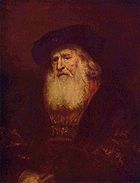
, Elector of Saxony, like two paintings by Rembrandt - Portrait of a Bearded Man in Black Beret (1657 also known as the Portrait of a Rabbi) and Portrait of a Man in the Hat Decorated with Pearls (1667), today displayed in the Gemäldegalerie Alte Meister
Gemäldegalerie Alte Meister
The Gemäldegalerie Alte Meister in Dresden features major works of art. It is located in the gallery wing of the Zwinger....
in Dresden
Dresden
Dresden is the capital city of the Free State of Saxony in Germany. It is situated in a valley on the River Elbe, near the Czech border. The Dresden conurbation is part of the Saxon Triangle metropolitan area....
, Germany.
Ancestors
See also
- History of Poland (1569-1795)
|-