

Pitch accent

Encyclopedia
Pitch accent is a linguistic
term of convenience for a variety of restricted tone
systems that use variations in pitch
to give prominence to a syllable
or mora
within a word. The placement of this tone or the way it is realized can give different meanings to otherwise similar words. The term has been used to describe certain Scandinavian and South Slavic
languages, Ancient Greek
, Vedic Sanskrit
, Japanese
, some dialects of Korean
, and Shanghainese
. Although it has been claimed that "pitch accent" is not a coherently defined term, it is commonly understood to refer to a language that uses phonemic tone, but where only one or two syllables in a word can be phonemically marked for tone, and many words are not marked for tone at all. In such languages, the syllable with phonemic tone typically is acoustically prominent, in a similar fashion to the dynamic stress
of languages such as English
or Spanish
.
Pitch-accented languages may have a more complex accentual system than stress-accented languages, in that in some cases they have more than a binary distinction, but are sometimes less complex than fully tonal languages such as Chinese
or Yoruba
, which may assign tone to an entire word without association to specific syllables, or which may assign a separate tone to each syllable. For example, Japanese allows short nouns (1-4 moras) to have tone on any one mora, but more frequently on none at all, so that in disyllabic words there are three-way minimal contrasts such as káki "oyster" vs. kakí "fence" vs. kaki "persimmon"); Ancient Greek
in contrast had obligatory tone on one of three final moras, so that if the tonic syllable had a long vowel or diphthong, it had either a rising or a falling tone. In addition, the mapping between phonemic and phonetic tone may be more involved than the simple one-to-one mapping between stress and dynamic intensity in stress-accented languages.
Proto-Indo-European accent
is usually reconstructed as a freeThe term free here refers to the position of the accent—its position was unpredictable by phonological rules
, i.e. it could stand on any syllable of a word, regardless of its structure. This is opposed to fixed or bounded accent whose position is determined by factors such as the syllable quantity and/or position, e.g. in Latin where it's on the penultimate syllable if it's "heavy", antepenultimate otherwise. pitch-accent system, "From the available comparative evidence, it is standardly agreed that Proto-Indo-European was a pitch-accent language. There are numerous indications that the accented syllable was higher in pitch than the surrounding syllables. Among the Indo-European
daughters, a pitch-accent system is found in Vedic Sanskrit, Ancient Greek, the Baltic languages and some South Slavic languages, although none of these preserves the original system intact." preserved in Ancient Greek
, Vedic
, and Proto-Balto-Slavic. The Greek and Indic systems were lost: Modern Greek
has a pitch produced stress accent, and it was lost entirely from Indic by the time of the Prākrits. Balto-Slavic retained Proto-Indo-European pitch accent, reworking it into the opposition of "acute" (rising) and "circumflex" (falling) tone, and which, following a period of extensive accentual innovations, yielded pitch-accent based system that has been retained in modern-day Lithuanian
and West South Slavic languages
(in some dialects). Some other modern Indo-European languages have pitch accent systems, like Swedish
and Norwegian
, deriving from a stress-based system they inherited from Old Norse
,Proto-Germanic had fixed accent on the first syllable of a phonetic word, a state of affairs preserved in oldest attested Germanic languages like Gothic
, Old English and Old Norse
. Free Proto-Indo-European accent was lost in Germanic rather late, after the operation of Verner's law
. and Punjabi
, which developed tone distinctions that maintained lexical distinctions as consonants were conflated.
or morae
in a word, or at least in simple words, the position of which determines the tonal pattern of the whole word.The term is often defined as tone on only one syllable or mora. However, in the Korean pitch-accent system, tone is allowed on two adjacent syllables in initial position, and this contrasts with tone on just one of these syllables. Pitch accent may also be restricted in distribution, being found for example only on one of the last two syllables. This is unlike the situation in typical tone languages, where the tone of each syllable is independent of the other syllables in the word. For example, comparing two-syllable words like [aba] in a pitch-accented language and in a tonal language, both of which make only a binary distinction, the tonal language has four possible patterns:
Tone:
The pitch-accent language, on the other hand, has only three possibilities:
Pitch accent:
The combination *[ábá] does not occur.
With longer words, the distinction becomes more apparent: eight distinct tonal trisyllables [ábábá, ábábà, ábàbá, àbábá, ábàbà, àbábà, àbàbá, àbàbà], vs. four distinct pitch-accented trisyllables [ábaba, abába, ababá, ababa].
in a stress-accent language, as is sometimes claimed for English, there must always be a primary stress as well; such languages do not contrast [ˈaba] with primary stress only from [ˌaba] with secondary stress only.) In addition, many lexical words may have no tonic syllable at all, whereas normally in stress-accent languages every lexical word must have a stressed syllable; also, whereas non-compound words may have more than one stress-accented syllable, as in English, multiple pitch-accent words are not normally found.
, such as methods of conveying surprise, changing a statement into a question, or expressing information flow
(topic–focus, contrasting), using variations in pitch. A great number of languages use pitch in this way, including English
as well as all other major European languages. They are often called intonation
languages.
The term "pitch accent" is also used in Native American linguistics to refer to minimal tonal systems such as are found in Iroquoian
and Athabaskan
languages, for example.
and grave accent
, they may also be referred to as accent 1 and accent 2 or tone 1 and tone 2. Hundreds of two-syllable word pairs are differentiated only by their use of either grave or acute accent. Accent 1 is, generally speaking, used for words whose second syllable is the definite article
, and for words that in Old Norse
were monosyllabic.
These are described as tonal word accents by Scandinavian linguists, because there is a set number of tone patterns for polysyllabic words (in this case, two) that is independent of the number of syllables in the word; in more prototypical pitch-accent languages, the number of possible tone patterns is not set but increases in proportion to the number of syllables.
For example in many East Norwegian
dialects, the word "" (farmers) is pronounced using tone 1, while "" (beans or prayers) uses tone 2. Though the difference in spelling occasionally allow the words to be distinguished in written language, in most cases the minimal pair
s are written alike. A Swedish example would be the word "tomten," which means "Santa Claus
" (or "the house gnome
") when pronounced using tone 2, and means "the plot of land," "the yard," or "the garden" when pronounced using tone 1. Thus, the sentence "Är det tomten på tomten?" ("Is that Santa Claus out in the yard?") uses both pronunciations right next to each other.
Although most dialects make this distinction, the actual realizations vary and are generally difficult for non-natives to distinguish. In some dialects of Swedish
, including those spoken in Finland, this distinction is absent. There are significant variations in the realization of pitch accent between dialects. Thus, in most of western and northern Norway (the so-called high-pitch dialects) accent 1 is falling, while accent 2 is rising in the first syllable and falling in the second syllable or somewhere around the syllable boundary.
The word accents give Norwegian and Swedish a "singing" quality which makes it fairly easy to distinguish them from other languages. In Danish
, the pitch accent of Swedish and Norwegian corresponds to the glottalization phenomenon known as Stød
.
: Luxembourgish, Limburgish, Ripuarian and Moselle Franconian
.
. Common Slavic accentual innovations significantly reworked the original system primarily with respect to the position of the ictus (Dybo's law
, Illič-Svityč's law
, Meillet's law
etc.), and further developments yielded some new accents—e.g. the so-called neoacute (Ivšić's law
), or the new rising tone in Neoštokavian idioms (the so-called "Neoštokavian retraction"). As opposed to other Slavic dialect subgroups, West South Slavic idioms have largely retained the Proto-Slavic system of free and mobile tonal accent (including the dialect used for basis of codification of modern standard Slovene, as well as Neoštokavian used for the basis of standard varieties of Serbo-Croatian
: Bosnian
, Croatian
and Serbian
), though the discrepancy between codified norm and actually spoken speech may significantly vary.For example the accentual systems of the spoken idioms of the Croatian capital Zagreb
and the city of Rijeka
are stress-based and do not make use of distinctive vowel lengths or pitch accent.
itself but in Proto-Balto-Slavic have become much more widespread). Different inflected forms of the same lexeme can exhibit all four accents: lònac 'pot' (nominative sg.), lónca (genitive sg.), lȏnci (nominative pl.), lȍnācā (genitive pl.).
Restrictions on the distribution of the accent depend, beside the position of the syllable, also on its quality, as not every kind of accent can be manifested in every syllable.
Thus, monosyllabics generally have falling tone, whilst polysyllabics generally have falling or rising tone on the first syllable, and rising in all the other syllables but the last one. The tonal opposition rising ~ falling is hence generally only possible in the first accented syllable of polysyllabic words, while the opposition by lengths, long ~ short, is possible even in the non-accented syllable as well as in the post-accented syllable (but not in the pre-accented position).
Proclitics (clitics which latch on to a following word), on the other hand, may "steal" a falling tone (but not a rising tone) from the following mono- or disyllabic word. This stolen accent is always short, and may end up being either falling or rising on the proclitic. This phenomenon (accent shift to proclitic) is most frequent in the spoken idioms of Bosnia, in Serbian it is more limited (normally, with negation proclitic ne), and is almost absent from Croatian Neoštokavian idioms. Short rising accent resists such shift better than the falling one (as seen in the example /ʒěliːm/→/ne‿ʒěliːm/)
Older accentual system, as it was said, is tonal by quality and free (jágoda 'strawberry', malína 'raspberry', gospodár 'master, lord'). There are three kinds of accents: short falling , long falling and long rising . Non-final syllables always have long accents ( or ), e.g. rakîta 'crustacea', tetíva 'sinew'. Short falling accent can come only in the ultimate (or the only, as is the case in monosyllabics) syllable, e.g. bràt 'brother'. It is only there that three-way opposition among accents is present: deskà 'board' : 'goods, ware' : gospá 'lady'. Accent can be mobile throughout the inflectional paradigm: dȃr — darȗ, góra — gorẹ́ — goràm, bràt — bráta — o brȃtu, kráva — krȃv, vóda — vodọ̑ — na vọ̑do). The distinction is made between open -e- and -o- (either long or short) and closed -ẹ- and -ọ- (always long).
is often described as having pitch accent; this differs significantly between dialects. In standard (Tokyo-dialect) Japanese, this "accent" may be characterized as a downstep
rather than as pitch accent. The pitch of a word rises until it reaches a downstep, then drops abruptly. In a two-syllable word, this results in a contrast between high–low and low–high; accentless words are also low–high, but the pitch of following enclitics differentiates them.
uses pitch only for prosodic
purposes. However, several dialects outside Seoul retain a Middle Korean pitch accent system. In the dialect of North Gyeongsang
, in southeastern South Korea, any one syllable may have pitch accent in the form of a high tone, as may the initial two syllables. For example, in trisyllabic words, there are four possible tone patterns:
of Wu Chinese is marginally tonal, with characteristics of pitch accent.
Not counting closed syllables (those with a final glottal stop
), a Shanghainese word of one syllable may carry one of three tones, high, mid, low. (These tones have a contour in isolation, but for our purposes that can be ignored.) However, low always occurs after voiced consonants, and only there. Thus the only tonal distinction is after voiceless consonants and in vowel-initial syllables, and then there is only a two-way distinction between high and mid. In a polysyllabic word, the tone of the first syllable determines the tone of the entire word. If the first tone is high, following syllables are mid; if mid or low, the second syllable is high, and any following syllables are mid. Thus a mark for high tone is all that is needed to write tone in Shanghainese:
-metrical
theory for local intonational
features that are associated with particular syllables. Within this framework, pitch accents are distinguished from both the abstract metrical stress
and the acoustic stress
of a syllable. Different languages specify different relationships between pitch accent and stress placement.
{| class="wikitable"
|-
!
! Stress
! No Stress
|-
| Lexical
| Swedish
| Japanese
|-
| Post-lexical
| English
| Bengali
|}
Languages that use lexical pitch accents are described as pitch accent languages, in contrast to tone/tonal languages
like Mandarin Chinese and Yoruba. Pitch accent languages differ from tone languages in that pitch accents are only assigned to one syllable in a word, whereas tones can be assigned to multiple syllables in a word.
system,
pitch accents consist of a high (H) or low (L) pitch target or a combination of H and L targets. H and L indicate relative highs and lows in the intonation contour, and their actual phonetic realization is conditioned by a number of factors, such as pitch range and preceding pitch accents in the phrase. In languages in which pitch accents are associated with stressed syllables, one target within each pitch accent may be designated with a *, indicating that this target is aligned with the stressed syllable. For example, in the L*+H pitch accent the L target is aligned with the stressed syllable, and it is followed by a trailing H target.
This model of pitch accent structure differs from that of the British School, which described pitch accents in terms of 'configurations' like rising or falling tones. It also differs from the American Structuralists'
system, in which pitch accents were made up of some combination of low, mid, high, and overhigh tones. Evidence favoring the two-level system over other systems includes data from African tone languages and Swedish. One-syllable words in Efik (an African tone language) can have high, low, or rising tones, which would lead us to expect nine possible tone combinations for two-syllable words. However, we only find H-H, L-L, and L-H tone combinations in two-syllable words. This finding makes sense if we consider the rising tone to consist of an L tone followed by an H tone, making it possible to describe one- and two-syllable words using the same set of tones. Bruce also found that alignment of the peak of a Swedish pitch accent, rather than the alignment of a rise or fall, reliably distinguished between the two pitch accent types in Swedish. Systems with several target levels often over-predict the number of possible combinations of pitch targets.
-metrical
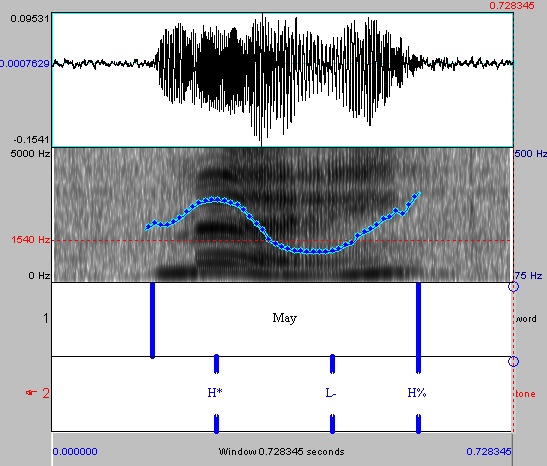
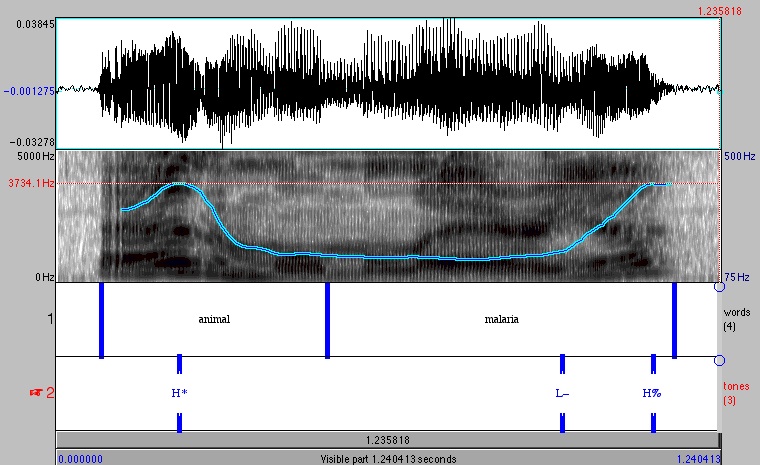
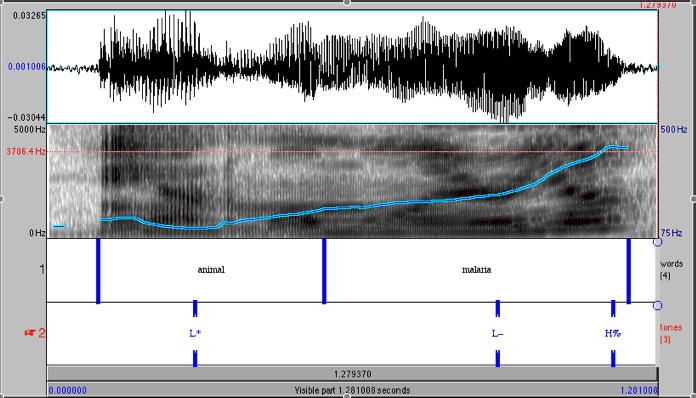
theory, pitch accents are combined with edge tones, which mark the beginnings and/or ends of prosodic phrases, to determine the intonational contour of a phrase. The need for pitch accents to be distinguished from edge tones can be seen in contours (1) and (2) in which the same intonational events - an H* pitch accent followed by an L- phrase accent and a H% boundary tone - are applied to phrases of different lengths. Note that in both cases, the pitch accent remains linked to the stressed syllable and the edge tone remains at the end of the phrase. Just as the same contour can apply to different phrases (e.g. (1) and (2)), different contours can apply to the same phrase, as in (2) and (3). In (3) the H* pitch accent is replaced with an L* pitch accent.
(1)
(2)
(3)
prosodic transcription system are: H*, L*, L*+H, L+H*, and H+!H*.
Most theories of prosodic meaning in English claim that pitch accent placement is tied to the focus, or most important part, of the phrase. Some theories of prosodic marking of focus are only concerned with nuclear pitch accents.
Linguistics
Linguistics is the scientific study of human language. Linguistics can be broadly broken into three categories or subfields of study: language form, language meaning, and language in context....
term of convenience for a variety of restricted tone
Tone (linguistics)
Tone is the use of pitch in language to distinguish lexical or grammatical meaning—that is, to distinguish or inflect words. All verbal languages use pitch to express emotional and other paralinguistic information, and to convey emphasis, contrast, and other such features in what is called...
systems that use variations in pitch
Pitch (music)
Pitch is an auditory perceptual property that allows the ordering of sounds on a frequency-related scale.Pitches are compared as "higher" and "lower" in the sense associated with musical melodies,...
to give prominence to a syllable
Syllable
A syllable is a unit of organization for a sequence of speech sounds. For example, the word water is composed of two syllables: wa and ter. A syllable is typically made up of a syllable nucleus with optional initial and final margins .Syllables are often considered the phonological "building...
or mora
Mora (linguistics)
Mora is a unit in phonology that determines syllable weight, which in some languages determines stress or timing. As with many technical linguistic terms, the definition of a mora varies. Perhaps the most succinct working definition was provided by the American linguist James D...
within a word. The placement of this tone or the way it is realized can give different meanings to otherwise similar words. The term has been used to describe certain Scandinavian and South Slavic
South Slavic languages
The South Slavic languages comprise one of three branches of the Slavic languages. There are approximately 30 million speakers, mainly in the Balkans. These are separated geographically from speakers of the other two Slavic branches by a belt of German, Hungarian and Romanian speakers...
languages, Ancient Greek
Ancient Greek
Ancient Greek is the stage of the Greek language in the periods spanning the times c. 9th–6th centuries BC, , c. 5th–4th centuries BC , and the c. 3rd century BC – 6th century AD of ancient Greece and the ancient world; being predated in the 2nd millennium BC by Mycenaean Greek...
, Vedic Sanskrit
Vedic Sanskrit
Vedic Sanskrit is an old Indo-Aryan language. It is an archaic form of Sanskrit, an early descendant of Proto-Indo-Iranian. It is closely related to Avestan, the oldest preserved Iranian language...
, Japanese
Japanese language
is a language spoken by over 130 million people in Japan and in Japanese emigrant communities. It is a member of the Japonic language family, which has a number of proposed relationships with other languages, none of which has gained wide acceptance among historical linguists .Japanese is an...
, some dialects of Korean
Korean language
Korean is the official language of the country Korea, in both South and North. It is also one of the two official languages in the Yanbian Korean Autonomous Prefecture in People's Republic of China. There are about 78 million Korean speakers worldwide. In the 15th century, a national writing...
, and Shanghainese
Shanghainese
Shanghainese , or the Shanghai language , is a dialect of Wu Chinese spoken in the city of Shanghai and the surrounding region. It is classified as part of the Sino-Tibetan family of languages. Shanghainese, like other Wu dialects, is largely not mutually intelligible with other Chinese varieties...
. Although it has been claimed that "pitch accent" is not a coherently defined term, it is commonly understood to refer to a language that uses phonemic tone, but where only one or two syllables in a word can be phonemically marked for tone, and many words are not marked for tone at all. In such languages, the syllable with phonemic tone typically is acoustically prominent, in a similar fashion to the dynamic stress
Stress (linguistics)
In linguistics, stress is the relative emphasis that may be given to certain syllables in a word, or to certain words in a phrase or sentence. The term is also used for similar patterns of phonetic prominence inside syllables. The word accent is sometimes also used with this sense.The stress placed...
of languages such as English
English phonology
English phonology is the study of the sound system of the English language. Like many languages, English has wide variation in pronunciation, both historically and from dialect to dialect...
or Spanish
Spanish phonology
This article is about the phonology and phonetics of the Spanish language. Unless otherwise noted, statements refer to Castilian Spanish, the standard dialect used in Spain on radio and television. For historical development of the sound system see History of Spanish...
.
Pitch-accented languages may have a more complex accentual system than stress-accented languages, in that in some cases they have more than a binary distinction, but are sometimes less complex than fully tonal languages such as Chinese
Chinese language
The Chinese language is a language or language family consisting of varieties which are mutually intelligible to varying degrees. Originally the indigenous languages spoken by the Han Chinese in China, it forms one of the branches of Sino-Tibetan family of languages...
or Yoruba
Yoruba language
Yorùbá is a Niger–Congo language spoken in West Africa by approximately 20 million speakers. The native tongue of the Yoruba people, it is spoken, among other languages, in Nigeria, Benin, and Togo and in communities in other parts of Africa, Europe and the Americas...
, which may assign tone to an entire word without association to specific syllables, or which may assign a separate tone to each syllable. For example, Japanese allows short nouns (1-4 moras) to have tone on any one mora, but more frequently on none at all, so that in disyllabic words there are three-way minimal contrasts such as káki "oyster" vs. kakí "fence" vs. kaki "persimmon"); Ancient Greek
Ancient Greek
Ancient Greek is the stage of the Greek language in the periods spanning the times c. 9th–6th centuries BC, , c. 5th–4th centuries BC , and the c. 3rd century BC – 6th century AD of ancient Greece and the ancient world; being predated in the 2nd millennium BC by Mycenaean Greek...
in contrast had obligatory tone on one of three final moras, so that if the tonic syllable had a long vowel or diphthong, it had either a rising or a falling tone. In addition, the mapping between phonemic and phonetic tone may be more involved than the simple one-to-one mapping between stress and dynamic intensity in stress-accented languages.
Proto-Indo-European accent
Proto-Indo-European accent
Proto-Indo-European accent refers to the accentual system of Proto-Indo-European language.-Description:Proto-Indo-European is reconstructed to have a pitch accent system that is usually described as a free tonal accent...
is usually reconstructed as a freeThe term free here refers to the position of the accent—its position was unpredictable by phonological rules
Proto-Indo-European phonology
The phonology of the Proto-Indo-European language has been reconstructed by linguists, based on the similarities and differences among current and extinct Indo-European languages...
, i.e. it could stand on any syllable of a word, regardless of its structure. This is opposed to fixed or bounded accent whose position is determined by factors such as the syllable quantity and/or position, e.g. in Latin where it's on the penultimate syllable if it's "heavy", antepenultimate otherwise. pitch-accent system, "From the available comparative evidence, it is standardly agreed that Proto-Indo-European was a pitch-accent language. There are numerous indications that the accented syllable was higher in pitch than the surrounding syllables. Among the Indo-European
Indo-European languages
The Indo-European languages are a family of several hundred related languages and dialects, including most major current languages of Europe, the Iranian plateau, and South Asia and also historically predominant in Anatolia...
daughters, a pitch-accent system is found in Vedic Sanskrit, Ancient Greek, the Baltic languages and some South Slavic languages, although none of these preserves the original system intact." preserved in Ancient Greek
Ancient Greek
Ancient Greek is the stage of the Greek language in the periods spanning the times c. 9th–6th centuries BC, , c. 5th–4th centuries BC , and the c. 3rd century BC – 6th century AD of ancient Greece and the ancient world; being predated in the 2nd millennium BC by Mycenaean Greek...
, Vedic
Vedic accent
The tone accent of Vedic Sanskrit, or Vedic accent for brevity, is traditionally divided by Sanskrit grammarians into three qualities, udātta "raised" , anudātta "not raised" and svarita "sounded" .-The accents:Udātta marks the place of the inherited PIE accent...
, and Proto-Balto-Slavic. The Greek and Indic systems were lost: Modern Greek
Modern Greek
Modern Greek refers to the varieties of the Greek language spoken in the modern era. The beginning of the "modern" period of the language is often symbolically assigned to the fall of the Byzantine Empire in 1453, even though that date marks no clear linguistic boundary and many characteristic...
has a pitch produced stress accent, and it was lost entirely from Indic by the time of the Prākrits. Balto-Slavic retained Proto-Indo-European pitch accent, reworking it into the opposition of "acute" (rising) and "circumflex" (falling) tone, and which, following a period of extensive accentual innovations, yielded pitch-accent based system that has been retained in modern-day Lithuanian
Lithuanian language
Lithuanian is the official state language of Lithuania and is recognized as one of the official languages of the European Union. There are about 2.96 million native Lithuanian speakers in Lithuania and about 170,000 abroad. Lithuanian is a Baltic language, closely related to Latvian, although they...
and West South Slavic languages
South Slavic languages
The South Slavic languages comprise one of three branches of the Slavic languages. There are approximately 30 million speakers, mainly in the Balkans. These are separated geographically from speakers of the other two Slavic branches by a belt of German, Hungarian and Romanian speakers...
(in some dialects). Some other modern Indo-European languages have pitch accent systems, like Swedish
Swedish language
Swedish is a North Germanic language, spoken by approximately 10 million people, predominantly in Sweden and parts of Finland, especially along its coast and on the Åland islands. It is largely mutually intelligible with Norwegian and Danish...
and Norwegian
Norwegian language
Norwegian is a North Germanic language spoken primarily in Norway, where it is the official language. Together with Swedish and Danish, Norwegian forms a continuum of more or less mutually intelligible local and regional variants .These Scandinavian languages together with the Faroese language...
, deriving from a stress-based system they inherited from Old Norse
Old Norse
Old Norse is a North Germanic language that was spoken by inhabitants of Scandinavia and inhabitants of their overseas settlements during the Viking Age, until about 1300....
,Proto-Germanic had fixed accent on the first syllable of a phonetic word, a state of affairs preserved in oldest attested Germanic languages like Gothic
Gothic language
Gothic is an extinct Germanic language that was spoken by the Goths. It is known primarily from the Codex Argenteus, a 6th-century copy of a 4th-century Bible translation, and is the only East Germanic language with a sizable Text corpus...
, Old English and Old Norse
Old Norse
Old Norse is a North Germanic language that was spoken by inhabitants of Scandinavia and inhabitants of their overseas settlements during the Viking Age, until about 1300....
. Free Proto-Indo-European accent was lost in Germanic rather late, after the operation of Verner's law
Verner's law
Verner's law, stated by Karl Verner in 1875, describes a historical sound change in the Proto-Germanic language whereby voiceless fricatives *f, *þ, *s, *h, *hʷ, when immediately following an unstressed syllable in the same word, underwent voicing and became respectively the fricatives *b, *d, *z,...
. and Punjabi
Punjabi language
Punjabi is an Indo-Aryan language spoken by inhabitants of the historical Punjab region . For Sikhs, the Punjabi language stands as the official language in which all ceremonies take place. In Pakistan, Punjabi is the most widely spoken language...
, which developed tone distinctions that maintained lexical distinctions as consonants were conflated.
Tone
Firstly, while the primary indication of accent is pitch (tone), there is only one or a few tonic syllablesSyllable
A syllable is a unit of organization for a sequence of speech sounds. For example, the word water is composed of two syllables: wa and ter. A syllable is typically made up of a syllable nucleus with optional initial and final margins .Syllables are often considered the phonological "building...
or morae
Mora (linguistics)
Mora is a unit in phonology that determines syllable weight, which in some languages determines stress or timing. As with many technical linguistic terms, the definition of a mora varies. Perhaps the most succinct working definition was provided by the American linguist James D...
in a word, or at least in simple words, the position of which determines the tonal pattern of the whole word.The term is often defined as tone on only one syllable or mora. However, in the Korean pitch-accent system, tone is allowed on two adjacent syllables in initial position, and this contrasts with tone on just one of these syllables. Pitch accent may also be restricted in distribution, being found for example only on one of the last two syllables. This is unlike the situation in typical tone languages, where the tone of each syllable is independent of the other syllables in the word. For example, comparing two-syllable words like [aba] in a pitch-accented language and in a tonal language, both of which make only a binary distinction, the tonal language has four possible patterns:
Tone:
- low-low [àbà],
- high-high [ábá],
- high-low [ábà],
- low-high [àbá].
The pitch-accent language, on the other hand, has only three possibilities:
Pitch accent:
- accented on the first syllable, [ába],
- accented on the second syllable, [abá], or
- no accent [aba].
The combination *[ábá] does not occur.
With longer words, the distinction becomes more apparent: eight distinct tonal trisyllables [ábábá, ábábà, ábàbá, àbábá, ábàbà, àbábà, àbàbá, àbàbà], vs. four distinct pitch-accented trisyllables [ábaba, abába, ababá, ababa].
Stress
Secondly, there may be more than one pitch possible for the tonic syllable. For example, for some languages the pitch may be either high or low. That is, if the stress is on the first syllable, it may be either [ába] or [àba] (or [ábaba] and [àbaba]). In stress-accent systems, on the other hand, there is no such variation: accented syllables are simply louder. (If there is secondary stressSecondary stress
Secondary stress is the weaker of two degrees of stress in the pronunciation of a word; the stronger degree of stress is called 'primary'. The International Phonetic Alphabet symbol for secondary stress is a short vertical line preceding and at the foot of the stressed syllable: the nun in ...
in a stress-accent language, as is sometimes claimed for English, there must always be a primary stress as well; such languages do not contrast [ˈaba] with primary stress only from [ˌaba] with secondary stress only.) In addition, many lexical words may have no tonic syllable at all, whereas normally in stress-accent languages every lexical word must have a stressed syllable; also, whereas non-compound words may have more than one stress-accented syllable, as in English, multiple pitch-accent words are not normally found.
Other usage
In a wider and less common sense of the term, "pitch accent" is sometimes also used to describe intonationIntonation (linguistics)
In linguistics, intonation is variation of pitch while speaking which is not used to distinguish words. It contrasts with tone, in which pitch variation does distinguish words. Intonation, rhythm, and stress are the three main elements of linguistic prosody...
, such as methods of conveying surprise, changing a statement into a question, or expressing information flow
Information flow
In discourse-based grammatical theory, information flow is any tracking of referential information by speakers. Information may be new, just introduced into the conversation; given, already active in the speakers' consciousness; or old, no longer active...
(topic–focus, contrasting), using variations in pitch. A great number of languages use pitch in this way, including English
English language
English is a West Germanic language that arose in the Anglo-Saxon kingdoms of England and spread into what was to become south-east Scotland under the influence of the Anglian medieval kingdom of Northumbria...
as well as all other major European languages. They are often called intonation
Intonation (linguistics)
In linguistics, intonation is variation of pitch while speaking which is not used to distinguish words. It contrasts with tone, in which pitch variation does distinguish words. Intonation, rhythm, and stress are the three main elements of linguistic prosody...
languages.
The term "pitch accent" is also used in Native American linguistics to refer to minimal tonal systems such as are found in Iroquoian
Iroquoian languages
The Iroquoian languages are a First Nation and Native American language family.-Family division:*Ruttenber, Edward Manning. 1992 [1872]. History of the Indian tribes of Hudson's River. Hope Farm Press....
and Athabaskan
Athabaskan languages
Athabaskan or Athabascan is a large group of indigenous peoples of North America, located in two main Southern and Northern groups in western North America, and of their language family...
languages, for example.
Norwegian and Swedish
Most dialects differentiate between two kinds of accents. Often referred to as acuteAcute accent
The acute accent is a diacritic used in many modern written languages with alphabets based on the Latin, Cyrillic, and Greek scripts.-Apex:An early precursor of the acute accent was the apex, used in Latin inscriptions to mark long vowels.-Greek:...
and grave accent
Grave accent
The grave accent is a diacritical mark used in written Breton, Catalan, Corsican, Dutch, French, Greek , Italian, Mohawk, Norwegian, Occitan, Portuguese, Scottish Gaelic, Vietnamese, Welsh, Romansh, and other languages.-Greek:The grave accent was first used in the polytonic orthography of Ancient...
, they may also be referred to as accent 1 and accent 2 or tone 1 and tone 2. Hundreds of two-syllable word pairs are differentiated only by their use of either grave or acute accent. Accent 1 is, generally speaking, used for words whose second syllable is the definite article
Definite Article
Definite Article is the title of British comedian Eddie Izzard's 1996 performance released on VHS. It was recorded on different nights at the Shaftesbury Theatre...
, and for words that in Old Norse
Old Norse
Old Norse is a North Germanic language that was spoken by inhabitants of Scandinavia and inhabitants of their overseas settlements during the Viking Age, until about 1300....
were monosyllabic.
These are described as tonal word accents by Scandinavian linguists, because there is a set number of tone patterns for polysyllabic words (in this case, two) that is independent of the number of syllables in the word; in more prototypical pitch-accent languages, the number of possible tone patterns is not set but increases in proportion to the number of syllables.
For example in many East Norwegian
Norwegian language
Norwegian is a North Germanic language spoken primarily in Norway, where it is the official language. Together with Swedish and Danish, Norwegian forms a continuum of more or less mutually intelligible local and regional variants .These Scandinavian languages together with the Faroese language...
dialects, the word "" (farmers) is pronounced using tone 1, while "" (beans or prayers) uses tone 2. Though the difference in spelling occasionally allow the words to be distinguished in written language, in most cases the minimal pair
Minimal pair
In phonology, minimal pairs are pairs of words or phrases in a particular language, which differ in only one phonological element, such as a phone, phoneme, toneme or chroneme and have distinct meanings...
s are written alike. A Swedish example would be the word "tomten," which means "Santa Claus
Santa Claus
Santa Claus is a folklore figure in various cultures who distributes gifts to children, normally on Christmas Eve. Each name is a variation of Saint Nicholas, but refers to Santa Claus...
" (or "the house gnome
Tomte
A tomte , nisse or tonttu is a mythical creature of Scandinavian folklore. The tomte or nisse was believed to take care of a farmer's home and children and protect them from misfortune, in particular at night, when the housefolk were asleep...
") when pronounced using tone 2, and means "the plot of land," "the yard," or "the garden" when pronounced using tone 1. Thus, the sentence "Är det tomten på tomten?" ("Is that Santa Claus out in the yard?") uses both pronunciations right next to each other.
Although most dialects make this distinction, the actual realizations vary and are generally difficult for non-natives to distinguish. In some dialects of Swedish
Swedish language
Swedish is a North Germanic language, spoken by approximately 10 million people, predominantly in Sweden and parts of Finland, especially along its coast and on the Åland islands. It is largely mutually intelligible with Norwegian and Danish...
, including those spoken in Finland, this distinction is absent. There are significant variations in the realization of pitch accent between dialects. Thus, in most of western and northern Norway (the so-called high-pitch dialects) accent 1 is falling, while accent 2 is rising in the first syllable and falling in the second syllable or somewhere around the syllable boundary.
The word accents give Norwegian and Swedish a "singing" quality which makes it fairly easy to distinguish them from other languages. In Danish
Danish language
Danish is a North Germanic language spoken by around six million people, principally in the country of Denmark. It is also spoken by 50,000 Germans of Danish ethnicity in the northern parts of Schleswig-Holstein, Germany, where it holds the status of minority language...
, the pitch accent of Swedish and Norwegian corresponds to the glottalization phenomenon known as Stød
Stød
Stød is a suprasegmental unit of Danish phonology, which in its most common form is a kind of creaky voice , but may also be realized as a glottal stop, above all in emphatic pronunciation...
.
Franconian languages
A pitch accent is found in the following Franconian languagesFranconian languages
Franconian refers to a West Germanic dialect continuum spoken in the Rhineland, including Dutch at one end and all the transitional dialects between Dutch and standard German which do not fully participate in the High German consonant shift or German diphthongization of long vowels...
: Luxembourgish, Limburgish, Ripuarian and Moselle Franconian
Moselle Franconian
Moselle Franconian is a group of West Central German dialects, part of the Central Franconian language area.It is spoken in the southern Rhineland and along the course of the Moselle River, from the Siegerland in the German state of North Rhine-Westphalia throughout western Rhineland-Palatinate and...
.
Welsh and Welsh English
Welsh has a simple pitch accent but this does not affect meaning because it is always on the same syllable. It does however make it easier to differentiate words in rapid speech. The stress accent is normally on the last or penultimate syllable in Welsh, but the pitch accent is always placed on the last syllable of a word as a high pitch. The rising pitch of the last syllable is also a distinctive feature of Welsh accents in English.West South Slavic languages
Late Proto-Slavic accentual system was based on the fundamental opposition of short/long circumflex (falling) tone, and the acute (rising) tone, position of the ictus being free as is the state of affairs inherited from Proto-Balto-SlavicProto-Balto-Slavic language
Proto-Balto-Slavic is reconstructed proto-language descending from Proto-Indo-European and out of which all later Balto-Slavic languages and dialects descended, such as modern Latvian, Lithuanian, Polish and Russian.The Proto-Balto-Slavic language is not directly attested by any surviving texts...
. Common Slavic accentual innovations significantly reworked the original system primarily with respect to the position of the ictus (Dybo's law
Dybo's law
Dybo's law, or Dybo-Illič-Svityč's law, is a Common Slavic accent law named after Russian accentologists Vladimir Dybo and Vladislav Illich-Svitych....
, Illič-Svityč's law
Illic-Svityc's law
In linguistics, Illič-Svityč's law refers to two Proto-Slavic rules, named after Russian Slavist Vladislav Illich-Svitych who first identified and explained them....
, Meillet's law
Meillet's law
Meillet's law is a Common Slavic accent law, named after the French Indo-Europeanist Antoine Meillet, who discovered it.According to the law, Slavic words have a circumflex on the root vowel with a Balto-Slavic acute if that word had a mobile accent paradigm in Proto-Slavic and Proto-Balto-Slavic...
etc.), and further developments yielded some new accents—e.g. the so-called neoacute (Ivšić's law
Ivšic's law
Ivšić's law is a Common Slavic accent law named after Croatian accentologist Stjepan Ivšić.According to the law, the accent was retracted from the word-final yers onto the preceding syllable. That syllable gained rising accent . Compare:...
), or the new rising tone in Neoštokavian idioms (the so-called "Neoštokavian retraction"). As opposed to other Slavic dialect subgroups, West South Slavic idioms have largely retained the Proto-Slavic system of free and mobile tonal accent (including the dialect used for basis of codification of modern standard Slovene, as well as Neoštokavian used for the basis of standard varieties of Serbo-Croatian
Serbo-Croatian language
Serbo-Croatian or Serbo-Croat, less commonly Bosnian/Croatian/Serbian , is a South Slavic language with multiple standards and the primary language of Serbia, Croatia, Bosnia and Herzegovina, and Montenegro...
: Bosnian
Bosnian language
Bosnian is a South Slavic language, spoken by Bosniaks. As a standardized form of the Shtokavian dialect, it is one of the three official languages of Bosnia and Herzegovina....
, Croatian
Croatian language
Croatian is the collective name for the standard language and dialects spoken by Croats, principally in Croatia, Bosnia and Herzegovina, the Serbian province of Vojvodina and other neighbouring countries...
and Serbian
Serbian language
Serbian is a form of Serbo-Croatian, a South Slavic language, spoken by Serbs in Serbia, Bosnia and Herzegovina, Montenegro, Croatia and neighbouring countries....
), though the discrepancy between codified norm and actually spoken speech may significantly vary.For example the accentual systems of the spoken idioms of the Croatian capital Zagreb
Zagreb
Zagreb is the capital and the largest city of the Republic of Croatia. It is in the northwest of the country, along the Sava river, at the southern slopes of the Medvednica mountain. Zagreb lies at an elevation of approximately above sea level. According to the last official census, Zagreb's city...
and the city of Rijeka
Rijeka
Rijeka is the principal seaport and the third largest city in Croatia . It is located on Kvarner Bay, an inlet of the Adriatic Sea and has a population of 128,735 inhabitants...
are stress-based and do not make use of distinctive vowel lengths or pitch accent.
Serbo-Croatian
Neoštokavian idiom used for the basis of standard Bosnian, Croatian and Serbian distinguishes four types of pitch accents: short falling , short rising , long falling and long rising . The accent is said to be relatively free as it can be manifested in any syllable but the last one. The long accents are realized by pitch change within the long vowel; the short ones are realized by the pitch difference from the subsequent syllable. Accent alternations are very frequent in inflectional paradigms, both by quality and placement in the word (the so-called "mobile paradigms", which were present in the PIEProto-Indo-European language
The Proto-Indo-European language is the reconstructed common ancestor of the Indo-European languages, spoken by the Proto-Indo-Europeans...
itself but in Proto-Balto-Slavic have become much more widespread). Different inflected forms of the same lexeme can exhibit all four accents: lònac 'pot' (nominative sg.), lónca (genitive sg.), lȏnci (nominative pl.), lȍnācā (genitive pl.).
Restrictions on the distribution of the accent depend, beside the position of the syllable, also on its quality, as not every kind of accent can be manifested in every syllable.
- Falling tone generally occurs in monosyllabic words or the first syllable of a word (pȃs 'belt', rȏg 'horn'; bȁba 'old woman', lȃđa 'river ship'; kȕćica 'small house', KȃrlovacKarlovacKarlovac is a city and municipality in central Croatia. The city proper has a population of 49,082, while the municipality has a population of 59,395 inhabitants .Karlovac is the administrative centre of Karlovac County...
). The only exception to this rule are the interjections, i.e. words uttered in the state of excitement (ahȁ, ohȏ) - Rising tone generally occurs in every syllable of a word except the ultimate and never in monosyllabics (vòda 'water', lúka 'harbour'; lìvada 'meadow', lúpānje 'slam'; siròta 'female orphan', počétak 'beginning'; crvotòčina 'wormhole', oslobođénje 'liberation').
Thus, monosyllabics generally have falling tone, whilst polysyllabics generally have falling or rising tone on the first syllable, and rising in all the other syllables but the last one. The tonal opposition rising ~ falling is hence generally only possible in the first accented syllable of polysyllabic words, while the opposition by lengths, long ~ short, is possible even in the non-accented syllable as well as in the post-accented syllable (but not in the pre-accented position).
Proclitics (clitics which latch on to a following word), on the other hand, may "steal" a falling tone (but not a rising tone) from the following mono- or disyllabic word. This stolen accent is always short, and may end up being either falling or rising on the proclitic. This phenomenon (accent shift to proclitic) is most frequent in the spoken idioms of Bosnia, in Serbian it is more limited (normally, with negation proclitic ne), and is almost absent from Croatian Neoštokavian idioms. Short rising accent resists such shift better than the falling one (as seen in the example /ʒěliːm/→/ne‿ʒěliːm/)
| in isolation | with proclitic | |||||
|---|---|---|---|---|---|---|
| Croatian | Serbian | Bosnian | English | |||
| rising | /ʒěliːm/ | I want | /ne‿ʒěliːm/ | I don't want | ||
| /zǐːma/ | winter | /u‿zîːmu/ | /û‿ziːmu/ | in the winter | ||
| /nemɔɡǔːtɕnɔːst/ | inability | /u‿nemɔɡǔːtɕnɔsti/ | not being able to | |||
| falling | /vîdiːm/ | I see | /ně‿vidiːm/ | I can't see | ||
| /ɡrâːd/ | city | /u‿ɡrâːd/ | /û‿ɡraːd/ | to the city (stays falling) | ||
| /ʃûma/ | forest | /u‿ʃûmi/ | /ǔ‿ʃumi/ | in the forest (becomes rising) | ||
Slovenian language
In Slovenian, there are two concurrent standard accentual systems—the older, tonal, with three "pitch accents", and younger, dynamic (i.e. stress-based) with distinctive length only. The stress-based system was introduced because two thirds of Slovenia does not have tonal accent anymore. In practice, however, even the stress-based accentual system is just an abstract ideal and speakers generally retain their own organic idiom even when trying to speak standard Slovenian (e.g. the speakers of urban idioms at the west of Slovenia which don't have distinctive lengths don't introduce that kind of quantitative opposition when speaking the standard language).Older accentual system, as it was said, is tonal by quality and free (jágoda 'strawberry', malína 'raspberry', gospodár 'master, lord'). There are three kinds of accents: short falling , long falling and long rising . Non-final syllables always have long accents ( or ), e.g. rakîta 'crustacea', tetíva 'sinew'. Short falling accent can come only in the ultimate (or the only, as is the case in monosyllabics) syllable, e.g. bràt 'brother'. It is only there that three-way opposition among accents is present: deskà 'board' : 'goods, ware' : gospá 'lady'. Accent can be mobile throughout the inflectional paradigm: dȃr — darȗ, góra — gorẹ́ — goràm, bràt — bráta — o brȃtu, kráva — krȃv, vóda — vodọ̑ — na vọ̑do). The distinction is made between open -e- and -o- (either long or short) and closed -ẹ- and -ọ- (always long).
Japanese
JapaneseJapanese language
is a language spoken by over 130 million people in Japan and in Japanese emigrant communities. It is a member of the Japonic language family, which has a number of proposed relationships with other languages, none of which has gained wide acceptance among historical linguists .Japanese is an...
is often described as having pitch accent; this differs significantly between dialects. In standard (Tokyo-dialect) Japanese, this "accent" may be characterized as a downstep
Downstep (phonetics)
In phonetics, downstep is a phonemic or phonetic downward shift of tone between the syllables or words of a tonal language. It is best known in the tonal languages of West Africa, but the pitch accent of Japanese is quite similar to downstep in Africa. Downstep contrasts with the much rarer upstep...
rather than as pitch accent. The pitch of a word rises until it reaches a downstep, then drops abruptly. In a two-syllable word, this results in a contrast between high–low and low–high; accentless words are also low–high, but the pitch of following enclitics differentiates them.
| Accent on first mora | Accent on second mora | Accentless | ||||||
|---|---|---|---|---|---|---|---|---|
| [kaꜜki.o] | 牡蠣を | oyster | [kakiꜜo] | 垣を | fence | [kaki.o] | 柿を | persimmon |
| high–low–low | low–high–low | low–mid–high | ||||||
Korean
Standard Seoul KoreanKorean language
Korean is the official language of the country Korea, in both South and North. It is also one of the two official languages in the Yanbian Korean Autonomous Prefecture in People's Republic of China. There are about 78 million Korean speakers worldwide. In the 15th century, a national writing...
uses pitch only for prosodic
Prosody (linguistics)
In linguistics, prosody is the rhythm, stress, and intonation of speech. Prosody may reflect various features of the speaker or the utterance: the emotional state of the speaker; the form of the utterance ; the presence of irony or sarcasm; emphasis, contrast, and focus; or other elements of...
purposes. However, several dialects outside Seoul retain a Middle Korean pitch accent system. In the dialect of North Gyeongsang
Gyeongsangbuk-do
Gyeongsangbuk-do or shortly Gyeongbuk is a province in eastern South Korea. The province was formed in 1896 from the northern half of the former Gyeongsang province, remained a province of Korea until the country's division in 1945, then became part of South Korea.The Gyeongsangbuk-do Office is...
, in southeastern South Korea, any one syllable may have pitch accent in the form of a high tone, as may the initial two syllables. For example, in trisyllabic words, there are four possible tone patterns:
| IPA | English |
|---|---|
| mé.nu.ɾi | daughter-in-law |
| ə.mú.i | mother |
| wə.nə.mín | native speaker |
| ó.ɾé.pi | elder brother |
Shanghainese
The Shanghai dialectShanghainese
Shanghainese , or the Shanghai language , is a dialect of Wu Chinese spoken in the city of Shanghai and the surrounding region. It is classified as part of the Sino-Tibetan family of languages. Shanghainese, like other Wu dialects, is largely not mutually intelligible with other Chinese varieties...
of Wu Chinese is marginally tonal, with characteristics of pitch accent.
Not counting closed syllables (those with a final glottal stop
Glottal stop
The glottal stop, or more fully, the voiceless glottal plosive, is a type of consonantal sound used in many spoken languages. In English, the feature is represented, for example, by the hyphen in uh-oh! and by the apostrophe or [[ʻokina]] in Hawaii among those using a preservative pronunciation of...
), a Shanghainese word of one syllable may carry one of three tones, high, mid, low. (These tones have a contour in isolation, but for our purposes that can be ignored.) However, low always occurs after voiced consonants, and only there. Thus the only tonal distinction is after voiceless consonants and in vowel-initial syllables, and then there is only a two-way distinction between high and mid. In a polysyllabic word, the tone of the first syllable determines the tone of the entire word. If the first tone is high, following syllables are mid; if mid or low, the second syllable is high, and any following syllables are mid. Thus a mark for high tone is all that is needed to write tone in Shanghainese:
| Romanzi | Hanzi | Pitch pattern | English | |
|---|---|---|---|---|
| Voiced initial | zaunheinin | 上海人 | low–high–mid | Shanghai resident (Shanghainese person) |
| No voiced initial (mid tone) | aodaliya | 澳大利亚 | mid–high–mid–mid | Australia |
| No voiced initial (high tone) | kónkonchitso | 公共汽車 | high–mid–mid–mid | bus |
Autosegmental-metrical theory
"Pitch accent" is a term used in autosegmentalAutosegmental phonology
Autosegmental phonology is the name of a framework of phonological analysis proposed by John Goldsmith in his PhD thesis in 1976 at the Massachusetts Institute of Technology....
-metrical
Metrical phonology
Metrical phonology is a theory of stress or linguistic prominence. The innovative feature of this theory is that the prominence of a unit is defined relative to other units in the same phrase...
theory for local intonational
Intonation (linguistics)
In linguistics, intonation is variation of pitch while speaking which is not used to distinguish words. It contrasts with tone, in which pitch variation does distinguish words. Intonation, rhythm, and stress are the three main elements of linguistic prosody...
features that are associated with particular syllables. Within this framework, pitch accents are distinguished from both the abstract metrical stress
Metrical phonology
Metrical phonology is a theory of stress or linguistic prominence. The innovative feature of this theory is that the prominence of a unit is defined relative to other units in the same phrase...
and the acoustic stress
Stress (linguistics)
In linguistics, stress is the relative emphasis that may be given to certain syllables in a word, or to certain words in a phrase or sentence. The term is also used for similar patterns of phonetic prominence inside syllables. The word accent is sometimes also used with this sense.The stress placed...
of a syllable. Different languages specify different relationships between pitch accent and stress placement.
Typology
Languages vary in terms of whether pitch accents must be associated with syllables that are perceived as prominent or stressed. For example, in French and Indonesian, pitch accents may be associated with syllables that are not acoustically stressed, while in English and Swedish, syllables that receive pitch accents are also stressed. Languages also vary in terms of whether pitch accents are assigned lexically or post-lexically. Lexical pitch accents are associated with particular syllables within words in the lexicon, and can serve to distinguish between segmentally similar words. Post-lexical pitch accents are assigned to words in phrases according to their context in the sentence and conversation. Within this word, the pitch accent is associated with the syllable marked as metrically strong in the lexicon. Post-lexical pitch accents do not change the identity of the word, but rather how the word fits into the conversation. The stress/no-stress distinction and the lexical/post-lexical distinction create a typology of languages with regards to their use of pitch accents.{| class="wikitable"
|-
!
! Stress
! No Stress
|-
| Lexical
| Swedish
| Japanese
|-
| Post-lexical
| English
| Bengali
|}
Languages that use lexical pitch accents are described as pitch accent languages, in contrast to tone/tonal languages
Tone (linguistics)
Tone is the use of pitch in language to distinguish lexical or grammatical meaning—that is, to distinguish or inflect words. All verbal languages use pitch to express emotional and other paralinguistic information, and to convey emphasis, contrast, and other such features in what is called...
like Mandarin Chinese and Yoruba. Pitch accent languages differ from tone languages in that pitch accents are only assigned to one syllable in a word, whereas tones can be assigned to multiple syllables in a word.
Realization
In the ToBIToBI
ToBI is a set of conventions for transcribing and annotating the prosody of speech. 'ToBI' is sometimes used to refer to the conventions used for describing English specifically, but ToBI systems have been defined for a number of other languages, for example J-ToBI refers to the ToBI conventions...
system,
pitch accents consist of a high (H) or low (L) pitch target or a combination of H and L targets. H and L indicate relative highs and lows in the intonation contour, and their actual phonetic realization is conditioned by a number of factors, such as pitch range and preceding pitch accents in the phrase. In languages in which pitch accents are associated with stressed syllables, one target within each pitch accent may be designated with a *, indicating that this target is aligned with the stressed syllable. For example, in the L*+H pitch accent the L target is aligned with the stressed syllable, and it is followed by a trailing H target.
This model of pitch accent structure differs from that of the British School, which described pitch accents in terms of 'configurations' like rising or falling tones. It also differs from the American Structuralists'
Structuralism
Structuralism originated in the structural linguistics of Ferdinand de Saussure and the subsequent Prague and Moscow schools of linguistics. Just as structural linguistics was facing serious challenges from the likes of Noam Chomsky and thus fading in importance in linguistics, structuralism...
system, in which pitch accents were made up of some combination of low, mid, high, and overhigh tones. Evidence favoring the two-level system over other systems includes data from African tone languages and Swedish. One-syllable words in Efik (an African tone language) can have high, low, or rising tones, which would lead us to expect nine possible tone combinations for two-syllable words. However, we only find H-H, L-L, and L-H tone combinations in two-syllable words. This finding makes sense if we consider the rising tone to consist of an L tone followed by an H tone, making it possible to describe one- and two-syllable words using the same set of tones. Bruce also found that alignment of the peak of a Swedish pitch accent, rather than the alignment of a rise or fall, reliably distinguished between the two pitch accent types in Swedish. Systems with several target levels often over-predict the number of possible combinations of pitch targets.
Edge tones
Within autosegmentalAutosegmental phonology
Autosegmental phonology is the name of a framework of phonological analysis proposed by John Goldsmith in his PhD thesis in 1976 at the Massachusetts Institute of Technology....
-metrical
Metrical phonology
Metrical phonology is a theory of stress or linguistic prominence. The innovative feature of this theory is that the prominence of a unit is defined relative to other units in the same phrase...
theory, pitch accents are combined with edge tones, which mark the beginnings and/or ends of prosodic phrases, to determine the intonational contour of a phrase. The need for pitch accents to be distinguished from edge tones can be seen in contours (1) and (2) in which the same intonational events - an H* pitch accent followed by an L- phrase accent and a H% boundary tone - are applied to phrases of different lengths. Note that in both cases, the pitch accent remains linked to the stressed syllable and the edge tone remains at the end of the phrase. Just as the same contour can apply to different phrases (e.g. (1) and (2)), different contours can apply to the same phrase, as in (2) and (3). In (3) the H* pitch accent is replaced with an L* pitch accent.
(1)
(2)
(3)
Nuclear and prenuclear pitch accents
Pitch accents can be divided into nuclear and prenuclear pitch accents. The nuclear pitch accent is defined as the head of a prosodic phrase. It is the most important accent in the phrase and perceived as the most prominent. In English it is the last pitch accent in a prosodic phrase. If there is only one pitch accent in a phrase, it is automatically the nuclear pitch accent. Nuclear pitch accents are phonetically distinct from prenuclear pitch accents, but these differences are predictable.English
Pitch accents in English serve as a cue to prominence, along with duration, intensity, and spectral composition. Pitch accents are made up of a high (H) or low (L) pitch target or a combination of an H and an L target. The pitch accents of English used in the ToBIToBI
ToBI is a set of conventions for transcribing and annotating the prosody of speech. 'ToBI' is sometimes used to refer to the conventions used for describing English specifically, but ToBI systems have been defined for a number of other languages, for example J-ToBI refers to the ToBI conventions...
prosodic transcription system are: H*, L*, L*+H, L+H*, and H+!H*.
Most theories of prosodic meaning in English claim that pitch accent placement is tied to the focus, or most important part, of the phrase. Some theories of prosodic marking of focus are only concerned with nuclear pitch accents.
Notations
- This usage of the term 'pitch accent' was proposed by Bolinger (1958), taken up by Pierrehumbert (1980), and described in Ladd (1996)..