

Scribal abbreviation

Encyclopedia
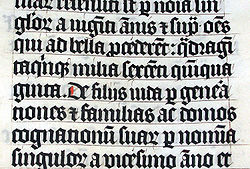
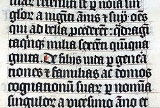
Scribal abbreviations (sigla [plural], siglum and sigil [singular]) are the abbreviations used by ancient and mediæval scribes writing in Latin
Latin
Latin is an Italic language originally spoken in Latium and Ancient Rome. It, along with most European languages, is a descendant of the ancient Proto-Indo-European language. Although it is considered a dead language, a number of scholars and members of the Christian clergy speak it fluently, and...
and, later, in Greek
Greek language
Greek is an independent branch of the Indo-European family of languages. Native to the southern Balkans, it has the longest documented history of any Indo-European language, spanning 34 centuries of written records. Its writing system has been the Greek alphabet for the majority of its history;...
and Old Norse
Old Norse
Old Norse is a North Germanic language that was spoken by inhabitants of Scandinavia and inhabitants of their overseas settlements during the Viking Age, until about 1300....
. Modern manuscript editing (substantive and mechanical) employs sigla as symbols indicating the location of a source manuscript and to identify the copyist
Copyist
A copyist is a person who makes written copies. In ancient times, a scrivener was also called a calligraphus . The term's modern use is almost entirely confined to music copyists, who are employed by the music industry to produce neat copies from a composer or arranger's manuscript.-Music...
(s) of a work.
History
Abbreviated writing, via sigla, arose partly from the exigencies of the workable nature of the materials — stoneRock (geology)
In geology, rock or stone is a naturally occurring solid aggregate of minerals and/or mineraloids.The Earth's outer solid layer, the lithosphere, is made of rock. In general rocks are of three types, namely, igneous, sedimentary, and metamorphic...
, metal
Metal
A metal , is an element, compound, or alloy that is a good conductor of both electricity and heat. Metals are usually malleable and shiny, that is they reflect most of incident light...
, parchment
Parchment
Parchment is a thin material made from calfskin, sheepskin or goatskin, often split. Its most common use was as a material for writing on, for documents, notes, or the pages of a book, codex or manuscript. It is distinct from leather in that parchment is limed but not tanned; therefore, it is very...
, et cetera — employed in record-making, and partly from their availability. Thus, lapidaries
Lapidary
A lapidary is an artist or artisan who forms stone, mineral, gemstones, and other suitably durable materials into decorative items such as engraved gems, including cameos, or cabochons, and faceted designs...
, engravers, and copyist
Copyist
A copyist is a person who makes written copies. In ancient times, a scrivener was also called a calligraphus . The term's modern use is almost entirely confined to music copyists, who are employed by the music industry to produce neat copies from a composer or arranger's manuscript.-Music...
s made the most of the available writing space. Scribal abbreviations were infrequent when writing materials were plentiful. Consequently, scribes recorded texts in long form. However, by the third and fourth centuries AD, when writing materials were scarce and costly, the scribe-artists became sparing in their use of the limited writing surface when inscribing long texts to record.
During the time of the Roman Republic
Roman Republic
The Roman Republic was the period of the ancient Roman civilization where the government operated as a republic. It began with the overthrow of the Roman monarchy, traditionally dated around 508 BC, and its replacement by a government headed by two consuls, elected annually by the citizens and...
, several abbreviations, known as sigla (siglum=symbol/abbreviation), were in common use in inscriptions and increased in number during Roman Empire
Roman Empire
The Roman Empire was the post-Republican period of the ancient Roman civilization, characterised by an autocratic form of government and large territorial holdings in Europe and around the Mediterranean....
. Additionally, in this period shorthand entered general usage. The earliest western shorthand system known to us is that employed by the Greek historian, Xenophon
Xenophon
Xenophon , son of Gryllus, of the deme Erchia of Athens, also known as Xenophon of Athens, was a Greek historian, soldier, mercenary, philosopher and a contemporary and admirer of Socrates...
in the memoir of Socrates
Memorabilia (Xenophon)
Memorabilia is a collection of Socratic dialogues by Xenophon, a student of Socrates...
, called notae socratae. In late republican times, the (nota = mark) short-hand writing system was developed possibly by Marcus Tullius Tiro
Marcus Tullius Tiro
Marcus Tullius Tiro was first a slave, then a freedman of Cicero.The date of Tiro's birth is uncertain. From Jerome it can be dated to 103 BC, which would make him only a little younger than Cicero...
, Cicero’s amanuensis, in 63 BC in order to record information with fewer symbols; Tironian notes include a shorthand/syllabic alphabet notation different from the Latin minuscule hand and square
Roman square capitals
Roman square capitals, also called capitalis monumentalis, inscriptional capitals, elegant capitals and quadrata, are an ancient Roman form of writing, and the basis for modern capital letters....
and rustic capital
Rustic capitals
Rustic capitals is an ancient Roman calligraphic script. As the term is negatively connotated supposing an opposition to the more 'civilized' form of the Roman square capitals Bernhard Bischoff prefers to call the script canonized capitals.Rustic capitals are similar to Roman square capitals, but...
letters, which is akin to modern stenographic writing systems, and also symbols for whole words or word roots and grammatical modifier marks and could either be used to write whole passages in shorthand or only certain words. In medieval times the symbols to represent words were widely used and the initial symbols, which were as low as 140 according to some sources, were expanded to 14,000 by the Carolingians who used them in conjunction with other abbreviations. However, the alphabet notation had a "murky existence" (C. Burnett) as it was often associated with witchcraft and magic and was eventually forgotten. Interest in it was rekindled by the archbishop of Canterbury
Archbishop of Canterbury
The Archbishop of Canterbury is the senior bishop and principal leader of the Church of England, the symbolic head of the worldwide Anglican Communion, and the diocesan bishop of the Diocese of Canterbury. In his role as head of the Anglican Communion, the archbishop leads the third largest group...
Thomas Beckett in the 12th century and later in the 15th, when it was rediscovered by Johannes Trithemius, abbot of the benedictine abbey of Sponheim, in a psalm written entirely in Tironian shorthand and a Ciceronian lexicon, which were discovered in a Benedictine monastery (notae benensis).
To learn the Tironian note system, scribes required formal schooling in some 4,000 symbols; by the Classical period (ca. 7th c. BC–AD 5th c.), the number increased to some 5,000 symbols, then to some 13,000 in the medieval period (AD 4th–15th c.); to date, the denotations of some characters remain uncertain. Sigla are mostly for lapidary inscription; in certain late historical periods (e.g. medieval Spain), scribal abbreviations were over-used to the extent that some are indecipherable.
Moreover, in the twenty-first century, sigla are a public matter, because, in re-establishing post–Devolution
Devolution
Devolution is the statutory granting of powers from the central government of a sovereign state to government at a subnational level, such as a regional, local, or state level. Devolution can be mainly financial, e.g. giving areas a budget which was formerly administered by central government...
Scots law, the Scottish Parliament
Scottish Parliament
The Scottish Parliament is the devolved national, unicameral legislature of Scotland, located in the Holyrood area of the capital, Edinburgh. The Parliament, informally referred to as "Holyrood", is a democratically elected body comprising 129 members known as Members of the Scottish Parliament...
must decipher their meaning(s) as used in the old, Latin-language Scottish law codes. Latinists who have not learned the palaeography
Palaeography
Palaeography, also spelt paleography is the study of ancient writing. Included in the discipline is the practice of deciphering, reading, and dating historical manuscripts, and the cultural context of writing, including the methods with which writing and books were produced, and the history of...
of the language cannot decipher many of the thirteen thousand medieval sigla used to write these laws.
Forms
The identity and usage of abbreviations is not constant but changes from region to region and increases in usage and reaches its height in the Carolingian Renaissance (8-10th century)Carolingian Renaissance
In the history of ideas the Carolingian Renaissance stands out as a period of intellectual and cultural revival in Europe occurring from the late eighth century, in the generation of Alcuin, to the 9th century, and the generation of Heiric of Auxerre, with the peak of the activities coordinated...
, in fact often transcription mistakes are seen in manuscripts where an abbreviation is unfamiliar. The most common abbreviations, called notae comunes, are encountered across most of Europe, whereas others appear in certain regions. Additionally in legal documents not only legal abbreviations appear, called notae juris but also capricious abbreviations, which the scribe manufactures to avoid repeating names and places in the document.
Scribal abbreviations can be found in epigraphy, sacred and legal manuscripts, written in Latin or in vulgar (less frequent and fewer abbreviations) calligraphically or not.
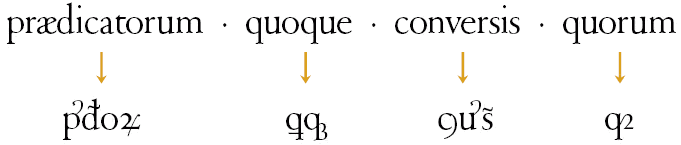
Epigraphy
Epigraphy Epigraphy Epigraphy (from the , literally "on-writing", is the study of inscriptions or epigraphs as writing; that is, the science of identifying the graphemes and of classifying their use as to cultural context and date, elucidating their meaning and assessing what conclusions can be...
, common abbreviations were comprehended in two observed classes:
- The abbreviation of a word to its initial letter;
- The abbreviation of a word to its first consecutive letters, or to several letters, spaced in the word.
These two forms of abbreviation are called "suspensions" (as the scribe suspends the writing of the word), a separate form of abbreviation is by "contraction" and was mostly a Christian usage for sacred words, Nomina Sacra
Nomina sacra
Nomina sacra means "sacred names" in Latin, and can be used to refer to traditions of abbreviated writing of several frequently occurring divine names or titles in early Greek language Holy Scripture...
; non-Christian sigla usage usually limited the number of letters the abbreviation comprised, and omitted no intermediate letter. One practice was rendering an over-used, formulaic phrase only as a siglum, e.g. DM for Dis Manibus
Manes
In ancient Roman religion, the Manes or Di Manes are chthonic deities sometimes thought to represent the souls of deceased loved ones. They were associated with the Lares, Genii, and Di Penates as deities that pertained to domestic, local, and personal cult...
(“Dedicated to the Manes”); IHS
Christogram
A Christogram is a monogram or combination of letters that forms an abbreviation for the name of Jesus Christ, traditionally used as a Christian symbol. Different types of Christograms are associated with the various traditions of Christianity, e.g...
from the first three letters of "ΙΗΣΟΥΣ
Jesus
Jesus of Nazareth , commonly referred to as Jesus Christ or simply as Jesus or Christ, is the central figure of Christianity...
"; and RIP for requiescat in pace (“Rest in Peace”), because the long-form written usage of the abbreviated phrase, itself, was rare. According to Trabe, these abbreviations are not really meant to lighten the burden of the scribe but rather to shroud in reverent obscurity the holiest words of the Christian religion.
Another practice was repeating the abbreviation’s final consonant a given number of times to indicate a group of as many persons, for example: AVG denoted “Augustus”, thus, AVGG denoted “Augusti duo”; however, lapidaries took typographic liberties with that rule, and, instead of using COSS to denote “Consulibus duobus”, invented the CCSS form. Still, when occasion required referring to three or four persons, the complex doubling of the final consonant yielded to the simple plural siglum. To that effect, a vinculum
Vinculum
A vinculum is a horizontal line used in mathematical notation. It may be placed over a mathematical expression to indicate that it is to be considered grouped together, or alternatively it may function as a binary connective between arguments appearing above and below it...
(overbar) above a letter or a letter-set also was so used, til becoming universal medieval typographic usage. Likewise the tilde
Tilde
The tilde is a grapheme with several uses. The name of the character comes from Portuguese and Spanish, from the Latin titulus meaning "title" or "superscription", though the term "tilde" has evolved and now has a different meaning in linguistics....
(~), an undulated, curved-end line, came into standard late-medieval usage.
Besides the tilde and macron
Macron
A macron, from the Greek , meaning "long", is a diacritic placed above a vowel . It was originally used to mark a long or heavy syllable in Greco-Roman metrics, but now marks a long vowel...
marks, above and below letters, modifying cross-bars and extended strokes were employed as scribal abbreviation marks — used mostly for prefixes and verb, noun, and adjectival suffixes. These typographic abbreviations should not be confused with the phrasal abbreviations: i.e. (id est — “that is”); loc. cit. (loco citato — “in the passage already cited”); viz. (vide licet — “namely”, “that is to say”, “in other words” — formed with “vi” and the yogh
Yogh
The letter yogh , was used in Middle English and Older Scots, representing y and various velar phonemes. It was derived from the Old English form of the letter g.In Middle English writing, tailed z came to be indistinguishable from yogh....
-like glyph [Ȝ], the siglum for the suffix -et and the conjunction et), and et cetera.
Moreover, besides scribal abbreviations, ancient texts also contain variant typographic characters, including digraph
Digraph (orthography)
A digraph or digram is a pair of characters used to write one phoneme or a sequence of phonemes that does not correspond to the normal values of the two characters combined...
s (e.g. Æ, Œ, etc.), the long s
Long s
The long, medial or descending s is a form of the minuscule letter s formerly used where s occurred in the middle or at the beginning of a word, for example "ſinfulneſs" . The modern letterform was called the terminal, round, or short s.-History:The long s is derived from the old Roman cursive...
(ſ), and the half r, resembling an Arabic number two (“2”). The “u” and “v” characters originated as scribal variants for their respective letters, like-wise the “i” and “j” pair. Modern publishers printing Latin-language works replace variant typography and sigla with full-form Latin spellings; the convention of using “u” and “i” for vowels and “v” and “j” for consonants is a late typographic development.
Latin alphabet
Some ancient and medieval sigla are still used in English and other European languages; the Latin ampersandAmpersand
An ampersand is a logogram representing the conjunction word "and". The symbol is a ligature of the letters in et, Latin for "and".-Etymology:...
(&), replaces the conjunctions and in English, et in Latin and French, and y in Spanish (though its use in Spanish is frowned upon, since the y is already smaller and easier to write). The Tironian sign ⁊
Tironian notes
Tironian notes is a system of shorthand said to have been invented by Cicero's scribe Marcus Tullius Tiro. Tiro's system consisted of about 4,000 signs, somewhat extended in classical times to 5,000 signs. In the European Medieval period, Tironian notes were taught in monasteries and the system...
, resembling the number seven (“7”), represents the conjunction et, and is written only to the x-height
X-height
In typography, the x-height or corpus size refers to the distance between the baseline and the mean line in a typeface. Typically, this is the height of the letter x in the font , as well as the u, v, w, and z...
; in current Irish language
Irish language
Irish , also known as Irish Gaelic, is a Goidelic language of the Indo-European language family, originating in Ireland and historically spoken by the Irish people. Irish is now spoken as a first language by a minority of Irish people, as well as being a second language of a larger proportion of...
usage, this siglum denotes the conjunction and. (See Tironian notes
Tironian notes
Tironian notes is a system of shorthand said to have been invented by Cicero's scribe Marcus Tullius Tiro. Tiro's system consisted of about 4,000 signs, somewhat extended in classical times to 5,000 signs. In the European Medieval period, Tironian notes were taught in monasteries and the system...
.) Other scribal abbreviations in modern typographic use are: the percentage
Percentage
In mathematics, a percentage is a way of expressing a number as a fraction of 100 . It is often denoted using the percent sign, “%”, or the abbreviation “pct”. For example, 45% is equal to 45/100, or 0.45.Percentages are used to express how large/small one quantity is, relative to another quantity...
sign (%), from the Italian per cento (“per hundred”); the permille
Permille
A per mil or per mille is a tenth of a percent or one part per thousand. It is written with the sign ‰ , which looks like a percent sign with an extra zero at the end...
sign (‰), from the Italian per mille (“per thousand”); the pound sign
Pound sign
The pound sign is the symbol for the pound sterling—the currency of the United Kingdom . The same symbol is used for similarly named currencies in some other countries and territories, such as the Irish pound, Gibraltar pound, Australian pound and the Italian lira...
(₤, £ and #, all descending from ℔ or lb, librum); and the dollar sign
Dollar sign
The dollar or peso sign is a symbol primarily used to indicate the various peso and dollar units of currency around the world.- Origin :...
($), which derives from the Spanish word Peso. The commercial at symbol (@), denoting “at the rate of”, is a ligature derived from the English preposition at; it became widely known internationally only when it was made part of e-mail address
E-mail address
An email address identifies an email box to which email messages are delivered. An example format of an email address is lewis@example.net which is read as lewis at example dot net...
es.
Typographically, the ampersand (&), representing the word et, is a space-saving ligature
Ligature (typography)
In writing and typography, a ligature occurs where two or more graphemes are joined as a single glyph. Ligatures usually replace consecutive characters sharing common components and are part of a more general class of glyphs called "contextual forms", where the specific shape of a letter depends on...
of the letters “e” and “t”, its component graphemes. Since the establishment of movable-type printing in the fifteenth century, founders created many such ligatures for each set of record type (font) in order to communicate much information with fewer symbols. Moreover, during the Renaissance
Renaissance
The Renaissance was a cultural movement that spanned roughly the 14th to the 17th century, beginning in Italy in the Late Middle Ages and later spreading to the rest of Europe. The term is also used more loosely to refer to the historical era, but since the changes of the Renaissance were not...
(ca. 14th–17th c.), when Ancient Greek-language manuscripts introduced that tongue to Western Europe, its scribal abbreviations were converted to ligatures, in imitation of the Latin scribal writing to which readers were accustomed. Later, in the sixteenth century, when the culture of publishing included Europe’s vernacular languages, Græco–Roman scribal abbreviations disappeared — an ideologic deletion ascribed to the anti-Latinist Protestant Reformation
Protestant Reformation
The Protestant Reformation was a 16th-century split within Western Christianity initiated by Martin Luther, John Calvin and other early Protestants. The efforts of the self-described "reformers", who objected to the doctrines, rituals and ecclesiastical structure of the Roman Catholic Church, led...
(1517–1648).
Church Slavonic
After the invention of printing, manuscript copying abbreviations continued to be employed in the Church Slavonic language and today remain in use in printed books as well as on icons and inscriptions. Many common long roots as well as nouns describing sacred persons are abbreviated and written under the special diacriticDiacritic
A diacritic is a glyph added to a letter, or basic glyph. The term derives from the Greek διακριτικός . Diacritic is both an adjective and a noun, whereas diacritical is only an adjective. Some diacritical marks, such as the acute and grave are often called accents...
symbol titlo
Titlo
Titlo is an extended diacritic symbol initially used in old Cyrillic manuscripts, e.g., in Old Church Slavonic and Old East Slavic languages. The word is a borrowing from the Greek "", "title"...
, as shown in the figure at the right. This corresponds to the Nomina sacra
Nomina sacra
Nomina sacra means "sacred names" in Latin, and can be used to refer to traditions of abbreviated writing of several frequently occurring divine names or titles in early Greek language Holy Scripture...
(Latin: "Sacred names") tradition of using contractions for certain frequently occurring names in Greek
Koine Greek
Koine Greek is the universal dialect of the Greek language spoken throughout post-Classical antiquity , developing from the Attic dialect, with admixture of elements especially from Ionic....
ecclesiastical texts. However, sigla for personal nouns are restricted to "good" beings and the same words, when referring to "bad" beings are spelled out; for example, while "God" in the sense of the one true God is abbreviated as «», "god" referring to "false" gods is spelled out; likewise, while the word for "angel" is generally abbreviated as «», “angels” is spelled out for “performed by evil angels” in Psalm 77.
Abbreviations listed by Cappelli
Adriano Cappelli, author of lexicon abbreviarum: dizionario di abbreviature latine ed italiane, enumerates the various mediaeval brachigraphic signs found in Latin and Italian vulgar texts, which originate from the roman sigla (a symbol to express a word) and notae TironianaeTironian notes
Tironian notes is a system of shorthand said to have been invented by Cicero's scribe Marcus Tullius Tiro. Tiro's system consisted of about 4,000 signs, somewhat extended in classical times to 5,000 signs. In the European Medieval period, Tironian notes were taught in monasteries and the system...
. Quite rarely abbreviations did not carry marks to indicate an abbreviation has occurred, if they did they were often copying errors, as an example e.g. is written with dots, however modern terms may not, such as PC (written uppercase).
It should be noted that the original manuscripts were not written in a modern san-serif or serif font, but in roman capitals, rustic, uncial, insular, Carolingian or blackletter styles, for more refer to Western calligraphy
Western calligraphy
Western Calligraphy is the art of writing. A contemporary definition of calligraphic practice is "the art of giving form to signs in an expressive, harmonious and skillful manner." The story of writing is one of aesthetic development framed within the technical skills, transmission speed and...
or for a good beginner's guide.
Additionally, abbreviation varied across Europe, in Nordic texts for instance two runes were used in text written in the Latin alphabet, which are ᚠ for fé (cattle/goods) and ᛘ for maðr (man).
He divides abbreviations into 6 overlapping categories:
- by suspension (Italian: troncamento)
- by contraction (Italian: contrazione)
- with independent meaning (Italian: con significato proprio)
- with relative meaning (Italian: con significato relativo)
- by nested letters (Italian: per lettere sovraposte)
- by convention (Italian: segni convenzionali)
Suspension
These are terms where only the first part is written, whilst the last part is substituted by a mark, which can be of two types:- general, indicating there has been an abbreviation but not how. These marks are placed above or across the ascenderAscenderIn typography, an ascender is the portion of a minuscule letter in a Latin-derived alphabet that extends above the mean line of a font. That is, the part of a lower-case letter that is taller than the font's x-height....
of the letters
the last three of this series are knot-like and are used in papal or regal documents
- specific, indicate that a truncation has occurred
The third case is a stylistic alternative found in several fonts, here Andron ( Unicode chart extended D).
Examples:
The largest class of these are single letters standing for a word starting with that letter.
A dot at the baseline following a capital letter may stand for a title if used in front of names, a persons name in mediaeval legal documents or other. However not all sigla use the beginning of the word. Here are some exceptions
Often for two or more, the sigla is doubled (FF.=fratres). Often trippled sigla stand for three (DDD = domini tres).
Letters which are lying on their side or mirrored often indicate female titles, however, a mirrored C stands generally for con or contra (the latter sometimes with a macron above).
To avoid confusion with abbreviations and numerals the latter are often written with a bar above, however in some contexts numbers with a line above indicate that number times a thousand whilst others several abbreviations have a line above, such as XP (Greek letters chi+rho) correctly = Christus or IHS =Jesus, the latter two for a special case of abbreviations known as nomina sacra
Nomina sacra
Nomina sacra means "sacred names" in Latin, and can be used to refer to traditions of abbreviated writing of several frequently occurring divine names or titles in early Greek language Holy Scripture...
.
From the 8-9th century, single letters sigla were less common and longer less ambiguous ones were used with bars above.
Contraction
Abbreviations by contractions have one or more middle letters omitted and were often represented with a general mark of abbreviation (above) such as a line above. These can be divided in pure or mixed:- pure contractions keep only the first (one or more) and last (one or more) letters but not letters in between. A special case of these is when they keep only the first and last letter resulting in a 2 letter sigla.
- mixed keep one or more intermediate letters
Marks with independent meaning
These marks inform the reader of the identity of the missing part of the word independently of its meaning. Some of these are:- The straight or curved macron above a letter means that a nasal consonantNasal consonantA nasal consonant is a type of consonant produced with a lowered velum in the mouth, allowing air to escape freely through the nose. Examples of nasal consonants in English are and , in words such as nose and mouth.- Definition :...
is missing either an "n" or an "m". However in Visigoth texts before the 9th century a dot is placed above the line to indicate "m", without a dot meaning "n", the line with dot later became the general mark after the 9th century in Visigoth texts. A remnant of this can be seen in Spanish where an n with a tilde (ñÑÑ is a letter of the modern Latin alphabet, formed by an N with a diacritical tilde. It is used in the Spanish alphabet, Galician alphabet, Asturian alphabet, Basque alphabet, Aragonese old alphabet , Filipino alphabet, Chamorro alphabet and the Guarani alphabet, where it represents...
) is used for ɲ. - The second mark, which looks like the Arabic numeral "9" or a mirrored "C" in gothic texts, is one of the oldest signs and can be found in the texts of Marcus Valerius ProbusMarcus Valerius ProbusMarcus Valerius Probus, of Berytus, was a Roman grammarian and critic, who flourished during the Flavian dynasty.He was a student rather than a teacher, and devoted himself to the criticism and elucidation of the texts of classical authors by means of marginal notes or by signs, after the manner...
and tironian notes with the same meaning of "con". - The third mark, similar to a fat comma placed after the letter on the median line represented us or os, generally at the end of the word being the Nominative caseNominative caseThe nominative case is one of the grammatical cases of a noun or other part of speech, which generally marks the subject of a verb or the predicate noun or predicate adjective, as opposed to its object or other verb arguments...
affixAffixAn affix is a morpheme that is attached to a word stem to form a new word. Affixes may be derivational, like English -ness and pre-, or inflectional, like English plural -s and past tense -ed. They are bound morphemes by definition; prefixes and suffixes may be separable affixes...
of the second declension sometimes is or simply s. The apostropheApostropheThe apostrophe is a punctuation mark, and sometimes a diacritic mark, in languages that use the Latin alphabet or certain other alphabets...
used today originated from various marks in sigla, hence its current use in elision, such as in the Saxon genitiveSaxon genitiveIn English language teaching, the term "Saxon genitive" is used to associate the possessive use of the apostrophe with the historical origin in Anglo Saxon of the morpheme that it represents...
. - the fourth mark, wave-like or omicron-like, stands for a missing r (rhotic consonant) or ra. Sometimes a similar wave-like mark at the end of a word indicated a missing -a or syllable in -a, this is however a coincidence as these marks stem one from a small r-like mark and the other from an a-like, this in later text became a dieresis (two dots) or a broken line.
- The fifth mark, Arabic numeral 2-like place on the median line after the letter, indicated a Tur or an ur, which occur generally at the end of the word, alternatively it could stand for ter or er but not at the end of the words (Nordic languages, such as old English, has a lightning bolt like mark for end of words in er)
- The sixth mark, an r rotundaR rotundaThe r rotunda , "rounded r," is an old letter variant found in full script-like typefaces, especially blackletters. Between the Middle Ages and today, many ways of writing alphabetical characters were lost. Besides a variety of ligatures, conjoined letters, scribal abbreviations, swash characters,...
with a cut generally stood for rum, but could also stand for a truncation after an r. - The seventh mark, which could either be 7-like (see "and" written in gaelic (agus) 0 or the ampersandAmpersandAn ampersand is a logogram representing the conjunction word "and". The symbol is a ligature of the letters in et, Latin for "and".-Etymology:...
(&) was used equally as the conjunction et (and) or as et in any part of the word. The 7-like symbol at the end of a word refers to the enclyctic -que (and). A corruption occurs in some manuscripts between the third and seventh mark.
Marks with relative meaning
The meaning of these marks depends on the letter they are on.- the first mark is not fully above the character but crosses the descender or ascender. Specifically these are:
- b bre-,ber-,-ub
- c (with a link on the right) cum, con, cen-
- con mark (above) quondam
- d de-, der, -ud (as noted, a crossed d (additionally, either with a straight or uncinal (curved) ascender is a Icelandic alphabet letter called ethEthEth is a letter used in Old English, Icelandic, Faroese , and Elfdalian. It was also used in Scandinavia during the Middle Ages, but was subsequently replaced with dh and later d. The capital eth resembles a D with a line through the vertical stroke...
representing a voiced dental fricativeVoiced dental fricativeThe voiced dental non-sibilant fricative is a type of consonantal sound, used in some spoken languages. The symbol in the International Phonetic Alphabet that represents this sound, eth, is . The symbol was taken from the Old English letter eth, which could stand for either a voiced or unvoiced...
) - h haec hoc, her
- l vel, ul-,-el
- m (above) mem-,mun-
- n (above) non, nun-
- o (crossed horizontally, not DanishDanish languageDanish is a North Germanic language spoken by around six million people, principally in the country of Denmark. It is also spoken by 50,000 Germans of Danish ethnicity in the northern parts of Schleswig-Holstein, Germany, where it holds the status of minority language...
Ø) oblit - p per, par-, por-
- p (above) prae, pre- (alternatively a mark similar (but with little spiral character) to -us comma above could be used for this meaning, also valid for above q)
- pp (above or below) propter, papa
- q qui and in Italy que but in England quam, quia
- q above quae
- qq ((above or below) quoque
- q (tilde above and line below) quam
- t ter-, tem-, ten-
- u (same as v, above) ven-,ver, -vit
- the dot, two dots, comma + dot (different than a semicolon) and the Arabic numeral 3-like mark were generally at the end of a word on the baseline. After b they mean -us (semicolon-like and 3-like also could mean -et). After q they for the conjunction -que (meaning "and" but attached to the end of the last world) with semicolon-like and 3-like the q could be omitted. semicolon-like, in Lombard documents, above s meant -sis. The dot above median line on an h hoc. dot above u ut or uti. The 3-like could mean -est, or after a, e, u vowels ment -m not us or ei, if after an o ment -nem. In certain papers the three like mark can be confused with a cut r rotunda (handwritten 4-like, see above). a dot to the left and right of a letter gave the following meanings: e=est, i=idest, n=enim, q=quasi, s=scilicet, t=tune, 9-like (con)=quondam, 7-like =etiam
- the third is a diagonal line, often hooked, crossing nearly all the letters giving a different meaning. commonly a missing er, ar, re. variants of which were placed above and were rotated question mark -like, tilde (crossing ascender) and similar to the us mark. These in combination gave additional meanings.
- 2-like mark, after a q =quia. after 15th century alone =et (being similar to 7-like) and alone with line above =etiam. After u and a at the end of a word =m, after s =et or ed.
stacked or nested letters
These generally referred to the letter missing, but in some instances of vowels may refer to a missing vowel and r before or after it (note: only in English r before consonants is silent and the preceding vowel r-colored). However, a, i, and o above g meant gna, gni, or gno respectively (this may seem counterintuitive to an English speaker where the g is silent in gn, but in other languages it is not, see Gn (digraph)). Vowels above q meant qu+vowel; a on r = regula; o on m = modo. Vowels were the most common superscripts, but consonants could be placed above letters (rarely with ascenders), the most common being c. A cut l above an n meant nihil or words with nihil. and so on.Convention marks
These marks are non alphabet letters with a particular meaning, several of which have survived to this day such as the monetary symbols. Unicode calls them letter-like glyphs.Additionally, several authors believe roman numeral for example were nothing but abbreviations of the words of those numbers.
Another examples of not-fully lost symbols are alchemical symbol
Alchemical symbol
Alchemical symbols, originally devised as part of alchemy, were used to denote some elements and some compounds until the 18th century. Note that while notation like this was mostly standardized, style and symbol varied between alchemists, so this page lists the most common.-Three primes:According...
and zodiac symbols, which were used rarely (only in alchemy and astrology texts).
Other
In addition to the signs used to signify abbreviations, other features of medieval manuscripts, which are not sigla, are:- ligatures which were used to reduce the space occupied, a characteristic particularly prominent in blackletter scripts
- disused characters such as r rotundaR rotundaThe r rotunda , "rounded r," is an old letter variant found in full script-like typefaces, especially blackletters. Between the Middle Ages and today, many ways of writing alphabetical characters were lost. Besides a variety of ligatures, conjoined letters, scribal abbreviations, swash characters,...
, thorn (þ=th)Thorn (letter)Thorn or þorn , is a letter in the Old English, Old Norse, and Icelandic alphabets, as well as some dialects of Middle English. It was also used in medieval Scandinavia, but was later replaced with the digraph th. The letter originated from the rune in the Elder Fuþark, called thorn in the...
and eth (ð=dh) (used only in modern Icelandic), long sLong sThe long, medial or descending s is a form of the minuscule letter s formerly used where s occurred in the middle or at the beginning of a word, for example "ſinfulneſs" . The modern letterform was called the terminal, round, or short s.-History:The long s is derived from the old Roman cursive...
and uncinal or insular variants (e.g. Insular GInsular GInsular G is a form of the letter g somewhat resembling a tailed z or lowercase delta, used in Britain and Ireland. It was first used by the Irish, passed into Old English, and developed into the Middle English letter yogh...
), Claudian lettersClaudian lettersThe Claudian letters were developed by, and named after, the Roman Emperor Claudius . He introduced three new letters:*a reversed C to replace BS and PS, much like X stood in for CS and GS...
etc.. - Features of an illuminated manuscriptIlluminated manuscriptAn illuminated manuscript is a manuscript in which the text is supplemented by the addition of decoration, such as decorated initials, borders and miniature illustrations...
, such as miniaturesMiniature (illuminated manuscript)The word miniature, derived from the Latin minium, red lead, is a picture in an ancient or medieval illuminated manuscript; the simple decoration of the early codices having been miniated or delineated with that pigment...
and decorated initialsInitialIn a written or published work, an initial is a letter at the beginning of a work, a chapter, or a paragraph that is larger than the rest of the text. The word is derived from the Latin initialis, which means standing at the beginning...
and littera notabilior (which later gave us uppercase)
Unicode encoding of abbreviation marks
In the UnicodeUnicode
Unicode is a computing industry standard for the consistent encoding, representation and handling of text expressed in most of the world's writing systems...
Standard v. 5.1 (4 April 2008), 152 medieval and classical glyphs were given specific locations outside of the deprecated private use group. Specifically, they are located in the charts Combining Diacritical Marks Supplement (26 chars.), Latin Extended Additional (10 chars.), Supplemental Punctuation (15 chars.), Ancient Symbols (12 chars.) and especially Latin Extended-D (89 chars.).
These consist in both precomposed characters and modifiers for other characters, called combining diacritical marks, (e.g. writing in LaTeX
LaTeX
LaTeX is a document markup language and document preparation system for the TeX typesetting program. Within the typesetting system, its name is styled as . The term LaTeX refers only to the language in which documents are written, not to the editor used to write those documents. In order to...
or using overstrike in MS Word).
Note about terminology: Characters are ‘the smallest components of written language that have semantic value’, while glyphs are ‘the shapes that characters can have when they are rendered or displayed’
See also
- Acronym and initialismAcronym and initialismAcronyms and initialisms are abbreviations formed from the initial components in a phrase or a word. These components may be individual letters or parts of words . There is no universal agreement on the precise definition of the various terms , nor on written usage...
- Claudian lettersClaudian lettersThe Claudian letters were developed by, and named after, the Roman Emperor Claudius . He introduced three new letters:*a reversed C to replace BS and PS, much like X stood in for CS and GS...
- List of acronyms and initialisms
- List of classical abbreviations
- List of medieval abbreviations
- Macron - Non-diacritical usage
Palaeographic letter variants
- PalaeographyPalaeographyPalaeography, also spelt paleography is the study of ancient writing. Included in the discipline is the practice of deciphering, reading, and dating historical manuscripts, and the cultural context of writing, including the methods with which writing and books were produced, and the history of...
- The abbreviations used in the 1913 edition of Webster's dictionary
External links
- Bibliography on medieval abbreviations and other scribal conventions.
- Paleography: Scribal Abbreviations
- XML Specifications for the use of sigla