


Massacre of the Innocents

Encyclopedia
The Massacre of the Innocents is an episode of infanticide
by the King of Judea
, Herod the Great
. According to the Gospel of Matthew
Herod orders the execution of all young male children in the village of Bethlehem
, so as to avoid the loss of his throne to a newborn King of the Jews whose birth has been announced to him by the Magi
. The incident, like others in Matthew, is described as the fulfillment of a passage in the Old Testament
read as prophecy
, in this case a reading of Jeremiah
: "Then was fulfilled that which was spoken through Jeremiah
the prophet, saying, A voice was heard in Ramah, Weeping and great mourning, Rachel weeping for her children."
The infants, known in the Church as the Holy Innocents, have been claimed as the first Christian martyrs
. Some accounts number them at more than ten thousand, but more conservative estimates put their number in the low dozens.. Historians generally view the event as non-historical.
_001.jpg) In Matthew
In Matthew
's account, magi
from the east
go to Judea in search of the newborn king of the Jews, having "seen his star in the east". The King, Herod the Great
, directs them to Bethlehem, and asks them to let him know who this king is when they find him. They find Jesus and honor him, but an angel
tells them not to alert Herod, and they return home by another way.
The Massacre of the Innocents is at Matthew 2:16
-18
, although the preceding verses form the context:
Matthew's purpose is to present Jesus as the Messiah, and the Massacre of the Innocents as the fulfillment of passages in Hosea
, referring to the exodus, and Jeremiah
, to the Babylonian exile. Raymond Brown
sees the story as patterned on the Exodus
story of the killing of the Hebrew firstborn by Pharaoh and the birth of Moses
.
. The massacre is not mentioned in Luke's gospel
or by any contemporaneous historians, or by the later Roman Jewish historian, Josephus
.
The majority of Herod biographers, followed by biblical scholars, hold that the massacre is "legend and not historical". Geza Vermes
and E. P. Sanders
regard the story as creative hagiography
. Robert Eisenman
argues that the story may have its origins in Herod's murder of his own sons, an act which made a deep impression at the time and was recorded by Josephus
as well as in the 1st century Jewish apocryphal work, the Assumption of Moses
, where it is cast as a prophecy: An insolent king will succeed [the Hasmonean
priests]… he will slay all the young. Other arguments against historicity include the silence of Josephus (who does record several other examples of Herod’s willingness to commit such acts to protect his power, noting that he "never stopped avenging and punishing every day those who had chosen to be of the party of his enemies") and the views that the story is an apologetic device or a constructed fulfilment of prophesy.
R. T. France
argues for plausibility on the grounds that “the murder of a few infants in a small village [is] not on a scale to match the more spectacular assassinations recorded by Josephus”. Paul L. Maier argues that sceptics have tended to "regard opinion as fact, and have largely avoided a careful historical search into the parameters of the problem". After analysing the arguments against the historicity of the infant massacre Maier concludes they all "have very serious flaws". Maier follows Jerry Knoblet in arguing for historicity based on the "identical personality profiles that emerge of Herod" in both Matthew and Josephus;
of c.150 AD, which excludes the Flight into Egypt
and switches the attention of the story to the infant John the Baptist
:
The first non-Christian reference to the massacre is recorded four centuries later by Macrobius (c. 395-423), who writes in his Saturnalia:
The story assumed an important place in later Christian tradition; Byzantine liturgy estimated 14,000 Holy Innocents while an early Syrian list of saints stated the number at 64,000. Copt
ic sources raise the number to 144,000 and place the event on 29 December. Taking the narrative literally and judging from the estimated population of Bethlehem, the Catholic Encyclopedia (1910) more soberly suggested that these numbers were inflated, and that probably only between six and twenty children were killed in the town, with a dozen or so more in the surrounding areas.
 Medieval liturgical drama
recounted Biblical events, including Herod's slaughter of the innocents. The Pageant of the Shearmen and Tailors, performed in Coventry, England, included a haunting song about the episode, now known as the Coventry Carol
. The Ordo Rachelis
tradition of four plays includes the Flight into Egypt
, Herod's succession by Archelaus
, the return from Egypt, as well as the Massacre all centred on Rachel weeping in fulfillment of Jeremiah's prophecy. These events were likewise in one of the Medieval N-Town Plays
.
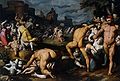
The theme of the "Massacre of the Innocents" has provided artists of many nationalities with opportunities to compose complicated depictions of massed bodies in violent action. It was an alternative to the Flight into Egypt in cycles of the Life of the Virgin
. It decreased in popularity in Gothic art
, but revived in the larger works of the Renaissance, when artists took inspiration for their "Massacres" from Roman reliefs of the battle of the Lapith
s and Centaur
s to the extent that they showed the figures heroically nude. The horrific subject matter of the Massacre of the Innocents also provided a comparison of ancient brutalities with early modern ones during the period of religious wars that followed the Reformation - Bruegel's versions show the soldiers carrying banners with the Habsburg
double-headed eagle (often used at the time for Ancient Roman soldiers).
The 1590 version by Cornelis van Haarlem
also seems to reflect the violence of the Dutch Revolt
. Guido Reni
's early (1611) Massacre of the Innocents
, in an unusual vertical format, is at Bologna. The Flemish painter Peter Paul Rubens painted the theme more than once. One version, now in Munich, was engraved and reproduced as a painting as far away as colonial Peru. Another, his grand Massacre of the Innocents
is now at the Art Gallery of Ontario
in Toronto
. The French painter Nicolas Poussin
painted The Massacre of the Innocents (1634) at the height of the Thirty Years' War
.
The Childermass, after a traditional name for the Feast of the Holy Innocents, is the opening novel of Wyndham Lewis
's trilogy The Human Age. In the novel The Fall (La Chute) by Albert Camus
, the incident is argued by the main character to be the reason why Jesus chose to let himself be crucified—as he escaped the punishment intended for him while many others died, he felt responsible and died in guilt. A similar interpretation is given in José Saramago
's controversial The Gospel According to Jesus Christ
, but there attributed to Joseph, Jesus' father, rather than to Jesus himself. As depicted by Saramago, Joseph knew of Herod's intention to massacre the children of Bethlehem, but failed to warn the townspeople and chose only to save his own child. Guilt-ridden ever after, Joseph finally expiates his sin by letting himself be crucified (an event not narrated in the New Testament).
The Massacre is the opening plot used in the 2006 movie The Nativity Story
.
s for Christ—first appears as a feast of the western church in the Leonine Sacramentary, dating from about 485. The earliest commemorations were connected with the Feast of the Epiphany, 6 January: Prudentius
mentions the Innocents in his hymn on the Epiphany. Leo in his homilies on the Epiphany speaks of the Innocents. Fulgentius of Ruspe
(6th century) gives a homily De Epiphania, deque Innocentum nece et muneribus magorum ("On Epiphany, and on the murder of the Innocents and the gifts of the Magi").
Today, the date of Holy Innocents' Day, also called Childermas or Children's Mass, varies. 27 December is the date for West Syrians (Syriac Orthodox Church
, Syro-Malankara Catholic Church
, and Maronite Church
) and East Syrians (Chaldean
s and Syro-Malabar Catholic Church
). 28 December is the date in the Church of England
, the Lutheran Church and the Roman Catholic Church
(in which, except on Sunday, violet vestments were worn before 1961, instead of red, the normal liturgical colour for celebrating martyrs). The Eastern Orthodox Church
celebrates the feast on 29 December.
In the 1962 Roman Catholic calendar, the violet vestments for Holy Innocents were eliminated (red used instead), and if December 28 falls on Sunday, this feast is commemorated on the Sunday within the Octave of Christmas
.
In Spain
, Hispanic America
and the Philippines
, December 28 is a day for pranks
, equivalent to April Fool's Day in many countries. Pranks (bromas) are also known in Spain as inocentadas and their victims are called inocentes, or alternatively, the pranksters are the "inocentes" and the victims should not be angry at them, since they could not have committed any sin
. One of the more famous of these traditions is the annual "Els Enfarinats
" festival of Ibi
in Alicante, where the inocentadas dress up in full military dress and incite a flour fight. Various Catholic countries had a tradition (no longer widely observed) of role reversal between children and their adult educators, including boy bishop
s, perhaps a Christianized version of the Roman annual feast of the Saturnalia
(when even slaves played "masters" for a day). In some cultures it is said to be an unlucky day, when no new project should be started.
In addition, there was a medieval custom of refraining where possible from work on the day of the week on which the feast of "Innocents Day" had fallen for the whole of the following year until the next Innocents Day. This was presumably mainly observed by the better-off. Philippe de Commynes, the minister of King Louis XI of France
tells in his memoirs how the king observed this custom, and describes the trepidation he felt when he had to inform the king of an emergency on the day.
Infanticide
Infanticide or infant homicide is the killing of a human infant. Neonaticide, a killing within 24 hours of a baby's birth, is most commonly done by the mother.In many past societies, certain forms of infanticide were considered permissible...
by the King of Judea
Iudaea Province
Judaea or Iudaea are terms used by historians to refer to the Roman province that extended over parts of the former regions of the Hasmonean and Herodian kingdoms of Israel...
, Herod the Great
Herod the Great
Herod , also known as Herod the Great , was a Roman client king of Judea. His epithet of "the Great" is widely disputed as he is described as "a madman who murdered his own family and a great many rabbis." He is also known for his colossal building projects in Jerusalem and elsewhere, including his...
. According to the Gospel of Matthew
Gospel of Matthew
The Gospel According to Matthew is one of the four canonical gospels, one of the three synoptic gospels, and the first book of the New Testament. It tells of the life, ministry, death, and resurrection of Jesus of Nazareth...
Herod orders the execution of all young male children in the village of Bethlehem
Bethlehem
Bethlehem is a Palestinian city in the central West Bank of the Jordan River, near Israel and approximately south of Jerusalem, with a population of about 30,000 people. It is the capital of the Bethlehem Governorate of the Palestinian National Authority and a hub of Palestinian culture and tourism...
, so as to avoid the loss of his throne to a newborn King of the Jews whose birth has been announced to him by the Magi
Biblical Magi
The Magi Greek: μάγοι, magoi), also referred to as the Wise Men, Kings, Astrologers, or Kings from the East, were a group of distinguished foreigners who were said to have visited Jesus after his birth, bearing gifts of gold, frankincense and myrrh...
. The incident, like others in Matthew, is described as the fulfillment of a passage in the Old Testament
Old Testament
The Old Testament, of which Christians hold different views, is a Christian term for the religious writings of ancient Israel held sacred and inspired by Christians which overlaps with the 24-book canon of the Masoretic Text of Judaism...
read as prophecy
Prophecy
Prophecy is a process in which one or more messages that have been communicated to a prophet are then communicated to others. Such messages typically involve divine inspiration, interpretation, or revelation of conditioned events to come as well as testimonies or repeated revelations that the...
, in this case a reading of Jeremiah
Jeremiah
Jeremiah Hebrew:יִרְמְיָה , Modern Hebrew:Yirməyāhū, IPA: jirməˈjaːhu, Tiberian:Yirmĭyahu, Greek:Ἰερεμίας), meaning "Yahweh exalts", or called the "Weeping prophet" was one of the main prophets of the Hebrew Bible...
: "Then was fulfilled that which was spoken through Jeremiah
Jeremiah
Jeremiah Hebrew:יִרְמְיָה , Modern Hebrew:Yirməyāhū, IPA: jirməˈjaːhu, Tiberian:Yirmĭyahu, Greek:Ἰερεμίας), meaning "Yahweh exalts", or called the "Weeping prophet" was one of the main prophets of the Hebrew Bible...
the prophet, saying, A voice was heard in Ramah, Weeping and great mourning, Rachel weeping for her children."
The infants, known in the Church as the Holy Innocents, have been claimed as the first Christian martyrs
Christian martyrs
A Christian martyr is one who is killed for following Christianity, through stoning, crucifixion, burning at the stake or other forms of torture and capital punishment. The word "martyr" comes from the Greek word μάρτυς, mártys, which means "witness."...
. Some accounts number them at more than ten thousand, but more conservative estimates put their number in the low dozens.. Historians generally view the event as non-historical.
Biblical account
Gospel of Matthew
The Gospel According to Matthew is one of the four canonical gospels, one of the three synoptic gospels, and the first book of the New Testament. It tells of the life, ministry, death, and resurrection of Jesus of Nazareth...
's account, magi
Magi
Magi is a term, used since at least the 4th century BC, to denote a follower of Zoroaster, or rather, a follower of what the Hellenistic world associated Zoroaster with, which...
from the east
Orient
The Orient means "the East." It is a traditional designation for anything that belongs to the Eastern world or the Far East, in relation to Europe. In English it is a metonym that means various parts of Asia.- Derivation :...
go to Judea in search of the newborn king of the Jews, having "seen his star in the east". The King, Herod the Great
Herod the Great
Herod , also known as Herod the Great , was a Roman client king of Judea. His epithet of "the Great" is widely disputed as he is described as "a madman who murdered his own family and a great many rabbis." He is also known for his colossal building projects in Jerusalem and elsewhere, including his...
, directs them to Bethlehem, and asks them to let him know who this king is when they find him. They find Jesus and honor him, but an angel
Angel
Angels are mythical beings often depicted as messengers of God in the Hebrew and Christian Bibles along with the Quran. The English word angel is derived from the Greek ἄγγελος, a translation of in the Hebrew Bible ; a similar term, ملائكة , is used in the Qur'an...
tells them not to alert Herod, and they return home by another way.
The Massacre of the Innocents is at Matthew 2:16
Matthew 2:16
Matthew 2:16 is the sixteenth verse of the second chapter of the Gospel of Matthew in the New Testament.Joseph and Mary had been visited by an angel and told that Herod would attempt to kill Jesus, their son. Doing as told, they took their infant son and fled by night into Egypt, where they stayed...
-18
Matthew 2:18
Matthew 2:18 is the eighteenth verse of the second chapter of the Gospel of Matthew in the New Testament. Herod has ordered the Massacre of the Innocents and this verse quotes from the Book of Jeremiah to show that this event was predicted by the prophets....
, although the preceding verses form the context:
When [the Magi] had gone, an angel of the Lord appeared to JosephSaint JosephSaint Joseph is a figure in the Gospels, the husband of the Virgin Mary and the earthly father of Jesus Christ ....
in a dreamDreamDreams are successions of images, ideas, emotions, and sensations that occur involuntarily in the mind during certain stages of sleep. The content and purpose of dreams are not definitively understood, though they have been a topic of scientific speculation, philosophical intrigue and religious...
. Get up, he said, take the child and his mother and escape to Egypt. Stay there until I tell you, for Herod is going to search for the child to kill him. So he got up, took the child and his mother during the night and left for Egypt, where he stayed until the death of Herod. And so was fulfilled what the Lord had said through the prophet: "Out of Egypt I called my son." When Herod realised that he had been outwitted by the Magi, he was furious, and he gave orders to kill all the boys in Bethlehem and its vicinity who were two years old and under, in accordance with the time he had learned from the Magi. Then what was said through the prophet Jeremiah was fulfilled: "A voice is heard in Ramah, weeping and great mourning, Rachel weeping for her children and refusing to be comforted, because they are no more."
Matthew's purpose is to present Jesus as the Messiah, and the Massacre of the Innocents as the fulfillment of passages in Hosea
Hosea
Hosea was the son of Beeri and a prophet in Israel in the 8th century BC. He is one of the Twelve Prophets of the Jewish Hebrew Bible, also known as the Minor Prophets of the Christian Old Testament. Hosea is often seen as a "prophet of doom", but underneath his message of destruction is a promise...
, referring to the exodus, and Jeremiah
Jeremiah
Jeremiah Hebrew:יִרְמְיָה , Modern Hebrew:Yirməyāhū, IPA: jirməˈjaːhu, Tiberian:Yirmĭyahu, Greek:Ἰερεμίας), meaning "Yahweh exalts", or called the "Weeping prophet" was one of the main prophets of the Hebrew Bible...
, to the Babylonian exile. Raymond Brown
Raymond E. Brown
The Reverend Raymond Edward Brown, S.S. , was an American Roman Catholic priest, a member of the Sulpician Fathers and a major Biblical scholar of his era...
sees the story as patterned on the Exodus
The Exodus
The Exodus is the story of the departure of the Israelites from ancient Egypt described in the Hebrew Bible.Narrowly defined, the term refers only to the departure from Egypt described in the Book of Exodus; more widely, it takes in the subsequent law-givings and wanderings in the wilderness...
story of the killing of the Hebrew firstborn by Pharaoh and the birth of Moses
Moses
Moses was, according to the Hebrew Bible and Qur'an, a religious leader, lawgiver and prophet, to whom the authorship of the Torah is traditionally attributed...
.
Historicity
The single account of the Massacre comes in the Gospel of MatthewMatthew 2:16
Matthew 2:16 is the sixteenth verse of the second chapter of the Gospel of Matthew in the New Testament.Joseph and Mary had been visited by an angel and told that Herod would attempt to kill Jesus, their son. Doing as told, they took their infant son and fled by night into Egypt, where they stayed...
. The massacre is not mentioned in Luke's gospel
Gospel of Luke
The Gospel According to Luke , commonly shortened to the Gospel of Luke or simply Luke, is the third and longest of the four canonical Gospels. This synoptic gospel is an account of the life and ministry of Jesus of Nazareth. It details his story from the events of his birth to his Ascension.The...
or by any contemporaneous historians, or by the later Roman Jewish historian, Josephus
Josephus
Titus Flavius Josephus , also called Joseph ben Matityahu , was a 1st-century Romano-Jewish historian and hagiographer of priestly and royal ancestry who recorded Jewish history, with special emphasis on the 1st century AD and the First Jewish–Roman War, which resulted in the Destruction of...
.
The majority of Herod biographers, followed by biblical scholars, hold that the massacre is "legend and not historical". Geza Vermes
Geza Vermes
Géza Vermes or Vermès is a British scholar of Jewish Hungarian origin and writer on religious history, particularly Jewish and Christian. He is a noted authority on the Dead Sea Scrolls and other ancient works in Aramaic, and on the life and religion of Jesus...
and E. P. Sanders
E. P. Sanders
Ed Parish Sanders is a New Testament scholar, and is one of the principal proponents of the New Perspective on Paul. He has been Arts and Sciences Professor of Religion at Duke University, North Carolina, since 1990. He retired in 2005....
regard the story as creative hagiography
Hagiography
Hagiography is the study of saints.From the Greek and , it refers literally to writings on the subject of such holy people, and specifically to the biographies of saints and ecclesiastical leaders. The term hagiology, the study of hagiography, is also current in English, though less common...
. Robert Eisenman
Robert Eisenman
Robert Eisenman is an American Biblical scholar, theoretical writer, historian, archaeologist, and "road" poet. He is currently Professor of Middle East Religions, Archaeology, and Islamic Law and director of the Institute for the Study of...
argues that the story may have its origins in Herod's murder of his own sons, an act which made a deep impression at the time and was recorded by Josephus
Josephus
Titus Flavius Josephus , also called Joseph ben Matityahu , was a 1st-century Romano-Jewish historian and hagiographer of priestly and royal ancestry who recorded Jewish history, with special emphasis on the 1st century AD and the First Jewish–Roman War, which resulted in the Destruction of...
as well as in the 1st century Jewish apocryphal work, the Assumption of Moses
Assumption of Moses
The Assumption of Moses is a Jewish apocryphal pseudepigraphical work. It is known from a single sixth-century incomplete manuscript in Latin that was discovered by Antonio Ceriani in the Biblioteca Ambrosiana in Milan in the mid-nineteenth century and published by him in 1861.-Identification:The...
, where it is cast as a prophecy: An insolent king will succeed [the Hasmonean
Hasmonean
The Hasmonean dynasty , was the ruling dynasty of Judea and surrounding regions during classical antiquity. Between c. 140 and c. 116 BCE, the dynasty ruled semi-autonomously from the Seleucids in the region of Judea...
priests]… he will slay all the young. Other arguments against historicity include the silence of Josephus (who does record several other examples of Herod’s willingness to commit such acts to protect his power, noting that he "never stopped avenging and punishing every day those who had chosen to be of the party of his enemies") and the views that the story is an apologetic device or a constructed fulfilment of prophesy.
R. T. France
R. T. France
Richard Thomas France is a New Testament scholar and Anglican cleric. He was Principal of Wycliffe Hall Oxford from 1989 to 1995. He has also worked for the London School of Theology.-Biography:...
argues for plausibility on the grounds that “the murder of a few infants in a small village [is] not on a scale to match the more spectacular assassinations recorded by Josephus”. Paul L. Maier argues that sceptics have tended to "regard opinion as fact, and have largely avoided a careful historical search into the parameters of the problem". After analysing the arguments against the historicity of the infant massacre Maier concludes they all "have very serious flaws". Maier follows Jerry Knoblet in arguing for historicity based on the "identical personality profiles that emerge of Herod" in both Matthew and Josephus;
Later accounts
The story's first appearance in any source other than Matthew is in the 2nd-century apocryphal Protoevangelium of JamesGospel of James
The Gospel of James, also known as the Infancy Gospel of James or the Protoevangelium of James, is an apocryphal Gospel probably written about AD 145, which expands backward in time the infancy stories contained the Gospels of Matthew and Luke, and presents a narrative concerning the birth and...
of c.150 AD, which excludes the Flight into Egypt
Flight into Egypt
The flight into Egypt is a biblical event described in the Gospel of Matthew , in which Joseph fled to Egypt with his wife Mary and infant son Jesus after a visit by Magi because they learn that King Herod intends to kill the infants of that area...
and switches the attention of the story to the infant John the Baptist
John the Baptist
John the Baptist was an itinerant preacher and a major religious figure mentioned in the Canonical gospels. He is described in the Gospel of Luke as a relative of Jesus, who led a movement of baptism at the Jordan River...
:
"And when Herod knew that he had been mocked by the Magi, in a rage he sent murderers, saying to them: Slay the children from two years old and under. And Mary, having heard that the children were being killed, was afraid, and took the infant and swaddled Him, and put Him into an ox-stall. And Elizabeth, having heard that they were searching for John, took him and went up into the hill-country, and kept looking where to conceal him. And there was no place of concealment. And Elizabeth, groaning with a loud voice, says: O mountain of God, receive mother and child. And immediately the mountain was cleft, and received her. And a light shone about them, for an angel of the Lord was with them, watching over them."
The first non-Christian reference to the massacre is recorded four centuries later by Macrobius (c. 395-423), who writes in his Saturnalia:
"When he [emperor Augustus] heard that among the boys in Syria under two years old whom Herod, king of the Jews, had ordered to kill, his own son was also killed, he said: it is better to be Herod's pig, than his son."
The story assumed an important place in later Christian tradition; Byzantine liturgy estimated 14,000 Holy Innocents while an early Syrian list of saints stated the number at 64,000. Copt
Copt
The Copts are the native Egyptian Christians , a major ethnoreligious group in Egypt....
ic sources raise the number to 144,000 and place the event on 29 December. Taking the narrative literally and judging from the estimated population of Bethlehem, the Catholic Encyclopedia (1910) more soberly suggested that these numbers were inflated, and that probably only between six and twenty children were killed in the town, with a dozen or so more in the surrounding areas.
In the arts
Liturgical drama
Liturgical drama or religious drama, in its various Christian contexts, originates from the mass itself, and usually presents a relatively complex ritual that includes theatrical elements...
recounted Biblical events, including Herod's slaughter of the innocents. The Pageant of the Shearmen and Tailors, performed in Coventry, England, included a haunting song about the episode, now known as the Coventry Carol
Coventry Carol
The "Coventry Carol" is a Christmas carol dating from the 16th century. The carol was performed in Coventry in England as part of a mystery play called The Pageant of the Shearmen and Tailors. The play depicts the Christmas story from chapter two in the Gospel of Matthew...
. The Ordo Rachelis
Ordo Rachelis
The Ordo Rachelis , Interfectio Puerorum , or Ludus Innocentium is a medieval dramatic tradition consisting in four plays and based on the Massacre of the Innocents, an event recorded in the Gospel of Matthew, and on the prophecy recorded in the Book of Jeremiah: "A voice was heard in Ramah,...
tradition of four plays includes the Flight into Egypt
Flight into Egypt
The flight into Egypt is a biblical event described in the Gospel of Matthew , in which Joseph fled to Egypt with his wife Mary and infant son Jesus after a visit by Magi because they learn that King Herod intends to kill the infants of that area...
, Herod's succession by Archelaus
Herod Archelaus
Herod Archelaus was the ethnarch of Samaria, Judea, and Idumea from 4 BC to 6 AD. He was the son of Herod the Great and Malthace the Samaritan, the brother of Herod Antipas, and the half-brother of Herod Philip I....
, the return from Egypt, as well as the Massacre all centred on Rachel weeping in fulfillment of Jeremiah's prophecy. These events were likewise in one of the Medieval N-Town Plays
N-Town Plays
The N-Town Plays are a cycle of 42 medieval Mystery plays from between 1450 and 1500.-The manuscript:...
.
The theme of the "Massacre of the Innocents" has provided artists of many nationalities with opportunities to compose complicated depictions of massed bodies in violent action. It was an alternative to the Flight into Egypt in cycles of the Life of the Virgin
Life of the Virgin
The Life of the Virgin, showing narrative scenes from the life of Mary, the mother of Jesus, is a common subject for pictorial cycles in Christian art, often complementing, or forming part of, a cycle on the Life of Christ. In both cases the number of scenes shown varies greatly with the space...
. It decreased in popularity in Gothic art
Gothic art
Gothic art was a Medieval art movement that developed in France out of Romanesque art in the mid-12th century, led by the concurrent development of Gothic architecture. It spread to all of Western Europe, but took over art more completely north of the Alps, never quite effacing more classical...
, but revived in the larger works of the Renaissance, when artists took inspiration for their "Massacres" from Roman reliefs of the battle of the Lapith
Lapith
The Lapiths are a legendary people of Greek mythology, whose home was in Thessaly, in the valley of the Peneus and on the mountain Pelion.They were an Aeolian tribe. Like the Myrmidons and other Thessalian tribes, the Lapiths were pre-Hellenic in their origins...
s and Centaur
Centaur
In Greek mythology, a centaur or hippocentaur is a member of a composite race of creatures, part human and part horse...
s to the extent that they showed the figures heroically nude. The horrific subject matter of the Massacre of the Innocents also provided a comparison of ancient brutalities with early modern ones during the period of religious wars that followed the Reformation - Bruegel's versions show the soldiers carrying banners with the Habsburg
Habsburg
The House of Habsburg , also found as Hapsburg, and also known as House of Austria is one of the most important royal houses of Europe and is best known for being an origin of all of the formally elected Holy Roman Emperors between 1438 and 1740, as well as rulers of the Austrian Empire and...
double-headed eagle (often used at the time for Ancient Roman soldiers).
The 1590 version by Cornelis van Haarlem
Cornelis van Haarlem
Cornelis Corneliszoon van Haarlem , Dutch Golden Age painter and draughtsman, was one of the leading Northern Mannerist artists in The Netherlands, and an important forerunner of Frans Hals as a portraitist.-Biography:...
also seems to reflect the violence of the Dutch Revolt
Dutch Revolt
The Dutch Revolt or the Revolt of the Netherlands This article adopts 1568 as the starting date of the war, as this was the year of the first battles between armies. However, since there is a long period of Protestant vs...
. Guido Reni
Guido Reni
Guido Reni was an Italian painter of high-Baroque style.-Biography:Born in Bologna into a family of musicians, Guido Reni was the son of Daniele Reni and Ginevra de’ Pozzi. As a child of nine, he was apprenticed under the Bolognese studio of Denis Calvaert. Soon after, he was joined in that...
's early (1611) Massacre of the Innocents
Massacre of the Innocents (Guido Reni)
Massacre of the Innocents is a painting by the Italian Baroque painter Guido Reni, now in the Pinacoteca Nazionale, Bologna.-Description:...
, in an unusual vertical format, is at Bologna. The Flemish painter Peter Paul Rubens painted the theme more than once. One version, now in Munich, was engraved and reproduced as a painting as far away as colonial Peru. Another, his grand Massacre of the Innocents
Massacre of the Innocents (Rubens)
The Massacre of the Innocents is the title of either of two paintings by Peter Paul Rubens depicting an episode of the biblical Massacre of the Innocents as related in the Gospel of Matthew.-The lost masterpiece:...
is now at the Art Gallery of Ontario
Art Gallery of Ontario
Under the direction of its CEO Matthew Teitelbaum, the AGO embarked on a $254 million redevelopment plan by architect Frank Gehry in 2004, called Transformation AGO. The new addition would require demolition of the 1992 Post-Modernist wing by Barton Myers and Kuwabara Payne McKenna Blumberg...
in Toronto
Toronto
Toronto is the provincial capital of Ontario and the largest city in Canada. It is located in Southern Ontario on the northwestern shore of Lake Ontario. A relatively modern city, Toronto's history dates back to the late-18th century, when its land was first purchased by the British monarchy from...
. The French painter Nicolas Poussin
Nicolas Poussin
Nicolas Poussin was a French painter in the classical style. His work predominantly features clarity, logic, and order, and favors line over color. His work serves as an alternative to the dominant Baroque style of the 17th century...
painted The Massacre of the Innocents (1634) at the height of the Thirty Years' War
Thirty Years' War
The Thirty Years' War was fought primarily in what is now Germany, and at various points involved most countries in Europe. It was one of the most destructive conflicts in European history....
.
The Childermass, after a traditional name for the Feast of the Holy Innocents, is the opening novel of Wyndham Lewis
Wyndham Lewis
Percy Wyndham Lewis was an English painter and author . He was a co-founder of the Vorticist movement in art, and edited the literary magazine of the Vorticists, BLAST...
's trilogy The Human Age. In the novel The Fall (La Chute) by Albert Camus
Albert Camus
Albert Camus was a French author, journalist, and key philosopher of the 20th century. In 1949, Camus founded the Group for International Liaisons within the Revolutionary Union Movement, which was opposed to some tendencies of the Surrealist movement of André Breton.Camus was awarded the 1957...
, the incident is argued by the main character to be the reason why Jesus chose to let himself be crucified—as he escaped the punishment intended for him while many others died, he felt responsible and died in guilt. A similar interpretation is given in José Saramago
José Saramago
José de Sousa Saramago, GColSE was a Nobel-laureate Portuguese novelist, poet, playwright and journalist. His works, some of which can be seen as allegories, commonly present subversive perspectives on historic events, emphasizing the human factor. Harold Bloom has described Saramago as "a...
's controversial The Gospel According to Jesus Christ
The Gospel According to Jesus Christ
The Gospel According to Jesus Christ is a novel by the Portuguese author José Saramago. A fictional re-telling of Jesus Christ's life, it depicts him as a flawed, humanised character with passions and doubts...
, but there attributed to Joseph, Jesus' father, rather than to Jesus himself. As depicted by Saramago, Joseph knew of Herod's intention to massacre the children of Bethlehem, but failed to warn the townspeople and chose only to save his own child. Guilt-ridden ever after, Joseph finally expiates his sin by letting himself be crucified (an event not narrated in the New Testament).
The Massacre is the opening plot used in the 2006 movie The Nativity Story
The Nativity Story
The Nativity Story is a 2006 drama film based on the nativity of Jesus starring Keisha Castle-Hughes and Shohreh Aghdashloo. Filming began on May 1, 2006 in Matera, Italy and in Morocco. New Line Cinema released it on December 1, 2006 in the United States and one week later on December 8 in the...
.
Feast days
The commemoration of the massacre of these "Holy Innocents"—considered by some Christians as the first martyrMartyr
A martyr is somebody who suffers persecution and death for refusing to renounce, or accept, a belief or cause, usually religious.-Meaning:...
s for Christ—first appears as a feast of the western church in the Leonine Sacramentary, dating from about 485. The earliest commemorations were connected with the Feast of the Epiphany, 6 January: Prudentius
Prudentius
Aurelius Prudentius Clemens was a Roman Christian poet, born in the Roman province of Tarraconensis in 348. He probably died in Spain, as well, some time after 405, possibly around 413...
mentions the Innocents in his hymn on the Epiphany. Leo in his homilies on the Epiphany speaks of the Innocents. Fulgentius of Ruspe
Fulgentius of Ruspe
Saint Fulgentius of Ruspe was bishop of the city of Ruspe, North Africa, in the 5th and 6th century who was canonized as a Christian saint...
(6th century) gives a homily De Epiphania, deque Innocentum nece et muneribus magorum ("On Epiphany, and on the murder of the Innocents and the gifts of the Magi").
Today, the date of Holy Innocents' Day, also called Childermas or Children's Mass, varies. 27 December is the date for West Syrians (Syriac Orthodox Church
Syriac Orthodox Church
The Syriac Orthodox Church; is an autocephalous Oriental Orthodox church based in the Eastern Mediterranean, with members spread throughout the world. The Syriac Orthodox Church claims to derive its origin from one of the first Christian communities, established in Antioch by the Apostle St....
, Syro-Malankara Catholic Church
Syro-Malankara Catholic Church
The Syro-Malankara Catholic Church is an Eastern Catholic Church in full communion with the Holy See...
, and Maronite Church
Maronite Church
The Syriac Maronite Church of Antioch is an Eastern Catholic Church in full communion with the Holy See of Rome . It traces its heritage back to the community founded by Maron, a 4th-century Syriac monk venerated as a saint. The first Maronite Patriarch, John Maron, was elected in the late 7th...
) and East Syrians (Chaldean
Chaldean Catholic Church
The Chaldean Catholic Church , is an Eastern Syriac particular church of the Catholic Church, maintaining full communion with the Bishop of Rome and the rest of the Catholic Church...
s and Syro-Malabar Catholic Church
Syro-Malabar Catholic Church
The Syro-Malabar Catholic Church in India is an East Syrian Rite, Major Archiepiscopal Church in full communion with the Catholic Church. It is one of the 22 sui iuris Eastern Catholic Churches in the Catholic Church. It is the largest of the Saint Thomas Christian denominations with more than 3.6...
). 28 December is the date in the Church of England
Church of England
The Church of England is the officially established Christian church in England and the Mother Church of the worldwide Anglican Communion. The church considers itself within the tradition of Western Christianity and dates its formal establishment principally to the mission to England by St...
, the Lutheran Church and the Roman Catholic Church
Roman Catholic Church
The Catholic Church, also known as the Roman Catholic Church, is the world's largest Christian church, with over a billion members. Led by the Pope, it defines its mission as spreading the gospel of Jesus Christ, administering the sacraments and exercising charity...
(in which, except on Sunday, violet vestments were worn before 1961, instead of red, the normal liturgical colour for celebrating martyrs). The Eastern Orthodox Church
Eastern Orthodox Church
The Orthodox Church, officially called the Orthodox Catholic Church and commonly referred to as the Eastern Orthodox Church, is the second largest Christian denomination in the world, with an estimated 300 million adherents mainly in the countries of Belarus, Bulgaria, Cyprus, Georgia, Greece,...
celebrates the feast on 29 December.
In the 1962 Roman Catholic calendar, the violet vestments for Holy Innocents were eliminated (red used instead), and if December 28 falls on Sunday, this feast is commemorated on the Sunday within the Octave of Christmas
Sunday within the Octave of Christmas
The Sunday within the Octave of Christmas is a liturgical celebration in the Tridentine rite of the Roman Catholic Church which, in missals before 1962, takes place on either December 29, December 30, or December 31. If one of these three days is a Sunday, the celebration occurs on that day...
.
In Spain
Spain
Spain , officially the Kingdom of Spain languages]] under the European Charter for Regional or Minority Languages. In each of these, Spain's official name is as follows:;;;;;;), is a country and member state of the European Union located in southwestern Europe on the Iberian Peninsula...
, Hispanic America
Hispanic America
Hispanic America or Spanish America is the region comprising the American countries inhabited by Spanish-speaking populations.These countries have significant commonalities with each other and with Spain, whose colonies they formerly were...
and the Philippines
Philippines
The Philippines , officially known as the Republic of the Philippines , is a country in Southeast Asia in the western Pacific Ocean. To its north across the Luzon Strait lies Taiwan. West across the South China Sea sits Vietnam...
, December 28 is a day for pranks
Practical joke
A practical joke is a mischievous trick played on someone, typically causing the victim to experience embarrassment, indignity, or discomfort. Practical jokes differ from confidence tricks in that the victim finds out, or is let in on the joke, rather than being fooled into handing over money or...
, equivalent to April Fool's Day in many countries. Pranks (bromas) are also known in Spain as inocentadas and their victims are called inocentes, or alternatively, the pranksters are the "inocentes" and the victims should not be angry at them, since they could not have committed any sin
Sin
In religion, sin is the violation or deviation of an eternal divine law or standard. The term sin may also refer to the state of having committed such a violation. Christians believe the moral code of conduct is decreed by God In religion, sin (also called peccancy) is the violation or deviation...
. One of the more famous of these traditions is the annual "Els Enfarinats
Els Enfarinats
The annual festival of Els Enfarinats takes place in the town of Ibi in Alicante, Spain on December 28, as part of celebrations related to the Day of the Innocents. In the day long festival, participants known as the Els Enfarinats dress in mock military dress and stage a mock coup d'état...
" festival of Ibi
Ibi
Ibi is a town located in the comarca of Alcoià, in the province of Alicante, Spain. As of 2009, Ibi has a total population of c. 24,000 inhabitants. The town, which is located 37 km from the city of Alicante, is surrounded by mountains and gorges.The economy of Ibi is chiefly based on the toy...
in Alicante, where the inocentadas dress up in full military dress and incite a flour fight. Various Catholic countries had a tradition (no longer widely observed) of role reversal between children and their adult educators, including boy bishop
Boy bishop
Boy bishop was a name given to a custom very widespread in the Middle Ages, whereby a boy was chosen, for example among cathedral choristers, to parody the real Bishop, commonly on the feast of Holy Innocents...
s, perhaps a Christianized version of the Roman annual feast of the Saturnalia
Saturnalia
Saturnalia is an Ancient Roman festival/ celebration held in honour of Saturn , the youngest of the Titans, father of the major gods of the Greeks and Romans, and son of Uranus and Gaia...
(when even slaves played "masters" for a day). In some cultures it is said to be an unlucky day, when no new project should be started.
In addition, there was a medieval custom of refraining where possible from work on the day of the week on which the feast of "Innocents Day" had fallen for the whole of the following year until the next Innocents Day. This was presumably mainly observed by the better-off. Philippe de Commynes, the minister of King Louis XI of France
Louis XI of France
Louis XI , called the Prudent , was the King of France from 1461 to 1483. He was the son of Charles VII of France and Mary of Anjou, a member of the House of Valois....
tells in his memoirs how the king observed this custom, and describes the trepidation he felt when he had to inform the king of an emergency on the day.
See also
- Flight into EgyptFlight into EgyptThe flight into Egypt is a biblical event described in the Gospel of Matthew , in which Joseph fled to Egypt with his wife Mary and infant son Jesus after a visit by Magi because they learn that King Herod intends to kill the infants of that area...
- Seven Sorrows of MaryOur Lady of SorrowsOur Lady of Sorrows , the Sorrowful Mother or Mother of Sorrows , and Our Lady of the Seven Sorrows or Our Lady of the Seven Dolours are names by which the Blessed Virgin Mary is referred to in relation to sorrows in her life...
- Matthew 2:16Matthew 2:16Matthew 2:16 is the sixteenth verse of the second chapter of the Gospel of Matthew in the New Testament.Joseph and Mary had been visited by an angel and told that Herod would attempt to kill Jesus, their son. Doing as told, they took their infant son and fled by night into Egypt, where they stayed...
- Matthew 2:17Matthew 2:17Matthew 2:17 is the seventeenth verse of the second chapter of the Gospel of Matthew in the New Testament. Herod has ordered the Massacre of the Innocents and this verse links this event to a quotation from the Old Testament....
- Matthew 2:18Matthew 2:18Matthew 2:18 is the eighteenth verse of the second chapter of the Gospel of Matthew in the New Testament. Herod has ordered the Massacre of the Innocents and this verse quotes from the Book of Jeremiah to show that this event was predicted by the prophets....
External links
- Catholic Encyclopedia: "Holy Innocents"
- Images of the "Massacre of the Innocents"
- The Holy Martyred 14,000 Infants
| Massacre of the Innocents Life of Jesus Gospel harmony A Gospel harmony is an attempt to merge or harmonize the canonical gospels of the Four Evangelists into a single gospel account, the earliest known example being the Diatesseron by Tatian in the 2nd century. A gospel harmony may also establish a chronology for the events of the life of Jesus... : The Nativity Nativity of Jesus The Nativity of Jesus, or simply The Nativity, refers to the accounts of the birth of Jesus in two of the Canonical gospels and in various apocryphal texts.... |
||
| New Testament New Testament The New Testament is the second major division of the Christian biblical canon, the first such division being the much longer Old Testament.... Events |
||