

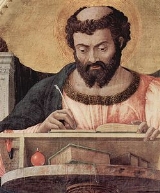
Luke the Evangelist

Encyclopedia
Luke the Evangelist was an Early Christian writer whom Church Fathers
such as Jerome
and Eusebius said was the author of the Gospel of Luke
and the Acts of the Apostles
. He is considered one of the Four Evangelists
.
He is venerated as Saint Luke, patron saint
of artists, physician
s, surgeon
s, student
s, butcher
s; his feast day is 18 October.
in Ancient Syria.
His earliest notice is in Paul's
Epistle to Philemon
, verse 24. He is also mentioned in Colossians 4:14 and 2 Timothy 4:11, two works commonly ascribed to Paul. The next earliest account of Luke is in the Anti-Marcionite Prologue to the Gospel of Luke, a document once thought to date to the 2nd century, but which has more recently been dated to the later 4th century. Helmut Koester
, however, claims that the following part – the only part preserved in the original Greek
– may have been composed in the late 2nd century:
Epiphanius
states that Luke was one of the Seventy (Panarion 51.11), and John Chrysostom
indicates at one point that the "brother" Paul mentions in 2 Corinthians 8:18 is either Luke or Barnabas
. J. Wenham asserts that Luke was "one of the Seventy, the Emmaus
disciple
, Lucius of Cyrene and Paul's kinsman." Not all scholars are as confident of all of these attributes as Wenham is, not least because Luke's own statement at the beginning of the Gospel of Luke freely admits that he was not an eyewitness to the events of the Gospel.
If one accepts that Luke was in fact the author of the Gospel bearing his name and also the Acts of the Apostles, certain details of his personal life can be reasonably assumed. While he does exclude himself from those who were eyewitnesses to Jesus' ministry, he repeatedly uses the word "we" in describing the Pauline missions in Acts of the Apostles, indicating that he was personally there at those times.
There is similar evidence that Luke resided in Troas, the province which included the ruins of ancient Troy, in that he writes in Acts in the third person about Paul and his travels until they get to Troas, where he switches to the first person plural. The "we" section of Acts continues until the group leaves Philippi
, when his writing goes back to the third person. This change happens again when the group returns to Philippi. There are three "we sections" in Acts, all following this rule. Luke never stated, however, that he lived in Troas, and this is the only evidence that he did.
The composition of the writings, as well as the range of vocabulary used, indicate that the author was an educated man. The quote in the Letter of Paul to the Colossians differentiating between Luke and other colleagues "of the circumcision
" has caused many to speculate that this indicates Luke was a Gentile
. If this were true, it would make Luke the only writer of the New Testament who can clearly be identified as not being Jewish. However, that is not the only possibility. The phrase could just as easily be used to differentiate between those Christians who strictly observed the rituals of Judaism
and those who did not.
Luke's presence in Rome with the Apostle Paul near the end of Paul's life was attested by 2 Timothy 4:11: "Only Luke is with me". In the last chapter of the Book of Acts, widely attributed to Luke, we find several accounts in the first person also affirming Luke's presence in Rome including Acts 28:16: "And when we came to Rome..." According to some accounts, Luke also contributed to authorship of the Epistle to the Hebrews
.
Luke died at age 84 in Boeotia, according to a "fairly early and widespread tradition". According to Nikiphoros-Kallistos Xanthopoulos (Eccles. History XIVth c. AD., Migne P.G. 145, 876) and others, Luke's Tomb was located in Thebes (Greece), from whence his relics were transferred to Constantinople
in the year 357.
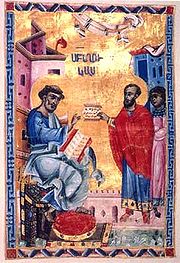 Most scholars understand Luke's works (Luke-Acts) in the tradition of Greek historiography
. The preface of The Gospel of Luke drawing on historical investigation is believed to have identified the work to the readers as belonging to the genre of history. There is some disagreement about how best to treat Luke's writings, with some historians regarding Luke as highly accurate, and others taking a more critical approach.
Archaeologist Sir William Ramsay
wrote that "Luke is a historian of the first rank; not merely are his statements of fact trustworthy...[he] should be placed along with the very greatest of historians." Professor of classics at Auckland University, E.M. Blaiklock, wrote: "For accuracy of detail, and for evocation of atmosphere, Luke stands, in fact, with Thucydides
. The Acts of the Apostles is not shoddy product of pious imagining, but a trustworthy record...it was the spadework of archaeology which first revealed the truth." New Testament scholar Colin Hemer has made a number of advancements in understanding the historical nature and accuracy of Luke's writings.
On the purpose of Acts, New Testament Scholar Luke Timothy Johnson
has noted that "Luke's account is selected and shaped to suit his apologetic interests, not in defiance of but in conformity to ancient standards of historiography." Such a position is shared by most commentators such as Richard Heard who sees historical deficiencies as arising from "special objects in writing and to the limitations of his sources of information." However, during modern times, Luke's competence as a historian is questioned. A narrative which relates supernatural, fantastic things like angels, demons etc. is seen as problematic as a historical source. Besides these factors, several discrepancies are found in his accounts. His knowledge of geography is seen as rudimentary. And it is understood that Luke did not intend to record history. His intention was to proclaim and to persuade. Many see this understanding as the final nail in Luke the historian's coffin. Robert M. Grant has noted that although Luke saw himself within the historical tradition, his work contains a number of statistical improbabilities such as the sizable crowd addressed by Peter in Acts 4:4. He has also noted chronological difficulties whereby Luke "has Gamaliel refer to Theudas and Judas in the wrong order, and Theudas actually rebelled about a decade after Gamaliel spoke(5:36-7)'
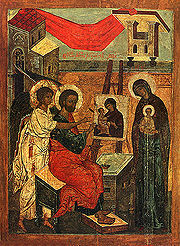 Another Christian tradition states that he was the first icon
painter. He is said to have painted pictures of the Virgin Mary
(for example, The Black Madonna of Częstochowa or Our Lady of Vladimir
) and of Peter
and Paul. Thus late medieval Guilds of St Luke in the cities of Flanders, or the "Accademia di San Luca
" (Academy of St. Luke) in Rome--imitated in many other European cities during the 16th century--gathered together and protected painters. The tradition that Luke painted icons of Mary and Jesus has been common, particularly in Eastern Orthodoxy. The tradition also has support from the Saint Thomas Christians
of India who claim to still have one of the Theotokos
icons that St. Luke painted and which St. Thomas brought to India.
Some scholars attribute to Luke the third Gospel and the Acts of the Apostles
, which is clearly meant to be read as a sequel to the Gospel account. Other scholars question Luke's authorship of these books. Many secular scholars give credit to Luke's abilities as a historian. Both books are dedicated to one Theophilus
and no scholar seriously doubts that the same person wrote both works, though neither work contains the name of its author.
Many argue that the author of the book must have been a companion of the Apostle Paul
, because of several passages in Acts written in the first person plural (known as the We Sections). These verses seem to indicate the author was traveling with Paul during parts of his journeys. Some scholars report that, of the colleagues that Paul mentions in his epistles, the process of elimination leaves Luke as the only person who fits everything known about the author of Luke/Acts.
Additionally, the earliest manuscript of the Gospel, dated circa AD 200, ascribes the work to Luke; as did Irenaeus
, writing circa AD 180; and the Muratorian fragment
from AD 170. Scholars defending Luke's authorship say there is no reason for early Christians to attribute these works to such a minor figure if he did not in fact write them, nor is there any tradition attributing this work to any other author.

s and church mosaic
s, St. Luke is often accompanied by an ox or bull, usually having wings. Also, only the symbol may be shown, especially when in a combination of those of all Four Evangelists
.
for 30.000 gold coins. After the Ottoman conquest of Bosnia, the kingdom's last queen, George's granddaughter Mary
, who had brought the relics with her from Serbia as her dowry, sold them to the Venetian Republic.
In 1992, the then Greek Orthodox Metropolitan Ieronymos
of Thebes and Levathia (the current Archbishop of Athens and All Greece) requested from Bishop Antonio Mattiazzo of Padua the return of a "a significant fragment of the relics of St. Luke to be placed on the site where the holy tomb of the Evangelist is located and venerated today". This prompted a scientific investigation of the relics in Padua, and by numerous lines of empirical evidence (archeological analyses of the Tomb in Thebes and the Reliquary of Padua, anatomical analyses of the remains, Carbon-14 dating, comparison with the purported skull of the Evangelist located in Prague) confirmed that these were the remains of an individual of Syrian descent who died between 72 and 416 A.D. The Bishop of Padua then delivered to Metropolitan Ieronymos the rib of St. Luke that was closest to his heart to be kept at his tomb in Thebes, Greece.
Church Fathers
The Church Fathers, Early Church Fathers, Christian Fathers, or Fathers of the Church were early and influential theologians, eminent Christian teachers and great bishops. Their scholarly works were used as a precedent for centuries to come...
such as Jerome
Jerome
Saint Jerome was a Roman Christian priest, confessor, theologian and historian, and who became a Doctor of the Church. He was the son of Eusebius, of the city of Stridon, which was on the border of Dalmatia and Pannonia...
and Eusebius said was the author of the Gospel of Luke
Gospel of Luke
The Gospel According to Luke , commonly shortened to the Gospel of Luke or simply Luke, is the third and longest of the four canonical Gospels. This synoptic gospel is an account of the life and ministry of Jesus of Nazareth. It details his story from the events of his birth to his Ascension.The...
and the Acts of the Apostles
Acts of the Apostles
The Acts of the Apostles , usually referred to simply as Acts, is the fifth book of the New Testament; Acts outlines the history of the Apostolic Age...
. He is considered one of the Four Evangelists
Four Evangelists
In Christian tradition the Four Evangelists are Matthew, Mark, Luke, and John, the authors attributed with the creation of the four Gospel accounts in the New Testament that bear the following titles:*Gospel according to Matthew*Gospel according to Mark...
.
He is venerated as Saint Luke, patron saint
Patron saint
A patron saint is a saint who is regarded as the intercessor and advocate in heaven of a nation, place, craft, activity, class, clan, family, or person...
of artists, physician
Physician
A physician is a health care provider who practices the profession of medicine, which is concerned with promoting, maintaining or restoring human health through the study, diagnosis, and treatment of disease, injury and other physical and mental impairments...
s, surgeon
Surgeon
In medicine, a surgeon is a specialist in surgery. Surgery is a broad category of invasive medical treatment that involves the cutting of a body, whether human or animal, for a specific reason such as the removal of diseased tissue or to repair a tear or breakage...
s, student
Student
A student is a learner, or someone who attends an educational institution. In some nations, the English term is reserved for those who attend university, while a schoolchild under the age of eighteen is called a pupil in English...
s, butcher
Butcher
A butcher is a person who may slaughter animals, dress their flesh, sell their meat or any combination of these three tasks. They may prepare standard cuts of meat, poultry, fish and shellfish for sale in retail or wholesale food establishments...
s; his feast day is 18 October.
Life
Luke was a Greco-Syrian physician who lived in the Greek city of AntiochAntioch
Antioch on the Orontes was an ancient city on the eastern side of the Orontes River. It is near the modern city of Antakya, Turkey.Founded near the end of the 4th century BC by Seleucus I Nicator, one of Alexander the Great's generals, Antioch eventually rivaled Alexandria as the chief city of the...
in Ancient Syria.
His earliest notice is in Paul's
Paul of Tarsus
Paul the Apostle , also known as Saul of Tarsus, is described in the Christian New Testament as one of the most influential early Christian missionaries, with the writings ascribed to him by the church forming a considerable portion of the New Testament...
Epistle to Philemon
Epistle to Philemon
Paul's Epistle to Philemon, usually referred to simply as Philemon, is a prison letter to Philemon from Paul of Tarsus. Philemon was a leader in the Colossian church. This letter, which is one of the books of the New Testament, deals with forgiveness.Philemon was a wealthy Christian of the house...
, verse 24. He is also mentioned in Colossians 4:14 and 2 Timothy 4:11, two works commonly ascribed to Paul. The next earliest account of Luke is in the Anti-Marcionite Prologue to the Gospel of Luke, a document once thought to date to the 2nd century, but which has more recently been dated to the later 4th century. Helmut Koester
Helmut Koester
Helmut Koester is a German-born American scholar of the New Testament and currently Morison Research Professor of Divinity and Winn Research Professor of Ecclesiastical History at Harvard Divinity School. He teaches courses at both the Divinity School and at Harvard Extension School, and was the...
, however, claims that the following part – the only part preserved in the original Greek
Greek language
Greek is an independent branch of the Indo-European family of languages. Native to the southern Balkans, it has the longest documented history of any Indo-European language, spanning 34 centuries of written records. Its writing system has been the Greek alphabet for the majority of its history;...
– may have been composed in the late 2nd century:
Epiphanius
Epiphanius of Salamis
Epiphanius of Salamis was bishop of Salamis at the end of the 4th century. He is considered a saint and a Church Father by both the Eastern Orthodox and Catholic Churches. He gained a reputation as a strong defender of orthodoxy...
states that Luke was one of the Seventy (Panarion 51.11), and John Chrysostom
John Chrysostom
John Chrysostom , Archbishop of Constantinople, was an important Early Church Father. He is known for his eloquence in preaching and public speaking, his denunciation of abuse of authority by both ecclesiastical and political leaders, the Divine Liturgy of St. John Chrysostom, and his ascetic...
indicates at one point that the "brother" Paul mentions in 2 Corinthians 8:18 is either Luke or Barnabas
Barnabas
Barnabas , born Joseph, was an Early Christian, one of the earliest Christian disciples in Jerusalem. In terms of culture and background, he was a Hellenised Jew, specifically a Levite. Named an apostle in , he and Saint Paul undertook missionary journeys together and defended Gentile converts...
. J. Wenham asserts that Luke was "one of the Seventy, the Emmaus
Emmaus
Emmaus was an ancient town located approximately northwest of present day Jerusalem...
disciple
Disciple (Christianity)
In Christianity, the disciples were the students of Jesus during his ministry. While Jesus attracted a large following, the term disciple is commonly used to refer specifically to "the Twelve", an inner circle of men whose number perhaps represented the twelve tribes of Israel...
, Lucius of Cyrene and Paul's kinsman." Not all scholars are as confident of all of these attributes as Wenham is, not least because Luke's own statement at the beginning of the Gospel of Luke freely admits that he was not an eyewitness to the events of the Gospel.
If one accepts that Luke was in fact the author of the Gospel bearing his name and also the Acts of the Apostles, certain details of his personal life can be reasonably assumed. While he does exclude himself from those who were eyewitnesses to Jesus' ministry, he repeatedly uses the word "we" in describing the Pauline missions in Acts of the Apostles, indicating that he was personally there at those times.
There is similar evidence that Luke resided in Troas, the province which included the ruins of ancient Troy, in that he writes in Acts in the third person about Paul and his travels until they get to Troas, where he switches to the first person plural. The "we" section of Acts continues until the group leaves Philippi
Philippi
Philippi was a city in eastern Macedonia, established by Philip II in 356 BC and abandoned in the 14th century after the Ottoman conquest...
, when his writing goes back to the third person. This change happens again when the group returns to Philippi. There are three "we sections" in Acts, all following this rule. Luke never stated, however, that he lived in Troas, and this is the only evidence that he did.
The composition of the writings, as well as the range of vocabulary used, indicate that the author was an educated man. The quote in the Letter of Paul to the Colossians differentiating between Luke and other colleagues "of the circumcision
Circumcision controversy in early Christianity
There is evidence of a controversy over religious male circumcision in Early Christianity. A Council of Jerusalem, possibly held in approximately 50 AD, decreed that male circumcision was not a requirement for Gentile converts. This became known as the "Apostolic Decree" and may be one of the...
" has caused many to speculate that this indicates Luke was a Gentile
Gentile
The term Gentile refers to non-Israelite peoples or nations in English translations of the Bible....
. If this were true, it would make Luke the only writer of the New Testament who can clearly be identified as not being Jewish. However, that is not the only possibility. The phrase could just as easily be used to differentiate between those Christians who strictly observed the rituals of Judaism
Jewish Christians
Jewish Christians is a term which appears in historical texts contrasting Christians of Jewish origin with Gentile Christians, both in discussion of the New Testament church and the second and following centuries....
and those who did not.
Luke's presence in Rome with the Apostle Paul near the end of Paul's life was attested by 2 Timothy 4:11: "Only Luke is with me". In the last chapter of the Book of Acts, widely attributed to Luke, we find several accounts in the first person also affirming Luke's presence in Rome including Acts 28:16: "And when we came to Rome..." According to some accounts, Luke also contributed to authorship of the Epistle to the Hebrews
Authorship of the Epistle to the Hebrews
The authorship of the Epistle to the Hebrews is uncertain; most modern scholars generally agree that it was not written by Paul, and doubts have been raised about the true author since the third century AD...
.
Luke died at age 84 in Boeotia, according to a "fairly early and widespread tradition". According to Nikiphoros-Kallistos Xanthopoulos (Eccles. History XIVth c. AD., Migne P.G. 145, 876) and others, Luke's Tomb was located in Thebes (Greece), from whence his relics were transferred to Constantinople
Constantinople
Constantinople was the capital of the Roman, Eastern Roman, Byzantine, Latin, and Ottoman Empires. Throughout most of the Middle Ages, Constantinople was Europe's largest and wealthiest city.-Names:...
in the year 357.
Luke as a historian
Greek historiography
The historical period of Ancient Greece is unique in world history as the first period attested directly in proper historiography, while earlier ancient history or proto-history is known by much more circumstantial evidence, such as annals, chronicles, king lists, and pragmatic epigraphy.Herodotus...
. The preface of The Gospel of Luke drawing on historical investigation is believed to have identified the work to the readers as belonging to the genre of history. There is some disagreement about how best to treat Luke's writings, with some historians regarding Luke as highly accurate, and others taking a more critical approach.
Archaeologist Sir William Ramsay
William Mitchell Ramsay
Sir William Mitchell Ramsay was a Scottish archaeologist and New Testament scholar. By his death in 1939 he had become the foremost authority of his day on the history of Asia Minor and a leading scholar in the study of the New Testament...
wrote that "Luke is a historian of the first rank; not merely are his statements of fact trustworthy...[he] should be placed along with the very greatest of historians." Professor of classics at Auckland University, E.M. Blaiklock, wrote: "For accuracy of detail, and for evocation of atmosphere, Luke stands, in fact, with Thucydides
Thucydides
Thucydides was a Greek historian and author from Alimos. His History of the Peloponnesian War recounts the 5th century BC war between Sparta and Athens to the year 411 BC...
. The Acts of the Apostles is not shoddy product of pious imagining, but a trustworthy record...it was the spadework of archaeology which first revealed the truth." New Testament scholar Colin Hemer has made a number of advancements in understanding the historical nature and accuracy of Luke's writings.
On the purpose of Acts, New Testament Scholar Luke Timothy Johnson
Luke Timothy Johnson
Luke Timothy Johnson is the Robert W. Woodruff Professor of New Testament and Christian Origins at Candler School of Theology and a Senior Fellow at the Center for the Study of Law and Religion at Emory University...
has noted that "Luke's account is selected and shaped to suit his apologetic interests, not in defiance of but in conformity to ancient standards of historiography." Such a position is shared by most commentators such as Richard Heard who sees historical deficiencies as arising from "special objects in writing and to the limitations of his sources of information." However, during modern times, Luke's competence as a historian is questioned. A narrative which relates supernatural, fantastic things like angels, demons etc. is seen as problematic as a historical source. Besides these factors, several discrepancies are found in his accounts. His knowledge of geography is seen as rudimentary. And it is understood that Luke did not intend to record history. His intention was to proclaim and to persuade. Many see this understanding as the final nail in Luke the historian's coffin. Robert M. Grant has noted that although Luke saw himself within the historical tradition, his work contains a number of statistical improbabilities such as the sizable crowd addressed by Peter in Acts 4:4. He has also noted chronological difficulties whereby Luke "has Gamaliel refer to Theudas and Judas in the wrong order, and Theudas actually rebelled about a decade after Gamaliel spoke(5:36-7)'
Luke as an artist
Icon
An icon is a religious work of art, most commonly a painting, from Eastern Christianity and in certain Eastern Catholic churches...
painter. He is said to have painted pictures of the Virgin Mary
Mary (mother of Jesus)
Mary , commonly referred to as "Saint Mary", "Mother Mary", the "Virgin Mary", the "Blessed Virgin Mary", or "Mary, Mother of God", was a Jewish woman of Nazareth in Galilee...
(for example, The Black Madonna of Częstochowa or Our Lady of Vladimir
Theotokos of Vladimir
The Theotokos of Vladimir , also known as Our Lady of Vladimir or Virgin of Vladimir and "The Vladimir Madonna" - is one of the most venerated Orthodox icons and a typical example of Eleusa Byzantine iconography. The Theotokos is regarded as the holy protectress of Russia...
) and of Peter
Saint Peter
Saint Peter or Simon Peter was an early Christian leader, who is featured prominently in the New Testament Gospels and the Acts of the Apostles. The son of John or of Jonah and from the village of Bethsaida in the province of Galilee, his brother Andrew was also an apostle...
and Paul. Thus late medieval Guilds of St Luke in the cities of Flanders, or the "Accademia di San Luca
Accademia di San Luca
The Accademia di San Luca, was founded in 1577 as an association of artists in Rome, under the directorship of Federico Zuccari, with the purpose of elevating the work of "artists", which included painters, sculptors and architects, above that of mere craftsmen. Other founders included Girolamo...
" (Academy of St. Luke) in Rome--imitated in many other European cities during the 16th century--gathered together and protected painters. The tradition that Luke painted icons of Mary and Jesus has been common, particularly in Eastern Orthodoxy. The tradition also has support from the Saint Thomas Christians
Saint Thomas Christians
The Saint Thomas Christians are an ancient body of Christians from Kerala, India, who trace their origins to the evangelical activity of Thomas the Apostle in the 1st century. They are also known as "Nasranis" because they are followers of "Jesus of Nazareth". The term "Nasrani" is still used by St...
of India who claim to still have one of the Theotokos
Theotokos
Theotokos is the Greek title of Mary, the mother of Jesus used especially in the Eastern Orthodox, Oriental Orthodox, and Eastern Catholic Churches. Its literal English translations include God-bearer and the one who gives birth to God. Less literal translations include Mother of God...
icons that St. Luke painted and which St. Thomas brought to India.
New Testament books
- See also Gospel of Luke: Author and Acts of the Apostles: Authorship
Some scholars attribute to Luke the third Gospel and the Acts of the Apostles
Acts of the Apostles
The Acts of the Apostles , usually referred to simply as Acts, is the fifth book of the New Testament; Acts outlines the history of the Apostolic Age...
, which is clearly meant to be read as a sequel to the Gospel account. Other scholars question Luke's authorship of these books. Many secular scholars give credit to Luke's abilities as a historian. Both books are dedicated to one Theophilus
Theophilus (Biblical)
Theophilus is the name or honorary title of the person to whom the Gospel of Luke and the Acts of the Apostles are addressed...
and no scholar seriously doubts that the same person wrote both works, though neither work contains the name of its author.
Many argue that the author of the book must have been a companion of the Apostle Paul
Paul of Tarsus
Paul the Apostle , also known as Saul of Tarsus, is described in the Christian New Testament as one of the most influential early Christian missionaries, with the writings ascribed to him by the church forming a considerable portion of the New Testament...
, because of several passages in Acts written in the first person plural (known as the We Sections). These verses seem to indicate the author was traveling with Paul during parts of his journeys. Some scholars report that, of the colleagues that Paul mentions in his epistles, the process of elimination leaves Luke as the only person who fits everything known about the author of Luke/Acts.
Additionally, the earliest manuscript of the Gospel, dated circa AD 200, ascribes the work to Luke; as did Irenaeus
Irenaeus
Saint Irenaeus , was Bishop of Lugdunum in Gaul, then a part of the Roman Empire . He was an early church father and apologist, and his writings were formative in the early development of Christian theology...
, writing circa AD 180; and the Muratorian fragment
Muratorian fragment
The Muratorian fragment is a copy of perhaps the oldest known list of the books of the New Testament. The fragment, consisting of 85 lines, is a 7th-century Latin manuscript bound in an eighth or 7th century codex that came from the library of Columban's monastery at Bobbio; it contains internal...
from AD 170. Scholars defending Luke's authorship say there is no reason for early Christians to attribute these works to such a minor figure if he did not in fact write them, nor is there any tradition attributing this work to any other author.
The ox as symbol of St. Luke
In traditional depictions, such as paintings, evangelist portraitEvangelist portrait
Evangelist portraits are a specific type of miniature included in ancient and mediæval illuminated manuscript Gospel Books, and later in Bibles and other books, as well as other media. Each Gospel of the Four Evangelists, the books of Matthew, Mark, Luke, and John, may be prefaced by a portrait of...
s and church mosaic
Mosaic
Mosaic is the art of creating images with an assemblage of small pieces of colored glass, stone, or other materials. It may be a technique of decorative art, an aspect of interior decoration, or of cultural and spiritual significance as in a cathedral...
s, St. Luke is often accompanied by an ox or bull, usually having wings. Also, only the symbol may be shown, especially when in a combination of those of all Four Evangelists
Four Evangelists
In Christian tradition the Four Evangelists are Matthew, Mark, Luke, and John, the authors attributed with the creation of the four Gospel accounts in the New Testament that bear the following titles:*Gospel according to Matthew*Gospel according to Mark...
.
The relics of St. Luke the Evangelist
Despot George of Serbia bought the relics from the Ottoman sultan Murad IIMurad II
Murad II Kodja was the Sultan of the Ottoman Empire from 1421 to 1451 ....
for 30.000 gold coins. After the Ottoman conquest of Bosnia, the kingdom's last queen, George's granddaughter Mary
Mary of Serbia, Queen of Bosnia
Helena of Serbia, later known as Maria was the last Queen of Bosnia and Despoina of Serbia.-Background:...
, who had brought the relics with her from Serbia as her dowry, sold them to the Venetian Republic.
In 1992, the then Greek Orthodox Metropolitan Ieronymos
Archbishop Ieronymos II of Athens
Ieronymos II is the Archbishop of Athens and All Greece and as such the primate of the Autocephalous Orthodox Church of Greece. He was elected on 7 February 2008.-Early life and career:...
of Thebes and Levathia (the current Archbishop of Athens and All Greece) requested from Bishop Antonio Mattiazzo of Padua the return of a "a significant fragment of the relics of St. Luke to be placed on the site where the holy tomb of the Evangelist is located and venerated today". This prompted a scientific investigation of the relics in Padua, and by numerous lines of empirical evidence (archeological analyses of the Tomb in Thebes and the Reliquary of Padua, anatomical analyses of the remains, Carbon-14 dating, comparison with the purported skull of the Evangelist located in Prague) confirmed that these were the remains of an individual of Syrian descent who died between 72 and 416 A.D. The Bishop of Padua then delivered to Metropolitan Ieronymos the rib of St. Luke that was closest to his heart to be kept at his tomb in Thebes, Greece.
External links
- The Life of St. Luke the Evangelist, Apostle & Martyr
- Gospel of St.Luke - Douay-Rheims Bible
- Biblical Interpretation of Texts of Saint Luke
- Early Christian Writings: Gospel of Luke e-texts, introductions
- National Academy of Sciences on Luke the Evangelist
- Gospel of Saint Luke
- Patron Saint Luke
- Photo of the grave of Luke in Padua (in German)
- DNA testing of the Saint Luke corpse