

Gravitational lens

Encyclopedia
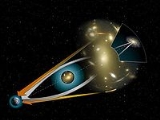
A gravitational lens refers to a distribution of matter (such as a cluster of galaxies
) between a distant source (a background galaxy
) and an observer, that is capable of bending (lensing) the light from the source, as it travels towards the observer. This effect is known as gravitational lensing and is one of the predictions of Albert Einstein
's General Theory of Relativity
.
Although Orest Chwolson is credited as being the first to discuss the effect in print in 1924, the effect is more commonly associated with Einstein, who published a more famous article on the subject in 1936.
Fritz Zwicky
posited in 1937 that the effect could allow galaxy clusters to act as gravitational lenses. It was not until 1979 that this effect was confirmed by observation of the so-called "Twin QSO" SBS 0957+561.
A gravitational image can be confused with image of a Strömgren sphere
. The following tests can distinguish between the two types of images: - the spectra of a Strömgren sphere
are discrete, and hydrogen lines are dominant. - the phases of two adjacent spots of Strömgren spheres differ by pi, so a well visible necklace consists of an even number of spots.
 Spacetime
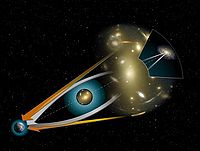
around a massive object (such as a galaxy cluster
or a black hole
) is curved, and as a result light
rays from a background source (such as a galaxy
) propagating through spacetime are bent. The lensing effect can magnify and distort the image of the background source.
Unlike an optical lens
, maximum 'bending' occurs closest to, and minimum 'bending' furthest from, the center of a gravitational lens. Consequently, a gravitational lens has no single focal point
, but a focal line instead. If the (light) source, the massive lensing object, and the observer lie in a straight line, the original light source will appear as a ring around the massive lensing object. If there is any misalignment the observer will see an arc segment instead. This phenomenon was first mentioned in 1924 by the St. Petersburg physicist Orest Chwolson, and quantified by Albert Einstein
in 1936. It is usually referred to in the literature as an Einstein ring
, since Chwolson did not concern himself with the flux or radius of the ring image. More commonly, where the lensing mass is complex (such as galaxy groups and clusters
) and does not cause a spherical distortion of space–time, the source will resemble partial arcs scattered around the lens. The observer may then see multiple distorted images of the same source; the number and shape of these depending upon the relative positions of the source, lens, and observer, and the shape of the gravitational well of the lensing object.
There are three classes of gravitational lensing:
1. Strong lensing: where there are easily visible distortions such as the formation of Einstein ring
s, arcs, and multiple images.
2. Weak lensing
: where the distortions of background sources are much smaller and can only be detected by analyzing large numbers of sources to find coherent distortions of only a few percent. The lensing shows up statistically as a preferred stretching of the background objects perpendicular to the direction to the center of the lens.
By measuring the shapes and orientations of large numbers of distant galaxies, their orientations can be averaged to measure the shear
of the lensing field in any region. This, in turn, can be used to reconstruct the mass distribution in the area: in particular, the background distribution of dark matter
can be reconstructed. Since galaxies are intrinsically elliptical and the weak gravitational lensing signal is small, a very large number of galaxies must be used in these surveys. These weak lensing surveys must carefully avoid a number of important sources of systematic error
: the intrinsic shape of galaxies, the tendency of a camera's point spread function
to distort the shape of a galaxy and the tendency of atmospheric seeing to distort images must be understood and carefully accounted for. The results of these surveys are important for cosmological parameter estimation, to better understand and improve upon the Lambda-CDM model
, and to provide a consistency check on other cosmological observations. They may also provide an important future constraint on dark energy
.
3. Microlensing
: where no distortion in shape can be seen but the amount of light received from a background object changes in time. The lensing object may be stars in the Milky Way in one typical case, with the background source being stars in a remote galaxy, or, in another case, an even more distant quasar
. The effect is small, such that (in the case of strong lensing) even a galaxy with a mass more than 100 billion times that of the sun
will produce multiple images separated by only a few arcseconds. Galaxy cluster
s can produce separations of several arcminutes. In both cases the galaxies and sources are quite distant, many hundreds of megaparsecs away from our Galaxy.
Gravitational lenses act equally on all kinds of electromagnetic radiation
, not just visible light. Weak lensing effects are being studied for the cosmic microwave background as well as galaxy surveys. Strong lenses have been observed in radio
and x-ray
regimes as well. If a strong lens produces multiple images, there will be a relative time delay between two paths: that is, in one image the lensed object will be observed before the other image.
"warps" space–time to create gravitational field
s and therefore bend light
as a result. This theory was confirmed in 1919 during a solar eclipse
, when Arthur Eddington observed the light from star
s passing close to the sun
was slightly bent, so that stars appeared slightly out of position.
Einstein realized that it was also possible for astronomical object
s to bend light, and that under the correct conditions, one would observe multiple images of a single source, called a gravitational lens or sometimes a gravitational mirage
.
However, as he only considered gravitational lensing by single stars, he concluded that the phenomenon would most likely remain unobserved for the foreseeable future. In 1937, Fritz Zwicky
first considered the case where a galaxy
could act as a source, something that according to his calculations should be well within the reach of observations.
It was not until 1979 that the first gravitational lens would be discovered. It became known as the "Twin QSO" since it initially looked like two identical quasistellar objects; it is officially named SBS 0957+561. This gravitational lens was discovered accidentally by Dennis Walsh
, Bob Carswell, and Ray Weymann using the Kitt Peak National Observatory
2.1 meter telescope
.
In the 1980s, astronomers realized that the combination of CCD imagers and computers would allow the brightness of millions of stars to be measured each night. In a dense field, such as the galactic center or the Magellanic clouds, many microlensing events per year could potentially be found. This led to efforts such as Optical Gravitational Lensing Experiment
, or OGLE, that have characterized hundreds of such events.
Light rays are the boundary between the future, the spacelike, and the past regions. The gravitational attraction can be viewed as the motion of undisturbed objects in a background curved geometry or alternatively as the response of objects to a force in a flat geometry. The angle of deflection is:

toward the mass M at a distance r from the affected radiation, where G is the universal constant of gravitation
and c is the speed of light in a vacuum. Some care needs to be taken in defining this distance because gravity is not instantaneous: like light, it propagates at speed c. The path of the gravitational wave and the electromagnetic radiation intersect at specific space–time coordinates, and the lensing is determined by the component of the incident gravitational wave perpendicular to the direction of the electromagnetic radiation's motion.
A similar search in the southern hemisphere would be a very good step towards complementing the northern hemisphere search as well as obtaining other objectives for study. As can be expected, if such a search is done using well calibrated and well parametrized instrument and data, we can expect to have a very good outcome. The use of the Australia Telescope 20 GHz (AT20G) Survey data collected using the Australia Telescope Compact Array (ATCA) stands to be such a collection of data. As the data were collected using the same instrument maintaining a very stringent quality of data we should expect to obtain good results from the search. The AT20G survey is a blind survey at 20 GHz frequency in the radio domain of the electromagnetic spectrum. Due to the high frequency used, the chances finding gravitational lenses increases as the relative number of compact core objects (e.g. Quasars) are higher (Sadler et al. 2006). This is important as the lensing is easier to detect and identify in simple objects compared to objects with complexity in them. This search involves the use of interferometric methods to identify candidates and follow them up at higher resolution to identify them. Full detail of the project is currently under works for publication.
In a recent article on Science Daily (Jan. 21 2009) a team of scientists led by a cosmologist from the U.S. Department of Energy's Lawrence Berkeley National Laboratory has made major progress in extending the use of gravitational lensing to the study of much older and smaller structures than was previously possible by stating that weak gravitational lensing improves measurements of distant galaxies.
Galaxy cluster
A galaxy cluster is a compact cluster of galaxies. Basic difference between a galaxy group and a galaxy cluster is that there are many more galaxies in a cluster than in a group. Also, galaxies in a cluster are more compact and have higher velocity dispersion. One of the key features of cluster is...
) between a distant source (a background galaxy
Galaxy
A galaxy is a massive, gravitationally bound system that consists of stars and stellar remnants, an interstellar medium of gas and dust, and an important but poorly understood component tentatively dubbed dark matter. The word galaxy is derived from the Greek galaxias , literally "milky", a...
) and an observer, that is capable of bending (lensing) the light from the source, as it travels towards the observer. This effect is known as gravitational lensing and is one of the predictions of Albert Einstein
Albert Einstein
Albert Einstein was a German-born theoretical physicist who developed the theory of general relativity, effecting a revolution in physics. For this achievement, Einstein is often regarded as the father of modern physics and one of the most prolific intellects in human history...
's General Theory of Relativity
General relativity
General relativity or the general theory of relativity is the geometric theory of gravitation published by Albert Einstein in 1916. It is the current description of gravitation in modern physics...
.
Although Orest Chwolson is credited as being the first to discuss the effect in print in 1924, the effect is more commonly associated with Einstein, who published a more famous article on the subject in 1936.
Fritz Zwicky
Fritz Zwicky
Fritz Zwicky was a Swiss astronomer. He worked most of his life at the California Institute of Technology in the United States of America, where he made many important contributions in theoretical and observational astronomy.- Biography :Fritz Zwicky was born in Varna, Bulgaria to a Swiss father....
posited in 1937 that the effect could allow galaxy clusters to act as gravitational lenses. It was not until 1979 that this effect was confirmed by observation of the so-called "Twin QSO" SBS 0957+561.
A gravitational image can be confused with image of a Strömgren sphere
Strömgren sphere
In theoretical astrophysics, a Strömgren sphere is the sphere of ionized hydrogen around a young star of the spectral classes O or B. Its counterpart in the real world are the H II-regions, a type of emission nebula, the most prominent of which is the Rosette Nebula...
. The following tests can distinguish between the two types of images: - the spectra of a Strömgren sphere
Strömgren sphere
In theoretical astrophysics, a Strömgren sphere is the sphere of ionized hydrogen around a young star of the spectral classes O or B. Its counterpart in the real world are the H II-regions, a type of emission nebula, the most prominent of which is the Rosette Nebula...
are discrete, and hydrogen lines are dominant. - the phases of two adjacent spots of Strömgren spheres differ by pi, so a well visible necklace consists of an even number of spots.
Description
Spacetime
In physics, spacetime is any mathematical model that combines space and time into a single continuum. Spacetime is usually interpreted with space as being three-dimensional and time playing the role of a fourth dimension that is of a different sort from the spatial dimensions...
around a massive object (such as a galaxy cluster
Galaxy cluster
A galaxy cluster is a compact cluster of galaxies. Basic difference between a galaxy group and a galaxy cluster is that there are many more galaxies in a cluster than in a group. Also, galaxies in a cluster are more compact and have higher velocity dispersion. One of the key features of cluster is...
or a black hole
Black hole
A black hole is a region of spacetime from which nothing, not even light, can escape. The theory of general relativity predicts that a sufficiently compact mass will deform spacetime to form a black hole. Around a black hole there is a mathematically defined surface called an event horizon that...
) is curved, and as a result light
Light
Light or visible light is electromagnetic radiation that is visible to the human eye, and is responsible for the sense of sight. Visible light has wavelength in a range from about 380 nanometres to about 740 nm, with a frequency range of about 405 THz to 790 THz...
rays from a background source (such as a galaxy
Galaxy
A galaxy is a massive, gravitationally bound system that consists of stars and stellar remnants, an interstellar medium of gas and dust, and an important but poorly understood component tentatively dubbed dark matter. The word galaxy is derived from the Greek galaxias , literally "milky", a...
) propagating through spacetime are bent. The lensing effect can magnify and distort the image of the background source.
Unlike an optical lens
Lens (optics)
A lens is an optical device with perfect or approximate axial symmetry which transmits and refracts light, converging or diverging the beam. A simple lens consists of a single optical element...
, maximum 'bending' occurs closest to, and minimum 'bending' furthest from, the center of a gravitational lens. Consequently, a gravitational lens has no single focal point
Focus (optics)
In geometrical optics, a focus, also called an image point, is the point where light rays originating from a point on the object converge. Although the focus is conceptually a point, physically the focus has a spatial extent, called the blur circle. This non-ideal focusing may be caused by...
, but a focal line instead. If the (light) source, the massive lensing object, and the observer lie in a straight line, the original light source will appear as a ring around the massive lensing object. If there is any misalignment the observer will see an arc segment instead. This phenomenon was first mentioned in 1924 by the St. Petersburg physicist Orest Chwolson, and quantified by Albert Einstein
Albert Einstein
Albert Einstein was a German-born theoretical physicist who developed the theory of general relativity, effecting a revolution in physics. For this achievement, Einstein is often regarded as the father of modern physics and one of the most prolific intellects in human history...
in 1936. It is usually referred to in the literature as an Einstein ring
Einstein ring
In observational astronomy an Einstein ring is the deformation of the light from a source into a ring through gravitational lensing of the source's light by an object with an extremely large mass . This occurs when the source, lens and observer are all aligned...
, since Chwolson did not concern himself with the flux or radius of the ring image. More commonly, where the lensing mass is complex (such as galaxy groups and clusters
Galaxy groups and clusters
Galaxy groups and clusters are the largest known gravitationally bound objects to have arisen thus far in the process of cosmic structure formation. They form the densest part of the large scale structure of the universe...
) and does not cause a spherical distortion of space–time, the source will resemble partial arcs scattered around the lens. The observer may then see multiple distorted images of the same source; the number and shape of these depending upon the relative positions of the source, lens, and observer, and the shape of the gravitational well of the lensing object.
There are three classes of gravitational lensing:
1. Strong lensing: where there are easily visible distortions such as the formation of Einstein ring
Einstein ring
In observational astronomy an Einstein ring is the deformation of the light from a source into a ring through gravitational lensing of the source's light by an object with an extremely large mass . This occurs when the source, lens and observer are all aligned...
s, arcs, and multiple images.
2. Weak lensing
Weak gravitational lensing
While the presence of any mass bends the path of light passing near it, this effect rarely produces the giant arcs and multiple images associated with strong gravitational lensing. Most lines of sight in the universe are thoroughly in the weak lensing regime, in which the deflection is impossible...
: where the distortions of background sources are much smaller and can only be detected by analyzing large numbers of sources to find coherent distortions of only a few percent. The lensing shows up statistically as a preferred stretching of the background objects perpendicular to the direction to the center of the lens.
By measuring the shapes and orientations of large numbers of distant galaxies, their orientations can be averaged to measure the shear
Shear matrix
In mathematics, a shear matrix or transvection is an elementary matrix that represents the addition of a multiple of one row or column to another...
of the lensing field in any region. This, in turn, can be used to reconstruct the mass distribution in the area: in particular, the background distribution of dark matter
Dark matter
In astronomy and cosmology, dark matter is matter that neither emits nor scatters light or other electromagnetic radiation, and so cannot be directly detected via optical or radio astronomy...
can be reconstructed. Since galaxies are intrinsically elliptical and the weak gravitational lensing signal is small, a very large number of galaxies must be used in these surveys. These weak lensing surveys must carefully avoid a number of important sources of systematic error
Systematic error
Systematic errors are biases in measurement which lead to the situation where the mean of many separate measurements differs significantly from the actual value of the measured attribute. All measurements are prone to systematic errors, often of several different types...
: the intrinsic shape of galaxies, the tendency of a camera's point spread function
Point spread function
The point spread function describes the response of an imaging system to a point source or point object. A more general term for the PSF is a system's impulse response, the PSF being the impulse response of a focused optical system. The PSF in many contexts can be thought of as the extended blob...
to distort the shape of a galaxy and the tendency of atmospheric seeing to distort images must be understood and carefully accounted for. The results of these surveys are important for cosmological parameter estimation, to better understand and improve upon the Lambda-CDM model
Lambda-CDM model
ΛCDM or Lambda-CDM is an abbreviation for Lambda-Cold Dark Matter, which is also known as the cold dark matter model with dark energy...
, and to provide a consistency check on other cosmological observations. They may also provide an important future constraint on dark energy
Dark energy
In physical cosmology, astronomy and celestial mechanics, dark energy is a hypothetical form of energy that permeates all of space and tends to accelerate the expansion of the universe. Dark energy is the most accepted theory to explain recent observations that the universe appears to be expanding...
.
3. Microlensing
Gravitational microlensing
Gravitational microlensing is an astronomical phenomenon due to the gravitational lens effect. It can be used to detect objects ranging from the mass of a planet to the mass of a star, regardless of the light they emit. Typically, astronomers can only detect bright objects that emit lots of light ...
: where no distortion in shape can be seen but the amount of light received from a background object changes in time. The lensing object may be stars in the Milky Way in one typical case, with the background source being stars in a remote galaxy, or, in another case, an even more distant quasar
Quasar
A quasi-stellar radio source is a very energetic and distant active galactic nucleus. Quasars are extremely luminous and were first identified as being high redshift sources of electromagnetic energy, including radio waves and visible light, that were point-like, similar to stars, rather than...
. The effect is small, such that (in the case of strong lensing) even a galaxy with a mass more than 100 billion times that of the sun
Solar mass
The solar mass , , is a standard unit of mass in astronomy, used to indicate the masses of other stars and galaxies...
will produce multiple images separated by only a few arcseconds. Galaxy cluster
Galaxy cluster
A galaxy cluster is a compact cluster of galaxies. Basic difference between a galaxy group and a galaxy cluster is that there are many more galaxies in a cluster than in a group. Also, galaxies in a cluster are more compact and have higher velocity dispersion. One of the key features of cluster is...
s can produce separations of several arcminutes. In both cases the galaxies and sources are quite distant, many hundreds of megaparsecs away from our Galaxy.
Gravitational lenses act equally on all kinds of electromagnetic radiation
Electromagnetic radiation
Electromagnetic radiation is a form of energy that exhibits wave-like behavior as it travels through space...
, not just visible light. Weak lensing effects are being studied for the cosmic microwave background as well as galaxy surveys. Strong lenses have been observed in radio
Radio
Radio is the transmission of signals through free space by modulation of electromagnetic waves with frequencies below those of visible light. Electromagnetic radiation travels by means of oscillating electromagnetic fields that pass through the air and the vacuum of space...
and x-ray
X-ray
X-radiation is a form of electromagnetic radiation. X-rays have a wavelength in the range of 0.01 to 10 nanometers, corresponding to frequencies in the range 30 petahertz to 30 exahertz and energies in the range 120 eV to 120 keV. They are shorter in wavelength than UV rays and longer than gamma...
regimes as well. If a strong lens produces multiple images, there will be a relative time delay between two paths: that is, in one image the lensed object will be observed before the other image.
History
According to general relativity, massMass
Mass can be defined as a quantitive measure of the resistance an object has to change in its velocity.In physics, mass commonly refers to any of the following three properties of matter, which have been shown experimentally to be equivalent:...
"warps" space–time to create gravitational field
Gravitational field
The gravitational field is a model used in physics to explain the existence of gravity. In its original concept, gravity was a force between point masses...
s and therefore bend light
Light
Light or visible light is electromagnetic radiation that is visible to the human eye, and is responsible for the sense of sight. Visible light has wavelength in a range from about 380 nanometres to about 740 nm, with a frequency range of about 405 THz to 790 THz...
as a result. This theory was confirmed in 1919 during a solar eclipse
Solar eclipse
As seen from the Earth, a solar eclipse occurs when the Moon passes between the Sun and the Earth, and the Moon fully or partially blocks the Sun as viewed from a location on Earth. This can happen only during a new moon, when the Sun and the Moon are in conjunction as seen from Earth. At least...
, when Arthur Eddington observed the light from star
Star
A star is a massive, luminous sphere of plasma held together by gravity. At the end of its lifetime, a star can also contain a proportion of degenerate matter. The nearest star to Earth is the Sun, which is the source of most of the energy on Earth...
s passing close to the sun
Sun
The Sun is the star at the center of the Solar System. It is almost perfectly spherical and consists of hot plasma interwoven with magnetic fields...
was slightly bent, so that stars appeared slightly out of position.
Einstein realized that it was also possible for astronomical object
Astronomical object
Astronomical objects or celestial objects are naturally occurring physical entities, associations or structures that current science has demonstrated to exist in the observable universe. The term astronomical object is sometimes used interchangeably with astronomical body...
s to bend light, and that under the correct conditions, one would observe multiple images of a single source, called a gravitational lens or sometimes a gravitational mirage
Gravitational mirage
A gravitational mirage is the visual impression caused by a so-called gravitational lens in space, which may include multiple images, rings, etc. of background light sources. This is analogous to the familiar mirage which can frequently be observed where the air temperature varies strongly with...
.
However, as he only considered gravitational lensing by single stars, he concluded that the phenomenon would most likely remain unobserved for the foreseeable future. In 1937, Fritz Zwicky
Fritz Zwicky
Fritz Zwicky was a Swiss astronomer. He worked most of his life at the California Institute of Technology in the United States of America, where he made many important contributions in theoretical and observational astronomy.- Biography :Fritz Zwicky was born in Varna, Bulgaria to a Swiss father....
first considered the case where a galaxy
Galaxy
A galaxy is a massive, gravitationally bound system that consists of stars and stellar remnants, an interstellar medium of gas and dust, and an important but poorly understood component tentatively dubbed dark matter. The word galaxy is derived from the Greek galaxias , literally "milky", a...
could act as a source, something that according to his calculations should be well within the reach of observations.
It was not until 1979 that the first gravitational lens would be discovered. It became known as the "Twin QSO" since it initially looked like two identical quasistellar objects; it is officially named SBS 0957+561. This gravitational lens was discovered accidentally by Dennis Walsh
Dennis Walsh
Dennis Walsh was an English astronomer, born into a poor family in Manchester. He was best known for his discovery in 1979 of the first example of a gravitational lens which he made while studying quasars found in the Jodrell Bank 966MHz survey.He developed an early aptitude for mathematics and...
, Bob Carswell, and Ray Weymann using the Kitt Peak National Observatory
Kitt Peak National Observatory
The Kitt Peak National Observatory is a United States astronomical observatory located on 2,096 m Kitt Peak of the Quinlan Mountains in the Arizona-Sonoran Desert on the Tohono O'odham Nation, southwest of Tucson...
2.1 meter telescope
Telescope
A telescope is an instrument that aids in the observation of remote objects by collecting electromagnetic radiation . The first known practical telescopes were invented in the Netherlands at the beginning of the 1600s , using glass lenses...
.
In the 1980s, astronomers realized that the combination of CCD imagers and computers would allow the brightness of millions of stars to be measured each night. In a dense field, such as the galactic center or the Magellanic clouds, many microlensing events per year could potentially be found. This led to efforts such as Optical Gravitational Lensing Experiment
Optical Gravitational Lensing Experiment
The Optical Gravitational Lensing Experiment or OGLE is a Polish astronomical project based at the University of Warsaw that is chiefly concerned with discovering dark matter using the microlensing technique. Since the project began in 1992, it has discovered several extrasolar planets as a side...
, or OGLE, that have characterized hundreds of such events.
Explanation in terms of space–time curvature
In general relativity, light follows the curvature of spacetime, hence when light passes around a massive object, it is bent. This means that the light from an object on the other side will be bent towards your eye, just like an ordinary lens. Since light always moves at a constant speed, lensing changes the direction of the velocity of the light, but not the magnitude.Light rays are the boundary between the future, the spacelike, and the past regions. The gravitational attraction can be viewed as the motion of undisturbed objects in a background curved geometry or alternatively as the response of objects to a force in a flat geometry. The angle of deflection is:
toward the mass M at a distance r from the affected radiation, where G is the universal constant of gravitation
Gravitational constant
The gravitational constant, denoted G, is an empirical physical constant involved in the calculation of the gravitational attraction between objects with mass. It appears in Newton's law of universal gravitation and in Einstein's theory of general relativity. It is also known as the universal...
and c is the speed of light in a vacuum. Some care needs to be taken in defining this distance because gravity is not instantaneous: like light, it propagates at speed c. The path of the gravitational wave and the electromagnetic radiation intersect at specific space–time coordinates, and the lensing is determined by the component of the incident gravitational wave perpendicular to the direction of the electromagnetic radiation's motion.
Search for gravitational lenses
Most of the gravitational lenses in the past have been discovered accidentally. A search for gravitational lenses in the northern hemisphere (Cosmic Lens All Sky Survey, CLASS), done in radio frequencies using the Very Large Array (VLA) in New Mexico, led to the discovery of 22 new lensing systems, a major milestone. This has opened a whole new avenue for research ranging from finding very distant objects to finding values for cosmological parameters so we can understand the universe better.A similar search in the southern hemisphere would be a very good step towards complementing the northern hemisphere search as well as obtaining other objectives for study. As can be expected, if such a search is done using well calibrated and well parametrized instrument and data, we can expect to have a very good outcome. The use of the Australia Telescope 20 GHz (AT20G) Survey data collected using the Australia Telescope Compact Array (ATCA) stands to be such a collection of data. As the data were collected using the same instrument maintaining a very stringent quality of data we should expect to obtain good results from the search. The AT20G survey is a blind survey at 20 GHz frequency in the radio domain of the electromagnetic spectrum. Due to the high frequency used, the chances finding gravitational lenses increases as the relative number of compact core objects (e.g. Quasars) are higher (Sadler et al. 2006). This is important as the lensing is easier to detect and identify in simple objects compared to objects with complexity in them. This search involves the use of interferometric methods to identify candidates and follow them up at higher resolution to identify them. Full detail of the project is currently under works for publication.
In a recent article on Science Daily (Jan. 21 2009) a team of scientists led by a cosmologist from the U.S. Department of Energy's Lawrence Berkeley National Laboratory has made major progress in extending the use of gravitational lensing to the study of much older and smaller structures than was previously possible by stating that weak gravitational lensing improves measurements of distant galaxies.
External links
- Video: Evalyn Gates – Einstein's Telescope: The Search for Dark Matter and Dark Energy in the Universe, presentation in Portland, Oregon, on April 19, 2009, from the author's recent book tour.
- Audio: Fraser Cain and Dr. Pamela Gay – Astronomy Cast: Gravitational Lensing, May 2007