
All Topics  
Magnifying glass

 
Magnifying Glass

   Email Print
   Bookmark   Link


Magnifying glass


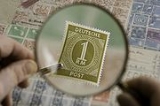
A magnifying glass (called a hand lens in laboratory contexts) is a convex lens
Lens (optics)

A lens is an optics device with perfect or approximate axial symmetry which transmittance and refraction light, converging or diverging the beam....
 which is used to produce a magnified
Magnification

Magnification is the process of enlarging something only in appearance, not in physical size. This enlargement is quantified by a calculated number also called magnification....
 image
Image

An image is an artifact, usually two-dimensional , that has a similar appearance to some subject —usually a physical object or a person....
 of an object. The lens
Lens (optics)

A lens is an optics device with perfect or approximate axial symmetry which transmittance and refraction light, converging or diverging the beam....
 is usually mounted in a frame with a handle (see image).

A magnifying glass works by creating a magnified virtual image
Virtual image

In optics, a virtual image is an image in which the outgoing ray from a point on the object never actually intersect at a point. A simple example is a plane mirror where the image of oneself is perceived at twice the distance from oneself to the mirror....
 of an object behind the lens. The distance between the lens and the object must be shorter than the focal length
Focal length

The focal length of an optics system is a measure of how strongly it converges or diverges light. A system with a shorter focal length has greater optical power than one with a long focal length....
 of the lens for this to occur.


Discussion
Ask a question about 'Magnifying glass'
Start a new discussion about 'Magnifying glass'
Answer questions from other users
Full Discussion Forum


Encyclopedia


A magnifying glass (called a hand lens in laboratory contexts) is a convex lens
Lens (optics)

A lens is an optics device with perfect or approximate axial symmetry which transmittance and refraction light, converging or diverging the beam....
 which is used to produce a magnified
Magnification

Magnification is the process of enlarging something only in appearance, not in physical size. This enlargement is quantified by a calculated number also called magnification....
 image
Image

An image is an artifact, usually two-dimensional , that has a similar appearance to some subject —usually a physical object or a person....
 of an object. The lens
Lens (optics)

A lens is an optics device with perfect or approximate axial symmetry which transmittance and refraction light, converging or diverging the beam....
 is usually mounted in a frame with a handle (see image).

A magnifying glass works by creating a magnified virtual image
Virtual image

In optics, a virtual image is an image in which the outgoing ray from a point on the object never actually intersect at a point. A simple example is a plane mirror where the image of oneself is perceived at twice the distance from oneself to the mirror....
 of an object behind the lens. The distance between the lens and the object must be shorter than the focal length
Focal length

The focal length of an optics system is a measure of how strongly it converges or diverges light. A system with a shorter focal length has greater optical power than one with a long focal length....
 of the lens for this to occur. Otherwise, the image appears smaller and inverted, and can be used to project images onto surfaces.

The framed lens may be mounted on a stand, keeping the lens at the right distance from the table, and therefore at the right distance from the object on the table. The latter applies if the object is small, and also if the height is adjustable. Some magnifying glasses are foldable (from the handle or stand).

A sheet magnifier consists of many very narrow concentric ring-shaped lenses, such that the combination acts as a single lens but is much thinner. This arrangement is known as a Fresnel lens
Fresnel lens

A Fresnel lens is a type of lens invented by France physics Augustin-Jean Fresnel. Originally developed for lighthouses, the design enables the construction of lenses of large aperture and short focal length without the weight and volume of material which would be required in conventional lens design....
.

A loupe
Loupe

A loupe , is a type of magnification device used to see things one is looking at more closely. In this respect, they are simply a form of a modified microscope, allowing the user to be able to better apply the phenomenon of microscopy to his or her trade....
 is a small magnification device used by surgeons, dentists, jewelers, watchmakers, and other precision craftsmen. The magnification of jewelers' loupes for studying gemstones is typically on the order of 10×.

The magnifying glass is an icon of detective fiction
Detective fiction

Detective fiction is a branch of crime fiction in which a detective , either professional or amateur, investigate a crime, usually murder. Detective fiction is the most popular form of both mystery fiction and hardboiled crime fiction....
, particularly that of Sherlock Holmes
Sherlock Holmes

Sherlock Holmes is a fictional character of the late nineteenth and early twentieth centuries, who first appeared in publication in 1887. He is the creation of Scotland-born author and physician Sir Arthur Conan Doyle....
.

Visually impaired
Visual impairment

Visual impairment or vision impairment is vision loss having reduced vision as to constitute a handicap that constitutes a significant limitation of visual perception capability resulting from disease, Physical trauma, or a congenital or degenerative condition that cannot be corrected by conventional means, including refractive correcti...
 people often benefit from magnifying glasses and similar low vision
Low vision

Low vision is a subspecialty within the professions of optometry and ophthalmology and opticianry dealing with individuals who have less than normal vision even with the most accurate conventional prescription available....
 aids.

History

The earliest evidence of "a magnifying device, a convex lens forming a magnified image," dates back to the Book of Optics
Book of Optics

The Book of Optics was a seven-volume treatise on optics, Islamic physics, Islamic mathematics, Islamic medicine and Islamic psychology written by the Iraqi Islamic science Ibn al-Haytham in 1011?21, when he was under house arrest in Cairo, Egypt....
 published by Alhazen in 1021. After the book was translated into Latin
Latin

Latin is an Italic language, historically spoken in Latium and Ancient Rome. Through the Military history of the Roman Empire, Latin spread throughout the Mediterranean and a large part of Europe....
, during the Latin translations of the 12th century, Roger Bacon
Roger Bacon

For the Nova Scotia premier see Roger Bacon .Roger Bacon, Order of Friars Minor , also known as Doctor Mirabilis , was an England philosopher and Franciscan friar who placed considerable emphasis on empiricism....
 described the properties of magnifying glass in 13th-century England
England

native_name =|conventional_long_name = England|common_name = England|image_flag = Flag of England.svg|image_coat = England COA.svg|symbol_type = Royal Coat of Arms...
, followed by the development of eyeglasses
Glasses

Glasses or specs, more formally known as eyeglasses or spectacles, are frames bearing lens worn in front of the eyes, normally for Corrective lens, eye protection, or for UV Coating....
 in 13th-century Italy
Italy

Italy , officially the Italian Republic , is a country located on the Italian Peninsula in Southern Europe and on the two largest islands in the Mediterranean Sea, Sicily and Sardinia....
.

Magnification

Us Navy Magnifying Glass 030903 N 2143t 001
The magnification
Magnification

Magnification is the process of enlarging something only in appearance, not in physical size. This enlargement is quantified by a calculated number also called magnification....
 of a magnifying glass depends on where it is placed between the user's eye and the object being viewed, and the total distance between the eye and the object. Magnifying glasses are typically described in terms of their magnifying power, which is equivalent to angular magnification (this should not be confused with optical power
Optical power

Optical power is the degree to which a lens , mirror, or other optical system converges or diverges light. It is equal to the Multiplicative inverse of the focal length of the device....
, which is a different quantity). The magnifying power is the ratio of the sizes of the images formed on the user's retina with and without the lens. For the "without" case, it is typically assumed that the user would bring the object as close to the eye as possible without it becoming blurry. This point, known as the near point, varies with age
Presbyopia

Presbyopia describes the condition where the eye exhibits a progressively diminished ability to focus on near objects with age. Presbyopia's exact mechanisms are not known with certainty, however, the research evidence most strongly supports a loss of elasticity of the Lens , although changes in the lens's curvature from continual growth and...
. In a young child it can be as close as 5 cm, while in an elderly person it may be as far as one or two metres. Magnifiers are typically characterized using a "standard" value of 0.25 m.

The highest magnifying power is obtained by putting the lens very close to the eye and moving the eye and the lens together to obtain the best focus. The object will then typically also be close to the lens. The magnifying power obtained in this condition is MP0=¼F+1, where F is the optical power in dioptre
Dioptre

A dioptre, or diopter, is a unit of measurement of the optical power of a lens or curved mirror, which is equal to the Multiplicative inverse of the focal length measured in metres ....
s, and the factor of ¼ comes from the assumed distance to the near point (about 25cm from the eye). This value of the magnifying power is the one normally used to characterize magnifiers. It is typically denoted "m×", where m=MP0. This is sometimes called the total power of the magnifier (again, not to be confused with optical power).

Magnifiers are not always used as described above, however. It is much more comfortable to put the magnifier close to the object (one focal length away). The eye can then be a larger distance away, and a good image can be obtained very easily; the focus is not very sensitive to the eye's exact position. The magnifying power in this case is roughly MP=¼F.

A typical magnifying glass might have a focal length
Focal length

The focal length of an optics system is a measure of how strongly it converges or diverges light. A system with a shorter focal length has greater optical power than one with a long focal length....
 of 25 cm, corresponding to an optical power of 4 dioptres. Such a magnifier would be sold as a "2×" magnifier. In actual use, an observer with "typical" eyes would obtain a magnifying power between 1 and 2, depending on where lens is held. An older person might obtain an actual magnifying power of 8 or more with this lens, however, due to the eye's longer near point distance.

See also

  • Burning-glass
    Burning-glass

    A burning-glass is a large Lens #Types of lenses that can concentrate the sun's rays onto a small area, heating up the area and thus resulting in Combustion of the exposed surface....
  • Eyeglasses
    Glasses

    Glasses or specs, more formally known as eyeglasses or spectacles, are frames bearing lens worn in front of the eyes, normally for Corrective lens, eye protection, or for UV Coating....
  • Screen magnifier
    Screen magnifier

    A screen magnifier is software that interfaces with a computer's graphical output to present enlarged screen content. It is a type of assistive technology suitable for visual impairment people with some functional vision; visually impaired people with little or no functional vision usually use a Screen reader....
  • Coddington magnifier
    Coddington magnifier

    A Coddington magnifier is a is magnifying glass consisting of a single very thick lens with a central deep groove diaphragm at the equator, thus limiting the rays to those close to the axis, which again minimizes spherical aberration....