


Photographic lens

Encyclopedia
A camera lens is an optical
lens
or assembly of lenses used in conjunction with a camera
body and mechanism to make images of objects either on photographic film
or on other media capable of storing an image chemically or electronically.
While in principle a simple convex lens
will suffice, in practice a compound lens made up of a number of optical lens elements
is required to correct (as much as possible) the many optical aberrations that arise. Some aberrations will be present in any lens system. It is the job of the lens designer to balance these out and produce a design that is suitable for photographic use and possibly mass production.
There is no major difference in principle between a lens used for a still camera
, a video camera
, a telescope
, a microscope
, or other apparatus, but the detailed design and construction are different.
A lens may be permanently fixed to a camera, or it may be interchangeable with lenses of different focal length
s, aperture
s, and other properties.
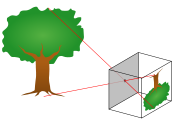 Typical rectilinear lens
es can be thought of as "improved" pinhole lens
es. As shown, a pinhole lens uses a tiny aperture to block most rays of light, ideally selecting one ray to the object for each point on the image sensor. Pinhole lenses would be excellent except for a few serious limitations:
Such lenses can be thought of as an answer to the question "how can we modify a pinhole lens to admit more light and give higher resolution?" A first step is to put a simple convex lens at the pinhole with a focal length equal to the distance to the film plane (assuming the camera will take pictures of distant objects). This allows us to open up the pinhole significantly (below right) because the convex lens bends light in proportion to its angle of incidence on the lens. The geometry is almost the same as with a simple pinhole lens, but rather than being illuminated by single rays of light, each image point is illuminated by a focused "pencil" of light rays. Standing in front of the camera, you would see the small hole, the aperture. The virtual image
of the aperture as seen from the world is known as the lens's entrance pupil
; ideally, all rays of light leaving a point on the object that enter the entrance pupil will be focused to the same point on the image sensor/film (provided the object point is in the field of view). If one were inside the camera, one would see the lens acting as a projector
. The virtual image of the aperture from inside the camera is the lens's exit pupil
.
Practical photographic lenses include more lens elements. The additional elements allow lens designers to reduce various aberrations, but the principle of operation remains the same: pencils of rays
are collected at the entrance pupil and focused down from the exit pupil onto the image plane.
 A camera lens may be made from a number of elements: from one, as in the Box Brownie's meniscus lens, to over 20 in the more complex zooms. These elements may themselves comprise a group of lenses cemented together.
The front element is critical to the performance of the whole assembly. In all modern lenses the surface is coated to reduce abrasion, flare
, and surface reflectance, and to adjust color balance. To minimize aberration, the curvature is usually set so that the angle of incidence
and the angle of refraction are equal. In a prime lens this is easy, but in a zoom there is always a compromise.
The lens usually is focused
by adjusting the distance from the lens assembly to the image plane, or by moving elements of the lens assembly. To improve performance, some lenses have a cam system that adjusts the distance between the groups as the lens is focused. Manufacturers call this different things. Nikon
calls it CRC (close range correction), while Hasselblad
and Mamiya
call it FLE (floating lens element).
Glass
is the most common material used to construct lens elements, due to its good optical properties and resistance to scratching. Other materials are also used, such as quartz glass, fluorite
, plastics like acrylic
(Plexiglass), and even germanium
and meteoritic glass
. Plastics allow the manufacturing of strongly aspherical lens elements which are difficult or impossible to manufacture in glass, and which simplify or improve lens manufacturing and performance. Plastics are not used for the outermost elements of all but the cheapest lenses as they scratch easily. Molded plastic lenses have been used for the cheapest disposable cameras for many years, and have acquired a bad reputation: manufacturers of quality optics tend to use euphemisms such as "optical resin". However many modern, high performance (and high priced) lenses from popular manufacturers include molded or hybrid aspherical elements, so it is not true that all lenses with plastic elements are of low photographic quality.
The 1951 USAF resolution test chart
is one way to measure the resolving power of a lens. The quality of the material, coatings, and build affect the resolution. Lens resolution is ultimately limited by diffraction
, and very few photographic lenses approach this resolution. Ones that do are called "diffraction limited" and are usually extremely expensive.
Today, most lenses are multi-coated
in order to minimize lens flare
and other unwanted effects. Some lenses have a UV coating to keep out the ultraviolet
light that could taint color. Most modern optical cements for bonding glass elements also block UV light, negating the need for a UV filter. UV photographers must go to great lengths to find lenses with no cement or coatings.
A lens will most often have an aperture adjustment mechanism, usually an iris diaphragm
, to regulate the amount of light that passes. In early camera models a rotating plate or slider with different sized holes was used. These Waterhouse stop
s may still be found on modern, specialized lenses. A shutter
, to regulate the time during which light may pass, may be incorporated within the lens assembly (for better quality imagery), within the camera, or even, rarely, in front of the lens. Some cameras with leaf shutters in the lens omit the aperture, and the shutter does double duty.
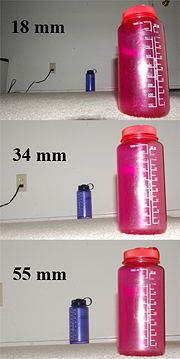
 The two fundamental parameters of an optical lens are the focal length
and the maximum aperture
. The lens' focal length determines the magnification of the image projected onto the image plane, and the aperture the light intensity of that image. For a given photographic system the focal length determines the angle of view
, short focal lengths giving a wider field of view than longer focal length lenses. The wider the aperture, identified by a smaller f-number, allows using a faster shutter speed for the same exposure.
The maximum usable aperture of a lens is specified as the focal ratio or f-number
, defined as the lens' focal length
divided by the effective aperture (or entrance pupil
), a dimensionless number. The lower the f-number, the higher light intensity at the focal plane. Larger apertures (smaller f-numbers) provide a much shallower depth of field
than smaller apertures, other conditions being equal. Practical lens assemblies may also contain mechanisms to deal with measuring light, secondary apertures for flare reduction, and mechanisms to hold the aperture open until the instant of exposure to allow SLR
cameras to focus with a brighter image with shallower depth of field, theoretically allowing better focus accuracy.
Focal lengths are usually specified in millimetres (mm), but older lenses might be marked in centimetres (cm) or inches. For a given film or sensor size, specified by the length of the diagonal, a lens may be classified as a:
An example of how lens choice affects angle of view. The photos above were taken by a 35 mm
camera at a constant distance from the subject.
A side effect of using lenses of different focal lengths is the different distances from which a subject can be framed, resulting in a different perspective
. Photographs can be taken of a person stretching out a hand with a wideangle, a normal lens, and a telephoto, which contain exactly the same image size by changing the distance from the subject. But the perspective will be different. With the wideangle, the hands will be exaggeratedly large relative to the head. As the focal length increases, the emphasis on the outstretched hand decreases. However, if pictures are taken from the same distance, and enlarged and cropped to contain the same view, the pictures will have identical perspective. A moderate long-focus (telephoto) lens is often recommended for portraiture because the perspective corresponding to the longer shooting distance is considered to look more flattering.
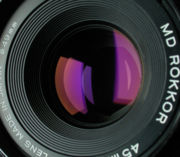 The complexity of a lens—the number of elements and their degree of asphericity—depends upon the angle of view and the maximum aperture, among other variables including intended price point. An extreme wideangle lens of large aperture must be of very complex construction to correct for optical aberrations, which are worse at the edge of the field and when the edge of a large lens is used for image-forming. A long-focus lens of small aperture can be of very simple construction to attain comparable image quality; a doublet (with two elements) will often suffice. Some older cameras were fitted with "convertible" lenses of normal focal length; the front element could be unscrewed, leaving a lens of twice the focal length and angle of view, and half the aperture. The simpler half-lens was of adequate quality for the narrow angle of view and small relative aperture. Obviously the bellows
had to extend to twice the normal length.
Good-quality lenses with maximum aperture no greater than f/2.8 and fixed, normal, focal length need at least three (triplet) or four elements (the trade name "Tessar
" derives from the Greek
tessera, meaning "four"). The widest-range zooms often have fifteen or more. The reflection of light at each of the many interfaces between different optical media (air, glass, plastic) seriously degraded the contrast
and color saturation of early lenses, zoom lenses in particular, especially where the lens was directly illuminated by a light source. The introduction many years ago of optical coating
s, and advances in coating technology over the years, have resulted in major improvements, and modern high-quality zoom lenses give images of quite acceptable contrast, although zoom lenses with many elements will transmit less light than lenses made with fewer elements (all other factors such as aperture, focal length, and coatings being equal).
s, and some rangefinder camera
s have detachable lenses. A few other types do as well, notably the Mamiya TLR cameras
. The lenses attach to the camera using a lens mount, which often also contains mechanical or electrical linkages between the lens and camera body. The lens mount is an important issue for compatibility between cameras and lenses; each major camera manufacturer typically has their own lens mount which is incompatible with others; notable exceptions are the Leica M39 lens mount
for rangefinders, M42 lens mount
for early SLRs, the later Pentax K mount
, and the Four Thirds System
mount for dSLRs, all of which are used by multiple camera brands. Most large-format cameras take interchangeable lenses as well, which are usually mounted in a lensboard or on the front standard.
or "close-up" photography (not to be confused with the compositional term "Close up
") is any lens that produces an image on the focal plane (i.e., film or a digital sensor) that is the same size or larger than the subject being imaged. This configuration is generally used to image close-up very small subjects. A macro lens may be of any focal length, the actual focus length being determined by its practical use, considering magnification, the required ratio, access to the subject, and illumination considerations. They can be special lens corrected optically for close up work or they can be any lens modified (with adapters or spacers) to bring the focal plane "forward" for very close photography. The depth-of-field is very narrow, limiting their usefulness. Lenses are usually stopped down to give a greater depth-of-field.
. Commonly, the lens may zoom from moderate wide-angle, through normal, to moderate telephoto; or from normal to extreme telephoto. The zoom range is limited by manufacturing constraints; the ideal of a lens of large maximum aperture which will zoom from extreme wideangle to extreme telephoto is not attainable. Zoom lenses are widely used for small-format cameras of all types: still and cine cameras with fixed or interchangeable lenses. Bulk and price limit their use for larger film sizes. Motorized zoom lenses may also have the focus, iris, and other functions motorized.

Note, the curvatures and spacing in the lens block diagrams are all approximate. In addition, they do not indicate the glass used. In other words, it is not possible to construct a usable lens solely from the diagrams. Note also, almost all the lens names given were trademarks; many are still properties of their respective owners and are used for identification purposes only.
(UK). It was first used for eyeglasses and was the first to be reasonably sharp over a wide field (about 50° at f/16) lens. Wollaston fitted it to an artist's aid camera obscura
in 1812.
Turned around so that the concave surface faced forward and with a front aperture stop, the Meniscus is called the first photographic lens because it was fitted to some of the camera obscuras adapted by Joseph Nicéphore Niépce (France) to his pioneering "heliography" experiments. The meniscus shape corrected the field curvature that limited the acceptably sharp field of the simple biconvex lens used on camera obscuras since Giambattista della Porta
(modern Italy) in 1550. Note, Niépce did not switch to a Meniscus until 1828; he made the first permanent photograph on a bitumen photosensitized pewter plate in 1826 or 1827 with a biconvex lens. Meniscus lenses were and are still used in simple focus-free box cameras, including innumerable Kodak Brownies.
Niépce and Louis-Jacques-Mandé Daguerre (France) shared the same optical supplier, Charles Chevalier (France), and Daguerre's daguerreotype
experiments also began using camera obscuras with Meniscus lenses. However, the refractive
index of glass increases from red to blue of the light spectrum (color dispersion). Blue is focused closer to the lens than red causing rainbow-like color fringing (chromatic aberration). The lack any chromatic aberration control in a Meniscus meant it was impossible to focus accurately – the daguerreotype process was blue sensitive only, while the human eye focused primarily using yellow.
Chevalier suggested a changeover to a Dollond Achromat
Doublet (originally a telescope
objective) in 1829. Although it is not inherently sharper than a Meniscus, an Achromatic Doublet cements a positive element of low refractive index and low dispersion crown (soda-lime) glass to a negative one of high refractive index and high dispersion flint (lead) glass to cancel out enough of their individual chromatic aberrations to bring blue and yellow to a common focus.
Modern photographic achromats (since about 1900) are normally designed to bring blue and red together – specifically 486 and 656 nanometer wavelengths. Note, although John Dollond
(UK) received the British Royal Society
's Copley Medal
in 1758 for the 1754 discovery (Isaac Newton
[UK] had concluded in 1666 that the chromatic aberration of lenses was unsolvable), the true inventor of the Achromat was Chester Moor Hall (UK) in 1729.
An Achromat Doublet was the specified lens in the official daguerreotype instructions issued by the French government 19 August 1839. Chevalier would add a meniscus curve to the Achromat by the end of 1839 to combine field flattening and chromatic aberration control, and create the standard outdoors lens of the nineteenth century – the Achromat Landscape.
s of the Austro-Hungarian army, took up the challenge of producing a lens fast enough for a daguerreotype portrait.
He came up with the Petzval Portrait (modern Austria) in 1840, a four element formula consisting of a front cemented achromat and a rear air-spaced achromat that, at f/3.6, was the first wide aperture, portrait lens. It was appropriate for one-to-two minute shaded outdoors daguerreotype exposures. With the faster colloidion (wet plate) process of 1851, it could take one-to-two minute indoor portraits. Due to national chauvinism, the Petzval did not win the prize, despite being far superior to all other entries.
A 150mm focal length Petzval lens was fitted to a conical metal Voigtländer (modern Austria) camera taking circular daguerreotypes in 1841. The Voigtländer-Petzval was the first camera and lens specifically designed to take photographs, instead of being a modified artist's camera obscura. The Petzval Portrait was the dominant portrait lens for nearly a century. It had what would now be considered severe field curvature and astigmatism. It was centrally sharp (about 20° field of view, 10° for critical applications), but quickly drifted out of focus to a soft outer field, producing a pleasant halo effect around the subject. The Petzval Portrait remains popular as a projection lens where the narrow angles involved means the field curvature does not matter.
The Portrait was illegally copied by every lens maker and Petzval had a nasty falling out with Peter Voigtländer over unpayable royalties and died an embittered old man. Although the Portrait was the first mathematically computed lens formula (not trial and error), trial and error would continue to dominate photographic lens design
for another half century, despite well established physical mathematics dating from 1856 (by Ludwig von Seidel [modern Germany], working for Hugo Adolph Steinheil [modern Germany]), to the retrospective detriment of lens advancement.
The first successful wide angle (92° maximum field of view; 80° was more realistic) lens was the Harrison & Schnitzer Globe (USA) of 1862, although with f/16 maximum aperture (f/30 was more realistic). Charles Harrison
and Joseph Schnitzer
's Globe had a symmetric four element formula – the name refers to the fact that if the two outer surfaces were continued and joined, they would form a sphere.
Symmetry was discovered in the 1850s to automatically correct three (distortion, coma and transverse chromatic) of the seven major lens aberrations (five monochromatic "Seidel sums": spherical, coma, astigmatism, field curvature and rectilinear distortion; plus two chromatic: axial [or longitudinal color] and transverse [or lateral color]) that prevent the formation of sharp images by simple lenses. There are also decentration aberrations arising from manufacturing errors. A real lens will not produce images of expected quality if it is not constructed to or cannot stay in specification. The more complex the design, the more sensitive it is to improperly polished or aligned elements.
There are additional optical phenomena that can degrade image quality but are not considered aberrations. For example, the oblique cos4θ light falloff, sometimes called natural vignetting, and lateral magnification and perspective distortions seen in wide angle lenses are really geometric effects of projecting three dimensional objects down into two dimensional images, not physical defects.
The Globe's symmetric formula directly influenced the design of the Dallmeyer Rapid-Rectilinear (UK) and Steinheil Aplanat (modern Germany). By coincidence, John Dallmeyer's Rapid-Rectilinear and Adolph Steinheil's Aplanat had virtually identical symmetric four element formulae, arrived at almost simultaneously in 1866, that corrected most optical aberrations, except for spherical and field curvature, to f/8. The breakthrough was to use glasses of maximum refractive index difference but equal dispersion in each achromat. The Rapid-Rectilinear and Aplanat were scalable over many focal lengths and fields of view for all contemporaneous film formats, and were the standard moderate-aperture, general purpose lenses for over half a century.
The Landscape, the Portrait, the Globe and the Rapid-Rectilinear/Aplanat constituted the nineteenth century photographer's entire lens arsenal.
Therefore even the Meniscus had a permanent stop. However, the earliest lenses did not have adjustable stops, because their small working apertures and the lack of sensitivity of the daguerreotype
process meant that exposure times were measured in many minutes. A photographer would not want to limit the light passing through the lens and further lengthen the exposure time. When the increased sensitivity wet colloidion process was invented in 1851, exposure times shortened dramatically and adjustable stops became practical.
The earliest selectable stops were the Waterhouse stops of 1858, named for John Waterhouse. These were sets of accessory brass plates with sized holes mounted through a slot in the side of the lens.
Around 1880, photographers realized that aperture size affected depth of field
. Aperture control gained much more significance and adjustable stops became a standard lens feature. The iris diaphragm made its appearance as an adjustable lens stop in the 1880s. It became the standard adjustable stop about 1900. The iris diaphragm had been common in early nineteenth century artists' aid camera obscuras and Niépce used one in at least one of his experimental cameras. However, the specific type of iris used in modern lenses was invented in 1858 by Charles Harrison and Joseph Schnitzer. Harrison and Schnitzer's iris diaphragm was capable of rapid open and close cycles, an absolute necessity for lenses with camera auto-aperture control.
The modern lens aperture markings of f-number
s in geometric sequence of f/1, 1.4, 2, 2.8, 4, 5.6, 8, 11, 16, 22, 32, 45, 64, 90, etc. was standardized in 1949. Previously, this British system competed with the Continental (German) sequence of f/1.1, 1.6, 2.2, 3.2, 4.5, 6.3, 9, 12.5, 18, 25, 36, 50, 71, 100 ratios. In addition, the Uniform System (U.S., invented UK) sequence of 1, 2, 4, 8, 16, 32, 64, 128, etc. (where U.S. 1 = f/4, U.S. 2 = f/5.6, U.S. 4 = f/8, etc.), was favored by Eastman Kodak early in the twentieth century.
is the modern photographic equivalent.
In 1891, Thomas Dallmeyer and Adolph Miethe simultaneously attempted to patent new lens designs with nearly identical formulae – complete photographic telephoto lenses consisting of a front achromat doublet and rear achromat triplet. Primacy was never established and no patent was ever granted for the first telephoto lens.
The front and rear cells of early telephotos were unmatched and the rear cell also magnified any aberrations, as well as the image, of the imaging cell. The cell spacing was also tunable, because that could be used to adjust the effective focal length, but that only worsened aberration problems. The first telephoto lens optically corrected and fixed as a system was the f/8 Busch Bis-Telar (Germany) of 1905.
's Protar was the first successful anastigmat (highly corrected [for the era] for all aberrations, including properly for astigmatism) lens. It was scalable from f/4.5 portrait to f/18 super wide angle. The Protar was originally called the Anastigmat, but that descriptive term quickly became generic and the lens was given a fanciful name in 1900.
The Protar is considered the first "modern" lens, because it had an asymmetric formula allowed by the new design freedom opened up by newly available barium oxide, crown optical glasses. These glasses were invented by Ernst Abbe, a physicist, and Otto Schott
, a chemist, (both Germany) in 1884, working for Carl Zeiss
' Jena Glass Works. Schott glasses have higher refractive index than soda-lime crown glass without higher dispersion. The Protar's front achromat used older glass, but the rear achromat used high index glass. Virtually all good quality photographic lenses since circa 1930 are anastigmat corrected. (The primary exceptions are deliberately "soft-focus" portrait lenses.)
Today's photographic lens state-of-the-art is apochromatic correction, which is, very roughly, twice as strict as anastigmatic. However, such lenses require correcting for higher ordered aberrations than the original seven with rare earth (lanthanum oxide) or fluorite (calcium fluoride) glasses of very high refractive index and/or very low dispersion of mid-twentieth century invention. The first apochromatic lens for consumer cameras was the Leitz APO-Telyt-R 180mm f/3.4 (1975, West Germany) for Leicaflex series (1964, West Germany) 35mm SLRs. Most professional telephoto lenses since the early 1980s are apochromatic. Note, better-than-apochromat lenses are available for scientific/military/industrial work.
's (UK, not related to the Taylors of T, T & H) Cooke Triplet
was a deceptively simple looking asymmetric three element anastigmat formula created by reexamining lens design from first principles to take maximum advantage of the advances in new Schott optical glasses. The elements were all of such strong power that they were highly sensitive to misalignment and required tight manufacturing tolerances for the era.
The Cooke Triplet became the standard "economy" lens of the twentieth century. For example, the Argus Cintar 50mm f/3.5 for the Argus C3
(1937, USA), probably the best-selling rangefinder camera
of all time, used a Cooke triplet.
The Triplet was adequate for contact prints from medium format roll film cameras and small enlargements from 35mm
"miniature" format cameras, but not for big ones. The films of the first half of the twentieth century did not have much resolving power either, so that was not necessarily a problem.
developed the Tessar from dissatisfaction with the performance of his earlier Protar, although it also resembles the Cooke triplet. The Tessar was originally an f/6.3 lens. It was refined to f/2.8 by 1930, although f/3.5 was the realistic limit for best image quality.
The Tessar was the standard high-quality, moderate-aperture, normal-perspective
lens of the twentieth century. The Kodak Anastigmat Special 100mm f/3.5 on the Kodak Super Six-20 (1938, USA), the first autoexposure still camera, was a Tessar the D. Zuiko 2.8 cm f/3.5 on the Olympus Pen (1959, Japan), the original Pen half frame camera; the Schneider S-Xenar 40mm f/3.5 on the late version of the Rollei 35 (1974, West Germany/Singapore); and the AF Nikkor D 45mm f/2.8P Special Edition for the Nikon FM3A (2001, Japan), the last manual focus 35mm SLR released by a major maker. It was fitting that the Zeiss Stiftung's last camera, the Zeiss Ikon S 312, had a Zeiss Tessar 40mm f/2.8 (1972, West Germany).
It is often incorrectly stated that the Leitz Elmar 50mm f/3.5 fixed to the Leica A (1925, Germany), Leitz's first camera, was a Tessar.. However, at the time the Leica was introduced the 50mm f/3.5 Kino Tessar had only been designed to cover the cine format of 18x24mm, which was insufficient for the new 24x36mm format of the Leica, and Leitz had to develop a new lens to provide adequate full frame coverage. It was only when Zeiss Ikon were designing the Contax in response to the success of the Leica that a 50mm Tessar which could cover the 24x36mm format was designed. The Elmar was based on a modified Cooke Triplet with a different computation to the Tessar and with the stop in the first air space.
's formula was originally a 10 cm f/2 lens, but he improved it to 10.5 cm and 85mm f/1.8 in 1924. The Ernostar was also a Cooke Triplet derivative; it has an extra front positive element or group.
Mounted on the Ernemann Ermanox (1923, Germany) camera and in the hands of Erich Salomon
, the Ernostar pioneered modern photojournalism. French Premier Aristide Briand
once said: "There are just three things necessary for a[n international] conference: a few Foreign Secretaries, a table and Salomon." Note, American photojournalists favored flash use into the 1950s (see Arthur Fellig [Weegee]).
Bertele continued Ernostar development under the more famous Sonnar name after Ernemann was absorbed by Zeiss in 1926. He reached f/1.5 in 1932 with the Zeiss Sonnar 50mm f/1.5 for the Contax I 35mm
rangefinder camera
(1932, Germany).
The Sonnar was (and is) also popular as a telephoto lens design – the Sonnar is always at least slightly telephoto because of its powerful front positive elements. The Zeiss Olympia Sonnar 180mm f/2.8 for the Contax II (both 1936, Germany) is a classic, if not mythic, example.
improved the Fraunhofer
telescope objective by adding a meniscus lens to its single convex and concave lens design. Alvan Clark
further refined the design in 1888 by taking two of these lenses and placing them back to back. The lens was named in honour of Gauss. The current design can be traced back to 1895, when Paul Rudolph
of Carl Zeiss Jena used cemented doublets as the central lenses to correct for chromatic aberration
.
Later the design was developed with additional glasses to give high-performance lenses of wide aperture. The main development was due to Taylor Hobson
in the 1920s, resulting in the f/2.0 Opic and later the Speed Panchro designs, which were licensed to various other manufacturers. The design forms the basis for many camera lenses in use today, especially the wide-aperture standard lenses used on 35 mm and other small-format cameras. It can offer good results up to with a wide field of view
, and has sometimes been made at 1.0.
The design is presently used in inexpensive-but-high-quality fast lenses such as the Canon EF 50mm 1.8
and Nikon 50 mm 1.8D AF Nikkor
. It is also used as the basis for faster designs, with elements added, such as a seventh element as in both Canon and Nikon's 50 mm 1.4 offerings or an aspherical seventh element in Canon's 50 mm 1.2. The design appears in other applications where a simple fast normal lens
is required (~53° diagonal) such as in projectors.
Some lenses were marked by T-stops (transmission stops) instead of f-stops to indicate the light losses. T-stops were "true" or effective aperture stops and were common for motion picture lenses, so that a cinematographer could ensure that consistent exposures were made by all the different lenses used to make a movie. This was less important for still cameras and only one still lens line was ever marked in T-stops: for the Bell & Howell Foton 35mm rangefinder camera. Bell & Howell was normally a cinematographic equipment maker. The Foton's standard lens was the Taylor, Taylor & Hobson Cooke Amotal Anastigmat 2 inch f/2 (T/2.2) (1948; camera USA; lens UK, a Double Gauss). The quarter stop difference between f/2 and T/2.2 is a 16% loss.
It was noticed by Dennis Taylor in 1896 that some lenses with glass tarnished by age counterintuitively produced brighter images. Investigation revealed that the oxidation layer suppressed surface reflections by destructive interference. Lenses with glass elements artificially "single-coated" by vacuum deposition of a very thin layer (approximately 130-140 nanometers) of magnesium or calcium fluoride to suppress surface reflections were invented by Alexander Smakula
working for Zeiss in 1935 and first sold in 1939. Antireflection coating could cut reflection by two-thirds.
In 1941, the Kodak Ektra (USA) 35mm
RF
was introduced with the first complete antireflection coated lens line for a consumer camera: the Kodak Ektar 35mm f/3.3, 50mm f/3.5, 50mm f/1.9, 90mm f/3.5, 135mm f/3.8 and 153mm f/4.5. World War II interrupted all consumer camera production and coated lenses did not appear in large numbers until the late 1940s. They became standard for high quality cameras by the early 1950s.
The availability of antireflection coating permitted the Double Gauss to rise to dominance over the Sonnar. The Sonnar had more popularity before World War II because, before antireflection coating, the Sonnar's three cell with six air-glass surfaces versus the Double Gauss's four and eight made it less vulnerable to flare. Its telephoto effect also made the lens shorter, an important factor for the Leica and Contax 35mm
RFs
designed to be compact.
As maximum aperture continued to increase, the Double Gauss's greater symmetry promised easier aberration correction. This was especially important for SLRs
because, without the parallax error of RFs
, they also began offering much closer focusing distances (typically a half meter instead a whole meter). The Double Gauss became the preferred normal lens design in the 1950s with the availability of antireflection coating and new generation extra high refractive index rare earth optical glasses.
Coating lenses with up to a dozen or more different layers of chemicals to suppress reflections across the visual spectrum (instead of at only one compromise wavelength) were a logical progression. Asahi Optical's SMC Takumar lenses (1971, Japan) were the first all multicoated (Super-Multi-Coated) lenses for consumer cameras (M42 screw mount Asahi Pentax SLRs). Modern highly corrected zoom lenses with fifteen, twenty or more elements would not be possible without multicoating. The transmission efficiency of a modern multicoated lens surface is about 99.7% or better.
Antireflection coating does not relieve the need for a lens hood (a conical tube slipped, clipped, screwed or bayoneted onto the front of a lens to block non-image forming rays from entering the lens) because flare can also result from strong stray light reflecting off of other inadequately blacked internal lens and camera components.
cameras require that lenses be mounted far enough in front of the film to provide space for the movement of the mirror (the "mirror box"); about 40 mm for a 35mm SLR compared to less than 10 mm in non-SLR 35mm cameras. This prompted the development of wide field of view lenses with more complex retrofocus optical designs. These use very large negative front elements to force back-focus distances long enough to ensure clearance.
In 1950, the Angénieux Retrofocus Type R1 35mm f/2.5 (France) was the first retrofocus wide angle lens for 35mm SLRs (Exaktas). Except for the front element, Pierre Angénieux
' R1 was a five element Tessar. Note, "retrofocus" was an Angénieux trademark before losing exclusive status. The original generic term was "inverted" or "reversed telephoto." A telephoto lens has a front positive cell and rear negative cell; retrofocus lenses have the negative cell in front and positive cell to the rear. The first inverted telephoto imaging lens was the Taylor, Taylor & Hobson 35mm f/2 (1931, UK) developed to provide back-focus space for the beamsplitter prism used by the full-color via three negatives Technicolor
motion picture camera. Other early members of the Angénieux Retrofocus line included the 28mm f/3.5 Type R11 of 1953 and the 24mm f/3.5 Type R51 of 1957.
Retrofocus lenses are extremely asymmetric with their large front elements and therefore very difficult to correct for distortion by traditional means. On the upside, the large negative element also limits the oblique cos4θ light falloff of regular wide-angle lenses.
Retrofocus design also influenced non-retrofocus lenses. For example, Ludwig Bertele's Zeiss Biogon 21mm f/4.5, released in 1954 for the Contax IIA (1950, West Germany) 35mm
RF
, and its evolution, the Zeiss Hologon 15mm f/8 of 1969, fixed to the Zeiss Ikon Hologon Ultrawide (West Germany), were roughly symmetrical designs. However, each half can visualized as retrofocus. The Biogon and Hologon designs take advantage of the large negative elements to limit the light falloff of regular wide angle lenses. With a 110° field of view, the Hologon would otherwise have had a 3¼ stop corner light falloff, which is wider than the exposure latitude of contemporaneous films. Nonetheless, the Hologon had a standard accessory radially graduated 2 stop neutral density filter to ensure completely even exposure. The distance from the Hologon's rear element to the film was only 4.5 mm.
Many normal perspective lenses for today's digital SLRs are retrofocus, because their smaller-than-35mm-film-frame image sensors require much shorter focal lengths to maintain equivalent fields of view, but the continued use of 35mm SLR lens mounts require long back-focus distances.
The first fisheye lens was the Beck Hill Sky (or Cloud; UK) lens of 1923. Robin Hill
intended it to be pointed straight up to take 360° azimuth barrel distorted hemispheric sky images for scientific cloud cover studies. It used a bulging negative meniscus to compress the 180° field to 60° before passing the light through a stop to a moderate wide angle lens. The Sky was 21mm f/8 producing 63mm diameter images. Pairs were used at 500 meter spacing producing stereoscopes for the British Meteorological Office.
Note, it is impossible to have 180° rectilinear coverage because of light falloff. 120° (12mm focal length for the 35mm film format) is about the practical limit for retrofocus designs; 90° (21mm focal length) for non-retrofocus lenses.
However, the Kilfitt Makro-Kilar 4 cm f/3.5 (West Germany/Liechtenstein) of 1955 for Exakta 35mm SLRs changed the everyday meaning of macro lens. It was the first lens to provide continuous close focusing. Version D of Heinz Kilfitt's (West Germany) Makro-Kilar focused from infinity to 1:1 ratio (life-size) at two inches; version E, to 1:2 ratio (half life-size) at four inches. The Makro-Kilar was a Tessar mounted in an extra long draw triple helical. SLR cameras were best for macro lenses because SLRs do not suffer from viewfinder parallax error at very close focus distances.
Designing close-up lenses is not really that hard – an image size that is close to object size increases symmetry. The Goerz Apo-Artar (Germany/USA) photoengraving process lens was apochromatic in 1904, although ultra-tight quality control helped. It is getting a sharp image continuously from infinity to close-up that is hard – before the Makro-Kilar, lenses generally did not continuously focus to closer than 1:10 ratio. Most SLR lens lines continue to include moderate aperture macro lenses optimized for high magnification. However, their focal lengths tend to be longer than the Makro-Kilar to allow more working distance.
"Macro zoom" lenses began appearing in the 1970s, but traditionalists object to calling most of them macro because they stray too far from the technical definition – they usually do not focus closer than 1:4 ratio with relatively poor image quality.
An afocal attachment is a more sophisticated supplementary lens. It is a so-called Galilean telescope accessory mounted to the front of a lens that alters the lens' effective focal length without moving the focal plane. There are two types: the telephoto and the wide angle. The telephoto type is a front positive plus rear negative cell combination that increases the image size; the wide angle has a front negative and rear positive arrangement to reduce the image size. Both have cell separation equal to cell focal length difference to maintain the focal plane.
Since afocal attachments are not an integral part of the main lens' formula, they degrade image quality and are not appropriate for critical applications. However, they have been available for amateur motion picture, video and still cameras since the 1950s. Before the zoom lens, afocal attachments were a way to provide a cheap sort of interchangeable lens system to an otherwise fixed lens camera. In the zoom lens era, they are a cheap way to extend the reach of a zoom.
Some afocal attachments, such as the Zeiss Tele-Mutar 1.5× and Wide-Angle-Mutar 0.7× (1963, West Germany) for various fixed lens Franke and Heidecke Rolleiflex brand 120 roll film
twin-lens reflex camera
s, were of higher quality and price, but still not equal to true interchangeable lenses in image quality. The very bulky Mutars could change a Rolleiflex 3.5E/C's Heidosmat 75mm f/2.8 and Zeiss Planar 75mm f/3.5 (1956, West Germany) viewing and imaging lenses into 115mm and 52mm equivalents. Afocal attachments are still available for digital point-and-shoot cameras.
The Kodak Retina IIIc and IIc (USA/West Germany) collapsable lens 35mm rangefinder cameras of 1954 took the supplementary lens idea to the extreme with their interchangeable lens "components." This system allowed swapping the front cell component of their standard Schneider Retina-Xenon C 50mm f/2 lenses (a Double Gauss) for Schneider Retina-Longar-Xenon 80mm f/4 long-focus and Schneider Retina-Curtar-Xenon 35mm f/5.6 wide-angle components. Component lens design is tightly constrained by the need to reuse the rear cell and the lenses are extremely bulky, range limited and complex compared with fully interchangeable lenses, but the Retina's interlens Synchro-Compur leaf shutter restricted lens options.
The first zoom lens for still cameras was the Voigtländer-Zoomar 36-82mm f/2.8 (USA/West Germany) of 1959, for Voigtländer Bessamatic series (1959, West Germany) 35mm leaf shutter SLRs. It was designed by Zoomar in the United States and manufactured by Kilfitt in West Germany for Voigtländer. The Zoomar 36-82 was very large and heavy for the focal length – 95mm filter size.
Frank Back (Germany/USA) was the early champion of zoom lenses and his Zoomars would hurl far into the future the lance of zoom lens development and popularity, starting with his original Zoomar 17-53mm f/2.9 (1946, USA) for 16mm motion picture cameras. The image quality of early zoom lenses could be very poor – the Zoomar's has been described as "pretty rotten."
) Hexar 10.5 cm f/4.5 for the Konishiroku Tropical Lily small plate camera. However, the Japanese advanced quickly and were able to manufacture very high quality lenses by 1950 – LIFE magazine photographer David Douglas Duncan
's "discovery" of Nikkor lenses is an oft-told tale.
In 1954, the Japan Camera Industry Association (JCIA) began promoting the development of a high quality photographic industry to increase exports as part of Japan's post-World War II economic recovery. To that end, the Japan Machine Design Center (JMDC) and Japan Camera Inspection Institute (JCII) banned the slavish copying of designs and the export of low quality photographic equipment, enforced by a testing program before issuance of shipping permits.
By the end of the 1950s, the Japanese were seriously challenging the Germans. For example, the Nippon Kogaku Nikkor-P Auto 10.5 cm f/2.5 of 1959, for the Nikon F 35mm SLR (1959), is reputed to be one of the best portrait lenses ever made, with superb sharpness and bokeh
. It originated as the Nikkor-P 10.5 cm f/2.5 (1954) for the Nikon S series 35mm RF, was optically upgraded in 1971 and available until 2006.
In 1963, the Tokyo Kogaku RE Auto-Topcor 5.8 cm f/1.4 came out along with the Topcon RE Super/Super D (1963) 35mm SLR. The Topcor is reputed to be one of the best normal lenses ever made. The Nikkor and the Topcor were sure signs of the Japanese optical industry eclipsing the Germans'. Topcon in particular was highly avant-garde in producing two ultra-fast lenses by 1960 - the R-Topcor 300 F2.8 (1958) and the R-Topcor 135 F2 1960). The former was not eclipsed until 1976. Germany had been the optical leader for a century, but the Germans turned very conservative after World War II; failing to achieve unity of purpose, innovate or respond to market conditions. Japanese camera production surpassed West German output in 1962.
Early Japanese lenses were not novel designs: the Hexar was a Tessar; the Nikkor was a Sonnar; the Topcor was a Double Gauss. They began breaking new ground around 1960: the Nippon Kogaku Auto-Nikkor 8.5–25 cm f/4-4.5 (1959), for the Nikon F, was the first telephoto zoom lens for 35mm still cameras (and second zoom after the Zoomar), the Canon 50mm f/0.95 (1961), for the Canon 7 35mm RF, with its superwide aperture, was the first Japanese lens a photographer might lust after, and the Nippon Kogaku Zoom-Nikkor Auto 43-86mm f/3.5 (1963), originally fixed on the Nikkorex Zoom 35mm SLR, later released for the Nikon F, was the first popular zoom lens, despite mediocre image quality.
German lenses disappear from this history at this point. After ailing throughout the 1960s, such famous German nameplates as Kilfitt, Leitz, Meyer, Schneider, Steinheil, Voigtländer and Zeiss went bankrupt, were sold off, contracted production to East Asia or became boutique brands in the 1970s. Names for design types also disappear at this point. Apparently the Japanese are not fans of lens names, they use only brand names and feature codes for their lens lines.
The JDMC/JCII testing program, having fulfilled its goals, ended in 1989 and its gold "PASSED" sticker passed into history. The JCIA/JCII morphed into the Camera & Imaging Products Association (CIPA) in 2002.
(1874), Schmidt camera
(1931), and the Maksutov telescope
(1941) along with Laurent Cassegrain's Cassegrain telescope (1672). The Cassegrain system folds the light path and the convex secondary acts as a telephoto element, making the focal length even longer than the folded system and extending the light cone to a focal point well behind the primary mirror
so it can reach the film plane of the attached camera. The Catadioptric system, where a spherical reflector is combined with a lens with the opposite spherical aberration, corrects the common optical errors of a reflector such as the Cassegrain system, making it suitable for devices that need a large aberration free focal plane (cameras).
The first general purpose photographic catadioptric lens was Dmitri Maksutov
1944 MTO (Maksutov Tele-Optic) 500mm f/8 Maksutov–Cassegrain configuration, adapted from his 1941 Maksutov telescope
. Designs followed using other optical configurations including Schmidt configuration and solid catadioptric designs (made from a single glass cylinder with a maksutov or aspheric form polished into the front face and the back spherical surface silvered to make the "mirror"). In 1979 Tamron
was able to produce a very compact light weight catadioptric by using rear surface silvered mirrors, a "Mangin mirror" configuration that saved on mass by having the aberration corrected by the light passing through the mirror itself.
The catadioptric camera lens' heyday was the 1960s and 70s, before apochromatic refractive telephoto lenses. CATs of 500mm focal length were common; some were as short as 250mm, such as the Minolta RF Rokkor-X 250mm f/5.6 (Japan) of 1979 (a Mangin mirror CAT roughly the size of a 50mm f/1.4 lens). The CAT is the only reasonable solution for 1000+ mm lenses.
Dedicated photographic mirror lenses fell out of favor in the 1980s for various reasons. However, commercial reflector astronomical Maksutov–Cassegrain and Schmidt–Cassegrain telescopes with 14 to 20 inch (or even larger) diameter primary mirrors are available. With an accessory camera adapter, they are 4000mm f/11 to f/8 equivalent.
In 1974, the Ponder & Best (Opcon/Kino) Vivitar Series 1 70-210mm f/3.5 Macro Focusing Zoom (USA/Japan) was widely hailed as the first professional-level quality very close focusing "macro" zoom lens for 35mm SLRs. Ellis Betensky's (USA) Opcon Associates perfected the Series 1's fifteen element/ten group/four cell formula by calculations on the latest digital computers. Freed from the drudgery of hand computation in the 1960s, designs of such variety and quality only dreamt of by earlier generations of optical engineers became possible. Modern computer created zoom designs may be so complex that they have no resemblance to any of the classical human created designs.
The optical zooming action of the Series 1 was different from most earlier zooms such as the Zoomar. The Zoomar was an "optically compensated" zoom. Its zooming cell and focal plane compensating cell were fixed together and moved together with a stationary cell in between. The Series 1 was a "mechanically compensated" zoom. Its zooming cell was mechanically cammed with a focal plane compensating cell and moved at different rates. The tradeoff for greater optical design freedom was this increase in mechanically complexity.
The external controls of the Series 1 were also mechanically more complex than the Zoomar. Most early zooms had separate twist control rings to vary the focus and focal length – a "two touch" zoom. The Series 1 used a single control ring: twist to focus, push-pull to zoom – a "one touch" zoom. For a short time, about 1980-1985, one-touch zooms were the dominant type, because of their ease of handling. However, the arrival of interchangeable lens autofocus cameras in 1985 with the Minolta Maxxum 7000
(Japan; called Alpha 7000 in Japan, 7000 AF in Europe) necessarily forced the decoupling of focusing and zooming controls and two touch zooms made an instant comeback.
In 1977, zoom lenses had advanced far enough that the Fuji Fujinon-Z 43-75mm f/3.5-4.5 (Japan) became the first zoom lens to be sold as the primary lens for an interchangeable lens camera, the Fujica AZ-1 (1977, Japan) 35mm SLR, instead of a prime.
Small quick framing "supernormal" zooms of around 35-70mm focal length became popular 50mm substitutes in Japan by 1980. However, they never gained much of a foothold in the United States, although 70-210mm telephoto zooms were very popular as second lenses. The first auto-everything 35mm point-and-shoot camera with built-in zoom lens, the camera type that dominated the 1990s, was the Asahi Optical Pentax IQZoom (1987, Japan) with Pentax Zoom 35-70mm f/3.5-6.7 Tele-Macro.
The next landmark zoom was the Sigma 21-35mm f/3.5-4 (Japan) of 1981. It was the first super-wide angle zoom lens for still cameras (most 35mm SLRs). Previously, combining the complexities of rectilinear super-wide angle lenses, retrofocus lenses and zoom lenses seemed impossible. The Sigma's all-moving eleven element/seven group/three cell formula was a triumph of computer-aided design and multicoating.
Along with optical complexity, the mechanical complexity of the Sigma, with three cells moving at differing rates, required the latest in manufacturing technology. Super-wide angle zoom lenses are even more complicated for most of today's digital SLRs, because the usually smaller-than-35mm-film-frame image sensors require much shorter focal lengths to maintain equivalent fields of view, but the continued use of 35mm SLR lens mounts require the same large back-focus distances.
Japanese zoom interchangeable lens production surpassed that of prime lenses in 1982, and to say that zooms are ubiquitous today, while primes are not, is stating the obvious.
Therefore, some prime lenses of this era began using "floating elements" – zoom-like differential cell movement in nested helicals for better close-up performance. For example, retrofocus wide angle lenses tend to have excessive spherical aberration and astigmatism at close focusing distances and so the Nippon Kogaku Nikkor-N Auto 24mm f/2.8 (Japan) of 1967 for Nikon 35mm SLRs had a Close Range Correction system with a rear three element cell that moved separately from the main lens to maintain good wide aperture image quality to a close focus distance of 30 cm/1 ft.
Other prime lenses began using "internal focusing," such as Kiyoshi Hayashi's Nippon Kogaku Nikkor 200mm f/2 ED IF (Japan) of 1977. Focusing by moving only a few internal elements, instead of the entire lens, ensured the lens' weight balance would not be upset during focusing.
Internal focusing was originally popular in heavyweight, wide-aperture telephoto lenses for professional press, sports and wildlife photographers, because it made their handling easier. IF gained all-around significance in the autofocus era, because moving a few internal elements instead of the entire lens for focusing conserved limited battery power and eased the strain on the focusing motor.
Note, floating elements and internal focusing produces a zooming effect and the effective focal length of an FE or IF lens at closest focusing distance can be one-third shorter than the marked focal length.
is the subjective quality of the out-of-focus or blurry part of the image. Traditionally, time consuming hand computation limited lens designers to correcting aberrations for the in-focus image only, with little consideration given to the out-of-focus image. Therefore, approaching and outside the specified circle of confusion or depth-of-field, aberrations built up in the out-of-focus image differently in different lens design families. Differences in the out-of-focus image can influence the perception of overall image quality.
There is no precise definition of bokeh and no objective tests for it – as with all aesthetic judgments. However, symmetrical optical formulae such as the Rapid-Rectilinear/Aplanat and the Double Gauss are usually considered pleasing, while asymmetric retrofocus wide angle and telephoto lenses are often thought harsh. The unique "donut" bokeh produced by mirror lenses because of the optical pathway obstruction of the secondary mirror is especially polarizing.
In the 1970s, as increasing powerful computers proliferated, the Japanese optical houses began to spare computing cycles to study the out-of-focus image. An early result of these explorations was the Minolta Varisoft Rokkor-X 85mm f/2.8 (Japan) of 1978 for Minolta 35mm SLRs. It used floating elements to allow the photographer to deliberately under-correct the spherical aberration of the lens system and render unsharp specular highlights as smoothly fuzzy blobs without affecting focus or other aberrations. In effect, the Varisoft, and later variable soft focus portrait lenses, attempt to recreate the qualities the Petzval Portrait had accidentally. Note, the Varisoft, except for the floating elements, is a Tessar.
Bokeh is now a normal lens design parameter for very high quality lenses. However, bokeh is virtually irrelevant for the tens of millions of very small sensor
digital point-and-shoot cameras sold every year. Their very short focal length and small aperture lenses have enormous depth-of-field – almost nothing is out of focus. Since wide aperture lenses are rare today, most contemporary photographers confuse bokeh with shallow depth-of-field, having never seen either. Many are even unaware of their existence.
The easiest way to prove this is to remember that camera image format sizes have been steadily shrinking over the last two centuries, while standard print sizes have stayed about the same. It is therefore obvious that today's lenses must have higher resolving power than lenses of past eras to maintain an equal level of print quality with the required higher level of enlargement. For example: the human eye can resolve about five lines per millimeter at distance of one foot (about 30 cm). Therefore, a lens must produce a minimum resolution of forty lines per millimeter on a 24×36 mm 35mm film negative if it to provide a linear enlargement of eight times to an 8×10 inch (about 20×25 cm) print and still appear sharp when viewed at one foot. A lens for an APS-sized (about 16×24 mm) digital SLR sensor needs a minimum resolution of fifty-two lines per millimeter to be enlarged thirteen times to a sharp 8×10 inch print.
Another way to understand how lenses have improved is to know the level of analysis that optical engineers devote to their lens formulae. In the nineteenth century, opticians dug to the level of the Seidel aberrations, called mathematically the third order aberrations, to reach basic anastigmatic correction. Opticians needed to calculate for the fifth order aberrations by the mid-twentieth century to produce a high quality lens. Today's lenses require seventh order aberration solutions.
Note, the best photographic lenses from forty or fifty years ago were already of very high image quality (twice the minimum resolution mentioned above) and it may not be possible to conclusively demonstrate the superiority of the best of today's lens without comparing 20×30 inch (about 50×75 cm) enlargements of exactly the same scene side by side.
in 1637, the grinding and polishing of aspheric glass surfaces was extremely difficult and expensive.
The first camera lens with an inexpensive mass-produced molded glass aspheric element was the unnamed 12.5mm f/2.8 lens built into the Kodak Disc 4000, 6000 and 8000 (USA) cameras in 1982. It was said to be capable of resolving 250 lines per millimeter. The four element lens was a Triplet with an added rear field-flattener. The Kodak Disc cameras contained very sophisticated engineering. They also had a lithium battery, microchip electronics, programmed autoexposure and motorized film wind for US$68 to US$143 list. It was the Disc film format that was unable to record 250 lpm.
Kodak began using mass-produced plastic aspheres in viewfinder optics in 1957, and the Kodak Ektramax (USA) Pocket Instamatic 110 cartridge film
camera had a built-in Kodak Ektar 25mm f/1.9 lens (also a four element Triplet) with a molded plastic aspheric element in 1978 for US$87.50 list. Plastic is easy to mold into complex shapes that can include an integral mounting flange. However, glass is superior to plastic for lens making in many respects – its refractive index, temperature stability, mechanical strength and variety is higher.
The new freedom allowed by inexpensive precision molded plastic or glass aspheric elements is one of the greatest influences on lens design in the last quarter century, producing a breathtaking variety of lenses.
Early 35mm SLR zooms focal length ratios rarely exceeded 3 to 1, because of unacceptable image quality issues. However, zoom versatility, despite increasing optical complexity and stricter manufacturing tolerances, continued to increase. Despite their many image quality compromises, convenient superzooms (sometimes with ratios over 10 to 1 and four or five independently moving cells) became common on amateur level 35mm SLRs by the late 1990s. They remain a standard lens on today's amateur digital SLRs, with the Tamron AF18-270mm f/3.5-6.3 Di II VC LD Aspherical (IF) MACRO attaining 15× in 2008. Superzooms also sell by the millions on digital point-and-shoots.
The desire for an all-in-one lens is hardly a new phenomenon. "Convertible" lenses, still used by large format film photographers (insofar as large format photography is used), consisting of two cells that could be used individually or screwed together, giving three-lenses-in-one, date back to at least the Zeiss Convertible Protar (Germany) of 1894.
Convenience of a different sort was the major feature of the Tokina SZ-X 70-210mm f/4-5.6 SD (Japan) of 1985. It was the first ultra-compact zoom (85×66 mm, 445 g, 52mm filter); half the size of most earlier 70-210 zooms (the third generation Vivitar Series 1 70-210mm f/2.8-4 [1984, USA/Japan] was 139×70 mm, 860 g, 62mm filter). Like the Kiron 28-210mm, the twelve element/eight group/three cell Tokina had a small variable maximum aperture, but added low dispersion glass and a new bidirectional nonlinear zooming action, to bring size and weight down to an absolute minimum.
Small aperture 35mm format lenses were made practical by the availability of snapshot quality, high sensitivity ISO 400 color films in the 1980s (and ISO 800 in the 1990s), as well as cameras with built-in flash units. During the 1990s, point-and-shoot cameras with compact small aperture zooms were the dominant camera type. Compact variable aperture zoom (some superzoom, some not) lenses remain a standard lens on today's digital point-and-shoot cameras.
At about this time the image quality of zooms equalled that of primes.
Note, many of today's superzooms are not "parfocal"; that is, not true zooms. They are "varifocal" – the focus point shifts with the focal length – but are easier to design and manufacture. The focus shift usually goes unnoticed as they are mounted on autofocus cameras that will automatically refocus.
However, for the record: the first autofocus lens for a still camera was the Konishiroku Konica Hexanon 38mm f/2.8 built into the Konica C35 AF (1977, Japan) 35mm point-and-shoot; the first autofocus lens for an SLR camera was the unnamed 116mm f/8 built into the Polaroid SX-70 Sonar (1978, USA) instant film SLR; the first interchangeable autofocus SLR lens was the Ricoh AF Rikenon 50mm f/2 (1980, Japan, for any Pentax K mount 35mm SLR), which had a self-contained passive electronic rangefinder AF system in a bulky top-mounted box; the first dedicated autofocus lens mount was the five electrical contact pin Pentax K-F mount on the Asahi Optical Pentax ME F
(1981, Japan) 35mm SLR camera with a TTL contrast detection AF system for its unique SMC Pentax AF 35mm-70mm f/2.8 Zoom Lens; the first built-in TTL autofocus SLR lens was the Opcon/Komine/Honeywell Vivitar Series 1 200mm f/3.5 (1984, USA/Japan, for most 35mm SLRs), which had a self-contained TTL passive phase detection AF system in a underslung box and the first complete autofocus lens line was the twelve Minolta AF A mount lenses (24mm f/2.8, 28mm f/2.8, 50mm f/1.4, 50mm f/1.7, 50mm f/2.8 Macro, 135mm f/2.8, 300mm f/2.8 APO, 28-85mm f/3.5-4.5, 28-135mm f/4-4.5, 35-70mm f/4, 35-105mm f/3.5-4.5 and 70-210mm f/4) introduced with the Minolta Maxxum 7000
(1985, Japan) 35mm SLR and its TTL passive phase detection AF system.
In 1994, the unnamed 38-105mm f/4-7.8 lens built into the Nikon Zoom-Touch 105 VR (Japan) 35mm point-and-shoot camera was the first consumer lens with built-in image stabilization. Its Vibration Reduction system could detect and counteract handheld camera/lens unsteadiness, allowing sharp photographs of static subjects at shutter speeds much slower than normally possible without a tripod. Although image stabilization is an electromechanical breakthrough, not optical, it was the biggest new feature of the 1990s.
The Canon EF 75-300mm f/4-5.6 IS USM (Japan) of 1995 was the first interchangeable lens with built-in image stabilization (called Image Stabilizer; for Canon EOS 35mm SLRs). Image stabilized lenses were initially very expensive and used mostly by professional photographers. Stabilization surged into the amateur digital SLR market in 2006. However, the Konica Minolta Maxxum 7D (Japan) digital SLR introduced the first camera body-based stabilization system in 2004 and there is now a great engineering and marketing battle over whether the system should be lens-based (counter-shift lens elements) or camera-based (counter-shift image sensor).
In 2001, the Canon EF 400mm f/4 DO IS USM (Japan) was first diffractive optics lens for consumer cameras (for Canon EOS 35mm SLRs). Normally photographic cameras use refractive lenses (with the occasional reflective mirror) as their image forming optical system. The 400 DO lens had a multilayer diffractive element containing concentric circular diffraction gratings to take advantage of diffraction's opposite color dispersion (compared to refraction) to correct chromatic and spherical aberrations with less low dispersion glass, fewer aspheric surfaces and less bulk.
As of 2010, there have been only two expensive professional level diffractive optics lenses for consumer cameras, but if the technology proves useful, prices will drop and its popularity will rise.
In 2004, the Kodak (Sigma) DSC Pro SLR/c (USA/Japan) digital SLR was loaded with optical performance profiles on 110 lenses so that the on-board computer could correct the lateral chromatic aberration of those lenses, on-the-fly as part of the capture process. Also in 2004, DO Labs DoX Optics Pro (France) computer software modules were introduced, loaded with information on specific cameras and lenses, that could correct distortion, vignetting, blur and lateral chromatic aberration of images in post-production.
Lenses have already appeared whose image quality would have been marginal or unacceptable in the film era, but are acceptable in the digital era because the cameras for which they are intended automatically correct their defects. For example, onboard automatic software image correction is a standard feature of 2008's Micro Four Thirds digital format. Images from the 2009 Panasonic 14-140mm f/4-5.8 G VARIO ASPH. MEGA O.I.S. and the 2010 Olympus M. Zuiko Digital 14-150mm f/4-5.6 ED lenses (both Japan) have their severe barrel distortion at the wide angle settings automatically reduced by a Panasonic LUMIX DMC-GH1 and Olympus Pen E-P2, respectively. The Panasonic 14-140mm lens also has its chromatic aberration corrected. (Olympus has not yet implemented chromatic aberration correction.)
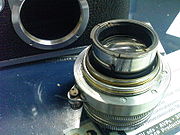 Some lens manufacturers (2009):
Optics
Optics is the branch of physics which involves the behavior and properties of light, including its interactions with matter and the construction of instruments that use or detect it. Optics usually describes the behavior of visible, ultraviolet, and infrared light...
lens
Lens (optics)
A lens is an optical device with perfect or approximate axial symmetry which transmits and refracts light, converging or diverging the beam. A simple lens consists of a single optical element...
or assembly of lenses used in conjunction with a camera
Camera
A camera is a device that records and stores images. These images may be still photographs or moving images such as videos or movies. The term camera comes from the camera obscura , an early mechanism for projecting images...
body and mechanism to make images of objects either on photographic film
Photographic film
Photographic film is a sheet of plastic coated with an emulsion containing light-sensitive silver halide salts with variable crystal sizes that determine the sensitivity, contrast and resolution of the film...
or on other media capable of storing an image chemically or electronically.
While in principle a simple convex lens
Simple lens
In optics, a simple lens or singlet lens is a lens consisting of a single simple element. Typical examples include a magnifying glass or a lens in a pair of simple reading glasses....
will suffice, in practice a compound lens made up of a number of optical lens elements
Lens (optics)
A lens is an optical device with perfect or approximate axial symmetry which transmits and refracts light, converging or diverging the beam. A simple lens consists of a single optical element...
is required to correct (as much as possible) the many optical aberrations that arise. Some aberrations will be present in any lens system. It is the job of the lens designer to balance these out and produce a design that is suitable for photographic use and possibly mass production.
There is no major difference in principle between a lens used for a still camera
Still camera
A still camera is a type of camera used to take photographs. Traditional cameras capture light onto photographic film. Digital cameras use electronics, usually a charge coupled device to store digital images in computer memory inside the camera...
, a video camera
Video camera
A video camera is a camera used for electronic motion picture acquisition, initially developed by the television industry but now common in other applications as well. The earliest video cameras were those of John Logie Baird, based on the electromechanical Nipkow disk and used by the BBC in...
, a telescope
Telescope
A telescope is an instrument that aids in the observation of remote objects by collecting electromagnetic radiation . The first known practical telescopes were invented in the Netherlands at the beginning of the 1600s , using glass lenses...
, a microscope
Microscope
A microscope is an instrument used to see objects that are too small for the naked eye. The science of investigating small objects using such an instrument is called microscopy...
, or other apparatus, but the detailed design and construction are different.
A lens may be permanently fixed to a camera, or it may be interchangeable with lenses of different focal length
Focal length
The focal length of an optical system is a measure of how strongly the system converges or diverges light. For an optical system in air, it is the distance over which initially collimated rays are brought to a focus...
s, aperture
Aperture
In optics, an aperture is a hole or an opening through which light travels. More specifically, the aperture of an optical system is the opening that determines the cone angle of a bundle of rays that come to a focus in the image plane. The aperture determines how collimated the admitted rays are,...
s, and other properties.
Theory of operation
Rectilinear lens
In photography, a rectilinear lens is a photographic lens that yields images where straight features, such as the walls of buildings, appear with straight lines, as opposed to being curved. In other words, it is a lens with little or no barrel or pincushion distortion...
es can be thought of as "improved" pinhole lens
Pinhole camera
A pinhole camera is a simple camera without a lens and with a single small aperture – effectively a light-proof box with a small hole in one side. Light from a scene passes through this single point and projects an inverted image on the opposite side of the box...
es. As shown, a pinhole lens uses a tiny aperture to block most rays of light, ideally selecting one ray to the object for each point on the image sensor. Pinhole lenses would be excellent except for a few serious limitations:
- A pinhole camera with a large apertureApertureIn optics, an aperture is a hole or an opening through which light travels. More specifically, the aperture of an optical system is the opening that determines the cone angle of a bundle of rays that come to a focus in the image plane. The aperture determines how collimated the admitted rays are,...
is blurry because each pixel is essentially the shadow of the aperture stop, so its size is no smaller than the size of the aperture (below left). [here a pixel is the area of the detector exposed to light from a point on the object] - Making the pinhole smaller improves resolution (up to a limit), but reduces the amount of light captured.
- DiffractionDiffractionDiffraction refers to various phenomena which occur when a wave encounters an obstacle. Italian scientist Francesco Maria Grimaldi coined the word "diffraction" and was the first to record accurate observations of the phenomenon in 1665...
limits the effectiveness of shrinking the hole, so at a point, making the hole smaller makes the image blurrier as well as darker (below center).
Such lenses can be thought of as an answer to the question "how can we modify a pinhole lens to admit more light and give higher resolution?" A first step is to put a simple convex lens at the pinhole with a focal length equal to the distance to the film plane (assuming the camera will take pictures of distant objects). This allows us to open up the pinhole significantly (below right) because the convex lens bends light in proportion to its angle of incidence on the lens. The geometry is almost the same as with a simple pinhole lens, but rather than being illuminated by single rays of light, each image point is illuminated by a focused "pencil" of light rays. Standing in front of the camera, you would see the small hole, the aperture. The virtual image
Virtual image
In optics, a virtual image is an image in which the outgoing rays from a point on the object always diverge. It will appear to converge in or behind the optical device . A simple example is a flat mirror where the image of oneself is perceived at twice the distance from oneself to the mirror...
of the aperture as seen from the world is known as the lens's entrance pupil
Entrance pupil
In an optical system, the entrance pupil is the optical image of the physical aperture stop, as 'seen' through the front of the lens system. The corresponding image of the aperture as seen through the back of the lens system is called the exit pupil...
; ideally, all rays of light leaving a point on the object that enter the entrance pupil will be focused to the same point on the image sensor/film (provided the object point is in the field of view). If one were inside the camera, one would see the lens acting as a projector
Image projector
An image projector is an optical device that projects an image onto a surface, commonly a projection screen.Most projectors creates an image by shining a light through a small transparent image, but some newer types of projectors can project the image directly, by using lasers...
. The virtual image of the aperture from inside the camera is the lens's exit pupil
Exit pupil
In optics, the exit pupil is a virtual aperture in an optical system. Only rays which pass through this virtual aperture can exit the system. The exit pupil is the image of the aperture stop in the optics that follow it. In a telescope or compound microscope, this image is the image of the...
.
Practical photographic lenses include more lens elements. The additional elements allow lens designers to reduce various aberrations, but the principle of operation remains the same: pencils of rays
Pencil beam
In optics, a pencil or pencil of rays is a geometric construct used to describe a beam or portion of a beam of electromagnetic radiation or charged particles, typically in the form of a narrow cone or cylinder....
are collected at the entrance pupil and focused down from the exit pupil onto the image plane.
Construction
The front element is critical to the performance of the whole assembly. In all modern lenses the surface is coated to reduce abrasion, flare
Lens flare
Lens flare is the light scattered in lens systems through generally unwanted image formation mechanisms, such as internal reflection and scattering from material inhomogeneities in the lens. These mechanisms differ from the intended image formation mechanism that depends on refraction of the image...
, and surface reflectance, and to adjust color balance. To minimize aberration, the curvature is usually set so that the angle of incidence
Angle of incidence
Angle of incidence is a measure of deviation of something from "straight on", for example:* in the approach of a ray to a surface, or* the angle at which the wing or horizontal tail of an airplane is installed on the fuselage, measured relative to the axis of the fuselage.-Optics:In geometric...
and the angle of refraction are equal. In a prime lens this is easy, but in a zoom there is always a compromise.
The lens usually is focused
Focus (optics)
In geometrical optics, a focus, also called an image point, is the point where light rays originating from a point on the object converge. Although the focus is conceptually a point, physically the focus has a spatial extent, called the blur circle. This non-ideal focusing may be caused by...
by adjusting the distance from the lens assembly to the image plane, or by moving elements of the lens assembly. To improve performance, some lenses have a cam system that adjusts the distance between the groups as the lens is focused. Manufacturers call this different things. Nikon
Nikon
, also known as just Nikon, is a multinational corporation headquartered in Tokyo, Japan, specializing in optics and imaging. Its products include cameras, binoculars, microscopes, measurement instruments, and the steppers used in the photolithography steps of semiconductor fabrication, of which...
calls it CRC (close range correction), while Hasselblad
Hasselblad
Victor Hasselblad AB is a Swedish manufacturer of medium-format cameras and photographic equipment based in Gothenburg, Sweden.The company is best known for the medium-format cameras it has produced since World War II....
and Mamiya
Mamiya
is a Japanese company that today manufactures high-end cameras and other related photographic and optical equipment. With headquarters in Tokyo, it has two manufacturing plants and a workforce of over 200 people...
call it FLE (floating lens element).
Glass
Glass
Glass is an amorphous solid material. Glasses are typically brittle and optically transparent.The most familiar type of glass, used for centuries in windows and drinking vessels, is soda-lime glass, composed of about 75% silica plus Na2O, CaO, and several minor additives...
is the most common material used to construct lens elements, due to its good optical properties and resistance to scratching. Other materials are also used, such as quartz glass, fluorite
Fluorite
Fluorite is a halide mineral composed of calcium fluoride, CaF2. It is an isometric mineral with a cubic habit, though octahedral and more complex isometric forms are not uncommon...
, plastics like acrylic
Acrylic glass
Poly is a transparent thermoplastic, often used as a light or shatter-resistant alternative to glass. It is sometimes called acrylic glass. Chemically, it is the synthetic polymer of methyl methacrylate...
(Plexiglass), and even germanium
Germanium
Germanium is a chemical element with the symbol Ge and atomic number 32. It is a lustrous, hard, grayish-white metalloid in the carbon group, chemically similar to its group neighbors tin and silicon. The isolated element is a semiconductor, with an appearance most similar to elemental silicon....
and meteoritic glass
Meteorite
A meteorite is a natural object originating in outer space that survives impact with the Earth's surface. Meteorites can be big or small. Most meteorites derive from small astronomical objects called meteoroids, but they are also sometimes produced by impacts of asteroids...
. Plastics allow the manufacturing of strongly aspherical lens elements which are difficult or impossible to manufacture in glass, and which simplify or improve lens manufacturing and performance. Plastics are not used for the outermost elements of all but the cheapest lenses as they scratch easily. Molded plastic lenses have been used for the cheapest disposable cameras for many years, and have acquired a bad reputation: manufacturers of quality optics tend to use euphemisms such as "optical resin". However many modern, high performance (and high priced) lenses from popular manufacturers include molded or hybrid aspherical elements, so it is not true that all lenses with plastic elements are of low photographic quality.
The 1951 USAF resolution test chart
1951 USAF Resolution Test Chart
1951 USAF resolution test chart is a resolution test pattern conforming to MIL-STD-150A standard, set by US Air Force in 1951. It is still widely accepted to test the resolving power of optical imaging systems such as microscopes, cameras and image scanners, although MIL-STD-150A was cancelled on...
is one way to measure the resolving power of a lens. The quality of the material, coatings, and build affect the resolution. Lens resolution is ultimately limited by diffraction
Diffraction
Diffraction refers to various phenomena which occur when a wave encounters an obstacle. Italian scientist Francesco Maria Grimaldi coined the word "diffraction" and was the first to record accurate observations of the phenomenon in 1665...
, and very few photographic lenses approach this resolution. Ones that do are called "diffraction limited" and are usually extremely expensive.
Today, most lenses are multi-coated
Optical coating
An optical coating is one or more thin layers of material deposited on an optical component such as a lens or mirror, which alters the way in which the optic reflects and transmits light. One type of optical coating is an antireflection coating, which reduces unwanted reflections from surfaces, and...
in order to minimize lens flare
Lens flare
Lens flare is the light scattered in lens systems through generally unwanted image formation mechanisms, such as internal reflection and scattering from material inhomogeneities in the lens. These mechanisms differ from the intended image formation mechanism that depends on refraction of the image...
and other unwanted effects. Some lenses have a UV coating to keep out the ultraviolet
Ultraviolet
Ultraviolet light is electromagnetic radiation with a wavelength shorter than that of visible light, but longer than X-rays, in the range 10 nm to 400 nm, and energies from 3 eV to 124 eV...
light that could taint color. Most modern optical cements for bonding glass elements also block UV light, negating the need for a UV filter. UV photographers must go to great lengths to find lenses with no cement or coatings.
A lens will most often have an aperture adjustment mechanism, usually an iris diaphragm
Diaphragm (optics)
In optics, a diaphragm is a thin opaque structure with an opening at its center. The role of the diaphragm is to stop the passage of light, except for the light passing through the aperture...
, to regulate the amount of light that passes. In early camera models a rotating plate or slider with different sized holes was used. These Waterhouse stop
Waterhouse stop
The Waterhouse stop or Waterhouse diaphragm is an interchangeable diaphragm with an aperture for controlling the entry of light into a camera. A thin piece of metal is drilled with a hole ; a set of these with varying hole sizes makes up a set of Waterhouse stops, corresponding to what today we...
s may still be found on modern, specialized lenses. A shutter
Shutter (photography)
In photography, a shutter is a device that allows light to pass for a determined period of time, for the purpose of exposing photographic film or a light-sensitive electronic sensor to light to capture a permanent image of a scene...
, to regulate the time during which light may pass, may be incorporated within the lens assembly (for better quality imagery), within the camera, or even, rarely, in front of the lens. Some cameras with leaf shutters in the lens omit the aperture, and the shutter does double duty.
Aperture and focal length
Focal length
The focal length of an optical system is a measure of how strongly the system converges or diverges light. For an optical system in air, it is the distance over which initially collimated rays are brought to a focus...
and the maximum aperture
Aperture
In optics, an aperture is a hole or an opening through which light travels. More specifically, the aperture of an optical system is the opening that determines the cone angle of a bundle of rays that come to a focus in the image plane. The aperture determines how collimated the admitted rays are,...
. The lens' focal length determines the magnification of the image projected onto the image plane, and the aperture the light intensity of that image. For a given photographic system the focal length determines the angle of view
Angle of view
In photography, angle of view describes the angular extent of a given scene that is imaged by a camera. It is used interchangeably with the more general term field of view....
, short focal lengths giving a wider field of view than longer focal length lenses. The wider the aperture, identified by a smaller f-number, allows using a faster shutter speed for the same exposure.
The maximum usable aperture of a lens is specified as the focal ratio or f-number
F-number
In optics, the f-number of an optical system expresses the diameter of the entrance pupil in terms of the focal length of the lens; in simpler terms, the f-number is the focal length divided by the "effective" aperture diameter...
, defined as the lens' focal length
Focal length
The focal length of an optical system is a measure of how strongly the system converges or diverges light. For an optical system in air, it is the distance over which initially collimated rays are brought to a focus...
divided by the effective aperture (or entrance pupil
Entrance pupil
In an optical system, the entrance pupil is the optical image of the physical aperture stop, as 'seen' through the front of the lens system. The corresponding image of the aperture as seen through the back of the lens system is called the exit pupil...
), a dimensionless number. The lower the f-number, the higher light intensity at the focal plane. Larger apertures (smaller f-numbers) provide a much shallower depth of field
Depth of field
In optics, particularly as it relates to film and photography, depth of field is the distance between the nearest and farthest objects in a scene that appear acceptably sharp in an image...
than smaller apertures, other conditions being equal. Practical lens assemblies may also contain mechanisms to deal with measuring light, secondary apertures for flare reduction, and mechanisms to hold the aperture open until the instant of exposure to allow SLR
Single-lens reflex camera
A single-lens reflex camera is a camera that typically uses a semi-automatic moving mirror system that permits the photographer to see exactly what will be captured by the film or digital imaging system, as opposed to pre-SLR cameras where the view through the viewfinder could be significantly...
cameras to focus with a brighter image with shallower depth of field, theoretically allowing better focus accuracy.
Focal lengths are usually specified in millimetres (mm), but older lenses might be marked in centimetres (cm) or inches. For a given film or sensor size, specified by the length of the diagonal, a lens may be classified as a:
- Normal lensNormal lensIn photography and cinematography a normal lens, also called a standard lens, is a lens that reproduces perspective that generally looks "natural" to a human observer under normal viewing conditions, as compared with lenses with longer or shorter focal lengths which produce an expanded or...
: angle of view of the diagonal about 50° and a focal length approximately equal to the image diagonal. - Wide-angle lensWide-angle lensFrom a design perspective, a wide angle lens is one that projects a substantially larger image circle than would be typical for a standard design lens of the same focal length; this enables either large tilt & shift movements with a view camera, or lenses with wide fields of view.More informally,...
: angle of view wider than 60° and focal length shorter than normal. - Long-focus lensLong-focus lensIn photography, a long-focus lens is a camera lens which has a focal length that is longer than the diagonal measure of the film or sensor that receives its image....
: any lens with a focal length longer than the diagonal measure of the film or sensor. Angle of view is narrower. The most common type of long-focus lens is the telephoto lensTelephoto lensIn photography and cinematography, a telephoto lens is a specific type of a long-focus lens in which the physical length of the lens is shorter than the focal length. This is achieved by incorporating a special lens group known as a telephoto group that extends the light path to create a long-focus...
, a design that uses special optical configurations to make the lens shorter than its focal length.
An example of how lens choice affects angle of view. The photos above were taken by a 35 mm
135 film
The term 135 was introduced by Kodak in 1934 as a designation for cartridge film wide, specifically for still photography. It quickly grew in popularity, surpassing 120 film by the late 1960s to become the most popular photographic film format...
camera at a constant distance from the subject.
A side effect of using lenses of different focal lengths is the different distances from which a subject can be framed, resulting in a different perspective
Perspective (visual)
Perspective, in context of vision and visual perception, is the way in which objects appear to the eye based on their spatial attributes; or their dimensions and the position of the eye relative to the objects...
. Photographs can be taken of a person stretching out a hand with a wideangle, a normal lens, and a telephoto, which contain exactly the same image size by changing the distance from the subject. But the perspective will be different. With the wideangle, the hands will be exaggeratedly large relative to the head. As the focal length increases, the emphasis on the outstretched hand decreases. However, if pictures are taken from the same distance, and enlarged and cropped to contain the same view, the pictures will have identical perspective. A moderate long-focus (telephoto) lens is often recommended for portraiture because the perspective corresponding to the longer shooting distance is considered to look more flattering.
Number of elements
Bellows (photography)
In photography, a bellows is the pleated expandable part of a camera, usually a large or medium format camera, to allow the lens to be moved with respect to the focal plane for focusing....
had to extend to twice the normal length.
Good-quality lenses with maximum aperture no greater than f/2.8 and fixed, normal, focal length need at least three (triplet) or four elements (the trade name "Tessar
Tessar
The Tessar is a famous photographic lens design conceived by physicist Paul Rudolph in 1902 while he worked at the Zeiss optical company and patented by Zeiss; the lens type is usually known as the Zeiss Tessar....
" derives from the Greek
Greek language
Greek is an independent branch of the Indo-European family of languages. Native to the southern Balkans, it has the longest documented history of any Indo-European language, spanning 34 centuries of written records. Its writing system has been the Greek alphabet for the majority of its history;...
tessera, meaning "four"). The widest-range zooms often have fifteen or more. The reflection of light at each of the many interfaces between different optical media (air, glass, plastic) seriously degraded the contrast
Contrast (vision)
Contrast is the difference in visual properties that makes an object distinguishable from other objects and the background. In visual perception of the real world, contrast is determined by the difference in the color and brightness of the object and other objects within the same field of view...
and color saturation of early lenses, zoom lenses in particular, especially where the lens was directly illuminated by a light source. The introduction many years ago of optical coating
Optical coating
An optical coating is one or more thin layers of material deposited on an optical component such as a lens or mirror, which alters the way in which the optic reflects and transmits light. One type of optical coating is an antireflection coating, which reduces unwanted reflections from surfaces, and...
s, and advances in coating technology over the years, have resulted in major improvements, and modern high-quality zoom lenses give images of quite acceptable contrast, although zoom lenses with many elements will transmit less light than lenses made with fewer elements (all other factors such as aperture, focal length, and coatings being equal).
Lens mounts
Many Single-lens reflex cameraSingle-lens reflex camera
A single-lens reflex camera is a camera that typically uses a semi-automatic moving mirror system that permits the photographer to see exactly what will be captured by the film or digital imaging system, as opposed to pre-SLR cameras where the view through the viewfinder could be significantly...
s, and some rangefinder camera
Rangefinder camera
A rangefinder camera is a camera fitted with a rangefinder: a range-finding focusing mechanism allowing the photographer to measure the subject distance and take photographs that are in sharp focus...
s have detachable lenses. A few other types do as well, notably the Mamiya TLR cameras
Twin-lens reflex camera
A twin-lens reflex camera is a type of camera with two objective lenses of the same focal length. One of the lenses is the photographic objective or "taking lens" , while the other is used for the viewfinder system, which is usually viewed from above at waist level...
. The lenses attach to the camera using a lens mount, which often also contains mechanical or electrical linkages between the lens and camera body. The lens mount is an important issue for compatibility between cameras and lenses; each major camera manufacturer typically has their own lens mount which is incompatible with others; notable exceptions are the Leica M39 lens mount
M39 lens mount
The M39 lens mount is a screw thread mounting system for attaching lenses to 35 mm cameras, primarily rangefinder Leicas. It is also the most common mount for Photographic enlarger lenses....
for rangefinders, M42 lens mount
M42 lens mount
The M42 lens mount is a screw thread mounting standard for attaching lenses to 35 mm cameras, primarily single-lens reflex models. It is more accurately known as the M42 × 1 mm standard, which means that it is a metric screw thread of 42 mm diameter and 1 mm thread pitch...
for early SLRs, the later Pentax K mount
Pentax K mount
The Pentax K mount, sometimes referred to as the "PK mount", is a lens mount standard for mounting interchangeable photographic lenses to 35 mm single-lens reflex cameras. It was created by Pentax in 1975, and has been used by all Pentax 35 mm and digital SLRs since...
, and the Four Thirds System
Four Thirds System
The Four Thirds system is a standard created by Olympus and Kodak for digital single-lens reflex camera design and development.The system provides a standard that, with digital cameras and lenses available from multiple manufacturers, allows for the interchange of lenses and bodies from different...
mount for dSLRs, all of which are used by multiple camera brands. Most large-format cameras take interchangeable lenses as well, which are usually mounted in a lensboard or on the front standard.
"Close-up" or macro
A macro lens used in macroMacro photography
Macrophotography is close-up photography, usually of very small subjects. Classically a macrophotograph is one in which the size of the subject on the negative is greater than life size. However in modern use it refers to a finished photograph of a subject at greater than life size...
or "close-up" photography (not to be confused with the compositional term "Close up
Close up
A close-up is tightly framed image of a person or an object.Close-Up or Close Up may refer to:- Film and television :*Close Up, two different New Zealand current affairs programmes...
") is any lens that produces an image on the focal plane (i.e., film or a digital sensor) that is the same size or larger than the subject being imaged. This configuration is generally used to image close-up very small subjects. A macro lens may be of any focal length, the actual focus length being determined by its practical use, considering magnification, the required ratio, access to the subject, and illumination considerations. They can be special lens corrected optically for close up work or they can be any lens modified (with adapters or spacers) to bring the focal plane "forward" for very close photography. The depth-of-field is very narrow, limiting their usefulness. Lenses are usually stopped down to give a greater depth-of-field.
Zoom
Some lenses, called zoom lenses, have a focal length that varies as internal elements are moved, typically by rotating the barrel or pressing a button which activates an electric motorElectric motor
An electric motor converts electrical energy into mechanical energy.Most electric motors operate through the interaction of magnetic fields and current-carrying conductors to generate force...
. Commonly, the lens may zoom from moderate wide-angle, through normal, to moderate telephoto; or from normal to extreme telephoto. The zoom range is limited by manufacturing constraints; the ideal of a lens of large maximum aperture which will zoom from extreme wideangle to extreme telephoto is not attainable. Zoom lenses are widely used for small-format cameras of all types: still and cine cameras with fixed or interchangeable lenses. Bulk and price limit their use for larger film sizes. Motorized zoom lenses may also have the focus, iris, and other functions motorized.
Special-purpose
- ApochromatApochromatAn apochromat, or apochromatic lens , is a photographic or other lens that has better correction of chromatic and spherical aberration than the much more common achromat lenses.-Explanation:...
(APO) lenses have added correction for chromatic aberrationChromatic aberrationIn optics, chromatic aberration is a type of distortion in which there is a failure of a lens to focus all colors to the same convergence point. It occurs because lenses have a different refractive index for different wavelengths of light...
. - Process lenses have extreme correction for aberrations of geometry (pincushion distortion, barrel distortionBarrel distortionIn geometric optics and cathode ray tube displays, distortion is a deviation from rectilinear projection, a projection in which straight lines in a scene remain straight in an image...
) and are generally intended for use at a specific distance.
- Process and apochromat lenses are normally of small aperture, and are used for extremely accurate photographs of static objects. Generally their performance is optimized for subjects a few inches from the front of the lens, and suffers outside this narrow range.
- Enlarger lenses are made to be used with photographic enlargers (specialised projectors), rather than cameras.
- Lenses for aerial photographyAerial photographyAerial photography is the taking of photographs of the ground from an elevated position. The term usually refers to images in which the camera is not supported by a ground-based structure. Cameras may be hand held or mounted, and photographs may be taken by a photographer, triggered remotely or...
. - Fisheye lensFisheye lensIn photography, a fisheye lens is a wide-angle lens that takes in a broad, panoramic and hemispherical image. Originally developed for use in meteorology to study cloud formation and called "whole-sky lenses", fisheye lenses quickly became popular in general photography for their unique, distorted...
es: extreme wide-angle lenses with an angle of view of up to 180 degrees or more, with very noticeable (and intended) distortion. - Stereoscopic lensesStereoscopyStereoscopy refers to a technique for creating or enhancing the illusion of depth in an image by presenting two offset images separately to the left and right eye of the viewer. Both of these 2-D offset images are then combined in the brain to give the perception of 3-D depth...
, to produce pairs of photographs which give a 3-dimensional effect when viewed with an appropriate viewer. - Soft-focusSoft focusIn photography, soft focus is a lens flaw, in which the lens forms images that are blurred due to spherical aberration. A soft focus lens deliberately introduces spherical aberration in order to give the appearance of blurring the image while retaining sharp edges; it is not the same as an...
lenses which give a soft, but not out-of-focus, image and have an imperfection-removing effect popular among portrait and fashion photographers. - Infrared lensesInfrared photographyIn infrared photography, the film or image sensor used is sensitive to infrared light. The part of the spectrum used is referred to as near-infrared to distinguish it from far-infrared, which is the domain of thermal imaging. Wavelengths used for photography range from about 700 nm to about...
- Ultraviolet lensesUltraviolet photographyUltraviolet photography is a photographic process of recording images by using light from the ultraviolet spectrum only.-Overview:Light which is visible to the human eye covers the spectral region from about 400 to 750 nanometers. This is the radiation spectrum used in normal photography...
- Swivel lensSwivel lensA swivel lens is a lens that freely rotates while attached to a camera body. They are used on some compact digital and video cameras . These lenses make it easy for a photographer to aim a camera without moving around too much. Swivel lenses come in different sizes and shapes...
es rotate while attached to a camera body to give unique perspectives and camera angles. - Shift lenses and tilt/shift lenses (collectively perspective control lenses) allow special control of perspectivePerspective (visual)Perspective, in context of vision and visual perception, is the way in which objects appear to the eye based on their spatial attributes; or their dimensions and the position of the eye relative to the objects...
on SLR cameras by mimicking view camera movements.
History and technical development of photographic camera lenses
An ideal lens would image an object, point for point, with absolute accuracy in relative space. However, the laws of physics, the state of our knowledge of those laws, the limits of engineering, as well as the practical considerations of size, weight and cost, mean that no real lens can be ideal. The first century of the history of the photographic camera lens can be understood as a slow increase of optical knowledge; enough to bring optical aberrations of real lenses to an acceptable level. The second century of the history of the photographic camera lens can be regarded as technical applications of that knowledge; to slowly increase the variety and versatility of real lenses.Note, the curvatures and spacing in the lens block diagrams are all approximate. In addition, they do not indicate the glass used. In other words, it is not possible to construct a usable lens solely from the diagrams. Note also, almost all the lens names given were trademarks; many are still properties of their respective owners and are used for identification purposes only.
The earliest photographic camera lenses
The history of the photographic camera lens began with the Wollaston Meniscus. The single element concavo-convex Meniscus was invented in 1804 by William Hyde WollastonWilliam Hyde Wollaston
William Hyde Wollaston FRS was an English chemist and physicist who is famous for discovering two chemical elements and for developing a way to process platinum ore.-Biography:...
(UK). It was first used for eyeglasses and was the first to be reasonably sharp over a wide field (about 50° at f/16) lens. Wollaston fitted it to an artist's aid camera obscura
Camera obscura
The camera obscura is an optical device that projects an image of its surroundings on a screen. It is used in drawing and for entertainment, and was one of the inventions that led to photography. The device consists of a box or room with a hole in one side...
in 1812.
Turned around so that the concave surface faced forward and with a front aperture stop, the Meniscus is called the first photographic lens because it was fitted to some of the camera obscuras adapted by Joseph Nicéphore Niépce (France) to his pioneering "heliography" experiments. The meniscus shape corrected the field curvature that limited the acceptably sharp field of the simple biconvex lens used on camera obscuras since Giambattista della Porta
Giambattista della Porta
Giambattista della Porta , also known as Giovanni Battista Della Porta and John Baptist Porta, was an Italian scholar, polymath and playwright who lived in Naples at the time of the Scientific Revolution and Reformation....
(modern Italy) in 1550. Note, Niépce did not switch to a Meniscus until 1828; he made the first permanent photograph on a bitumen photosensitized pewter plate in 1826 or 1827 with a biconvex lens. Meniscus lenses were and are still used in simple focus-free box cameras, including innumerable Kodak Brownies.
Niépce and Louis-Jacques-Mandé Daguerre (France) shared the same optical supplier, Charles Chevalier (France), and Daguerre's daguerreotype
Daguerreotype
The daguerreotype was the first commercially successful photographic process. The image is a direct positive made in the camera on a silvered copper plate....
experiments also began using camera obscuras with Meniscus lenses. However, the refractive
Refraction
Refraction is the change in direction of a wave due to a change in its speed. It is essentially a surface phenomenon . The phenomenon is mainly in governance to the law of conservation of energy. The proper explanation would be that due to change of medium, the phase velocity of the wave is changed...
index of glass increases from red to blue of the light spectrum (color dispersion). Blue is focused closer to the lens than red causing rainbow-like color fringing (chromatic aberration). The lack any chromatic aberration control in a Meniscus meant it was impossible to focus accurately – the daguerreotype process was blue sensitive only, while the human eye focused primarily using yellow.
Chevalier suggested a changeover to a Dollond Achromat
Achromatic lens
An achromatic lens or achromat is a lens that is designed to limit the effects of chromatic and spherical aberration. Achromatic lenses are corrected to bring two wavelengths into focus in the same plane....
Doublet (originally a telescope
Telescope
A telescope is an instrument that aids in the observation of remote objects by collecting electromagnetic radiation . The first known practical telescopes were invented in the Netherlands at the beginning of the 1600s , using glass lenses...
objective) in 1829. Although it is not inherently sharper than a Meniscus, an Achromatic Doublet cements a positive element of low refractive index and low dispersion crown (soda-lime) glass to a negative one of high refractive index and high dispersion flint (lead) glass to cancel out enough of their individual chromatic aberrations to bring blue and yellow to a common focus.
Modern photographic achromats (since about 1900) are normally designed to bring blue and red together – specifically 486 and 656 nanometer wavelengths. Note, although John Dollond
John Dollond
John Dollond was an English optician, known for his successful optics business and his patenting and commercialization of achromatic doublets.-Biography:...
(UK) received the British Royal Society
Royal Society
The Royal Society of London for Improving Natural Knowledge, known simply as the Royal Society, is a learned society for science, and is possibly the oldest such society in existence. Founded in November 1660, it was granted a Royal Charter by King Charles II as the "Royal Society of London"...
's Copley Medal
Copley Medal
The Copley Medal is an award given by the Royal Society of London for "outstanding achievements in research in any branch of science, and alternates between the physical sciences and the biological sciences"...
in 1758 for the 1754 discovery (Isaac Newton
Isaac Newton
Sir Isaac Newton PRS was an English physicist, mathematician, astronomer, natural philosopher, alchemist, and theologian, who has been "considered by many to be the greatest and most influential scientist who ever lived."...
[UK] had concluded in 1666 that the chromatic aberration of lenses was unsolvable), the true inventor of the Achromat was Chester Moor Hall (UK) in 1729.
An Achromat Doublet was the specified lens in the official daguerreotype instructions issued by the French government 19 August 1839. Chevalier would add a meniscus curve to the Achromat by the end of 1839 to combine field flattening and chromatic aberration control, and create the standard outdoors lens of the nineteenth century – the Achromat Landscape.
The Petzval Portrait lens
The Achromat Landscape was hardly perfect. It was quite slow – its f/16 working aperture required twenty to thirty minute outdoor daguerreotype exposures – and the French Society for the Encouragement of National Industry offered an international prize in 1840 for a faster lens. Joseph Petzval (modern Hungary) was a mathematics professor without any optical physics experience but, with the aid of several human computerHuman computer
The term "computer", in use from the mid 17th century, meant "one who computes": a person performing mathematical calculations, before electronic computers became commercially available....
s of the Austro-Hungarian army, took up the challenge of producing a lens fast enough for a daguerreotype portrait.
He came up with the Petzval Portrait (modern Austria) in 1840, a four element formula consisting of a front cemented achromat and a rear air-spaced achromat that, at f/3.6, was the first wide aperture, portrait lens. It was appropriate for one-to-two minute shaded outdoors daguerreotype exposures. With the faster colloidion (wet plate) process of 1851, it could take one-to-two minute indoor portraits. Due to national chauvinism, the Petzval did not win the prize, despite being far superior to all other entries.
A 150mm focal length Petzval lens was fitted to a conical metal Voigtländer (modern Austria) camera taking circular daguerreotypes in 1841. The Voigtländer-Petzval was the first camera and lens specifically designed to take photographs, instead of being a modified artist's camera obscura. The Petzval Portrait was the dominant portrait lens for nearly a century. It had what would now be considered severe field curvature and astigmatism. It was centrally sharp (about 20° field of view, 10° for critical applications), but quickly drifted out of focus to a soft outer field, producing a pleasant halo effect around the subject. The Petzval Portrait remains popular as a projection lens where the narrow angles involved means the field curvature does not matter.
The Portrait was illegally copied by every lens maker and Petzval had a nasty falling out with Peter Voigtländer over unpayable royalties and died an embittered old man. Although the Portrait was the first mathematically computed lens formula (not trial and error), trial and error would continue to dominate photographic lens design
Photographic lens design
The design of photographic lenses for use in still or cine cameras is intended to produce a lens that yields the most acceptable rendition of the subject being photographed within a range of constraints that include cost, weight and materials...
for another half century, despite well established physical mathematics dating from 1856 (by Ludwig von Seidel [modern Germany], working for Hugo Adolph Steinheil [modern Germany]), to the retrospective detriment of lens advancement.
Overcoming optical aberrations
The Achromat Landscape was also afflicted with rectilinear distortion – straight lines were imaged as curved. This was a pressing problem as architecture was an important photography subject early on – buildings do not move, making them popular to photograph with the early slow processes. In addition, photographs of faraway places (especially in stereoscope form) were a popular means to see the world from the comfort of one's home – the picture postcard is a mid-19th century invention. The distortion got progressively worse as the field of view increased, which meant the Achromat Landscape could not be used as a wide angle lens.The first successful wide angle (92° maximum field of view; 80° was more realistic) lens was the Harrison & Schnitzer Globe (USA) of 1862, although with f/16 maximum aperture (f/30 was more realistic). Charles Harrison
Charles Harrison
Charles Harrison may refer to:*Charles "Chuck" Harrison, industrial designer at Sears Roebuck*Charles Custis Harrison , provost of the University of Pennsylvania*Charles Townsend Harrison , British art historian.*Charles W...
and Joseph Schnitzer
Joseph Schnitzer
Joseph Schnitzer was a theologian. He taught at Munich University since 1902.- Literary works :* Quellen und Forschungen zur Geschichte Savonarolas, 6 vols., 1902–1914...
's Globe had a symmetric four element formula – the name refers to the fact that if the two outer surfaces were continued and joined, they would form a sphere.
Symmetry was discovered in the 1850s to automatically correct three (distortion, coma and transverse chromatic) of the seven major lens aberrations (five monochromatic "Seidel sums": spherical, coma, astigmatism, field curvature and rectilinear distortion; plus two chromatic: axial [or longitudinal color] and transverse [or lateral color]) that prevent the formation of sharp images by simple lenses. There are also decentration aberrations arising from manufacturing errors. A real lens will not produce images of expected quality if it is not constructed to or cannot stay in specification. The more complex the design, the more sensitive it is to improperly polished or aligned elements.
There are additional optical phenomena that can degrade image quality but are not considered aberrations. For example, the oblique cos4θ light falloff, sometimes called natural vignetting, and lateral magnification and perspective distortions seen in wide angle lenses are really geometric effects of projecting three dimensional objects down into two dimensional images, not physical defects.
The Globe's symmetric formula directly influenced the design of the Dallmeyer Rapid-Rectilinear (UK) and Steinheil Aplanat (modern Germany). By coincidence, John Dallmeyer's Rapid-Rectilinear and Adolph Steinheil's Aplanat had virtually identical symmetric four element formulae, arrived at almost simultaneously in 1866, that corrected most optical aberrations, except for spherical and field curvature, to f/8. The breakthrough was to use glasses of maximum refractive index difference but equal dispersion in each achromat. The Rapid-Rectilinear and Aplanat were scalable over many focal lengths and fields of view for all contemporaneous film formats, and were the standard moderate-aperture, general purpose lenses for over half a century.
The Landscape, the Portrait, the Globe and the Rapid-Rectilinear/Aplanat constituted the nineteenth century photographer's entire lens arsenal.
Aperture stops
It was known in the 1500s that an aperture stop would improve lens image quality. It would be discovered that this was because a center stop that blocks off peripheral light rays limits the transverse aberrations (coma, astigmatism, field curvature, distortion, and lateral chromatic) unless the stop is so small that diffraction becomes dominant. Even today, most lenses produce their best images at their middle apertures, at a compromise between transverse aberrations and diffraction.Therefore even the Meniscus had a permanent stop. However, the earliest lenses did not have adjustable stops, because their small working apertures and the lack of sensitivity of the daguerreotype
Daguerreotype
The daguerreotype was the first commercially successful photographic process. The image is a direct positive made in the camera on a silvered copper plate....
process meant that exposure times were measured in many minutes. A photographer would not want to limit the light passing through the lens and further lengthen the exposure time. When the increased sensitivity wet colloidion process was invented in 1851, exposure times shortened dramatically and adjustable stops became practical.
The earliest selectable stops were the Waterhouse stops of 1858, named for John Waterhouse. These were sets of accessory brass plates with sized holes mounted through a slot in the side of the lens.
Around 1880, photographers realized that aperture size affected depth of field
Depth of field
In optics, particularly as it relates to film and photography, depth of field is the distance between the nearest and farthest objects in a scene that appear acceptably sharp in an image...
. Aperture control gained much more significance and adjustable stops became a standard lens feature. The iris diaphragm made its appearance as an adjustable lens stop in the 1880s. It became the standard adjustable stop about 1900. The iris diaphragm had been common in early nineteenth century artists' aid camera obscuras and Niépce used one in at least one of his experimental cameras. However, the specific type of iris used in modern lenses was invented in 1858 by Charles Harrison and Joseph Schnitzer. Harrison and Schnitzer's iris diaphragm was capable of rapid open and close cycles, an absolute necessity for lenses with camera auto-aperture control.
The modern lens aperture markings of f-number
F-number
In optics, the f-number of an optical system expresses the diameter of the entrance pupil in terms of the focal length of the lens; in simpler terms, the f-number is the focal length divided by the "effective" aperture diameter...
s in geometric sequence of f/1, 1.4, 2, 2.8, 4, 5.6, 8, 11, 16, 22, 32, 45, 64, 90, etc. was standardized in 1949. Previously, this British system competed with the Continental (German) sequence of f/1.1, 1.6, 2.2, 3.2, 4.5, 6.3, 9, 12.5, 18, 25, 36, 50, 71, 100 ratios. In addition, the Uniform System (U.S., invented UK) sequence of 1, 2, 4, 8, 16, 32, 64, 128, etc. (where U.S. 1 = f/4, U.S. 2 = f/5.6, U.S. 4 = f/8, etc.), was favored by Eastman Kodak early in the twentieth century.
The telephoto lens
A single-element camera lens is as long as its focal length; for example, 500 mm-focal-length lens requires 500 mm from the lens to the image plane. A telephoto lens is made physically shorter than its nominal focal length by pairing a front positive imaging cell with a rear magnifying negative cell. The powerful front group over-refracts the image, the rear restores the focal plane, thereby greatly shortening the back-focus length. Originally, accessory negative cells were sold to attach to the rear of a regular lens. The Barlow lens, a negative achromat magnifier invented by Peter Barlow in 1833, is still sold to increase the eyepiece magnification of amateur telescopes. The teleconverterTeleconverter
A teleconverter is a secondary lens which is mounted between the camera and a photographic lens. Its job is to enlarge the central part of an image obtained by the objective lens...
is the modern photographic equivalent.
In 1891, Thomas Dallmeyer and Adolph Miethe simultaneously attempted to patent new lens designs with nearly identical formulae – complete photographic telephoto lenses consisting of a front achromat doublet and rear achromat triplet. Primacy was never established and no patent was ever granted for the first telephoto lens.
The front and rear cells of early telephotos were unmatched and the rear cell also magnified any aberrations, as well as the image, of the imaging cell. The cell spacing was also tunable, because that could be used to adjust the effective focal length, but that only worsened aberration problems. The first telephoto lens optically corrected and fixed as a system was the f/8 Busch Bis-Telar (Germany) of 1905.
The "modern" anastigmat lens
The photographic lens leapt forward in 1890 with the Zeiss Protar (Germany). Paul RudolphPaul Rudolph (physicist)
Paul Rudolph was a German physicist who designed the first anastigmatic lens while working for Carl Zeiss. After World War I, he joined the Hugo Meyer optical company, where he designed most of their cine lenses. -Work:...
's Protar was the first successful anastigmat (highly corrected [for the era] for all aberrations, including properly for astigmatism) lens. It was scalable from f/4.5 portrait to f/18 super wide angle. The Protar was originally called the Anastigmat, but that descriptive term quickly became generic and the lens was given a fanciful name in 1900.
The Protar is considered the first "modern" lens, because it had an asymmetric formula allowed by the new design freedom opened up by newly available barium oxide, crown optical glasses. These glasses were invented by Ernst Abbe, a physicist, and Otto Schott
Otto Schott
Friedrich Otto Schott was a German chemist, glass technologist, and the inventor of borosilicate glass. He was the son of a window glass maker, Simon Schott. From 1870 to 1873 Schott studied chemical technology at the technical college in Aachen and at the universities of Würzburg and Leipzig...
, a chemist, (both Germany) in 1884, working for Carl Zeiss
Carl Zeiss
Carl Zeiss was a German maker of optical instruments commonly known for the company he founded, Carl Zeiss Jena . Zeiss made contributions to lens manufacturing that have aided the modern production of lenses...
' Jena Glass Works. Schott glasses have higher refractive index than soda-lime crown glass without higher dispersion. The Protar's front achromat used older glass, but the rear achromat used high index glass. Virtually all good quality photographic lenses since circa 1930 are anastigmat corrected. (The primary exceptions are deliberately "soft-focus" portrait lenses.)
Today's photographic lens state-of-the-art is apochromatic correction, which is, very roughly, twice as strict as anastigmatic. However, such lenses require correcting for higher ordered aberrations than the original seven with rare earth (lanthanum oxide) or fluorite (calcium fluoride) glasses of very high refractive index and/or very low dispersion of mid-twentieth century invention. The first apochromatic lens for consumer cameras was the Leitz APO-Telyt-R 180mm f/3.4 (1975, West Germany) for Leicaflex series (1964, West Germany) 35mm SLRs. Most professional telephoto lenses since the early 1980s are apochromatic. Note, better-than-apochromat lenses are available for scientific/military/industrial work.
The Cooke Triplet
The quintessential twentieth century photographic lens was the 1893 Taylor, Taylor & Hobson Cooke Triplet. Dennis TaylorDennis Taylor
Dennis Taylor is a retired snooker player, and current BBC snooker commentator. Winner of two ranking events, he is best known for winning the 1985 World Championship, beating World number one Steve Davis on the final black in one of the sport's most memorable finals...
's (UK, not related to the Taylors of T, T & H) Cooke Triplet
Cooke triplet
The Cooke triplet is a photographic lens designed and patented in 1893 by Dennis Taylor who was employed as chief engineer by T. Cooke & Sons of York...
was a deceptively simple looking asymmetric three element anastigmat formula created by reexamining lens design from first principles to take maximum advantage of the advances in new Schott optical glasses. The elements were all of such strong power that they were highly sensitive to misalignment and required tight manufacturing tolerances for the era.
The Cooke Triplet became the standard "economy" lens of the twentieth century. For example, the Argus Cintar 50mm f/3.5 for the Argus C3
Argus C3
The Argus C3 was a low-priced rangefinder camera mass-produced from 1939 to 1966 by Argus in Ann Arbor, Michigan, USA. The camera was the best-selling 35mm camera in the world for nearly three decades, and helped popularize the 35mm format...
(1937, USA), probably the best-selling rangefinder camera
Rangefinder camera
A rangefinder camera is a camera fitted with a rangefinder: a range-finding focusing mechanism allowing the photographer to measure the subject distance and take photographs that are in sharp focus...
of all time, used a Cooke triplet.
The Triplet was adequate for contact prints from medium format roll film cameras and small enlargements from 35mm
135 film
The term 135 was introduced by Kodak in 1934 as a designation for cartridge film wide, specifically for still photography. It quickly grew in popularity, surpassing 120 film by the late 1960s to become the most popular photographic film format...
"miniature" format cameras, but not for big ones. The films of the first half of the twentieth century did not have much resolving power either, so that was not necessarily a problem.
The Tessar
Paul RudolphPaul Rudolph (physicist)
Paul Rudolph was a German physicist who designed the first anastigmatic lens while working for Carl Zeiss. After World War I, he joined the Hugo Meyer optical company, where he designed most of their cine lenses. -Work:...
developed the Tessar from dissatisfaction with the performance of his earlier Protar, although it also resembles the Cooke triplet. The Tessar was originally an f/6.3 lens. It was refined to f/2.8 by 1930, although f/3.5 was the realistic limit for best image quality.
The Tessar was the standard high-quality, moderate-aperture, normal-perspective
Normal lens
In photography and cinematography a normal lens, also called a standard lens, is a lens that reproduces perspective that generally looks "natural" to a human observer under normal viewing conditions, as compared with lenses with longer or shorter focal lengths which produce an expanded or...
lens of the twentieth century. The Kodak Anastigmat Special 100mm f/3.5 on the Kodak Super Six-20 (1938, USA), the first autoexposure still camera, was a Tessar the D. Zuiko 2.8 cm f/3.5 on the Olympus Pen (1959, Japan), the original Pen half frame camera; the Schneider S-Xenar 40mm f/3.5 on the late version of the Rollei 35 (1974, West Germany/Singapore); and the AF Nikkor D 45mm f/2.8P Special Edition for the Nikon FM3A (2001, Japan), the last manual focus 35mm SLR released by a major maker. It was fitting that the Zeiss Stiftung's last camera, the Zeiss Ikon S 312, had a Zeiss Tessar 40mm f/2.8 (1972, West Germany).
It is often incorrectly stated that the Leitz Elmar 50mm f/3.5 fixed to the Leica A (1925, Germany), Leitz's first camera, was a Tessar.. However, at the time the Leica was introduced the 50mm f/3.5 Kino Tessar had only been designed to cover the cine format of 18x24mm, which was insufficient for the new 24x36mm format of the Leica, and Leitz had to develop a new lens to provide adequate full frame coverage. It was only when Zeiss Ikon were designing the Contax in response to the success of the Leica that a 50mm Tessar which could cover the 24x36mm format was designed. The Elmar was based on a modified Cooke Triplet with a different computation to the Tessar and with the stop in the first air space.
The Ernostar and the Sonnar
With anastigmat image quality achieved, attention next turned to increasing aperture size to allow photography in lower light or with faster shutter speeds. The first common very wide aperture lens suitable for candid available light photography was the Ernemann Ernostar (Germany) of 1923. Ludwig BerteleLudwig Bertele
Ludwig Jakob Bertele was a German optics constructor. His developments received universal recognition and serve as a basis for considerable part of optical designs, which are used in modern world.-Biography:...
's formula was originally a 10 cm f/2 lens, but he improved it to 10.5 cm and 85mm f/1.8 in 1924. The Ernostar was also a Cooke Triplet derivative; it has an extra front positive element or group.
Mounted on the Ernemann Ermanox (1923, Germany) camera and in the hands of Erich Salomon
Erich Salomon
Erich Salomon was a German-born news photographer known for his pictures in the diplomatic and legal professions and the innovative methods he used to acquire them....
, the Ernostar pioneered modern photojournalism. French Premier Aristide Briand
Aristide Briand
Aristide Briand was a French statesman who served eleven terms as Prime Minister of France during the French Third Republic and received the 1926 Nobel Peace Prize.- Early life :...
once said: "There are just three things necessary for a[n international] conference: a few Foreign Secretaries, a table and Salomon." Note, American photojournalists favored flash use into the 1950s (see Arthur Fellig [Weegee]).
Bertele continued Ernostar development under the more famous Sonnar name after Ernemann was absorbed by Zeiss in 1926. He reached f/1.5 in 1932 with the Zeiss Sonnar 50mm f/1.5 for the Contax I 35mm
135 film
The term 135 was introduced by Kodak in 1934 as a designation for cartridge film wide, specifically for still photography. It quickly grew in popularity, surpassing 120 film by the late 1960s to become the most popular photographic film format...
rangefinder camera
Rangefinder camera
A rangefinder camera is a camera fitted with a rangefinder: a range-finding focusing mechanism allowing the photographer to measure the subject distance and take photographs that are in sharp focus...
(1932, Germany).
The Sonnar was (and is) also popular as a telephoto lens design – the Sonnar is always at least slightly telephoto because of its powerful front positive elements. The Zeiss Olympia Sonnar 180mm f/2.8 for the Contax II (both 1936, Germany) is a classic, if not mythic, example.
The asymmetric double Gauss
In 1817 Carl Friedrich GaussCarl Friedrich Gauss
Johann Carl Friedrich Gauss was a German mathematician and scientist who contributed significantly to many fields, including number theory, statistics, analysis, differential geometry, geodesy, geophysics, electrostatics, astronomy and optics.Sometimes referred to as the Princeps mathematicorum...
improved the Fraunhofer
Joseph von Fraunhofer
Joseph von Fraunhofer was a German optician. He is known for the discovery of the dark absorption lines known as Fraunhofer lines in the Sun's spectrum, and for making excellent optical glass and achromatic telescope objectives.-Biography:Fraunhofer was born in Straubing, Bavaria...
telescope objective by adding a meniscus lens to its single convex and concave lens design. Alvan Clark
Alvan Clark
Alvan Clark , born in Ashfield, Massachusetts, the descendant of a Cape Cod whaling family of English ancestry, was an American astronomer and telescope maker. He was a portrait painter and engraver , and at the age of 40 became involved in telescope making...
further refined the design in 1888 by taking two of these lenses and placing them back to back. The lens was named in honour of Gauss. The current design can be traced back to 1895, when Paul Rudolph
Paul Rudolph (physicist)
Paul Rudolph was a German physicist who designed the first anastigmatic lens while working for Carl Zeiss. After World War I, he joined the Hugo Meyer optical company, where he designed most of their cine lenses. -Work:...
of Carl Zeiss Jena used cemented doublets as the central lenses to correct for chromatic aberration
Chromatic aberration
In optics, chromatic aberration is a type of distortion in which there is a failure of a lens to focus all colors to the same convergence point. It occurs because lenses have a different refractive index for different wavelengths of light...
.
Later the design was developed with additional glasses to give high-performance lenses of wide aperture. The main development was due to Taylor Hobson
Cooke Optics
Cooke Optics Ltd. is a camera lens manufacturing company based in Leicester, known earlier as Taylor, Taylor and Hobson and then Taylor Hobson. T. S. Taylor, an optician, his brother W. Taylor, an engineer, and a Mr Hobson, a businessman, formed the company in 1886.The name Cooke originally came...
in the 1920s, resulting in the f/2.0 Opic and later the Speed Panchro designs, which were licensed to various other manufacturers. The design forms the basis for many camera lenses in use today, especially the wide-aperture standard lenses used on 35 mm and other small-format cameras. It can offer good results up to with a wide field of view
Field of view
The field of view is the extent of the observable world that is seen at any given moment....
, and has sometimes been made at 1.0.
The design is presently used in inexpensive-but-high-quality fast lenses such as the Canon EF 50mm 1.8
Canon EF 50mm lens
The EF 50mm lenses are a group of normal prime lenses made by Canon that share the same focal length. These lenses are based on the classic double-Gauss lens, with the f/1.8 being a standard six-element double-Gauss with an air gap and powers between element 2 and 3 and its faster cousins adding...
and Nikon 50 mm 1.8D AF Nikkor
Nikon 50 mm f/1.8D AF Nikkor
The Nikon 50 mm 1.8D AF Nikkor is one of Nikon's 50 mm lenses. This Double-Gauss lens replaces the 50mm 1.8 . A 50 mm prime lens is the normal lens for the 135 film format...
. It is also used as the basis for faster designs, with elements added, such as a seventh element as in both Canon and Nikon's 50 mm 1.4 offerings or an aspherical seventh element in Canon's 50 mm 1.2. The design appears in other applications where a simple fast normal lens
Normal lens
In photography and cinematography a normal lens, also called a standard lens, is a lens that reproduces perspective that generally looks "natural" to a human observer under normal viewing conditions, as compared with lenses with longer or shorter focal lengths which produce an expanded or...
is required (~53° diagonal) such as in projectors.
Antireflection coating
Surface reflection was a major limiting factor in nineteenth century lens design. With a four to eight percent (or more) reflective light loss at every glass-air interface dimming the light transmission plus the reflected light scattering everywhere producing flare, a lens would not be of practical use with more than six or eight losses. This, in turn, limited the number of elements a designer could use to control aberrations.Some lenses were marked by T-stops (transmission stops) instead of f-stops to indicate the light losses. T-stops were "true" or effective aperture stops and were common for motion picture lenses, so that a cinematographer could ensure that consistent exposures were made by all the different lenses used to make a movie. This was less important for still cameras and only one still lens line was ever marked in T-stops: for the Bell & Howell Foton 35mm rangefinder camera. Bell & Howell was normally a cinematographic equipment maker. The Foton's standard lens was the Taylor, Taylor & Hobson Cooke Amotal Anastigmat 2 inch f/2 (T/2.2) (1948; camera USA; lens UK, a Double Gauss). The quarter stop difference between f/2 and T/2.2 is a 16% loss.
It was noticed by Dennis Taylor in 1896 that some lenses with glass tarnished by age counterintuitively produced brighter images. Investigation revealed that the oxidation layer suppressed surface reflections by destructive interference. Lenses with glass elements artificially "single-coated" by vacuum deposition of a very thin layer (approximately 130-140 nanometers) of magnesium or calcium fluoride to suppress surface reflections were invented by Alexander Smakula
Alexander Smakula
Olexander Smakula was a Ukrainian physicist known for the discovery of anti-reflective coating of lenses.-Biography:...
working for Zeiss in 1935 and first sold in 1939. Antireflection coating could cut reflection by two-thirds.
In 1941, the Kodak Ektra (USA) 35mm
135 film
The term 135 was introduced by Kodak in 1934 as a designation for cartridge film wide, specifically for still photography. It quickly grew in popularity, surpassing 120 film by the late 1960s to become the most popular photographic film format...
RF
Rangefinder camera
A rangefinder camera is a camera fitted with a rangefinder: a range-finding focusing mechanism allowing the photographer to measure the subject distance and take photographs that are in sharp focus...
was introduced with the first complete antireflection coated lens line for a consumer camera: the Kodak Ektar 35mm f/3.3, 50mm f/3.5, 50mm f/1.9, 90mm f/3.5, 135mm f/3.8 and 153mm f/4.5. World War II interrupted all consumer camera production and coated lenses did not appear in large numbers until the late 1940s. They became standard for high quality cameras by the early 1950s.
The availability of antireflection coating permitted the Double Gauss to rise to dominance over the Sonnar. The Sonnar had more popularity before World War II because, before antireflection coating, the Sonnar's three cell with six air-glass surfaces versus the Double Gauss's four and eight made it less vulnerable to flare. Its telephoto effect also made the lens shorter, an important factor for the Leica and Contax 35mm
135 film
The term 135 was introduced by Kodak in 1934 as a designation for cartridge film wide, specifically for still photography. It quickly grew in popularity, surpassing 120 film by the late 1960s to become the most popular photographic film format...
RFs
Rangefinder camera
A rangefinder camera is a camera fitted with a rangefinder: a range-finding focusing mechanism allowing the photographer to measure the subject distance and take photographs that are in sharp focus...
designed to be compact.
As maximum aperture continued to increase, the Double Gauss's greater symmetry promised easier aberration correction. This was especially important for SLRs
Single-lens reflex camera
A single-lens reflex camera is a camera that typically uses a semi-automatic moving mirror system that permits the photographer to see exactly what will be captured by the film or digital imaging system, as opposed to pre-SLR cameras where the view through the viewfinder could be significantly...
because, without the parallax error of RFs
Rangefinder camera
A rangefinder camera is a camera fitted with a rangefinder: a range-finding focusing mechanism allowing the photographer to measure the subject distance and take photographs that are in sharp focus...
, they also began offering much closer focusing distances (typically a half meter instead a whole meter). The Double Gauss became the preferred normal lens design in the 1950s with the availability of antireflection coating and new generation extra high refractive index rare earth optical glasses.
Coating lenses with up to a dozen or more different layers of chemicals to suppress reflections across the visual spectrum (instead of at only one compromise wavelength) were a logical progression. Asahi Optical's SMC Takumar lenses (1971, Japan) were the first all multicoated (Super-Multi-Coated) lenses for consumer cameras (M42 screw mount Asahi Pentax SLRs). Modern highly corrected zoom lenses with fifteen, twenty or more elements would not be possible without multicoating. The transmission efficiency of a modern multicoated lens surface is about 99.7% or better.
Antireflection coating does not relieve the need for a lens hood (a conical tube slipped, clipped, screwed or bayoneted onto the front of a lens to block non-image forming rays from entering the lens) because flare can also result from strong stray light reflecting off of other inadequately blacked internal lens and camera components.
The retrofocus wide angle lens
Regular wide angle lenses (meaning lenses with focal length much shorter than the format diagonal and producing a wide field of view) need to be mounted close to the film. However, SLRSingle-lens reflex camera
A single-lens reflex camera is a camera that typically uses a semi-automatic moving mirror system that permits the photographer to see exactly what will be captured by the film or digital imaging system, as opposed to pre-SLR cameras where the view through the viewfinder could be significantly...
cameras require that lenses be mounted far enough in front of the film to provide space for the movement of the mirror (the "mirror box"); about 40 mm for a 35mm SLR compared to less than 10 mm in non-SLR 35mm cameras. This prompted the development of wide field of view lenses with more complex retrofocus optical designs. These use very large negative front elements to force back-focus distances long enough to ensure clearance.
In 1950, the Angénieux Retrofocus Type R1 35mm f/2.5 (France) was the first retrofocus wide angle lens for 35mm SLRs (Exaktas). Except for the front element, Pierre Angénieux
Pierre Angénieux
Pierre Angénieux was a French engineer and optician, one of the inventors of the modern zoom lenses, and famous for introducing the Angénieux retrofocus.-Biography:...
' R1 was a five element Tessar. Note, "retrofocus" was an Angénieux trademark before losing exclusive status. The original generic term was "inverted" or "reversed telephoto." A telephoto lens has a front positive cell and rear negative cell; retrofocus lenses have the negative cell in front and positive cell to the rear. The first inverted telephoto imaging lens was the Taylor, Taylor & Hobson 35mm f/2 (1931, UK) developed to provide back-focus space for the beamsplitter prism used by the full-color via three negatives Technicolor
Technicolor
Technicolor is a color motion picture process invented in 1916 and improved over several decades.It was the second major process, after Britain's Kinemacolor, and the most widely used color process in Hollywood from 1922 to 1952...
motion picture camera. Other early members of the Angénieux Retrofocus line included the 28mm f/3.5 Type R11 of 1953 and the 24mm f/3.5 Type R51 of 1957.
Retrofocus lenses are extremely asymmetric with their large front elements and therefore very difficult to correct for distortion by traditional means. On the upside, the large negative element also limits the oblique cos4θ light falloff of regular wide-angle lenses.
Retrofocus design also influenced non-retrofocus lenses. For example, Ludwig Bertele's Zeiss Biogon 21mm f/4.5, released in 1954 for the Contax IIA (1950, West Germany) 35mm
135 film
The term 135 was introduced by Kodak in 1934 as a designation for cartridge film wide, specifically for still photography. It quickly grew in popularity, surpassing 120 film by the late 1960s to become the most popular photographic film format...
RF
Rangefinder camera
A rangefinder camera is a camera fitted with a rangefinder: a range-finding focusing mechanism allowing the photographer to measure the subject distance and take photographs that are in sharp focus...
, and its evolution, the Zeiss Hologon 15mm f/8 of 1969, fixed to the Zeiss Ikon Hologon Ultrawide (West Germany), were roughly symmetrical designs. However, each half can visualized as retrofocus. The Biogon and Hologon designs take advantage of the large negative elements to limit the light falloff of regular wide angle lenses. With a 110° field of view, the Hologon would otherwise have had a 3¼ stop corner light falloff, which is wider than the exposure latitude of contemporaneous films. Nonetheless, the Hologon had a standard accessory radially graduated 2 stop neutral density filter to ensure completely even exposure. The distance from the Hologon's rear element to the film was only 4.5 mm.
Many normal perspective lenses for today's digital SLRs are retrofocus, because their smaller-than-35mm-film-frame image sensors require much shorter focal lengths to maintain equivalent fields of view, but the continued use of 35mm SLR lens mounts require long back-focus distances.
The "fisheye" lens
A fisheye lens is a special type of ultra-wide angle retrofocus lens with little or no attempt to correct for rectilinear distortion. Most fisheyes produce a circular image with a 180° field of view. The term fisheye comes from the supposition that a fish looking up at the sky would see in the same way.The first fisheye lens was the Beck Hill Sky (or Cloud; UK) lens of 1923. Robin Hill
Robin Hill
Robin Hill Adventure Park and Gardens is an theme park located close to village of Downend, on the Isle of Wight, England. It is owned by the Dabell family, who also own Blackgang Chine; another Isle of Wight amusement area....
intended it to be pointed straight up to take 360° azimuth barrel distorted hemispheric sky images for scientific cloud cover studies. It used a bulging negative meniscus to compress the 180° field to 60° before passing the light through a stop to a moderate wide angle lens. The Sky was 21mm f/8 producing 63mm diameter images. Pairs were used at 500 meter spacing producing stereoscopes for the British Meteorological Office.
Note, it is impossible to have 180° rectilinear coverage because of light falloff. 120° (12mm focal length for the 35mm film format) is about the practical limit for retrofocus designs; 90° (21mm focal length) for non-retrofocus lenses.
The macro lens
Strictly speaking, macrophotography is technical photography with actual image size ranging from near life-size (1:1 image-to-object ratio) to about ten or twenty times life-size (10 or 20:1 ratio, at which photomicrography begins). "Macro" lenses were originally regular formula lenses optimized for close object distances, mounted on a long extension tube or bellows accessory to provide the necessary close focusing, but preventing focusing on distant objects.However, the Kilfitt Makro-Kilar 4 cm f/3.5 (West Germany/Liechtenstein) of 1955 for Exakta 35mm SLRs changed the everyday meaning of macro lens. It was the first lens to provide continuous close focusing. Version D of Heinz Kilfitt's (West Germany) Makro-Kilar focused from infinity to 1:1 ratio (life-size) at two inches; version E, to 1:2 ratio (half life-size) at four inches. The Makro-Kilar was a Tessar mounted in an extra long draw triple helical. SLR cameras were best for macro lenses because SLRs do not suffer from viewfinder parallax error at very close focus distances.
Designing close-up lenses is not really that hard – an image size that is close to object size increases symmetry. The Goerz Apo-Artar (Germany/USA) photoengraving process lens was apochromatic in 1904, although ultra-tight quality control helped. It is getting a sharp image continuously from infinity to close-up that is hard – before the Makro-Kilar, lenses generally did not continuously focus to closer than 1:10 ratio. Most SLR lens lines continue to include moderate aperture macro lenses optimized for high magnification. However, their focal lengths tend to be longer than the Makro-Kilar to allow more working distance.
"Macro zoom" lenses began appearing in the 1970s, but traditionalists object to calling most of them macro because they stray too far from the technical definition – they usually do not focus closer than 1:4 ratio with relatively poor image quality.
The supplementary lens
A supplementary lens is an accessory lens clipped, screwed or bayoneted to the front of a main lens that alters the lens' effective focal length. If it is a positive (converging) only supplement, it will shorten the focal length and reset the infinity focus of the lens to the focal length of the supplementary lens. These so-called close-up lenses are often uncorrected single element menisci, but are a cheap way to provide close focusing for an otherwise limited focus range lens.An afocal attachment is a more sophisticated supplementary lens. It is a so-called Galilean telescope accessory mounted to the front of a lens that alters the lens' effective focal length without moving the focal plane. There are two types: the telephoto and the wide angle. The telephoto type is a front positive plus rear negative cell combination that increases the image size; the wide angle has a front negative and rear positive arrangement to reduce the image size. Both have cell separation equal to cell focal length difference to maintain the focal plane.
Since afocal attachments are not an integral part of the main lens' formula, they degrade image quality and are not appropriate for critical applications. However, they have been available for amateur motion picture, video and still cameras since the 1950s. Before the zoom lens, afocal attachments were a way to provide a cheap sort of interchangeable lens system to an otherwise fixed lens camera. In the zoom lens era, they are a cheap way to extend the reach of a zoom.
Some afocal attachments, such as the Zeiss Tele-Mutar 1.5× and Wide-Angle-Mutar 0.7× (1963, West Germany) for various fixed lens Franke and Heidecke Rolleiflex brand 120 roll film
120 film
120 is a film format for still photography introduced by Kodak for their Brownie No. 2 in 1901. It was originally intended for amateur photography but was later superseded in this role by 135 film...
twin-lens reflex camera
Twin-lens reflex camera
A twin-lens reflex camera is a type of camera with two objective lenses of the same focal length. One of the lenses is the photographic objective or "taking lens" , while the other is used for the viewfinder system, which is usually viewed from above at waist level...
s, were of higher quality and price, but still not equal to true interchangeable lenses in image quality. The very bulky Mutars could change a Rolleiflex 3.5E/C's Heidosmat 75mm f/2.8 and Zeiss Planar 75mm f/3.5 (1956, West Germany) viewing and imaging lenses into 115mm and 52mm equivalents. Afocal attachments are still available for digital point-and-shoot cameras.
The Kodak Retina IIIc and IIc (USA/West Germany) collapsable lens 35mm rangefinder cameras of 1954 took the supplementary lens idea to the extreme with their interchangeable lens "components." This system allowed swapping the front cell component of their standard Schneider Retina-Xenon C 50mm f/2 lenses (a Double Gauss) for Schneider Retina-Longar-Xenon 80mm f/4 long-focus and Schneider Retina-Curtar-Xenon 35mm f/5.6 wide-angle components. Component lens design is tightly constrained by the need to reuse the rear cell and the lenses are extremely bulky, range limited and complex compared with fully interchangeable lenses, but the Retina's interlens Synchro-Compur leaf shutter restricted lens options.
The zoom lens arrives
The zoom lens is a natural consequence of the telephoto lens, the original lens to manipulate focal length. Varying the spacing between a telephoto's front positive and rear negative cells changes the lens' magnification. However, this will upset focus and aberration optimization, and introduce pincushion distortion. A real zoom lens needs a compensating cell to push the focal plane back to the appropriate place and took decades of development to become practical. The earliest zooms came out between 1929 and 1932 for professional motion picture cameras and were called "Traveling," "Vario" and "Varo" lenses.The first zoom lens for still cameras was the Voigtländer-Zoomar 36-82mm f/2.8 (USA/West Germany) of 1959, for Voigtländer Bessamatic series (1959, West Germany) 35mm leaf shutter SLRs. It was designed by Zoomar in the United States and manufactured by Kilfitt in West Germany for Voigtländer. The Zoomar 36-82 was very large and heavy for the focal length – 95mm filter size.
Frank Back (Germany/USA) was the early champion of zoom lenses and his Zoomars would hurl far into the future the lance of zoom lens development and popularity, starting with his original Zoomar 17-53mm f/2.9 (1946, USA) for 16mm motion picture cameras. The image quality of early zoom lenses could be very poor – the Zoomar's has been described as "pretty rotten."
The rise of the Japanese optical industry
Japanese photographic lens production dates from 1931 with the Konishiroku (KonicaKonica
was a Japanese manufacturer of, among other products, film, film cameras, camera accessories, photographic and photo-processing equipment, photocopiers, fax machines and laser printers.- History :...
) Hexar 10.5 cm f/4.5 for the Konishiroku Tropical Lily small plate camera. However, the Japanese advanced quickly and were able to manufacture very high quality lenses by 1950 – LIFE magazine photographer David Douglas Duncan
David Douglas Duncan
David Douglas Duncan is an American photojournalist and among the most influential photographers of the 20th century. He is best known for his dramatic combat photographs.-Childhood and Education:...
's "discovery" of Nikkor lenses is an oft-told tale.
In 1954, the Japan Camera Industry Association (JCIA) began promoting the development of a high quality photographic industry to increase exports as part of Japan's post-World War II economic recovery. To that end, the Japan Machine Design Center (JMDC) and Japan Camera Inspection Institute (JCII) banned the slavish copying of designs and the export of low quality photographic equipment, enforced by a testing program before issuance of shipping permits.
By the end of the 1950s, the Japanese were seriously challenging the Germans. For example, the Nippon Kogaku Nikkor-P Auto 10.5 cm f/2.5 of 1959, for the Nikon F 35mm SLR (1959), is reputed to be one of the best portrait lenses ever made, with superb sharpness and bokeh
Bokeh
In photography, bokeh is the blur, or the aesthetic quality of the blur, in out-of-focus areas of an image, or "the way the lens renders out-of-focus points of light."...
. It originated as the Nikkor-P 10.5 cm f/2.5 (1954) for the Nikon S series 35mm RF, was optically upgraded in 1971 and available until 2006.
In 1963, the Tokyo Kogaku RE Auto-Topcor 5.8 cm f/1.4 came out along with the Topcon RE Super/Super D (1963) 35mm SLR. The Topcor is reputed to be one of the best normal lenses ever made. The Nikkor and the Topcor were sure signs of the Japanese optical industry eclipsing the Germans'. Topcon in particular was highly avant-garde in producing two ultra-fast lenses by 1960 - the R-Topcor 300 F2.8 (1958) and the R-Topcor 135 F2 1960). The former was not eclipsed until 1976. Germany had been the optical leader for a century, but the Germans turned very conservative after World War II; failing to achieve unity of purpose, innovate or respond to market conditions. Japanese camera production surpassed West German output in 1962.
Early Japanese lenses were not novel designs: the Hexar was a Tessar; the Nikkor was a Sonnar; the Topcor was a Double Gauss. They began breaking new ground around 1960: the Nippon Kogaku Auto-Nikkor 8.5–25 cm f/4-4.5 (1959), for the Nikon F, was the first telephoto zoom lens for 35mm still cameras (and second zoom after the Zoomar), the Canon 50mm f/0.95 (1961), for the Canon 7 35mm RF, with its superwide aperture, was the first Japanese lens a photographer might lust after, and the Nippon Kogaku Zoom-Nikkor Auto 43-86mm f/3.5 (1963), originally fixed on the Nikkorex Zoom 35mm SLR, later released for the Nikon F, was the first popular zoom lens, despite mediocre image quality.
German lenses disappear from this history at this point. After ailing throughout the 1960s, such famous German nameplates as Kilfitt, Leitz, Meyer, Schneider, Steinheil, Voigtländer and Zeiss went bankrupt, were sold off, contracted production to East Asia or became boutique brands in the 1970s. Names for design types also disappear at this point. Apparently the Japanese are not fans of lens names, they use only brand names and feature codes for their lens lines.
The JDMC/JCII testing program, having fulfilled its goals, ended in 1989 and its gold "PASSED" sticker passed into history. The JCIA/JCII morphed into the Camera & Imaging Products Association (CIPA) in 2002.
The catadioptric "mirror" lens
Catadioptric photographic lenses (or "CAT" for short) combine many historical inventions such as the Catadioptric Mangin mirrorMangin mirror
In optics, a Mangin mirror is a negative meniscus lens with the reflective surface on the rear side of the glass forming a curved mirror that reflects light without spherical aberration...
(1874), Schmidt camera
Schmidt camera
A Schmidt camera, also referred to as the Schmidt telescope, is a catadioptric astrophotographic telescope designed to provide wide fields of view with limited aberrations. Other similar designs are the Wright Camera and Lurie-Houghton telescope....
(1931), and the Maksutov telescope
Maksutov telescope
The Maksutov is a catadioptric telescope design that combines a spherical mirror with a weakly negative meniscus lens in a design that takes advantage of all the surfaces being nearly "spherically symmetrical". The negative lens is usually full diameter and placed at the entrance pupil of the...
(1941) along with Laurent Cassegrain's Cassegrain telescope (1672). The Cassegrain system folds the light path and the convex secondary acts as a telephoto element, making the focal length even longer than the folded system and extending the light cone to a focal point well behind the primary mirror
Primary mirror
A primary mirror is the principal light-gathering surface of a reflecting telescope.-Description:The primary mirror of a reflecting telescope is a spherical or parabolic shaped disks of polished reflective metal , or in later telescopes, glass or other material coated with a reflective layer...
so it can reach the film plane of the attached camera. The Catadioptric system, where a spherical reflector is combined with a lens with the opposite spherical aberration, corrects the common optical errors of a reflector such as the Cassegrain system, making it suitable for devices that need a large aberration free focal plane (cameras).
The first general purpose photographic catadioptric lens was Dmitri Maksutov
Dmitri Dmitrievich Maksutov
Dmitry Dmitrievich Maksutov was a Russian / Soviet optical engineer and amateur astronomer. He is best known as the inventor of the Maksutov telescope.-Biography:...
1944 MTO (Maksutov Tele-Optic) 500mm f/8 Maksutov–Cassegrain configuration, adapted from his 1941 Maksutov telescope
Maksutov telescope
The Maksutov is a catadioptric telescope design that combines a spherical mirror with a weakly negative meniscus lens in a design that takes advantage of all the surfaces being nearly "spherically symmetrical". The negative lens is usually full diameter and placed at the entrance pupil of the...
. Designs followed using other optical configurations including Schmidt configuration and solid catadioptric designs (made from a single glass cylinder with a maksutov or aspheric form polished into the front face and the back spherical surface silvered to make the "mirror"). In 1979 Tamron
Tamron
is a Japanese company manufacturing photographic lenses, optical components and commercial/industrial-use optics. Tamron Headquarters is located in Saitama City in the Saitama Prefecture of Japan....
was able to produce a very compact light weight catadioptric by using rear surface silvered mirrors, a "Mangin mirror" configuration that saved on mass by having the aberration corrected by the light passing through the mirror itself.
The catadioptric camera lens' heyday was the 1960s and 70s, before apochromatic refractive telephoto lenses. CATs of 500mm focal length were common; some were as short as 250mm, such as the Minolta RF Rokkor-X 250mm f/5.6 (Japan) of 1979 (a Mangin mirror CAT roughly the size of a 50mm f/1.4 lens). The CAT is the only reasonable solution for 1000+ mm lenses.
Dedicated photographic mirror lenses fell out of favor in the 1980s for various reasons. However, commercial reflector astronomical Maksutov–Cassegrain and Schmidt–Cassegrain telescopes with 14 to 20 inch (or even larger) diameter primary mirrors are available. With an accessory camera adapter, they are 4000mm f/11 to f/8 equivalent.
The zoom lens comes of age
Most early zoom lenses produced mediocre, or even poor, images. They were adequate for low resolution requirements such television and amateur movie cameras, but usually not still photography. For example, Nippon Kogaku always apologetically acknowledged that Takashi Higuchi's Zoom-Nikkor Auto 43-86mm f/3.5, the first popular zoom lens, did not meet its normal image quality standards. However, efforts to improve them were ongoing.In 1974, the Ponder & Best (Opcon/Kino) Vivitar Series 1 70-210mm f/3.5 Macro Focusing Zoom (USA/Japan) was widely hailed as the first professional-level quality very close focusing "macro" zoom lens for 35mm SLRs. Ellis Betensky's (USA) Opcon Associates perfected the Series 1's fifteen element/ten group/four cell formula by calculations on the latest digital computers. Freed from the drudgery of hand computation in the 1960s, designs of such variety and quality only dreamt of by earlier generations of optical engineers became possible. Modern computer created zoom designs may be so complex that they have no resemblance to any of the classical human created designs.
The optical zooming action of the Series 1 was different from most earlier zooms such as the Zoomar. The Zoomar was an "optically compensated" zoom. Its zooming cell and focal plane compensating cell were fixed together and moved together with a stationary cell in between. The Series 1 was a "mechanically compensated" zoom. Its zooming cell was mechanically cammed with a focal plane compensating cell and moved at different rates. The tradeoff for greater optical design freedom was this increase in mechanically complexity.
The external controls of the Series 1 were also mechanically more complex than the Zoomar. Most early zooms had separate twist control rings to vary the focus and focal length – a "two touch" zoom. The Series 1 used a single control ring: twist to focus, push-pull to zoom – a "one touch" zoom. For a short time, about 1980-1985, one-touch zooms were the dominant type, because of their ease of handling. However, the arrival of interchangeable lens autofocus cameras in 1985 with the Minolta Maxxum 7000
Minolta Maxxum 7000
The Minolta MAXXUM 7000 35mm SLR camera was introduced in 1985. It marked a significant milestone in photography as it was the first camera to feature both integrated autofocus and motorised film advance, the standard configuration for later amateur and professional single lens reflex...
(Japan; called Alpha 7000 in Japan, 7000 AF in Europe) necessarily forced the decoupling of focusing and zooming controls and two touch zooms made an instant comeback.
In 1977, zoom lenses had advanced far enough that the Fuji Fujinon-Z 43-75mm f/3.5-4.5 (Japan) became the first zoom lens to be sold as the primary lens for an interchangeable lens camera, the Fujica AZ-1 (1977, Japan) 35mm SLR, instead of a prime.
Small quick framing "supernormal" zooms of around 35-70mm focal length became popular 50mm substitutes in Japan by 1980. However, they never gained much of a foothold in the United States, although 70-210mm telephoto zooms were very popular as second lenses. The first auto-everything 35mm point-and-shoot camera with built-in zoom lens, the camera type that dominated the 1990s, was the Asahi Optical Pentax IQZoom (1987, Japan) with Pentax Zoom 35-70mm f/3.5-6.7 Tele-Macro.
The next landmark zoom was the Sigma 21-35mm f/3.5-4 (Japan) of 1981. It was the first super-wide angle zoom lens for still cameras (most 35mm SLRs). Previously, combining the complexities of rectilinear super-wide angle lenses, retrofocus lenses and zoom lenses seemed impossible. The Sigma's all-moving eleven element/seven group/three cell formula was a triumph of computer-aided design and multicoating.
Along with optical complexity, the mechanical complexity of the Sigma, with three cells moving at differing rates, required the latest in manufacturing technology. Super-wide angle zoom lenses are even more complicated for most of today's digital SLRs, because the usually smaller-than-35mm-film-frame image sensors require much shorter focal lengths to maintain equivalent fields of view, but the continued use of 35mm SLR lens mounts require the same large back-focus distances.
Japanese zoom interchangeable lens production surpassed that of prime lenses in 1982, and to say that zooms are ubiquitous today, while primes are not, is stating the obvious.
The zoom influenced prime lens
The increasingly complex internal movements of zoom lenses also inspired improved prime lens designs. Traditionally, prime lenses for rigid cameras were focused closer by physically shifting the entire lens toward the object in a helical or rack and pinion mount. (Cameras with bellows expanded the bellows to shift the lens forward.) However, element spacing for best aberration correction may be different for near versus far objects.Therefore, some prime lenses of this era began using "floating elements" – zoom-like differential cell movement in nested helicals for better close-up performance. For example, retrofocus wide angle lenses tend to have excessive spherical aberration and astigmatism at close focusing distances and so the Nippon Kogaku Nikkor-N Auto 24mm f/2.8 (Japan) of 1967 for Nikon 35mm SLRs had a Close Range Correction system with a rear three element cell that moved separately from the main lens to maintain good wide aperture image quality to a close focus distance of 30 cm/1 ft.
Other prime lenses began using "internal focusing," such as Kiyoshi Hayashi's Nippon Kogaku Nikkor 200mm f/2 ED IF (Japan) of 1977. Focusing by moving only a few internal elements, instead of the entire lens, ensured the lens' weight balance would not be upset during focusing.
Internal focusing was originally popular in heavyweight, wide-aperture telephoto lenses for professional press, sports and wildlife photographers, because it made their handling easier. IF gained all-around significance in the autofocus era, because moving a few internal elements instead of the entire lens for focusing conserved limited battery power and eased the strain on the focusing motor.
Note, floating elements and internal focusing produces a zooming effect and the effective focal length of an FE or IF lens at closest focusing distance can be one-third shorter than the marked focal length.
Bokeh
BokehBokeh
In photography, bokeh is the blur, or the aesthetic quality of the blur, in out-of-focus areas of an image, or "the way the lens renders out-of-focus points of light."...
is the subjective quality of the out-of-focus or blurry part of the image. Traditionally, time consuming hand computation limited lens designers to correcting aberrations for the in-focus image only, with little consideration given to the out-of-focus image. Therefore, approaching and outside the specified circle of confusion or depth-of-field, aberrations built up in the out-of-focus image differently in different lens design families. Differences in the out-of-focus image can influence the perception of overall image quality.
There is no precise definition of bokeh and no objective tests for it – as with all aesthetic judgments. However, symmetrical optical formulae such as the Rapid-Rectilinear/Aplanat and the Double Gauss are usually considered pleasing, while asymmetric retrofocus wide angle and telephoto lenses are often thought harsh. The unique "donut" bokeh produced by mirror lenses because of the optical pathway obstruction of the secondary mirror is especially polarizing.
In the 1970s, as increasing powerful computers proliferated, the Japanese optical houses began to spare computing cycles to study the out-of-focus image. An early result of these explorations was the Minolta Varisoft Rokkor-X 85mm f/2.8 (Japan) of 1978 for Minolta 35mm SLRs. It used floating elements to allow the photographer to deliberately under-correct the spherical aberration of the lens system and render unsharp specular highlights as smoothly fuzzy blobs without affecting focus or other aberrations. In effect, the Varisoft, and later variable soft focus portrait lenses, attempt to recreate the qualities the Petzval Portrait had accidentally. Note, the Varisoft, except for the floating elements, is a Tessar.
Bokeh is now a normal lens design parameter for very high quality lenses. However, bokeh is virtually irrelevant for the tens of millions of very small sensor
Image sensor format
In digital photography, the image sensor format is the shape and size of the image sensor.The image sensor format of a digital camera determines the angle of view of a particular lens when used with a particular camera...
digital point-and-shoot cameras sold every year. Their very short focal length and small aperture lenses have enormous depth-of-field – almost nothing is out of focus. Since wide aperture lenses are rare today, most contemporary photographers confuse bokeh with shallow depth-of-field, having never seen either. Many are even unaware of their existence.
Improving standards of quality
Despite the grousing of traditionalists that lenses were better in the past, lenses have improved over time. On average, lenses are sharper today than they were in the past.The easiest way to prove this is to remember that camera image format sizes have been steadily shrinking over the last two centuries, while standard print sizes have stayed about the same. It is therefore obvious that today's lenses must have higher resolving power than lenses of past eras to maintain an equal level of print quality with the required higher level of enlargement. For example: the human eye can resolve about five lines per millimeter at distance of one foot (about 30 cm). Therefore, a lens must produce a minimum resolution of forty lines per millimeter on a 24×36 mm 35mm film negative if it to provide a linear enlargement of eight times to an 8×10 inch (about 20×25 cm) print and still appear sharp when viewed at one foot. A lens for an APS-sized (about 16×24 mm) digital SLR sensor needs a minimum resolution of fifty-two lines per millimeter to be enlarged thirteen times to a sharp 8×10 inch print.
Another way to understand how lenses have improved is to know the level of analysis that optical engineers devote to their lens formulae. In the nineteenth century, opticians dug to the level of the Seidel aberrations, called mathematically the third order aberrations, to reach basic anastigmatic correction. Opticians needed to calculate for the fifth order aberrations by the mid-twentieth century to produce a high quality lens. Today's lenses require seventh order aberration solutions.
Note, the best photographic lenses from forty or fifty years ago were already of very high image quality (twice the minimum resolution mentioned above) and it may not be possible to conclusively demonstrate the superiority of the best of today's lens without comparing 20×30 inch (about 50×75 cm) enlargements of exactly the same scene side by side.
The inexpensive asphere
Typical lens elements have spherically curved surfaces. However, this causes off-axis light to be focused closer to the lens than axial rays (spherical aberration); especially severe in wide angle or aperture lenses. This can be prevented by using elements with convoluted aspheric curves. Although this was theoretically proven by René DescartesRené Descartes
René Descartes ; was a French philosopher and writer who spent most of his adult life in the Dutch Republic. He has been dubbed the 'Father of Modern Philosophy', and much subsequent Western philosophy is a response to his writings, which are studied closely to this day...
in 1637, the grinding and polishing of aspheric glass surfaces was extremely difficult and expensive.
The first camera lens with an inexpensive mass-produced molded glass aspheric element was the unnamed 12.5mm f/2.8 lens built into the Kodak Disc 4000, 6000 and 8000 (USA) cameras in 1982. It was said to be capable of resolving 250 lines per millimeter. The four element lens was a Triplet with an added rear field-flattener. The Kodak Disc cameras contained very sophisticated engineering. They also had a lithium battery, microchip electronics, programmed autoexposure and motorized film wind for US$68 to US$143 list. It was the Disc film format that was unable to record 250 lpm.
Kodak began using mass-produced plastic aspheres in viewfinder optics in 1957, and the Kodak Ektramax (USA) Pocket Instamatic 110 cartridge film
110 film
110 is a cartridge-based film format used in still photography. It was introduced by Kodak in 1972. 110 is a miniaturised version of Kodak's earlier 126 film format. Each frame is , with one registration hole....
camera had a built-in Kodak Ektar 25mm f/1.9 lens (also a four element Triplet) with a molded plastic aspheric element in 1978 for US$87.50 list. Plastic is easy to mold into complex shapes that can include an integral mounting flange. However, glass is superior to plastic for lens making in many respects – its refractive index, temperature stability, mechanical strength and variety is higher.
The new freedom allowed by inexpensive precision molded plastic or glass aspheric elements is one of the greatest influences on lens design in the last quarter century, producing a breathtaking variety of lenses.
The zoom lens triumphant
The hunger for one lens able to do everything, or at least as much as possible, is probably the other great influence on lens design in the last quarter century. The Kino Precision Kiron 28-210mm f/4-5.6 (Japan) of 1985 was the first very large ratio focal length "superzoom" lens for still cameras (most 35mm SLRs). The fourteen element/eleven group Kiron was first 35mm SLR zoom lens to extend from standard wide angle to long telephoto, able to replace 28, 35, 50, 85, 105, 135 and 200mm prime lenses, albeit restricted to a small variable maximum aperture to keep size, weight and cost within reason (129×75 mm, 840 g, 72mm filter, US$359 list).Early 35mm SLR zooms focal length ratios rarely exceeded 3 to 1, because of unacceptable image quality issues. However, zoom versatility, despite increasing optical complexity and stricter manufacturing tolerances, continued to increase. Despite their many image quality compromises, convenient superzooms (sometimes with ratios over 10 to 1 and four or five independently moving cells) became common on amateur level 35mm SLRs by the late 1990s. They remain a standard lens on today's amateur digital SLRs, with the Tamron AF18-270mm f/3.5-6.3 Di II VC LD Aspherical (IF) MACRO attaining 15× in 2008. Superzooms also sell by the millions on digital point-and-shoots.
The desire for an all-in-one lens is hardly a new phenomenon. "Convertible" lenses, still used by large format film photographers (insofar as large format photography is used), consisting of two cells that could be used individually or screwed together, giving three-lenses-in-one, date back to at least the Zeiss Convertible Protar (Germany) of 1894.
Convenience of a different sort was the major feature of the Tokina SZ-X 70-210mm f/4-5.6 SD (Japan) of 1985. It was the first ultra-compact zoom (85×66 mm, 445 g, 52mm filter); half the size of most earlier 70-210 zooms (the third generation Vivitar Series 1 70-210mm f/2.8-4 [1984, USA/Japan] was 139×70 mm, 860 g, 62mm filter). Like the Kiron 28-210mm, the twelve element/eight group/three cell Tokina had a small variable maximum aperture, but added low dispersion glass and a new bidirectional nonlinear zooming action, to bring size and weight down to an absolute minimum.
Small aperture 35mm format lenses were made practical by the availability of snapshot quality, high sensitivity ISO 400 color films in the 1980s (and ISO 800 in the 1990s), as well as cameras with built-in flash units. During the 1990s, point-and-shoot cameras with compact small aperture zooms were the dominant camera type. Compact variable aperture zoom (some superzoom, some not) lenses remain a standard lens on today's digital point-and-shoot cameras.
At about this time the image quality of zooms equalled that of primes.
Note, many of today's superzooms are not "parfocal"; that is, not true zooms. They are "varifocal" – the focus point shifts with the focal length – but are easier to design and manufacture. The focus shift usually goes unnoticed as they are mounted on autofocus cameras that will automatically refocus.
The autofocus lens
Since autofocus is primarily an electromechanical feature of the camera, not an optical one of the lens, it did not greatly influence lens design. The only changes wrought by AF were mechanical adaptations: the popularity of "internal focusing", the switch back to "two touch" zooming and the inclusion of AF motors or driveshafts, gearing and electronic control microchips inside the lens shell.However, for the record: the first autofocus lens for a still camera was the Konishiroku Konica Hexanon 38mm f/2.8 built into the Konica C35 AF (1977, Japan) 35mm point-and-shoot; the first autofocus lens for an SLR camera was the unnamed 116mm f/8 built into the Polaroid SX-70 Sonar (1978, USA) instant film SLR; the first interchangeable autofocus SLR lens was the Ricoh AF Rikenon 50mm f/2 (1980, Japan, for any Pentax K mount 35mm SLR), which had a self-contained passive electronic rangefinder AF system in a bulky top-mounted box; the first dedicated autofocus lens mount was the five electrical contact pin Pentax K-F mount on the Asahi Optical Pentax ME F
Pentax ME F
The Pentax ME F was an amateur level, interchangeable lens, 35 mm film, single-lens reflex camera. It was manufactured by Asahi Optical Co., Ltd. of Japan from November 1981 to 1984...
(1981, Japan) 35mm SLR camera with a TTL contrast detection AF system for its unique SMC Pentax AF 35mm-70mm f/2.8 Zoom Lens; the first built-in TTL autofocus SLR lens was the Opcon/Komine/Honeywell Vivitar Series 1 200mm f/3.5 (1984, USA/Japan, for most 35mm SLRs), which had a self-contained TTL passive phase detection AF system in a underslung box and the first complete autofocus lens line was the twelve Minolta AF A mount lenses (24mm f/2.8, 28mm f/2.8, 50mm f/1.4, 50mm f/1.7, 50mm f/2.8 Macro, 135mm f/2.8, 300mm f/2.8 APO, 28-85mm f/3.5-4.5, 28-135mm f/4-4.5, 35-70mm f/4, 35-105mm f/3.5-4.5 and 70-210mm f/4) introduced with the Minolta Maxxum 7000
Minolta Maxxum 7000
The Minolta MAXXUM 7000 35mm SLR camera was introduced in 1985. It marked a significant milestone in photography as it was the first camera to feature both integrated autofocus and motorised film advance, the standard configuration for later amateur and professional single lens reflex...
(1985, Japan) 35mm SLR and its TTL passive phase detection AF system.
The image stabilized lens
Even with a high optical quality lens, it is still easy to produce deficient images. Exposure error was solved by electronic autoexposure in the 1970s and focusing errors were alleviated by autofocus in the 1980s.In 1994, the unnamed 38-105mm f/4-7.8 lens built into the Nikon Zoom-Touch 105 VR (Japan) 35mm point-and-shoot camera was the first consumer lens with built-in image stabilization. Its Vibration Reduction system could detect and counteract handheld camera/lens unsteadiness, allowing sharp photographs of static subjects at shutter speeds much slower than normally possible without a tripod. Although image stabilization is an electromechanical breakthrough, not optical, it was the biggest new feature of the 1990s.
The Canon EF 75-300mm f/4-5.6 IS USM (Japan) of 1995 was the first interchangeable lens with built-in image stabilization (called Image Stabilizer; for Canon EOS 35mm SLRs). Image stabilized lenses were initially very expensive and used mostly by professional photographers. Stabilization surged into the amateur digital SLR market in 2006. However, the Konica Minolta Maxxum 7D (Japan) digital SLR introduced the first camera body-based stabilization system in 2004 and there is now a great engineering and marketing battle over whether the system should be lens-based (counter-shift lens elements) or camera-based (counter-shift image sensor).
The diffractive optic lens
With computer-aided design, aspherics, multicoating, very high refraction/low dispersion glass and unlimited budget, it is now possible to control the monochromatic aberrations to almost any arbitrary limit – subject to the absolute diffraction limit demanded by the laws of physics. However, chromatic aberrations remain resistant to these solutions in many practical applications.In 2001, the Canon EF 400mm f/4 DO IS USM (Japan) was first diffractive optics lens for consumer cameras (for Canon EOS 35mm SLRs). Normally photographic cameras use refractive lenses (with the occasional reflective mirror) as their image forming optical system. The 400 DO lens had a multilayer diffractive element containing concentric circular diffraction gratings to take advantage of diffraction's opposite color dispersion (compared to refraction) to correct chromatic and spherical aberrations with less low dispersion glass, fewer aspheric surfaces and less bulk.
As of 2010, there have been only two expensive professional level diffractive optics lenses for consumer cameras, but if the technology proves useful, prices will drop and its popularity will rise.
Lenses in the digital era
At first glance, digital photography would seem not to affect lenses, since it is a camera technology for the capture and storage, but not the creation, of images. However, electronic image processing provides an opportunity to improve lens images far beyond a simple contrast boosting Unsharp Mask.In 2004, the Kodak (Sigma) DSC Pro SLR/c (USA/Japan) digital SLR was loaded with optical performance profiles on 110 lenses so that the on-board computer could correct the lateral chromatic aberration of those lenses, on-the-fly as part of the capture process. Also in 2004, DO Labs DoX Optics Pro (France) computer software modules were introduced, loaded with information on specific cameras and lenses, that could correct distortion, vignetting, blur and lateral chromatic aberration of images in post-production.
Lenses have already appeared whose image quality would have been marginal or unacceptable in the film era, but are acceptable in the digital era because the cameras for which they are intended automatically correct their defects. For example, onboard automatic software image correction is a standard feature of 2008's Micro Four Thirds digital format. Images from the 2009 Panasonic 14-140mm f/4-5.8 G VARIO ASPH. MEGA O.I.S. and the 2010 Olympus M. Zuiko Digital 14-150mm f/4-5.6 ED lenses (both Japan) have their severe barrel distortion at the wide angle settings automatically reduced by a Panasonic LUMIX DMC-GH1 and Olympus Pen E-P2, respectively. The Panasonic 14-140mm lens also has its chromatic aberration corrected. (Olympus has not yet implemented chromatic aberration correction.)
Lens designs
Some notable photographic optical lens designs are:- Angenieux retrofocusAngenieux retrofocusThe Angénieux retrofocus photographic lens is a wide-angle lens design that uses an inverted telephoto configuration. The popularity of this lens design made the name retrofocus synonymous with this type of lens...
- Cooke tripletCooke tripletThe Cooke triplet is a photographic lens designed and patented in 1893 by Dennis Taylor who was employed as chief engineer by T. Cooke & Sons of York...
- Double-Gauss
- Goerz DagorGoerz (company)C. P. Goerz was founded in 1886 by Carl Paul Goerz. Originally, it made geometrical drawing instruments for schools. From 1888 it made cameras and lenses. During the First World War, Goerz's main production was for the German and Austrian military. Goerz is known primarily for Anschuetz...
- Leitz Elmar
- Rapid RectilinearRapid Rectilinear-External links:*...
- Zeiss SonnarZeiss SonnarThe Sonnar is a photographic lens originally designed by Dr. Ludwig Bertele in 1924 and patented by Zeiss Ikon. It was notable for its relatively light weight, simple design and fast aperture. The name "Sonnar" is derived from the German word "Sonne", meaning sun...
- Zeiss PlanarZeiss PlanarThe Zeiss Planar is a photographic lens designed by Paul Rudolph at Carl Zeiss in 1896. Rudolph's original was a six-element symmetrical design....
- Zeiss Tessar
- CanonCanon Inc.is a Japanese multinational corporation that specialises in the manufacture of imaging and optical products, including cameras, camcorders, photocopiers, steppers and computer printers. Its headquarters are located in Ōta, Tokyo, Japan.-Origins:...
- CosinaCosinais a designer and manufacturer of cameras and lenses, and a glassmaker, based in Nakano, Nagano Prefecture, Japan.-History:Cosina is the successor to Nikō , a company set up as a manufacturer oflenses in 1959...
- Dörr Danubia
- Leica/Leitz
- NikonNikon, also known as just Nikon, is a multinational corporation headquartered in Tokyo, Japan, specializing in optics and imaging. Its products include cameras, binoculars, microscopes, measurement instruments, and the steppers used in the photolithography steps of semiconductor fabrication, of which...
- Olympus
- PentaxPentaxPentax is a brand name used by Hoya Corporation for its medical-related products & services and Pentax Ricoh Imaging Company for cameras, sport optics , etc. Hoya purchased and merged with the Japanese optics company on March 31, 2008. Hoya's Pentax imaging business was sold to Ricoh Company, Ltd...
- RodenstockRodenstock GmbHThe Rodenstock GmbH is a renowned German manufacturer headquartered in Munich and the only brand producer of the entire spectacles product worldwide...
- Samyang OpticsSamyang OpticsSamyang Optics Company Limited is a Korean company founded in 1972, manufacturing optical equipment, CCTV and photographic accessories. All Samyang lenses are produced in the company's plant in Masan, South Korea...
- Schneider KreuznachSchneider KreuznachSchneider Kreuznach is the abbreviated name of the company Jos. Schneider Optische Werke GmbH, which is sometimes also simply referred to as Schneider. They are a manufacturer of industrial and photographic optics....
- Sigma CorporationSigma Corporationis a Japanese company founded in 1961, manufacturing cameras, lenses, flashes and other photographic accessories. All Sigma products are produced in the company's own Aizu factory in Bandai, Fukushima, Japan...
- SonySony, commonly referred to as Sony, is a Japanese multinational conglomerate corporation headquartered in Minato, Tokyo, Japan and the world's fifth largest media conglomerate measured by revenues....
- TamronTamronis a Japanese company manufacturing photographic lenses, optical components and commercial/industrial-use optics. Tamron Headquarters is located in Saitama City in the Saitama Prefecture of Japan....
- TokinaTokinais a Japanese manufacturer of photographic lenses and CCTV security equipment.-History:Tokina, become a partner of Pentax, division of Hoya Corporation and jointly developed some lenses. These will be available under the Pentax and Schneider Kreuznach D-Xenon and D-Xenogon brands in Pentax K mount...
- Zeiss
See also
- Anti-fogAnti-fogAnti-fog agents, also known as anti-fogging agents and treatments, are chemicals which prevent the condensation of water in the form of small droplets on a surface which resemble fog...
ging treatment of optical surfaces - Large format lensLarge format lensLarge format lenses are photographic optics that provide an image circle large enough to cover large format film or plates. Large format lenses are typically used in large format cameras and view cameras....
- Lens (optics)Lens (optics)A lens is an optical device with perfect or approximate axial symmetry which transmits and refracts light, converging or diverging the beam. A simple lens consists of a single optical element...
- Lens hoodLens hoodIn photography, a lens hood or lens shade is a device used on the end of a lens to block the sun or other light source in order to prevent glare and lens flare....
- Lens coverLens coverA lens cover or lens cap provides protection from scratches and minor collisions for camera and camcorder lenses. Lens covers come standard with most cameras and lenses...
- Lenses for SLR and DSLR camerasLenses for SLR and DSLR camerasThis article is about photographic lenses for single-lens reflex film cameras and digital single-lens reflex cameras .Furthermore, the emphasis is on modern lenses for 35 mm film SLRs and for DSLRs with sensor sizes less than or equal to 35 mm .-Interchangeable lenses:The major advantage...
- TeleconverterTeleconverterA teleconverter is a secondary lens which is mounted between the camera and a photographic lens. Its job is to enlarge the central part of an image obtained by the objective lens...
- Teleside converterTeleside converterA teleside converter is a secondary lens which is mounted on the front of a photographic lens to increase the effective focal length of the lens they are attached to. They are used on cameras and video cameras with non–interchangeable lenses to increase the magnification of the image...
External links
- Photo.net Lens Tutorial
- Canon virtual lens plant (requires Flash)
- optical glass