

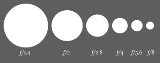
F-number

Encyclopedia

Optics
Optics is the branch of physics which involves the behavior and properties of light, including its interactions with matter and the construction of instruments that use or detect it. Optics usually describes the behavior of visible, ultraviolet, and infrared light...
, the f-number (sometimes called focal ratio, f-ratio, f-stop, or relative aperture) of an optical system expresses the diameter of the entrance pupil
Entrance pupil
In an optical system, the entrance pupil is the optical image of the physical aperture stop, as 'seen' through the front of the lens system. The corresponding image of the aperture as seen through the back of the lens system is called the exit pupil...
in terms of the focal length
Focal length
The focal length of an optical system is a measure of how strongly the system converges or diverges light. For an optical system in air, it is the distance over which initially collimated rays are brought to a focus...
of the lens
Photographic lens
A camera lens is an optical lens or assembly of lenses used in conjunction with a camera body and mechanism to make images of objects either on photographic film or on other media capable of storing an image chemically or electronically.While in principle a simple convex lens will suffice, in...
; in simpler terms, the f-number is the focal length divided by the "effective" aperture
Aperture
In optics, an aperture is a hole or an opening through which light travels. More specifically, the aperture of an optical system is the opening that determines the cone angle of a bundle of rays that come to a focus in the image plane. The aperture determines how collimated the admitted rays are,...
diameter. It is a dimensionless number that is a quantitative measure of lens speed
Lens speed
Lens speed refers to the maximum aperture diameter, or minimum f-number, of a photographic lens. A lens with a larger maximum aperture is a fast lens because it delivers more light intensity to the focal plane, allowing a faster shutter speed...
, an important concept in photography
Photography
Photography is the art, science and practice of creating durable images by recording light or other electromagnetic radiation, either electronically by means of an image sensor or chemically by means of a light-sensitive material such as photographic film...
.
Notation
The f-number (#) is often notated as and is given by
where
 is the focal length
Focal length
The focal length of an optical system is a measure of how strongly the system converges or diverges light. For an optical system in air, it is the distance over which initially collimated rays are brought to a focus...
, and
 is the diameter of the entrance pupil. By convention, "#" is treated as a single symbol, and specific values of # are written by replacing the number sign
Number sign
Number sign is a name for the symbol #, which is used for a variety of purposes including, in some countries, the designation of a number...
with the value. For example, if the focal length is 16 times the pupil diameter, the f-number is 16, or
 . The greater the f-number, the less light per unit area reaches the image
Image
An image is an artifact, for example a two-dimensional picture, that has a similar appearance to some subject—usually a physical object or a person.-Characteristics:...
plane of the system; the amount of light transmitted to the film (or sensor) decreases with the f-number squared. Doubling the f-number increases the necessary exposure time by a factor of four.
The pupil diameter is proportional to the diameter of the aperture stop of the system. In a camera, this is typically the diaphragm
Diaphragm (optics)
In optics, a diaphragm is a thin opaque structure with an opening at its center. The role of the diaphragm is to stop the passage of light, except for the light passing through the aperture...
aperture
Aperture
In optics, an aperture is a hole or an opening through which light travels. More specifically, the aperture of an optical system is the opening that determines the cone angle of a bundle of rays that come to a focus in the image plane. The aperture determines how collimated the admitted rays are,...
, which can be adjusted to vary the size of the pupil, and hence the amount of light that reaches the film
Photographic film
Photographic film is a sheet of plastic coated with an emulsion containing light-sensitive silver halide salts with variable crystal sizes that determine the sensitivity, contrast and resolution of the film...
or image sensor
Image sensor
An image sensor is a device that converts an optical image into an electronic signal. It is used mostly in digital cameras and other imaging devices...
. The common assumption in photography that the pupil diameter is equal to the aperture diameter is not correct for many types of camera lens, because of the magnifying effect of lens elements in front of the aperture.
A 100 mm focal length lens with an aperture setting of 4 will have a pupil diameter of 25 mm. A 200 mm focal length lens with a setting of 4 will have a pupil diameter of 50 mm. The 200 mm lens's 4 opening is larger than that of the 100 mm lens but both will produce the same illuminance
Illuminance
In photometry, illuminance is the total luminous flux incident on a surface, per unit area. It is a measure of the intensity of the incident light, wavelength-weighted by the luminosity function to correlate with human brightness perception. Similarly, luminous emittance is the luminous flux per...
in the focal plane when imaging an object of a given luminance
Luminance
Luminance is a photometric measure of the luminous intensity per unit area of light travelling in a given direction. It describes the amount of light that passes through or is emitted from a particular area, and falls within a given solid angle. The SI unit for luminance is candela per square...
.
In other types of optical system, such as telescope
Telescope
A telescope is an instrument that aids in the observation of remote objects by collecting electromagnetic radiation . The first known practical telescopes were invented in the Netherlands at the beginning of the 1600s , using glass lenses...
s and binoculars
Binoculars
Binoculars, field glasses or binocular telescopes are a pair of identical or mirror-symmetrical telescopes mounted side-by-side and aligned to point accurately in the same direction, allowing the viewer to use both eyes when viewing distant objects...
, the same principle holds: the greater the focal ratio, the fainter the images created (measuring brightness per unit area of the image).
Stops, f-stop conventions, and exposure
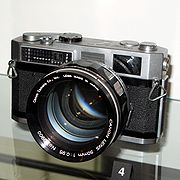
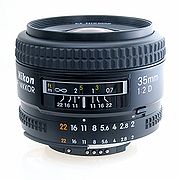
In photography, stops are also a unit used to quantify ratios of light or exposure, with one stop meaning a factor of two, or one-half. The one-stop unit is also known as the EV (exposure value
Exposure value
In photography, exposure value denotes all combinations of a camera's shutter speed and relative aperture that give the same exposure. In an attempt to simplify choosing among combinations of equivalent camera settings, the concept was developed by the German shutter manufacturer in the 1950s...
) unit. On a camera, the f-number is usually adjusted in discrete steps, known as f-stops. Each "stop" is marked with its corresponding f-number, and represents a halving of the light intensity from the previous stop. This corresponds to a decrease of the pupil and aperture diameters by a factor of
 or about 1.414, and hence a halving of the area of the pupil.
Modern lenses use a standard f-stop scale, which is an approximately geometric sequence of numbers that corresponds to the sequence of the powers
Exponentiation
Exponentiation is a mathematical operation, written as an, involving two numbers, the base a and the exponent n...
of the square root of 2
Square root of 2
The square root of 2, often known as root 2, is the positive algebraic number that, when multiplied by itself, gives the number 2. It is more precisely called the principal square root of 2, to distinguish it from the negative number with the same property.Geometrically the square root of 2 is the...
: 1, 1.4, 2, 2.8, 4, 5.6, 8, 11, 16, 22, 32, 45, 64, 90, 128, etc. The values of the ratios are rounded off to these particular conventional numbers, to make them easier to remember and write down.
The sequence above can be obtained as following: 1 =
 , 1.4 =
  ,2 =
,2 =  , 2.8 =
  ...
...Shutter speed
Shutter speed
In photography, shutter speed is a common term used to discuss exposure time, the effective length of time a camera's shutter is open....
s are arranged in a similar scale, so that one step in the shutter speed scale corresponds to one stop in the aperture scale. Opening up a lens by one stop allows twice as much light to fall on the film in a given period of time, therefore to have the same exposure at this larger aperture, as at the previous aperture, the shutter speed is set twice as fast (i.e., the shutter is open half as long); the film will usually respond equally to these equal amounts of light, since it has the property known as reciprocity
Reciprocity (photography)
In photography reciprocity refers to the inverse relationship between the intensity and duration of light that determines the reaction of light-sensitive material. Within a normal exposure range for film stock, for example, the reciprocity law states that the film response will be determined by the...
. Alternatively, one could use a film that is half as sensitive
Film speed
Film speed is the measure of a photographic film's sensitivity to light, determined by sensitometry and measured on various numerical scales, the most recent being the ISO system....
to light, with the original shutter speed.
Photographers sometimes express other exposure
Exposure (photography)
In photography, exposure is the total amount of light allowed to fall on the photographic medium during the process of taking a photograph. Exposure is measured in lux seconds, and can be computed from exposure value and scene luminance over a specified area.In photographic jargon, an exposure...
ratios in terms of 'stops'. Ignoring the f-number markings, the f-stops make a logarithmic scale of exposure intensity. Given this interpretation, one can then think of taking a half-step along this scale, to make an exposure difference of "half a stop".
Fractional stops
Most old cameras had an aperture scale graduated in full stops but the aperture is continuously variable allowing selection of any intermediate aperture.Click-stopped aperture became a common feature in the 1960s; the aperture scale was usually marked in full stops, but many lenses had a click between two marks, allowing a gradation of one half of a stop.
On modern cameras, especially when aperture is set on the camera body, f-number is often divided more finely than steps of one stop. Steps of one-third stop (1/3 EV) are the most common, since this matches the ISO system of film speed
Film speed
Film speed is the measure of a photographic film's sensitivity to light, determined by sensitometry and measured on various numerical scales, the most recent being the ISO system....
s. Half-stop steps are also seen on some cameras. As an example, the aperture that is one-third stop smaller than 2.8 is 3.2, two-thirds smaller is 3.5, and one whole stop smaller is 4. The next few f-stops in this sequence are
- 4.5, 5, 5.6, 6.3, 7.1, 8, etc.
To calculate the steps in a full stop (1 EV) one could use
- 20×0.5, 21×0.5, 22×0.5, 23×0.5, 24×0.5 etc.
The steps in a half stop (1/2 EV) series would be
- 20/2×0.5, 21/2×0.5, 22/2×0.5, 23/2×0.5, 24/2×0.5 etc.
The steps in a third stop (1/3 EV) series would be
- 20/3×0.5, 21/3×0.5, 22/3×0.5, 23/3×0.5, 24/3×0.5 etc.
As in the earlier DIN and ASA film-speed standards, the ISO speed is defined only in one-third stop increments, and shutter speeds of digital cameras are commonly on the same scale in reciprocal seconds. A portion of the ISO range is the sequence
- ... 16/13°, 20/14°, 25/15°, 32/16°, 40/17°, 50/18°, 64/19°, 80/20°, 100/21°, 125/22°...
while shutter speeds in reciprocal seconds have a few conventional differences in their numbers (1/15, 1/30, and 1/60 second instead of 1/16, 1/32, and 1/64).
In practice the maximum aperture of a lens is often not an integral
Integer
The integers are formed by the natural numbers together with the negatives of the non-zero natural numbers .They are known as Positive and Negative Integers respectively...
power of
 (i.e.,
  to the power of a whole number), in which case it is usually a half or third stop above or below an integral power of
  .
.Modern electronically-controlled interchangeable lenses, such as those from Canon and Sigma for SLR cameras, have f-stops specified internally in 1/8-stop increments, so the cameras' 1/3-stop settings are approximated by the nearest 1/8-stop setting in the lens.
Standard full-stop f-number scale
Including aperture valueAPEX system
APEX stands for Additive system of Photographic EXposure, whichwas proposed in the 1960 ASA standardfor monochrome film speed, ASA PH2.5-1960,as a means of simplifying exposure computation.-Exposure equation:...
AV:
# =

| AV | −1 | 0 | 1 | 2 | 3 | 4 | 5 | 6 | 7 | 8 | 9 | 10 | 11 | 12 | 13 | 14 | 15 | 16 |
|---|---|---|---|---|---|---|---|---|---|---|---|---|---|---|---|---|---|---|
| 0.7 | 1.0 | 1.4 | 2 | 2.8 | 4 | 5.6 | 8 | 11 | 16 | 22 | 32 | 45 | 64 | 90 | 128 | 180 | 256 |
Typical one-half-stop f-number scale
| 0.7 | 0.8 | 1.0 | 1.2 | 1.4 | 1.7 | 2 | 2.4 | 2.8 | 3.3 | 4 | 4.8 | 5.6 | 6.7 | 8 | 9.5 | 11 | 13 | 16 | 19 | 22 | 27 | 32 |
Typical one-third-stop f-number scale
| 0.7 | 0.8 | 0.9 | 1.0 | 1.1 | 1.2 | 1.4 | 1.6 | 1.8 | 2 | 2.2 | 2.5 | 2.8 | 3.2 | 3.5 | 4 | 4.5 | 5.0 | 5.6 | 6.3 | 7.1 | 8 | 9 | 10 | 11 | 13 | 14 | 16 | 18 | 20 | 22 |
Typical one-quarter-stop f-number scale
| 1.0 | 1.1 | 1.2 | 1.3 | 1.4 | 1.5 | 1.7 | 1.8 | 2 | 2.2 | 2.4 | 2.6 | 2.8 | 3.2 | 3.4 | 3.7 | 4 | 4.4 | 4.8 | 5.2 | 5.6 | 6.2 | 6.7 | 7.3 | 8 | 8.7 | 9.5 | 10 | 11 | 12 | 14 | 15 | 16 | 17 | 19 | 21 | 22 |
Notice that sometimes a number shows on several scales; for example, 1.2 may be used in either a half-stop
or a one-third-stop system;
sometimes 1.3 and 3.2 and other differences are used for the one-third stop scale.
T-stops
Since all lenses absorb some portion of the light passing through them (particularly zoom lensZoom lens
A zoom lens is a mechanical assembly of lens elements for which the focal length can be varied, as opposed to a fixed focal length lens...
es containing many elements), T-stops are sometimes used instead of f-stops for exposure purposes, especially for motion picture camera lenses. The T in T-stop stands for transmission
Transmittance
In optics and spectroscopy, transmittance is the fraction of incident light at a specified wavelength that passes through a sample. A related term is absorptance, or absorption factor, which is the fraction of radiation absorbed by a sample at a specified wavelength...
. The practice became popular in cinematographic usage before the advent of zoom lenses, where fixed focal length lenses were calibrated to T-stops: This allowed the turret-mounted lenses to be changed without affecting the overall scene brightness. Lenses were bench-tested individually for actual light transmission and assigned T stops accordingly. Modern cinematographic lenses now usually tend to be factory-calibrated in T-stops. T-stops measure the amount of light transmitted through the lens in practice, and are equivalent in light transmission to the f-stop of an ideal lens with 100% transmission. Since all lenses absorb some quantity of light, the T-number of any given aperture on a lens will always be greater than the f-number. Consequently, the depth of field
Depth of field
In optics, particularly as it relates to film and photography, depth of field is the distance between the nearest and farthest objects in a scene that appear acceptably sharp in an image...
for a given T-number will be slightly less than that when the f-number is set to the same value, since the aperture diameter is slightly greater. In recent years, advances in lens technology and in film and sensor exposure latitude have reduced the need for T-stop values, although T-stops are still considered industry standard for cinematographic lenses (Zeiss, Cooke, etc). This is because in multi-camera shoots cinematographers need to be able to achieve the same exposure across all cameras, especially important when using different lenses with varying light characteristics.
Sunny 16 rule
An example of the use of f-numbers in photography is the sunny 16 ruleSunny 16 rule
In photography, the Sunny 16 rule is a method of estimating correct daylight exposures without a light meter. Apart from the obvious advantage of independence from a light meter, the Sunny 16 rule can also aid in achieving correct exposure of difficult subjects...
: an approximately correct exposure will be obtained on a sunny day by using an aperture of 16 and the shutter speed closest to the reciprocal of the ISO speed of the film; for example, using ISO 200 film, an aperture of 16 and a shutter speed of 1/200 second. The f-number may then be adjusted downwards for situations with lower light.
Effects on image quality
Depth of field
In optics, particularly as it relates to film and photography, depth of field is the distance between the nearest and farthest objects in a scene that appear acceptably sharp in an image...
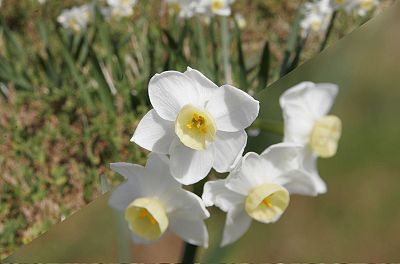
increases with f-number, as illustrated in the image here. This means that photographs taken with a low f-number will tend to have subjects at one distance in focus, with the rest of the image (nearer and farther elements) out of focus. This is frequently useful for nature photography
Nature photography
Nature photography refers to a wide range of photography taken outdoors and devoted to displaying natural elements such as landscapes, wildlife, plants, and close-ups of natural scenes and textures...
, portraiture
Portrait photography
Portrait photography or portraiture is the capture by means of photography of the likeness of a person or a small group of people , in which the face and expression is predominant. The objective is to display the likeness, personality, and even the mood of the subject...
, and certain special effects. The depth of field
Depth of field
In optics, particularly as it relates to film and photography, depth of field is the distance between the nearest and farthest objects in a scene that appear acceptably sharp in an image...
of an image produced at a given f-number is dependent on other parameters as well, including the focal length
Focal length
The focal length of an optical system is a measure of how strongly the system converges or diverges light. For an optical system in air, it is the distance over which initially collimated rays are brought to a focus...
, the subject distance, and the format
Film format
A film format is a technical definition of a set of standard characteristics regarding image capture on photographic film, for either stills or movies. It can also apply to projected film, either slides or movies. The primary characteristic of a film format is its size and shape.In the case of...
of the film or sensor used to capture the image. Depth of field can be described as depending on just angle of view, subject distance, and entrance pupil
Entrance pupil
In an optical system, the entrance pupil is the optical image of the physical aperture stop, as 'seen' through the front of the lens system. The corresponding image of the aperture as seen through the back of the lens system is called the exit pupil...
diameter (as in von Rohr's method
Moritz von Rohr
Moritz von Rohr was an optical scientist at Carl Zeiss in Jena.A street in Jena is named after him: Moritz-von-Rohr-Straße, near Carl-Zeiss-Promenade and Otto-Schott-Straße, reminders of the proud optical heritage of the city.-Life:...
). As a result, smaller formats will have a deeper field than larger formats at the same f-number for the same distance of focus and same angle of view
Angle of view
In photography, angle of view describes the angular extent of a given scene that is imaged by a camera. It is used interchangeably with the more general term field of view....
since entrance-pupil diameter goes by the format size at a given f-number. Therefore, reduced–depth-of-field effects, like those shown below, will require smaller f-numbers (and thus larger apertures and so potentially more complex optics) when using small-format cameras than when using larger-format cameras.
Picture sharpness also varies with f-number. The optimal f-stop varies with the lens characteristics. For modern standard lenses having 6 or 7 elements, the sharpest image is often obtained around 5.6–8, while for older standard lenses having only 4 elements (Tessar formula) stopping to 11 will give the sharpest image. The reason the sharpness is best at medium f-numbers is that the sharpness at high f-numbers is constrained by diffraction
Diffraction
Diffraction refers to various phenomena which occur when a wave encounters an obstacle. Italian scientist Francesco Maria Grimaldi coined the word "diffraction" and was the first to record accurate observations of the phenomenon in 1665...
, whereas at low f-numbers limitations of the lens design known as aberration
Aberration in optical systems
Aberrations are departures of the performance of an optical system from the predictions of paraxial optics. Aberration leads to blurring of the image produced by an image-forming optical system. It occurs when light from one point of an object after transmission through the system does not converge...
s will dominate. The larger number of elements in modern lenses allow the designer to compensate for aberrations, allowing the lens to give better pictures at lower f-numbers. Light falloff is also sensitive to f-stop. Many wide-angle lenses will show a significant light falloff (vignetting
Vignetting
In photography and optics, vignetting is a reduction of an image's brightness or saturation at the periphery compared to the image center. The word vignette, from the same root as vine, originally referred to a decorative border in a book. Later, the word came to be used for a photographic...
) at the edges for large apertures. To measure the actual resolution of the lens at the different f-numbers it is necessary to use a standardized measurement chart like the 1951 USAF resolution test chart
1951 USAF Resolution Test Chart
1951 USAF resolution test chart is a resolution test pattern conforming to MIL-STD-150A standard, set by US Air Force in 1951. It is still widely accepted to test the resolving power of optical imaging systems such as microscopes, cameras and image scanners, although MIL-STD-150A was cancelled on...
.
Photojournalists have a saying, "8 and be there", meaning that being on the scene is more important than worrying about technical details. The aperture of 8 gives adequate depth of field, assuming a 35 mm or DSLR camera, minimum shutter-speed, and ISO film rating within reasonable limits subject to lighting.
Human eye
Computing the f-number of the human eyeHuman eye
The human eye is an organ which reacts to light for several purposes. As a conscious sense organ, the eye allows vision. Rod and cone cells in the retina allow conscious light perception and vision including color differentiation and the perception of depth...
involves computing the physical aperture and focal length of the eye. The pupil can be as large as 6–7 mm wide open, which translates into the maximum physical aperture.
The f-number of the human eye varies from about 8.3 in a very brightly lit place to about 2.1 in the dark. The presented maximum f-number has been questioned, as it seems to only match the focal length that assumes outgoing light rays. According to the incoming rays of light (what we actually see), the focal length of the eye is a bit longer, resulting in maximum f-number of 3.2.
Note that computing the focal length requires that the light-refracting properties of the liquids in the eye are taken into account. Treating the eye as an ordinary air-filled camera and lens results in a different focal length, thus yielding an incorrect f-number.
Toxic substances and poison
Poison
In the context of biology, poisons are substances that can cause disturbances to organisms, usually by chemical reaction or other activity on the molecular scale, when a sufficient quantity is absorbed by an organism....
s (like Atropine
Atropine
Atropine is a naturally occurring tropane alkaloid extracted from deadly nightshade , Jimson weed , mandrake and other plants of the family Solanaceae. It is a secondary metabolite of these plants and serves as a drug with a wide variety of effects...
) can significantly reduce the range of aperture. Pharmaceutical products such as eye drops may also cause similar side-effects.
Focal ratio in telescopes
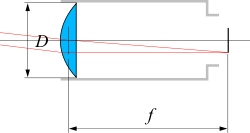
 . It is still defined as the focal length
Focal length
The focal length of an optical system is a measure of how strongly the system converges or diverges light. For an optical system in air, it is the distance over which initially collimated rays are brought to a focus...
 of an objective
Objective (optics)
In an optical instrument, the objective is the optical element that gathers light from the object being observed and focuses the light rays to produce a real image. Objectives can be single lenses or mirrors, or combinations of several optical elements. They are used in microscopes, telescopes,...
divided by its diameter
 or by the diameter of an aperture
Aperture
In optics, an aperture is a hole or an opening through which light travels. More specifically, the aperture of an optical system is the opening that determines the cone angle of a bundle of rays that come to a focus in the image plane. The aperture determines how collimated the admitted rays are,...
stop in the system.

For example if you want to make a 12", f/8 telescope, then the focal length will be 96", which means that light from distant objects must focus 96" behind the lens or 96" in front of the concave mirror.
Even though the principles of focal ratio are always the same, the application to which the principle is put can differ. In photography
Photography
Photography is the art, science and practice of creating durable images by recording light or other electromagnetic radiation, either electronically by means of an image sensor or chemically by means of a light-sensitive material such as photographic film...
the focal ratio varies the focal-plane illuminance (or optical power per unit area in the image) and is used to control variables such as depth of field
Depth of field
In optics, particularly as it relates to film and photography, depth of field is the distance between the nearest and farthest objects in a scene that appear acceptably sharp in an image...
. When using an optical telescope
Optical telescope
An optical telescope is a telescope which is used to gather and focus light mainly from the visible part of the electromagnetic spectrum for directly viewing a magnified image for making a photograph, or collecting data through electronic image sensors....
in astronomy, there is no depth of field issue, and the brightness of stellar point sources in terms of total optical power (not divided by area) is a function of absolute aperture area only, independent of focal length. The focal length controls the field of view of the instrument and the scale of the image that is presented at the focal plane to an eyepiece
Eyepiece
An eyepiece, or ocular lens, is a type of lens that is attached to a variety of optical devices such as telescopes and microscopes. It is so named because it is usually the lens that is closest to the eye when someone looks through the device. The objective lens or mirror collects light and brings...
, film plate, or CCD
Charge-coupled device
A charge-coupled device is a device for the movement of electrical charge, usually from within the device to an area where the charge can be manipulated, for example conversion into a digital value. This is achieved by "shifting" the signals between stages within the device one at a time...
.
For example, the SOAR 4m telescope has a small field of view (~f/16) which is useful for stellar studies. The LSST 8.4m telescope, which will cover the entire sky every 3 days has a very large field of view. Its short 10.3 meter focal length (f/1.2) is made possible by an error correction system which includes secondary and tertiary mirrors, a three element refractive system and active mounting and optics.
Working f-number
The f-number accurately describes the light-gathering ability of a lens only for objects an infinite distance away. This limitation is typically ignored in photography, where objects are usually not extremely close to the camera, relative to the distance between the lens and the film. In optical design, an alternative is often needed for systems where the object is not far from the lens. In these cases the working f-number is used. The working f-number Nw is given by ,
,where N is the uncorrected f-number, NAi is the image-space numerical aperture
Numerical aperture
In optics, the numerical aperture of an optical system is a dimensionless number that characterizes the range of angles over which the system can accept or emit light. By incorporating index of refraction in its definition, NA has the property that it is constant for a beam as it goes from one...
of the lens, and
 is the absolute value
Absolute value
In mathematics, the absolute value |a| of a real number a is the numerical value of a without regard to its sign. So, for example, the absolute value of 3 is 3, and the absolute value of -3 is also 3...
of lens's magnification
Magnification
Magnification is the process of enlarging something only in appearance, not in physical size. This enlargement is quantified by a calculated number also called "magnification"...
for an object a particular distance away. In photography, the working f-number is described as the f-number corrected for lens extensions by a bellows factor. This is of particular importance in macro photography
Macro photography
Macrophotography is close-up photography, usually of very small subjects. Classically a macrophotograph is one in which the size of the subject on the negative is greater than life size. However in modern use it refers to a finished photograph of a subject at greater than life size...
.
History
The system of f-numbers for specifying relative apertures evolved in the late nineteenth century, in competition with several other systems of aperture notation.Origins of relative aperture
In 1867, Sutton and Dawson defined "apertal ratio" as essentially the reciprocal of the modern f-number:In every lens there is, corresponding to a given apertal ratio (that is, the ratio of the diameter of the stop to the focal length), a certain distance of a near object from it, between which and infinity all objects are in equally good focus. For instance, in a single view lens of 6 inch focus, with a 1/4 in. stop (apertal ratio one-twenty-fourth), all objects situated at distances lying between 20 feet from the lens and an infinite distance from it (a fixed star, for instance) are in equally good focus. Twenty feet is therefore called the 'focal range' of the lens when this stop is used. The focal range is consequently the distance of the nearest object, which will be in good focus when the ground glass is adjusted for an extremely distant object. In the same lens, the focal range will depend upon the size of the diaphragm used, while in different lenses having the same apertal ratio the focal ranges will be greater as the focal length of the lens is increased. The terms 'apertal ratio' and 'focal range' have not come into general use, but it is very desirable that they should, in order to prevent ambiguity and circumlocution when treating of the properties of photographic lenses.
In 1874, John Henry Dallmeyer
John Henry Dallmeyer
John Henry Dallmeyer , Anglo-German optician, was born at Loxten, Westphalia, the son of a landowner.On leaving school at the age of sixteen he was apprenticed to an Osnabrück optician, and in 1851 he came to London, where he obtained work with an optician, W Hewitt, who shortly afterwards, with...
called the ratio
 the "intensity ratio" of a lens:
The rapidity of a lens depends upon the relation or ratio of the aperture to the equivalent focus. To ascertain this, divide the equivalent focus by the diameter of the actual working aperture of the lens in question; and note down the quotient as the denominator with 1, or unity, for the numerator. Thus to find the ratio of a lens of 2 inches diameter and 6 inches focus, divide the focus by the aperture, or 6 divided by 2 equals 3; i.e., 1/3 is the intensity ratio.
Although he did not yet have access to Ernst Abbe's theory of stops and pupils, which was made widely available by Siegfried Czapski
Siegfried Czapski
-Overview:See the German Wikipedia article :de:Siegfried Czapski for details of Siegried Czapski's life.Czapski succeeded Ernst Abbe as the head of Carl Zeiss in Jena in 1903....
in 1893, Dallmeyer knew that his working aperture was not the same as the physical diameter of the aperture stop:
It must be observed, however, that in order to find the real intensity ratio, the diameter of the actual working aperture must be ascertained. This is easily accomplished in the case of single lenses, or for double combination lenses used with the full opening, these merely requiring the application of a pair of compasses or rule; but when double or triple-combination lenses are used, with stops inserted between the combinations, it is somewhat more troublesome; for it is obvious that in this case the diameter of the stop employed is not the measure of the actual pencil of light transmitted by the front combination. To ascertain this, focus for a distant object, remove the focusing screen and replace it by the collodion slide, having previously inserted a piece of cardboard in place of the prepared plate. Make a small round hole in the centre of the cardboard with a piercer, and now remove to a darkened room; apply a candle close to the hole, and observe the illuminated patch visible upon the front combination; the diameter of this circle, carefully measured, is the actual working aperture of the lens in question for the particular stop employed.
This point is further emphasized by Czapski in 1893. According to an English review of his book, in 1894, "The necessity of clearly distinguishing between effective aperture and diameter of physical stop is strongly insisted upon."
J. H. Dallmeyer's son, Thomas Rudolphus Dallmeyer
Thomas Rudolphus Dallmeyer
Thomas Rudolphus Dallmeyer , English optician, was the son of John Henry Dallmeyer who ran an optics business.He assumed control of the business on the failure of his father's health, was principally known as the first to introduce the telephoto lens into ordinary practice , and he was the author...
, inventor of the telephoto lens, followed the intensity ratio terminology in 1899.
Aperture numbering systems
At the same time, there were a number of aperture numbering systems designed with the goal of making exposure times vary in direct or inverse proportion with the aperture, rather than with the square of the f-number or inverse square of the apertal ratio or intensity ratio. But these systems all involved some arbitrary constant, as opposed to the simple ratio of focal length and diameter.For example, the Uniform System (U.S.) of apertures was adopted as a standard by the Photographic Society of Great Britain
Royal Photographic Society
The Royal Photographic Society is the world's oldest national photographic society. It was founded in London, United Kingdom in 1853 as The Photographic Society of London with the objective of promoting the Art and Science of Photography...
in the 1880s. Bothamley in 1891 said "The stops of all the best makers are now arranged according to this system." U.S. 16 is the same aperture as 16, but apertures that are larger or smaller by a full stop use doubling or halving of the U.S. number, for example 11 is U.S. 8 and 8 is U.S. 4. The exposure time required is directly proportional to the U.S. number. Eastman Kodak
Eastman Kodak
Eastman Kodak Company is a multinational imaging and photographic equipment, materials and services company headquarted in Rochester, New York, United States. It was founded by George Eastman in 1892....
used U.S. stops on many of their cameras at least in the 1920s.
By 1895, Hodges contradicts Bothamley, saying that the f-number system has taken over: "This is called the f/x system, and the diaphragms of all modern lenses of good construction are so marked."
Here is the situation as seen in 1899:
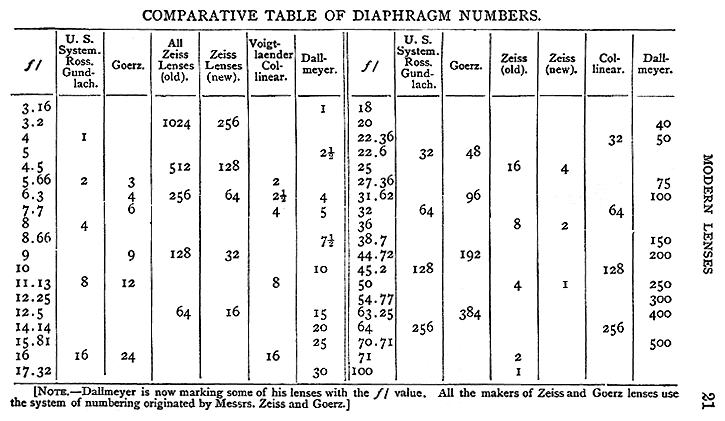
Carl Zeiss
Carl Zeiss was a German maker of optical instruments commonly known for the company he founded, Carl Zeiss Jena . Zeiss made contributions to lens manufacturing that have aided the modern production of lenses...
systems based on actual intensity (proportional to reciprocal square of the f-number); and the U.S., C.I., and Dallmeyer systems based on exposure (proportional to square of the f-number). He calls the f-number the "ratio number," "aperture ratio number," and "ratio aperture." He calls expressions like 8 the "fractional diameter" of the aperture, even though it is literally equal to the "absolute diameter" which he distinguishes as a different term. He also sometimes uses expressions like "an aperture of f 8" without the division indicated by the slash.
Beck and Andrews in 1902 talk about the Royal Photographic Society standard of 4, 5.6, 8, 11.3, etc. The R.P.S. had changed their name and moved off of the U.S. system some time between 1895 and 1902.
Typographical standardization
By 1920, the term f-number appeared in books both as F number and f/number. In modern publications, the forms f-number and f number are more common, though the earlier forms, as well as F-number are still found in a few books; not uncommonly, the initial lower-case f in f-number or f/number is set in a hooked italic form: f, or f. Notations for f-numbers were also quite variable in the early part of the twentieth century. They were sometimes written with a capital F, sometimes with a dot (period) instead of a slash, and sometimes set as a vertical fraction.The 1961 ASA
American National Standards Institute
The American National Standards Institute is a private non-profit organization that oversees the development of voluntary consensus standards for products, services, processes, systems, and personnel in the United States. The organization also coordinates U.S. standards with international...
standard PH2.12-1961 American Standard General-Purpose Photographic Exposure Meters (Photoelectric Type) specifies that "The symbol for relative apertures shall be f/ or f : followed by the effective f-number." Note that they show the hooked italic f not only in the symbol, but also in the term f-number, which today is more commonly set in an ordinary non-italic face.
See also
- Circle of confusionCircle of confusionIn optics, a circle of confusion is an optical spot caused by a cone of light rays from a lens not coming to a perfect focus when imaging a point source...
- Depth of fieldDepth of fieldIn optics, particularly as it relates to film and photography, depth of field is the distance between the nearest and farthest objects in a scene that appear acceptably sharp in an image...
- Group f/64Group f/64Group f/64 was a group of seven 20th century San Francisco photographers who shared a common photographic style characterized by sharp-focused and carefully framed images seen through a particularly Western viewpoint...
- Exposure valueExposure valueIn photography, exposure value denotes all combinations of a camera's shutter speed and relative aperture that give the same exposure. In an attempt to simplify choosing among combinations of equivalent camera settings, the concept was developed by the German shutter manufacturer in the 1950s...
- Optical telescopeOptical telescopeAn optical telescope is a telescope which is used to gather and focus light mainly from the visible part of the electromagnetic spectrum for directly viewing a magnified image for making a photograph, or collecting data through electronic image sensors....
- Photographic lens designPhotographic lens designThe design of photographic lenses for use in still or cine cameras is intended to produce a lens that yields the most acceptable rendition of the subject being photographed within a range of constraints that include cost, weight and materials...
- Pinhole cameraPinhole cameraA pinhole camera is a simple camera without a lens and with a single small aperture – effectively a light-proof box with a small hole in one side. Light from a scene passes through this single point and projects an inverted image on the opposite side of the box...
- Printer pointPrinter pointIn photography, a printer point is a unit of relative exposure, in printing a negative, equal to a 1/12 of a stop or 0.025 Log unit of exposure ratio ....
s - TelescopeTelescopeA telescope is an instrument that aids in the observation of remote objects by collecting electromagnetic radiation . The first known practical telescopes were invented in the Netherlands at the beginning of the 1600s , using glass lenses...