


Binoculars

Encyclopedia
Symmetry
Symmetry generally conveys two primary meanings. The first is an imprecise sense of harmonious or aesthetically pleasing proportionality and balance; such that it reflects beauty or perfection...
telescope
Optical telescope
An optical telescope is a telescope which is used to gather and focus light mainly from the visible part of the electromagnetic spectrum for directly viewing a magnified image for making a photograph, or collecting data through electronic image sensors....
s mounted side-by-side and aligned to point accurately in the same direction, allowing the viewer to use both eyes (binocular vision
Binocular vision
Binocular vision is vision in which both eyes are used together. The word binocular comes from two Latin roots, bini for double, and oculus for eye. Having two eyes confers at least four advantages over having one. First, it gives a creature a spare eye in case one is damaged. Second, it gives a...
) when viewing distant objects. Most are sized to be held using both hands, although sizes vary widely from opera glasses
Opera glasses
Opera glasses, also known as theater binoculars or Galilean binoculars, are compact, low-power optical magnification devices, usually used at performance events, whose name is derived from traditional use at opera performances. Magnification power below 5x is usually desired in these circumstances...
to large pedestal mounted military models. Many different abbreviations are used for binoculars, including glasses, nocs, noculars, binos and bins.
Unlike a (monocular
Monocular
A monocular is a modified refracting telescope used to magnify the images of distant objects by passing light through a series of lenses and sometimes prisms; the use of prisms results in a lightweight telescope. Volume and weight are less than half those of binoculars of similar optical...
) telescope, binoculars give users a three-dimensional image: for nearer objects the two views, presented to each of the viewer's eyes from slightly different viewpoints, produce a merged view with an impression of depth
Depth perception
Depth perception is the visual ability to perceive the world in three dimensions and the distance of an object. Depth sensation is the ability to move accurately, or to respond consistently, based on the distances of objects in an environment....
.
Galilean binoculars
.jpg)
Objective (optics)
In an optical instrument, the objective is the optical element that gathers light from the object being observed and focuses the light rays to produce a real image. Objectives can be single lenses or mirrors, or combinations of several optical elements. They are used in microscopes, telescopes,...
and a concave eyepiece lens
Eyepiece
An eyepiece, or ocular lens, is a type of lens that is attached to a variety of optical devices such as telescopes and microscopes. It is so named because it is usually the lens that is closest to the eye when someone looks through the device. The objective lens or mirror collects light and brings...
. The Galilean design has the advantage of presenting an erect image
Erect image
An erect image, in optics, is one that appears right-side up.Some telescopes and other devices, such as the camera obscura present an inverted image on the viewing surface. Various means are used to achieve an erect image. A common example of an erect image is the image of a person in a standard...
but has a narrow field of view and is not capable of very high magnification. This type of construction is still used in very cheap models and in opera glasses
Opera glasses
Opera glasses, also known as theater binoculars or Galilean binoculars, are compact, low-power optical magnification devices, usually used at performance events, whose name is derived from traditional use at opera performances. Magnification power below 5x is usually desired in these circumstances...
or theater glasses.
Prism binoculars

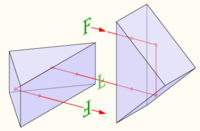
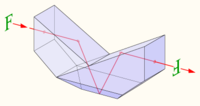
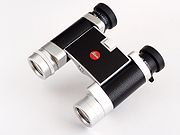
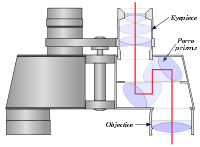
Porro prism binoculars are named after Italian optician Ignazio Porro
Ignazio Porro
Ignazio Porro was an Italian inventor of optical instruments.Porro's name is most closely associated with the prism system which he invented around 1850 and which is used in the construction of Porro prism binoculars....
who patented this image erecting system in 1854 and later refined by makers like the Carl Zeiss company in the 1890s. Binoculars of this type use a Porro prism
Porro prism
In optics, a Porro prism, named for its inventor Ignazio Porro, is a type of reflection prism used in optical instruments to alter the orientation of an image....
in a double prism Z-shaped configuration to erect the image. This feature results in binoculars that are wide, with objective lenses that are well separated but offset from the eyepiece
Eyepiece
An eyepiece, or ocular lens, is a type of lens that is attached to a variety of optical devices such as telescopes and microscopes. It is so named because it is usually the lens that is closest to the eye when someone looks through the device. The objective lens or mirror collects light and brings...
s. Porro prism designs have the added benefit of folding the optical path
Optical path
The path that light takes in traversing an optical system is often called the optical path. The physical length of an optical device can be reduced to less than the length of the optical path by using folded optics. The optical path length as defined in optics is the length of the path multiplied...
so that the physical length of the binoculars is less than the focal length
Focal length
The focal length of an optical system is a measure of how strongly the system converges or diverges light. For an optical system in air, it is the distance over which initially collimated rays are brought to a focus...
of the objective and wider spacing of the objectives gives a better sensation of depth.
Binoculars using roof prism
Roof prism
A roof prism is in general any kind of reflective optical prism containing a section where two faces meet at a 90° angle...
s may have appeared as early as the 1870s in a design by Achille Victor Emile Daubresse. Most roof prism binoculars use either the Abbe-Koenig prism
Abbe-Koenig prism
An Abbe–Koenig prism is a type of reflecting prism used to invert an image . They are commonly used in binoculars and some telescopes for this purpose. The prism is named after Ernst Abbe and Albert Koenig....
(named after Ernst Karl Abbe
Ernst Karl Abbe
- See also :*Abbe prism*Abbe refractometer*Abbe error*Aberration in optical systems*Calculation of glass properties* German inventors and discoverers-External links:*...
and Albert Koenig and patented by Carl Zeiss in 1905) or Schmidt-Pechan prism
Schmidt-Pechan prism
A Schmidt–Pechan prism is a type of optical prism used to rotate an image by 180°. They are commonly used in binoculars as an image erecting system...
(invented in 1899) designs to erect the image and fold the optical path. They have objective lenses that are approximately in line with the eyepieces.
Roof-prisms designs create an instrument that is narrower and more compact than Porro prisms. There is also a difference in image brightness. Porro-prism
Porro prism
In optics, a Porro prism, named for its inventor Ignazio Porro, is a type of reflection prism used in optical instruments to alter the orientation of an image....
binoculars will inherently produce a brighter image than roof-prism
Roof prism
A roof prism is in general any kind of reflective optical prism containing a section where two faces meet at a 90° angle...
binoculars of the same magnification, objective size, and optical quality, because the roof-prism design employs silvered surfaces that reduce light transmission by 12% to 15%. Roof-prisms designs also require tighter tolerances as far as alignment of their optical elements (collimation). This adds to their expense since the design requires them to use fixed elements that need to be set at a high degree of collimation at the factory. Porro prisms binoculars occasionally need their prism sets to be re-aligned to bring them into collimation. The fixed alignment in roof-prism designs means the binoculars normally won't need re-collimation.
Optical parameters

- Magnification: The ratio of the focal length of the eyepiece divided into the focal length of the objective gives the linear magnifying power of binoculars (sometimes expressed as "diameters"). A magnification of factor 7, for example, produces an image as if one were 7 times closer to the object. The amount of magnification depends upon the application the binoculars are designed for. Hand-held binoculars have lower magnifications so they will be less susceptible to shaking. A larger magnification leads to a smaller field of view.
- Objective diameter: The diameterDiameterIn geometry, a diameter of a circle is any straight line segment that passes through the center of the circle and whose endpoints are on the circle. The diameters are the longest chords of the circle...
of the objective lensObjective (optics)In an optical instrument, the objective is the optical element that gathers light from the object being observed and focuses the light rays to produce a real image. Objectives can be single lenses or mirrors, or combinations of several optical elements. They are used in microscopes, telescopes,...
determines how much light can be gathered to form an image. This number directly affects performance. When magnification and quality is equal, the larger the second binocular number, the brighter the image as well as the sharper the image. An 8×40, then, will produce a brighter and sharper image than an 8×25, even though both enlarge the image an identical eight times. The larger front lenses in the 8×40 also produce wider beams of light (exit pupil) that leave the eyepieces. This makes it more comfortable to view with an 8×40 than an 8×25. It is usually expressed in millimeters. It is customary to categorize binoculars by the magnification × the objective diameter; e.g. 7×50. - Field of view: The field of viewField of viewThe field of view is the extent of the observable world that is seen at any given moment....
of a pair of binoculars is determined by its optical design. It is usually notated in a linearLinearIn mathematics, a linear map or function f is a function which satisfies the following two properties:* Additivity : f = f + f...
value, such as how many feet (meters) in width will be seen at 1,000 yards (or 1,000 m), or in an angularAngleIn geometry, an angle is the figure formed by two rays sharing a common endpoint, called the vertex of the angle.Angles are usually presumed to be in a Euclidean plane with the circle taken for standard with regard to direction. In fact, an angle is frequently viewed as a measure of an circular arc...
value of how many degrees can be viewed. - Exit pupil: Binoculars concentrate the light gathered by the objective into a beam, the exit pupilExit pupilIn optics, the exit pupil is a virtual aperture in an optical system. Only rays which pass through this virtual aperture can exit the system. The exit pupil is the image of the aperture stop in the optics that follow it. In a telescope or compound microscope, this image is the image of the...
, whose diameter is the objective diameter divided by the magnifying power. For maximum effective light-gathering and brightest image, the exit pupil should equal the diameter of the fully dilated irisIris (anatomy)The iris is a thin, circular structure in the eye, responsible for controlling the diameter and size of the pupils and thus the amount of light reaching the retina. "Eye color" is the color of the iris, which can be green, blue, or brown. In some cases it can be hazel , grey, violet, or even pink...
of the human eye— about 7 mm, reducing with age. If the cone of light streaming out of the binoculars is larger than the pupil it is going into, any light larger than the pupil is wasted in terms of providing information to the eye. In daytime use the human pupil is typically dilated about 3 mm, which is about the exit pupil of a 7×21 binocular. Much larger 7×50 binoculars will produce a cone of light bigger than the pupil it is entering, and this light will, in the day, be wasted. It is therefore seemingly pointless to carry around a larger instrument. However, a larger exit pupil makes it easier to put the eye where it can receive the light: anywhere in the large exit pupil cone of light will do. This ease of placement helps avoid vignettingVignettingIn photography and optics, vignetting is a reduction of an image's brightness or saturation at the periphery compared to the image center. The word vignette, from the same root as vine, originally referred to a decorative border in a book. Later, the word came to be used for a photographic...
, which is a darkened or obscured view that occurs when the light path is partially blocked. And, it means that the image can be quickly found which is important when looking at birds or game animals that move rapidly, or by a seaman on the deck of a pitching boat. Narrow exit pupil binoculars may also be fatiguing because the instrument must be held exactly in place in front of the eyes to provide a useful image. Finally, many people use their binoculars at dusk, in overcast conditions, and at night, when their pupils are larger. Thus the daytime exit pupil is not a universally desirable standard. For comfort, ease of use, and flexibility in applications, larger binoculars with larger exit pupils are satisfying choices even if their capability is not fully used by day. - Eye relief: Eye reliefEye relief-Eye Relief and Exit Pupil:The eye relief of a telescope, a microscope, or binoculars is the distance from the last surface of an eyepiece at which the eye can obtain the full viewing angle. If a viewer's eye is outside this distance, a reduced field of view will be obtained...
is the distance from the rear eyepiece lens to the exit pupil or eye point. It is the distance the observer must position his or her eye behind the eyepiece in order to see an unvignetted image. The longer the focal length of the eyepiece, the greater the eye relief. Binoculars may have eye relief ranging from a few millimeters to 2.5 centimeters or more. Eye relief can be particularly important for eyeglass wearers. The eye of an eyeglass wearer is typically further from the eye piece which necessitates a longer eye relief in order to still see the entire field of view. Binoculars with short eye relief can also be hard to use in instances where it is difficult to hold them steady. - Close focus distance: Close focus distance is the closest point that the binocular can focus on. This distance varies from about 0.5m to 30m, depending upon the design of the binoculars.
Focus and adjustment
Binoculars to be used to view objects that are not at a fixed distance must have a focusingFocus (optics)
In geometrical optics, a focus, also called an image point, is the point where light rays originating from a point on the object converge. Although the focus is conceptually a point, physically the focus has a spatial extent, called the blur circle. This non-ideal focusing may be caused by...
arrangement which changes the distance between ocular and objective lenses. Traditionally, two different arrangements have been used to provide focus. Binoculars with "independent focus" require the two telescopes to be focused independently by adjusting each eyepiece. Binoculars designed for heavy field use, such as military applications, traditionally have used independent focusing. Because general users find it more convenient to focus both tubes with one adjustment action, a second type of binoculars incorporates "central focusing", which involves rotation of a central focusing wheel to adjust both tubes together. In addition, one of the two eyepieces can be further adjusted to compensate for differences between the viewer's eyes (usually by rotating the eyepiece in its mount). Because the focal change effected by the adjustable eyepiece can be measured in the customary unit of refractive power, the diopter, the adjustable eyepiece itself is often called a "diopter". Once this adjustment has been made for a given viewer, the binoculars can be refocused on an object at a different distance by using the focusing wheel to move both tubes together without eyepiece readjustment. Most modern binoculars are also adjustable via a hinged construction that enables the distance between the two telescope halves to be adjusted to accommodate viewers with different eye separation. Most are optimized for the interpupillary distance
Interpupillary distance
Interpupillary distance is the distance between the center of the pupils of the two eyes. IPD is critical for the design of binocular viewing systems, where both eye pupils need to be positioned within the exit pupils of the viewing system. These viewing systems include binocular microscopes,...
(typically 56mm) for adults.
There are "focus-free" or "fixed-focus" binoculars that have no focusing mechanism. They are designed to have a fixed depth of field from a relatively close distance to infinity, having a large hyperfocal distance
Hyperfocal distance
In optics and photography, hyperfocal distance is a distance beyond which all objects can be brought into an "acceptable" focus. There are two commonly used definitions of hyperfocal distance, leading to values that differ only slightly:...
. These are considered to be compromise designs, suited for convenience, but not well suited for work that falls outside their designed range.
Some binoculars have adjustable magnification, zoom binoculars, intended to give the user the flexibility of having a single pair of binoculars with a wide range of magnifications, usually by moving a "zoom" lever. This is accomplished by a complex series of adjusting lenses similar to a zoom camera lens
Zoom lens
A zoom lens is a mechanical assembly of lens elements for which the focal length can be varied, as opposed to a fixed focal length lens...
. These designs are noted to be a compromise and even a gimmick
Gimmick
In marketing language, a gimmick is a unique or quirky special feature that makes something "stand out" from its contemporaries. However, the special feature is typically thought to be of little relevance or use. Thus, a gimmick is a special feature for the sake of having a special feature...
since they add bulk, complexity and fragility to the binocular. The complex optical path also leads to a narrow field of view and a large drop in brightness at high zoom. Models also have to match the magnification for both eyes throughout the zoom range and hold collimation to avoid eye strain and fatigue.
Image stability
Shake can be much reduced, and higher magnifications used, with binoculars using image-stabilizationImage stabilization
Image stabilization is a family of techniques used to reduce blurring associated with the motion of a camera during exposure. Specifically, it compensates for pan and tilt of a camera or other imaging device. It is used in image-stabilized binoculars, still and video cameras, and astronomical...
technology. Parts of the instrument which change the position of the image may be held steady by powered gyroscope
Gyroscope
A gyroscope is a device for measuring or maintaining orientation, based on the principles of angular momentum. In essence, a mechanical gyroscope is a spinning wheel or disk whose axle is free to take any orientation...
s or by powered mechanisms driven by gyroscopic or inertial detectors, or may be mounted in such a way as to oppose and damp the effect of shaking movements. Stabilization may be enabled or disabled by the user as required. These techniques allow binoculars up to 20× to be hand-held, and much improve the image stability of lower-power instruments. There are some disadvantages: the image may not be quite as good as the best unstabilized binoculars when tripod-mounted, stabilized binoculars also tend to be more expensive and heavier than similarly specified non-stabilised binoculars.
Alignment
Well-collimated binoculars, when viewed through human eyes and processed by a human brain, should produce a single circular, apparently three-dimensional image, with no visible indication that one is actually viewing two distinct images from slightly different viewpoints. Departure from the ideal will cause, at best, vague discomfort and visual fatigue, but the perceived field of view will be close to circular anyway. The cinematic convention used to represent a view through binoculars as two circles partially overlapping in a figure-of-eight shape is not true to life.Misalignment is remedied by small movements to the prisms, often by turning screws accessible without opening the binoculars, or by adjusting the position of the objective via eccentric
Eccentric (mechanism)
In mechanical engineering, an eccentric is a circular disk solidly fixed to a rotating axle with its centre offset from that of the axle ....
rings built into the objective cell. Alignment is usually done by a professional although instructions for checking binoculars for collimation errors and for collimating them can be found on the Internet.
Optical coatings
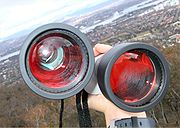
Optical coating
An optical coating is one or more thin layers of material deposited on an optical component such as a lens or mirror, which alters the way in which the optic reflects and transmits light. One type of optical coating is an antireflection coating, which reduces unwanted reflections from surfaces, and...
s for technical reasons and to improve the image they produce.
Anti-reflective coatings
Anti-reflective coatingAnti-reflective coating
An antireflective or anti-reflection coating is a type of optical coating applied to the surface of lenses and other optical devices to reduce reflection. This improves the efficiency of the system since less light is lost. In complex systems such as a telescope, the reduction in reflections also...
s reduce light lost at every optical surface through reflection
Reflection (physics)
Reflection is the change in direction of a wavefront at an interface between two differentmedia so that the wavefront returns into the medium from which it originated. Common examples include the reflection of light, sound and water waves...
at each surface. Reducing reflection via anti-reflective coatings also reduces the amount of "lost" light bouncing around inside the binocular which can making the image appear hazy (low contrast). A pair of binoculars with good optical coatings may yield a brighter image than uncoated binoculars with a larger objective lens, on account of superior light transmission through the assembly. A classic lens-coating material is magnesium fluoride
Magnesium fluoride
Magnesium fluoride is an inorganic compound with the formula MgF2. The compound is a white crystalline salt and is transparent over a wide range of wavelengths, with commercial uses in optics.-Production and structure:...
, which reduces reflected light from 5% to 1%. Modern lens coatings consist of complex multi-layers and reflect only 0.25% or less to yield an image with maximum brightness and natural colors.
Phase correction coatings
In binoculars with roof prisms the light path is split in two paths that reflect on either side of the roof prism ridge. One half of the light reflects from roof surface 1 to roof surface 2. The other half of the light reflects from roof surface 2 to roof surface 1. This causes the light to becomes partially polarized (due to a phenomenon called Brewster's angleBrewster's angle
Brewster's angle is an angle of incidence at which light with a particular polarization is perfectly transmitted through a transparent dielectric surface, with no reflection. When unpolarized light is incident at this angle, the light that is reflected from the surface is therefore perfectly...
). During subsequent reflections the direction of this polarization vector is changed but it is changed differently for each path in a manner similar to a Foucault pendulum
Foucault pendulum
The Foucault pendulum , or Foucault's pendulum, named after the French physicist Léon Foucault, is a simple device conceived as an experiment to demonstrate the rotation of the Earth. While it had long been known that the Earth rotated, the introduction of the Foucault pendulum in 1851 was the...
. When the light following the two paths are recombined the polarization vectors of each path do not coincide. The angle between the two polarization vectors is called the phase shift, or the geometric phase
Geometric phase
In classical and quantum mechanics, the geometric phase, Pancharatnam–Berry phase , Pancharatnam phase or most commonly Berry phase, is a phase acquired over...
, or the Berry phase. This interference between the two paths with different geometric phase results in a varying intensity distribution in the image reducing apparent contrast and resolution compared to a porro prism erecting system. These unwanted interference effects can be suppressed by vapour depositing
Chemical vapor deposition
Chemical vapor deposition is a chemical process used to produce high-purity, high-performance solid materials. The process is often used in the semiconductor industry to produce thin films. In a typical CVD process, the wafer is exposed to one or more volatile precursors, which react and/or...
a special dielectric coating known as a phase-correction coating or P-coating on the roof surfaces of the roof prism. This coating corrects for the difference in geometric phase between the two paths so both have effectively the same phase shift and no interference degrades the image.
Binoculars using either a Schmidt-Pechan roof prism
Schmidt-Pechan prism
A Schmidt–Pechan prism is a type of optical prism used to rotate an image by 180°. They are commonly used in binoculars as an image erecting system...
or an Abbe-Koenig roof prism
Abbe-Koenig prism
An Abbe–Koenig prism is a type of reflecting prism used to invert an image . They are commonly used in binoculars and some telescopes for this purpose. The prism is named after Ernst Abbe and Albert Koenig....
benefit from phase coatings. Porro prism
Porro prism
In optics, a Porro prism, named for its inventor Ignazio Porro, is a type of reflection prism used in optical instruments to alter the orientation of an image....
binoculars do not recombine beams after following two paths with different phase and so do not benefit from a phase coating.
Metallic mirror coatings
In binoculars with Schmidt-Pechan roof prismSchmidt-Pechan prism
A Schmidt–Pechan prism is a type of optical prism used to rotate an image by 180°. They are commonly used in binoculars as an image erecting system...
s, mirror coatings are added to some surfaces of the roof prism because the light is incident at one of the prism's glass-air boundaries at an angle less than the critical angle
Critical angle
Critical angle can refer to:*Critical angle the angle of incidence above which total internal reflection occurs*Critical angle of attack, in aerodynamics; the angle of attack which produces the maximum lift coefficient...
so total internal reflection
Total internal reflection
Total internal reflection is an optical phenomenon that happens when a ray of light strikes a medium boundary at an angle larger than a particular critical angle with respect to the normal to the surface. If the refractive index is lower on the other side of the boundary and the incident angle is...
does not occur. Without a mirror coating most of that light would be lost. Schmidt-Pechan roof prism use aluminium mirror coating (reflectivity
Reflectivity
In optics and photometry, reflectivity is the fraction of incident radiation reflected by a surface. In general it must be treated as a directional property that is a function of the reflected direction, the incident direction, and the incident wavelength...
of 87% to 93%) or silver mirror coating (reflectivity of 95% to 98%) is used.
In older designs silver mirror coatings were used but these coatings oxidized and lost reflectivity over time in unsealed binoculars. Aluminium mirror coatings were used in later unsealed designs because it did not tarnish even though it has a lower reflectivity than silver. Modern designs use either aluminium or silver. Silver is used in modern high-quality designs which are sealed and filled with a nitrogen or argon inert atmosphere so the silver mirror coating doesn't tarnish.
Porro prism
Porro prism
In optics, a Porro prism, named for its inventor Ignazio Porro, is a type of reflection prism used in optical instruments to alter the orientation of an image....
binoculars and roof prism binoculars using the Abbe-Koenig roof prism
Abbe-Koenig prism
An Abbe–Koenig prism is a type of reflecting prism used to invert an image . They are commonly used in binoculars and some telescopes for this purpose. The prism is named after Ernst Abbe and Albert Koenig....
typically do not use mirror coatings because these prisms reflect with 100% reflectivity using total internal reflection
Total internal reflection
Total internal reflection is an optical phenomenon that happens when a ray of light strikes a medium boundary at an angle larger than a particular critical angle with respect to the normal to the surface. If the refractive index is lower on the other side of the boundary and the incident angle is...
in the prism.
Dielectric mirror coatings
Dielectric coatings are used in Schmidt-Pechan roof prismSchmidt-Pechan prism
A Schmidt–Pechan prism is a type of optical prism used to rotate an image by 180°. They are commonly used in binoculars as an image erecting system...
to cause the prism surfaces to act as a dielectric mirror
Dielectric mirror
A dielectric mirror is a type of a mirror composed of multiple thin layers of dielectric material, typically deposited on a substrate of glass or some other optical material. By careful choice of the type and thickness of the dielectric layers, one can design an optical coating with specified...
. The non-metallic dielectric
Dielectric
A dielectric is an electrical insulator that can be polarized by an applied electric field. When a dielectric is placed in an electric field, electric charges do not flow through the material, as in a conductor, but only slightly shift from their average equilibrium positions causing dielectric...
reflective coating is formed from several multilayers of alternating high and low refractive index
Refractive index
In optics the refractive index or index of refraction of a substance or medium is a measure of the speed of light in that medium. It is expressed as a ratio of the speed of light in vacuum relative to that in the considered medium....
materials deposited on the roof prism's reflective surfaces. Each single multilayer reflects a narrow band of light frequencies so several multilayers, each tuned to a different color, are required to reflect white light
White Light
White Light may refer to:*Light with the color white*White Light , a 1980 novel by Rudy Rucke*White Light , 1971 album*White Light , 2010 album...
. This multi-multilayer coating increases reflectivity from the prism surfaces by acting as a distributed Bragg reflector
Distributed Bragg reflector
A distributed Bragg reflector is a reflector used in waveguides, such as optical fibers. It is a structure formed from multiple layers of alternating materials with varying refractive index, or by periodic variation of some characteristic of a dielectric waveguide, resulting in periodic variation...
. A well-designed dielectric coating can provide a reflectivity of more than 99% across the visible light spectrum. This reflectivity
Reflectivity
In optics and photometry, reflectivity is the fraction of incident radiation reflected by a surface. In general it must be treated as a directional property that is a function of the reflected direction, the incident direction, and the incident wavelength...
is much improved compared to either an aluminium mirror coating (87% to 93%) or silver mirror coating (95% to 98%).
Porro prism binoculars and roof prism binoculars using the Abbe-Koenig roof prism
Abbe-Koenig prism
An Abbe–Koenig prism is a type of reflecting prism used to invert an image . They are commonly used in binoculars and some telescopes for this purpose. The prism is named after Ernst Abbe and Albert Koenig....
do not use dielectric coatings because these prisms reflect with very high reflectivity using total internal reflection
Total internal reflection
Total internal reflection is an optical phenomenon that happens when a ray of light strikes a medium boundary at an angle larger than a particular critical angle with respect to the normal to the surface. If the refractive index is lower on the other side of the boundary and the incident angle is...
in the prism rather than requiring a mirror coating.
Terms used to describe coatings
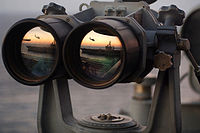
The presence of any coatings is typically denoted on binoculars by the following terms:
- coated optics: one or more surfaces are anti-reflective coated with a single-layer coating.
- fully coated: all air-to-glass surfaces are anti-reflective coated with a single-layer coating. Plastic lenses, however, if used, may not be coated.
- multi-coated: one or more surfaces have anti-reflective multi-layer coatings.
- fully multi-coated: all air-to-glass surfaces are anti-reflective multi-layer coated.
for binoculars with roof prisms only (not needed for Porro prisms)
- phase-coated or P-coating: the roof prism has a phase-correcting coating
- aluminium-coated: the roof prism mirrors are coated with an aluminium coating. The default if a mirror coating isn't mentioned.
- silver-coated: the roof prism mirrors are coated with a silver coating
- dielectric-coated: the roof prism mirrors are coated with a dielectric coating
General use

Opera glasses
Opera glasses, also known as theater binoculars or Galilean binoculars, are compact, low-power optical magnification devices, usually used at performance events, whose name is derived from traditional use at opera performances. Magnification power below 5x is usually desired in these circumstances...
, used in theaters, to glasses with 7 to 12 diameters magnification and 30 to 50 mm objectives for typical outdoor use.
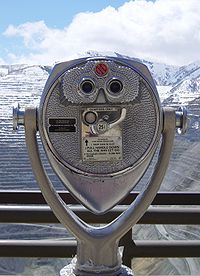
Many tourist attraction
Tourist attraction
A tourist attraction is a place of interest where tourists visit, typically for its inherent or exhibited cultural value, historical significance, natural or built beauty, or amusement opportunities....
s have installed pedestal-mounted, coin-operated binoculars to allow visitors to obtain a closer view of the attraction. In the United Kingdom
United Kingdom
The United Kingdom of Great Britain and Northern IrelandIn the United Kingdom and Dependencies, other languages have been officially recognised as legitimate autochthonous languages under the European Charter for Regional or Minority Languages...
, 20 pence often gives a couple of minutes of operation, and in the United States
United States
The United States of America is a federal constitutional republic comprising fifty states and a federal district...
, one or two quarters
Quarter (United States coin)
A quarter dollar, commonly shortened to quarter, is a coin worth ¼ of a United States dollar, or 25 cents. The quarter has been produced since 1796. The choice of 25¢ as a denomination, as opposed to 20¢ which is more common in other parts of the world, originated with the practice of dividing...
gives between one-and-a-half to two-and-a-half minutes.
Range finding
Many binoculars have range finding reticle (scale) superimposed upon the view. This scale allows the distance to the object to be estimated if the objects height is known (or estimable). The common mariner 7×50 binoculars have these scales with the angle between marks equal to 5 milAngular mil
An angular mil, also mil, is a unit of angle. All versions of the angular mil are approximately the same size as a trigonometric milliradian.-History:The milliradian was first identified in the mid nineteenth Century...
. One mil is equivalent to the angle between the top and bottom of an object one meter in height at a distance of 1000 meters.
Therefore to estimate the distance to an object that is a known height the formula is:

where:
-
 is the Distance to the object in meters.
 -
 is the known Object Height.
 -
 is the height of the object in number of Mil.
With the typical 5 mil scale (each mark is 5 mil), a lighthouse that is 3 marks high that is known to be 120 meters tall is 8000 meters distance.

Military
Binoculars have a long history of military use. Galilean designs were widely used up to the end of the 19th century when they gave way to porro prism types. Binoculars constructed for general military use tend to be more rugged than their civilian counterparts. They generally avoid fragile center focus arrangements in favor of independent focus, which also makes for easier, more effective weatherproofing. Prism sets in military binoculars may have redundant aluminized coatings on their prism sets to guarantee they don't lose their reflective qualities if they get wet.One variant form was called "trench binoculars", a combination of binoculars and periscope
Periscope
A periscope is an instrument for observation from a concealed position. In its simplest form it consists of a tube with mirrors at each end set parallel to each other at a 45-degree angle....
, often used for artillery spotting purposes. It projected only a few inches above the parapet, thus keeping the viewer's head safely in the trench.
Military binoculars of the Cold War
Cold War
The Cold War was the continuing state from roughly 1946 to 1991 of political conflict, military tension, proxy wars, and economic competition between the Communist World—primarily the Soviet Union and its satellite states and allies—and the powers of the Western world, primarily the United States...
era were sometimes fitted with passive sensors that detected active IR emissions
Infrared
Infrared light is electromagnetic radiation with a wavelength longer than that of visible light, measured from the nominal edge of visible red light at 0.74 micrometres , and extending conventionally to 300 µm...
, while modern ones usually are fitted with filters blocking laser beams used as weapons. Further, binoculars designed for military usage may include a stadiametric reticle in one ocular in order to facilitate range estimation.
There are binoculars designed specifically for civilian and military use at sea. Hand held models will be 5× to 7× but with very large prism sets combined with eyepieces designed to give generous eye relief. This optical combination prevents the image vignetting or going dark when the binoculars are pitching and vibrating relative to the viewer's eye. Large, high-magnification models with large objectives are also used in fixed mountings.
Very large binocular naval rangefinder
Rangefinder
A rangefinder is a device that measures distance from the observer to a target, for the purposes of surveying, determining focus in photography, or accurately aiming a weapon. Some devices use active methods to measure ; others measure distance using trigonometry...
s (up to 15 meters separation of the two objective lenses, weight 10 tons, for ranging World War II
World War II
World War II, or the Second World War , was a global conflict lasting from 1939 to 1945, involving most of the world's nations—including all of the great powers—eventually forming two opposing military alliances: the Allies and the Axis...
naval gun targets 25 km away) have been used, although late-20th century technology made this application redundant.
Astronomical
Binoculars are widely used by amateur astronomersAmateur astronomy
Amateur astronomy, also called backyard astronomy and stargazing, is a hobby whose participants enjoy watching the night sky , and the plethora of objects found in it, mainly with portable telescopes and binoculars...
; their wide field of view
Field of view
The field of view is the extent of the observable world that is seen at any given moment....
makes them useful for comet
Comet
A comet is an icy small Solar System body that, when close enough to the Sun, displays a visible coma and sometimes also a tail. These phenomena are both due to the effects of solar radiation and the solar wind upon the nucleus of the comet...
and supernova
Supernova
A supernova is a stellar explosion that is more energetic than a nova. It is pronounced with the plural supernovae or supernovas. Supernovae are extremely luminous and cause a burst of radiation that often briefly outshines an entire galaxy, before fading from view over several weeks or months...
seeking (giant binoculars) and general observation (portable binoculars). Some binoculars in the 70 mm and larger range remain useful for terrestrial viewing; true astronomical binocular designs (often 90 mm and larger) typically dispense with prisms for correct image terrestrial viewing in order to maximize light transmission. Such binoculars also have removable eyepieces to vary magnification and are typically not designed to be waterproof or withstand rough field use.
Ceres, Neptune
Neptune
Neptune is the eighth and farthest planet from the Sun in the Solar System. Named for the Roman god of the sea, it is the fourth-largest planet by diameter and the third largest by mass. Neptune is 17 times the mass of Earth and is slightly more massive than its near-twin Uranus, which is 15 times...
, Pallas, Titan
Titan (moon)
Titan , or Saturn VI, is the largest moon of Saturn, the only natural satellite known to have a dense atmosphere, and the only object other than Earth for which clear evidence of stable bodies of surface liquid has been found....
, and the Galilean moons
Galilean moons
The Galilean moons are the four moons of Jupiter discovered by Galileo Galilei in January 1610. They are the largest of the many moons of Jupiter and derive their names from the lovers of Zeus: Io, Europa, Ganymede and Callisto. Ganymede, Europa and Io participate in a 1:2:4 orbital resonance...
of Jupiter
Jupiter
Jupiter is the fifth planet from the Sun and the largest planet within the Solar System. It is a gas giant with mass one-thousandth that of the Sun but is two and a half times the mass of all the other planets in our Solar System combined. Jupiter is classified as a gas giant along with Saturn,...
are invisible to the naked eye
Naked eye
The naked eye is a figure of speech referring to human visual perception unaided by a magnifying or light-collecting optical device, such as a telescope or microscope. Vision corrected to normal acuity using corrective lenses is considered "naked"...
but can readily be seen with binoculars. Although visible unaided in pollution
Air pollution
Air pollution is the introduction of chemicals, particulate matter, or biological materials that cause harm or discomfort to humans or other living organisms, or cause damage to the natural environment or built environment, into the atmosphere....
-free skies, Uranus
Uranus
Uranus is the seventh planet from the Sun. It has the third-largest planetary radius and fourth-largest planetary mass in the Solar System. It is named after the ancient Greek deity of the sky Uranus , the father of Cronus and grandfather of Zeus...
and Vesta require binoculars for easy detection. 10×50 binoculars are limited to an apparent magnitude
Apparent magnitude
The apparent magnitude of a celestial body is a measure of its brightness as seen by an observer on Earth, adjusted to the value it would have in the absence of the atmosphere...
of +9.5 to +11 depending on sky conditions and observer experience. Asteroids like Interamnia
704 Interamnia
704 Interamnia is a very large asteroid, with an estimated diameter of 350 kilometres. Its mean distance from the Sun is 3.067 . It was discovered on October 2, 1910 by Vincenzo Cerulli, and named after the Latin name for Teramo, Italy, where Cerulli worked...
, Davida
511 Davida
511 Davida is a large main-belt C-type asteroid. It was discovered by R. S. Dugan in 1903. It is one of the ten most massive asteroids. It is approximately 270–310 km in diameter and comprises an estimated 1.5% of the total mass of the asteroid belt...
, Europa
52 Europa
52 Europa is one of the larger asteroids in the asteroid belt, having a diameter of 300 km. It was discovered on February 4, 1858, by Hermann Goldschmidt from his balcony in Paris...
and, unless under exceptional conditions Hygiea
10 Hygiea
10 Hygiea is an asteroid located in the asteroid belt. With somewhat oblong diameters of 350–500 km, and a mass estimated to be 2.9% of the total mass of the belt, it is the fourth largest asteroid by volume and mass...
, are too faint to be seen with commonly sold binoculars. Likewise too faint to be seen with most binoculars are the planetary moons except the Galileans and Titan, and the dwarf planet
Dwarf planet
A dwarf planet, as defined by the International Astronomical Union , is a celestial body orbiting the Sun that is massive enough to be spherical as a result of its own gravity but has not cleared its neighboring region of planetesimals and is not a satellite...
s Pluto
Pluto
Pluto, formal designation 134340 Pluto, is the second-most-massive known dwarf planet in the Solar System and the tenth-most-massive body observed directly orbiting the Sun...
and Eris
Eris (dwarf planet)
Eris, formal designation 136199 Eris, is the most massive known dwarf planet in the Solar System and the ninth most massive body known to orbit the Sun directly...
. Among deep sky objects, open clusters can be magnificent, such as the bright double cluster (NGC 869
NGC 869
NGC 869 is an open cluster located 7600 light years away in the constellation of Perseus. The cluster is most likely around 13 million years old. It is the westernmost of the Double Cluster with NGC 884. Located in the Perseus OB1 association both clusters are located physically close to one...
and NGC 884
NGC 884
NGC 884 is an open cluster located 7600 light years away in the constellation of Perseus. The cluster is most likely around 12.5 million years old. It is the easternmost of the Double Cluster with NGC 869. Located in the Perseus OB1 association both clusters are located physically close to one...
) in the constellation Perseus
Perseus
Perseus ,Perseos and Perseas are not used in English. the legendary founder of Mycenae and of the Perseid dynasty of Danaans there, was the first of the mythic heroes of Greek mythology whose exploits in defeating various archaic monsters provided the founding myths of the Twelve Olympians...
, and globular clusters, such as M13
Messier 13
Messier 13 or M13 is a globular cluster of about 300,000 stars in the constellation of Hercules....
in Hercules, are easy to spot. Among nebulae, M17 in Sagittarius
Sagittarius (constellation)
Sagittarius is a constellation of the zodiac, the one containing the galactic center. Its name is Latin for the archer, and its symbol is , a stylized arrow. Sagittarius is commonly represented as a centaur drawing a bow...
and the North American nebula (NGC 7000) in Cygnus are also readily viewed.
Of particular relevance for low-light and astronomical viewing is the ratio
Ratio
In mathematics, a ratio is a relationship between two numbers of the same kind , usually expressed as "a to b" or a:b, sometimes expressed arithmetically as a dimensionless quotient of the two which explicitly indicates how many times the first number contains the second In mathematics, a ratio is...
between magnifying power and objective lens diameter. A lower magnification facilitates a larger field of view which is useful in viewing large deep sky
Deep sky
Deep-sky objects are astronomical objects other than individual stars and solar system objects . The classification is used for the most part by amateur astronomers to denote visually observed faint naked eye and telescopic objects such as star clusters, nebulae and galaxies.-Origins and...
objects such as the Milky Way
Milky Way
The Milky Way is the galaxy that contains the Solar System. This name derives from its appearance as a dim un-resolved "milky" glowing band arching across the night sky...
, nebulae, and galaxies, though the large (typically 7 mm) exit pupil means some of the gathered light is not used by older observers, as past age 50 most eyes' pupils rarely dilate over 5 mm wide. The large exit pupil will also image the night sky background, effectively decreasing contrast, making the detection of faint objects more difficult except perhaps in remote locations with negligible light pollution
Light pollution
Light pollution, also known as photopollution or luminous pollution, is excessive or obtrusive artificial light.The International Dark-Sky Association defines light pollution as:...
. Binoculars geared towards astronomical uses provide the most satisfying views with larger aperture
Aperture
In optics, an aperture is a hole or an opening through which light travels. More specifically, the aperture of an optical system is the opening that determines the cone angle of a bundle of rays that come to a focus in the image plane. The aperture determines how collimated the admitted rays are,...
objectives (in the 70 mm or 80 mm range). Astronomy binoculars typically have magnifications of 12.5 and greater. Many of the objects in the Messier Catalog and other objects of eighth magnitude and brighter are readily viewed in hand-held binoculars in the 35 to 40 mm range, such as are found in many households for birding, hunting, and viewing sports events. However larger binocular objectives are preferred for astronomy because the diameter of the objective lens regulates the total amount of light captured, and therefore determines the faintest star that can be observed. Due to their high magnification and heavy weight, these binoculars usually require some sort of mount to stabilize the image. A magnification of ten (10×) is usually considered the most that can be held comfortably steady without a tripod or other mount. Much larger binoculars have been made by amateur telescope makers
Amateur telescope making
Amateur telescope making is the activity of building telescopes as a hobby, as opposed to being a paid professional. Amateur telescope makers build their instruments for personal enjoyment of a technical challenge, as a way to obtain an inexpensive or personally customized telescope, or as a...
, essentially using two refracting or reflecting astronomical telescopes, with mixed results.
List of binocular manufacturers
There are many companies that manufacturer binoculars, both past and present. They include:- Barr and StroudBarr and StroudBarr & Stroud Limited was a pioneering Scottish optical engineering firm, based in Glasgow, that played a leading role in the development of modern optics, including rangefinders, for the Royal Navy and for other branches of British Armed Forces during the 20th century...
(UK) — sold binoculars commercially and primary supplier to the Royal Navy in WWIIWorld War IIWorld War II, or the Second World War , was a global conflict lasting from 1939 to 1945, involving most of the world's nations—including all of the great powers—eventually forming two opposing military alliances: the Allies and the Axis...
. The new range of Barr & Stroud binoculars are currently made in China (Nov. 2011) and distributed by Optical Vision Ltd. - Bausch & LombBausch & LombBausch & Lomb, an American company based in Rochester, New York, is one of the world's leading suppliers of eye health products, such as contact lenses and lens care products today. In addition to this main activity, in recent years the area of medical technology has been developed...
(USA) — has not made binoculars since 1976, when they licensed their name to Bushnell, Inc., who made binoculars under the Bausch & Lomb name until the license expired, and was not renewed, in 2005. - Bresser (Germany)
- Bushnell CorporationBushnell CorporationBushnell Corporation, also known as Bushnell and Bushnell Outdoor Products, is an American company specializing in optics and imaging. Its products include binoculars, spotting scopes, telescopes, night vision equipment, GPS devices, laser rangefinders, riflescopes, holographic weapon sights, game...
(USA) - Canon Inc (Japan) — I.S. series: porro variants?
- CelestronCelestronCelestron is a company that manufactures and imports telescopes, binoculars, spotting scopes, microscopes, and accessories for their products.-Origins and History:...
- DOCTER (optics)DOCTER (optics)DOCTER is a trade name for a German manufacturer of sports optics, including binoculars, rifle scopes, spotting scopes, red dot sights, flashlights and reading glasses. Its headquarters are in Eisfeld, Germany, where most of the products are developed and manufactured...
(Germany) - Nobilem series (Porro prisms) - FujinonFujinonFujinon is a division of Fujifilm that specialises in the production of optical lenses for photographic, medical, video, and television use.- Fujinon SWD :...
(Japan) — FMTSX, FMTSX-2, MTSX series: porro. - I.O.R.I.O.R.IOR is the acronym for the name of Întreprinderea Optică Română . It is a major optics company established in 1936 in Bucharest, Romania. I.O.R. produces military and civilian grade optics for export and domestic production. Famous for its own version of the Russian PSO-1 type scopes , binoculars...
(Romania) - Kamakura Koki Co., Ltd. - Large original equipment manufacturerOriginal Equipment ManufacturerAn original equipment manufacturer, or OEM, manufactures products or components that are purchased by a company and retailed under that purchasing company's brand name. OEM refers to the company that originally manufactured the product. When referring to automotive parts, OEM designates a...
manufacturer with factories in Japan and in China for companies such as Bushnell, Alpen, Zen Ray, Eagle Optics, Leupold & Stevens, Vixen - Leica Camera (Germany) — Ultravid, Duovid, Geovid, Trinovid: all are roof prism.
- Leupold & Stevens, IncLeupold & StevensLeupold & Stevens, Inc. is a manufacturer of telescopic sights, red dot sights, spotting scopes, and binoculars located in Beaverton, Oregon, United States...
(USA) - Meade Instruments (USA)– Glacier (roof prism), TravelView (porro), CaptureView (folding roof prism) and Astro Series (roof prism). Also sells under the name Coronado.
- MeoptaMeoptaMeopta is Czech-American global manufacturer of precision optics, specializing in the design, engineering and assembly of complex optical, opto-mechanical and opto-electronic systems. Meopta makes stuff for the consumer, industrial and military markets....
(Czech Republic) — Meostar B1 (roof prism). - MinoxMinoxThe Minox is a subminiature camera conceived in 1922 and invented in 1936 by German-Latvian Walter Zapp, which Latvian factory VEF manufactured from 1937 to 1943. After World War II, the camera was redesigned and production resumed in Germany in 1948. Originally envisioned as a luxury item, it...
- NikonNikon, also known as just Nikon, is a multinational corporation headquartered in Tokyo, Japan, specializing in optics and imaging. Its products include cameras, binoculars, microscopes, measurement instruments, and the steppers used in the photolithography steps of semiconductor fabrication, of which...
(Japan) — EDG Series, High Grade series, Monarch series, RAII, Spotter series: roof prism; Prostar series, Superior E series, E series, Action EX series: porro. - Olympus CorporationOlympus Corporationis a Japan-based manufacturer of optics and reprography products. Olympus was established on 12 October 1919, initially specializing in microscope and thermometer businesses. Its global headquarters are in Shinjuku, Tokyo, Japan, while its USA operations are based in Center Valley, Pennsylvania,...
(Japan) - PentaxPentaxPentax is a brand name used by Hoya Corporation for its medical-related products & services and Pentax Ricoh Imaging Company for cameras, sport optics , etc. Hoya purchased and merged with the Japanese optics company on March 31, 2008. Hoya's Pentax imaging business was sold to Ricoh Company, Ltd...
(Japan) — DCFED/SP/XP series: roof prism; UCF series: inverted porro; PCFV/WP/XCF series: porro. - SteinerSteiner-Surname:*Achim Steiner , German expert in environmental politics*Anton Steiner , Austrian former alpine skier*Ben Steiner , Major League Baseball player*Cecil C...
(Germany) - SunagorSunagorSunagor is a Japanese manufacturer and brand of optical products, founded in 1948. The company specialises in binoculars and has been manufacturing them for over 60 years. Sunagor advertises ultra high magnification zoom binoculars and in early 2009 Sunagor launched what they claim to be the...
(Japan) - Swarovski OptikSwarovski OptikSwarovski Optik is an Austrian manufacturer of sports optics, including binoculars, rifle scopes, telescopes, laser rangefinders and image intensifiers. Its headquarters are in Absam, Tyrol, where most of the products are developed and manufactured....
- Vixen (telescopes)Vixen (telescopes)Vixen is a Japanese company that makes telescopes, binoculars, spotting scopes and accessories for their products.Among many other more mainstream products they have created two unusual varieties of catadioptric telescopes with an open tube design instead of the full-aperture corrector plate of the...
(Japan) — Apex/Apex Pro: roof prism; Ultima: porro. - VivitarVivitarVivitar Corporation was a manufacturer, distributor and marketer of photographic and optical equipment originally based in Oxnard, California. Since 2008 the Vivitar name serves as Sakar International's photographic and optical equipment brand.-Products:...
(USA) - Vortex OpticsVortex OpticsVortex Optics is an American company developing optics for hunting, bird watching, wildlife watching, outdoor recreational sports, and law enforcement. Vortex products include binoculars, spotting scopes, riflescopes, and other optical equipment.-History:...
(USA) - Zeiss (Germany) — FL, Victory, Conquest: roof prism; 7×50 BGAT/T porro, 15×60 BGA/T porro, discontinued.
See also
- Anti-fogAnti-fogAnti-fog agents, also known as anti-fogging agents and treatments, are chemicals which prevent the condensation of water in the form of small droplets on a surface which resemble fog...
- BinoviewerBinoviewerA binoviewer is an optical device designed to enable binocular viewing through a single objective.In contrast to binoculars, it does not allow stereoscopic viewing, as both images are produced by the same objective and do not differ except for aberrations induced by the binoviewer itself...
- Globe effectGlobe effectThe globe effect, sometimes called the rolling ball effect or the spinning globe effect, is an optical phenomenon that occurs with visual optical instruments, in particular binoculars and telescopes, that are designed to be free of distortion. When these instruments are panned, the moving image...
- Lens (optics)Lens (optics)A lens is an optical device with perfect or approximate axial symmetry which transmits and refracts light, converging or diverging the beam. A simple lens consists of a single optical element...
- List of telescope types
- MonocularMonocularA monocular is a modified refracting telescope used to magnify the images of distant objects by passing light through a series of lenses and sometimes prisms; the use of prisms results in a lightweight telescope. Volume and weight are less than half those of binoculars of similar optical...
- Optical telescopeOptical telescopeAn optical telescope is a telescope which is used to gather and focus light mainly from the visible part of the electromagnetic spectrum for directly viewing a magnified image for making a photograph, or collecting data through electronic image sensors....
- Spotting scopeSpotting scopeA spotting scope is a small portable telescope with added optics to present an erect image, optimized for the observation of terrestrial objects...
- Tower viewerTower viewerA tower viewer is a telescope or binoculars permanently mounted on a stalk. The device magnifies objects seen through its lenses, allowing users to see farther and more clearly than they could with the naked eye or with less powerful viewing devices...
External links
- A Guide to Binoculars by Emil Neata
- The history of the telescope & the binocular by Peter Abrahams, May 2002